




Abstract
The purpose of the paper is to reveal the impact of the war unleashed by Russia against Ukraine on the foreign policy of Kazakhstan, as well as to consider the potential development of Kazakhstan’s relations with China, Turkey, the United States and others. Analysis, induction, deduction and synthesis serve as the main methods of research on this problem. The article discloses the problem of preservation by Kazakhstan of a multi-vector, neutral policy in relation to its partners in modern conditions. The strategic programme documents adopted by the government of Kazakhstan were also studied. The analysis of interstate trade turnover for 2022 was used to determine relations between Kazakhstan and Russia after its invasion of Ukraine. Separately, it was considered whether the Russian Federation poses a military threat to Kazakhstan. The materials of the article are of practical and theoretical value for political scientists and specialists in the field of international relations, and researchers of the foreign policy of the Republic of Kazakhstan interested in the features and aspects of the implementation of a multi-vector policy by its leadership.
Keywords
Introduction
It is safe to say that Russia’s full-scale military aggression against Ukraine on 24 February 2022 became a catalyst for changing the geopolitical situation around the world. Having openly attacked Ukraine, Russia left itself no other way than to go into direct confrontation with the West. The consequences were the imposition of economic sanctions against Russia by the United States and the European Union (EU) and the supply of weapons and equipment to Ukraine, which forced third countries to reconsider their cooperation with Russia. These countries include representatives of Central Asia, in particular Kazakhstan, an informal leader in the region, which has a large number of close and comprehensive relations with the Russian Federation (RF) and is largely dependent on it. Consequently, the relevance of this paper is the change and development of the geopolitical situation around Kazakhstan and the neighbouring regions and the need for the Republic to adapt to the new geopolitical realities.
Engvall (2022) pays attention to the fact that in the Russo-Ukrainian war, Kazakhstan had little room for political and diplomatic manoeuvring. Nevertheless, the government of Kazakhstan quickly announced that it would not recognise the independence and sovereignty of the separatist regions of Ukraine after the actions of official Moscow. Moreover, President Tokayev intensified his diplomatic activity, calling for dialogue, offering a mediatory role in resolving the conflict and addressing both the Russian and Ukrainian sides (Oxford Analytica, 2022).
Liu (2023) notes that although Kazakhstan did not support Russia’s aggression against Ukraine, it continues to maintain close economic relations with RF, including helping to circumvent Western sanctions by re-exporting. In her paper, Auzhanova (2022) pays much attention to the issue of the Eurasian integration of Kazakhstan. She notes that this idea was first voiced by the President of the Republic of Kazakhstan N. Nazarbayev in 1994, although it was developed much later. As a result, in 2015, the RF, the Republic of Belarus and the Republic of Kazakhstan founded the Eurasian Economic Union (EEU). Armenia and Kyrgyzstan will later join it as well. The scholar also points out that the Union is mostly economic, not political. Shared economic ties result in states supporting each other in every way, as their economic benefits largely depend on the well-being of their partners. She also notes that Eurasian integration is extremely important for Kazakhstan, as it is a path to integration into the global economy.
It is also worth taking a separate look at regional integration in Central Asia. Krapohl and Vasileva–Dienes (2020) argue that the process of integration in this region has actually failed, which is unusual for the post-Cold War world order. This also raises questions, because Kazakhstan, Uzbekistan, Turkmenistan, Tajikistan and Kyrgyzstan have certain cultural, political and economic similarities. Researchers believe that the failure of regional integration in Central Asia is primarily due to extra-regional economic factors. Kazakhstan, whose cooperation with Russia within the EEU provides it with greater financial benefits than possible cooperation within a separate Central Asian organisation, is cited as an example.
Engvall (2023) also considers other poles that Central Asia countries can focus on. He notes that China is significantly increasing its both economic and political influence in the region. For example, in September 2022, the head of China Xi Jinping visited Kazakhstan, and stated his support for the sovereignty of both Kazakhstan and all other Central Asian states. The scholar also notes Turkey’s growing cooperation with the Turkic-speaking countries of the region—Kazakhstan, Kyrgyzstan, Turkmenistan and Uzbekistan. Cooperation between the parties is developing in the military–industrial aspect, as well as the development of the Organization of Turkic States. At the same time, economic interaction between the countries of the region and the EU is developing. In October 2022, the first EU–Central Asia summit was held, where the president of the European Council, Ch. Michel, met with the leaders of all states. As a result, the parties agreed to increase and diversify cooperation.
Thus, the purpose of the paper is to study the impact that the war in Ukraine had on the relations of Kazakhstan and Russia, as well as to consider the influence of other countries in Kazakhstan.
Materials and Methods
The following methods were used in the process of research: method of analysis, method of comparison, method of generalisation, method of graphic representation of information and method of classification. Using the method of analysis, the level of influence exerted by the war provoked by the RF against Ukraine on the foreign policy of the Republic of Kazakhstan was studied; the aspects of Kazakhstan’s cooperation with its partners in the region and beyond it were disclosed. It also helped to reveal the relevance of this issue based on the study of papers devoted to this problem, its features, peculiarities and approaches to explanation; to show how the aggravation of relations between Russia and Western countries forced the leadership of Kazakhstan to change its policy towards Russia. Also, using the method of classification, the goals of the National Security Strategy of the Republic of Kazakhstan were highlighted, the main threats to the national security of Kazakhstan, as well as changes made to the Military Doctrine of the Republic, were identified. In addition, the problem, purpose, forms and methods (ways) of analysis of this problem were highlighted, and a plan for conducting research was made.
The method of analysis was used to identify the attitude of the political elite of the Republic of Kazakhstan to the war unleashed by Russia against Ukraine, as well as their reaction to it. The difficulties Kazakhstan faced, given its position in the region and its close partnership with theRF, were described. The induction method was used to assess the development of bilateral relations between the RF and the Republic of Kazakhstan in the context of the ongoing war in Ukraine. The method of graphical representation of information was used to create a graph showing the trade turnover between Kazakhstan and Russia, as well as between Kazakhstan and EEU countries. Separately, the way in which Kazakhstan’s integration within such international organisations as the EEU, the Organization of Turkic States, the Chinese ‘One Belt–One Road’ initiative, as well as the process of regional integration of Central Asian countries, took place was considered. The current level and prospects of Kazakhstan’s relations with world powers other than Russia, in particular China, the United States and Turkey, were also revealed. By means of summarising the material and describing the results, aspects of the conducted political science research were substantiated; conclusions obtained while writing the scientific paper were systematised.
In addition, using various theoretical methods, the data obtained during the research were processed; the conclusions and results of the research were substantiated. A comparative analysis of studies and approaches aimed at a detailed study of the difficulties of regional integration in Central Asia; positive and negative consequences for Kazakhstan of participation in the EEU; Turkey’s activities in the Central Asian region within the Organization of Turkic States; the growing influence of China both on Kazakhstan in particular and on Central Asia in general through the implementation of its economic and logistics initiative ‘One Belt, One Road’ were presented. Also, using methods of classification and generalisation, the results of the paper were logically outlined and its contribution to political science, sociology and the study of international relations was determined.
Results
The full-scale military invasion of Ukraine by the RF on 24 February 2022 has had many repercussions around the world. Many countries were forced to decide on whose side they were on. The same challenge faced the Republic of Kazakhstan, which throughout its independence has been trying to pursue a multi-vector foreign policy, remaining neutral in all interstate conflicts. On the one hand, Kazakhstan is one of the most important allies of the RF in the Collective Security Treaty Organization (CSTO) and the EEU, in particular in the Central Asian region. On the other hand, it cannot but be aware of the threat from Russia, which is trying to revive the Soviet Union and expand its sphere of influence (Arynov, 2022).
Despite the fact that Kazakhstan is a member of the CSTO, its government refused to participate in the Russian invasion of Ukraine, both formally and in fact (the only member of the organisation that directly supported the RF in the war is the Republic of Belarus). On the contrary, the leadership of Kazakhstan continues to insist on the need to comply with international law and the inviolability of borders, recognising the independence, sovereignty and territorial integrity of Ukraine. For example, the president of Kazakhstan, Kassym-Jomart Kemeluly Tokayev, stated directly that the Republic is not going to recognise the independence of the separatist entities, even calling them ‘quasi-state territories’ (Dave, 2022).
Nevertheless, the current geopolitical realities prove to the leadership of Kazakhstan the need to review their relations with other world powers, such as China and Turkey. It is important to note that the geographical position of Kazakhstan plays a key role in this context, based on which the country is in constant search of balance between the influence of world powers. The pursuit of such a policy is also conditioned by the Decree of the Government of the Republic of Kazakhstan No. 344 ‘On approval of the main directions of the state policy of the Republic of Kazakhstan in the field of official development assistance for 2021–2025’. The main provisions of this document are the desire to maintain the security of the state and its citizens. This applies to both military and economic, as well as cultural and political, aspects (Decree of the Government of the Republic of Kazakhstan No. 344. 2021). Under current conditions, it is possible to achieve these goals only by adhering to a multi-vector policy. Historically, relations between Russia and the United States have been unfriendly, and tensions between Washington and Beijing are not subsiding. All of these conditions do not allow Kazakhstan to give full preference to one of the players in the international arena, which means the country has to pursue a multi-vector policy strategy.
On this basis, it would be appropriate to consider Kazakhstan’s relations with its main partners other than the RF. Speaking of the relations between the People’s Republic of China (PRC) and Kazakhstan, it is important to take a closer look at China’s ‘One Belt, One Road’ economic initiative. ‘One Belt, One Road’ is an initiative aimed at creating more efficient trade chains and logistics routes and expanding cooperation in trade and labour exchange. It does this by attracting Chinese investment to build infrastructure facilities abroad, such as roads, railroads, pipelines, ports and information projects. With the help of this initiative, China’s neighbours can improve the level of their own infrastructure, as well as strengthen their position in the sphere of influence of China (Brauweiler & Yerimpasheva, 2022).
Kazakhstan also actively cooperates with China within the Shanghai Cooperation Organization. China is one of Kazakhstan’s main partners in terms of trade. Agricultural products of Kazakhstan have significant demand in the Chinese market. The main areas of PRC investment are transport, storage of goods, financial and insurance activities, as well as oil and gas, construction and mining industries. In recent years, the China–Kazakhstan gas pipeline has been built, through which gas is actively pumped. Cooperation in nuclear and ‘green’ energy is actively developing (Matiukhin et al., 2022). It is important that among all the countries in the region, China considers Kazakhstan to be the most reliable and priority. This is due to both the direct economic success of the Republic of Kazakhstan and its political course, since the main task of the country’s leadership is to maintain neutrality and balance in the influence of major world players in the region. No less important role is played by the geographical location of Kazakhstan, which is located at the junction of Asia and Europe, which is important for China, because it allows it to create a stable overland route to Europe as part of its New Silk Road project (Harutyunyan, 2022).
It is worth noting that the countries jointly implement large-scale infrastructure and logistics projects, develop mutually beneficial cooperation in the energy and financial sectors, as well as deepen humanitarian and cultural relations (Harutyunyan, 2022). In addition to its economic relations, over the past two decades, Kazakhstan has become a reliable partner of China in the field of security, opposing separatism, extremism and terrorism in the region within the framework of the Shanghai Cooperation Organization. Kazakhstan’s relations with the United States, one of the poles of the country’s multi-vector foreign policy, are also developing. It should not be forgotten that the United States has a reputation as the ‘world’s policeman’, which means that the cooperation between the two states will be carried out in the field of security. In the current geopolitical environment, there are several threats to Kazakhstan’s security that the United States can help the country to deal with:
Isolation of Russia: This could have major long-term consequences for Kazakhstan, as Astana may soon be forced to turn its back on Moscow both diplomatically and geopolitically. This is due to the fact that as the West will unite against Russia, it will be increasingly difficult for Kazakhstan to maintain neutral relations with Russia (Bokhari, 2022). Consequently, having secured the support of the United States and refocusing on improving relations with them, Kazakhstan, although it will abandon its traditional multi-vector policy but will be able to more easily endure the coming turmoil, because the place of Russia as a strong partner will be taken by the United States. China’s growing influence in the region: In this context, it is worth realising that the United States is unlikely to completely displace China from Central Asia. Nevertheless, in the case of Kazakhstan, it can be concluded that a deeper relationship and further cooperation between the two countries could allow Kazakhstan to continue its political development independent of China while cooperating with China only economically. Increased terrorist threat in the region: After the withdrawal of American forces from Afghanistan and the capture of that country by the Taliban terrorist group, the spread of Islamic terrorists to neighbouring countries became almost the main threat to all Central Asian countries, especially Turkmenistan and Tajikistan, which have a long border with Afghanistan.
In considering Kazakhstan’s possible geopolitical partners, it is also worth noting Turkey, which traditionally maintains warm relations with Kazakhstan. The expansion and deepening of Kazakhstan’s partnership with Turkey within the framework of the Organization of the Turkic States is one of the most advantageous vectors for Kazakhstan. Since the Turkic peoples have much in common culturally and linguistically, and with first-hand knowledge of the difficulties characteristic of the region, they can more effectively respond to the challenges that arise. It is also worth noting that after 24 February 2022, Turkey began to conduct more active communication with the countries of Central Asia, especially in terms of the supply of weapons, which proved effective in the war in Ukraine. Thus, cooperation between Turkic countries, based on linguistic and cultural proximity, has significant prospects of becoming a strong and sustainable alliance (Kushkumbayev & Mussabekova, 2022).
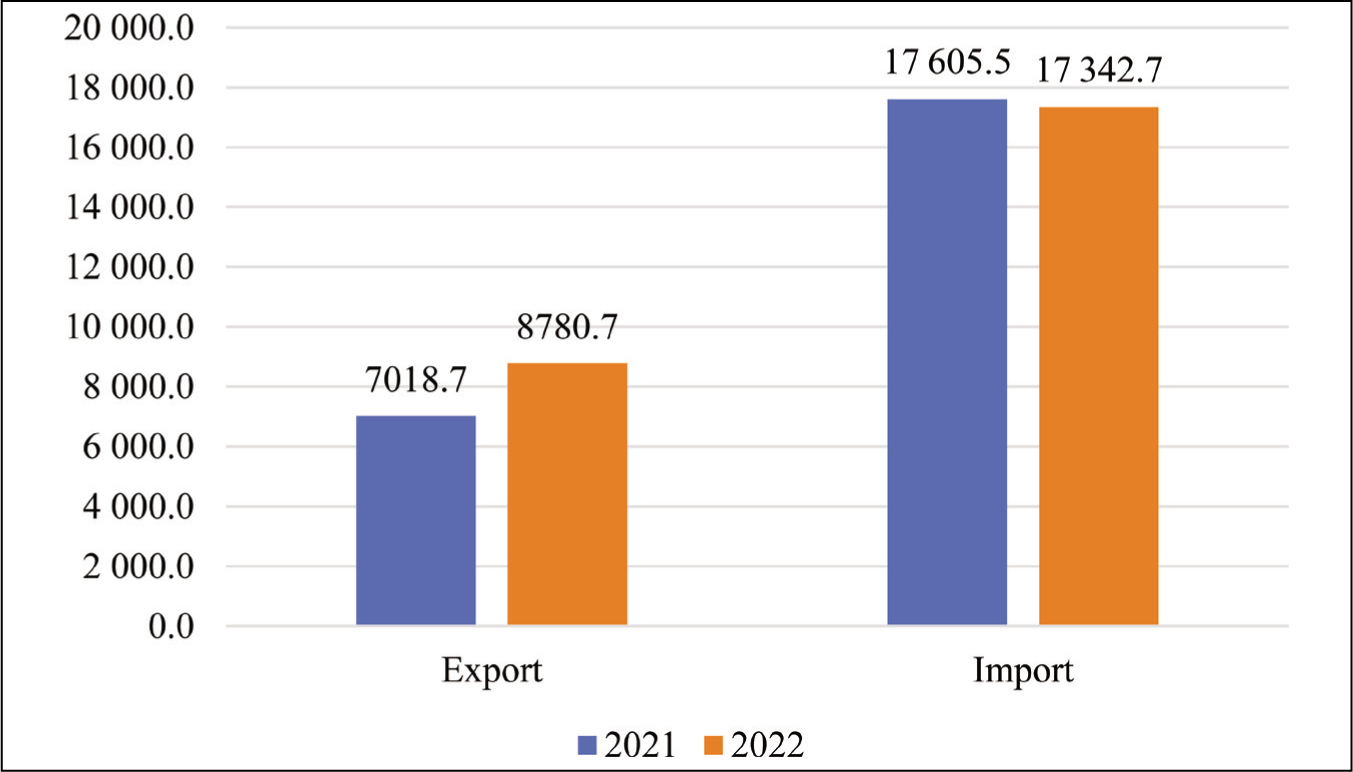
The level of current relations between the Republic of Kazakhstan and the RF can be traced not only in the rhetoric of the leaders of the two states but also empirically. This can be determined by identifying the impact of RF military action against Ukraine on trade with Kazakhstan, as well as on the Military Doctrine of Kazakhstan (supplemented in October 2022). Thus, based on the information provided by the Bureau of National Statistics of the Republic of Kazakhstan, exports from Kazakhstan to Russia increased by 25% in 2022, which cannot be evidence of Kazakhstan’s estrangement from Russia, even despite attempts by the Republic of Kazakhstan leadership to maintain a neutral position in the current conflict (Figure 1).
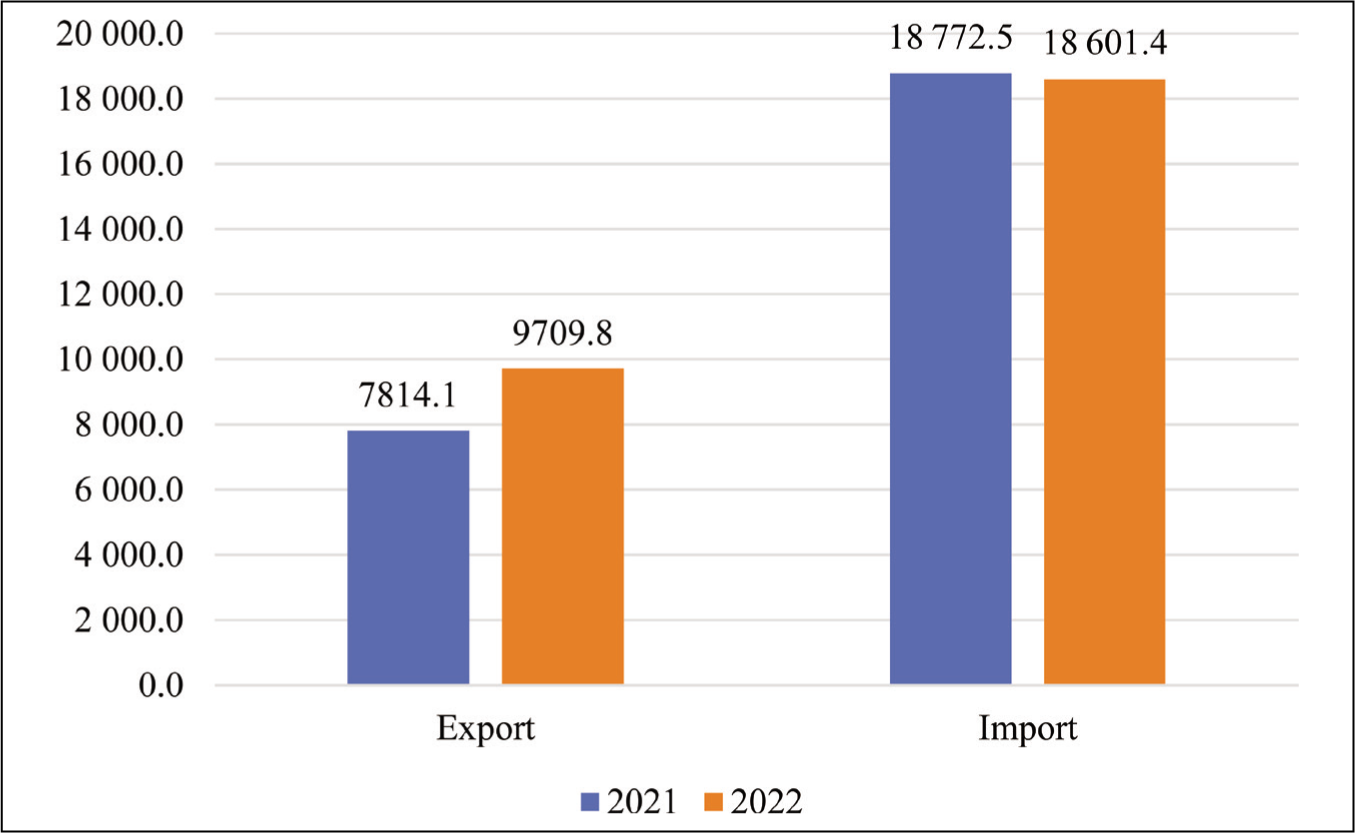
In confirmation of this conclusion, the attention could be taken to the fact that Kazakhstan has not joined the Western economic sanctions against Russia, and even on the contrary, it provides it with support. This is done by re-exporting sanctioned goods from Western countries to Russia via Kazakhstan. Noteworthy is the fact that according to these statistics, Kazakhstan’s total trade turnover with all other EEU member countries increased by 6.5%. Separately, it should be noted that Kazakhstan’s exports increased by 24.3% in this trade turnover, which indicates the success of the ongoing Eurasian integration (Figure 2).
Relations with the EU remain a priority for Kazakhstan. On 27 October 2022, the President of the European Council, Charles Michel, paid an official visit to Astana. EU heads of state and government called on all countries to join the EU sanctions to increase collective pressure on Russia. Special attention was paid to the issue of avoiding the unintended negative impact of EU sanctions on Kazakhstan’s economy. President Ch. Michel confirmed that the EU sanctions were not directed against third countries and stressed the importance of avoiding evasion and circumvention of international sanctions. The sides also discussed the relocation of European companies producing goods not subject to sanctions to Kazakhstan. The European Council discussed the energy crisis and accepted the need to accelerate and intensify efforts to reduce energy demand, avoid rationing, secure supplies and reduce prices. The leaders stressed that the integrity of the single market must be preserved. Given the current geopolitical situation, President K. Tokayev and President Ch. Michel noted the importance of expanding existing and developing new international transport corridors between Europe and Central Asia to ensure global production and supply chains. They also discussed the potential of the Trans-Caspian international transport route, options for its further development and the role of other transport routes in the region (Economic Research Institute, 2022).
Supply of oil to Germany from the beginning of 2023: As DW Global Media Forum news agency noted in this regard, it is supposed to replace Russian oil for the EU, the export of which was sanctioned due to the Russian war in Ukraine. At the same time, according to the agency, Moscow will now earn from transit, not directly from the sale of raw materials. In turn, Kazakhstan’s Energy Minister Bolat Akchulakov said on 11 January that the first batch of 20,000 tonnes could be delivered to Germany in January. ‘The total for the year could be up to 1.5 million tons. But the maximum is 6–7 million tons a year,’ he added, referring to the potential volume of supplies. Germany will use the Druzhba pipeline system. RF Deputy Prime Minister Alexander Novak pointed out in December 2022 that Germany and Poland had submitted applications to pump oil through the Druzhba system of main oil pipelines (Venkina, 2023).
Speaking about the impact of Russia’s war against Ukraine on RF and RК relations, it is also worth paying attention to the Military Doctrine of the Republic of Kazakhstan, adopted in September 2017. According to this document, the main conditions for the emergence of military threats to Kazakhstan are (2017):
Increased confrontation between the world’s largest states in order to change the world order and expand their own spheres of influence. Ineffectiveness of international law and the failure of international organisations to prevent open military confrontations between states. Violation of existing treaties prohibiting the use, proliferation and reduction of strategic weapons in the world. Continuing trends of growing separatist activity, as well as the use of separatist movements to exert influence on sovereign states.
As can be seen, the RF’s actions with regard to Ukraine meet all of the above conditions for the emergence of military threats to the Republic of Kazakhstan. Given the rather unfriendly rhetoric of some of Russia’s top officials in relation to the Republic, the invasion of RF on the territory of Ukraine could have a destructive effect on the bilateral relations between Kazakhstan and Russia (Kyrydon & Troyan, 2023). It is also worth noting that changes were made to the Military Doctrine in October 2022, including (Adilet, 2022):
Creation of territorial defence units designed for a more mobile and adequate response to military threats. Creation of a unit designed to counter enemy information and psychological operations as well as cyberattacks. Measures aimed at improving the country’s economic and military mobilisation are described.
Considering the above changes in the Military Doctrine of Kazakhstan, it can be concluded that they were developed based on the analysis of the course of military actions of Russia against Ukraine. In other words, the military and political leadership of the Republic of Kazakhstan draws conclusions from the experience of both Russia and Ukraine in the current conflict. On the other hand, it can be interpreted as the preparation of Kazakhstan for a possible future military confrontation with Russia. Thus, it can be stated that economic cooperation between Kazakhstan and Russia is effectively developing, which means the continuation of partnership relations between the states. But at the same time, in the military–political aspect, the relations between the countries, if not becoming more tense, then exactly remain in the same place, given that Kazakhstan refused to help Russia in the war against Ukraine and adopts its experience of military struggle with Russia.
Discussion
Considering the policy pursued by the current President of Kazakhstan Tokayev, it is worth noting the paper of Sim and Aminjonov (2022). In this paper, the scientists describe the policy of the President of Kazakhstan Kassym-Jomart Tokayev in relation to Russia in the context of the war against Ukraine as cautious and balanced, based on the principles of diplomacy, maintaining neutrality and respect for the sovereignty and territorial integrity of all countries. It is noted that Kazakhstan recognises the conflict between Russia and Ukraine as multidimensional and that it cannot be solved only by military means. At the same time, the leader of Kazakhstan calls for the observance of international law, as well as insists on respect for the territorial integrity of Ukraine and the principles of non-interference in the internal affairs of other countries. According to scholars, this position is already quite distant from Russia, since Kazakhstan has many close cultural, economic and political ties with RF, such as common membership in EEU, Comodo Internet Security (CIS) and CSTO. Thus, the conclusions of researchers regarding the policy of K. Tokayev towards Russia in the context of the current conflict in Ukraine are largely consistent with the results of this paper.
Speaking about the changes in the relations of the Central Asian countries with the RF after its full-scale military invasion of the territory of Ukraine at the end of February 2022, it is worth noting the paper of Anceschi (2022), which examines this problem in detail. Scientists believe that Russia’s invasion of Ukraine has finally made it clear to the countries of Central Asia that the neo-imperial policy of Putin’s regime is becoming open. In turn, the leaders of these countries, unwilling to reap the benefits of full cooperation with the aggressor country, determine certain ‘red lines’ in bilateral relations with RF that they have no desire to cross. Among them, she singles out: the continuation of the RF colonial policy in its attitude; further integration of the region into the so-called Russian world. Also, the scholar notes that the authority of both Russia itself and the CSTO under its control in the region has fallen significantly, which is a distinctive feature of the end of the post-Soviet regional order in Central Asia. The researcher’s conclusions are largely consistent with the results of this paper, except for the thesis about the full-fledged estrangement of all Central Asian countries from Russia.
Continuing the theme of relations between Russia and Kazakhstan, it would be useful to consider the paper by Payne (2022), who considers how Russia uses its foreign diasporas as an instrument of influence on neighbouring states. The author draws attention to the fact that a large number of ethnic Russians (3.5 million people, or 21% of the total population of the country) live in the regions bordering with the RF, which can be used against the country. The scientist also draws attention to the fact that Kazakhstan’s relations with Russia are far from good, as top RF officials often question the sovereignty of the Republic. As an example, he uses a statement by V. Putin from 2014, where he called Kazakhstan an ‘artificial state’ and claimed that it had never had statehood before the collapse of the Soviet Union. Based on all this, the scholar suggests that if Astana implements too independent a policy, RF may use a large number of Russian and Russian-speaking population of Kazakhstan as a pretext to start a hybrid or open military conflict, following the example of Ukraine. The results of Payne (2022) are consistent with the results of this paper in the aspect that RF can be a potential security threat to the Republic of Kazakhstan.
Speaking of regional integration within the framework of Central Asia, it is worth paying attention to the paper by Azizov (2017). He argues that this process took place in the discourse of the ‘five stans’ (meaning that the names of all five states in the region end with ‘stan’). This implies that these states are one Turkic nation (despite the fact that Tajikistan is a Persian-speaking country), united by a common origin, language, culture and region. According to the researcher, the formation of such a pan-Turkic identity should help maintain stability in the region, as well as continue the successful development of comprehensive cooperation between the states of the region. The researcher’s conclusions qualitatively complement the results of this paper in the aspect of considering the process of regional integration in Central Asia.
Given that Kazakhstan is one of the founders of the EEU, it is worth separately considering the paper of Pieper (2021), who notes that the EEU is a regional integration project, the structure of which has supranational institutions. The main purpose of the organisation was to reduce customs duties and eliminate non-tariff barriers between the states that are members of it. The researcher points out that membership in the EEU allows Kazakhstan access to a larger regional market, protecting the Kazakh industry from lower prices for imported Chinese products. On the other hand, entrepreneurs in medium-sized enterprises lost profits, as Kazakhstan had to raise its external tariffs to the same level as Russian ones. The scientist separately notes the fact that Russia is gradually trying to give the initial purely economic project a political significance, planning to use it to achieve its own goals and expand its sphere of influence. Although the conclusions of the researcher differ from the results of this research in the aspect of the influence of membership in the EEU on Kazakhstan, nevertheless, they deserve attention.
In the context of the growth of Turkey’s influence in the countries of Central Asia, Donnellon-May (2022) notes that Turkey has been conducting active foreign policy and economic activities in relation to Central Asian countries since their independence. In the scientist’s opinion, the establishment of the Cooperation Council of Turkic-Speaking States in 2009, which was renamed the Organization of Turkic Peoples in Istanbul in 2021, deserves the most attention in this context. The Central Asian countries of the organisation are Kazakhstan, Uzbekistan and Kyrgyzstan, as well as Turkmenistan as an observer. Since Russia launched a full-scale war against Ukraine in February 2022, Turkey has increased economic and cultural ties with Central Asian countries, entered into a number of defence agreements and increased the supply of Turkish military–industrial products. There have also been many bilateral meetings between the leaders of the region’s countries and the President of Turkey R. Erdogan. Thus, the researcher’s conclusions and the results of this paper on the issue of Turkey’s influence on the countries of Central Asia converge.
It is also worth considering the influence of China in Kazakhstan. In this connection, Mosher (2022) notes that China realises its influence on Kazakhstan through the development of the ‘One Belt–One Road’ initiative aimed at the development of transport, energy and industrial infrastructure in more than 60 countries around the world. Because of its important geographical location, Kazakhstan is key to China’s New Silk Road project, an overland corridor that will carry Chinese goods to Europe. The Kazakh leadership is clearly interested in the implementation of this project, as it means significant investments in the country’s transport infrastructure, as well as investments in local businesses. In addition, it is worth paying attention to the fact that the current head of Kazakhstan Kassym-Jomart Tokayev was a Soviet diplomat in China in the past, which cannot but affect the communication between the leaders of the two countries. The researcher’s conclusions regarding China’s influence on Kazakhstan through the implementation of the ‘One Belt–One Road’ project are consistent with the conclusions of this paper.
In continuation of this topic, Louthan (2022) assesses the political impact of the ‘One Belt–One Road’ initiative on Kazakhstan. In particular, the scholar argues that China does not fully influence Kazakhstan, because it does not want to spoil relations with Russia, and also because Kazakhstan’s economic dependence on China in recent years has decreased significantly. The scholar concludes that Kazakhstan was able to maintain a certain independent political course due to its own efforts to maintain a multi-vector policy of the state. Thus, the researcher’s conclusions about the impact of the Chinese ‘One Belt, One Road’ initiative on Kazakhstan agree with the results of this article.
Considering the cooperation between Kazakhstan and the United States, Starr et al. (2014) argue that the best way for Washington to avoid threats to stability and security in Central Asia is to strengthen regional states and economies, as well as create and develop political, economic and security ties with all states in the region, especially with Kazakhstan, which is its tacit leader. Consequently, the thesis of the researchers that the main area of cooperation between the United States and Kazakhstan is the sphere of security converges with the results of this paper.
Conclusions
From all of the above, it can be concluded that Russia’s full-scale military invasion of Ukraine in early 2022 has led to a dramatic change in the geopolitical situation in the world as a whole, and in Central Asia in particular. This article examined the reaction of the leadership of the Republic of Kazakhstan to Russia’s invasion of Ukraine. It was noted that although the government of the country led by President Tokayev did not condemn the invasion, it insists on compliance with international law and the principle of inviolability of borders, as well as supports the independence, sovereignty and territorial integrity of Ukraine. The Strategy of National Security of Kazakhstan for 2021–2025 was considered. It was noted that in the context of international relations, it lays down the need for the state to conduct a multi-vector foreign policy. Kazakhstan’s cooperation in economic, political, cultural and military spheres with such countries as the United States, China and Turkey was studied separately. The relations of the Republic of Kazakhstan with Russia after its attack on Ukraine were studied, as a result of which it was noted that although Russia has shown itself as an aggressive player on the world stage, Kazakhstan maintains and even strengthens bilateral economic relations with RF. Integration processes in the region within the framework of the EEU, the Organization of Turkic States and at the level of mutual relations of the five Central Asian countries were considered separately.
The materials of the presented articles can be useful and relevant for political scientists, scientists engaged in the study of the foreign policy of Kazakhstan in the context of the war of the RF against Ukraine. Also, these articles will be valuable for specialists in the field of international relations, students and researchers who are interested in the features and aspects of cooperation of the Republic of Kazakhstan with such powers as the United States, PRC, Turkey and Central Asian countries. It is worth to continue the research and conduct it more in-depth, to extend the study of the problem of the possible distancing of Kazakhstan from Russia in the consequence of increasing international pressure on it in the future. The conducted diagnosis does not exhaust all the peculiarities of this political science topic and requires further consideration of such issues as regional integration processes in Central Asia.
Footnotes
Declaration of Conflicting Interests
The authors declared no potential conflicts of interest with respect to the research, authorship and/or publication of this article.
Funding
This research has been funded by the Science Committee of the Ministry of Science and Higher Education of the Republic of Kazakhstan (Grant No. AP14870606).