



Abstract
Visual analysis and questions of aesthetics are central to global histories of screen colour, yet many early Indian colour films are now lost. This archival absence has therefore produced a scholarly silence on colour in Indian cinemas. How then can we develop new methods for studying colour that can account for Indian cinema? Focusing on Bombay contexts, we take the lost film Pamposh as a case study. A demonstration film designed to showcase the new colour laboratory at Film Center Bombay, the film was shot on location in Kashmir using Belgian Gevacolor film stock. While no colour materials from the film have survived, it has left rich traces in other forms as music, text, paper ephemera and oral history. These alternatives sources illuminate different histories of Bombay film colour from those developed around extant films, revealing how the assimilation of colour into Bombay cinema became a paradigm for the assimilation of Kashmir into India. As we explore, Pamposh’s Kashmiri locations were chosen both for their climatic conditions (closer to the European norms that Gevacolor was designed for), and as part of an ideological campaign to assimilate Kashmir against a backdrop of geopolitical conflict over the region.
There is little that Pamposh (Mir, 1954) can tell us about colour aesthetics in the 1950s Bombay cinema. Although it has a privileged status as the first colour feature film domestically produced and processed in postcolonial India, it is now considered lost. The National Film Archive of India holds no visual material on the film, and a display on ‘The Advent of Colour’ at the National Museum of Indian Cinema makes no mention of it. While black-and-white stills of the film are held in various European archives, there are no colour traces of Pamposh beyond a chromolithographed poster, available as a low-resolution JPEG online (Figure 1). The poster’s illustration aligns with accounts of the film’s plot recorded in contemporary reviews, describing a fictional tale of a poor houseboat owner and his adopted daughter, who live a simple life amid the lotus blooms on the Dal Lake in Kashmir. We have no way of knowing if the colours of the ink correlate with those on the celluloid and can make no assessments about the look or feel of colour from this poor-quality image. Pamposh is therefore typical of the early history of colour in Bombay film – a history marked by loss, absence and degradation.
Undated Poster for Pamposh (Mir, 1954) Found for Sale on eBay July 2024.
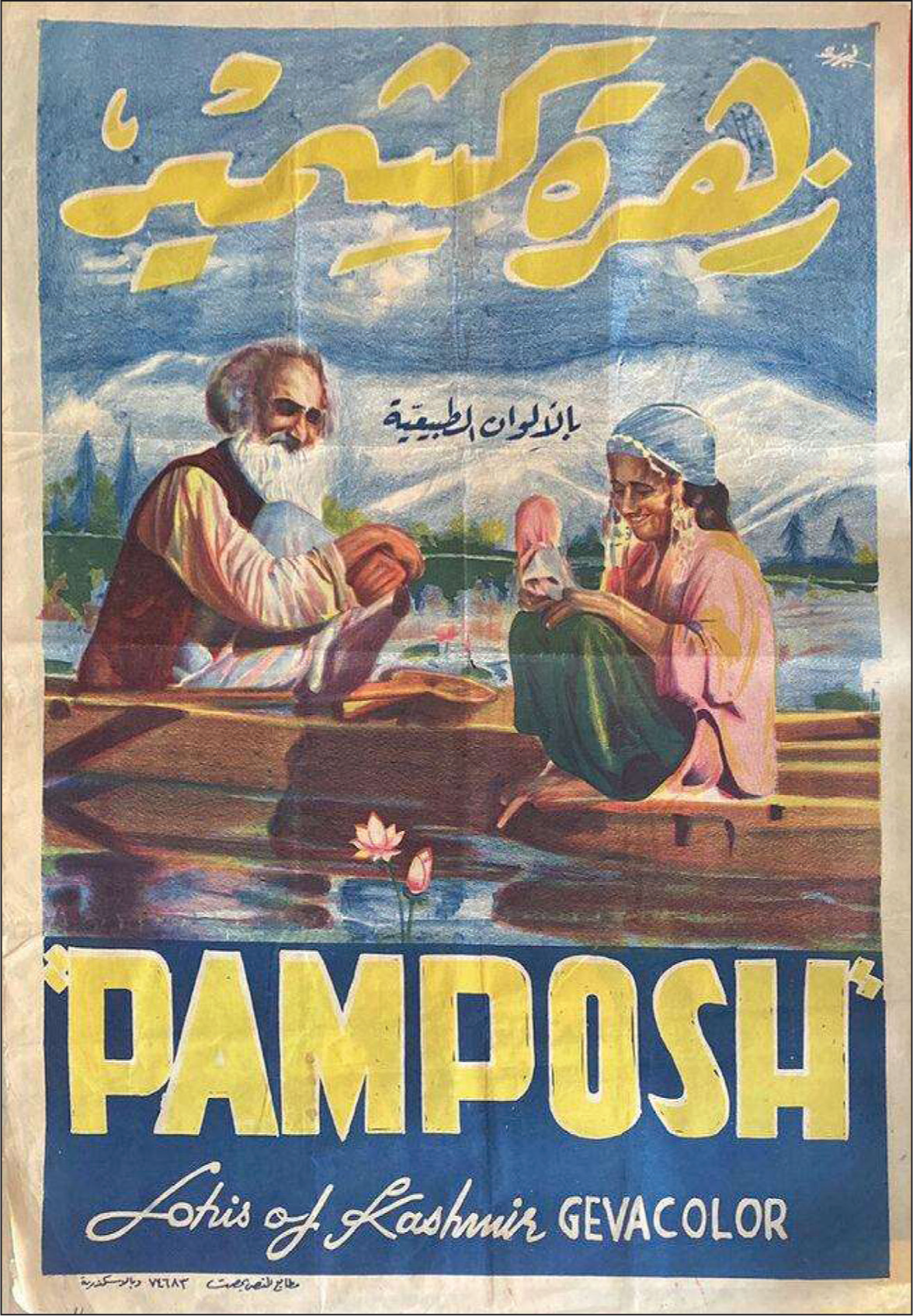
Pamposh is one of many lost films from the first decades of Indian cinema’s engagement with colour, as there are no extant Hindi colour films predating the 1950s. 1 India’s earliest colour films, including Sairandhri (Shantaram, 1933), Kisan Kanya (Gidwani, 1937) and Mother India (Gunjal, 1938), are now believed lost. Even some of the most significant colour features of the 1950s like Jhansi Ki Rani (Modi, 1953) have survived only in black-and-white or degraded colour copies, while a small number – Aan (Khan, 1952), Mother India (Khan, 1957), Jhanak Jhanak Payal Baaje (Shantaram, 1955) and Navrang (Shantaram, 1959) – are available in middling quality online or on DVD. None has undergone colour restoration. These archival losses help account for the scholarly silence on the question of colour in Bombay film history. The few scholars that offer a sustained engagement with colour unsurprisingly focus on extant films, albeit often working from low-quality copies (Dootson, 2023, pp. 135–141; Jaikumar, 2019, pp. 127–180, 270–273; Mazumdar, 2024; Nair, 2024, pp. 93–98).
Yet gaps in the archive should not be reproduced as gaps in film history. Given the asymmetries and biases along axes of race, gender and colonial power that have shaped the collection and preservation of film, historians of marginalised cinemas have developed practices to circumnavigate these supposed limitations. Feminist film historians and historians of Black and colonial cinemas have called for greater attention to issues of loss and partiality, not to lament the absence of missing films but to develop new ways of engaging with film history beyond close textual analysis (Beeston & Solomon, 2023; Bruno, 2021; Field, 2015; Groo, 2019). Historians of Indian cinema are intimately familiar with such arguments, routinely lamenting the paucity of official archives and the importance of innovative methods to address these lacunae (Iyer, 2024; Mahadevan, 2015, pp. 161–166; Mukherjee, 2019; Vasudevan et al., 2013). Oral histories, unofficial ‘pirate archives’ of low-quality and unlicensed material, fan ephemera, and accounts of film exhibition and reception, have therefore become critical to the practice of Bombay film history, not least in work published in this journal (Kumar, 2016; Mukherjee, 2010, 2019; Tanvir, 2013).
But such approaches seem antithetical to the study of colour. Despite the growing body of work on colour in film and media studies over the past two decades, questions of aesthetics remain at the centre of the field’s intellectual gravity. While scholars of film colour are well-versed in the limitations of visual analysis (colour prints fade, historical exhibition conditions are impossible to recreate, digital copies are far removed from originals), visual analysis remains central to our work (Frith & Johnston, 2021; McKernan, 2012). Surprisingly one of the biggest areas of recent investigation has been colour in silent cinema, a field notorious for its archival losses, yet this expansive body of work has focused on extant films available for high-quality reproduction and aesthetic analysis, with publications often linked to well-preserved collections in archives like the Eye Film Museum in Amsterdam or the George Eastman Museum in New York (Fossati et al., 2018; Gunning et al., 2015; Yumibe, 2012). Of course, these scholars have attended to the social, cultural, geopolitical, material and technological histories of colour – these are far from formalist accounts – yet there is an expectation that such narratives should work in service of arguments about aesthetics and style. Publishing and presenting on colour film is often met (in peer review, in audience comments, in colleagues’ feedback) with requests for more colour images, more visual analysis, and a general foregrounding of aesthetic evidence to prove the value of other aspects of colour film history.
Such doggedly optical approaches to colour create a dependency on high-quality copies of extant films, well-preserved in archives or available on DVD. In turn, this produces an overwhelming scholarly focus on European and American cinema. 2 For instance, an invaluable resource for researchers of colour film is the Timeline of Historical Film Colors, a diligently compiled online database including high-resolution images of hundreds of film prints from thirty-five archives around the world, constituting a meticulous chronology of analogue cinema’s chromatic history (Flueckiger, 2012). Yet the timeline contains few archives or films from the Global South. 3 Wider writing that does account for the history of colour cinema in the Global South is often linked to archival rediscoveries and restorations – foregrounding the print as the most venerated object of study (Chotirosseranee, 2017; Salgia, 2005). The interdependence of methods of visual analysis with archival availability has therefore doubly conspired to orient the geographies of film colour around North American and European film.
As the title of our essay (derived from Ashish Rajadhyaksha’s work) implies, the methods we have for writing histories of colour film in Europe and America, cannot account for Indian cinema (Rajadhyaksha, 2009). Not only are archival losses more prevalent in Indian contexts than in Europe or America, but even something as seemingly neutral as a ‘timeline’ of colour becomes fraught when applied to Indian cinemas. The importance timelines attach to technological firsts can problematically suggest colour came belatedly to India, reproducing colonial narratives of what Manishita Dass calls the perceived ‘belatedness or derivativeness’ of Indian modernity, which Sudhir Mahadevan has also critiqued (Dass, 2021, p. 129; Mahadevan, 2015). Oriented around technological developments, timelines can reinforce teleological histories that place emphasis on successful, dominant film processes (chiefly American Technicolor and Kodak’s Eastmancolor) at the expense of marginal or short-lived processes. Timelines also invite a misplaced sense of linear incorporation of colour into black-and-white film. In Bombay, colour productions stopped and started (sometimes over decades), films begun in black-and-white transitioned into colour (or returned to black-and-white when money ran out), and practices like hand-colouring (associated with nineteenth-century American and European film) continued into the 1950s. Furthermore, stock shortages meant that different types of colour film were often combined in a single project. Colour moved in anything but a straight line through Indian film history.
Sarah Street and Joshua Yumibe’s landmark recent volume Global Film Color compellingly argues for expanding the geographic scope of chromatic cinema studies and a departure from conventional timelines as central to this work (Street & Yumibe, 2024). But to properly grapple with the history of colour in Indian cinemas we need to depart from the established methods conventionally applied to film colour and embrace more innovative approaches already used in other areas of Indian film history. A history of colour cinema that can account for India must therefore be open to: de-centre extant films and visual analysis (examining films that are lost or degraded), take up unconventional forms of evidence (ephemera, unofficial materials, oral histories, sound) and work outside linear histories of dominant colour film technologies (examining marginal, unsuccessful and low-quality processes).
This work has already begun. For instance, Kartik Nair reads the degraded quality of colour in Bombay horror films as constitutive of their material histories of censorship (2024, pp. 103–108). Oral history projects have surveyed practitioners who recall the early decades of colour (Mukherjee, 2010; Raqs Media Collective, 2000). Similarly, the recently established Bombay Film Colour research network is foregrounding oral history as a means of gathering personal recollections of colour from industry practitioners (Mazumdar et al., 2024). We use oral history here as one among many methods to construct a history of colour cinema that can account for Indian cinema, by taking as our case study, Bombay cinema and the lost film Pamposh. The methodological issues we describe are not unique to Bombay but apply to India’s many film industries. Yet we focus here on popular, Hindi-language cinema as the gap between the prolific production of colour and the dearth of scholarly discussion is particularly pronounced in this context. Moreover, as the first chromatic feature film domestically produced and processed in postcolonial India, Pamposh carries a symbolic status as a national product, emblematic both of the rhetorical articulation of a unifying and modernising state, as well as the new aesthetic and sensorial possibilities of colour. 4 But rather than reduce Pamposh to an abstract symbol of ‘Indian’ colour, we attend here to the truly global nature of colour filmmaking in 1950s Bombay, when the city drew in technologies, materials and personnel from across the world, thereby throwing into question the idea of a straightforwardly ‘national’ application of colour film at this time.
Furthermore, our aim is not to restore a forgotten colour masterpiece to the canon of Hindi cinema, but in keeping with wider practices of studying lost and incomplete film, we aim to reconceptualise what Alix Beeston and Stephen Solomon describe as ‘signs of deficiency and failure as signs of possibility’ (2023, p. 10). While we are unable to study the colour of Pamposh, here we ask what else we might learn about the history of Bombay film colour if we are not pursuing close textual analysis? What new histories might emerge when we are invited to, in Stephen Putnam Hughes’s terms, use ‘creative approaches to what counts as a source and a greater willingness to critically rework the corpus of ready-made historical narratives’ (2010, p. 73)? Although the colour prints of Pamposh are lost, rich traces remain in other forms: music collected by passionate fans online, paper ephemera in European archives, and personal memories of film-going in Kashmir. As Hughes describes, ‘the main problem that faces film historians now is not that there are too few, but that there are too many sources on film history in India that have not been fully considered or consulted’ (2010, p. 73), a sentiment echoed by Mahadevan who admits ‘the challenge isn’t to track down and locate ephemera; the challenge is to notice it and figure out what to do with all of it’ (2015, p. 161).
Pamposh, like many objects of postcolonial study, can be traced in part through materials held in European archives, where collections like the Cinémathèque française, Foto Museum Antwerp (hereafter FOMU) and British Film Institute (hereafter BFI) harbour both direct and indirect links to the operations of imperial power (Ingravalle, 2022). As Ann Laura Stoler describes, while these archives hold a problematic status as sites of erasure, bias and violence – their materials can also be understood as ‘active, generative substances with histories, as documents with itineraries of their own’ (2009, p. 1). Here we explore what she calls both the political and ‘epistemic anxieties’ of the colonial archive, to consider how, despite a reliance on materials held in state-sponsored archives in Britain, France and Belgium, these materials might reveal untold histories of post-colonial colour cinema in Bombay.
We are particularly interested in what Pamposh can tell us about the relationship between colour, climate and Kashmir in 1950s India. Intended as a demonstration film to showcase the colour processing capabilities of the new Film Center laboratory in Bombay, the film was shot entirely on location in Kashmir using Belgian Gevacolor film. As we explore, the film’s location was selected simultaneously for the chromatic appeals of its landscapes, its climatic conditions (closer to the European norms Gevacolor was designed for), and we argue, as part of a wider ideological campaign to strengthen India’s claims to Kashmir within the context of geopolitical conflict over the region.
By focusing on this lost film of the 1950s, we revisit understandings of Kashmir’s representation in Hindi colour cinema, which have primarily focused on extant films of the 1960s known for their vibrant chromatic design, such as Subodh Mukherjee’s Junglee (1961). Scholars have already offered rich analyses of how colour (especially American Eastmancolor) conjured Kashmir as what Ananya Jahanara Kabir calls a ‘territory of desire’, a location redolent of escapism, fantasy and postcolonial modernity, against a backdrop of political instability (Kabir, 2005; Mazumdar, 2024; Rajadhyaksha & Willemen, 1994, p. 368). Here, by moving away from issues of textual analysis, and instead investigating the multiple links between Pamposh (a fiction film) and the operations of Films Division, the documentary unit of India’s Ministry of Information and Broadcasting, we consider alternative possibilities for colour. Exploring how discourses of documentary realism in Pamposh could be exploited to naturalise India’s presence in the disputed territory of Kashmir, we propose another register for colour’s operations in Bombay cinema, one that does not foreclose its many other capacities (as spectacle, sensation and visual pleasure) but opens additional ways of considering colour’s powers and potentials in the 1950s.
When considering the use of European colour technologies in Bombay cinema, we are reminded of Brian Larkin’s observations (in the context of urban African media infrastructure) that ‘the meanings attached to technologies, their technical functions and the social uses to which they are put are not an inevitable consequence, but something worked out over time in the context of considerable cultural debate’ (2008, p. 2). As colour is inherently contingent, subjective, embodied and unstable, colour film presents a technology liable to multiple political, aesthetic and economic mobilisations. Therefore, this essay explores the lost film Pamposh as one configuration of the multiple, evolving and complex discourses around the uses and meanings of colour in post-colonial Bombay. We use the film to ask how placing India at the centre, rather than the margins of colour film history not only challenges our narratives of colour film, but the very method we use to write that history.
Film Center and Glorious Gevacolor
Pamposh was conceived to demonstrate the quality of the new colour processing facilities at Film Center laboratory in Bombay. Pamposh was rare in this regard, as the film drew attention to its own material fabrication, with press coverage highlighting that Pamposh was ‘the first full colour feature film to be produced, processed and printed in this country’ (Times of India, 1953, p. 3). Unusually, reviews commented on the quality of the laboratory processing (Monthly Film Bulletin, 1954, p. 158), a form of chromatic labour conventionally hidden from public scrutiny, and still overlooked in histories of colour film in favour of the more visible, and glamorous, work of designers and cinematographers. 5
Film Center had been processing black-and-white material since 1946, but in 1952 became the first colour laboratory, not only in Asia, but anywhere in the world outside Europe or the US. 6 This ambitious undertaking was overseen by Ambalal J. Patel (Figure 2), a Bombay stockist of photographic materials, who had identified a gap in the colour market. While Bombay filmmakers had been working sporadically in colour for decades by the 1950s, exposed negatives were flown overseas for processing in Germany, Britain or the US, delaying production schedules and incurring transit costs and import taxes. 7 There were other drawbacks, as the lab was also crucial for shaping a film’s colour aesthetics. As the laboratory advisor to Film Center Krishna Gopal described, the lab is ‘responsible for everything that is beautiful in a motion picture’ (1956, p. 57). By sending processing work overseas, Bombay filmmakers entrusted the look of their films to their former colonial power (Britain) or chief rivals in the market (Hollywood). There was a clear incentive for Patel to establish a domestic processing laboratory to capitalise on the growing number of Indian colour productions forecast for the 1950s.
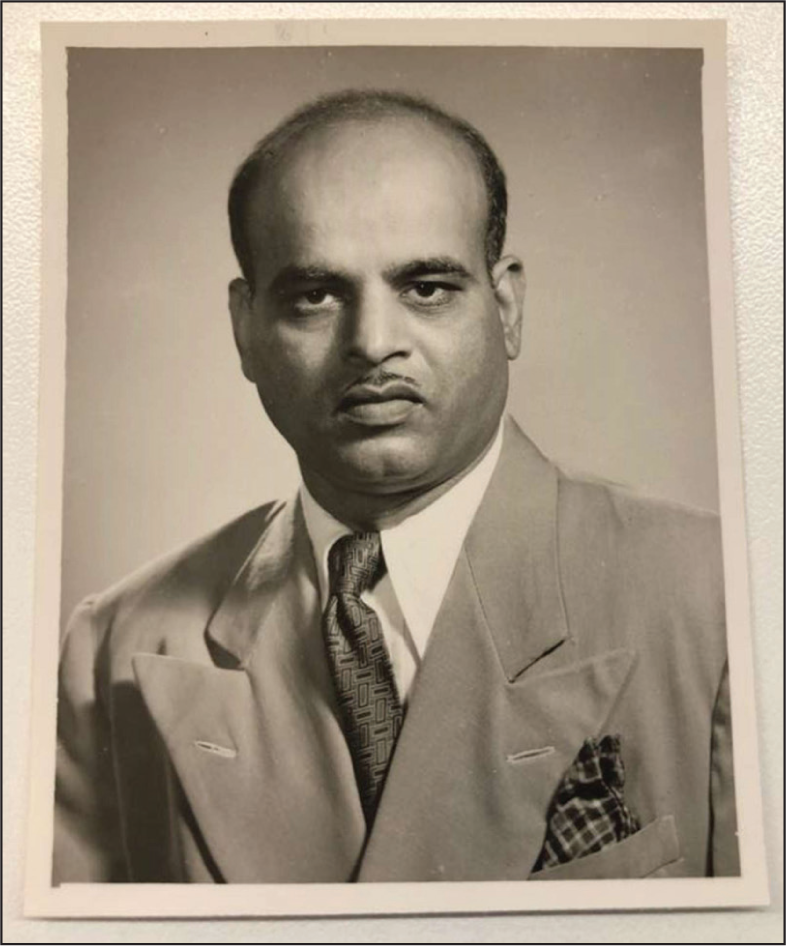
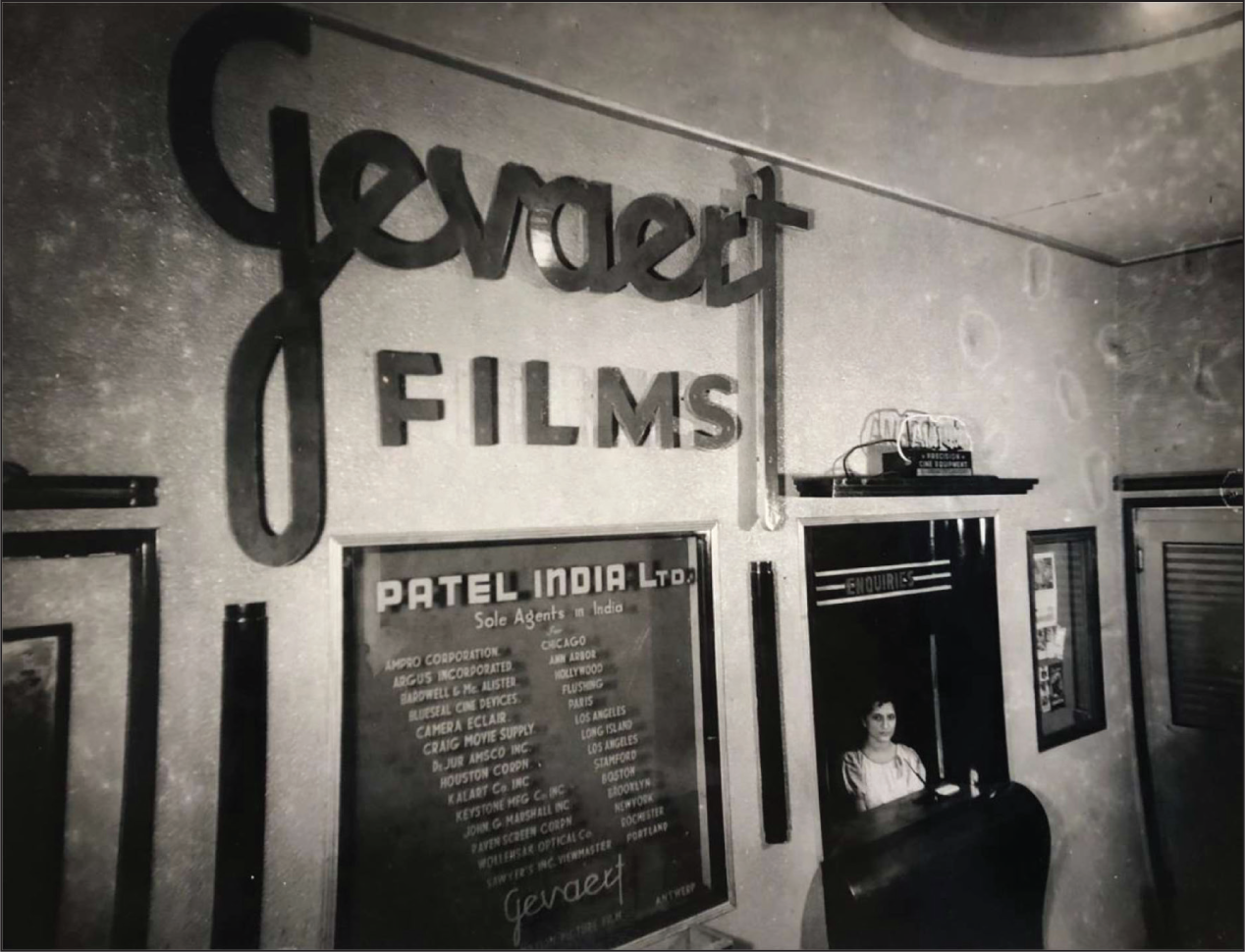
Patel was a well-established Bombay film entrepreneur before Film Center, having sold camera equipment and projectors as well as establishing the journal Camera in the Tropics (Baskar, 2021). He owned a documentary production company Educational Films of India and was both a director of Allied Photographic Limited (hereafter APL), a firm importing photographic goods from Europe, and director of his own firm Patel India Limited (Vasudevan, 2011, p. 77). Established in 1946, Patel’s firm was the ‘sole agents in India’ of the Belgian cine-film Gevacolor (Agency Agreement Between Allied Photographic and Gevaert, 1956), a fact proudly displayed inside the firm’s Bombay office (Figure 3). It was a shrewd business decision by Patel to establish Film Center as a domestic site for processing Gevacolor, as he could profit both from selling the negative, and its development into positive release prints. While later advertisements for Film Center boasted of the lab’s capacity to develop various colour film stocks (Figure 4), initially it only processed Gevacolor.
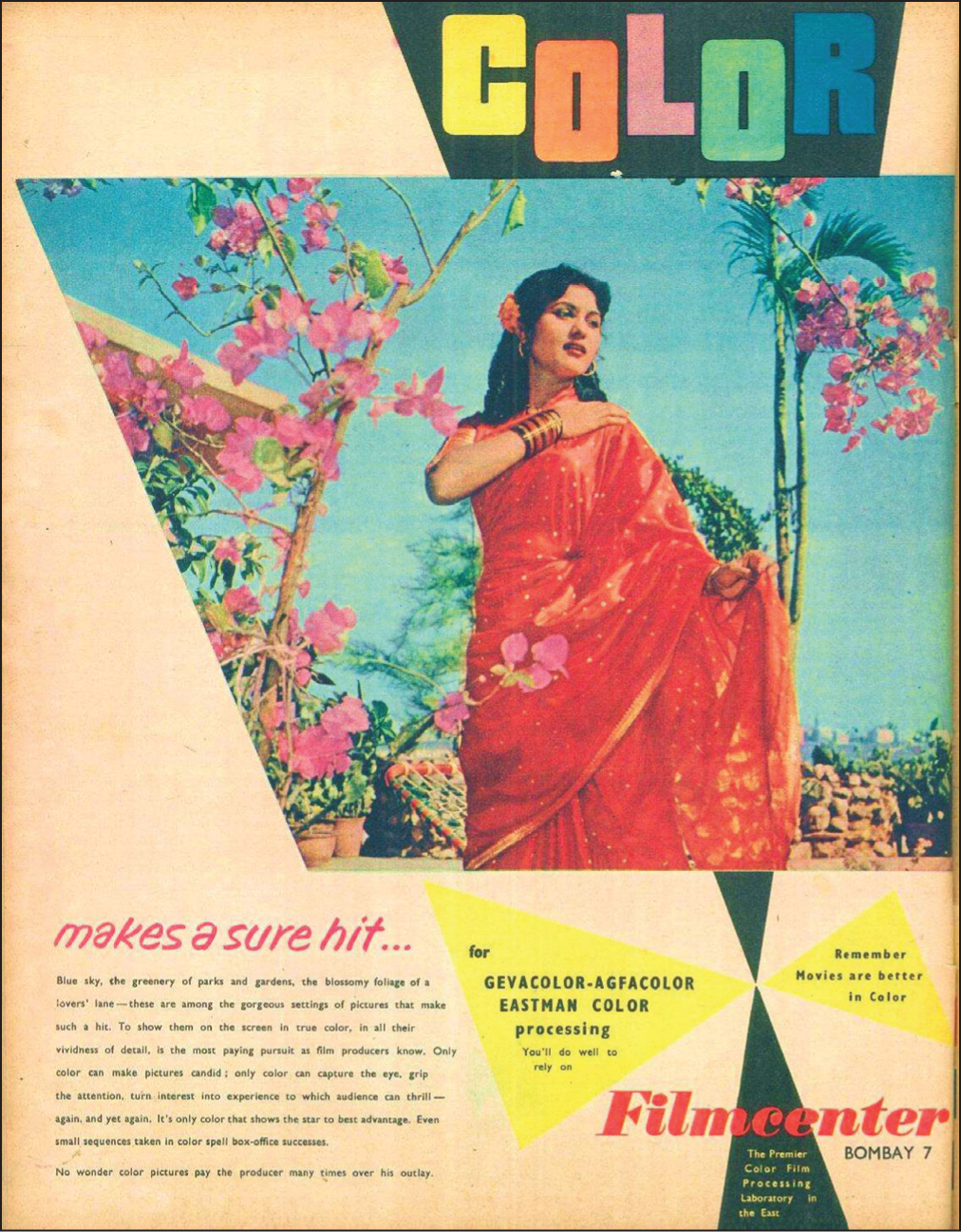
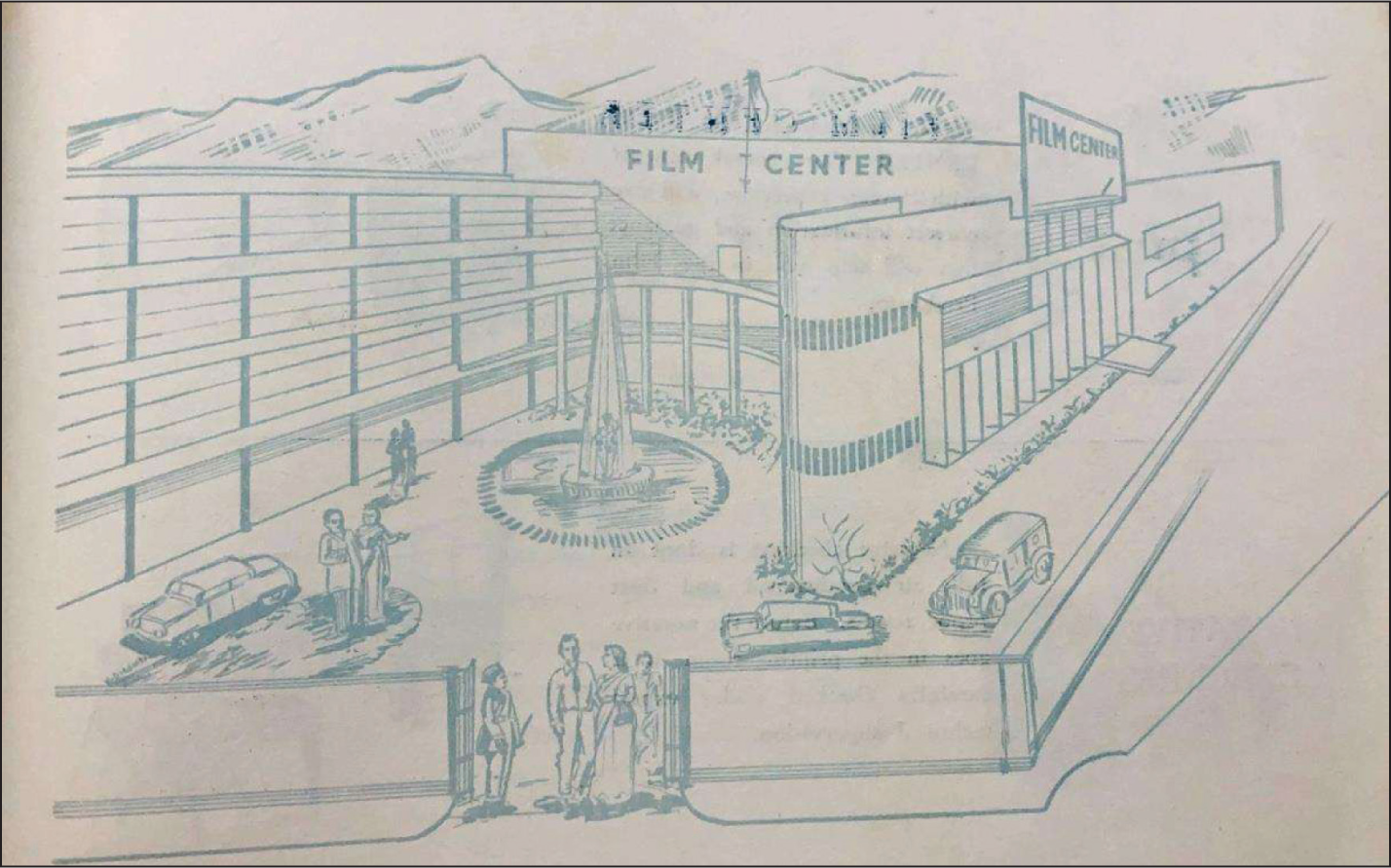
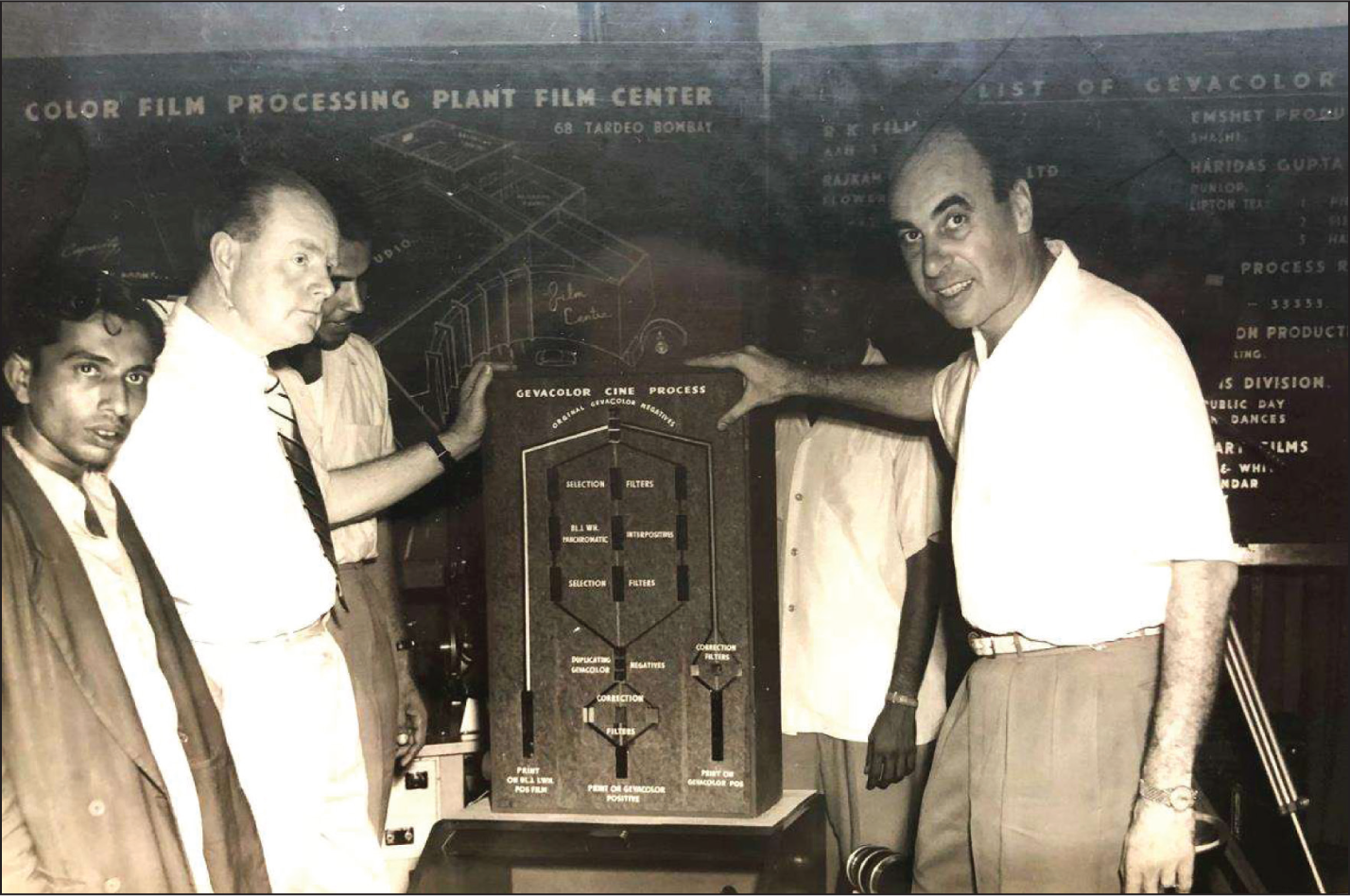
Yet Bombay filmmakers had to be convinced about the quality of these facilities. Many preferred to send their film to London’s Technicolor laboratory, which had unparalleled colour saturation (Dootson, 2023, pp. 135–141). Film Center manager Shashi Patel criticised filmmakers for this ‘craze for getting their colour films processed abroad’ noting Film Center could not expect to attract customers from across Asia, ‘when Indian producers themselves go abroad for their requirements for the sake of false glamour and prestige’ (Sports and Pastime, 1963, p. 52). This scepticism may have been warranted, however. As Gopal noted, prior to Film Center, film processing in Bombay was unstandardised, haphazard and technologically outdated, what he compared to ‘a Dhobie Ghat [outdoor laundry] where instead of cloth, film was washed, with the same potentiality of the Dhobie [laundry worker] to ruin the product’ (Gopal, 1956, p. 157). Patel instead promoted Film Center as the cutting edge in film technology through striking advertising materials with crisp graphic illustrations invoking an aesthetic of clean precision (Figure 5), while the flow-charts and technical models promoting Film Center at the All India Cine Technicians Conference in 1954 similarly present the lab as scientific, rational and modern (Figure 6). But to prove Film Center marked a new era of modern film processing in India, Patel decided to produce Pamposh, a feature that would simultaneously showcase Gevacolor film and Film Center’s capacity to process it, to Bombay and the wider world.
Pamposh both highlights the importance of the laboratory to colour film history, and trains our focus on Gevacolor, a process marginalised in post-war histories of colour because it was never used in Hollywood and only sporadically taken up in Europe. However, Gevacolor is critical to histories of colour in the Global South. It is often homogenised among the many new colour film stocks that emerged from the late 1940s known as chromogenic monopack, all based on the newly available Agfacolor patents from Germany, developed in the 1930s then extracted and circulated by the Allies after the war. 8 Monopack comprised a single strip of film that, unlike earlier technologies, required no special camera to record colour. Belgian photographic manufacturer Gevaert began making Gevacolor film in Antwerp from 1947 based on Agfa’s patents (as a reversal and positive stock, negative followed in 1948), and later in 1964, the firm merged with West German Agfa to form Agfa-Gevaert.
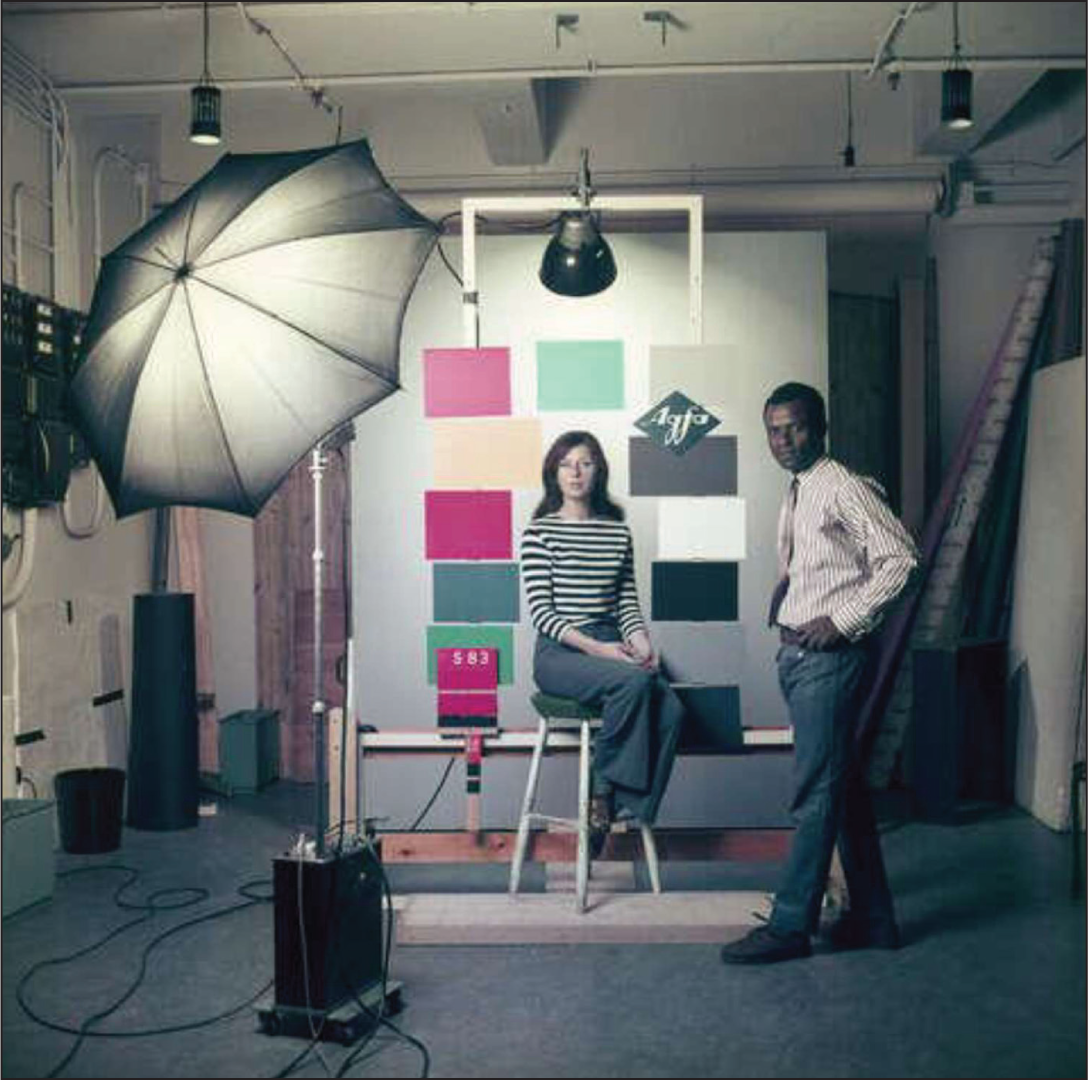
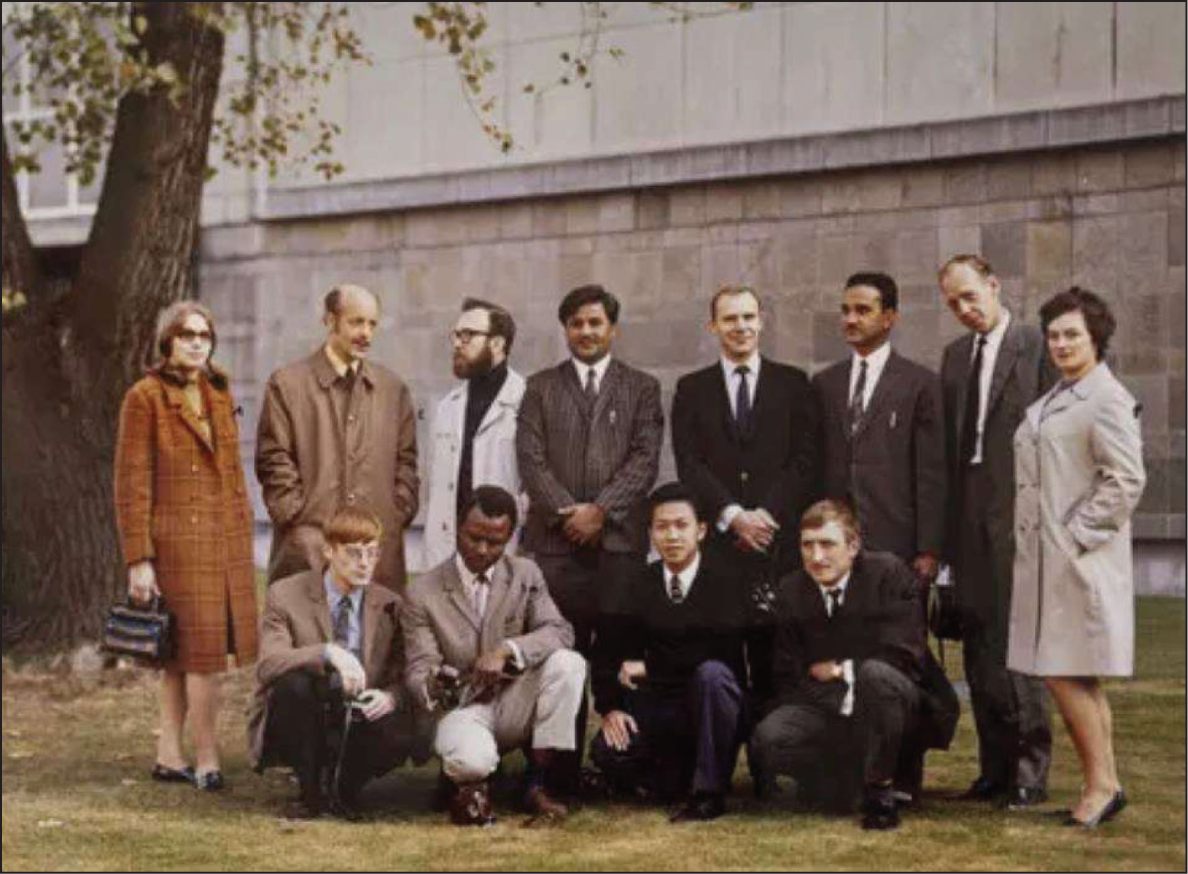
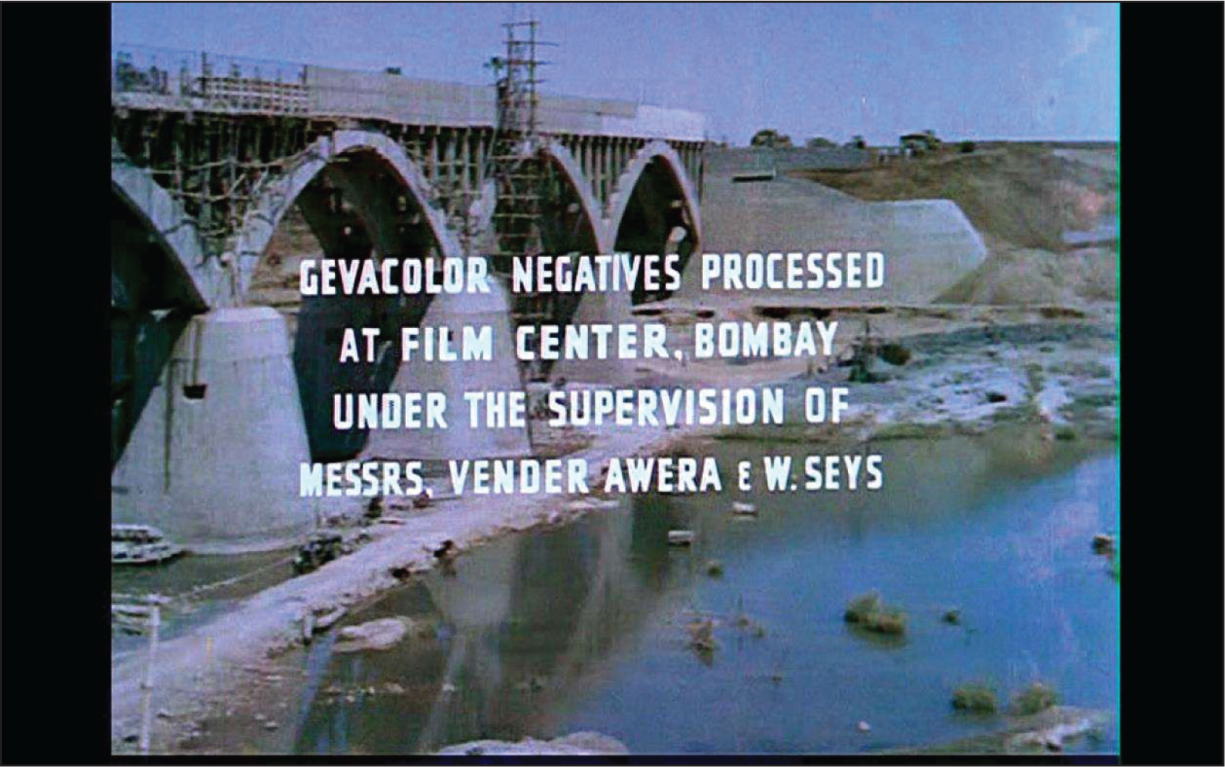
Gevacolor never broke into the American market and its popularity in Europe (chiefly France) was short-lived, as it was swiftly superseded by American Eastmancolor, which although more expensive, gave better saturation and contrast than the muted hues of the Agfa-derivatives. Yet as both a photographic and cinematographic stock Gevacolor played an important role in colour work in the Global South. For instance, photographer James Barnor established the first photographic colour processing laboratory in Ghana in 1970 after studying at the Gevacolor school in Belgium (Figure 7), where he graduated with trainees from Singapore and Pakistan (Figure 8) (Barnor & Obrist, 2021). 9 The first Malaysian colour film Buloh Perindu (Rajhans, 1953) was shot in Gevacolor, and Chinese, Sri Lankan and Thai filmmakers all used the stock. However, Gevacolor enjoyed a sustained popularity in Indian cinemas, particularly in the 1950s. In this decade we believe Gevacolor was used for at least 60 shorts (including documentaries, advertisements and dance sequences within features across Bombay, Calcutta, Bengal and Tamil cinemas) and at least 16 feature films in Bombay alone. 10 Indeed, Gevacolor hides in plain sight in Hindi film history. The first FilmFare Awards (the Indian Oscars) were recorded in Gevacolor (FilmFare, April 1954, p. 6) and the most iconic colour film of the decade, Mother India was shot on Gevacolor negatives processed at Film Center, a fact proudly displayed in the film’s opening credits (in a shot doubly iconic of a modernising India through its conflation of colour film processing and industrial infrastructure) (Figure 9). 11 Yet the technology has attracted negligible scholarly attention either in histories of Indian cinema or colour film history.
Gevacolor’s popularity in India was undoubtedly determined as much by economics as aesthetics. In the 1950s, colour film was on the open general licence (meaning no licence was needed for import), and Belgium’s status as a soft-currency region facilitated economic exchange (Jaikumar, 2019, pp. 110–112; Patel, 1951, p. 150). The capacity to process the film domestically also significantly reduced costs, helping galvanise its popularity. However, the aesthetic flaws of Gevacolor were well known. Make-up artist Ram Tipnis recalled how it rendered skin tones too yellow (Quoted in Eswaran, 2021), cinematographer Mankada Ravi Varma said it was only ever used if Eastmancolor or Fujicolor were unavailable, cinematographer Jal Mistry criticised how it demanded significantly more light than other stocks, while Krishnan Hariharan of Kodak India (aka ‘Kodak Krishnan’) complained it left shadows brown and ‘trees were never green’ (Varma, Mistry, Krishnan oral histories collected by Raqs Media Collective, 2000). While Gevacolor may not have been the first choice for cinematographers, unlike prestigious, high-quality processes like Technicolor or Eastmancolor, it was affordable and could be processed locally. The challenge for Patel was to convince filmmakers to adopt this stock despite its aesthetic drawbacks by showcasing its potential in Pamposh.
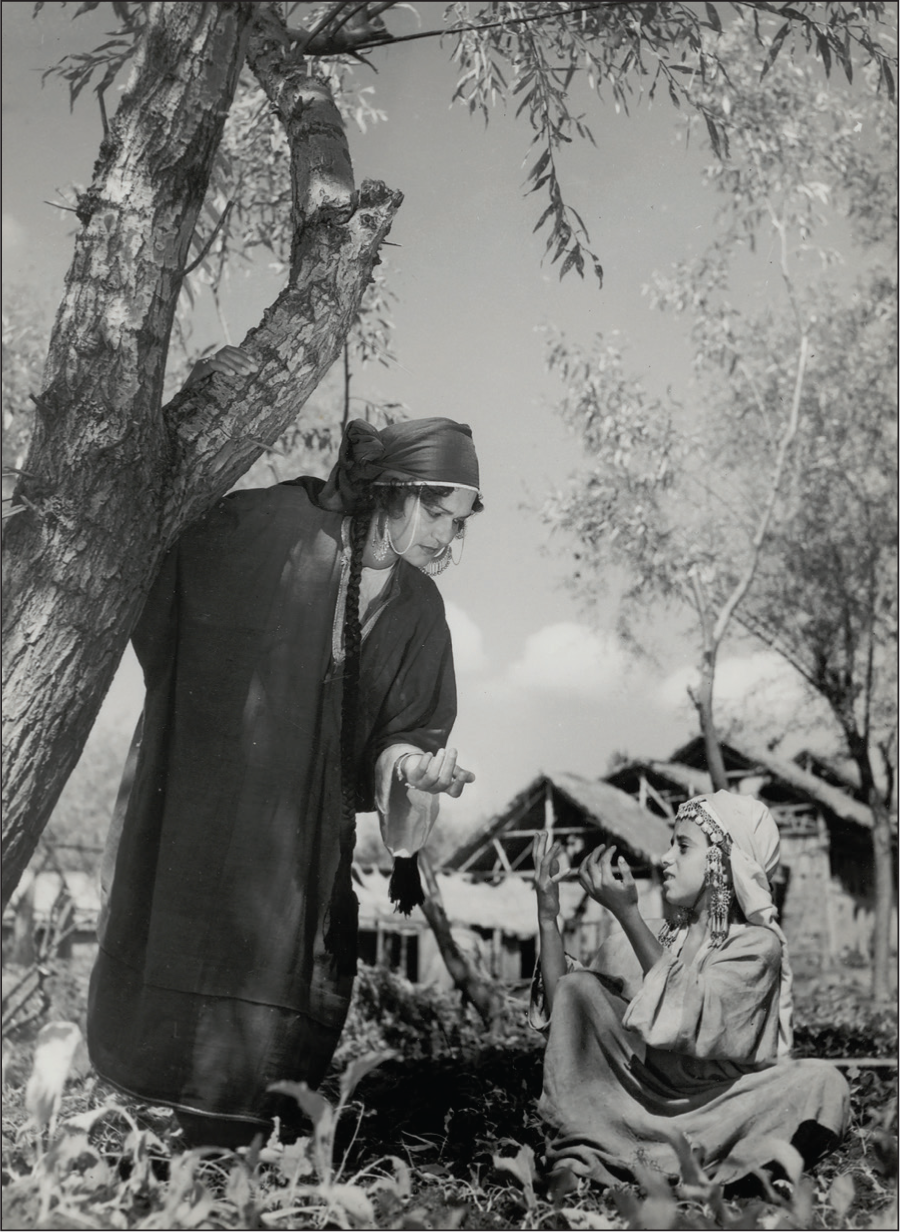
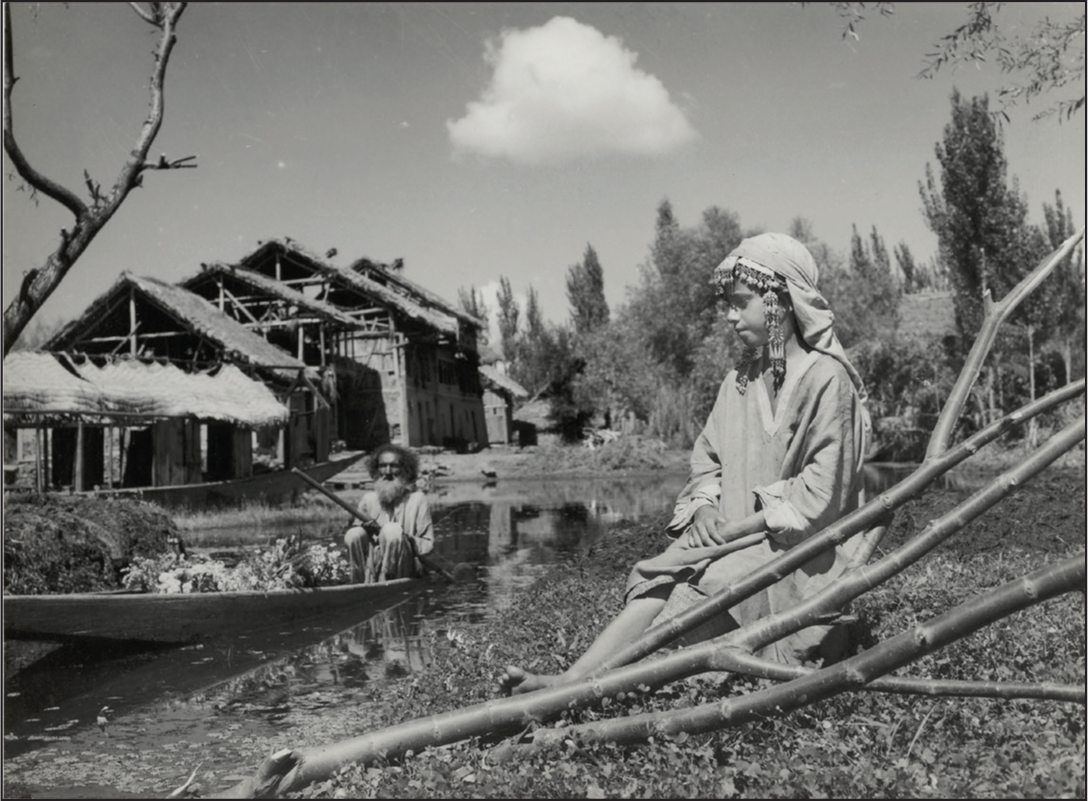
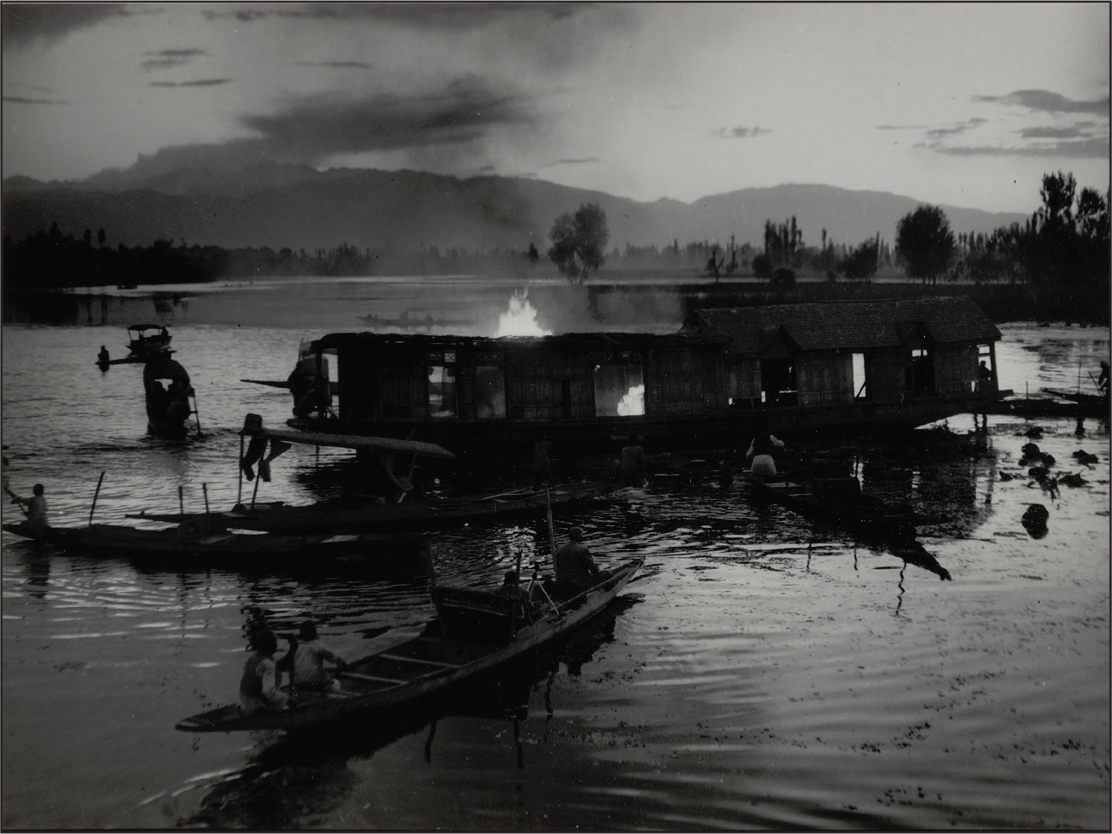
We know from contemporary reviews and promotional materials that the film focuses on Mogli (played by a local non-actor of the same name), a mute orphan child who lives on the Dal Lake in Kashmir. She is the adopted daughter of Kassim (B. Billimoria), who lives in poverty with his wife (Violet Smith) and biological daughter Naseem (Savitri) on a rundown houseboat. The film tells a conventional tale of wicked foster-mothering, as Mogli becomes a target for Kassim’s wife, who accuses the child of cursing the family with ill fortune (Figure 10). Mogli makes a meagre living selling flowers and seeks solace in nature among birds, butterflies, frogs and fishes as well as the mysterious Old Man of the Lake (Siddiq Chellah), who lives on the edge of the water (Figure 11). He soothes her with stories about the Frog King, who resides in a magical underwater kingdom governed by kindness. After Mogli accidentally causes a fire on the family houseboat (Figures 12 and 13), an especially vicious exchange occurs with her foster mother, and Mogli leaves in her canoe, resolving to escape to the mythic lagoon of the Frog King. Searching for Mogli, the Old Man and her family find only her doll stranded in the boat, where the lake’s waters are the deepest. Mogli is never seen again, assumed to be drowned.
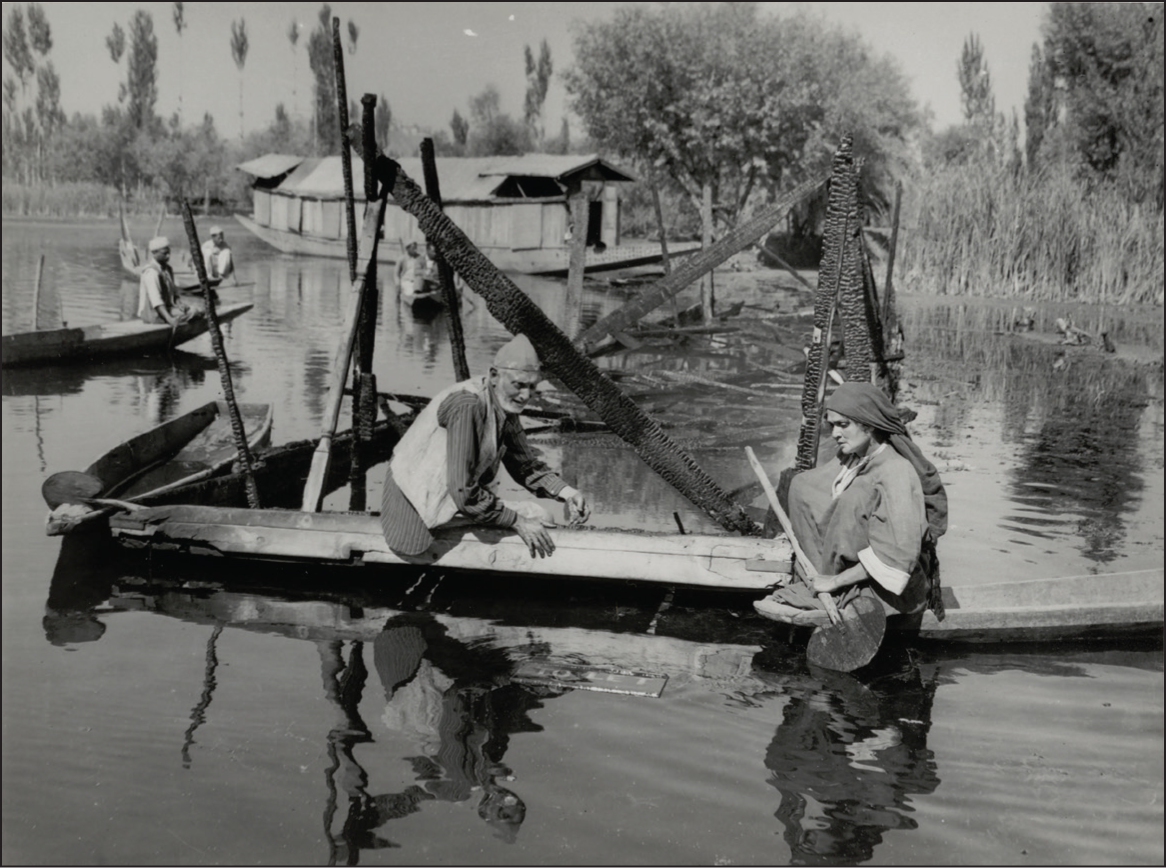
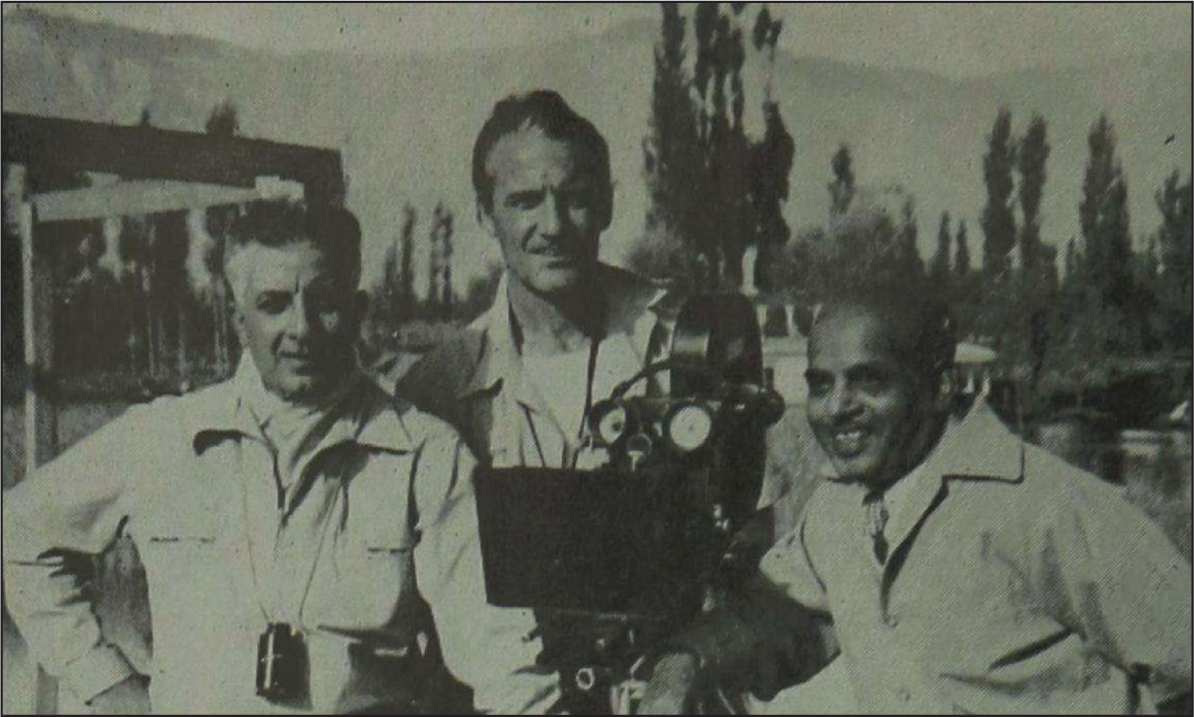
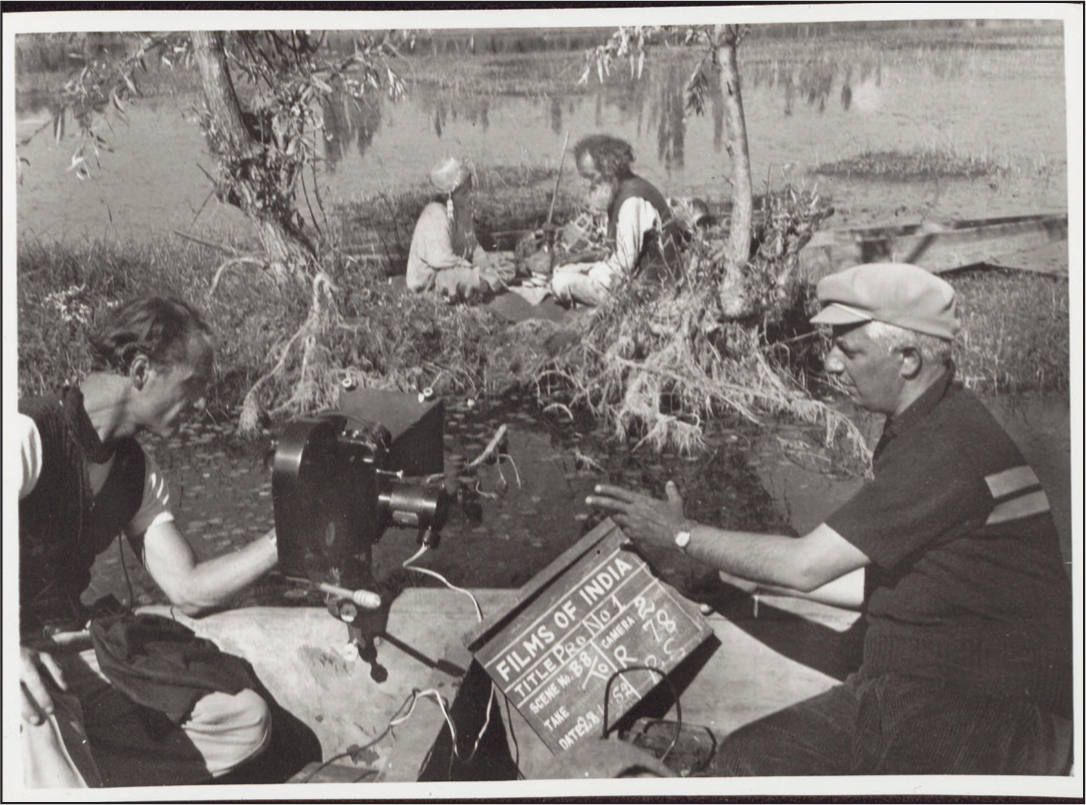
The film was shot on location between 1951 and 1952 by Italian cinematographer Carlos Marconi under the direction of Ezra Mir (Figure 14), who also wrote the script after he allegedly ‘walked around the lake for weeks for atmosphere and inspiration’ (Foster, 1954, p. 415). Although Mir had previously worked in fiction films in both Bombay and Hollywood, he was best known at this point as a documentarian. He established his own documentary production company India Film Enterprises in 1949 after working for Information Films of India (the British-run documentary unit charged with propagandising colonial rule and the war effort). In 1956, Mir would become Chief Producer at the successor to Information Films of India, the government’s documentary unit Films Division of India. While Patel’s choice of a documentarian to write and direct Pamposh speaks broadly to a rhetoric of aesthetic naturalism and authenticity that dominated the project, it is also possible to imagine other motivations behind this decision. In light of Mir’s proximity to state-sponsored filmmaking, Patel’s ambitions to secure state contracts (as the largest consumer of film stock at this time), and the disputed nature of Kashmir in Indian political discourse, we might read Patel’s choice of Mir for director and Kashmir as location, as animated by multiple aesthetic, political and economic incentives.
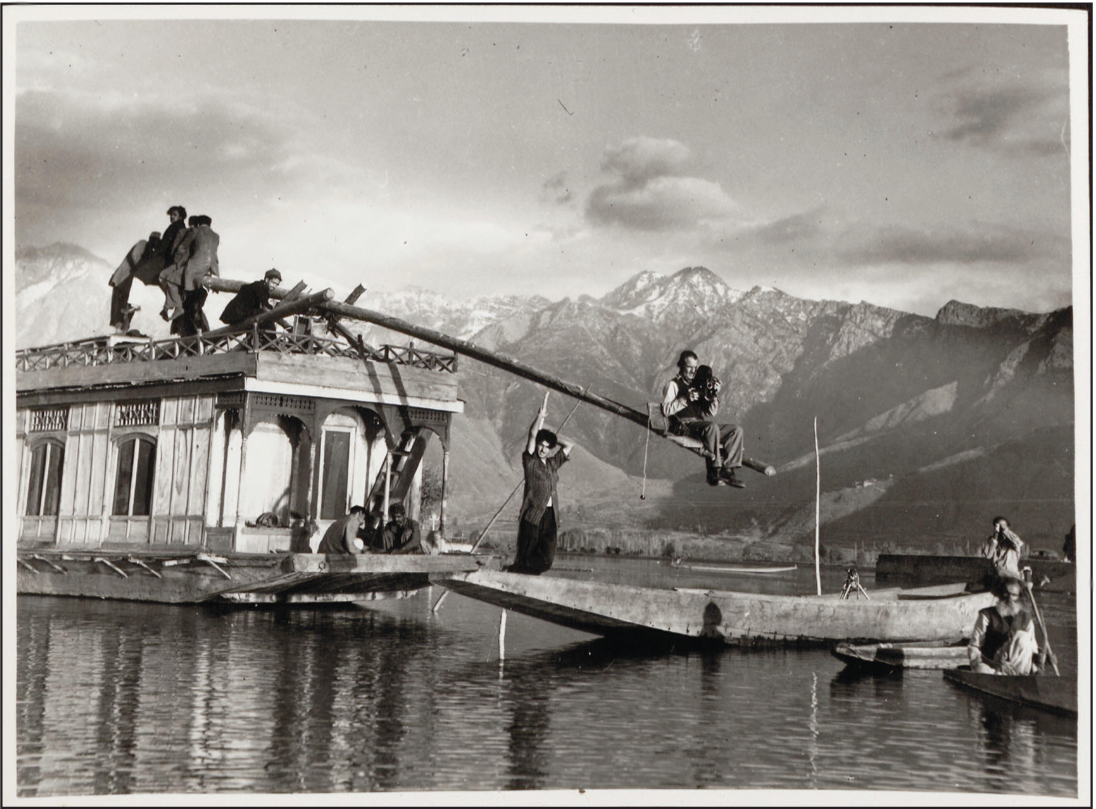
The Dal Lake in Kashmir was chosen as the film’s setting to exploit the chromatism of its natural scenery. A promotional pamphlet for the film held in the BFI describes how Gevacolor helps capture the ‘natural beauty of Kashmir with its delightful gardens brimming with luxuriance of flowers of every hue and variety’ (Pamposh Pressbook, 1954). As Frederick Foster, an American Technicolor cameraman working in India reported in his account of the film’s production in American Cinematographer, the film was shot on location entirely outdoors as Mir and Patel had agreed ‘the key note of the picture should be authenticity in the utmost degree’ (1954, p. 415). Outdoor shooting required complex rigs to capture scenes on the houseboat, as celebrated in production stills held at the BFI showing Marconi on a crane over the lake with his Eclair Camerette or dynamically shooting while perched in a boat (Figures 15 & 16). Despite these challenges, Foster noted the production team had selected the Dal Lake as a location where ‘the riotous profusion of colors in the world’s most beautiful springtime combines with ideal sunlight to provide the perfect testing ground for any color film’ (1954, p. 414). The film thus walks the fine line all colour demonstration films must: between demonstrating the value of colour by foregrounding its visual allure through subjects deemed to be inherently chromatic (the ‘riotous’ colours of Kashmir), while insisting colour is not a superficial gimmick but an essential part of cinematic realism (‘authenticity in the utmost degree’).
These discourses of naturalism are familiar tropes from colour demonstration films. Yet Pamposh had a particular emphasis placed on its documentary-like quality, described at the time as a ‘cross film’ – a mix of fiction and documentary (FilmIndia, 1954, pp. 95–96). Foster praised Pamposh for its ‘documentary character’ (1954, p. 416), an effect so powerful the film has consistently been mistaken for a documentary in subsequent histories. Despite the film’s strong element of mysticism and fantasy, including what one review described as ‘under-water sequences depicting … a dance ensemble in the frog kingdom’ (Times of India, 1953, p. 3), the film was routinely praised for its realism by both domestic and international viewers. Following the film’s premiere in Bombay, Delhi and Calcutta in September 1954, it was celebrated in Times of India for ‘the straight-forward presentation of these real life scenes’ (26 September 1954, p. 3). Pamposh was dubbed into seven languages in addition to Hindi (Bengali, Tamil, English, French, Spanish, German and Japanese) and screened internationally at the Cannes Film Festival, the South-East Asian Film Festival in Tokyo, in London as part of a Silver Jubilee of Indian Talkies, and at the 1954 Photokina exhibition in Cologne. Reviewers singled out the realistic representation of Kashmir as the film’s main charm, emphasising the authenticity of the non-professional cast (although most key roles were played by professional actors). The British magazine The Daily Film Renter, highlighted that for ‘those interested in seeing the Indian as he sees himself, there is plenty of curiosity value’ (1954, p. 7).
There were commercial, aesthetic and ideological reasons for framing Pamposh within these paradigms of naturalism. For Patel, situating Pamposh as a realist film masked Gevacolor’s aesthetic flaws as the film’s muted palette carried associations of the real in contrast to the assumed artificiality of vibrant colour. As Dudley Andrew describes, Gevacolor’s pale tonality and need for vast quantities of natural light (thus best used outdoors) meant it was perceived as well suited ‘for documentary work or for fiction hoping to spawn a documentary feel’ (1979, p. 47). While subdued colour itself has no inherent political valence, describing this look as ‘natural’ is a political act, as it frames a particular way of seeing – and thus a particular world order – as unmediated, legitimate, and inevitable. Gevacolor’s so-called naturalistic palette could therefore be mobilised for different ideological ends. For instance, Andrew notes that in the Cold War context of 1950s France an aesthetic preference for the imagined authenticity of Gevacolor over the artificial veneer of super-saturated Technicolor, articulated a political preference for European socialism over American capitalist imperialism. Yet in the context of 1950s India, a non-aligned state in the Cold War, which worked across the political spectrum of film stocks in the 1950s, exploiting both Russian Sovcolor and American Technicolor, the naturalism of Gevacolor could perform different ideological work. 12 Indeed, as a stock used more widely across the Global South than the Global North, Gevacolor highlights the intersection of Cold War chromatism with colonial, anti-colonial and post-colonial histories of colour. 13 Read specifically within the context of India’s violent military occupation of Kashmir in the 1950s, we suggest it is possible to view Gevacolor’s palette as a means of naturalising India’s presence there. 14
Although Pamposh was unprecedented as the first colour feature film shot in Kashmir, the film participates in a much longer visual tradition of images that served to justify the valley’s occupation and annexation by different groups, particularly in relation to its colourful scenery and its idealised climate. In other words, while Pamposh is a demonstration film, it did not just demonstrate the quality of Gevacolor film or Film Center’s equipment, but also revealed the possibilities of Gevacolor’s compatibility with established ideological paradigms of the Indian state and its political program in Kashmir.
Some Like It Cold: Climate, Gevacolor and the Films Division in the ‘Territory of Desire’
Since Indian Independence and Partition, Jammu and Kashmir has been a centre of conflict between the neighbouring states of India and Pakistan and partially ruled by both. In 1947, India and Pakistan would fight their first war over the territory, followed by two more in 1965 and 1999, which alongside Kashmiri separatist struggles in 1989, have blighted the region with violence and political unrest. Many Kashmiris still hope today for what they term Azaadi, meaning freedom or independence from both India and Pakistan.
The 1950s was a particularly fraught period in Kashmir’s history. In 1948, the United Nations Security Council passed Resolution 47 requesting India and Pakistan withdraw troops and hold a plebiscite enabling the people of Kashmir to vote on their own political future. However, India disregarded the resolution, proceeding to stage general elections in 1951 whilst maintaining that the results of this election would not be binding to the Security Council resolutions. The elections witnessed the Nehru state-endorsed party (the Jammu & Kashmir National Conference or NC) winning all of India’s 75 seats (43 in the Kashmir Valley, 30 in Jammu and two in Ladakh) unopposed, resulting in NC’s governance under the slogan ‘one leader, one party and one programme’. Political chaos ensued within the Valley, with Pakistan and the UN insisting on the continued importance of the referendum. By 1953 Sheikh Abdullah, the Constituent Assembly’s leader and Prime Minister of Kashmir – despite his initial support for Nehru and Kashmir’s accession to India – was imprisoned by India on charges of conspiring to overthrow the government in a bid for Kashmiri independence. Meanwhile the Jammu Praja Parishad party, an offshoot of the Bharatiya Jana Sangh (now known as Bharatiya Janata Party) supporting accession to India, were launching their own agitation campaign.
As Kabir describes, these ongoing disputes over Kashmir have profoundly shaped its visual representation. As ‘the earliest and most frequently photographed landscape in South Asia’, the Kashmir valley has a well-established, and politically inflected set of visual paradigms (2009, p. 13). These tropes evolved over centuries through travel writing and painting before being taken up by the modern media technologies of photography and film. Kabir argues these technologies helped establish Kashmir as a ‘territory of desire’ for India, desirable not for its extractive potential or military advantages, but because it was ‘professed by all to be a singularly beautiful place’ (2009, p. 1). Visual representations of Kashmir’s visual beauty are therefore inseparable from, but not purely synonymous with political strategies of its violent occupation. Colour played a key role in these interlocking aesthetic and ideological paradigms.
As Kabir describes, photography and film rendered visually the long articulated and widely repeated poetic notions of Kashmir as an ‘Elysium on Earth’, an ecosystem unparalleled in the beauty of its crystal blue lakes, white snow-capped mountains and colourful abundance of exotic flowers, fruits and birds. 15 These ideas date back as far as Kashmir’s annexation in the sixteenth century, when Moghul rulers sought relief in the cool of the Kashmir valley as an escape from the heat of the plains, a practice similarly taken up by officials of the British East India Company who found respite in the vassal state of Kashmir from the unfamiliar humidity of British India. For the Moghuls, Kashmir invoked a cool nostalgia for the climate of their original homelands in Central Asia – to the British, Kashmir conjured the temperate feel of England. Over centuries, Kashmir became established in various colonial imaginaries as an earthly paradise—simultaneously exotic and familiar—recognisable for its moderate climate yet spectacular in its colourful scenery. Kabir draws particular attention to technologies of chromatic reproduction (chromolithography, oleography, photography and cinema) as fundamental to the aestheticisation, exoticisation and even eroticisation of the valley that fuelled its desirability, as well as its mobilisation by various colonial gazes in both political and sensual terms (2009, p. 13, 38).
This long history by no means generated a singular or stable mode of representing Kashmir but produced a flexible set of aesthetic paradigms that could be deployed variously at different times to different ideological and geopolitical ends. Idealised, colourful depictions of Kashmir might serve simultaneously to Orientalise indigenous populations and to displace them: whether omitting local people entirely (rendering the valley an unpopulated, pristine paradise ready for occupation) or adopting primitivising tropes (to insist upon the Kashmiri’s poor custodianship of this paradise). They could also help multiple generations of different regimes attenuate claims to indigenous sovereignty through their own imagined sense of climatic belonging in the cool of the Kashmir valley, a version of what Hi’ilei Julia Kawehipuaakahaopulani Hobart calls ‘thermal colonialism’ (2022, p. 6).
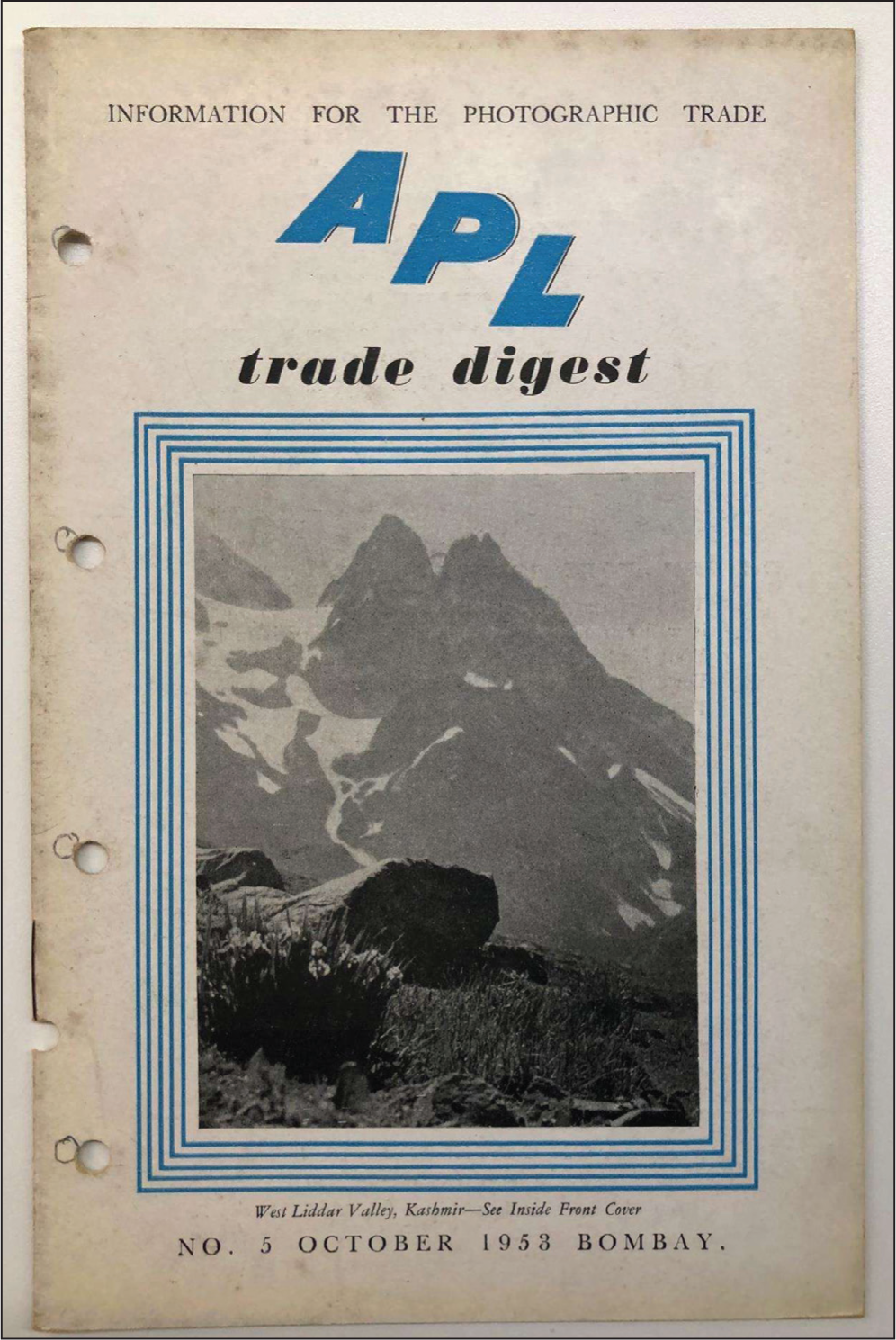
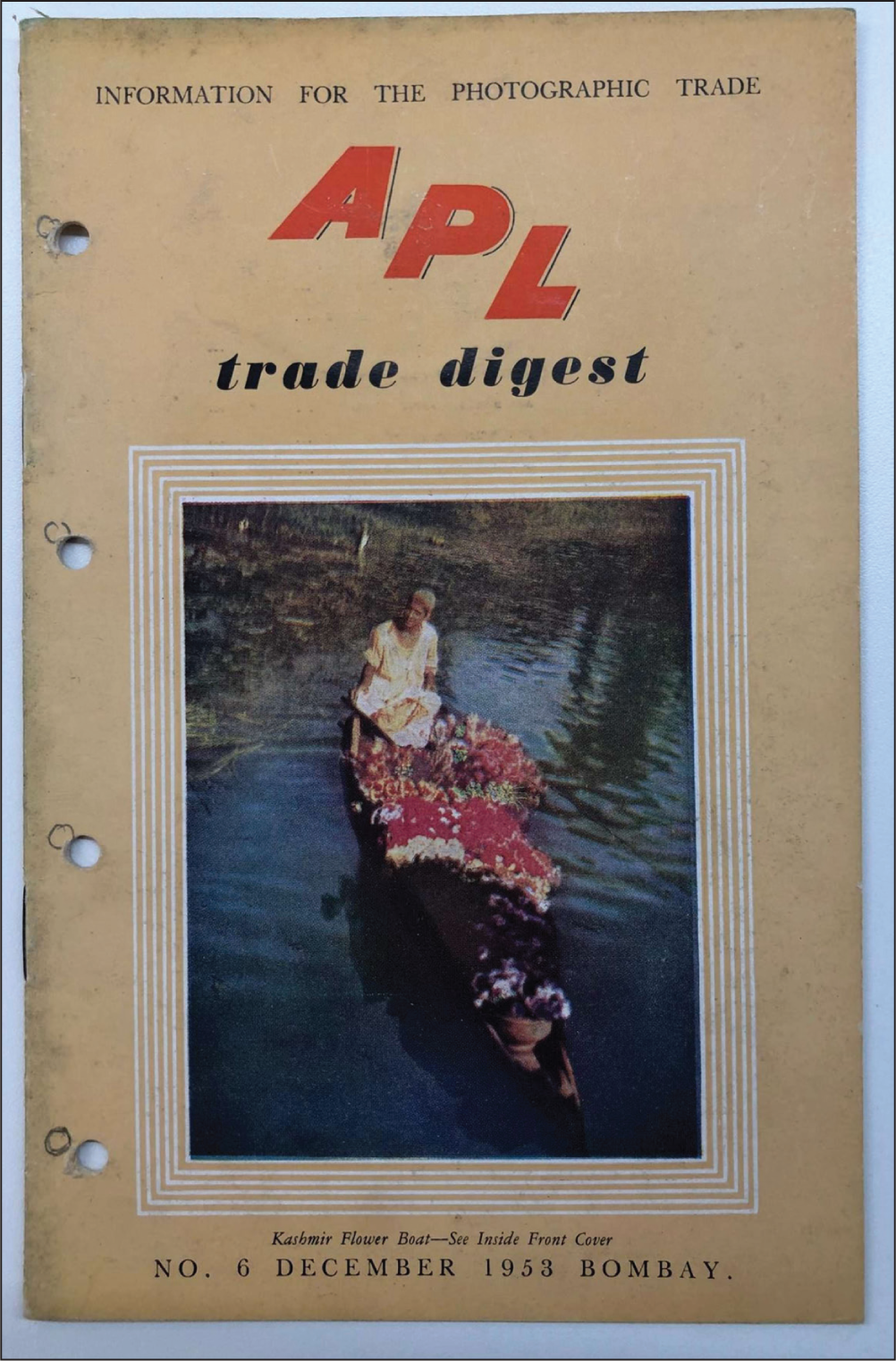
These tropes of Kashmir’s exotic colour and ideal climate, combined with India’s intensified struggles over the region in the 1950s, clearly informed the selection of the Dal Lake as the location for Pamposh. Indeed, by the time of the film’s production, Kashmir had already been exploited to demonstrate the chromatic potential of Gevacolor film in ways that drew upon the paradigms identified by Kabir. The year before Pamposh’s release, the APL Trade Digest (the in-house publication of APL, of which Patel was a director), ironically featured a black-and-white photograph of the Kashmir valley drawing attention to the importance of colour for representing the region where ‘the cobalt-blue of the high altitude skies, the fresh green of the grasses and the rainbow of flowers make Kashmir a paradise for Gevacolor photography’ (1953, p. 1) (Figure 17). Two months later the cover featured an exoticised Gevacolor photograph of a ‘Kashmir Flower Boat’ and its ‘flowerman’, celebrating the ‘colourful craft’ carrying ‘Kashmir’s famous flowers’ (1953b, p. 1) (Figure 18). Shot from a high angle (implying a hierarchy of power between photographer and photographed), the flowerman is rendered a compositional element in the colourful image, which both aestheticises and neutralises the presence of Kashmiris within the valley’s beautiful surroundings. Reviews of Pamposh similarly reprised historical discourses that sought to disenfranchise Kashmiris by cathecting on the natural beauty of the region and the ideal quality of its climate. The Times of India described how the film’s celebration of ‘the fabled beauty of Kashmir’ called to mind ‘the Moghul, pining for his native uplands, [who] said “if there is a Paradise on earth, it is this, it is this, it is this!”’ (1953, p. 3).
Kashmir’s climate undoubtedly played a role in the decision to shoot Pamposh on location, as the tropical and sub-tropical climates of India were identified as inimical to working in colour (Mazumdar, 2024; Shijith & Matthew, 2024). In American Cinematographer, Foster explicitly described India’s ‘beastly humid climate’ as a serious ‘handicap’ (1952, p. 252). The heat and humidity made work uncomfortable and eroded film stocks designed with European and North American conditions in mind. As Gevaert’s technical advisor to Film Center J. F. H. Vandarauwera [Van Der Auwera] described in his guide to using Gevacolor in Indian Documentary ‘care should be taken that the film is not exposed to conditions of high humidity or temperature any more than is necessary’ (1956, pp. 26–27). Gevaert also advised in the APL Trade Digest (1955, p. 2) that its photographic stocks expired in as little as six months in tropical countries.
Film Center, situated in the tropical climate of Bombay, had to grapple with these issues when handling Gevacolor film. Gopal noted that the lab, modelled on Denham Laboratories outside London and Éclair Laboratories in Paris, required much greater thermal regulation of air conditioning and water cooling than its European precedents (1950, p. 61). Yet these issues could be circumnavigated in production by filming in Kashmir. With its moderate climate, cooler than India’s tropical and subtropical temperatures, the Kashmir Valley offered conditions closer to those of Europe around which Gevacolor had been designed.
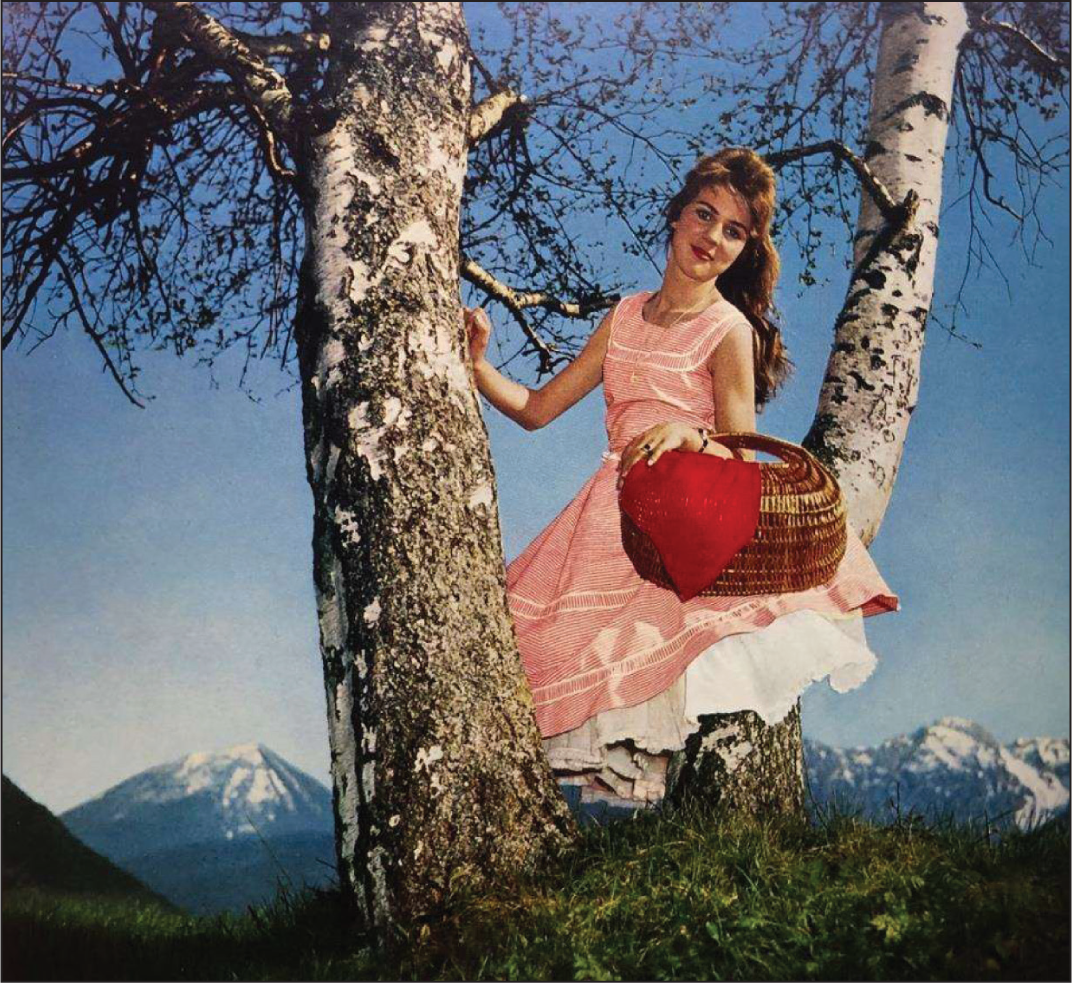
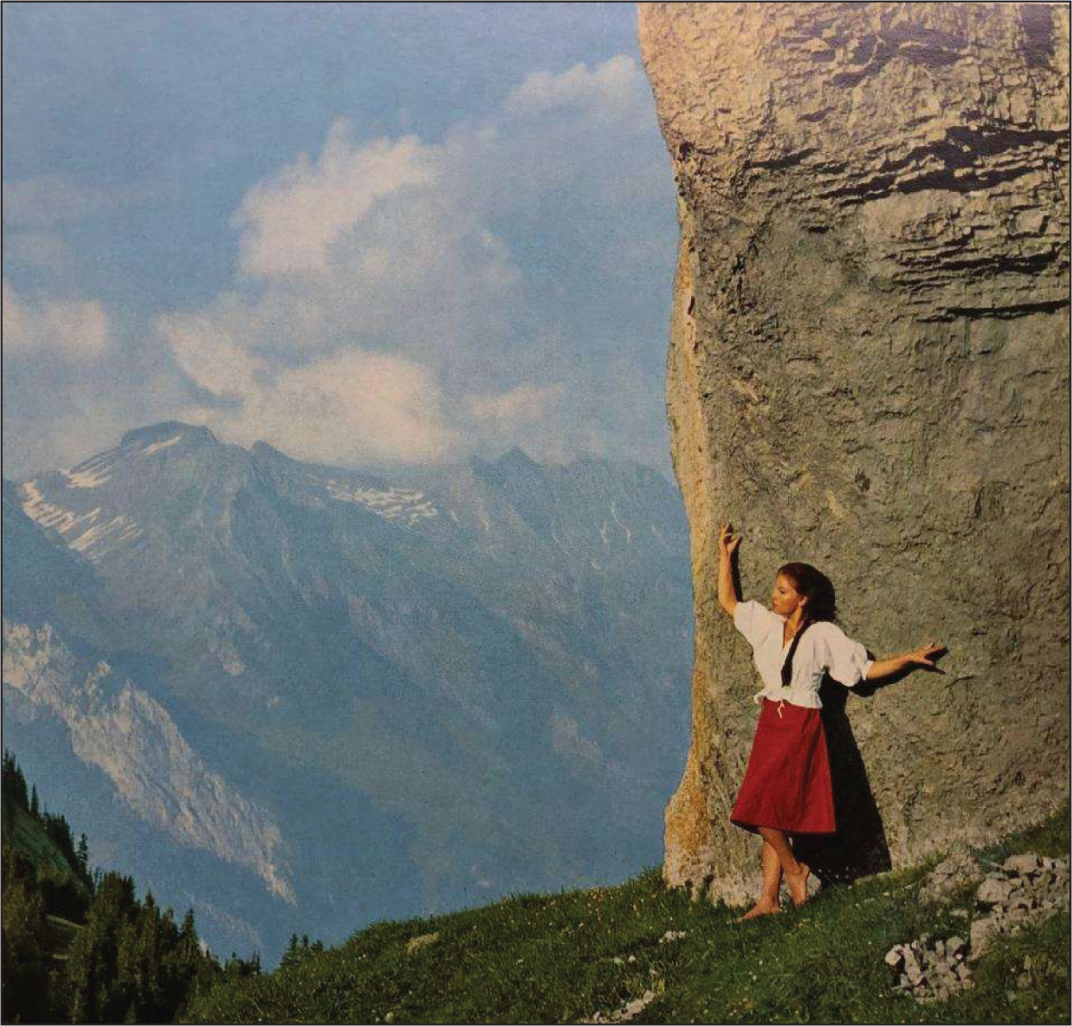
Perhaps it is unsurprising Patel found in Kashmir the ideal conditions for Gevacolor, as Gevaert had already imagined the iconography of the valley in promotional images for the stock in the 1950s (Figures 19 and 20). Captured in what we assume to be the Swiss Alps, these demonstration images for Gevacolor photography strongly resemble depictions of Kashmir in Hindi cinema, not least because Switzerland doubled for Kashmir following intensified violence over independence in the region from 1989. The perceived interchangeability of Kashmir’s climate for that of Europe – whether articulated at an iconographic level (the visual echo of Switzerland in Kashmir) or at a techno-material level (Kashmir’s reproduction of the climatic conditions of Belgium where Gevaert manufactured the film) – thus repeated earlier forms of thermal colonialism that exploited Kashmir’s temperate climate to legitimise various territorial claims, and in turn political rule, over the region. It is interesting to speculate whether Gevaert saw in Pamposh a model for its own expansion into Belgium’s colonial territories in the tropical climate of Congo where they began supplying film in 1952 and sponsored films promoting tourism in the region. 16
While Foster noted in American Cinematographer that for all these reasons, Kashmir was ‘the perfect testing ground for any color film’ (1954, p. 414), the specificity of Gevacolor and its muted palette is important for understanding the possible political resonances of Pamposh in the 1950s. Kabir and Mazumdar have already explored how Indian nationalist articulations of the Kashmir Valley were conveyed through the sensorial pleasures of Eastmancolor in the cinematic imagination of Hindi cinema of the 1960s. Kabir identifies a distinctive cadence to Kashmiri representation in the 1960s when the valley featured in multiple films as a retrograde rural idyll for the escapist pleasures of urban Indian tourists seeking romance and adventure, captured in what she calls the ‘cinematic excess’ of ‘candyfloss Eastmancolor’ (2005, p. 88). These colourful, touristic images of leisure and consumption in the Valley appealed to the newly emergent middle classes in postcolonial India. Similarly in her discussion of Eastmancolor’s relation to tourism in the 1960s, Mazumdar has explored the spectacular ‘avalanche of cinematic images of Kashmir that followed Junglee’, the wildly successful 1961 Subodh Mukherjee film that foregrounded Kashmir in the ‘new cinematic map of 1960s India’ (2024, p. 80).
After Junglee came an upsurge of successful Eastmancolor films shot and set in Kashmir, typically featuring Indian tourists on holiday in the Valley, either hiding or denying the presence of the local citizens altogether, including: Phir Wohi Dil Laya Hoon (Hussain, 1963), Kashmir Ki Kali (Samanta, 1964), Jab Jab Phool Khile (Prakash, 1965), Janwar (Sonie, 1965) and Aarzoo (Sagar, 1965) – all processed at Film Center. These films exploited the well-established tropes of Kashmir as an imagined paradise of untouched natural beauty, which in the context of the 1960s, operated as a foil to the technological modernity of an increasingly urbanised India. In these films, the brilliant saturation of Eastmancolor was, alongside travel, photography and tourism, one of the many forms of technological modernity on display (Mazumdar, 2011).
While Mazumdar notes the increasing popularity of globalised location shooting in the 1960s means Kashmir must be contextualised within a host of spaces, chiefly hill stations, that also gained visibility as privileged sites for colour work due to their cool climates (2024), as Kabir argues ‘the political context of the 1960s lend these films [shot in Kashmir] a specific ideological charge’ (2005: 85). Pamposh carried a different ‘charge’ in the 1950s. Unlike the spectacular modernity of 1960s films like Junglee, bustling with motorboats, rock music and contemporary western fashions, captured in the vibrant hues of Eastmancolor, Pamposh – framed as a documentary-style study of impoverishment and tragedy on the Dal Lake in the muted hues of Gevacolor – mobilises colour differently. While Mazumdar notes colour cinema’s simultaneous capacity for fantasy and naturalism, the rhetorical emphasis on authenticity and realism in Pamposh invites us to read it as a film that not only tests the possibilities of Film Center’s processing equipment, but also the possibilities of colour film to naturalise and thus legitimise India’s fantasies underpinning its presence in the Kashmir valley (2024).
During Pamposh’s planning and production, uncertainty regarding the future of Kashmir lingered ahead of the Indian state. The overwhelming rhetoric of naturalism that dominated discussions of the film might therefore be read within the context of a statist anxiety about its position in Kashmir that required legitimation and stabilisation. To some extent, these instabilities would begin to fade by the 1960s. The imprisonment of NC leader Sheikh Abdullah in the 1950s and his replacement in the form of a relatively collaborative (to the Nehru state) Bakshi Ghulam Mohammad heralded a drastic transformation from the colonial desire to assert the Indian state’s hold in Kashmir to the solidification of that hold in the subsequent decade. By the 1960s Kashmir was perceived in India not only as a more stable political entity, but an established, viable location for Bombay cinema. In other words, the ‘riotous’ colours of Kashmir needed to be naturalised into Bombay cinema before their vibrancy could be celebrated in films like Junglee.
As a phenomenon that is resistant to control and containment, Natasha Eaton has speculated that colour, although ‘not … identical with the artistic and political struggles of the colonized against colonial subjugation’, through its ‘potential alterity’ created a possible point of identification for colonial subjects (Eaton, 2013, p. 5). 17 Pamposh, as an experiment in colour and the colonial imaginary, therefore invites us to consider how the assimilation of Gevacolor into Bombay cinema may be read as a paradigm for the assimilation of Kashmir into independent India. The film suggests a further application of what Kirsty Sinclair Dootson and Xin Peng have described (in the context of Hollywood) as the ‘colour integration narrative’ – whereby the integration of new colour film technologies was routinely played out through narratives dramatising the social integration of marginalised groups synonymous with colour into a dominant social order (2025). Indeed, we find a precedent for such an application of Gevacolor in Australia’s first colour feature film Jedda (Charles Chauvel), which uses colour to explore the assimilation of Indigenous Australians into White settler society (Barnett, 2018; Kevin, 2020; Millard & Solomon, 2024). With Pamposh, we suggest the integration of Gevacolor into Bombay’s film industry parallels Kashmir’s integration into a newly modernised and unified India.
A fascinating echo of this analogy is offered by Urdu literary critic Muhammad Hasan Askari in his March 1947 essay ‘Color in Film: Why and to What End?’ (2014).
18
Written in what translator Ali Nobil Ahmad calls Askari’s ‘final months as a (British) Indian subject’ before relocating to Pakistan, Askari writes on the problem of incorporating colour into established filmmaking practice in India, noting:
Color … will need to inhabit the film like a good, responsible citizen – one who establishes his own individuality and personality but retains a harmonious relationship with the film’s overall visual aspect and makes every effort to remain within its own limits. (p. 170)
Reading Askari’s comments in the context of Pamposh, we can imagine how the supposedly naturalistic, documentary-like colour, worked to render Kashmir’s ‘riotous’ colours as ‘harmonious’ and co-operative. Yet Eaton’s astute observations that colour resists regimes of regulation and restriction, remind us that however strong the rhetorical and ideological pressures placed upon colour, it always remains open to the possibility of alternative, oppositional meanings. In other words, while Patel may have hoped to show Gevacolor’s potential as a statist tool, audiences may have found myriad other aesthetic, sensorial and touristic pleasures that exceeded or even overwrote such geopolitical intentions.
Pamposh was not a documentary, yet its rhetorical positioning as documentary-like, and its subsequent misreading as a documentary, is important given the 1950s cycle of government-sponsored documentary films capturing Kashmir using various colour stocks. The advent of independent India’s documentary movement is undeniably marked by the founding of the Films Division, which borrowed the colonial ideology of propaganda films from the wartime Information Films of India but also struck a distinctly different chord as it aimed to consolidate (through its cinematic imaginations) the Nehruvian dream of discovering ‘the strong but invisible threads that united this country’ (Garga, 2007, p. 138). Films Division was responsible for propagandising the modernising agenda of a newly independent India, yet the unit was far from a straightforward government tool, as Films Division became a site of competing political and aesthetic attitudes about the perceived function and form of documentary (Jain, 2013; Kaushik, 2017). However, the fact that Kashmir was the subject in 1949 of Films Division’s first (now lost) colour documentary shot on Kodachrome, titled Vale of Kashmir (Mohan Bhavnani), reveals statist ambitions among the new possibilities imagined for colour documentary. 19 The state’s new publicity plan relied on film among other tools to ‘show [Indians as well as the world] what Kashmir stands to gain by acceding to India and stands to lose by acceding to Pakistan’ (Government of India, 1949, p. 10). 20 Vale of Kashmir was therefore followed by subsequent (extant) documentaries shot in Kashmir in Eastmancolor: Magic of the Mountains (Bhavnani, 1955) and Spring Comes to Kashmir (Prakash, 1956), as well as the (lost) Gevacolor documentary produced by Mir, Kashmir Festival (1957). We have no account of the lost films, and the extant Eastmancolor documentaries make no reference to political unrest, relishing in the familiar iconography of flower boats, kaleidoscopic montages of brilliantly hued flora, and naturally colourful produce like saffron and chillies (Figures 21–23). While these films undoubtedly evidence new aesthetic possibilities for their directors, and novel forms of modern visual delight for Indian audiences, they were also framed by the state’s publicity plan as tools within its dispute over Kashmir.
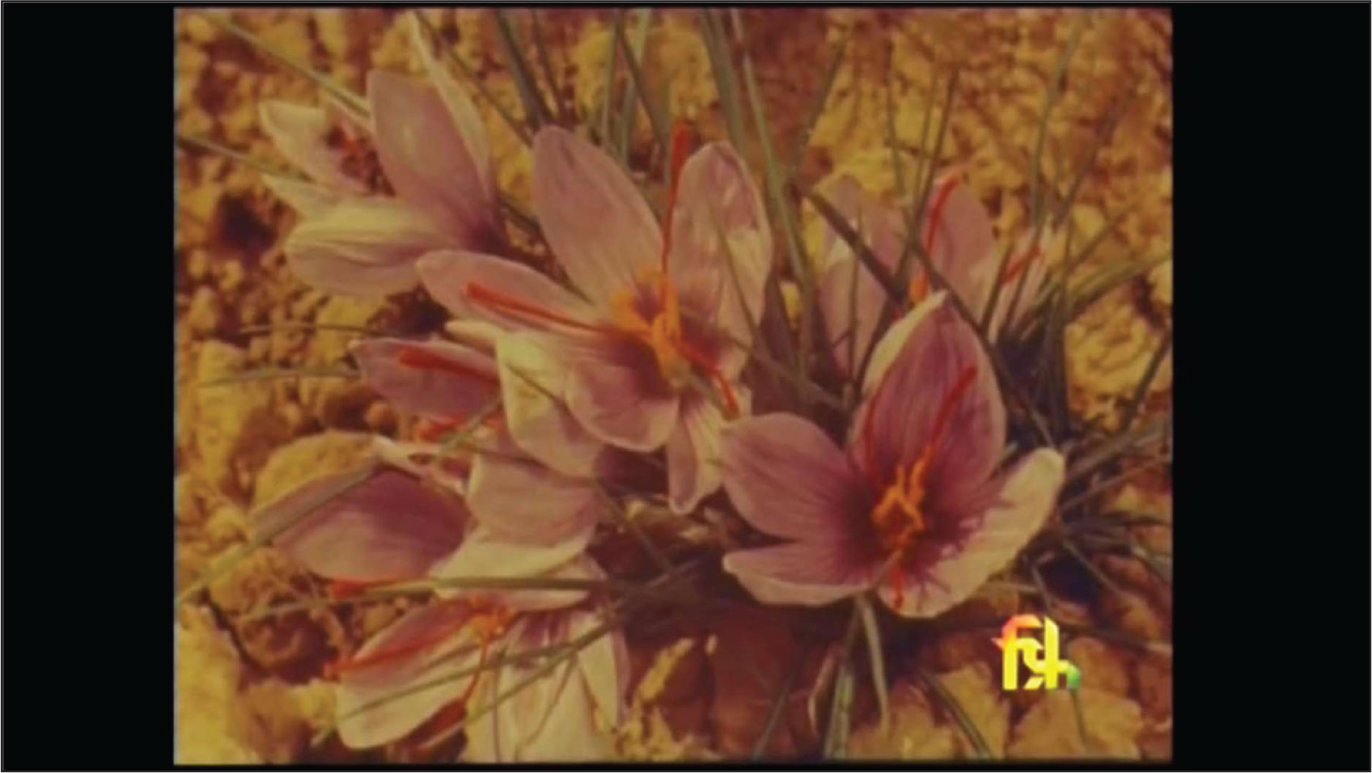
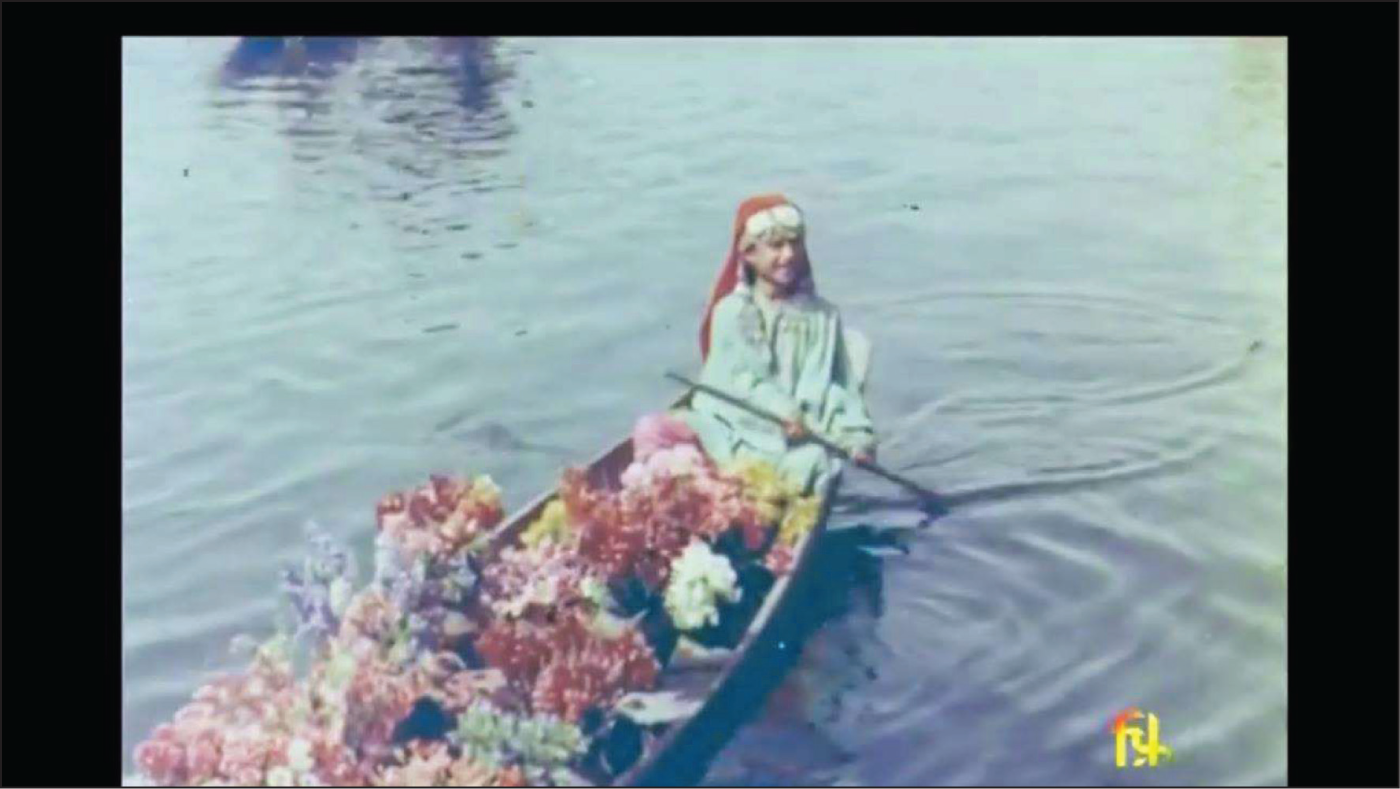
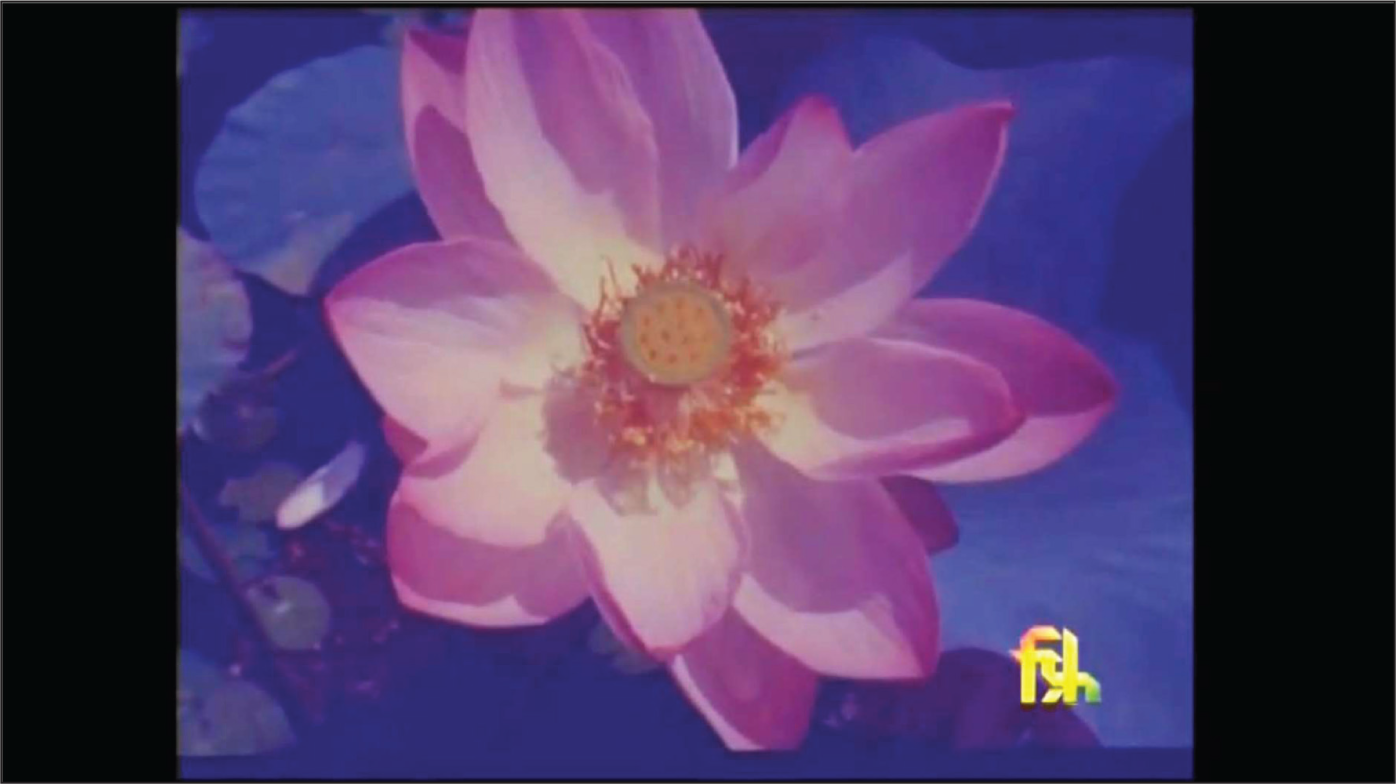
In light of this cycle of colour documentaries about Kashmir, it seems likely that Patel hoped to position Gevacolor as a naturalistic documentary stock to capitalise on the government’s production program, given they were the largest consumer of film stock in India at this time. Patel certainly courted the government’s favour: an advertisement for Pamposh claims the film was screened for Nehru in 1954, who claimed ‘I greatly liked it’ (The Times of India, 28 September 1954, p. 2). Presumably, Patel hoped his depiction of Kashmir in Pamposh would demonstrate Gevacolor was suited both to the artistic and political program of the government’s Films Division.
Patel and Pamposh had varied connections to documentary practice and Films Division. In addition to Mir’s subsequent documentary work for Films Division, Film Center’s advisor Gopal was a senior director of Films Division from 1949 (Sutoris, 2016, p. 64). Patel had also formerly supplied informational films to the government through his production company Educational Films of India – an undated photograph in the FOMU archives shows Patel on the steps of Films Division’s Headquarters in Bombay, with his Educational Films of India van parked outside (Figure 24). Patel’s various connections to documentary presumably informed his decision, while shooting Pamposh, to produce and direct two additional short documentary travelogues in Gevacolor, both shot by Marconi and released in 1954: Heavenly Holiday (shot on the Dal Lake) and Two in a Shikara (shot in the capital city of Kashmir, Srinagar). The BFI’s Monthly Film Bulletin described the former’s appeals as similar to Pamposh: ‘exotic flowers, a little frog immersed in a dew-filled water lily, fantastic houses, withdrawn old people and solemn children at play’ (1954, p. 79), while in the latter Srinagar is described ‘a sort of oriental Venice’ (1954, p. 78) reprising ideas of Kashmir as an exoticised European home away from home. Patel’s attempts to situate Pamposh within a documentary context, seems to have convinced Mir, as following Mir’s appointment as Chief Producer of Films Division we see an uptick in Gevacolor documentary productions.
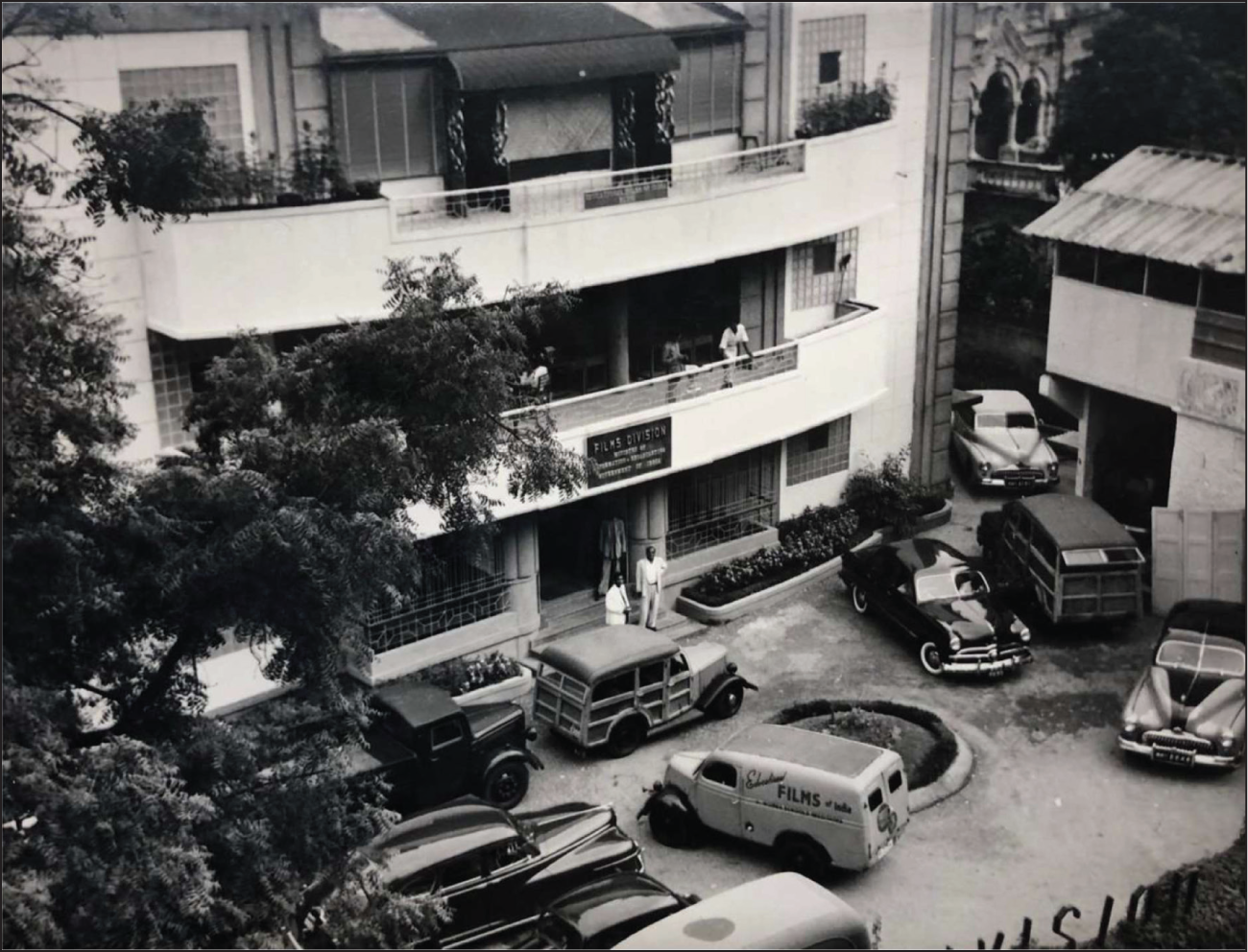
Situating Pamposh within these documentary contexts reveals a different way of reading the relationship between colour cinema and Kashmir. In the 1960s, the vibrant dazzle of Eastmancolor rendered Kashmir’s landscape a colourful confection for visual consumption by the touristic gaze to cement among Indians a collective sense of belonging for the Valley. Indeed, it was not just Bombay cinema that was cinematically transporting Indian audiences to Kashmir in the 1960s, as increasing numbers of pan-Indian productions began exploiting the location, including Tamil films like Thennilavu (Sridhar, 1961), and Idhaya Veenai (Krishnan & Panju, 1972). A more settled political situation in Kashmir meant more established producers could plan their star-studded, high-budget films in Kashmir and thus, ‘an entire decade reeled under its colourful impact as Colour, Kashmir and Bouffants ruled the 1960s’, (Bali, 2011). Yet the ideological and aesthetic paradigms of what Kabir calls Hindi cinema’s ‘turn to Kashmir’ in the 1960s, was only one possibility for colour, as evidenced by this earlier period of experimentation in the 1950s (2009, p. 95). Already in the 1950s colour evidenced its capacity for articulating a statist ideology at a time when the desire to assimilate Kashmir was fiercely contested, while also revealing its other multiple applications for artistic experimentation, commercial appeal and garnering international prestige for the Bombay film industry.
Alternative Archives: Sound, Language and Memory
While we cannot substantiate our claims about Pamposh’s ideological strategy through visual analysis, we can draw upon other evidence left by the film, including sonic traces and oral history. Often song booklets and music albums are the only traces left of Bombay colour film, which despite their textual and sonic rather than chromatic character, can still yield important historical information as Usha Iyer has compellingly argued (2024). With regards to Pamposh, there are four surviving songs archived online by Hindi movie music fans, who have uploaded recordings of the film’s original vinyl soundtrack.
21
Three of these are romantic songs sung by Naseem, who is in love with her neighbour, but the fourth song, focuses on the beauty of Kashmir:
Jannat hai Kashmir hamara Kudrat ki Godi mei khele, Har nazara pyara pyara Phoolon ke hain yahan khazaane, Jharno me sangeet suhane Har dum behti prem ki dhara Sada dil insaano ki basti – Mehnat hai jeevan ki Kashti Har mehnat hai humein gawara Our Kashmir is Heavenly Playing in the lap of nature, each scenery is lovely There is a treasure of flowers here, music in the waterfalls Waves of love flow at every moment It is a land of simple-hearted human beings Hard work is the boat that rows our lives We will toil away
The song is a portrait of the Koshur community in motion (Koshur referring to Kashmiris in the local language). Their idyllic lives revolving around the glorious yet difficult terrains of the Valley, it imagines an entirely flat description of its people, free from the turmoil of political agency, aggression and justice. The lyrics thus capture the dominant political narrative that assumed the native people to be simple folk unable to decide their own political fate (implying total surrender to India’s accession of Kashmir).
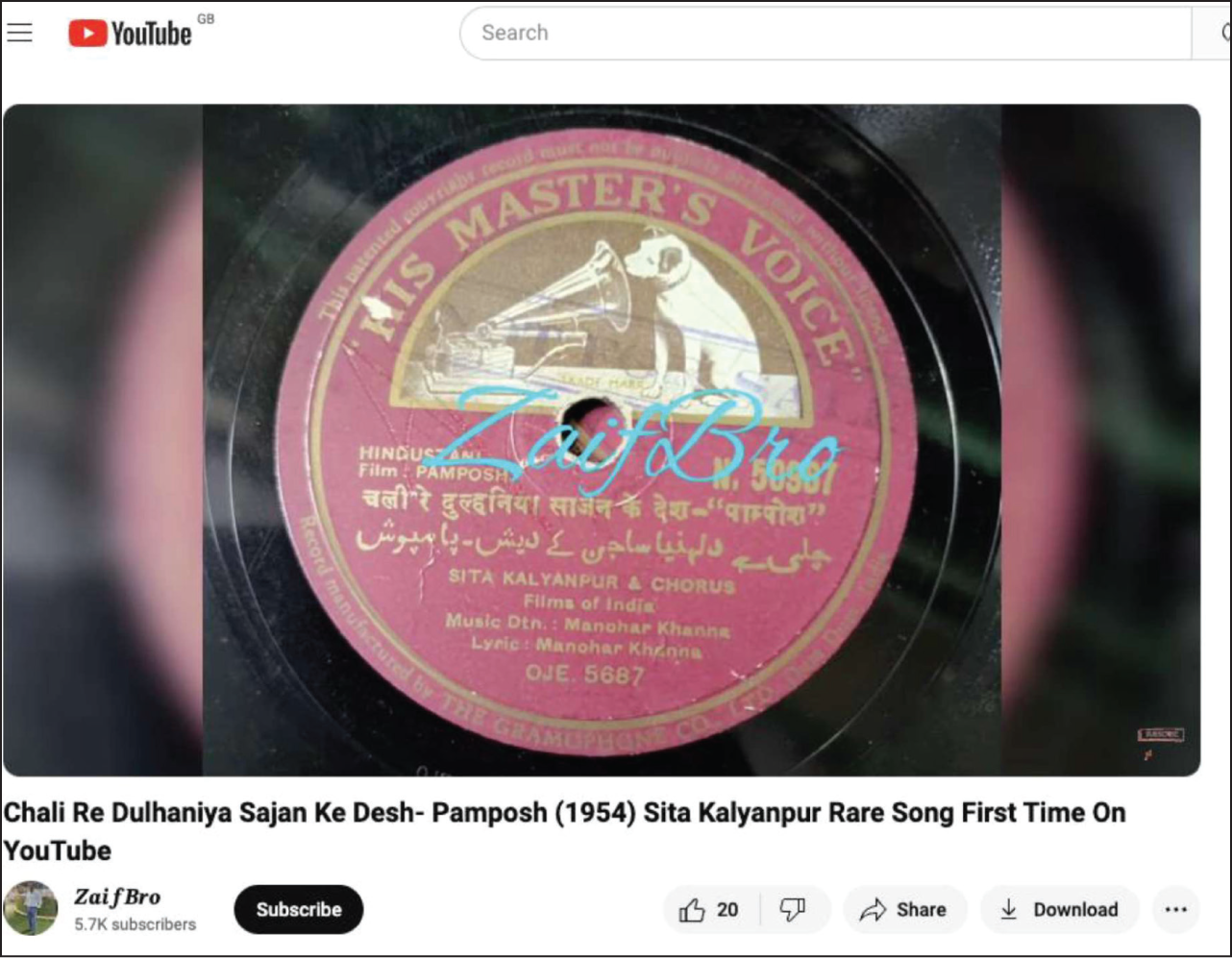
In the scattered manner that the film’s paratexts exist today, there is some confusion regarding the film’s music directors, however. Today, most online Hindi music fans – whether uploading songs to YouTube Channels (Nadir Shah, 2023; Shalin Bhatt; Zaif Bro) or cataloguing and debating music history on blogs (Dutt, 2019; Singh, 2022) – attribute the film’s music to Manohar Khanna, an Indian music director who is named on the record label (Figure 25), or to his daughter Usha Khanna. However, as other fans have noted, Mir’s biography and the Hindi Film Geet Kosh (Encyclopaedia of Hindi Film Song, first published in 1980) originally stated that the music was by Indian classical composer Cecil Mendoza and Kashmiri composer Mohanlal Aima, the latter a popular local musician from Srinagar, who seems to have subsequently been discredited from the film (Deshmukh, 2022; Kamath, 2005, p. 30). 22 Aima was also discredited for other work, for instance, on the bilingual film Shair-E-Kashmir Mahjoor (Mukherjee, 1972), mistakenly credited to Prem Dhawan, a subject music fans have debated online (Mota, 2018; Singh, 2022). To add to this confusion, Pamposh’s songs utilise popular Hindustani instruments including Sarod, Sitar, Harmonium and Tabla. However, often, in traditional Koshur singing, local musicians use Nout and Tumbaknaari as the preferred percussion instruments rather than Tabla. The use of Hindustani instrumentation in a Kashmiri film that boasts of so-called authenticity through Aima’s contributions, reveals something of the wider political strategy of authenticity in relation to Pamposh and its colour – celebrating a supposedly authentic Kashmir whilst erasing and discrediting Kashmiris themselves.
YouTube Clip Uploaded by Zaif Bro Showing Khanna’s Credit on the Record Label for the Music from Pamposh.
When considering the film’s sound, issues of language are also important. Although the film reportedly included a small number of dialogues in Kashmiri, the cast of non-professional actors were made to lip-sync the dialogues in English (Film India, 1954; Foster, 1954; The Daily Film Renter, 1954) and although the film was dubbed into eight languages, none were Kashmiri. With a narrative that revolves around a mute Kashmiri, we might assess that despite ostensibly offering an authentic depiction of life in Kashmir, the film refuses a voice to its inhabitants.
The film was, however, shown locally in Kashmir. In an article covering the theatre-going history of Kashmir, Khalid Ahmad Bashir describes how the film screened during his childhood at the Amresh Cinema, a popular movie theatre in Lal Chowk – the commercial hub of Kashmir’s capital city (2018). 23 Bashir notes that despite being set in Kashmir, including some Kashmiri dialogue and featuring locals as actors – including his neighbour G. M. Paraya from Sonawar, a Geography teacher at Srinagar’s Amar Singh College – it did not perform well at the box-office, its run ending after a few shows (2018). Bashir also revealed to us through personal communication that he was too young to be allowed to visit the cinemas in keeping with a collective sense of taboo about cinema-going that persisted in Kashmir until the late 1960s (2024). In looking at prospective grooms for their daughters’ matrimony, Kashmiri parents would be wary of men who frequented cinema halls Bashir noted. Although we argue that Pamposh was primarily designed with industry professionals in Bombay and international festival audiences in mind, Bashir’s recollections underscore how little the film served the local populace who appeared as subjects of chromatic and colonial fascination in the film.
The claim by British critics that the film portrays ‘the Indian as he sees himself’, is therefore perhaps more perspicacious than it first appears – as the film clearly tells us more about Indian perceptions of (colonially inflected) national identity than it does about Kashmir. Drawing on Edward Bruner’s critique of touristic images that seek to capture so-called authentic depictions of developing nations and in so doing reproduce colonial power dynamics, we can situate the so-called authentic depiction of Kashmir and Kashmiris in Pamposh as a visual strategy that in Bruner’s terms does ‘more to mystify than clarify’ the valley and its people (1991, p. 241).
Being attentive to Pamposh’s multiple layers of meaning (aesthetic, commercial, geopolitical), helps us understand colour’s role within larger filmic histories of silencing the Kashmiris’ struggle for freedom as the Indian state forcibly established its claim on the Valley. That colour technology aligns with what Kabir calls the ‘original framework of fantasy’ that structured perceptions of Kashmir, beginning with painting and photography, and evolving into colour film, positions Gevacolor as a further iteration of these earlier Orientalist technologies of modernity crucial to India’s political project (2009, p. 14). Yet returning to Larkin’s understanding of media infrastructure as ‘often unstable, vulnerable to changing political orders and subject to the contingencies of objects’ physical life’ we might say that while Gevacolor revealed the possibilities of colour cinema as a statist tool to legitimise India’s ongoing violent presence in Kashmir, by no means were these meanings fixed or transparent, either during the life or the afterlife of the film (2008, p. 2). That Gevacolor went on to be used across documentary, fiction, mythologicals, advertising films, comedy and crime, by a host of studios, producers and entrepreneurs, invites ongoing and closer scrutiny of the specificities of colour’s converging aesthetic, financial, ideological and technological registers.
Conclusion: Decolouring and Decentring Film History
Pamposh cannot help us understand issues of colour design or composition in Bombay cinema. Yet the extensive traces the film has left behind, both material and immaterial, across music, memory, technical journals and reviews, illuminates a different history of colour, one disarticulated from visual analysis. Placing this lost film at the centre of our work, we animate a host of other overlooked and marginalised aspects of colour film history: the role of the laboratory in the global development of colour, the importance of Gevacolor for film industries in the Global South, and the imbrication of climatic and chromatic concerns in the global spread of colour film technologies. While there is still a great deal of important work to be done examining the artistic and aesthetic history of colour in extant Bombay films, Pamposh illuminates other possibilities for reading colour, through connections to state ideology and documentary practice that operate in tandem with its visual and economic appeals.
In addition to these industrial and geopolitical discourses, Pamposh can also tell us a great deal about the relationship between colour and desire. Colour clearly played a vital role in cultivating an attraction to Kashmir as a ‘territory of desire’ both for domestic Indian audiences and international viewers. Yet Pamposh also gives us, as authors and scholars, cause to reflect on our own forms of chromatic desire. Precisely because Pamposh denies us the very thing we pursue, meeting our quest for colour with greyscale images and black-and-white texts, we are invited to speculate about what it is that motivates our desire for colour. As Iyer describes, working with ‘paratextual ephemera may heighten the sense of cobbling together fragmentary and elusive histories that foil the desire for strong evidentiary claims and affirm the impossibility of fully recovering the past’ (2024, p. 331). But what is it that we hope to find when we go in search of Bombay film colour, and what desires are frustrated by the denial of this optical pleasure? As Jagjeet Lally describes:
the entanglements of British colonialism, European capitalism and Indian colour are not only evident in the residue of physical things, including the substances of colour. They are also evident in the practices of writing about Indian societies, as well as in the writing of historical actors and historians themselves. (2019)
It is difficult therefore to disarticulate the extractive, and colonial histories of Indian colour from contemporary scholarship that might similarly frame India as a rich source of chromatic material. Furthermore, when examining the multiple and complex layers of violence, occupation and dispossession that attended desire for Kashmiri colour, we must remain attentive to our own chromatic desires and how they inform the histories we write. It is not so much that writing film history about lost colour entirely circumnavigates such logics, but it may help us think more critically about how and why we write colour film history in the first place. To conclude then we would like to speculate whether it is possible to decentre the field of colour film history by de-colourising our objects of study? By frustrating our desire for colour, can a film like Pamposh draw attention to the colonial, extractive or violent logics driving our interest in the chromatism of Bombay and Kashmir? Given it is the seductive optical appeal of colour that orients our discipline around the visual analysis of extant films, could removing the visual pleasure of colour from our work not only broaden the geographic scope of our research beyond the Global North but also invite us to reflect critically on our desire for colour in the Global South? How might letting go of our chromatic desire open colour film history up to new areas of investigation?
Footnotes
Acknowledgements
The authors would like to express their sincere gratitude to the many named and unnamed sources who continue to remember, in silence, ‘the deed and the date’, and have made this research possible, including: Ranjani Mazumdar, Thomas Jenné, Khalid Ahmad Bashir, Nele Van Bogaert, Joshua Yumibe, Sarah Law, and Gowhar Farooq.
Declaration of Conflicting Interests
The authors declared no potential conflicts of interest with respect to the research, authorship and/or publication of this article.
Funding
The authors received no financial support for the research, authorship and/or publication of this article.