



Abstract
This article demonstrates how new media technologies remediate traditional cinematic modes of stardom, specifically in and through small towns in India. Through two case studies, it explores registers of stardom that have emerged through the short video sharing app TikTok – both on the platform and in its filmic renditions. The first case looks at the cinematic construct of a TikTok star, which fuels the formal and narrative force of the 2019 film Bala (dir. Amar Kaushik). Bala illustrates how cinema can self-reflexively interweave traditional tropes with new media technologies. The second case features a ‘real-life’ TikTok star and political aspirant who brings into focus the political and electoral valence of TikTok stardom in the town of Adampur, Haryana. The cinematic is central to this narrative, where cinephilic nostalgia indicates a shared cultural intimacy between the political candidate and her followers and helps further her political ambitions. While the real TikTok star, Sonali Phogat, directly addresses her constituency, lip-syncing to old movie songs in 15-second videos, her reel counterparts pay homage to their cine-ancestors, 15 seconds at a time. In a setting where ‘the star’ has traditionally been understood through the prism of cinema, this article brings to light shifting registers invoked through the platformisation of the star and the cinematic in small town India.
Opening Montage, or a Sweeping History of Stardom and Indian Cinema
The significance of cinema, and the role it plays in the everyday lives of its audience, cannot be overstated, especially for the reader who might already be well-versed in the mammoth discourse that exists on stardom and fandom in India. However, it remains pertinent to gesture towards the three most significant veins of this discourse, centred on the Hindi, Tamil and Telugu-language film industries. There are three vectors that historically tie these forces together – the figure of the star, the fan and the site of the cinematic – which has traditionally been understood as the cinema hall, but is increasingly being expanded to include more individual, intimate encounters – that by no means are a product of the contemporary, but have most certainly been thrust into the spotlight in emerging debates on the post-cinematic.
‘Post-cinema’ is a framework that acknowledges digital media technologies within a long history of cinematic traditions that began in the twentieth century. As an analytical category, it allows us to delineate new ‘structures of feeling’ that emerge from ‘new formal strategies, radically changed conditions of viewing and new ways in which films address their spectators’ (Denson & Leyda, 2016; Williams, 1977). Technology then needs to be centre-stage in any discussion of stardom/fandom in the contemporary.
This focus on technology has also led to revisions in the academic discourse on fandom in India. Historically, the figure of the fan in southern India has received a certain degree of attention, while its north Indian counterpart has been somewhat neglected. Fan activity in the south has traditionally been caught in the dichotomy of devotion and defiance (Srinivas, 1996), with the film industry either cashing in on or grappling with the fans’ expectations of their star. Fan associations have been of particular interest to scholars of Tamil and Telugu cinema for the great degree of political clout that they command, which has often fueled the political careers of their stars (Neidhart & Hardgrave, 1975; Prasad, 1998; Srinivas, 2009, 2018). However, recent scholarship has attempted to break away from the binary classification of fans as rowdy or rasika, and instead focused on the work of fan communities in negotiating and building transnational circuits of archiving, exhibiting and circulating star texts online (Punathambekar, 2005).
One of the earliest researchers to highlight the relevance of technology in its relation to stardom was Ranjani Mazumdar. In an article signalling the conglomerate turn that the Hindi film industry was transitioning into in the early 2010s, with the emergence of televised live events and the presence of stars on reality shows, Mazumdar observes how star texts now begin to be recalibrated within a vector of ‘liveness’. For her, live crowds of onlookers at performances akin to concerts and studio audiences during reality TV shows are central to this new configuration. The star’s interactions with spectators at these events create a powerful new kind of image, where ‘we see the stars as stars, not as the characters they play’ (Mazumdar, 2012). Further, the presence of the crowd or sea of onlookers at live events in the mise-en-scène of their recordings is critical to the techno-display of stardom- – it lends credence to the live nature of an event, and their collective energy or ‘madness’ stands as testament to the performer’s star power. Mazumdar’s observation stands as a testament to the way in which television and the internet are no longer an extension of the cinematic, but are fundamental to its reconstitution in the contemporary era. In a concluding remark, her observation that ‘this is a new mediatised environment where stars have to be produced constantly, not just through the release of films but also through new geographies of liveness’ has renewed vigour for this article that is edged at the emergence of over-the-top (OTT) stardom and its intersection with the cinematic. This new nexus not only implicates traditional cinestars but also involves tracking and monetising the habits of active viewers in search of specific content on these platforms. Moreover, their interaction with content creators now propels individuals to star status.
With growing internet access on mobile devices, Bollywood stars are increasingly being treated as online ‘brands’ managed by PR agencies and tasked with the agenda of seeming more accessible – often by engaging more directly with fans on social media. This has, on the one hand, led to fans feeling included in the inner world of stars, while, on the other hand, it has prompted troll activity. Sreya Mitra argues that
as the stars become more accessible and familiar, particularly on social media platforms, fans no longer comprise merely the rasika and the rowdy but also the troll. Emboldened by the anonymity provided by the social media sites, the troll feels empowered to chastise and ridicule the star for any perceived transgressions in the virtual realm. (Mitra, 2020)
Fans, for their part, have been known to band together to defend their stars and, on occasion, indulge in ‘actively trolling each other as well as the critics of their idols’ (Srinivas, 2021). The distinction between fan and troll is thus nebulous, as the viewer/user of digital media is ushered to actively participate in internet-based media cultures. It is the activity of these fans-as-users, who often chase content from one media platform to another, that leads to production decisions and determines the fate of large film franchises (Jenkins, 2007).
The viewer now emerges as a performer of taste rather than just a spectator of cinema (Basu, 2015). It is this performative turn that fuels cinema’s reorientation in the contemporary and spurs a generation of apps like Dubsmash and TikTok, poised to harness the cinematic appetite of prosumers, that is, users who primarily create the content hosted on these platforms. These apps then serve as a growing repository of film culture, where the activities of their users make visible the everyday presence of the cinematic in India, and present us with a performative archive driven by the desire to participate in an imagined filmi past tinted with nostalgia (Chakravarty, 2019). In terms of cinema, and more specifically, the ‘cinema-effect’ on TikTok, user videos are created by accessing a large metadata of audio tracks, which mainly includes sound effects and sound tracks of film songs readily available on the app. In the following sections, the author describes how the interface of the emergent app economy gets translated into a remediation of the cinematic, where not just the format of the app but also the very aspirations of its users get projected onto the cinematic and become the veritable driving force of the narrative. Further, we will witness how the cinema effect produced by the audio bank readily available on TikTok helps construct a virtual self, cheered on by an imagined community of fans who share in the collective nostalgia of a cine-past. The small town itself will emerge from the surface tension of these observations, where aspiration is either mapped for OTT success or falls short of achieving any sustained change. It is the uncertainty of these digital exchanges that drives the dialogue of the post-cinematic contemporary.
First Encounter: TikTok and the Small Town
In September 2019, the short-form (15-second) video sharing app TikTok was the most downloaded social media app globally, beating category leaders like Facebook, Snapchat, Instagram and Twitter (SensorTower, 2019a). 1 In November, TikTok clocked in 1.5 billion downloads, with India accounting for over a third of the total new downloads. With these additional 277.6 million unique users, India now accounted for 59.5% of TikTok’s total lifetime users (SensorTower, 2019b). During the time in which the two case studies discussed here transpired, TikTok continued to be the most downloaded app across categories in India, a position it steadfastly maintained until the app was banned by the Indian government on 29 June 2020 (SensorTower, 2020).
Acknowledging the app’s initial success, Tiktok’s sales and partnership director, Sachin Sharma, stated – ‘we believe that TikTok filled the gap by bringing people from the remotest of towns online. We are currently available in 10 major Indian languages, celebrating diversity and giving everyone a platform’ (Mitter, 2019). In this statement, Sharma echoed the 2017 ‘Internet in India’ report (based on the ICUBE 2017 report), which found that one of the biggest reasons for digital entertainment’s popularity was the availability of content in Indic languages (Kantar IMRB, 2017). 2 Thus, TikTok’s recognition of the role played by language in forming regional identities was key to expanding its reach in India. 3 They had effectively ‘localised’ their content to the needs of the ‘remotest of towns’. 4 Further, as Sriram Mohan and Aswin Punathambekar have noted in their work on YouTube, when it comes to the expansion of digital platforms in new markets, ‘even language, the immanent domain of the cultural and the political, turns into an infrastructural concern that ought to be managed, not negotiated’ (2019). This, they found, was key to the platform’s success, which lay in concerted efforts to showcase content created by local users and exemplified their call to ‘broadcast yourself’, resulting in a situation wherein ‘the notion of a YouTube star started becoming legible in the Indian context’ (Mohan & Punathambekar, 2019).
This notion of broadcasting yourself on a platform is the principal drive of TikTok. Riding on a wave of social media influencers and YouTube stars, TikTok draws from the trajectory of its predecessors and commands its own niche hybrid category. As Jia Tolentino, a staff writer for the New Yorker remarks, ‘TikTok doesn’t ask you to pretend that you’re on the Internet for a good reason’ (2019). It simply wants you to broadcast yourself, or watch other users put on a show. The desire for content imprints itself onto the interface of the app, where the main goal of the design team is ‘to lower the barriers for content creation, from app design to the editing tools and filters’ (Kobie, 2019). This content-first strategy, along with their localised curation and its resulting vast user base, led to a monumental shift in online content consumption, where the time gap between uploading and circulation collapsed and content became ‘viral’ simply by existing on the platform. In India, particularly, the app was popular with users across Tiers I, II and III, reaching ‘hidden pockets’ that had not been explored before (Mitter, 2019). 5 A big part of this monumental shift can be attributed to the app’s short 15-second video format and to its interface that bypasses text-based language barriers, effectively encouraging and onboarding first-time internet users (Mitter, 2019). In this new age where the old parameter for virality, the total number of views, has been replaced by the total number of likes on a video, and videos are circulated based on geographic proximity and popularity, the TikTok star emerges as a unique assemblage of regional novelty. As an attempt to understand this precipitating shift, the author will now present two case studies that centred on TikTok stars in India.
In India, the figure of the star has traditionally been understood through the prism of cinema. Within this context, the 2019 Hindi film Bala prompts us to relocate the logic of stardom onto the TikTok star in small-town India. The small town has long captivated Hindi cinema’s imagination, first emerging more as form rather than content – the small town drenched in nostalgia became a cinematic rendition of everything that stood outside of Bombay cinema and its fixation with the metropolis (Kumar, 2013). The small town as an idea represented a sense of belonging to an elsewhere, which more often than not shared no resemblance with an actual small town, but instead fetishised provincial north India, and was either mocked or cautioned against its lawless and unruly tendencies (Kumar, 2013). Akshaya Kumar notes, however, that this stereotypical representation changed in 2016, which marked a watershed year for the small-town genre with films like Sultan (dir. Ali Abbas Zafar) and Dangal (dir. Nitesh Tiwari), set in provincial Haryana and featuring big stars such as Salman Khan and Aamir Khan. The presence of big stars, and with them big capital, ‘brought the small-town genre within the cathartic fold, away from the dominant tendencies of a mocking portrait’ (Kumar, 2020). Kumar notes that in these sports biopics, it is the individual triumph of sportspersons that brings narrative restitution to provincial north India and exposes the crisis of neoliberalism, spatially locating it within big cities (in this case Delhi) as a ‘deficit of moral resources’. However, in acknowledging a new media-enabled participatory film culture, Bala presents us with a different kind of small town in north India, one that bypasses the category of the provincial, and tweaks the small town to fit the film-fuelled aspirations of its TikTok stars. TikTok serves as the central formal and narrative force of the film, enabling Bala to self-reflexively interject traditional tropes through the screen of new media technologies.
In temporally placing the film’s plot after TikTok’s first flush of ‘newness’ has passed and the app has become part of everyday life, Bala naturalises the adoption of TikTok and cleverly highlights the persistence of the ‘cinema effect’ on the digital platform. Further, the author finds that Bala signals the arrival of a new mode of cinematic that can tap into and participate in the performative archive of filmi culture, and in doing so, signals the implications of app-based technologies for cinematic intimacies to come. Moving from the reel to the real, the second example presented here brings into focus the political (electoral) valence of TikTok stardom in small town India, where its promise as a disruptive force is projected onto a flesh-and-bone representative through the TikTok star. Cinema returns in this story, where cinephilic nostalgia indicates a shared cultural intimacy between the political candidate and her followers. It is this shared love for a cine-past that fuels the stardom of the TikTok star, Sonali Phogat, who curates her political ambitions and electoral promises through a shared recognition of cine-cues and popular songs. Put another way, here is a TikTok star whose stardom is pegged on the performance of a filmi culture. Furthermore, the prevailing format of short video apps that allow us quick glimpses into the everyday surroundings of creators provides liminal encounters with ‘real’ small town India and its stars. While ordinary glimpses of a small town are transformed into glamorous reels with their cine-reverberations on TikTok, cinema for its part celebrates the everyday encounters that TikTok enables with the small town through its ‘ordinary’ star.
Bala (2019): A Hairy Techno-Cine Affair
Bala opens with an aerial shot of the city of Kanpur as a drone glides through its low-rise skyline. A Voice of God commentary introduces us to the ‘hero’ of the story, Balmukund Shukla, aka, Bala (Hindi for hair) – named after the glorious mane he had at birth. The ‘popular kid’ in school, he is friends with the dark-skinned, less-than-popular Latika. As the opening flashback wraps up, we realise the omniscient narrator is Bala’s disembodied hair, which severs ties with him in his early youth. In the present timeline where the narrative takes place, Bala is an aspiring comedian by night and ‘Fair You’ salesman by day, selling skin-lightening products. Proficient at impersonating Hindi film heroes, he impersonates his own projected hero-self, hiding his receding hair under a baseball cap. We are reintroduced to Latika as she storms into his sales pitch and flicks the cap off his head. The crowd, which up until this point has been encouraging him, bursts out in laughter. The 25-year-old Bala is left embarrassed by the revelation of his naked scalp. Unlike Bala, Latika has grown into a fierce young lawyer who openly rejects social prejudices such as colourism. The colour of her skin becomes an interface where one half of the story takes place.
Bala, on the other hand, is desperately trying to regain his lost ‘glory’. As he sits photoshopping hair onto his pictures on a laptop, the TV screen in his room plays an ad for yet another miracle hair treatment. Moving on to idly scroll through his phone, he encounters Pari, a TikTok star. This is the first time that we are privy to an over-the-shoulder shot of Bala’s phone screen. The frame then splits into two (Figure 1), indicating a splinter in the narrative’s trajectory. While the audio track plays a song about hair, the magnified TikTok screen introduces us to the TikTok star, who is now the object of Bala’s desires – as has been established through a quick classic montage. The end of the montage cues TikTok’s reappearance in the frame, though now confined to the screen of Bala’s phone, as he attempts to create a reaction video for Pari.
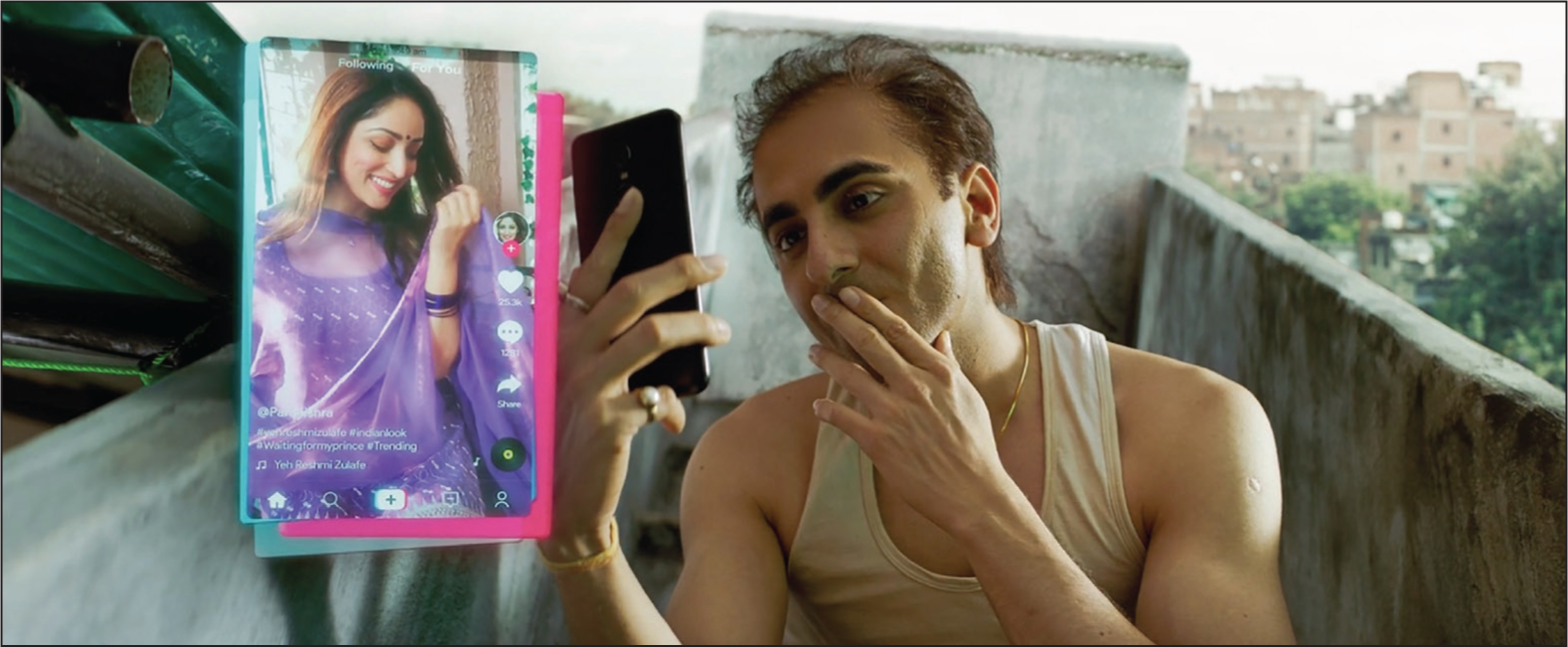
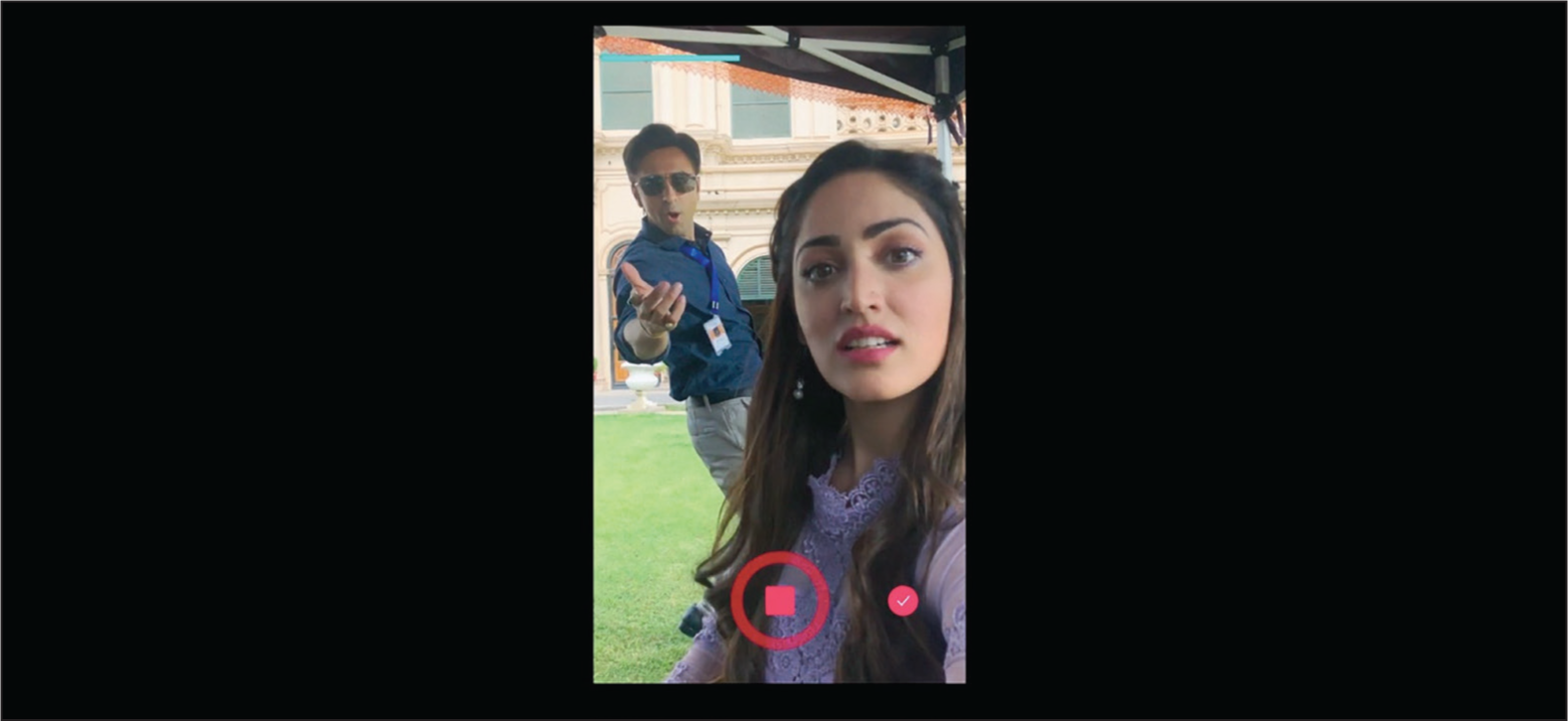
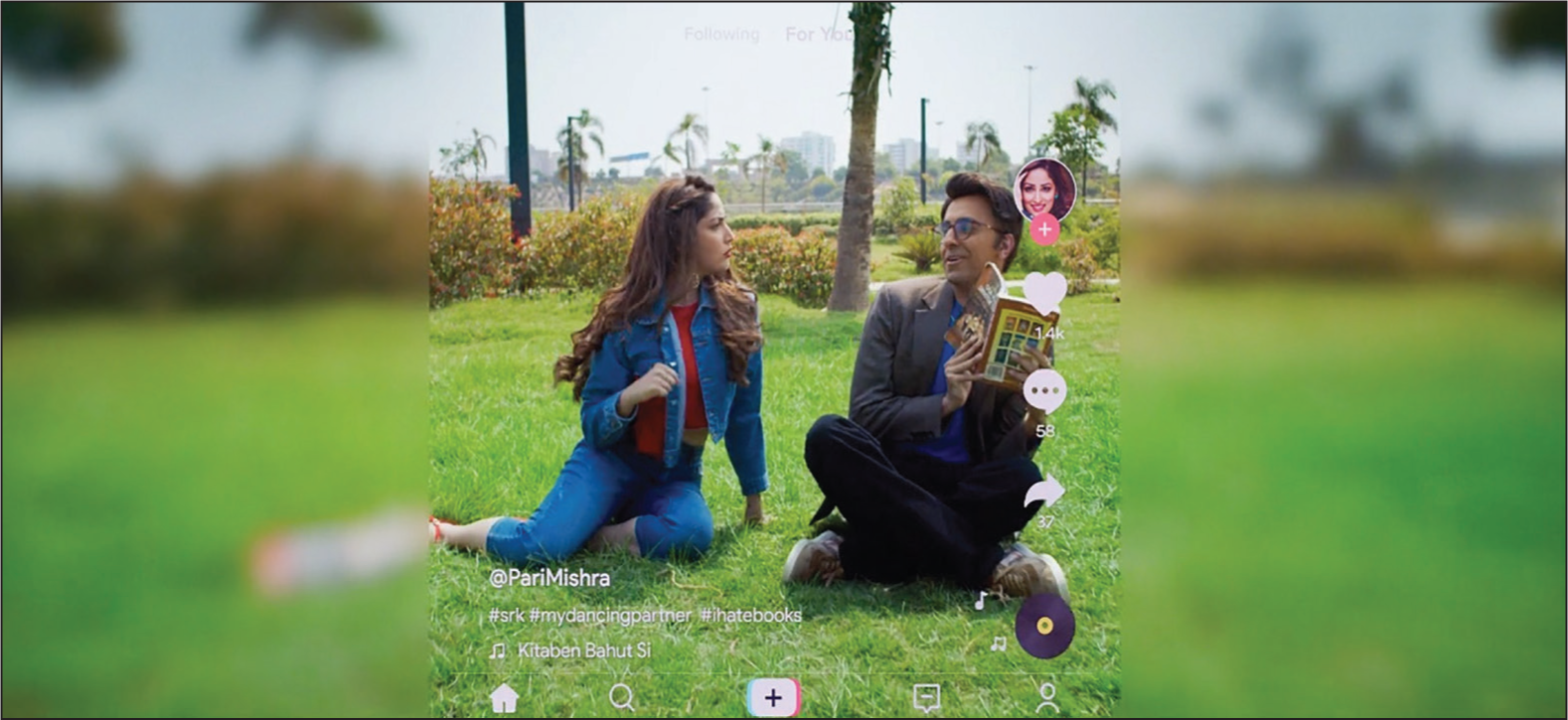
The narrative takes a detour as Bala, unable to find a willing bride, concedes to adopting a wig as a permanent solution. Meanwhile, Latika’s aunt has been surreptitiously using filters to make her seem lighter-skinned on fake Instagram profiles that she curates to lure in prospective grooms. Technology becomes the stage for amorous encounters, where digital avatars bear little to no resemblance to the characters on screen. Though Latika is initially unaware of her aunt’s schemes, Bala’s deceptions are very self-conscious. He meets Pari at a campaign shoot for his company, where the local TikTok star doubles as their brand ambassador. The voice of his lost tresses returns here to remind the viewer that ‘The “real” is rarely a part of life’s “reality”. This is the opportunity to realise your TikTok aspirations in real life’. 6 Bala thus walks up to Pari, who is shooting a TikTok video, and joins her in the duet ‘Tera naam liya’ from the superhit 1989 film, Ram Lakhan. This is their first encounter in person, playing out over a lip-synced TikTok video, a space where they earlier shared a split screen in his reaction video (Figure 2). He references that prior video to remind her who he is, and their romance plays out on the streams of the app. In a long-drawn montage of their courtship, TikTok takes over the frame as the couple recreates cinematic song and dance sequences that reference older Hindi movies, finally culminating with his proposal framed in a classic TikTok template, where the difference in the aspect ratio of a video shot in portrait mode and then rendered to landscape is covered up by blurring the boundaries of the frame -– bringing all attention to the action in the centre (Figure 3). Such compositions are typical of TikTok videos that get circulated across other online platforms (like YouTube and Facebook). In a final sequence marking the culmination of the three-way romance between Bala, Pari and TikTok, on their wedding night, Pari tells Bala, ‘aao na suhag raat ka TikTok banatein hei’ (come let’s make a TikTok of our wedding night), and as they kiss in a selfie, the frame dissolves into a dream sequence.
As the plot unfolds, Bala and Latika’s storylines intersect, and Pari learns the bald truth. This is when the TikTok screen starts fading from the frame, though we continue to witness Bala perform for the platform, making sad compilations to win Pari back. The split screen makes a final, brief appearance in a parallel sequence where, as Latika laughs at Bala, Pari looks at the same video as she signs the divorce papers.
Following classic 1990s Bollywood tropes, in the third act leading up to the climax, an amicably divorced Bala realises that Latika was always the girl for him. As he rushes to confess his feelings, and the audience anticipates her reciprocal response, she says, ‘DDLJ chal rahi hai kya yahaan pe? Matlab filmi climax ka koi chance toh nahi hai / trans. There is no way you’ll get a melodramatic/filmi resolution’ -– and turns him down. This reference to an iconic film in the classic turn towards the Bollywoodisation of Hindi cinema is a conscious indicator to audiences that they are now watching a different kind of cinema. Replete with cinephilic references through characters, costumes and dialogues, Bala self-consciously refers to an early Bollywood moment to indicate a shift in narrative strategy and thus signposts a new kind of cinema – one that acknowledges the popular love for cinema and, like its fans, is heavily steeped in new technological infrastructures that permeate the most intimate encounters of everyday life. Both Bala and Latika, who would have been the star-crossed lovers of classic Bollywood finally brought together in a melodramatic climax, now perform their separate love stories through apps. While Latika chats with her amour on WhatsApp, Bala grapples with TikTok’s broadcasts.
In the final scene of the film, a confident and bald Bala performing a stand-up routine declares, ‘Doston, aaj hum yahaan Shah Rukh Khan, Salman Khan, Amitabh Bachchan nahi banne aye hain / trans. Friends, we have not gathered here to become Shah Rukh Khan, Salman Khan, or Amitabh Bacchan’, and invoking the classic Shah Rukh pose with his arms held wide apart, Bala adds, ‘Come fall in love with yourself’. This is the message of the TikTok world, where old styles echo and persist through new voices.
The Cinematic Is the Political: Sonali Phogat, BJP’s TikTok Ticket
In the weeks leading up to the Haryana State Assembly elections in 2019, domestic news was abuzz with the possibility of a young new ‘star’, Sonali Phogat, winning the Adampur Assembly seat against the three-time MLA, Kuldeep Bishnoi. Bishnoi’s claim to political success lay in the promise of succeeding his father, former Chief Minister Bhajan Lal, fortified by their family’s stronghold over Adampur. Under Bishnoi’s leadership, the district was one of the 15 constituencies that voted for the Indian National Congress (INC) in the 2014 elections, in which the BJP won by a long shot.
In the 2019 assembly elections, the BJP aimed to win at least 75 of the 90 seats (compared to the 47 they won in 2014), and celebrities were their calling cards this time around. Their first list of 78 candidates was released on 29 September and included Olympic gold-winning wrestler Yogeshwar Dutt, former hockey captain Sandeep Singh and a wrestler with a biopic to her name – Babita Phogat (Dangal, 2016). Sonali Phogat was part of the second list of candidates released on 3 October, three weeks prior to polling. In Phogat’s political debut, she was being pitted against Kuldeep Bishnoi, who, along with Randeep Singh Surjewala, Kiran Choudhary and Ranbir Mahendra, are considered the bigwigs of the INC. 7 Her potential victory was positioned as a rupture in the culture of political inheritance that has plagued national politics and has often been used as a primary accusation against the current opposition leader in national elections as well. Phogat’s success relied primarily on her ‘star’ status. As some reports noted, her candidature added ‘glamour’ to the Adampur assembly elections (Sehgal, 2019b).
Phogat, a former television news anchor for DD Haryana, received widespread fame in the Zee TV serial Amma (when she was cast in 2016), but is most famous for her stardom off the small screen on the streams of TikTok, where, at its peak, she had over 221,000 followers. In the period leading up to her nomination in October 2019, she had over 120,000 followers (IANS, 2019) and had become a regular feature in the news, largely thanks to her TikTok star status. The BJP’s faith in Phogat’s stardom, given her ability to become instantly ‘viral’, is manifest in their choice to issue the Ghaziabad resident a ticket to fight a heavyweight like Bishnoi on his home turf. Though news media declared her candidature a testament to her TikTok stardom, Phogat insisted that her candidature was a result of her long-standing association with the party. 8 However, the most notable (and the only one to receive any media coverage) amongst her campaign promises was to use TikTok to promote patriotism among her followers. In an interview conducted on the day her nomination was announced, Phogat said, ‘Once I get the seat I will use the app [TikTok] to spread awareness about the work I do as an MLA, upload videos on girls’ safety and also on patriotism to instil desh bhakti [love for the country] in the young generation’. In the same interview, she went on to declare her support for (the widely critiqued) National Register of Citizens (NRC), 9 claiming ‘infiltrators should go’, and further declared that she had ‘no knowledge’ about the families of slain mob lynching victims in Haryana (Agha, 2019). While her stand on these issues was in keeping with the official BJP party line, Phogat’s campaign strategy differed from the party’s set precedent. Apart from addressing rallies and going door to door, she frequently uploaded content on her TikTok profile.
A collection of 16 campaign videos echoes the kind of content Phogat uploaded before the nomination when she used the channel to showcase her work as an artist and performer. However, now the theme of the videos pivoted to her ‘patriotic’ campaign agenda. For instance, in the first video uploaded on the day her selection was announced, we are presented a composed and somewhat pleased Phogat in a handheld, self-framed frontal shot, lip-syncing to Alisha Chinai’s 1995 pop hit single ‘Made in India’. In the original video, Chinai is seated on a gilded throne with a leopard by her side as she vocalises her heart’s ultimate desire for an authentic Indian lover. Phogat is instead sitting inside a car with a male co-traveller seated behind her, who impassively looks into the camera over her shoulders as she lip-syncs to this section of Chinai’s verse:
Dil jiska Hindustani, nahi koi Englishtani, raat aur din mujhe pyaar koi karne waala. Made in India. Trans. One with an Indian heart, not a foreigner, one who will love me night and day. Made in India.
In this short, excerpt severed from the rest of the song, Phogat presents herself as an answer to Chinai’s crooning. Though you do not actually hear the whole word ‘India’ in the short clip, and Phogat cuts her syncing short of the last line, the audio sample from the iconic song is unmistakable in its message. It serves a double purpose – one of nostalgic recollection and another of political fealty – a catchy reminder of the BJP’s ‘Make in India’ 2014 initiative, which promised to usher in rapid development across industries in India by focusing on increased domestic production.
10
Phogat is a product of this dual play; she is the home-grown Indian star who appropriates the OTT platform to further her own ambition and broadcasts her election campaign onto the app’s interface. The intimacy of door-to-door political campaigning is further heightened by her performance on the app. In a second video, potential voters can see her riding a motorbike accompanied by her compatriots while a Punjabi song (‘Kardiyan Follow Gaddiyan’ by Nawab, 2018) plays in the background, reminding them that she is the one they follow (‘all the cars follow me, so you drive behind me, making me smile’). In another video, Phogat directly addresses her viewers, asking them to join her in a broadcast of her campaign. This video is uploaded right after another lip sync video, where she teasingly pans her camera to include an interviewer and press videographer in the frame, as the soundtrack plays Asha Bhosle:
Dekhne me bhola hai dil ka salona, Bambai se aya hai babu chinnanna. Trans. He looks innocent and kind, he’s my brother from Bombay.
Playful on the surface, Bhosle’s song and its implication are a knowing nod, an auteurial wink from Phogat to her viewers, who are in on the joke – old media, in this case television news, seems even more dated set against a film song from 1960 and a monochromatic frame. Further, in the film Bambai Ka Babu (1960), Suchitra Sen sings this song for Dev Anand under the false impression that he is her long-lost brother, while in reality, he is a stranger who has just escaped Bombay after committing a murder. Though the film’s viewer is privy to this information, Sen is blissfully unaware until much later in the story. However, in Phogat’s TikTok video, the tables are turned, and Phogat is already suspicious of the news media, sharing her reservations with her confidantes through a coded audiovisual clip. Her viewers for their part respond encouragingly, with one asking, ‘who can relate?’.
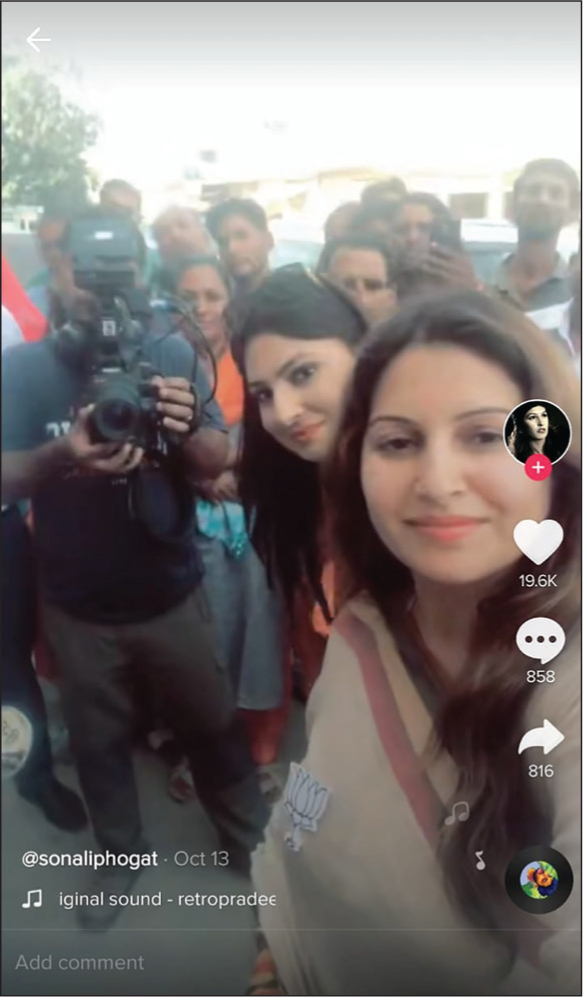
Phogat’s reservations regarding the press are unsurprising in context of the events leading up to this clip. Five days before she uploaded this video, Phogat addressed an unresponsive crowd at a political rally by shouting, ‘Pakistan se aaye ho kya? Pakistani ho kya? Agar Hindustan se aaye ho to “Bharat Mata ki Jai” bolo./trans. Have you come from Pakistan? Are you a Pakistanis? If you have come from India then say “Long Live Mother India”’. She went on to claim that their votes were of no value if they could not join her in sloganeering (News18.com, 2019). The video from this event was widely circulated, and Phogat was criticised for her jingoistic outburst (Sehgal, 2019a). With the public visibly perturbed, she released a video the next day clarifying that she simply wanted the crowd, as citizens of the country, to showcase their patriotic duty. News channels juxtaposed this clarification video against her TikTok videos and further ridiculed her outburst (Aajtak.in, 2019). News audiences were now privy to the two sides of Phogat’s political persona – the solemn talking head and her playful, seemingly flippant digital avatar – all the while missing the play and intimacy of her more potent ‘influencer’ persona. Taken out of context, the satirising news reports juxtaposed her clarification on a split screen with clips of Phogat dancing in her living room or lying in bed, in cue with rally footage, reducing her TikTok self into an easily dismissed figure. This treatment, however, far from dampening her spirit, prompted her to dance and regain control of her narrative in her TikTok universe. The ‘Dekhne mein bhola hai’ video is part of a three-part series of clips she uploaded on 13 October; the final clip featuring a defiant pan, with Mohammad Rafi singing ‘Saare shehar mein aap sa, koi nahin, koi nahi / trans. There is no one like you in this whole town, no one, no one’ as a smiling Phogat films a crowd of pleased onlookers while two cameramen frame her, framing herself (Figure 4).
Quickie Intimacies: TikTok and the Small Town
Sonali Phogat’s political interlude on TikTok culminated three days prior to the Adampur voting, when a determined Phogat draped in saffron (the official colour of BJP and the party’s Hindutva agenda) 11 strode across her living room with the patriotic song ‘Ek mein, aur ek emaan hai, dono tujphe / trans. There is only one of me, one faith, both for you’ playing in the soundtrack. Taken from the controversial Sanjay Leela Bansali film Padmaavat (2018), this song’s inclusion in Phogat’s electoral escapade is a nod to the casteist and Islamophobic outcry that threatened the release of the film. 12 The audio excerpt, taken from a live session, includes a cheering crowd, signifying a community of virtual fans cheering her on as the polling draws closer.
The aural cheers of Phogat’s simulated virtual audience usher us back to Mazumdar’s earlier observation, which earmarked the presence of fans on screen as central to the liveness of a televised event. Unlike the film star, whose live public event is attested to by the presence of a mass of spectators in the frame, Phogat’s cheering audience is a simulated stand-in for her imagined community of followers. Though the collective force of their action might have been optimistically overstated in her final video, given her eventual loss in the elections, her performance at the polls was quite significant granted her late entry into the race. Phogat polled second to the now three-time reigning MLA, Kuldeep Bishnoi, with a total of 34,222 votes that accounted for 27.78% of the total. This was a marked improvement from her predecessor, Karan Singh Ranolia, the BJP candidate from Adampur for 2014, who could only acquire 8,319 votes in total. While attributing this 411% jump in polling might be an ill-guided leap of faith if solely attributed to her presence on TikTok, her star status on the platform was a determining factor in her candidature and thus merits further inquiry.
The significance of short videos on apps like TikTok needs to be better understood. In a recent article, Ravi Sundaram notes how the short video ‘expressed through the app economy … is a political and cultural narcotic in contemporary platform capitalism. It fuels the rhythms of everyday life and produces temporal markers of day and night’ (2022). In the case of TikTok in India, the author wants to carry Sundaram’s proposition further and add that, along with producing a temporal orientation, these 15-second videos also locate the viewer and creator of content in a specific cultural context – that of the nostalgic cinephile. Further, the author finds that this shared cultural nostalgia is then harnessed to build and maintain a star persona, which plays out in distinct ways in the two cases discussed here. Audio tracks of popular songs (both filmic and otherwise) are key to this negotiation.
Popular music in India has always existed at the cross section of global currents and local traditions. Hindi film music in particular has been the veritable ‘white elephant’ enjoying a mammoth share of both production and reception from the days of early radio to the age of digital streaming (Shope, 2013). It has enjoyed circuits of distribution and circulation that far exceed the reach of films and constitute a significant chunk of the afterlife of the cinematic, becoming a potent vehicle for both stardom and fandom. Neepa Majumdar signals the amplified sense of pleasure historically offered by the song sequence in Hindi cinema, where a dual stardom – of a famous actor lip-syncing to the voice of a well-known playback singer – is acknowledged and attested to by communities of fans dedicated to actors and singers alike (Majumdar, 2001). In recent years, fans of music composers have also played a decisive role in building and perpetuating their star image across transnational circuits (Punathambekar, 2007), while composers themselves have staked Indian film music’s claim to a distinctly globalised aesthetic (Sarrazin, 2013). With the rise of participatory cultures, fandom revolving around Hindi film song has proliferated quite conspicuously. Such fandom often manifests in a potent display of nostalgia, where online fan communities actively reminisce about their first encounters with Hindi film music (Ghosh, 2020). Fan texts now take the form of memes, GIFs and, most importantly, audio snippets uploaded on OTT platforms like Dubsmash, Instagram, TikTok and YouTube, which in turn become the topic of ‘trending’ listicles on websites like BuzzFeed and SchoopWhoop. These artefacts make visible a new mode of cinephilia where individual and collective remediations of cinematic texts create a repository of diffused encounters with the cinematic. It has been argued that the collective memory of cinema, instead of a love for particular films themselves, now accounts for cinephilia in the contemporary (Chakravarty, 2019). Furthermore, memory itself is increasingly being commodified as nostalgia in the ongoing neoliberal project of resurrecting a nationalist sentiment poised on the ‘ritual of commemoration’, where cinema is emerging as a ‘collective heritage’ (Majumdar, 2015). The film industry, for its part, is actively commemorating cine-nostalgia in two ways: first, by using audio cues from popular songs during live events, and second, through its own post-cinematic dalliances (using songs, music, sound effects, dialogues and even crafting characters after popular yesteryear stars) where it pays homage to the past – both draw their affective force from the audience’s collective recognition of specific cues.
This sense of community drawn from a shared love for a cine-past also fuels encounters on short video apps like TikTok, where a peculiar play of the everyday and the cinematic emerges when selfie videos are lip-synced to iconic songs. A third register of pleasure is added to the dual stardom traditionally offered by the soundtrack; the song now carries with it the memory markers of both the singer and the actor who originally embodied the song sequence on the cinematic screen, now replaced by the TikTok star lip-syncing to remediated short excerpts of songs on the screens of mobile phones. As Phogat saunters down her living room or Bala dances atop his rooftop, we are being lent a brief encounter with the intimate everyday surroundings of these characters through their TikTok videos. Add to this the shared cultural memory of the song and a curious mix of the familiar and the never-seen-before emerge, which marks these short videos as a novel attraction of the contemporary. The author using the term ‘attraction’ here to gesture towards early cinema’s formal characteristics, which harnessed the power of vision by consciously integrating ‘spectacles’ (Gunning, 1986). Its aim was to maximise its impact upon spectators by displaying unique marvels of modernity. With the turn to post-cinema, there has been a revival of many of early cinema’s tendencies, including its desire to capture spectacles. The spectacular in cinema now arises from a desire to interact with rather than attract viewers (Grusin, 2016). It is this desire for interaction that links TikTok and Bala. Armed with popular songs, the everyday becomes a potent forcefield where nostalgia and cinephilia come out to play, and intimate private spaces become public sites of exhibition. This is perhaps why, when the audio accompaniments of Phogat’s TikTok videos are silenced in lieu of the voice of news commentators, her star persona evades translation, leading to her misrecognition as an easily dismissible figure. Without the soundtrack and its cine-nostalgia for a shared past of the popular, Phogat’s videos lose their star sheen and are stripped of her implicit wit. In other words, they become ordinary. On the other hand, it is the celebration of this ‘ordinariness’ in the unromanticised reflection of the small town TikTok star that Bala succeeds.
Bala needs to be read within the lead actor Ayushmann Khurrana’s oeuvre, which includes films like Bareilly Ki Barfi (2017), Shubh Mangal Saavdhan (2017), Badhaai Ho (2018) and Dream Girl (2019). The conflict in the narrative of each film is a product of his character’s own making. He plays a lovelorn writer caught in a web of his own deceit, a stressed groom with erectile dysfunction, an adult who is embarrassed about his mother’s pregnancy and a vagrant conman who secretly moonlights as a crossdressing bar girl. Narrative resolution is only achieved when his elaborate scheme falls apart: After he is married and the wedding night has passed, taking with it the pressure of conjugal confirmation, he realises how terribly he has treated his parents, or when he is compelled to finally come out or risk losing his lover, who is set to marry another. Each film culminates with a happy ending, and the hero’s journey is not one of self-discovery or an allegory, even for the social and moral universe within which he is embroiled, but one of self-acceptance. His struggles are steeped in the everyday, where he must constantly keep up appearances, in one form or another. This is a new turn in the melodramatic, where conflict does not necessarily occur within the nexus of a family but instead within the mind of the protagonist of the film. We witness this struggle with Bala, and in the final scene of the film, Khurrana’s auteurial message from before booms louder. This is a message that also implicates his audience, as he reminds us that we are not here to become Shah Rukh Khan, Salman Khan or Amitabh Bachchan, but instead, ‘Come fall in love, with yourself’. In contrasting himself against the most iconic male superstars of the industry, he positions his star persona as not necessarily less than, but as ordinary. Khurrana does this so effortlessly that, as a star, he has become a go-to intertextual reference for being ordinary. For instance, in Thank You for Coming (2023), which is currently streaming on Netflix, a jilted Jeevan turns to his fiancé after she has broken their engagement and says,
Kya kami hai mujhme?… Haan Hrithik nahi lagta hu par Ayushmann waale toh looks bhi hai mere. Mil jaegi mujhe koi. Trans. In what way am I not enough? Sure, I don’t look like Hrithik but I could pass for Ayushmann. I’ll find someone else.
Jeevan has been positioned as a nice, albeit boring, average guy. This reference comes as no surprise, as Ayushmann Khurrana has stated in multiple interviews that his agenda is ‘to focus on the common imperfect man who is a hero in life’ (PTI, 2019).
Khurrana’s is not an image of exceptionalism, but of the everyday. Unlike the small town that Akshaya Kumar discusses, which either lies outside the fold of the metropolis or is suspended as a caricature or simulacrum, the small town in Khurrana’s films serves as the natural habitat of the ordinary, imperfect common man, where the sole focus of their narratives lies in the aspiration of its characters, and small individual triumphs bring narrative resolution. Even when based in larger cities, Khurrana’s films create a sense of ‘small town’ charm by placing the lives of their characters within specific old neighbourhoods, which are divorced from the hustle and bustle of the larger city. The small town then becomes a site where the aspirations of its unexceptional inhabitants have the potential to play out. The author must point out again that she is using the term ‘small town’ here to refer to the character of the space, and not as a description of its actual size or population. Like we see with Bala, whose only claim to fame was his full head of hair, Kanpur, despite being Uttar Pradesh’s largest city, is constructed as a ‘small town’ with its undemanding pace of life, giving Bala the space to mourn his loss and come into himself. The way the film positions Kanpur as a small town thus allows it to become the natural habitat of the TikTok star, who through his love for cinema learns to express his love for himself. Khurana’s self-projected ordinariness allows him to comfortably mobilise cine-gestures that no longer belong to a specific star text but are part of ephemeral cine-texts that belong to the viewer–producers of filmi content in the contemporary.
Ephemerality marks the lives of real-life TikTok stars like Phogat, who made her final public appearance not through the bright light of her TikTok stream but instead through the grainy images of CCTV videos on 23 August 2022. Footage from inside a popular beach shack in Goa serves as witness to Phogat’s last known whereabouts before her untimely death in the wee hours of the morning. The 5-second clips, one in monochrome and one in colour, are often juxtaposed in news footage or on YouTube uploads and bear witness to an incapacitated Phogat being forced to drink by a male companion, who then steers her out of the establishment. These short videos are looped to the beat of a dramatic synthesiser (a formulaic auditory cue before the final reveal in a thriller film) and index the predetermined demise of a star. Once beloved by a legion of fans, the TikTok star has now receded to the corners of public memory along with the platform of her fame. Like TikTok videos that still persist despite their ban, perhaps we have not yet encountered the final resurgence of Phogat, who might be resurrected in her media afterlife, 15 seconds at a time.
Footnotes
Acknowledgements
The author extends her sincere gratitude to Dr Debashree Mukherjee for her meticulous attention to this article, and to the anonymous peer reviewer for their encouraging feedback. The author acknowledges with appreciation the guidance provided by Professor Ravi Vasudevan and Professor Ravi Sundaram in the early stages. An initial draft of this article was presented at a conference organised by the Department of Cinema Studies at the School of Arts and Aesthetics, Jawaharlal Nehru University. The author is grateful for the feedback received from the faculty and cohort. Special thanks to Dr Vebhuti Duggal for her unwavering support throughout this process and to Sarah Khan for her technical assistance.
Declaration of Conflicting Interests
The author declared no potential conflicts of interest with respect to the research, authorship and/or publication of this article.
Funding
The author received no financial support for the research, authorship and/or publication of this article.