




Abstract
Despite its aesthetic experimentation, its intervention into urgent questions about citizenship and belonging in contemporary India, and its attention to the most iconic of Indian cities, Mumbai, Madhusree Dutta’s 2006 documentary film 7 Islands and a Metro—and Dutta’s work more broadly—has yet to receive the critical attention it demands. Addressing this gap, this article examines Dutta’s use of spectrality to structure her search for a documentary form that makes room for Mumbai’s marginalised subjects to narrate themselves into its representational histories and contemporary spaces. Key to Dutta’s approach is a visual dialogue between the city’s historical ghosts and its spectral citizens—those who exist in a state of dispossession and social invisibility in the present, such as women, migrant workers, casteised and Muslim subjects, and the urban poor. Through this spectral framework—a dialogue between the living and the dead, which is also an intertextual dialogue between the past and the present, the fictional and the actual—Dutta’s film probes the complexities of representation and self-representation, agency and access to story-making processes and platforms. Dutta’s formal play foregrounds the multiple ways in which the city and citizenship are mediated, represented and claimed, and the multiple ways in which spectral subjects are produced and displaced. Her aesthetic experimentation—particularly her use of spectrality and performative modes of representation—enables reflections on the ways in which spectral subjects seek to render themselves visible in the city and claim themselves as active agents and participants in the making of Mumbai.
Keywords
Introduction
A third of the way through Madhusree Dutta’s (2006) experimental documentary film 7 Islands and a Metro, retired stunt actor Reshma recalls her work on iconic and still hugely popular films of the 1970s and 1980s, such as Sholay (1975). Reshma explains how, as a stunt double, she was paid ‘1000 [rupees] to show [her] face, 2000 to hide it!’ That is, Reshma was paid substantially more for scenes in which her body stood in for another actor while her face remained invisible, either turned away from the camera or kept out of shot, less for scenes where she could be identified as Reshma. Well-known in her neighbourhood as ‘the tanga rider’ from Sholay, Reshma is proud of her work but nevertheless frustrated by its continued invisibility to the cinematic audience. ‘You’ve seen my earlier photos’, she tells her interviewer as she flicks through an album, before asking: ‘Did I lack anything? Did I have to remain a stunt woman?’ Yet, even as she articulates dissatisfaction at her erasure from Mumbai’s cinematic history, Reshma acknowledges the monetary value of her celluloid invisibility. ‘When people rave about the shots done by Hema Malini or whoever’, she protests, ‘I want to go up to them and say it’s me who’s done that shot. But if I were [to do that], they’d think I’ve gone crazy, so I console myself, thinking that at least I got my money’.
In Reshma’s account, we see a subject negotiating what we might understand as her own spectrality—her ambivalent position of simultaneous visibility and invisibility, of bodily presence and absence both on screen and off. As she does so, Reshma works through the paradoxical ways in which invisibility is both a frustrating form of erasure and a necessary mode of economic survival, all the while using her interview for a documentary to assert her significance within the city’s representational histories and demand its recognition. ‘Couldn’t I have been a heroine?’ she asks, as sequences from Sholay invite us to acknowledge her work. In her demand that her contributions to Indian cinematic history—her labour and its social and economic value—be recognised and remembered, Reshma introduces the central concerns of this article as it examines the representation of urban inequality in contemporary Mumbai: how might marginalised subjects—those I term spectral citizens—be involved in the process of their own representation, as participants and collaborators? What kinds of formal innovations might be made to open up space for such subjects to claim for themselves their right to the city, and to assert their materiality within it? And how might their involvement transform our understandings of the dispossessions at work in the postcolonial, neoliberal city?
This article explores these questions through a close study of 7 Islands and a Metro, a film that—as Reshma’s story suggests—places the bodies, words and voices of marginalised subjects at the centre of its self-reflexive processes of representation. One of India’s leading feminist filmmakers, Dutta is a writer, director, curator and cultural activist, and was recently the Artistic Director of the Academy of the Arts of the World in Cologne, Germany (from 2018 to 2021). In 1991, with the women’s rights lawyer Flavia Agnes, Dutta co-founded Majlis, an interdisciplinary centre focussed on cultural production, legal support and campaigning for women’s rights. Alongside her earlier films, such as I Live in Behrampada (1993) and Memories of Fear (1995), and her curatorial work on the wide-ranging Project Cinema City (see Dutta et al., 2013), 7 Islands forms a key part of Dutta’s activism in relation to rights and experiences of urban dwelling. The film is a direct response to the impacts of liberalisation and communalisation of Bombay/Mumbai in the late 1990s and early 2000s, including its name change in 1995, examining the contested terrains of public and private space particularly in the post-Ayodhya context. The film centres on the experiences of those exploited, targeted or marginalised by corporate and communal ideologies, or erased from Mumbai’s representational histories, particularly migrant labourers, slum-dwellers, Muslims and women. Examining the long history of such experiences, 7 Islands probes how such subjects resist or refuse their marginalisation, as well as how they might themselves be complicit in the marginalisation of others.
Despite its attention to the most iconic of Indian cities, its intervention into urgent questions about citizenship and belonging in contemporary India, and its fascinating aesthetic experimentation, 7 Islands—and indeed Dutta’s work more broadly—has yet to receive the critical attention it demands (brief studies by Wolf, 2013; Jayasankar & Monteiro, 2015; and Kishore, 2018; and an extended interview by Sarkar & Wolf, 2012, are important exceptions). Addressing this gap, in this article I demonstrate that 7 Islands is significant for Dutta’s search for a documentary form that will make room for Mumbai’s marginalised subjects to narrate themselves into its representational histories, contemporary spaces and fiction-making processes. I argue that the key to Dutta’s approach is the establishment of a visual dialogue between the city’s historical ghosts and those I term its spectral citizens. In 7 Islands, the ghosts of the iconic Bombay writers Ismat Chughtai and Saadat Hasan Manto remind us of the city’s rich cultural heritage as they walk its contemporary streets. Their ghostly itineraries are juxtaposed with the lives of construction workers, migrant labourers, bar dancers, sex workers and mill labourers, subjects who—in different ways and to different degrees—experience social invisibility and marginalisation in the present. Through this dialogue between the living and the dead, which is also an intertextual dialogue between the past and the present, the fictional and the actual, Dutta’s film probes the complexities of representation and self-representation, agency and access to story-making processes and platforms.
I use the term ‘spectral citizen’ to indicate a subject who exists in a state of dispossession and social invisibility in the present, whose experiences are unrecognised, or whose legal status or right to the city is under question or undermined by state discourse or majoritarian thinking. In doing so, I draw on Arjun Appadurai’s description of Mumbai as ‘one of the world’s most dramatic scenes of urban inequality and spectral citizenship’ in his analysis of the relationship between the city’s social and spatial crises in the 1980s and 1990s (2000, p. 649). Invoking the spectre as a sign of the absent presence of exploited bodies in speculative networks of global capital, Appadurai deploys the concept of ‘spectral citizenship’ to denote those subjects marginalised, excluded or rendered invisible by the reimagining of Bombay/Mumbai as a Hinduised, world-class city—the destitute, slum-dwellers, casteised, non-Hindu bodies. In Appadurai’s work, spectrality offers a language through which to mediate ‘between the steady dematerialization of Bombay’s economies and the relentless hypermaterialization of its citizens’ through the violence of poverty, embodied labour and communal conflict (p. 635). Appadurai explicitly acknowledges his debt to Jacques Derrida in elucidating Mumbai’s spectral economies. In Specters of Marx, Derrida (1994) theorises the spectre in relation to urgent questions of social and economic justice, locating it in relation to international networks of political and social responsibility, and within global circulations of capital, property, debt and repayment. Derrida describes the spectre as a ‘paradoxical incorporation’ (1994, p. 5) that disrupts distinctions between presence and absence, the past and the future, the here and the there, the living and the dead. Oscillating between concrete presence and material absence, the Derridean spectre appears as a prosthetic body that designates a subject exploited or excluded by the structures and flows of global capital (p. 7).
Drawing on Derrida’s work, postcolonial scholars have recognised the figurative possibilities of the spectre as a sign of the recurrence of the past in the present, and as both a ‘missing person’ and marginalised ‘social figure’ (Gordon, 1998, p. 8). As Bishnupriya Ghosh suggests, the spectre ‘bear[s] witness to erasures in the “living present”’ (2004, p. 207) and returns us to ‘ethical questions of historical, cultural and economic violence’ (p. 217). Much critical attention in postcolonial studies to what Esther Peeren terms the ‘spectral metaphor’ has focussed on literary fiction and feature films (see, for example, Barclay, 2011; Craps, 2013; Ghosh, 2004; Joseph-Vilain & Misrahi-Barak, 2009; Peeren, 2014; Sugars & Turcotte, 2009; White, 2020). Attuned to the potential limits of Derrida’s focus on the relationship between the past and the future, Peeren analyses contemporary figures who are imagined as ‘living ghosts’ in the present by virtue of their specific positions of social marginalisation, namely the undocumented migrant, the servant or domestic worker, the medium and missing person (2013, p. 5). As I argue elsewhere, literary and cinematic representations of Bombay/Mumbai have themselves frequently drawn attention to such ‘living ghosts’ or spectral citizens, figuring the city as haunted by spectral subjectivities, from the ‘invisible workforce’ of ‘wraiths’ who build its skyscrapers in Salman Rushdie’s Moor’s Last Sigh (1995, p. 212; see Herbert, 2012), to the ghost of a sex worker who haunts the streets in Reema Kagti’s Talaash (2012). Such texts offer narratives of visibility and invisibility to examine critically the inequalities of urban citizenship in the context of global capitalism and Hindu nationalism (Herbert, 2012). Hindi cinema and ‘Bollywood’ film has likewise been drawn to spectral frameworks (Herbert, 2010). As Meheli Sen (2017) demonstrates in her study of supernatural and Gothic films, Hindi cinema has since the 1940s repeatedly turned to ghosts, spectrality and experiences of haunting to dramatise the complexities of gender, citizenship and modernity in the Indian context.
Departing from the tendency to focus on literary fiction and feature film in this scholarship, I argue that ghosts present specific formal and political possibilities for Dutta as a practitioner of documentary film. Spectrality, I suggest, appeals to Dutta because of its ‘deconstructive force’ (Peeren, 2014, p. 11), its ability to disrupt distinctions between the past and the present, the material and immaterial, the actual and invented, the here and there. As a formal device, and particularly given the intertextual elements of 7 Islands, spectrality enables Dutta to emphasise connections between the city’s past and its present, while also accentuating its status as a ‘real’ and ‘imagined’, ‘representational space’ (Lefebvre, 1991, pp. 38–39) that is both lived and narrated. Spectrality might also interest Dutta because of its association—via Derrida—with challenging nostalgia for ‘primary realities, original simplicities, full presences and self-sufficient phenomena cleansed of the extraneous or residual’ (Jameson, 1999, p. 45). In Fredric Jameson’s reading, the spectral challenges forms of authority that seek to fetishise and protect the ‘unmixed in all its forms’ (p. 45). Dutta’s film, I contend, brings together historical ghosts and spectral subjects to challenge Hindu nationalist discourses and nativist reimaginings of Bombay and what Leela Fernandes (2004) terms ‘the spatialized purification of ‘Indian culture’’ (p. 195); that is, discursive and spatial practices that seek to cleanse space and citizenship of the city’s caste, class, religious and gendered others, those deemed contaminative to its global future. In her experimental approach, Dutta seeks to formulate a documentary aesthetic that challenges the exclusions and inequalities of the world-class city at large and testifies to its messy multiplicity. Furthermore, by opening up space for marginalised subjects to negotiate, critique and refuse their spectral dispossession—their marginalisation within Mumbai’s economies, and their social invisibility within the city and its representational histories—Dutta pushes our understandings of spectrality in new directions, explicitly positioning form—and the formal possibilities of spectrality—at the centre of this critique.
Documentary Form and Citizenship Formation
Documentary film in India, and the question of its form and function, has long been associated with matters of citizenship formation. After independence, the government’s Films Division (FD) produced documentaries with propagandist and pedagogical functions aimed at building national consensus, and introducing ideas of democracy, citizenship and civic duty to the public (see Kishore, 2013, pp. 121–122; Roy, 2002). Following approaches established in the colonial era—the FD itself was a reworking of the imperial Information Films of India—FD films were influenced by John Grierson’s vision of documentary as a medium of public service, education and social uplift (Kishore, 2013, p. 121; Rajagopal & Vohra, 2012, p. 9; Roy, 2002, p. 236). On a formal level, FD films followed a Griersonian approach, with a ‘detached, observational aesthetic’ (Kishore, 2013, p. 122) that was ‘strongly grounded in realism’ and ‘avoid[ed] the habits of fiction’ which were perceived to diminish documentary’s pedagogical function (Rajagopal & Vohra, 2012, p. 9). FD films dominated the first three decades after independence, but from the mid-1970s, independent filmmakers began to reshape documentaries as a mode of activism and a medium through which to interrogate the nation-state, inequality and injustice (Kishore, 2013, p. 123). Yet many of these important political documentaries, such as those by the pioneering and influential filmmaker Anand Patwardhan, were focussed on political content rather than formal innovation (Vohra, 2011, pp. 48−49).
Dutta is one of a number of feminist filmmakers who have challenged this documentary film tradition. Paromita Vohra (2011), an innovative filmmaker whose work is referenced in 7 Islands, claims that the post-liberalisation period saw the significant transformation of documentary film practice, and by the 2000s there was wider recognition of ‘documentary as creative endeavour’ (2011, p. 50). Vohra connects this shift to the fragmentation of organised leftist politics, as well as a dispersal of audiences who would identify with a particular political position, which opened up space for diverse practices and increased experimentation (p. 49). Documentary filmmakers since 2000—including Dutta, Vohra and Anjali Monteiro—have disrupted traditions of objectivity, detachment and authenticity, developing self-reflexive styles that draw attention to acts of representation and mediation (Kishore, 2013, p. 123). These filmmakers emphasise the personal and subjective, the theatrical and performative, in order to interrogate constructions of power, history and reality, and to make visible the interaction between creative form and political content. According to Deborah Matzner (2012), political documentary allows filmmakers to ‘enact alternative modes of citizenship to those that neoliberalism proposes’ (p. 36). Through aesthetic experimentation, filmmakers such as Dutta examine social injustice and attempt to create new, interactive spaces where more inclusive understandings of citizenship rights and responsibilities might emerge.
Formal experimentation is an integral part of Dutta’s interrogation of citizenship and social invisibility in post-liberalisation Mumbai, as well as her critique of majoritarian Hindu nationalist uses of the past. ‘The agenda [in my work]’, she claims, ‘is to dislodge all notions of being original and monolithic, as that eventually creates hegemony [ … ] and then that leads to majoritarianism’. ‘Forms’, she claims, ‘create a habit for the general audience and habit, in turn, feeds into dominant ideology. So, for me, it has become pivotal to shake the prevalent habit of watching documentary images by introducing different forms’ (Dutta quoted in Jayasankar & Monteiro, 2015, p. 98–99). Describing the ‘Cinema City’ project that emerged alongside 7 Islands, Dutta explains the need for a multidisciplinary approach to researching and documenting Mumbai, to ‘take account of the multiple locations, channels, economies, creative practices and imaginaries’ through which the city is produced and experienced (Sarkar & Wolf, 2012, p. 28).
7 Islands condenses this multidisciplinary approach into a ninety-minute exploration of the ‘speculative desirescape’ of Bombay/Mumbai (Dutta et al., 2013, p. 15), as it is imagined and reimagined by diverse constituencies. Dutta presents a fragmentary, non-linear, intertextual and self-reflexive interpretation of the city that foregrounds its mediation in a broad range of literary, visual, political, social and anthropological texts. The film comprises a collage of fragments of historical accounts of Bombay/Mumbai, including maps, facts, figures and statistics; footage of political rallies; newspaper clippings; and interviews with writers, scholars, labourers, dancers, housewives, fisherwomen and actors. These ‘factual’ accounts are interwoven with excerpts and songs from cinema, readings of poetry and fiction in Urdu, Marathi, Hindi and English, by writers as diverse as Narayan Surve, Namdeo Dhasal, Mirza Ghalib, Faiz Ahmad Faiz, Kwaja Haider Ali Aatish and Saadat Hasan Manto. Staged art installations, explicitly theatrical sequences, performed monologues and scripted interviews intersperse the film, while ghosts of fictionalised versions of the legendary Urdu short story writers Ismat Chughtai and Saadat Hasan Manto navigate the contemporary city. This collage of fragments is organised into seven sections, reflecting the city’s own production from a series of seven islands, the spaces between which have been gradually filled in with urban waste and debris. Together, the sections trace a broad historical arc through the rise of Bombay as an imperial metropolis and centre of migrant labour in the eighteenth and nineteenth centuries, to the decline of the mills and the communal violence of the late twentieth century, as well as its renaming as Mumbai. The sections are not presented as sequential, but provide a conceptual framework through which to view processes of imagining and reimagining that have shaped the city and its shifting meanings as ‘Bombay’ and ‘Mumbai’.
Dutta’s use of realist and theatrical forms, and her referencing of voices from a diverse array of cultural, linguistic, religious and historical contexts, are crucial components of her critique of discourses of cultural and spatial purity, in the context of ascendent Hindu nationalism and neoliberal discourse. As Romila Thapar (2007) explains, since at least the 1980s, Hindu nationalist groups and governments have sought to bolster their narrow vision of a Hindu rashtra by propagating a ‘simplistic, one-dimensional view’ of Indian history, which is linear, unchanging and ensures the primacy of Hindus (themselves narrowly defined) (p. 194). In her writing, Dutta has reflected on the politics of form, connecting aesthetic experimentation to questions of citizenship and to challenging the ‘fundamentalist histories’ (Thapar, 2007, p. 194) circulating in the public domain. In her essay ‘In Defense of Political Documentary’, for example, Dutta links documentary aesthetics to the ‘polemics around citizenship’ and authenticity:
The presence of the term document in documentary is a contentious matter. The other nomenclature non-fiction is even more problematic. The moral insinuation of both terms has been plaguing this genre since its inception. Documentary due to its relation with document implies proof of authenticity and non-fiction asserts the privilege of being factual. These implications, in turn, lead us to a kind of linearity, a fixed text, a representation of ‘the truth’. This comes from the tendency of treating ‘fact’ or ‘authenticity’ as truth. (Dutta, 2007, n.p.)
Dutta articulates her suspicion of the ‘moral insinuations’ that accrue around the documentary where it claims to offer transparent, ‘authentic’ representations of ‘truth’ and/as ‘fact’. As Dutta suggests elsewhere, there is a problem with the assumption that ‘evidence talks by itself. It doesn’t’ (2013, n.p.). Via the inference that ‘document implies proof of authenticity’, Dutta invokes other documents of proof, namely those of citizenship— passports, identity cards, visas—that seek to legislate a ‘fixed’ text of identity, locating the individual within (or excluding them from) an authorised history, culture and local or national space. Dutta’s experimentation with form, then, is symbiotic with her interrogation of monolithic constructions of citizen and nation. The visible, non-linear suturing of fact and fiction in her work challenges both documentary form and the politics of cultural purity, Hindutva’s ‘sledgehammer history’, in Thapar’s powerful phrasing, that ‘reduc[es] everything to a single reading, narrowly defined according to its own choice’ (p. 203).
Spectral Poetics and Documentary Form: Manto and Chughtai in Mumbai
Dutta’s exploration of documentary form and the politics of citizenship is most immediately evident in her use of richly intertextual spectral poetics to structure the film. The primary scaffolding of 7 Islands is an imagined correspondence between the dead Urdu writers Ismat Chughtai and Saadat Hasan Manto, fictionalised versions of whom meander through contemporary Mumbai (performed by Vibha Chhiber and Harish Khanna, respectively). I read these figures as ghosts, whose reappearance invites us to make connections between the spectral dispossessions of the past and those of the present. Through the course of 7 Islands, the presence of Chughtai and Manto evokes the multiple meanings of ghosts: as figures of mourning, absence and loss; as figures of return and repetition who disrupt chronologies to emphasise the persistence of the past in the present; as reminders of the promise of social justice; and as markers of historical and contemporary experiences of social exclusion and invisibility. Moreover, as writers whose work Dutta both directly and indirectly references, these figures literalise intertextuality itself as a mode of haunting, wherein the film is inscribed with voices, words and texts from the past (Wolfreys, 2002, pp. ix–xii). While Dutta’s engagement with Chughtai’s work is implicit, particularly in her examinations of women’s experiences of sex work, exploitation and economic injustice, her engagement with Manto’s life and work is more extensive and explicit over the course of the film and includes direct recitals of his fiction. Through this intertextual haunting, Dutta constructs a powerful representational history of Bombay/Mumbai, one that builds connections between the past and the present to examine critically the experiences of those who deviate from dominant constructions of citizenship because of religious and cultural affiliation, class or caste location, ethnic identity or gendered occupation.
Our first encounter with Manto foregrounds the relationship between cinematic form, spectrality and citizenship. Before he appears in a railway ticket office queue, Manto’s off-screen voice reads his visa application in response to an officer’s severe questioning (name, father’s name, occupation), as travellers wait to submit their own documents; an installation shows a wind tunnel full of fluttering visa forms, lit by the harsh lights of police vans, while voices respond to official interrogations. Manto first comes into view via a television screen. Here, filmed in black and white and in close-up, Manto delivers his first monologue, a reflection on his preparations to leave India. As he talks, the frame widens and the camera pans upwards to reveal first two, then three, rows of televisions, presented as if they were screens in a security guard’s office displaying CCTV footage of a railway station. While the top and bottom rows of screens show images of busy foyers and platforms, the middle row shows Manto in a ticket office queue, filmed in wide-shot, mid-shot and close-up (Figure 1). Finally, the camera pans left to reveal the queue itself behind the screens, filmed in full colour; Manto turns to the camera to address the viewer directly. The effect of the multiple screens and frames in this sequence, and the theatricality of his direct address, as well as the shift from black and white CCTV footage to colour, is to emphasise the highly mediated nature of Manto’s presence in 7 Islands, and his status as both a ‘real’ historical figure and a fictionalised character. The movement between screen image and material presence effects Manto’s spectral oscillation between concrete presence and material absence, between the past and the present, and between historical figure and fictionalised persona.
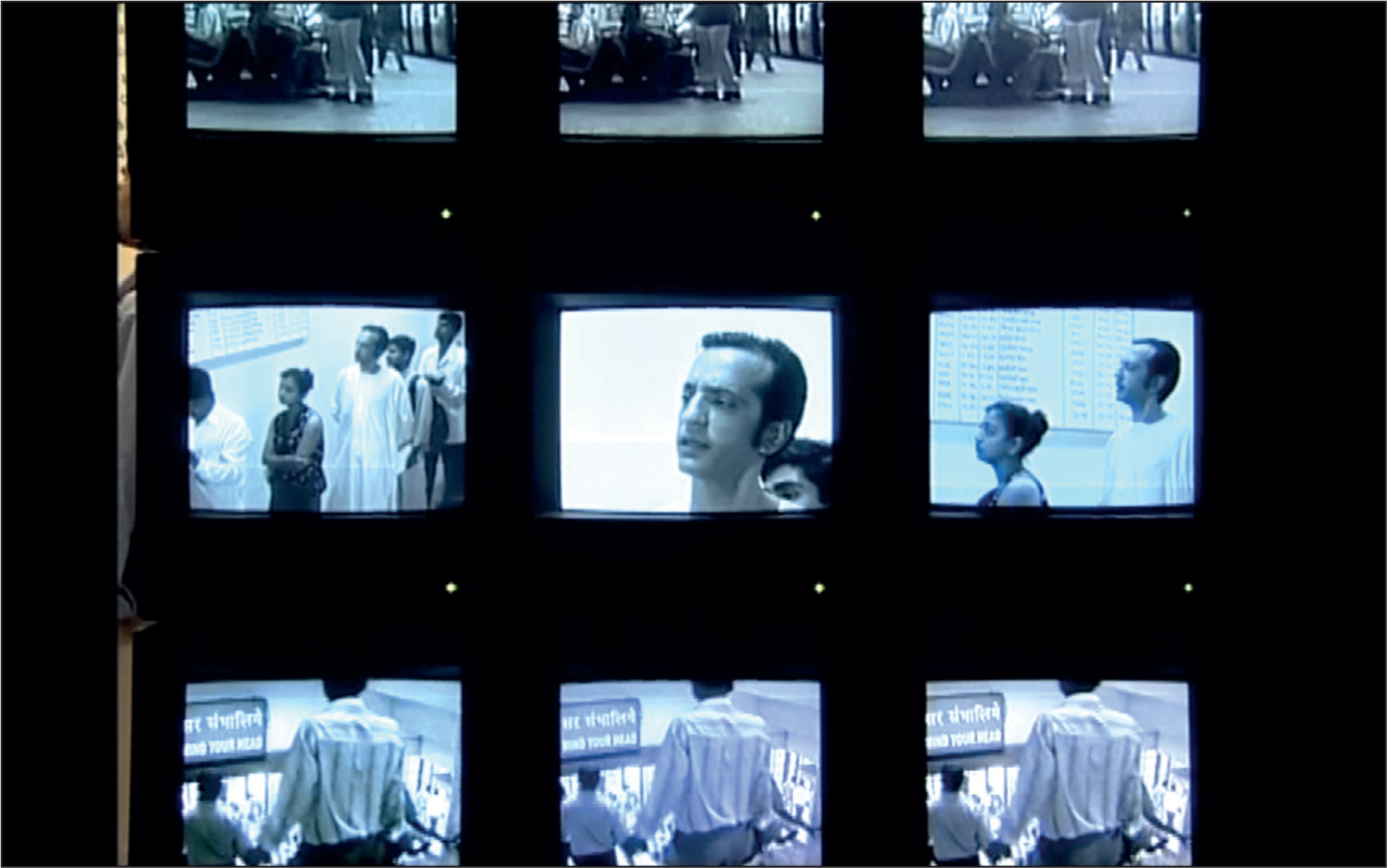
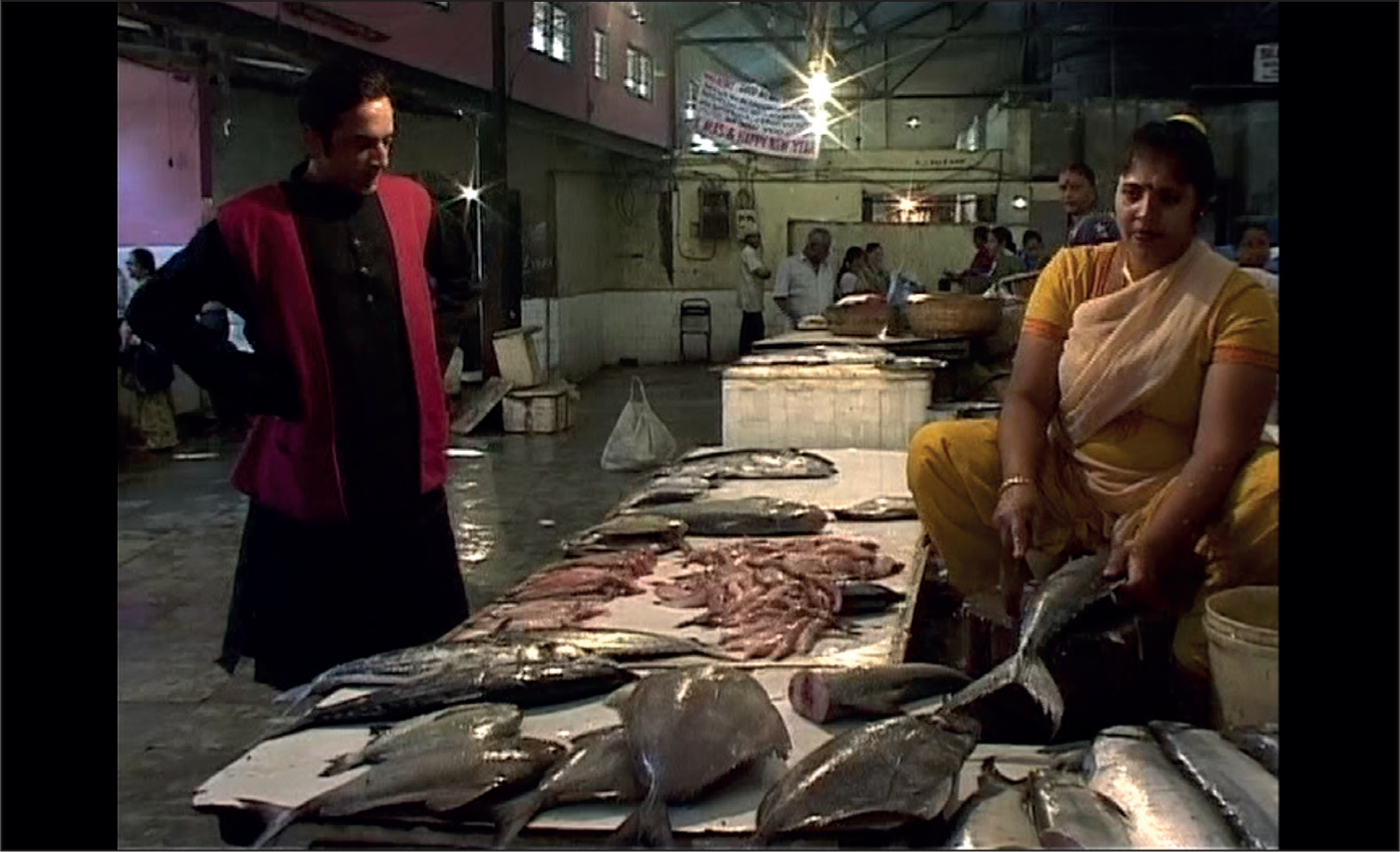
The performative, mediated, aspects of Manto’s appearance here are characteristic of two writers’ presence throughout the film and constitute a key part of Dutta’s effort to develop documentary modes that disrupt normative, state-ordered, understandings of citizenship. As he prepares to leave the city, Manto stresses the importance of having ‘your papers […] in order’. Against the demands of authorities to present histories and identities in linear fashion – here depicted as oppressive and reductive—Manto and Chughtai emphasise movement and itinerancy. Storytellers, Manto claims, ‘flow like water seeking out opportunities like wind’; Chughtai, meanwhile, observes that Manto’s ‘restless, mercurial ways’ match those of the city itself. This opening sequence foregrounds arrivals and departures; throughout the rest of the film both figures’ appearances, but particularly Manto’s, are characterised by movement, their location varying each time. They appear alone, either in specific, often liminal spaces—the immigration office, railway station, cemetery, in doorways, on the water—or travelling through Mumbai by bus, train, car, boat or by foot, reflecting on their relationship with the city, or recounting specific histories or myths of its development. The pair’s presence in Mumbai is not presented as uncanny or unsettling, and neither interacts with denizens of the contemporary city itself; they are not integrated into the ‘present’ of the city even as they move within its spaces (Figure 2). Their movements through Mumbai, meanwhile, lend the film the quality of a dérive, travelling rapidly between spaces and stories to allow connections between apparently disparate contexts to emerge, emphasising the city as formed through layers of movement and migration, and multiple processes of imagining and reimagining.
These connections are reinforced by the histories embodied by Chughtai and Manto and the ways in which the relationship between the past and present is put to work by their spectral presence in contemporary Mumbai. While the rise of spectrality as an analytical framework for examining cultural texts has been criticised for its generalising tendencies and frequent elision of the particular ‘generative loci’ from which hauntings emerge (Luckhurst, 2002, p. 528), the figures of Chughtai and Manto remind us that ghosts often appear at and return from specific times and locales, embodying particular histories and memories. Both are celebrated and pioneering Urdu writers of the mid-twentieth-century: Chughtai is amongst South Asia’s leading feminist authors; Manto is one of the subcontinent’s most important practitioners of the short story, a reputation due in particular to his partition stories, extracts of which are rehearsed in Dutta’s film. The pair appear as phantoms from the late 1930s to early 1950s, when they lived in Bombay and formed their friendship, and when their work came to prominence. Key decades in the subcontinent’s transition to independence, the 1930s to 1950s were important years in the establishment of Bombay as a centre of artistic creativity and radical leftist politics. Energised by its reputation for anti-colonial, working-class and trade union activism, and for Communist and Marxist organisation, intellectuals moved to Bombay from across India to participate in its vibrant literary cultures and growing film industry. Manto and Chughtai, both from North Indian Muslim families, were part of the migration of artists from the north, arriving in a city ‘teeming with immigrants, plush with money and the amenities of modern life’ (Jalal, 2013, p. 55), cosmopolitan and multicultural, and yet full of vibrant source material for work committed to exploring the structural inequalities of colonial capitalism.
In 7 Islands, it is possible to read the pair as reminders or remainders of this oft-idealised period, akin to Thomas Blom Hansen’s (2001) ‘Bombay classique’ when the city was established as a hub of intellectual activity, ‘organized capitalism, working-class culture, trade unions, and modern institutions’ (p. 39). As Hansen notes, this period is most often invoked in celebrations of Bombay’s cosmopolitan diversity and restless modernity, as well as in narratives of its demise (pp. 39–41). Dutta’s deployment of these authors to structure 7 Islands repeats this invocation of the mid-century as a period against which the contemporary crisis might be measured. As spectral presences, Chughtai and Manto can be understood as both revenants and arrivants. They invoke the promise of Bombay—an intellectually vibrant and energetically creative space, characterised by diversity—that appealed to their historical counterparts (Manto once described himself as a ‘walking, talking Bombay’ [2008, p. 655]). As revenants, Manto and Chughtai return to mourn the loss of this promise, in both the 1940s and the 1990s. As arrivants, however, the pair suggest that such a promise—when contextualised within a critical engagement with the past and the present—might yet be recuperated.
Within this broader spectral framework, Dutta deploys specific instances of intertextuality as a mode of haunting that connects the 1940s and 1990s as comparable moments where communal violence ruptured the promise of the city and nation. In this regard, Manto’s work has more explicit prominence in the film than Chughtai’s. Manto is most well-known for his Partition writing, both short stories and briefer sketches in Urdu which examine the horrific, often gendered, violence surrounding the emergence of the subcontinent from colonial rule. In Section 5, ‘Left Luggage’, Dutta juxtaposes recitals of Manto’s work with audio-visual materials from the 1990s. The sequence opens with audio footage of a Shiv Sena rally, in which the leader Bal Thackeray exhorts his followers to ‘reduce to ashes anyone who challenges the Hindu religion!’ While men carry an imitation Shiv Sena poster, Khanna’s voice-over reads Manto’s Partition sketch ‘Munasib Karawai’ (For Necessary Action) in its entirety, a very short piece in which a couple survive one riot only to be handed over by neighbours to be killed by residents in another locality (2008, p. 403). A montage follows, showing photographs and newspaper cuttings relating to the post-Ayodhya violence of December 1992 to January 1993. This precedes a highly performative sequence in which Chughtai, dressed in white and filmed in subdued, blue-toned lighting, walks along a railway track littered by visual references to the anti-colonial nationalist movement and contemporary violence. As she sits down on the track, a discarded red dupatta on the ground nearby—a symbol, perhaps, of the gendered nature of nationalist and communal violence—Chughtai directly addresses the viewer to reflect on the traumas that lead citizens to flee their homes and homelands. Dating the end of her correspondence with Manto on 15 January 1993, when a series of bomb blasts shook Bombay, Chughtai lays down of the tracks, staging a tableau that implies this moment as the death of the restless but hospitable city she describes throughout the film.
The interaction between the audio and visual aspects of the scene point to the haunting of the present by the past. Chughtai jolts up to a sitting position on the railway track as the extra-diegetic sound of a train plays, and a woman runs along the track in the distance, before Manto’s voice is heard reading his work. The climax to the sequence is Khanna’s highly charged and feverish rendition of the conclusion of one of Manto’s most well-known Partition stories, ‘Thanda Gosht’ (Cold Meat), in which a Sikh man is stabbed by his lover, who suspects him of betrayal. As he lays bleeding to death, he confesses to abducting a Muslim girl during a riot and attempting to rape her, only to discover that she is already dead. The movement between the past and the present, the fictional and the actual, effected by the interweaving and overlaying of intertextual elements and archival footage draws a direct lineage between Partition and the Ayodhya violence, positioning them as comparable and directly connected moments. Seated in the shadows of a darkened room, and dressed in black, Manto recites ‘Thanda Gosht’ as the camera draws in until his exhausted, sweating, face is filmed in close-up. As he becomes more agitated, Manto sharpens his pencil with increasingly ferocious gestures, offering a visual and sonic representation of the violence at the centre of the story, and a reminder—via the pencil—of the powerful role of representation in both fomenting and exposing the brutality of communal thinking in both the past and present. The deconstructive energies of Manto and Chughtai’s ghosts challenge the discourses of cultural purity that underlie Partition and Ayodhya as historical moments, whilst foregrounding the horrifying impact of these discourses on individuals and communities. Manto’s presence is a specific reminder of this damage. In addition to his stories, Manto’s increasing agitation, and his departure that begins and ends the film, emblematise his distress over Partition, his final decision to leave Bombay in view of increasing anti-Muslim hostility, and his death from alcohol-related illness (Jalal, 2013, pp. 130–137).
Like the Derridean spectre, Dutta’s ghosts appear as part of a project that challenges nostalgic narratives of local and national culture that would replace secular, multicultural complexity with purified ‘originary simplicities’ (Jameson, 1999, p. 45). The complex, multiple histories that Chughtai and Manto embody and narrate in 7 Islands contest—directly and indirectly—majoritarian articulations of regional and national history and identity as monolithic, homogeneous or static. In Section 4, ‘Chronology’, for example, Chughtai explores Mumbai’s layered histories of migration, mapping, and renaming. She recounts the transformation of the port named ‘Al-Oman’ by Arab traders into ‘Old Woman’s Island’ under the British; later, she lays out cards outlining details of the city’s many cemeteries, with labels indicating burial grounds for Portuguese and Armenian communities, Christian and European settlers, and for Jewish sex workers. The city, she says, is ‘restless as mercury’ and is ‘built on shifting sands’. In the same section, Manto appears beside a mocked-up Shiv Sena poster that promotes that group’s violent nativist agenda: ‘Sons of the soil, wake up! Her own sons sleep hungry, while stepsons enjoy the loot!’ (Figure 3). Here, Manto begins a retelling of the mytho-history of the ‘Bombay Duck’, a fish which, in this account, resists ideas of autochthony and refuses to conform to normative expectations in mythical, colonial and postcolonial contexts. As he does so, Manto moves through various sites of the city with the fish itself, from the doorways in which a fish-seller sells his produce, to the fish markets, beaches and restaurants where the fish is prepared and consumed. Manto’s narrative is woven between interviews with home cooks from diverse communities sharing traditional recipes for cooking the bombil fish, and Koli fisherwomen asserting the primacy of their right to the city as descendants of its original inhabitants in the face of threats to their livelihoods as fish-sellers, caused by shifts in buying patterns and by gentrification. The juxtaposition of competing claims to autochthony and ownership highlights the violent rhetoric that can emerge from everyday efforts to claim a right to the city, while at the same time emphasising the diverse cultural histories and traditions that jostle together in Mumbai. Like the bombil fish itself, the city is not easily appropriated by a single narrative. Moreover, the very presence of Manto and Chughtai as Muslim migrants from North India is a direct rejection of efforts to reimagine Mumbai as an exclusively Hindu, Marathi space. Through Manto and Chughtai, Dutta reasserts the vital role that Muslims, and indeed through them the Urdu language, have played in the history, economy and creative production of the city. Dutta reclaims the city as a space of and for Muslims and minoritised subjects, and Muslims and minoritised subjects as Bombayites/Mumbaikars.
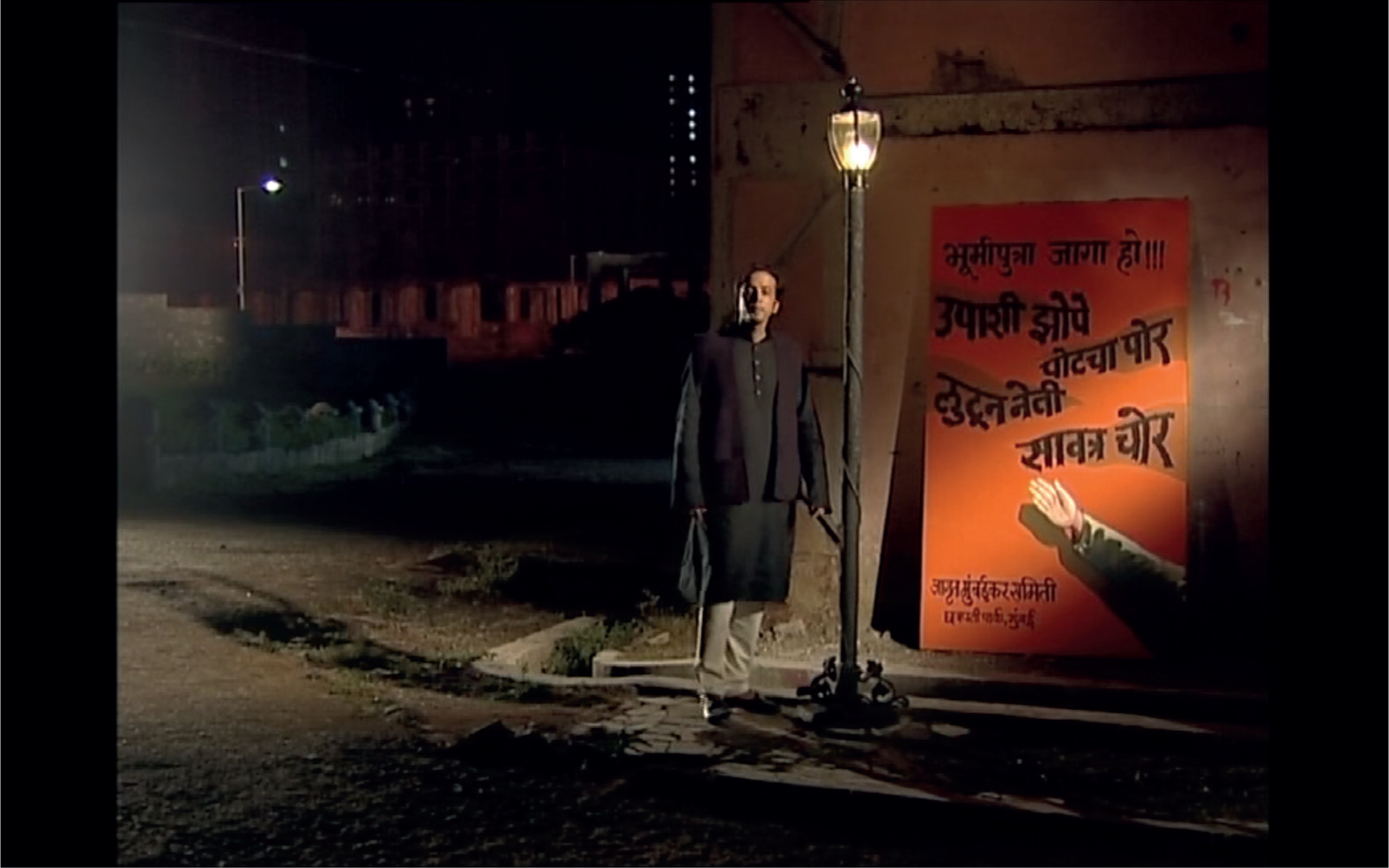
Manto’s significance extends beyond his Partition writing and into his reputation as a chronicler of urban subaltern life, a celebrated ‘writer of low-life fictions’ (Rushdie, 1997, p. 52). In 7 Islands, Manto suggests that it is the ‘capacity to see’ the city’s marginalised subjects that marks his work as a writer. ‘My eyes see’, he declares: ‘I know Maria, the vivacious Jew; Sultana, the local prostitute; Sher Khan, trolley man at Filmalaya Studios who, crablike, gets everywhere; the handsome Tulsiram who sells illicit liquor. All pillion riders, fools with no voice.’ This cast of spectral subjects, ‘the city’s dumb inhabitants’, Manto claims, ‘have chosen me to write the story of their poverty’. Manto’s fiction, including his extensive Bombay writing, is full of such characters as these, with the prostitute a particular figure of interest. Gyan Prakash (2010) describes Manto as a flaneur (p. 121), but he might more appropriately be aligned with Walter Benjamin’s poet-ragpicker who wanders the city streets, scavenging the debris and detritus for his subjects (Benjamin, 1999 [1982], p. 349). As Parsons (2000) observes, both flaneur and ragpicker are ‘itinerant metaphors that register the city as a text to be inscribed, read, rewritten and reread’ (p. 3). Chughtai and Manto appear as similarly itinerant metaphors, moving through the city collecting stories from marginal or discarded subjects, while revealing the layers of imagining and reimagining that produce ‘Bombay’ and ‘Mumbai’. Their spectral presences embody a radical politics and mode of creative engagement with the inequalities of urban existence, a cultural inheritance that Dutta reclaims for herself and the city. Furthermore, their presence as fictionalised versions of historical figures signals Dutta’s self-reflexive approach to the process of giving ‘voice’ to subaltern subjects and ‘writing the story of their poverty’. As I discuss next, while Dutta opens up space for Mumbai’s spectral subjects to speak, she does so drawing our attention to the processes of mediation and story-making at work in these representations and self-representations.
Documenting Spectral Subjects
Chughtai and Manto’s presence as fictionalised versions of historical figures, whose appearances are often theatrical, staged and deploy direct address, dramatises the interplay between the real and imagined which lies at the centre of Dutta’s approach to the documentary form and her critique of monolithic constructions of local and national history and identity. Through the dialogue between the factual and fictional Dutta opens up space for Mumbai’s spectral subjects themselves to examine their experiences of social invisibility and assert their materiality within the city. For Nicole Wolf (2013), a distinguishing feature of Dutta’s work since Memories of Fear (1993) is her examination of the relationship between modes of social realism and melodrama to ‘unhinge perceptions of authenticity, narrative and, hence, political closure’ (Wolf, 2013, p. 368). One technique Dutta uses is to juxtapose interviews with performed soliloquies, as in the section involving construction workers. These sequences interrogate the attractions and exclusions of the world-class metropolis, revealing the interplay between the ‘real’ and ‘imagined’ cities. At the same time, they offer spectral subjects a space to assert their (sometimes terrifying) role in bringing the city into being. The second section of 7 Islands, ‘Goddess Two: Construction’, includes several conversations with migrant labourers who articulate the attractions and disappointments of the city. Hasaan is a proud worker, interviewed as he cleans windows high up on a glossy corporate structure in the Bandra-Kurla complex, a commercial and financial hub and home to the National Stock Exchange, various Indian and international banks, and international info-tech companies. “‘Our Mumbai” looks so beautiful!’ Hasan declares; ‘Soon it’ll become Singapore’. Hasaan repeats World-City-making discourse, having apparently absorbed and appropriated aspirational narratives of Mumbai as a pre-eminent global city. Speaking from his elevated position above Mumbai, ‘out of [its] grasp’ and ‘transformed […] into a voyeur’, to borrow from de Certeau (1984, p. 92), Hasaan glosses over the difficulties of his everyday life as an ‘ordinary practitioner’ on the ground to present a positive outlook on the city and his place in it: ‘I was afraid at the start’, he says of his vertiginous work, ‘but soon got used to it’. He admits that ‘It would be nice to remain up here and not come down. Life is so peaceful at this height… while down there it’s—nothing’. Hasaan appropriates his elevated position as one of temporary empowerment that enables him to read and re-present Mumbai and his place within it in multiple ways.
Hasaan acknowledges his marginalisation from the neoliberal city and the casting of its poorer and labouring constituents as ‘nothing’, while insisting on the mutually constitutive relationship between the hutment dwellings down below and the vertical constructions on which he works: ‘If no buildings are built… what will the hutment dwellers do? … People want nothing but the chance to be somebody. Earlier in Bharat Nagar [the location of the Bandra-Kurla complex], there was nothing. And now look at it! It’s a good feeling’. Hasaan articulates an ironic and (inadvertently) resistant account of the structural inequalities of Mumbai’s combined and uneven development, delineating and tentatively reclaiming the symbiotic relationship between the underdevelopment of the informal settlements and the rapid development of its financial and corporate zones; he insists that the hutment and the high-rise are necessarily adjacent and interrelated urban signs of neoliberal globalisation. Yet he also deploys this dynamic of combined and uneven development to refuse his inscription as an invisible ‘nothing’, appropriating the power that his vertical elevation implies and proudly reimagining himself as ‘somebody’, insisting on his contribution to Mumbai’s immanent world-class status, his central role in creating the city’s tangible materiality, its something-ness.
Central to Dutta’s project is an effort to examine the complex and often ambivalent ways in which spectral subjects seek their ‘chance to be somebody’, to render themselves visible and recognisable as active agents and participants in the making of Mumbai’s neoliberal economy. However, Hasaan’s appropriation of a vertical axis to assert his right to the city and to render himself visible as ‘somebody’ within ‘our Mumbai’, is contrasted with a sequence involving ground-level demolition workers, one ‘real’ and one staged. Sanjay Bharati is a labourer working on a vast housing development. Against the confident assertion of Hasaan’s fellow window cleaner that ‘Nobody goes to sleep hungry in Bombay … not if he works hard’, Sanjay provides a scathing critique that punctures narratives of aspiration and opportunity with the material difficulties of survival. He offers advice to those considering moving there: ‘first of all you can’t get a job. And there’s no place to live. You can’t find a room even in a slum. So, where will you live once you’re there?’ Sanjay’s interview is intercut with the brief performed monologue of a fictionalised construction worker (performed by Omprakash Kumar) who offers pithy, generic statements on migrant labour and the promise of Mumbai. ‘I came here because they said Mumbai was a really nice place’, he says. ‘Nowadays everyone has a TV or a fridge or a music system. A motorbike’s what I want’. As he makes these aspirational statements, he is filmed scavenging amongst the building debris, before changing his clothes and neatening his hair. This process of self-transformation is echoed in Sanjay’s appearance; he, too, has taken care to present himself neatly dressed in a smart shirt.
Yet, Sanjay’s narrative contrasts with this ordered appearance and with that of the fictionalised labourer in its emphasis on loss, disorientation and fear. His words highlight the complex ways in which his life is structured by the violence of neoliberal programmes of redevelopment and beautification. With no contacts in the city, Sanjay struggles to find work until he is offered employment ‘dredging sand, cleaning drains, all types of work’. Finally, he gains work demolishing slums. When asked what it felt like to destroy homes, Sanjay explains:
Not just others’ [homes], I lost my own home too. How do you think that felt? I felt fear. I too am poor. How will I feel when poor people’s homes are broken? My two rooms and my uncle’s house were broken down. The house I was living in—I razed it myself.
The juxtaposition of Sanjay’s account and the staged monologue emphasises the discrepancy between the promises of the world-class city and its lived realities, particularly for those of lower caste and class positions. They also make visible the performative qualities of Sanjay’s account, his effort to render himself ‘somebody’ in a city that would erase his very home—and, indeed, requires him to do so as a condition of his stay. Dutta claims that the use of ‘contrived narratives (stylized performances, embellished re-enactments) back-to-back with standard testimonies’ transforms our understanding of the authenticity of the ‘real material’ and of the interviewee’s own understanding of their place in the city (Sarkar & Wolf, 2012, p. 22). The juxtaposition between the real and the staged here heightens the tensions between Sanjay’s critique of utopian mythologisations of Mumbai, his efforts to survive the city, and his complicity in the violence of neoliberal redevelopment, rendering visible the precarious and often ambivalent position of the spectral subject who is both victim and perpetrator of the planned violence of urban development.
Elsewhere, Dutta provides her subjects with cameras so that they can record and narrate their own experiences beyond the interview format. For one sequence, Dutta gave two chaiwallahs (tea sellers)—Santosh and Jawahar—flycams to attach to their bicycles, and radio microphones to wear. They then recorded audio-visual material whilst cycling around the city on their night shift, while Dutta’s team followed to film additional footage. The resulting sequence presents a visual counter-narrative to familiar images of the megacity as overcrowded, noisy, brash, and busy, while offering glimpses of the dynamic nightlife of Mumbai’s streets. The chaiwallahs navigate streets that are quiet, certainly, but not empty; and while they boast of selling tea to Bollywood film stars, we mainly witness them selling refreshments to fellow night-time workers, such as doormen and pavement dwellers. The sequence therefore offers valuable insights into the nocturnal economy of the city, from those who labour after dark to those who sleep in the shadows.
The mode of filming, as well as its temporal and spatial location—gliding silently through night-time streets—emphasises the spectral quality of the chaiwallahs’ lives. Throughout most of the sequence Santosh and Jawahar are absent presences, voices narrating their experiences from behind the camera. In their recordings, they appear as brief, ghostly flashes across the screen, while the cameras primarily record the street from their basket or bicycle wheel; their faces are visible only fleetingly in Dutta’s additional footage as they cycle past, and more fully only briefly at the end of the sequence. The mode of documentation therefore formally reflects the chaiwallahs’ marginal status, in terms of caste and class, and their social invisibility. Against this marginalisation, Dutta claims that her aim here was explicitly to position the subjects as collaborators within the documentary process, offering them an opportunity to ‘ch[oose] to create their own script of the self’ (Sarkar & Wolf, 2012, p. 24). As this emphasis on creativity and the script suggests, Dutta is, like Vohra, sceptical of the practice of giving subaltern subjects cameras as a means of accessing the ‘truth’ of their lives ‘as if’, in Vohra’s words, ‘they were tabula rasa, noble savages whose truth will automatically emerge’ (Vohra quoted in Anjaria 2019, p. 195). Dutta is, rather, interested in recognising the performative qualities of the narratives that arise, and the tensions between the fictions a subject might create of themselves and the city.
Such tensions emerge as the chaiwallahs recount their negotiations of official efforts to regulate space. The sequence begins with stories of their encounters with police who interrogate them, move them on, or demand bribes in exchange for the right to occupy space and pursue their business. The pair claim a defiantly resistant stance, remarking that ‘After all the to and fro, I might earn 20 bucks and if I give that to the cops, what’s left for me? So let them punish me, deflate my tyres, whatever.’ Such defiance appears performed, however; the pair also admit to frequently simply moving politely on when they encounter such hostility, while having their tyres slashed would endanger their livelihood. Nevertheless, this performed defiance becomes a means through which Santosh and Jawahar stake their right to the city on screen; that is, they use the film as a means by which to assert their presence within, and right to, Mumbai’s streets. Similarly, one chaiwallah’s narration of his journey to Mumbai – the result of a tragically failed inter-caste love affair—appears clichéd and potentially fictionalised. Dutta remarks, ‘this tale has been told many times. It could very well be a popular script that [the chaiwallah] contributes to my task of making the film’ (Sarkar & Wolf, 2012, p. 24). Crucially, Dutta confesses that ‘I shall never know the truth and I am not interested in knowing it either’ (p. 24). Rather than uncover a ‘truth’ about these marginalised subjects, Dutta aims to open up space for them to narrate themselves into Mumbai in the manner of their choosing, to claim recognition through a script or performance that they devise or appropriate from elsewhere, and to acknowledge that the performance, the scripted, the creative, is at play.
Dutta expands this exploration of the scripted and performative as modes of claiming space through her use of intertextuality to probe specifically gendered experiences of spectral dispossession, which develops and connects with the intertextual hauntings of Manto and Chughtai. In the third section of 7 Islands, entitled ‘Pillion Riders’—which includes the chaiwallah sequence—Dutta juxtaposes interviews with Mumbai’s bar dancers with song and dance sequences from iconic Bollywood films, footage from political rallies and staged performances by the dancers themselves. The sequence opens up a space for these women to articulate their experiences as simultaneously hyper-visible and socially marginal, and to assert their right to the city in the face of legislative efforts to exclude them. Dutta’s formal approach, specifically her use of cinematic intertextuality, emphasises that efforts to represent the dancers’ stories, including her own, are layered within and framed by complex representational histories.
Dance bars—in which young women dance to Hindi music in front of male patrons for money, occasionally being showered with cash by an employer or customer—have gained ‘iconic’ status in Mumbai’s nightlife (Mazzarella, 2015, p. 481). Well-known to Hindi film audiences, the Mumbai dance bar has gained international notoriety through high-profile works of literary reportage by Suketu Mehta (2004) and Sonia Faleiro (2010). However, as Emma Bird (2015) notes, bar dancers themselves have tended to ‘occupy an occluded space’ (p. 381) within the city itself, despite their importance to its ‘spectacular image and economic life’ (p. 388). In the 2000s, dance bars gained prominence within debates about gender, class and social and spatial purity, when the Maharashtrian State Government sought to ban them, arguing that they exploited the women and risked corrupting the public (Mazzarella, 2015, p. 482). The 2005 ban rendered approximately 75,000 women unemployed, 75% of whom were the sole earners in their family (Kotiswaran, 2010, p. 108). Launched on the 15th August—Independence day—the ban was enmeshed within neoliberal ambitions for Mumbai’s world-class future and populist nationalist drives to clean the city of unwanted subjects and activities. Mazzarella warns that it is too simplistic to read the ban as solely a ‘symptom’ of the ‘Right-wing policing’ of space and culture promoted by the Shiv Sena since the 1990s, not least because dance bars ‘flourished during the high-water mark of the Shiv Sena decency crusades against films, television shows, magazines and art exhibitions’ (2015, p. 483). Nevertheless, discourses surrounding the ban connected anti-immigrant rhetoric with classist and misogynistic approaches to public order and spatial control (Faleiro, 2010, p. 157; Kotiswaran, 2010, p. 110).
Much of the attention to dance bars, including Dutta’s own, emerged in the context of the ban and appeals against it. In 7 Islands, Dutta includes footage from a public hearing co-ordinated in 2005 by her own organisation Majlis, along with Partners for Urban Knowledge and Research and Point of View, designed to provide space for bar dancers to share testimonies of their experiences and the impact of the ban. It was intended as an opportunity for the dancers to represent themselves, as against their simplistic depiction in public debates as either ‘violated victim’ or ‘voracious vamp’ (‘Bar Dancers Speak’, 2005). The women at this hearing assert their right to the city through scathing critiques of the patriarchal capitalist structures they are disenfranchised by. One speaker, Madhu, condemns class-based discrimination telling the gathering that ‘Because we’re poor they say “These dancers are whores”’. Another speaker, Pinky Yadav, stresses how bar dancers are caught within intersecting networks of class and gender discrimination: ‘Women are denounced for dancing in bars but’, she asks, ‘do bosses treat their secretaries as sisters?’ Enabling a collective assertion of agency, the ‘Bar Dancers Speak’ event shows women analysing the structural inequalities that contextualise both their work and the ban, and refusing their marginalisation within the neoliberal city.
Alongside this footage, intertextual elements keep the interplay between the real and imagined, the actual and the performed, to the forefront of Dutta’s examination of bar dancers’ experiences. Interviews with individual women are framed by brief segments from two 1970s ‘courtesan’ films. The first, appearing before the interviews, is from the hugely popular Muqaddar Ka Sikandar (1978) and features the actor Rekha as a courtesan performing in front of a male audience. Music from the film plays extra-diegetically as a rain-soaked Manto walks along a dark street and then sits on a bench, drinking and reciting Urdu poetry. We observe the clip of Rekha dancing itself through a projectionist’s viewing window, over their shoulder as it plays in a cinema (Figure 4), before Dutta expands the view of the screen in the auditorium to the full screen, with the music now diegetic. As we move between this screen back to Manto and then to a dancer in a contemporary Mumbai bar, the music from Muqaddar Ka Sikandar continues to play, shifting from extra-diegetic to diegetic again. The second clip, immediately following the last interview, features the song and dance sequence ‘Teer-e-Nazar’ (‘I shall see arrows from your glances’) from the 1971 hit, Pakeezah. In this sequence, the courtesan Sahibjaan (Meena Kumari) dances for her lover on the night of his wedding (to another woman), watched by a male audience and women peering through a partition. To demonstrate her distress, Sahibjaan dramatically smashes a chandelier and dances across the broken glass. Dutta moves from full to split screen, to present four versions of Sahibjaan’s dancing body as it moves across broken glass, her bloody steps painting her pain across the white floor in an astounding depiction of the violence of patriarchal discourses of female purity (Figure 5).
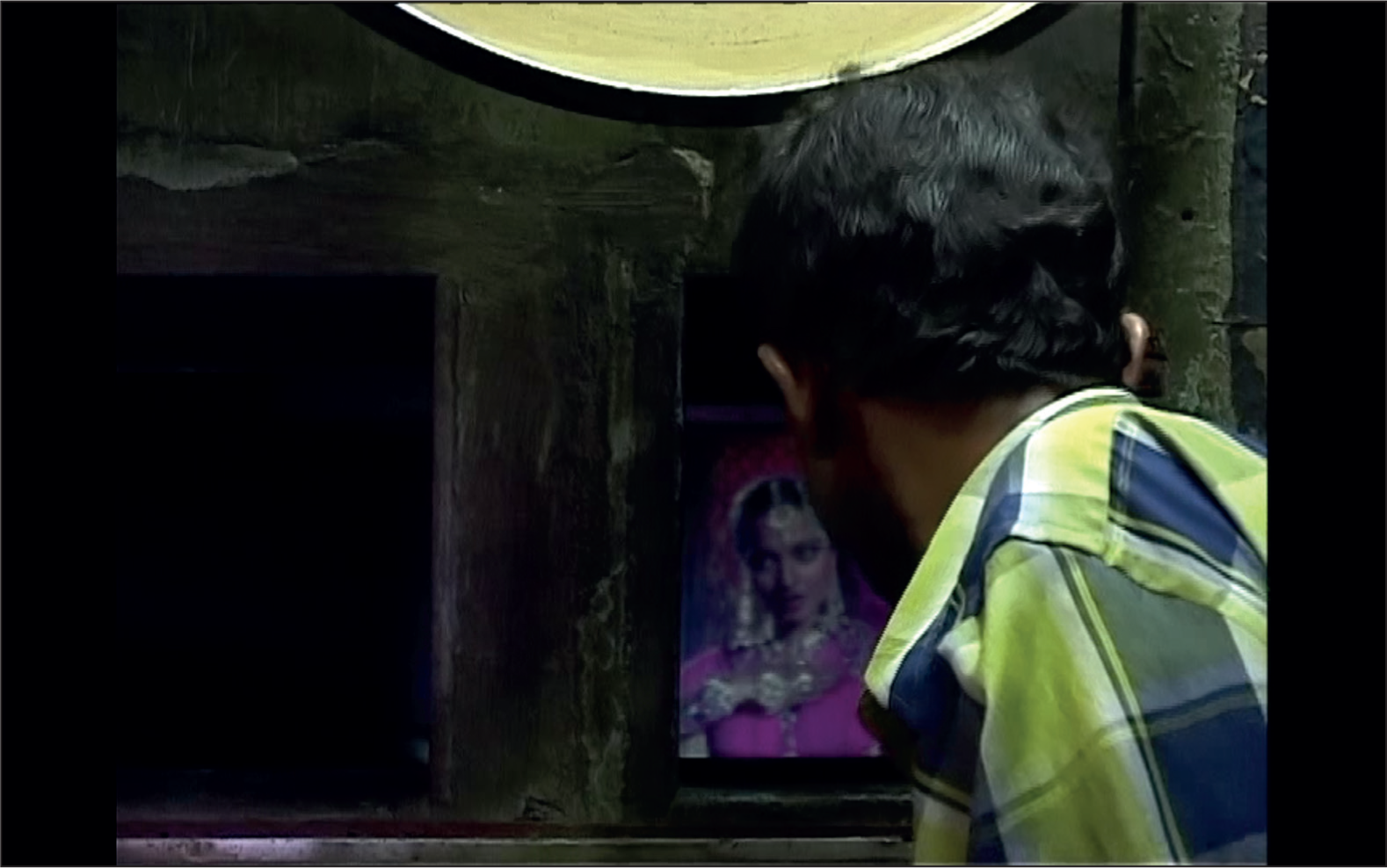
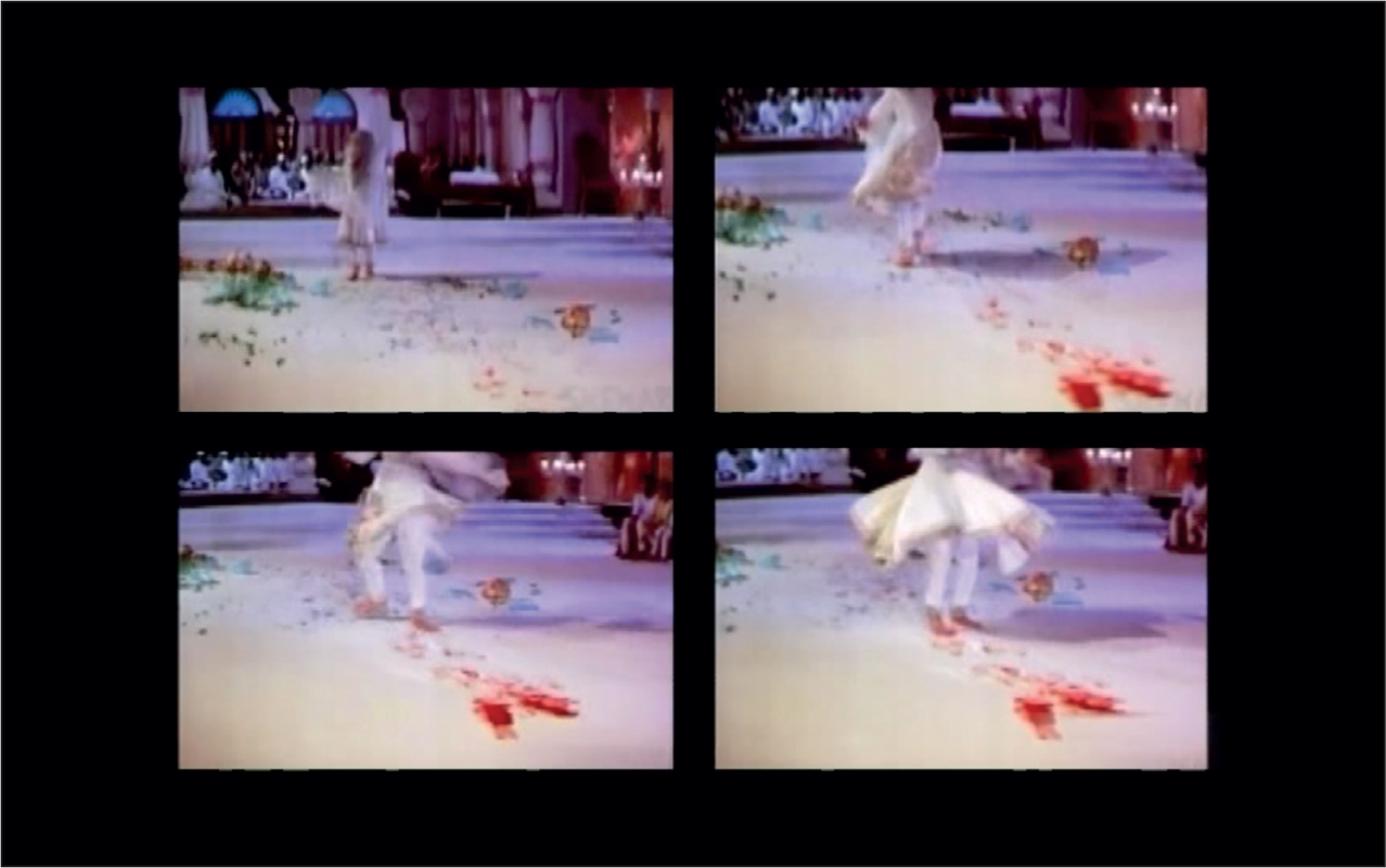
Manto’s presence in this sequence, and his recital of Urdu poetry, serves to emphasise the vital contributions made by Muslim writers to Bombay films, and the integral presence of Islamicate cultures within them—visible here also via the references to courtesan films and the song lyrics themselves—as against majoritarian revisions of Indian history and culture. The significance of the film clips further pivots on the ways in which the dancing women—and by extension the bar dancers with whom they are juxtaposed—are positioned as objects of the gaze, rather than subjects and agents of their own stories. The multiple framings of the excerpts—from the diegetic audience watching the courtesans perform within the films, to the projectionist’s viewing window, to the wolf-whistles of the off-screen cinema audience, to the split screen—emphasise the highly mediated ways in which the dancing women (cinematic courtesan and bar dancer) come into view, and the ways in which their bodies are subjected to the male gaze on screen and in public spaces. The interviews with bar dancers show them ambivalently negotiating this mediation. ‘I’m really fond of dancing’, Saloni comments shyly, ‘not too good with words’. Saloni remembers enjoying the performative aspects of her work: ‘I enjoy putting on make-up and dressing nicely. When we danced, how I would dress up!’ But since the dance bar ban, she feels pressure to render that part of her invisible, to conform to public expectations of respectability: ‘now if we dress up, people say “Why all the refinery? Take it off, wear regular clothes.”’ Against such pressures to hide her identity and conform, Solani appears in 7 Islands in full make-up and finely sequined sari, and is filmed dancing (alone and with other women) to music from Muqaddar Ka Sikandar and Bunty Aur Babli (a 2005 film featuring scenes in dancing bars).
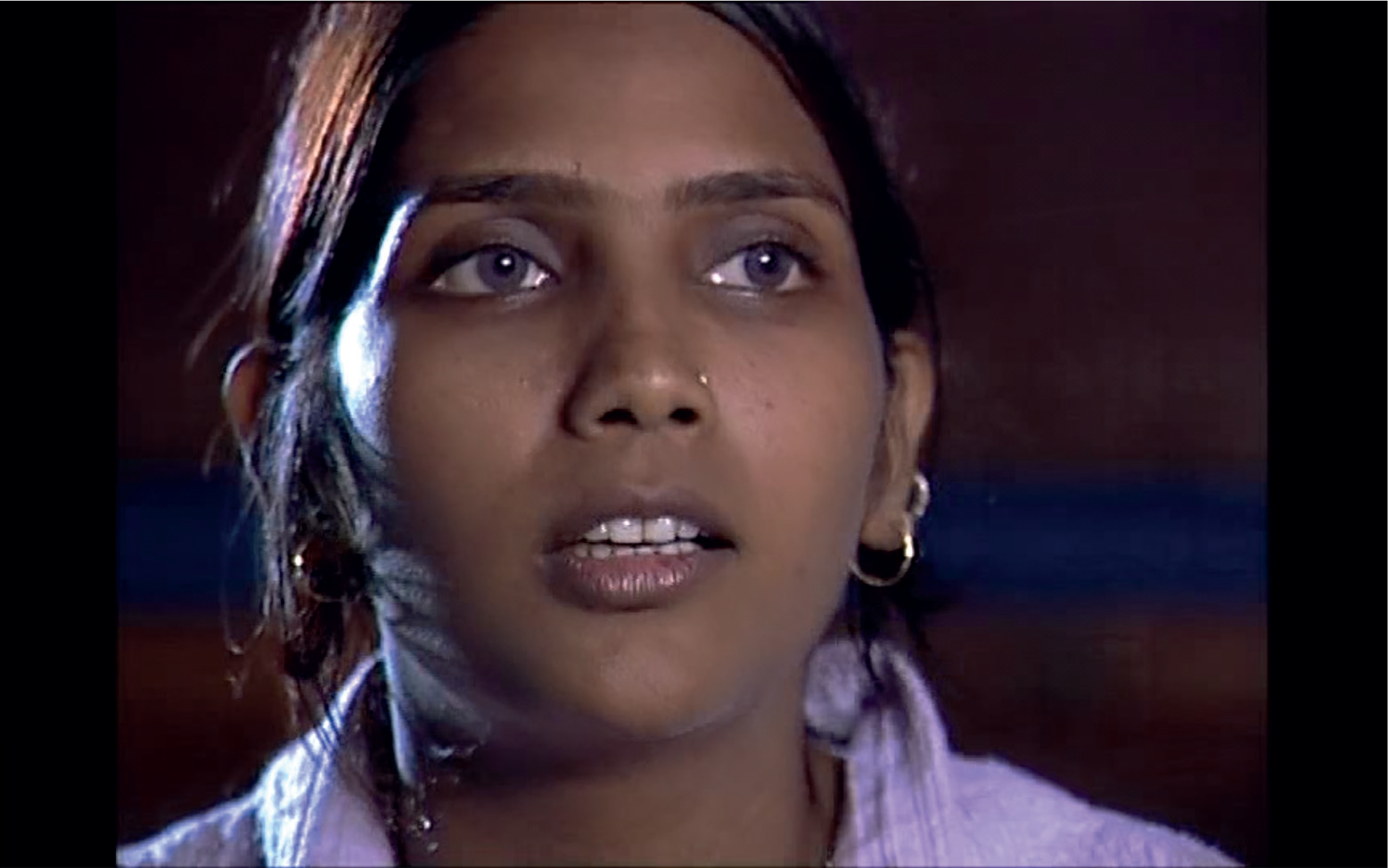
Furthermore, Dutta highlights how bar dancers themselves deploy intertextual manoeuvres to assert their right to the city. This is emphasised by the continuity between the diegetic and extra-diegetic music from Muqaddar Ka Sikandar, which iterates the symbiotic relationship between the contemporary bar dancer and a long history of cinematic representation. The film clips point to the lineages often traced between the courtesan and the bar dancer, with defenders of the latter invoking dance and music idioms associated with the courtesan in an effort to position bar dancing within a ‘respectable’ and ‘plausible narrative of Indian cultural tradition’ (Mazzarella, 2015, p. 485). Dutta alludes to these arguments via the clips, and when she presents bar dancers moving to music from courtesan films and filing past live musicians, including a tabla and a harmonium player. Furthermore, the cinematic courtesan holds significance for dancers themselves, as Faleiro observes in Beautiful Thing: ‘Rekha, as the courtesan, was their icon’, particularly in her role in Umrao Jaan (2010, p. 107). In 7 Islands, a bar dancer declares that ‘There’s just one Rekha: me’, in a move that both invokes the cultural heritage of the courtesan and appropriates a cinematic icon as a means to assert her claim to Mumbai. This Rekha’s account of her life outlines a history of poverty and dispossession in rural India as a motivation for dancing in the city; ‘poverty’, she bluntly states, ‘is a terrible thing. Whether you’re rich or poor, money’s all that matters’. Poverty, she makes clear, renders the question of agency and choice ambivalent, for ‘Once a woman starts working in the dance bars she can never leave, under any circumstance’; the money is too good when compared to other employment opportunities. Throughout her interview, Rekha appears both confident and assertive, all the while revealing the daily labour involved in claiming her right to the city: ‘When I was new here, the people in my building wanted me thrown out. Gradually they accepted me. If you’re not firm in this city, people won’t let you live’. Filmed in close-up to accentuate her defiant presence in Mumbai (Figure 6), Rekha offers her account as one of a refusal of invisibility, a refusal to disappear from view or conform to dominant expectations of respectability: ‘I say to people straight out, “I’m a bar girl”. I don’t hide anything or pretend. If they don’t like it, they needn’t talk to me’. Rekha uses intertextuality as part of her assertion of her identity and her rejection of efforts to render her materially and socially invisible; she will be neither, offering an important counter-narrative to the marginalisation of bar girls from their own stories in popular representations, public debates and urban spaces.
For Dutta, the performative is a key mode through which spectral subjects claim citizenship and their right to the city. This is why, Dutta says, she ‘shot the bar dancers in their fineries and dancing paraphernalia even when they were out of work and most probably starving’ (Sarkar & Wolf, 2012, p. 24). The interviews offer their subjects a space to detail their role in the city’s economies and assert their importance to its social, cultural and economic development. Dutta claims that her method is ‘not to make films about small people but to facilitate their desires to appear tall if they wish so and if they can pull it off’. This ‘“play” between “small” and “tall”’ becomes, Dutta argues, ‘a discourse on citizenship: an intersection between the memory of the self and the fantasy of the self’ (Sarkar & Wolf, 2012, p. 24). Sequences such as those with the chaiwallahs, the construction workers, the bar dancers, or Reshma the stunt woman with whom I began this article, work to recognise the ambivalent agency of subaltern subjects; their ability and desire to assert their right to the city, even as that right is limited or curtailed by the structural inequalities of world-class development, by caste or class discrimination, or by the regulation of space and citizenship in neoliberal Mumbai. What is particularly valuable about Dutta’s work and her deployment of spectral frameworks is the attention she draws to the ways in which her subjects negotiate the risks of both invisibility and visibility. Invisibility, for these subjects, might be enabling, allowing an economic means to survival; but it might also mean—to the same subject—that their life is framed as disposable, unwanted and undesirable. To be visible, for Reshma the stunt woman, is to be paid less, but it is also to have her work and body go unrecognised; for the bar dancer, to be visible in public is risky, leaving her open to representation as an obscene, contaminative presence; for the Muslim, to make oneself visible—or to be rendered visible by Hindu nationalism—is to be marked as a target for violence. At the same time, for these and for many of the subjects of Dutta’s film, to be socially invisible is to be precariously positioned, exposed to poverty, danger and dispossession. The formal play of Dutta’s work, bringing together historical ghosts and spectral citizens and juxtaposing a wide array of forms, is central to this process, drawing attention to the multiple ways in which the city and citizenship are mediated, represented and claimed, and the multiple ways in which spectral subjects are produced and displaced by majoritarian discourse and the neoliberal economy. In Dutta’s work, the spectral and the performative come together to open up space for the radical reimagining of citizenship within current nationalist ideologies, through the need to continually question monolithic understandings of space, history and identity. By emphasising the performative as a mode of making visible, or of refusing invisibility (which might not be the same thing), Dutta does not seek merely to bring the spectral subject into view, give them a voice, or uncover the ‘truth’ of the city in any fixed or straightforward way, even as she seeks to bear witness to their lives. Rather, she demands the viewer critically engage with the complex and ambivalent ways in which spectral subjects seek to render themselves visible in the city and claim themselves as active agents and participants in the making of Mumbai.
Footnotes
Declaration of Conflicting Interests
The author declared no potential conflicts of interest with respect to the research, authorship and/or publication of this article.
Funding
The author received no financial support for the research, authorship and/or publication of this article.