




Abstract
This article interrogates live-in factory labour as a distinct feature of informalised industrial structure, an absence of state regulation and an outcome of kinship-based internal migration processes and labour precariousness. It also demonstrates the fallacy of analysing living arrangements of migrant workers as undifferentiated structural artefacts and highlights the underlying social relational dynamics. It argues that suboptimal wages and terms of employment embedded in highly asymmetrical relations between employer and worker mediated through labour contractors and organised on caste, ethnicity and regional lines dictate the persistence of the system of in-factory living of workers. Such a living arrangement represents a distinct configuration of urban employment that allows firms to have greater control over workers’ lives to extract surplus value and determine their relations with the city. Thus, the article posits that migration, informal workplaces and informal labour relations converge together to create certain hyper-precarious occupational niches reserved for workers from particularly marginalised communities. Apart from debt bondage, a phenomenon which has received significant scholarly attention over the years, on-site accommodation is used by employers to keep vulnerable migrant workers in these niches.
Introduction
The thriving urban industrial centres in the country for long have accommodated their workers in labour colonies around factories, which eventually grew into slums and chawls. As urban spaces started becoming scarce, contractor-run lodging facilities began to appear in many industrial neighbourhoods. With urbanisation gathering momentum, resulting in escalation of land values and heightened speculative activity in the real estate sector, access to housing for the poor and circulating migrant workers has become severely restricted over the past few decades. As firms simultaneously integrated with global value chains enabled by liberal domestic policies, they have been in search of newer ways to maximise production, mainly leveraging the ever-increasing supply of cheap migrant labour. Newer work-residence systems have emerged that help firms reconfigure local production spaces in ways that expand control over migrant labour beyond the workplace and regulated work time. That these arrangements seek to accelerate surplus extraction by controlling both the productive and reproductive lives of workers renders their dynamics deeply political.
Migrants’ housing choices in urban industrial hubs attracted the attention of scholars like Bert Hoselitz way back in the mid-1950s. He noted that migrants settled in the less developed economies of Asia, Africa and Latin America considered their stay in the cities as temporary and preferred to live in clustered dwellings among other migrants from their regions and community so that they could maintain their ties with the place of origin (Hoselitz, 1955). They could thus manage the mental stress of being in an alien place by residing among kinship groups and forging relationships peculiar to their native culture and tradition.
The later inquiries into the issue of worker residence have been informed by conceptualisations put forth by scholars such as Michael Burawoy and David Harvey. Harvey’s theorisation of the spatial politics of contemporary capitalist production, which is increasingly globalised and transnational, has helped reinterpret labour migration as a ‘spatial fix’ to balance labour surplus in the source regions and shortage at the destinations (Harvey, 2001a, 2001b). Burawoy (1976, 1985) made an important contribution to labour studies by explaining the reproduction of a migrant labour system. According to him, migrant labour system is reproduced through the separation of the means of renewal from the means of maintenance of the labour force. Such splitting of labour and costs of social reproduction spatially across the city and the village is captured through the concept of translocal householding in the more recent literature (Gidwani & Ramamurthy, 2018; Ramamurthy, 2020). The interpenetration of the capitalist and subsistence economies and the forceful separation of the family and the worker—while preserving their mutual dependence—are the two aspects of social reproduction under migrant labour arrangement. Thus, in a capitalist society, the labour process works as a social process that reproduces the extant relations of domination and exploitation (Burawoy, 1976).
A few scholars have tried to examine specific cases of worker residence arrangements in the light of such insights. Ngai and Smith (2007) and Ngai et al. (2020), for instance, have looked at the dormitory labour regime (DLR) in China and Czech Republic as exemplifying a new spatial politics of transnational labour process associated with the delegitimisation of flexible production politics and the rise of deterritorialisation of production. The worker dormitories in China are part of larger complexes that house them along with factories and other basic service facilities. Importantly, while dormitories ensure tighter integration of working and non-working lives of workers, they facilitate management to exercise absolute control over labour outside normal work hours. Such arrangements are hence central to continually reproducing a disciplined, low-cost and ever-available workforce for meeting fluctuating industrial needs. Pun and Smith (2007) argued that DLR is a unique Chinese system, the sustenance of which is made possible by a short-term employment pattern of rural migrants, quasi-paternalistic relationship between capital and worker and the state’s policies restricting permanent migration to work destinations. However, Goodburn and Mishra (2023) demonstrate structural similarities as well as adaptations of DLR to local and historical contexts in India such as privately owned labour colonies and worker hostels and argue that such arrangements are integral to the political economy of contemporary global capitalism that relies increasingly on migrant workforce for the purpose of value extraction. They also emphasise the need to pay attention to the locally adapted, context-specific characteristics of workplace-residence configurations to be able to fully understand their dynamics. Recent enquiries have also emphasised the need to deploy more discursive approaches to study worker hostels going beyond the simplistic binary conception of freedom/unfreedom (slavery) of inhabitants. For instance, in their study of Tiruppur cluster, the famed knitwear-manufacturing hub in Tamil Nadu, India, Crane et al. (2022) emphasise the need to have a more systemic view of freedom in hostels of workers considering that individual experiences are ‘shaped by the system of relationships, traditions, and social and economic arrangements that workers are embedded within’ (p. 1,931). They argue that the complexity in the manifestation of freedom/unfreedom makes it difficult to be categorised as binary labels. What is more tenable is conceptualisation of living experience of workers, especially women workers, in hostels as ‘a form of hybrid (un)freedom that simultaneously constrains, protects, and liberates them in quite specific ways’ (p. 1,954).
Another notable contribution on labour accommodation arrangements has been made by feminist scholars. Mezzadri’s (2017) enquiry into the garment sweatshops in India unequivocally pointed to the substantial social costs that lie hidden behind its global image as a front-running garment manufacturer and exporter. While she did not find dormitory-like arrangements anywhere in her study sites, she observed that ‘neither employers nor the state bear any of the costs of workers’ daily social needs, and it is up to workers to find suitable living arrangements …’ (Mezzadri, 2017, p. 175). She points out that daily social reproduction practices evolve to act as labour surveillance and control mechanisms that help capital to extract surplus value. Appropriation of value is made possible by externalisation of social reproduction costs as also by relegating the cost of intergenerational reproduction of the industrial workforce to the informal economies of care at work back in villages. In a later contribution, Mezzadri and Banerjee (2022) argued that precarious living condition is one of the reasons why workers return to their source areas at the end of their work life in the industry and change livelihood strategies.
Jan Breman’s anthropological inquiries in western India since the 1960s have contributed significantly to the understanding of the changing nature of unfreedoms experienced by informal workers in the agricultural and industrial economies. Particularly important is his conceptualisation of the institution of ‘neo-bondage’ that refers to the labour attachment mechanism practiced widely in Gujarat (Breman, 2007, 2010). 1 Payment of advance wages to workers is the crux of this arrangement. As Lerche (2007) points out, the jobbers who wield significant social and political power in migrants’ local settings act as central agents in the debt-based migration process. Workers who accept the payment get entrapped at the worksite and are forced to comply with all the conditions laid down by employers and their contractors. This way, the entrepreneurs satisfy their time-bound demand for labour by recruiting workers in the rural hinterland. Mapping the informal practices followed in Gujarat’s urban industrial centres through a political economy lens, Jain and Sharma (2019) found that on-site housing allows employers to extend work days of vulnerable segments like Adivasi workers and extract the surplus thus generated. The arrangement renders the migrant workforce more docile to the industry’s preference of keeping them in the least rewarding and most extractive tasks. They demonstrate that such an exploitative practice is part of a work regime that reproduces Adivasi migrants’ historically disadvantaged socio-economic position.
Several empirical studies also seek to link on-site housing with exclusionary and discriminatory urban labour and migration governance regimes. Desai (2020, 2017) examines the provision of on-site accommodation to migrant construction workers in the cities of Ahmedabad, Surat and Vadodara in Gujarat by developers and contractors as well as the legal framework that governs it. The studies highlight the pervasiveness of temporary living arrangements for floating construction workers, who move from one site to another, and those who make their own living arrangements in these cities. Similarly, a report on urban governance by Aajeevika Bureau (2020, p. 31) examines the experiences of seasonal migrants within Ahmedabad’s informal labour market, where it finds that many migrant workers reside at construction sites, within factories and hotels, around head loading markets or as domestic workers in homes ‘in order to save on rent and get access to regular work, or because they move from one worksite to another with a specific contractor’.
All the above studies link on-site living arrangements with recruitment practices to which contractors are central and contribute to caste-, kinship- and ethnicity-based segmentation of the labour market. In this article, we specifically interrogate live-in factory labour as a distinct feature of informalised industrial structure (characterised by low-entry barriers, competition from substitutes and weak bargaining power of firms due to their relatively small size), absence of state regulation and an outcome of kin-based migration processes and labour precariousness. We also demonstrate the fallacy of analysing living arrangements of migrant workers as undifferentiated structural artefacts and highlight the underlying social relational dynamics. Suboptimal wages and terms of employment embedded in highly asymmetrical relations between employer and workers mediated through labour contractors dictate the persistence of the system of in-factory living of workers. This living arrangement for migrants therefore represents a distinct configuration of urban employment that allows firms to have greater control over workers’ lives to extract surplus value and dictate their relations with the city.
This article is organised into four sections including the introduction. The methodology of the study is discussed in the second section. The third section discusses the major observations from the study in terms of working conditions and living arrangements, and how they intersect to produce typical vulnerabilities for migrant workers. In the final section, an attempt is made to synthesise the learnings from the study and identify implications for policy.
Methodology
The study took place in two adjoining industrial clusters, Narol and Vatva, in the southern periphery of the Ahmedabad urban agglomeration. Known through the sixteenth and seventeenth centuries as a vibrant centre of trade and commerce, Ahmedabad came to prominence as a textile industry centre in the second half of the nineteenth century, earning the title of the ‘Manchester of India’ (Spodek, 2011). Though initially the industry drew its labour from those who were already settled in the city, it started recruiting workers in later years from rural peripheries and other states as labour shortage began to affect production (Breman, 2004). By the second half of the twentieth century, workers from many other states such as Uttar Pradesh (UP), Bihar, Maharashtra and Rajasthan began to find employment in the city’s textile industry. By the mid-1960s, Ahmedabad was home to the country’s most industrialised workforce (Spodek, 2011). The large composite textile mills started collapsing during the 1980s due to a policy shift and smaller spinning mills, and power looms began to appear in their place (Roy Chowdhury, 1996; Spodek, 2011).
Narol and Vatva have emerged as important garment and textile industrial clusters since the 2000s and undergone significant social-spatial transformation. Narol is interspersed with villages, farm and pastoral lands increasingly usurped for industrial enclaves of large factories and small workshop compounds, textile parks, truck depots, warehouses, tenement colonies and residential blocks for housing industrial workforce. Vatva, which lies to the east of Narol, was developed in phases over the years by the Gujarat Industrial Development Corporation (GIDC). It also emerged as an important resettlement site for dispossessed slum dwellers from various development projects. Small and medium enterprises (SMEs) of varying capacities involved in a range of production activities along the garment and textile supply chain—stitching, dyeing, printing, washing and finishing work—are found in large numbers in these industrial hubs. Most of them are not covered under the Factories Act, 1948, which regulates working conditions in manufacturing establishments with more than 10 workers. The minuscule proportion of registered enterprises simply remain unmonitored by the labour department. These situations work to the disadvantage of workers in that the employment contracts have become increasingly casual and informal, while their occupational health and safety and overall well-being are completely ignored.
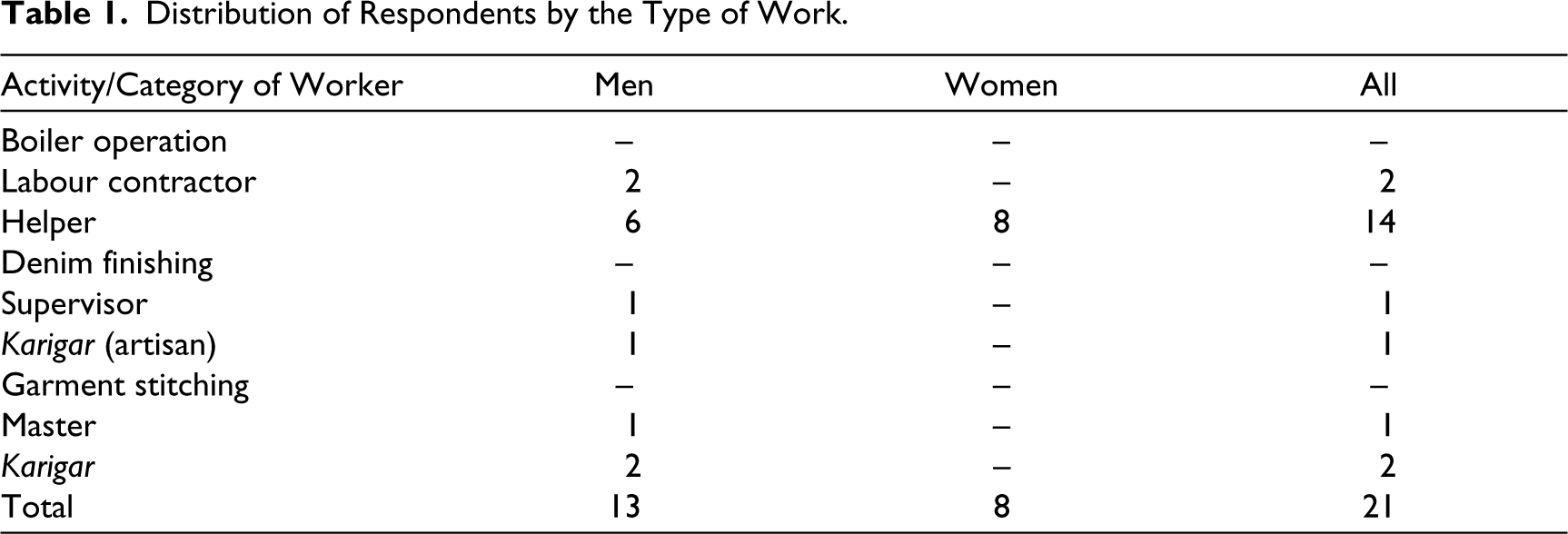
Fieldwork for this study was undertaken between August 2021 and September 2022, during the time when the first author was associated with Aajeevika Bureau (AB), a workers’ rights organisation with a long presence in the western Indian labour migration corridors. We followed a qualitative approach to study the working and living conditions of migrant workers engaged in three different activities—boiler operation, denim finishing (or washing 2 ) and garment stitching—in the textile industry. Data was gathered through observation and unstructured personal and focused group interviews with workers, contractors and employers. In all, 21 workers from different work categories were interviewed—13 men and 8 women. The first author conducted these interviews in person. The respondent details are given in Tables 1.
Distribution of Respondents by the Type of Work.
The focus of the interviews was on understanding the reasons why some workers choose to live within workshops, factories or their larger compounds and how such living arrangements affect their social life as migrant workers without any roots in the city and scarce rights of access to its myriad services and facilities. All the interviews were recorded and transcribed. The transcripts were coded to arrive at the core themes for discussion, which were further developed through multiple rounds of interaction between the authors.
The respondents of this study were identified with the help of the Karkhana Shramik Suraksha Sangh (KSSS), a registered trade union of garment and textile workers supported by AB. The association with KSSS was critical in the study as the factory sites are generally not accessible to researchers. The relationships developed by AB with workers and local networks through its legal aid work became particularly useful in our field research. We benefitted from long-term observation of labour relations as part of AB’s activities in the area. Names of participants and their worksites have been changed to safeguard their identity.
Living arrangements differ distinctly among boiler operation, denim finishing and garment-stitching occupations in Ahmedabad’s textile industry. These distinctions in the daily reproduction of migrants are an outcome of labour market segmentation wherein migrant workers from Adivasi and Dalit 3 groups remain at the bottom-most rung of the labour market characterised by insecure, erratic, low-waged and unskilled labour (Jain & Sharma, 2019; Shah & Lerche, 2018). Thus, Adivasi workers are engaged predominantly to run boilers, an activity which demands hard manual labour for loading and unloading charcoal into boiler chambers and periodically cleaning the chambers. The work goes on round the clock, and workers are constantly exposed to the risk of burns, explosions and carbon monoxide poisoning. The work is divided into two shifts of 12 hours each. Women also bear the additional burden of domestic responsibilities while dealing with poor and inconsistent availability of basic facilities and lack of childcare.
Denim washing and garment stitching, which are more skilled occupations and offer better wages, are dominated by migrants hailing from states such as UP, Bihar and western Rajasthan and belonging mainly to OBC categories. They secure work in the units through ethnicity-based networks just the same way as it used to happen in the late nineteenth century. Labour turnover is high as the only way for workers to obtain a higher piece rate or ensure sustained income is by changing employers. In a few cases, workers become in-house contractors after few years of working with the same employer. Then, the employer contracts out a certain number of machines to such workers to run. This enables them to access better accommodation, secure the accommodation for a longer time period and relocate their kin to live with them in the city. Adivasi migrants engaged in boiler operations are rarely able to enjoy these facilities.
Major Observations and Discussion
Nature and Conditions of Work
Boiler Operation
Adivasi boiler workers are usually recruited in jodi (or a pair usually consisting of husband and wife) directly from the neighbouring districts in southern Rajasthan, western Madhya Pradesh and eastern Gujarat with the help of thekedaars (labour contractors). The contractor extends them a lumpsum advance beforehand. Though illegal under the Bonded Labour System Abolition Act, 1976, the wage advance system is pervasive among boiler workers. Wage advance is a crucial mechanism that sustains mutual dependence of employers and workers over migration cycles by ensuring continuous supply of cheap labour force for the former and availability of lumpsum cash for the latter to be used for a variety of consumption and other needs and for building modest savings. Workers repay the advance from wages earned at predetermined daily rates—₹400 per male and ₹350 per female. Female workers earn lesser wages than males even when they perform similar tasks. There is no periodic payment of wages. The contractor extends small sums (or kharchi), weekly or fortnightly or as and when demanded by the worker to purchase essential provisions and to travel to and from their source village. At the end of every employment cycle, wage advances and recurring daily expenses are set against the total wages due to workers. Labour relations enmeshed in debt make it difficult for workers to negotiate higher wage rates or access better-paying jobs even within the sector. Instances of upward occupational mobility are hence very rare. We found one such case in our study where a boiler helper could rise to the position of a labour contractor. Even when factories shift to more labour-intensive processes, the work time and wages of the operators hardly improve. At the time of our fieldwork, one of the factories, the ABC Company, was found to be in the process of transitioning boiler fuel from charcoal to firewood to comply with regulatory guidelines. This shift meant doubling of labour as workers now had to manually remove firewood from the boiler, while charcoal would have turned into ash. However, the Adivasi workers were paid the same wages.
Denim Finishing
Denim finishing work, referred to as designing or creation by workers, includes tasks such as hand scrapping, whiskering, tearing, tagging and spraying denim with potassium permanganate subject to the sample approved by the buyer. These processes are followed by washing to give further aesthetic treatments, which may sometimes be outsourced to other specialised units. This work runs on short deadlines, with the number of pieces to be produced typically ranging in the thousands, divided among 10–12 workers. A minimum of 12 hours of work is expected, though work hours often stretch to 14–18 hours to meet order deadlines. The wage per piece is in the range of ₹2–4 depending on the material’s quality and the work required per piece.
Garment Stitching
Garment-stitching units pay ₹19–21 per piece as wages to workers. This work involves cutting and stitching of shirts, kurtis (women’s tunics) and trousers, as well as fixing buttons and loops on jeans. Over the past couple of years, particularly since the COVID-19 pandemic, there has been a reported reduction of more than 50% in the margins earned by workshop employers. Wages paid to workers have suffered a significant decline. A worker who puts in 10 hours a day on an average used to make around 800–1,000 a day earlier. To make the same amount now, one must put in extra hours of work, provided work is available, as workers explained. Vipul, a garment-stitching worker, recounted that his wage rate has been halved and working hours extended since the pandemic.
Pehle to 43 rupiya me karta tha, 50 rupiya me karta tha, toh wo 25 rupiya–30 rupiya deta tha. Ab 23 rupiya me kar raha hai. To jab uske khud ko nahi paisa ayega to humko kya dega. Toh 19–20 rupiya me maal banata hai. Pehle se apeksha me ab samay zyada hai aur rate kam hai. 800–1,000 rupiya roj ki kamani hai. Pehle 10 ghanta me, ab ded-do ghanta badh gaya.
(Earlier [his employer] used to get ₹43–50 [per piece]; then he could pay [us] ₹25–30 [per piece]. Now [he] gets a rate of ₹23. So, if [he] does not get money then what would he give us. So, order is made at ₹19–20. In comparison to earlier times, it takes more time now, and rate is less. [I] must make ₹800–1,000 daily. Earlier [I could do that] in 10 hours; now it has increased by one and half to two hours.)
Living Arrangements
The living arrangements of migrant workers differ across occupational categories. Typically, labour contractors arrange for accommodation exclusively for boiler workers inside factory compounds or immediately outside the premises in proximity to the boiler. Factory owners and managers usually pretend not to be aware of the living conditions of this critical workforce. The housing is of make-shift nature and lacks access to basic facilities. Workers move into these shelters with some ration and their personal belongings brought from home.
At ABC company, we found that workers were living in a hutment on a vacant plot adjoining the boiler. They informed us that this hutment had been around for nearly two decades—since the time workers from their village began migrating to this factory for running boilers. Access to facilities within the factory, such as toilets, is not available to them. Hence, they have to resort to open defecation in the plot behind their hutment. Women have to wait for late night or early morning hours to be able to access this. The hutment has temporary enclosures for washing and bathing. Water is provided from the factory in large blue drums. Recently, their contractor installed a water cooler for them. After work, the women cook on hearths inside shelters, which emits thick smoke that fills up the entire hutment. The plot on which the hutment stands is low-lying, with dense undergrowth, and prone to accumulation of rainwater with no outlet channel. Some of the shelters have bunds lining their walls to protect against ingress of water during continuous spells of rains. For hutments in the interstices between factory compounds and vacant lands adjoining factory premises, the labour contractor pays rent to the land right holders. The landlords usually belong to the Bharwad community, a protected pastoral community in Gujarat.
Some factories also provide accommodation for boiler workers inside the factory premises. In one such processing factory in Narol that one of the respondent labour contractors took us to, boiler workers were accommodated in five rooms in a brick-walled structure situated at the far end of the factory compound. These were adjacent to the effluent treatment plant (ETP) and chemical storage area; both continuously emanated a foul stench. Nearly 50 boiler helpers reside in these rooms along with their children, who spend time playing around unsafe worksites. The only source of ventilation in the rooms is a small square-shaped hole in the corrugated metal roof, allowing light into the otherwise poorly lit rooms. There are no windows inside, and the open doorways are covered with cloth and plastic curtains. The women cook outside the room in a small open paved area abutting the rooms. The firewood is supplied by the factory, possibly the wood left from the phasing out of old boilers in the factory. Water is also provided by the factory, while there is no proper provision of toilets. However, the workers consider the arrangements better in comparison to living outside the premises in a temporary hutment. Though the labour contractor deducts rent from the wages for this accommodation, it is counted as an additional benefit given to workers.
One of our respondents, Suresh, has always lived inside his factory wherever he has worked in Ahmedabad. As a young unmarried male migrant, he easily manages to live with other male migrants. He does not think about bringing his dependents to live with him. In the denim finishing factory that he works, about 40– 50 other male workers from Barmer and Jaisalmer districts of western Rajasthan also reside. They make up a dominant share of the workforce in the factory. Most of them are engaged in tasks that require certain level of knowledge and skills and are often found to be in-house contractors as well. There are also workers from UP, Assam and Bihar. A few tribal migrants, including women, who operate boilers also live there. They live adjacent to the boiler.
There is no demarcated area for dwelling or sleeping within the factory. It is up to workers to find space between machines or in the open ground behind the building that is used for line-drying denims. Two rooms were being constructed at the far end of the open ground to accommodate workers. Some of the in-house contractors were bearing the cost of the construction, which will be recouped eventually in the form of rents from workers. The cooking arrangements differ between caste and ethnolinguistic groups, though each such group prefers to share the same arrangement. Thus, the group of male migrants from Rajasthan have engaged a cook for themselves, while the small group from Assam have food parcels. Most of the workers from UP and Bihar rent rooms in residential colonies outside the factory since the employer does not prefer to have them spending nights in the factory.
Unlike processing factories, garment-stitching units are usually located in one or two galas (small one-room establishments) inside buildings. Workers keep their belongings, sleep and rest on the shop floor in spaces between their stitching machines and long tables used for cutting garments to size. Employers do not usually invest to make the workplace habitable. In one rather exceptional case, the builder has designed the galas with provision of a tap, chowkdi (washing area) and a toilet in each. Drinking water is provided in 20 litre drums arranged by the employer through a supplier agency. Workers mostly hailing from UP and Bihar also cook inside the galas. They get tea and food parcels, twice a day, from eateries in the vicinity. In another workshop, however, 15 workers who have migrated from western Bihar and eastern UP spend their days and nights crammed inside the gala. The windows and ceiling fans do not help ventilate the excessive indoor heat trapped by the metal roofing during afternoons and summer months.
Provision of decent and adequate living facilities for migrant workers is not a priority of the employers in most of the processing factories and workshops. They let the workers simply occupy the factory floor or free areas within galas and leave them to fend for themselves under the surveillance of labour contractors. However, their biases about workers from certain regions and caste-ethnic groups do influence the decisions as to who can occupy which of these spaces. The employers and contractors particularly make sure that certain categories of workers remain segregated from the rest. We found this to be the case with boiler operators from tribal households whose work involves greater risk and whose contracts are drastically different from those of others, thanks to their deeper entanglement in persistent debt-bonded relationship with jobbers.
Occupational Safety and Health Risks and Ways of Coping
The health of labourers depends critically on both working and living environments. In India, workers usually have to routinely deal with hazardous work processes and worksites. Proper living arrangements mitigate the negative impact of the work environment and are largely essential for the renewal and regeneration of labour power. Onsite living increases exposure of workers to hazards and bodily injuries and severely compromises the ability to mend and nurture their bodies every day.
The tasks performed in garment-processing and boiler operations are inherently hazardous. The repetitive nature of tasks and excessive work hours make workers more vulnerable to injuries and health hazards. Bodily pains and fatigue by the end of arbitrarily prolonged workdays are brought up as issues by the workers repeatedly. In garment-stitching units, finger injuries from the needle of the stitching machine are common. Vipul showed the scar where the needle gashed his index finger recently. ‘Seth lejakar dava-vava kara ke, phir araamse soye the, phir theek hogaya. Uske do-teen din baad phir hum kaam karne lage’ (‘The employer got me treated, then I rested and slept easily. I resumed working two to three days later’). He did not receive any wages for the days when he was absent due to the injury.
At one of the meetings with Suresh after his work shift, he showed his scarred thumb. It was usual for him to bruise the edge of his thumb while using sandpaper or other tools while hand scrapping the denim. To prevent getting injured, he usually wraps his fingers and thumb with tape rolls or Band-Aids (a popular brand of adhesive bandage) that he purchases on his own. However, his employer asked him to urgently prepare one sample pair of denim for a potential buyer. He had no time to apply the tape roll. The repeated motion of the sand block hitting against his thumb deeply bruised his skin. ‘Agar haatho me cover hota to phir kuch nahi hota’, he said (‘If my hands were covered, nothing would have happened’).
Other denim-finishing processes like spraying of chemicals on denim to give it a distressed appearance are hazardous for workers’ health. Fumes produced in the process cause irritation to the nose and eyes, while dust from the fabric flies into the mouth, nose and eyes and sticks onto the skin. Suresh states that masks help cope to an extent, but wearing masks for long causes discomfort and suffocation. Workers who live on sites like that of Vipul end up being exposed constantly to excessive levels of heat inside the workshop. Garment-processing units like the one where Suresh works use and store a variety of chemicals required for pre-washing and finishing processes. Given that no worker safety measures are followed in their storage and deployment, these substances remain on workers’ hands and bodies. They can often be spotted with dye-stained fingernails and scald marks on the hands and feet, all of which creep into their food and water as well.
For boiler workers, exposure to ash, soot and coal dust is routine, which they endure with stoicism. Cleaning work is particularly hazardous and requires extraordinary willpower and ability to withstand pollutants and surface heat of the boiler touching against the skin. Even if it has been flushed with fresh water and shut down for half a day before entering, surface temperatures only come down to about 80–100◦C, as informed by a labour contractor. Boiler cleaning is a recurrent job, its frequency ranging from once a week to once every month. No safety gear is provided to workers who perform the task. Skin burns, blackened hands and feet, respiratory illnesses and bodily fatigue are common among boiler workers. Some workers tie cloth around their exposed body parts, cover their noses and mouths and use head protections for lifting loads overhead.
The workers who live on-site are the most likely victims of industrial accidents. Suresh mentioned such an incident in his factory. He was woken up in the middle of the night by workers raising an alarm when they suddenly found themselves shrouded by smoke. Most workers inside ran out of the factory, yet there were some who did not realise and continued sleeping. A careless use of peroxide had started a fire in a chemical container. It was contained immediately, and the smoke dissipated in sometime. He said that after this incident, fewer workers wanted to sleep inside the factory premises.
When asked whether this risk is common in his work, Suresh responded, ‘Risk ka saamna to humari majdoori me hai, hume karna hi hoga kaam’ (‘Taking risk is part of our job, we have to do it’). He is not sure, however, of the long-term impact on his body of regularly inhaling fabric dust emitted from whiskering jeans, erratic working hours and prolonged standing in one position. Workers are hardly left with time to think about dealing with risks with the tight production cycles they are subjected to. For garment-stitching workers like Vipul, long working hours are the biggest source of risks. ‘Sabse badi jokhim ye hai ki time hi bohot zyada hai. 12–16 ghanta duty karna hum nahi chahte magar majbooran karna padhta hai … Jab paisa kamana hai to thoda bardaash karna padhta hai’ (‘The long working hours is the worst risk. We do not want work for 12–16 hours but are forced to do it. We must endure all these as we have to earn money’). The workers are clear about the trade-off between routine experience of risk and losing jobs and earnings that they badly need.
‘Choosing’ to Live On-site? Workers’ Rationality
Why do workers live inside their crammed workplaces? For many workers, the option of in-factory accommodation is like an additional benefit extended by the employer. Vipul, who works as a karigar in a garment-stitching unit, experienced many problems when he was renting a room with four other migrants. In his previous employment he used to live in Bombay Hotel, close to the workplace. There, he did not have access to regular water and electricity despite timely rent payment. He faced threats of abuse and violence whenever he demanded any service. Once he decided to leave that accommodation, he sought workplaces that offered on-site living, food and timely wage payment. In the new workplace too, he had difficulties initially with food and living setup: ‘Hum bole tab toh dikat hojayega phir woh log socha ki naya aaya hai, dhal jayega … kaam ka jor padega to dhal jayega’ (‘I said then it would be difficult, then the others [workers] thought that I am new, and I would adapt to the situation under work pressure’). For him the ideal option is to live outside the factory. ‘Room lijiye toh 3,500 rupiya lag jayega. Yaha das-pandra hazaar ek mahina kama ke, kya karlijiyega?’ (‘Renting a room will cost ₹3,500. What can one do here with earnings of 10–15,000 a month?’). In such a situation, he has no choice but to live inside the workplace. It is true that in-factory accommodation helps migrant workers maximise daily earnings by working longer hours and saving on the rental cost, especially when wages are low and falling.
Adivasi migrant workers, however, are hired with the condition of on-site living to ensure the persistent running of boilers. As mentioned earlier, these workers have a highly dependent relationship with their labour contractor. The shared kinship identity enables him to exercise paternalistic control over workers to continue such a hyper-extractive work-residence system to sustain production. According to one labour contractor, tribal migrants prefer to take up work in boiler and construction sites, because they are able to stay with their families in settings that mimic social life back home. Also, by maintaining social and kinship ties at the workplace, they are able to enjoy greater mobility between home and workplace with a sense of security of employment. Each time they take a break from work, their kin take up their place in the factory. Access to such ‘perks’ appear to be the reason why they do not grudge lesser wages compared to those who live outside.
As mentioned earlier, certain types of occupations like running boilers require that workers are always present on the floor. On-site living is hence part of the work modality for such workers. However, even in garment-stitching units, employers offer on-site accommodation to workers as a strategy to stagnate wage rates and retain workers even during lean seasons. Asif, who works and lives in such a unit, says that living on-site is beneficial for him as his employer allows him to work in other stitching units in the vicinity if there is less work. This keeps his sleeping space undisturbed. In this way, the employer is able to ensure Asif’s continued loyalty even during periods of no wage payment. The employer can put moral pressure on the worker to meet his firm’s needs during busy periods.
As living gets woven into work, the division between both obfuscates. Suresh says that in Narol, 12-hour workday is the norm. The hours can get longer and erratic. Sometimes he barely gets to rest.
Mera koi fix nahi rehta … Dipawali ke mausam me 18–20 ghante duty deni padti hai … seth humko 24 ghante me se kabhi bhi jagaa sakta hai kaam ke liye … Hum rehte hai toh urgent haato haath maal nikal dete hai. Aesa kahi baar hua hai aur parso bhi aesa hi hua tha. Me raat ko teen baje jagaya soya hua. Ki machine sab band hai toh fata fat karke maal nikal ke de. Phir mene ek ghante me 100 piece nikal ke diye.
(‘Mine is not fixed … during Diwali season, I have to work 18–20 hours … employer can wake us up for work at any hour in the 24 hours … we stay [in the factory] so that we can urgently fulfil orders. This happens often, including day before yesterday. I was woken up at three [in the morning] to quickly produce orders since the machines were all shut. Then I made 100 pieces in one hour.’)
His employer’s ability to obtain new orders and deliver them just in time even at shorter deadlines rests entirely on workers like him being always at the factory’s disposal.
The excessively long work hours means that there is hardly any time left for workers for cooking, childcare, leisure or organising routine household activities. Among boiler workers, women are doubly burdened with boiler work and household work in a living arrangement with uncertain access to facilities, whereas girls take care of their younger siblings. They barely get to rest as they explained: ‘Sabhi paanch baje utth jaatein hai, aur aanth-nau baje tak kaam shuru kar dete hai … Raat ka koi thikana nahi hota, kabhi 10, kabhi 11’ (‘All wake up at five in the morning and start the work-shift by eight or nine … There is no certainty as to when the work shift ends, sometimes ten, sometimes eleven [at night]’). Each of the women participating in the discussion with us had four to seven members—young children and husbands—to look after.
Making Sense of Workers’ Experiences with On-site Living
The workplace-residence arrangement discussed above is a feature specific to the informal industrial configuration found in Ahmedabad. While it bears some resemblance in terms of drivers and outcomes to the other models we discussed in the beginning of the article, like the dormitory labour regime or labour hostel arrangement, there are notable differences too. For instance, in most of the factories, living arrangements of migrant workers are segregated on caste/ethnolinguistic lines. Migrants from the most marginalised communities are typically engaged to perform tasks that involve drudgery and occupational risks and are isolated from the rest. Following Hoselitz (1955), one might argue that migrant workers tend to draw a sense of security from individuals with whom they share kinship ties or ties of previous residence or dialect/language. What is important, however, is to note that the employers encourage and reinforce such a practice as it suits their economic calculus better than when the migrants are united and conscious of their identity as industrial workers.
While economic considerations and survival needs drive migrants to on-site living, employers increasingly use it as a strategy to extend definitive control and regulate the employment of unskilled migrant workers. It is meant to address the just-in-time production rhythms of firms with the help of a mobile workforce readily available at the workplace. At least in some cases (as in garment-processing and stitching work in this study), employers also live in the factories and exercise complete control over the work and non-work time of labourers. No effort is made by employers and contractors to invest in basic facilities to make the workplace habitable. But they usually project on-site living as an additional facility or benefit offered to rural migrants. The focus unwaveringly is on ensuring the continuous availability of workers on the shop floor to meet production demands and expropriate surplus value. Such confounding of production and reproduction makes the labour process highly exploitative.
It is important to note that on-site living does not mean the same degree of (un)freedom of mobility in all situations. Garment-stitching workers, for instance, are able to move between workshops to maximise their earnings and avoid idle time while retaining their sleeping space. In contrast, the debt-linked relation of boiler workers with the labour contractor and the factory impedes their mobility and resistance, turning them into an amenable workforce for continuously running boilers. The boiler labour gang has been engaged at the same factory through kinship-based ties and wage advances for nearly two decades. For garment-stitching and denim-finishing workers, the accommodation system does not engender long-lasting relationships with the employer, since workers are able to attain better wage rates only by changing employers and workplaces.
Living arrangement, however, profoundly influences workers’ relationship with employers, industry and the city. On-site living serves to isolate individuals from the larger lived realities around them and bind them exclusively to devote maximum time and labour to the firm. Interactions among workers get limited only to the group they reside within the workplace, who more often than not hail from the same caste/ethnolinguistic backgrounds as themselves. Such segregation, which closely corresponds to the deeply divided social order outside, means that the migrant workers never transfer their loyalty to the place of living and continue to belong to the place of origin (Hoselitz, 1955). The social isolation within the workplace is almost absolute for the most marginalised migrant workers like Adivasi migrants, whose only point of contact and source of security is the labour contractor. The on-site living arrangement eloquently demonstrates how labour processes reproduce the relations of domination and exploitation within factories. It is worth noting that labour historians have highlighted that the early twentieth-century textile mills in Ahmedabad strictly adhered to social segregation of workers along the lines of caste and religion on the shop floor as well as communal pattern of worker housing (Breman, 2004).
Intriguingly, many workers refer to the relationship that underlies practices like on-site living using terms such as sahyog (cooperation), ‘reciprocity’ and ‘benevolence’. These may be derived from their internalisation of social structures in which authority and responsibility are ‘naturally’ uneven between the socially and economically resourceful and the resource poor, with the former taking moral charge of caring for the latter commanding loyalty and commitment in return. In this sense, many of them seem to consider their working and living conditions as shaped by the same social relations as they were accustomed to in the source villages. This finding seems to lend support to the argument made by Crane et al. (2022) that living arrangements provide workers with an experience of a hybrid form of freedom/unfreedom, the elements of which are shaped by the social relations they are embedded in. This, however, is an analytical quandary as one cannot risk overlooking the complexities and divergences in perceptions and experiences of migrant workers’ relationship with their employers as discussed in this article while being cautious not to reify the bondage and unfreedom implicit in arrangements like in-factory living as a free choice. However, the findings of our enquiry give us some evidence to argue that migration, informal workplaces and informal labour relations converge together to create certain hyper-precarious occupational niches reserved for workers from particularly marginalised communities. Apart from debt bondage, a phenomenon which has received significant scholarly attention over the years, on-site accommodation is used by employers to keep vulnerable migrant workers in these niches.
Footnotes
Declaration of Conflicting Interests
The authors declared no potential conflicts of interest with respect to the research, authorship and/or publication of this article.
Funding
The authors received no financial support for the research, authorship and/or publication of this article.