




Abstract
The article starts by making a case as to why it is necessary to transform knowledge and research. It is argued that transformation is essential for epistemic justice and to tackle the complex problems of unsustainable development. Higher education (HE) has a crucial role given its pivotal position in knowledge generation, circulation and governance processes. However, the HE sector must be transformed to play such a role. The article argues that the current neoliberal social imaginary based on markets and competition is antithetical to the required transformations. Instead, a new social imaginary based on Mbembe’s idea of a new planetary consciousness is suggested to provide a more robust vision to base reform. The article discusses priorities for transforming teaching, research, global and civic engagement and how universities are governed. The article concludes by arguing that transformation must be considered holistically across these areas and that governments, civil society and multilateral organizations, such as UNESCO, also have a critical role in transforming the broader knowledge ecosystem HE currently operates.
Keywords
Introduction
In a recent public lecture, 1 the Cameroonian critical theorist Achille Mbembe made a compelling case for a new way of thinking, ‘commensurate with the planet’, that implies transforming knowledge and research as a basis for realizing more just and sustainable futures. According to Mbembe (2023), addressing the contemporary challenges, including climate change, inequality and the threats posed by global pandemics, such as COVID-19, and the opportunities and risks associated with the rise of new technologies requires the development of a new ‘planetary consciousness’. This implies a way of thinking that recognizes the interconnectedness of all living things and the need to protect the planet for future generations.
This new ‘planetary consciousness’ would require a shift away from Western, neoliberal ideas about development that are based on individualism and competition towards a more collective and cooperative approach. It requires the nurturing of a new kind of intelligence that is more holistic and interconnected and that must emerge from paying attention to three sets of relationships, namely our relationships with nature, with technology and with each other. Underpinning each must be an ethics of care based on a recognition of our ‘all-worldness’ as human beings. According to Mbembe, ‘Living together on the same planet means … learning to take care of it; learning to repair it and, above all, to share it. Care, repair and sharing are … the very conditions of its sustainability and ours’ (Mbembe, 2023, p. 6). Crucially for Mbembe, developing such a consciousness as a way of thinking means moving away from a Eurocentric view of knowledge and instead embracing ‘all of the archives of the world’. Mbembe identifies Indigenous knowledge systems that are premised on the interconnectedness of all people and all living things as having an important role to play.
Challenging existing knowledge hierarchies and hegemonies and embracing epistemic pluralism is also called for by the International Commission on the Futures of Education. The report of the Commission (UNESCO, 2021) calls for cooperation and solidarity to strengthen complex ecologies of knowledge, acknowledging the necessity of drawing upon the diversity of knowledge systems and sources (pp. 126–127). This conception of a multiplicity of knowledge advocates for the inclusion of ideas and thoughts that celebrate a ‘greater diversity of possible futures beyond the present’ (p. 126) and legitimizes ‘diverse sources of knowledge to the exigencies of the present and future’ (p. 126). There is an urgent need to transform knowledge and research to realize more just and sustainable futures for people and the planet. This article proposes a radical reform agenda for higher education (HE) that can make the sector fit to meet these challenges. 2
It is important from the outset to be clear about what is meant by ‘just and sustainable futures’ in the context of this article. The concept of ‘just transitions’ provides a useful starting point, a way of conceiving how and in whose interests transitions to sustainable futures might be realized. Swilling (2020, p. 7) defines a just transition as
[A] process of increasingly radical incremental changes that accumulate over time in the actually emergent transformed world envisaged by the SDGs and sustainability. The outcome is a state of well-being founded on greater environmental sustainability and social justice (including the eradication of poverty). These changes arise from a vast multiplicity of struggles, each with their own context-specific temporal and spatial dimensions. (p. 7)
The idea of just transitions is fundamentally concerned with redressing intersecting inequalities, including those based on class, caste, race, ethnicity, gender, rurality and disability, whilst simultaneously living in harmony with the natural environment and other species as a basis for just and sustainable futures. Although the current article is focused principally on issues of epistemic justice, it will be argued that the quest for epistemic justice is intricately linked to social, economic and environmental justice and the idea of just transitions. Struggles over just and sustainable futures inevitably draw attention to the role of different kinds of knowledge in perpetuating and overcoming inequalities, and that communities’ control and ownership of knowledge are essential if they are to be empowered in leading the transformation process.
Here it is important to recognize that knowledge systems, including the disciplinary knowledge systems taught in higher education, are never neutral and reflect dominant interests. One of the legacies of over 500 years of European colonialism, for example, has been the development of knowledge hierarchies and hegemonies that have valorized certain ways of knowing the natural and social worlds and have marginalized and, in some cases, completely erased the knowledge systems and languages of the colonized. The knowledge systems that served the colonizers’ interests were considered superior and universal in their application and scope. In contrast, colonizers often delegitimized the knowledge systems of the colonized as being provincial and based on superstitious beliefs rather than on ‘objective’ truth.
The scientific disciplines evolved in the context of colonialism, capitalism and patriarchy and have been used to legitimize the hegemony of powerful social and economic interests (Harding, 2008; Shiva, 2016). For Mbembe, the dominance of a form of scientific rationality based on the abstract and dispassionate extraction of knowledge makes it possible for science to be used instrumentally. Technological mastery over nature has facilitated new forms of violence over ecosystems (Mbembe, 2001; Shiva, 2016). The extraction of raw materials has led to the pollution of land, seas and rivers, whilst the reliance on fossil fuels has contributed to climate change. States have often deployed science to develop surveillance and means of violence that have been used against their own and other populations. The rise of ‘scientism’ (Visvanathan, 1997), based on a belief in the objectivity and universality of empirical, scientific methodologies as the ‘gold standard’ against which all forms of knowledge and research must be judged, has also influenced the development of social sciences. How these disciplines have developed also reflects the predominance of Western cultural assumptions (Odora Hoppers & Richards, 2012). For instance, they frequently draw on individualistic conceptions that contrast with the more collectivist understanding of human subjectivity that characterizes many non-Western cultural traditions. As Mbembe puts it, the ‘universal scientific subject remains … a Western man, the product of a specific historical trajectory …. It is this universality that needs to be questioned’ (Mbembe, 2001, p. 159).
In the context of contemporary globalization, knowledge systems coexist within a wider knowledge governance system that reproduces knowledge hierarchies (Odora Hoppers, 2021). There exists a hierarchy in funding and status between universities at a national level and between universities based in the global North and South, reinforced by global league tables and rankings. Research funding favours elite institutions in the global North, and Northern-based funders often determine what research should be funded. These dynamics lead to inequalities in the working partnership between Northern and Southern partners. Furthermore, publishing houses predominantly located in the global North produce outputs in English and other dominant languages, making it more difficult for academics in the global South to publish. Southern-based academic journals are rarely afforded the same status or prestige in academic rankings as those in the North. Knowledge is often organized according to a hierarchy between disciplines, which influences the peer review process. Citation practices discriminate against Indigenous knowledge outputs (Priyadharshini, 2023). Governments also have a crucial role in governing knowledge production through, for example, intellectual property legislation, competition law and regulation of access to different kinds of knowledge.
Knowledge and research are increasingly privatized. Both public and privately funded education is a vast marketplace for various private interests, from producing textbooks and learning materials to educational technologies with implications for education understood as a public good (Srivastava, 2013; Verger et al., 2016). The private sector funds research through its own research, design and innovation processes and philanthropic activities, often with limited accountability for what is funded and how it is funded. Some privately funded research, for example, has relied on extracting knowledge from community-based and Indigenous knowledge systems with little acknowledgement or recompense for the Indigenous communities involved (UNESCO, 2022b). Multinational corporations are prominent in producing and disseminating digital content with implications for the knowledge commons. Although the private sector is mainly driven by profit, it depends on publicly funded education to provide the expertise required to meet its knowledge needs.
Why Transform Knowledge and Research?
Two deeply interconnected reasons for transforming knowledge and research flow from the above understanding of just and sustainable futures. The asymmetries described above within the current global knowledge ecosystem reinforce (albeit in complex and sometimes contradictory ways) knowledge hierarchies and forms of epsitemicide (Santos, 2012) and linguicide (Skutnabb-Kangas & Phillipson, 1995) developed through colonialism. Therefore, the first rationale for transforming knowledge and research is linked to the quest for epistemic justice. Schmelkes has recently defined epistemic justice as
[T]he right of every person to their own knowledge and ways of generating, legitimizing and valuing it, as well as the right of everyone to the knowledge of humankind. The quest for epistemic justice also entails stopping the disappearance of languages and cultures that is occurring every day. (Schmelkes, 2023, p. 1)
Four interrelated dimensions of epistemic justice are relevant here. The first is to recognize the intrinsic value of all knowledge systems—an essential first step in repairing the injustices of the past. As suggested above, this aspect of epistemic justice needs to consider the cultural embeddedness of knowledge systems and their contributions to supporting and sustaining ways of life that communities have reason to value. Recognition of knowledge systems also needs to take account of their historicity, including their relationship to other knowledge systems.
The second aspect is concerned with ensuring that human beings have epistemic access to diverse knowledge systems. One of the implications of existing knowledge hierarchies is that learners are often exposed largely to Western knowledge through the formal curriculum. When considered in relation to this dimension of epistemic justice, the view of an inclusive and good-quality education at the heart of Sustainable Development Goal 4 (SDG4) must necessarily involve an education built on a pluriverse of knowledge systems rather than Western knowledge alone. Of relevance here is the issue of language. It has been suggested that language is how learners access diverse knowledge systems. This indicates that education should also be supporting the development of plurilingualism.
The third aspect concerns redressing what Fricker (2007) describes as testimonial injustice, that is, the extent to which marginalized communities’ perspectives and lived experiences are seldom listened to or considered in formal educational settings (see also Walker, 2019). Redressing testimonial injustice is also critical for the fourth dimension of epistemic justice, namely, to recognize human beings in our capacities as both knowledge takers and knowledge makers. As will be discussed below, this involves supporting the agency of human beings to engage critically with diverse knowledge systems in the curriculum through their role as knowledge takers and their agency as knowledge makers through their involvement in research and in processes of ‘commoning’.
As previously argued, however, epistemic justice is not only important in its own right. It is a fundamental prerequisite for realizing economic, social and environmental justice. In this regard, there are practical, pragmatic reasons for transforming knowledge and research for just and sustainable futures linked to a rapidly changing context. Tackling global challenges such as the fight against poverty, unsustainable cities and communities, unemployment, biodiversity loss and climate change and empowering communities most at risk in the process are complex ‘wicked’ problems. Empowering communities, policymakers and the third sector to tackle these problems is enhanced if we can draw on diverse knowledge systems or what Mbembe describes as ‘all of the worlds archives’ (Mbembe, 2023, p. 1).
New Ecologies of Knowledge
Transforming knowledge along the above lines requires moving away from a reliance on disciplinary knowledge and creating new ‘ecologies of knowledge’. The term is used to embrace the interconnectedness and interdependencies of knowledge systems and the possibilities for creating valuable synergies between them analogous to a natural ecosystem (Akera, 2007; de Sousa Santos, 2007; Star, 2016; Wojciechowski, 2009). Acknowledging that no knowledge system has innate superiority in explaining complex reality is essential. Epistemic justice demands that each needs to be evaluated using its internal criteria of validity whilst taking account of the broader historical and cultural context in which knowledge systems have emerged and developed (Odora Hoppers, 2002, 2022). All knowledge systems are also subject to biases and are ultimately fallible. The value of different knowledge systems lies in the extent to which each can contribute within broader ecologies of knowledge towards a theoretical understanding of complex reality to solve real-world problems. It is through bringing diverse knowledge systems into critical conversation with each other that it becomes possible to appreciate the strengths and limitations of knowledge systems and their ability to contribute to just transitions.
Recognizing the potential of ecologies of knowledge does not imply ‘rejecting’ academically based, disciplinary knowledge. Disciplinary knowledge has evolved over centuries and, as argued, has drawn on insights from many civilizations, even if they have taken their modern form in the context of capitalism, patriarchy and colonialism. They encapsulate specialized, systematic knowledge of the natural and social worlds related to discrete areas of human activity. They provide an invaluable resource (along with other knowledge systems) for developing new ecologies of knowledge.
However, suppose the disciplines are to play such a role. In that case, they themselves must be transformed to ensure that they are not universalizing in their assumptions and exclusionary of other ways of understanding the world. As Odora Hoppers and Richards (2014) have argued, this must include a metaphysical examination of the ‘constitutive rules of the game’ that underpin the disciplines. For the gatekeepers and guardians of disciplinary knowledge systems, this demands exercising ‘epistemic humility’ (see, e.g., Srivastava, 2022) whilst encouraging processes of critical reflection on the discipline itself. In the case of science, there is much that can be learnt from Indigenous African approaches that integrate an understanding of the natural world with a fundamental belief in the interconnectedness of human beings with each other but with past and future generations and with all living and non-living things (Asabere-Ameyaw et al., 2012; Harding, 2008). These ways of thinking about the natural and social worlds are also evident in other Indigenous knowledge systems.
Revitalizing and Expanding The Knowledge Commons
By creating new ecologies of knowledge, a revitalized and expanded knowledge commons can emerge, providing the intellectual and practical resources urgently needed for realizing more just and sustainable futures. The term ‘knowledge commons’ is often traced back to the anti-enclosure movement in England between the sixteenth and nineteenth centuries and to the American tradition of shared spaces and democracy that emerged during the American Revolution. More recently, the idea of the knowledge commons has often been associated with the rise of digital technologies and the internet. Open-source software, mass online education and training programmes, Wikipedia and creative commons licences have become prominent examples of sharing and collaboration in the digital realm. However, corporate interests’ control over these initiatives poses threats of knowledge enclosure through patents, copyrights and paywalls, restricting access and stifling innovation. Powerful technology companies can control online platforms, manipulate information and shape public discourse, undermining the free flow of ideas central to the commons.
There is a need to expand understanding of the knowledge commons beyond its current dominant usage. For instance, it is essential to note that many Indigenous cultures and civilizations have emphasized knowledge as a common good developed and shared intergenerationally. Environmental and social justice movements have also championed the common good, reclaiming resources from neoliberal forces for many years (Lotz-Sisitka, 2017). Leaders like Vandana Shiva (2005), for example, advocate for ‘Earth Democracy’, linking environmental justice and sustainability to democratizing and de-commodifying Earth’s material and immaterial resources, like water, seeds and knowledge. Such a broader interpretation, encompassing people and the planet, is critical to achieving environmental justice and sustainability. It is crucial, however, not to have an idealized view of a knowledge commons as a ‘real’ global entity. What might be considered the knowledge commons straddles national borders and diverse interests and must contend with intellectual property laws at national, regional and global scales. Instead, Lotz-Sisitka (2017) argues for a view of ‘commoning as a process’ which recognizes the struggles of Indigenous and other groups to maintain intellectual property rights but is also concerned with the educational process of empowering communities with the knowledge and agency required to transform their lives.
Towards a New Social Imaginary for Higher Education
Education is essential for the transformation of knowledge and research. Through formal and informal education processes across the lifespan, people gain access to the knowledge commons. This article, however, focuses on higher education, as it is often within the HE sector that academically based, disciplinary knowledge is produced, validated and circulated. As argued below, the sector must also play a leading role in creating new ecologies of knowledge. However, if HE is to contribute towards building a safer, more just, democratic and sustainable world, then, according to UNESCO, HE needs to be reinvented (UNESCO, 2022a).
Of relevance here is the idea of a new social imaginary, that is, a change in the collective consciousness that shapes how individuals perceive their relationships, institutions and shared future. In his seminal work Modern Social Imaginaries, the philosopher Charles Taylor (2004) argues that modernity brought about a new social imaginary characterized by the rise of individual autonomy, the nation-state and the market economy. Neoliberalism, with its focus on free markets, deregulation and the commodification of public services, has reshaped HE to prioritize economic utility over broader social goals. One of the most visible impacts of neoliberalism is the marketization of higher education, where universities are increasingly treated as businesses and students as consumers. This shift has led to the rise of tuition fees, reduced public funding and an emphasis on employability metrics. As Cannella and Koro-Ljungberg (2017) note, the transformation of universities into market-driven institutions has resulted in an ‘entrepreneurial self’ among faculty and students, where individuals are encouraged to compete for resources, recognition and prestige, often at the expense of collaborative and socially driven goals. As Krishnan (2024) has argued, if universities are to play a socially transformative role, then the current neoliberal, marketized model of the university needs to be ‘un-imagined’. Here, Mbembe’s idea of a new ‘planetary consciousness’, it is suggested, provides a powerful, alternative basis upon which the university can be ‘re-imagined’ so as to realize more just and sustainable futures. The possible implications for such a new social imaginary for HE are explored in the sections below.
A Reform Agenda for Higher Education
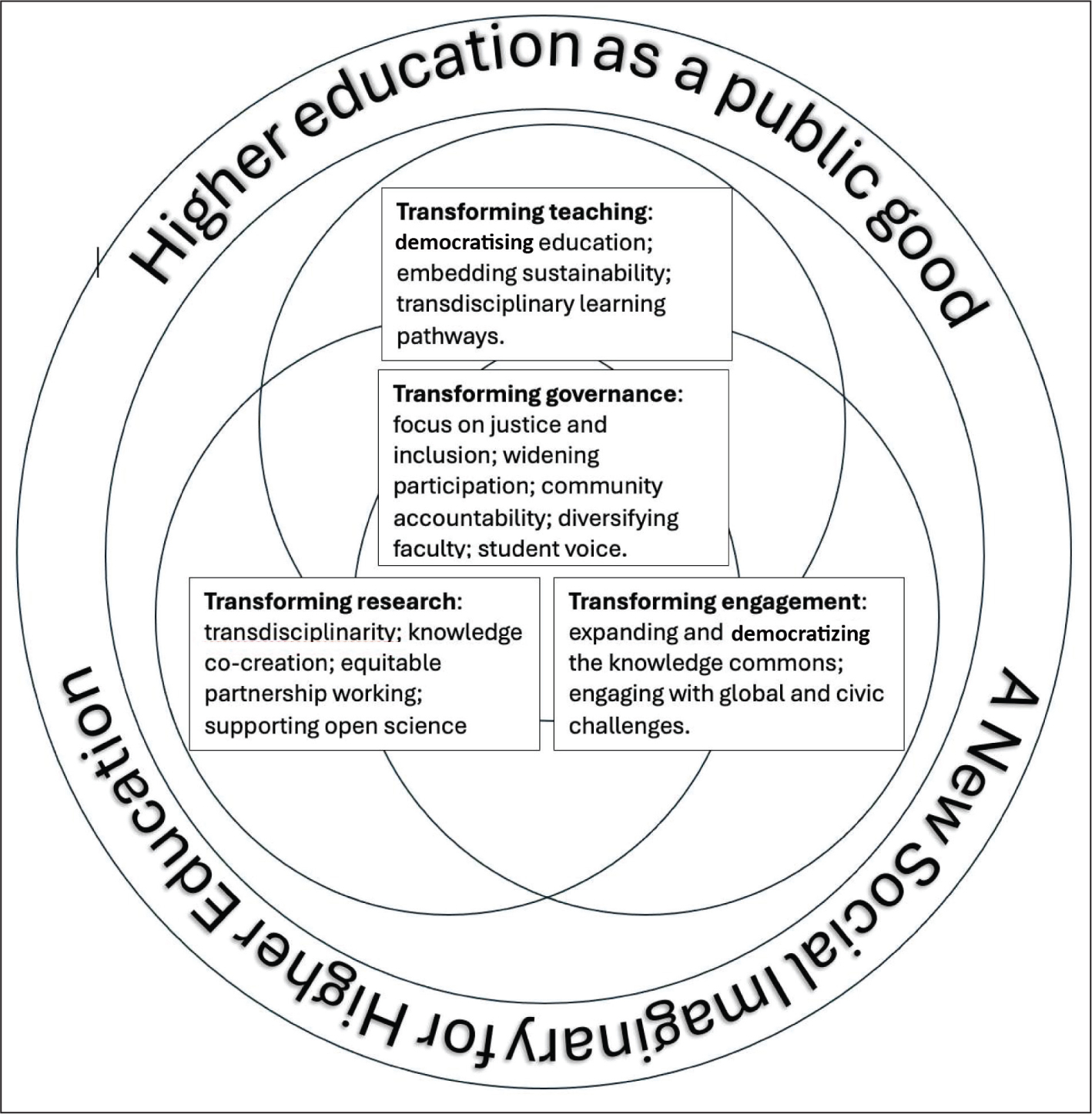
This section will focus on four intersecting areas of HE policy and practice that must be reformed if the sector is to play a role in transforming knowledge and research. These relate to the core functions of the university, namely teaching, research and engagement. Cutting across these three domains is the cross-cutting need to democratize HE institutions. At the level of policy, it is argued there must be a commitment to education as a public rather than as a private good linked to a new social imaginary for HE. A model for a transformed HE is represented in Figure 1 and elaborated in the following sections.
A Reform Agenda for Higher Education.
Transforming Teaching in HE
The recent report of the Sahle-Work Commission entitled Reimagining Our Futures Together: A New Social Contract for Education makes a strong case for rejecting knowledge hegemonies and hierarchies in the curriculum in favour of a knowledge commons built on a recognition of diverse epistemological perspectives, as the following quote makes clear:
We should resist knowledge hegemonies and foster possibilities for creativity, border-crossing and experimentation that can only come through the full inclusion of humanity’s diverse epistemological perspectives. Inherited prejudices, arbitrary hierarchies and exploitative notions must be rejected. Education can enhance people’s abilities to build on the knowledge commons, with each generation contributing to their reinventions of the world. (UNESCO, 2021, p. 65)
A priority is to decolonize the curriculum (see, e.g., Bhambra et al., 2018; Jansen, 2019; Mbembe, 2016). Decolonizing means that the curriculum needs to draw attention to the colonial legacy in education and society, decentering the Eurocentric bias of the formal curriculum and instead drawing on diverse knowledge systems. Decolonizing approaches also argue for reparative pedagogies that use understanding the effects of the colonial legacy, racism and the trade in enslaved peoples to open up possibilities for reparative futures (Paulson, 2023; Sriprakash et al., 2020; Walker et al., 2023).
In keeping with the idea of planetary consciousness, education must also pivot towards sustainability and planetary well-being, extending beyond traditional academic subjects to include sustainability-related knowledge and values such as environmental awareness, ecological stewardship, responsible consumption and understanding the interconnectedness of social, economic and environmental systems (Facer, 2020; Lotz-Sisitka et al., 2015). Indigenous knowledge systems offer unique perspectives and values in this context (Mbembe, 2023). Teaching and learning should start by recognizing and valuing students’ community knowledge and languages, providing a foundation to explore other knowledge systems. Education should facilitate learners’ movement between these systems in the form of transdisciplinary learning pathways, helping them understand, respect and appreciate diverse knowledge systems’ history, integrity and distinctiveness and explore their interrelatedness and potential for creating synergies (Odora Hoppers, 2002; Tikly, 2020). Many examples exist worldwide where universities have attempted to introduce such transdisciplinary learning pathways, particularly in sustainability-related areas. There is much that can be learnt from these efforts as we advance. A key obstacle is the hegemony of disciplinary knowledge, often linked to the way that assessment regimes, quality assurance mechanisms and professional standards are understood and implemented (below).
Pedagogical approaches should traverse both formal and informal spaces, including opportunities for land- and place-based learning (Jackson, 2023). They should foster collaborative learning environments where students, educators and local communities collaborate to identify challenges, co-create solutions and actively share knowledge. These processes of knowledge ‘commoning’ (Lotz-Sisitka, 2017) empower communities as knowledge creators able to act as agents of change. They help to ensure that educational efforts are relevant to community needs and contexts. Additionally, educational institutions should promote plurilingualism (i.e., an approach in education that recognizes and promotes the ability of individuals to use and learn multiple languages) and translanguaging (i.e., approaches to pedagogy that allow learners to draw on their entire linguistic repertoire to engage in learning, rather than restricting them to a single, dominant language such as the official medium of instruction). These approaches seek to recognize the value of all community languages and have the potential to enhance learners’ access to diverse knowledge systems (Garcia & Wei, 2014; Milligan & Tikly, 2016). This inclusive approach facilitates a deeper, more contextual engagement with various knowledge systems, enriching the educational experience.
Transforming Research
Creating new ecologies of knowledge requires investment in socially and ethically engaged research that can bridge diverse knowledge systems to assist communities in realizing more sustainable futures. The idea of ‘engaged research’ has different meanings in academia (Holliman, 2017), and it is necessary to clarify what the term means in the context of the current article. Here, the term refers to bringing the disciplines into dialogue with each other and with community knowledge systems through transdisciplinary research based on principles of knowledge co-creation and equitable partnership working. The model of socially and ethically engaged research developed here aligns with Mbembe’s idea of a new planetary consciousness in that its focus is on complex, real-world problems that are societally relevant, working in a transformative manner to understand these issues and support proactive actions or interventions.
Transdisciplinary research aims to integrate diverse knowledge systems (Lawrence et al., 2022). Transdisciplinary research pursues theoretical explanations of reality across disciplines and knowledge systems, transcending traditional academic boundaries. It, therefore, encompasses multidisciplinary, interdisciplinary research that uses mixed methods and actively involves non-academic actors in the process. Transdisciplinary research is marked by a strong sense of reflexivity, in which participants constantly consider the broader context and ensure the compatibility of all project components, methodologies and tasks throughout (DeJaeghere, 2024). However, approaches to transdisciplinary research may differ in the extent to which they become embedded in contextual realities and meet the needs of the research participants, as the examples below illustrate.
However, engaged research brings substantial ethical and practical challenges (Facer & Enright, 2016; Lepore et al., 2023; TESF Collective, 2024). These challenges include managing equal participation across all partners, reconciling diverse research interests, ensuring adequate resources and recognition for non-academic participants, promoting the use of multiple languages, and building trust and reciprocity in partnerships. There is also a need to adapt traditional research ethics to fit co-created research contexts and provide diverse modalities for presenting research findings that respect different knowledge systems. This shift is challenging for universities historically equipped to support disciplinary research and more limited applied research with industry and government. Supporting engaged research requires changing university knowledge cultures (Lepore et al., 2023) with implications for core university processes, including financial and contractual arrangements between partners and ethical protocols.
Transforming Global and Civic Engagement
As has been discussed, the idea that universities ought to be socially and ethically engaged with the needs of the communities they serve goes to the heart of the two key functions of HE institutions: teaching and research. Engagement has also often been seen as a third dimension of university activity in its own right. Traditionally, this has taken the form of providing extra-mural learning activities for the public and engaging in public ‘service’. In the context of globalization, the traditional civic mission of the university has been extended to fostering international collaborations with HE institutions around the world in the form of staff and student exchanges and international research collaborations with universities, INGOs and multilateral organizations aimed at tackling global challenges in the interests of sustainable development. These global and civic forms of engagement can be seen as a contribution to the university’s role in expanding the knowledge commons and promoting the public good.
Under neoliberalism, however, global and civic engagement have been in tension with processes of marketization in which universities have increasingly competed with each other to attract students locally and globally. The idea of the knowledge commons has also been in tension with the commodification of knowledge. Universities have a responsibility, therefore, to engage with the politics of knowledge production, governance and exchange if they are to realize their public mandate. For example, HE institutions are well-placed to transform the broader research ecosystem by deepening collaboration between well-resourced universities in the global North and resource-poor universities in the global South. They can influence how funding councils, publishers and peer review processes can better support socially engaged and Southern-led research. 3 Faculty members acting individually and collectively through professional associations can influence the content of the curriculum, for example, through their role in shaping assessment regimes and quality control mechanisms, determining ethical protocols and setting professional standards. Importantly, however, HE institutions cannot act alone. Through their engagement with civil society at local and global levels, they can seek to deepen awareness of the importance of epistemic justice as a means for achieving social and environmental justice and, in this way, actively contribute to campaigns for knowledge democracy and open science.
Organizations, such as UNESCO, that have a historic mandate to support education as a common good also have an essential role to play in advancing these more comprehensive processes of transforming the knowledge ecosystem, for example, by their role in promoting open science and international collaborations and championing the rights of Indigenous and other marginalized groups to have their knowledge and languages protected and expanded. UNESCO is well-placed to contribute also to the decolonization of education by ensuring that the idea of inclusive, good-quality education that currently sits at the heart of global educational agendas goes beyond current, Western-centric views of what counts as ‘quality education’ and is instead based on a notion of epistemic pluralism. This means expanding the understanding of epistemic justice beyond a concern with outcomes in existing global assessment regimes to also deal with the broader issues of epistemic and linguistic marginalization, exclusion and violence that characterize curricula worldwide.
Transforming the Governance of HE
Concomitant to transforming teaching, research and engagement must be transforming how universities are governed. The inherited colonial model of the university as an ivory tower, distanced from the local and global constituencies it is supposed to serve, must be fundamentally challenged. Existing mechanisms for ensuring accountability focus on global league tables based on performative assessments of research and teaching. Absent from debates about accountability is a discussion of how the voice of critical constituencies can be enhanced. Universities should ensure that their governing bodies include faculty and administrators, students, alumni, community members and international representatives. This would enable broader input and accountability to diverse constituencies. Including students and staff in crucial decision-making processes through committees and governance structures enhances their voice and ensures decisions are aligned with the needs of those they serve.
Higher education must dismantle barriers to access and promote inclusion for marginalized groups. Inclusion involves addressing gender inequalities and tackling forms of discrimination, micro-aggressions and violence based on race, ethnicity, home language or disability. Instead, HE should cultivate empathy, compassion and respect for diverse ways of knowing and nurturing a new planetary consciousness amongst learners. It should promote values like peacebuilding, intercultural dialogue and care for humanity and the planet. There is also a need to increase the participation of historically excluded and marginalized groups among faculty, especially at higher levels of the university. Diversifying faculty provides one mechanism for integrating marginalized knowledges and reorienting research in the interests of under-represented groups (UNESCO, 2022b).
Conclusion
There is an urgent need to transform knowledge and research so as to realize more just and sustainable futures. Given the sector’s pivotal role in knowledge creation, circulation and governance, HE has a critical role to play in transformation processes. However, if HE is to play such a role, then the sector itself needs to be fundamentally transformed. In the sections above, some possible ways forward have been identified. Seeking to transform a complex system such as HE requires a holistic rather than a piecemeal approach. Key to the arguments developed above is the idea that the transformation of teaching, research, engagement and governance are co-dependent. Furthermore, HE operates within a broader knowledge ecosystem that it cannot transform independently. Here, governments, civil society organizations and multilateral organizations such as UNESCO also have a critical role to play.
Footnotes
Declaration of Conflicting Interests
The author declared no potential conflicts of interest with respect to the research, authorship and/or publication of this article.
Funding
The author received no financial support for the research, authorship and/or publication of this article.