




Abstract
This formative paper reviews the recent expansion in online teacher education programmes for Education for Sustainable Development (ESD) in southern Africa. The research informs the design of resource-based learning. An activity systems approach and a preliminary mapping of the design features for online learning for ESD enabled us to tease out key pedagogical and design concerns related to the development of an online learning resource platform for teacher professional development. The proposed online resource is conceptualized as an open-source learning platform for student and in-service teachers to learn together in work with schematic models of the process for mediating the inclusion of ESD in subject teaching. A course-activated learning process is being framed around an online navigation tool for a question-led induction into the use of six key ESD lesson-planning tools. The tools are approached as mediating tools for teachers to utilize together towards ESD lesson planning that is more subject-based and better curriculum-activated.
Introduction
Online and e-learning teacher education platforms are now playing a key role in mediating teacher competencies for responding to the world’s socio-ecological and climate variation challenges by supporting learning to integrate environmental and sustainability in classroom settings. The mediating challenges here include the acquisition of knowledge in relation to sustainability challenges like widening food insecurity and poverty in relation to climate change and biodiversity loss, for example, along with learning to develop Education for Sustainability (ESD) competencies for their students to initiate and adapt to a global socio-ecological change (UNESCO, 2021a).
There has been a rapid expansion of both face-to-face and online educational programmes and a recent shift to more solutions-oriented transformative learning approaches to mediate a grasp of the long-term and the root causes of the social–ecological challenges faced by humanity. These imperatives have seen the growth of online learning in-service and pre-service teacher capacity-building programmes mediating the development of an understanding of and competencies in ESD as a holistic and transformational education which addresses learning content and outcomes, pedagogy and the learning environment (Capra, 2005; Schudel et al., 2021). These programmes have been developed to enhance teacher competencies to initiate knowledge-mediated learning in school-in-community settings and to support students in navigating the conceptual and behavioural changes for transitioning to more just and sustainable futures together.
Online learning is transforming learning landscapes at all levels in southern Africa and globally (Meyer et al., 2023; Mitrofanova, 2020). In this article, we speak of online learning as a the form of learning where there is interactions between the instructor/tutor and course participant, whereas e-learning is more self-paced. During COVID-19, various teacher capacity-building programmes and teacher resources were redeveloped for online use. When searching for ‘Sustainability Teacher Resources’, Google listed over 78 million search hits. Massive Open Online Courses (MOOCs) have also become an important platform for expanding higher education accessibility and online education innovation. These training platforms have provoked discussion about the accentuation of inequalities and considerable concerns around the issues of pedagogy, quality assurance and poor completion rates (Daniel, 2012; van Staden & Lotz-Sisitka, 2023). Through the recent expansion of online learning, we have noted that there is a need to reframe many current design conventions. Conventional design practices, particularly large-scale initiatives, have tended to bracket out the live learning transactions with a course convenor, displacing the educator of a course with online fora, webinars and tasks with facilitators working in the shadows to mediate the work of participants within systems that track the successful completion of tasks towards certification.
This article examines some of the design challenges of online learning and ESD to inform the design of an ESD-situated learning platform for the Handprints for Change 1 collaboration in teacher education. Handprints for Change uses ESD as an approach to build education systems that support learners of all ages to be responsible and active contributors to more sustainable societies and a healthy planet. This led to the emergence of ‘Handprint CARE’, which is based on the core idea of promoting ‘ethics-led action learning’ (Sarabhai et al., 2022). This paper is framed around the following research questions guided by the design challenges that surfaced in our recent online learning design work.
What range of ESD e-resources and online mediating tools are being explored and deployed for professional teacher training in ESD?
How are current ESD e-resource and online course platforms addressing existing teacher professional learning and uptake of ESD challenges in school-in-community settings?
In what ways can an ESD e-resource and online course platform be utilized as a mediating tool to support teacher professional learning and uptake of ESD in subject teaching?
How can e-resource and online course platforms be best designed as mediating tools to be utilized by teacher educators, in-service and pre-service teachers?
We start by reviewing the existing ESD-aligned online mediating tools, including online courses, e-libraries and online resource learning platforms designed and developed by ourselves or other team members. We take a closer look at how these online platforms can open-up new spaces for co-engaged learning that can facilitate and support transformative environments and sustainability-oriented learning (van Staden & van Staden et al., 2022). We then continue to investigate ways in which online courses and e-resource platforms might best be navigated by participants towards mediating transformative learning in their teaching and learning practices. The paper concludes with framing the development of an ESD online learning resources platform design to develop insights into what is required of such a platform as a mediating tool to support teacher uptake of new materials and an agency for change.
Theoretical Framework: Approaching E-Learning as a Mediating Tool for Teacher Professional Learning
For consistency with the action learning focus underlying this article, we developed an analytical vantage point for this study using the cultural–historical activity theory (CHAT) perspective to contemplate online learning platforms such as online courses and e-resource platforms as mediating tools for ESD and as transactional space where teachers learn together. The first generation of CHAT is based on Vygotsky’s concept of mediated action, which provided us with a unit of analysis focusing on the developmental role of mediation tools (concepts, language, and semiotics) for subjects concerning their object (purposeful action or activity) (Zinchenkon, 1985, cited in). Engeström (1987) further developed this perspective on learning by drawing on the post-Vygotskian work of Leon’tev, who emphasized the importance of object-oriented activity. His work highlighted how mediation tools and artefacts play out in activity systems where subjects can take up mediation tools, within existing rules of the game, with other members of their communities and within divisions of labour to advance the object of activity (their education purpose). This allowed us to approach ESD e-learning resource platforms such as the Handprint for Change as a source of schematic models of the process as mediating tools for teachers to take up within their school subject teaching with their students.
This activity theory tradition, known as second-generation CHAT, builds on the basic principles of mediation outlined above in Vygotsky’s work. The perspective enables us to contemplate processes of change and the development of agency through mediated activity (Kaptelinin & Nardi, 2006). We were, thus, able to approach the design of an ESD learning resource platform for the Handprints for Change project as a mediation process to engage and resource teachers to enable ESD within an activity system. This enabled us to lift out a design focus to clarify the objective of the course as an activity system (supporting professional learning and the uptake of ESD), undertaken in a system and with and by teachers (the subject) and within the rules of the activity system (e.g., curriculum alignment and departmental requirements) and as a professional learning community (made up of in-service and pre-service teachers and teacher educators), with divisions of labour. These dimensions of Handprints for Change are apparent in e-learning platforms and processes as mediating tools for teachers to become co-engaged in the activation of ESD as learning-led change with their students in curriculum settings.
An activity theory approach notes that artefacts or tools mediate human activity, such as social learning and that these artefacts (tools) are products of cultural and contextual requirements (Kaptelinin & Nardi, 2006). An activity always contains various artefacts (e.g., learning management systems, instruments, signs, procedures, machines, methods), which have a mediating role. Activity theory also emphasizes social interaction as a critical mediation process within an activity context and the processes of imagining that take place through deliberative interactions (Capra, 2005). These schematic contours of learning-to-change need to be considered when looking at how e-learning mediating tools can be designed to scaffold ESD as knowledge-activated innovation processes within an emerging community of practice (van Staden & Lotz-Sisitka, 2023).
Clearly, one cannot simply design an online learning process as an instrumental system to bring the desired change in teaching and learning transactions into effect. This needs to be an emergent and knowledge-practices process of co-engaged change that has to be taken into account in the design of an e-learning platform for teacher professional learning. Identifying and addressing teachers’ needs and how best to work with and support them in their professional learning journey to develop an understanding of ESD requires significant planning and rethinking to clarify online and face-to-face teacher training practices (van Staden & Lotz-Sisitka, 2023). Working from the vantage point of a CHAT perspective, we carefully reviewed how online learning platform design, curriculum-aligned resource development, accessibility and utilization of the resources can support teachers in their work on environment and sustainability (ESD) in our schooling systems. To inform the design of an ESD e-learning resources platform for our Handprint for Change resources, we review some of the ESD-aligned e-learning platforms available for teacher professional training in the following sections. We chose e-learning platforms that we were involved in the design and development of to review. We drew upon project reports and course review tools such as the Amanzi for Food Online Course Review Tool 2 to guide our review and highlight the e-learning platform challenge (van Staden et al., 2022).
Review of ESD E-Learning Mediating Tools for Teacher Professional Learning
There are diverse e-learning mediating tools. These include formal course narratives and activity sequences for professional training, teacher resource e-libraries and the learning resource platform upon which these are constituted. Each of these elements supports and, thus, mediates learning in diverse and interdependent ways. The mediating roles of these elements are only sometimes fully understood. They are commonly subsumed within existing design conventions for online learning programmes as well as in hybrid variations of these. In this way, the design of an online course framework for an ESD initiative, such as the Handprints for Change initiative, must be approached as co-engaged mediating transactions that can take many forms and where an e-library might provide access to necessary learning resources for teachers to utilize in the design of lessons that are enacted as models of the process (schema) for mediating ESD learning interactions in a classroom setting.
Review of ESD Online Courses as Mediating Tools
Online Course Challenges
For this formative paper, we have reviewed various ESD online courses, including
Sustainability Starts with Teacher course ( Amanzi for Food course ( Fundisa for Change courses ( Teaching Green Economy and Entrepreneurship Course: EMS and Business Studies (
These ESD online courses are framed around ESD as a holistic and transformational educational process that aims to transform society through change projects that are situated, transformative, agency-centered, developed and implemented within existing and emerging communities of practice (Lotz-Sisitka & Mandikonza, 2016). All the online courses reviewed were derived from face-to-face courses and constituted as online processes during the COVID-19 pandemic. The course designers and developers all faced the same challenge of shifting from mediating interactive learning within a face-to-face context to the use of e-learning tools to achieve the desired outcome of supporting teachers to expand teaching and learning practices for ESD.
The most general challenges we experienced as online course design teams and as course facilitators included:
The low digital literacy of many of the course participants. Some participants could not access online platforms due to data constraints, Wi-Fi challenges and inability to log in. Limited tutor and facilitator engagement with the platform. Tutors and facilitators did not have sound e-learning pedagogical knowledge. Low online participation and low online course completion rate.
Van Staden et al. (2022) developed a framework for ESD online courses including suggested actions to overcome these challenges. To address the low literacy levels, it is recommended that pre-course training on the learning platform is provided and that all tutors and course coordinators complete the online course before the course is made available to the participants. This ensured that course tutors and coordinators could engage and be familiar with the course content and structure. We also noted that for an online course to be successful, it should be accessible to all involved, provide friendly and empathetic support to participants throughout the course, promote the development of learning networks and be user-friendly, where participants are free to take up online opportunities to share knowledge. The design, development and implementation of the Sustainability Starts with Teachers (SST) online course research emphasized the importance of e-learning and online course design and technical support, pedagogical support, technical platform configuration, online hosting support and course content facilitation to ensure the success of the online course (van Staden & Lotz-Sisitka, 2023).
An Exemplar of UNESCO-SST as an ESD Online Course
SST is a UNESCO-led capacity-building programme for teacher educators on Education for Sustainable Development in southern Africa. The SST capacity-building programme was implemented in teacher education institutions in 11 southern African count- ries in collaboration with partners from Sweden. Following the emergence of the COVID-19 pandemic, the programme transitioned to an online learning platform and has since been successfully implemented in eight SADC countries. This online learning platform is the epitome of an ESD Online Course (
The programme is based on a five-step learning action framework centred on a situated change project for curriculum innovation and whole institution change. One of the challenges that the SST programme team faced was the support of situated change projects using virtual e-learning approaches. The SST programme reports outline that there are various components and actors that enable and facilitate the learning of such an online course (Lotz-Sisitka et al., 2022; van Staden & Lotz-Sisitka, 2023).
A Review of Regional E-Libraries and Online Teaching Resources as ESD Mediating Tools
E-Libraries and online resource platforms combine technology and information resources to allow remote access and teachers to access a wider range of materials outside their formal learning system. These e-libraries have been developed as mediating tools, and diverse e-libraries are available for teachers to utilize in planning their lessons.
For this article, we have reviewed various ESD e-libraries, including:
The Fundisa for Change Resources ( SST e-learning library for practical activities
3
( iBali Digital Collection UCT (
As ESD e-learning resource platforms have come into wider use for online learning, it has been notable that teachers are finding it hard to access and use resource materials on environmental and sustainability issues (Lotz-Sisitka & Olivier, 2001; Ramsarup, 2005). ESD e-libraries were compiled to enable teachers to easily access materials needed for classroom use. Still, there have been unforeseen barriers to their effective use and for teachers to take materials into use in curriculum settings.
E-Library Challenges That Are Emerging in ESD
The challenges we are noting include:
There is an increasing number of resource platforms that can be accessed for teaching needs. Few teaching resources on these platforms relate to sustainability concerns that are curriculum-referenced. Teachers need knowledge resources to inform them on issues, which need to be in a form that can be taken into lesson planning and curriculum-aligned learning activities. Teachers report that ESD resources related to African contexts are still challenging to find. It takes time to access and search a platform to select resources needed for lesson planning and teaching purposes, and then searches are often fruitless. The digital literacy level of teachers makes it difficult for them to navigate some online platforms and source the materials they need for lesson planning activities on online courses.
Key Design Components for ESD E-Learning and Resource Platforms
The Components of an ESD Online Course
Our review helped us to identify the key components required for an ESD online course to be successful. We noted how the success of an online ESD course like UNESCO-SST as a mediating tool for change depends on a wide range of variables. For this article, to inform our Handprints for Change e-learning resource platform design, we developed a schematic diagram that indicates key design components for an ESD online course as an e-learning ‘ecosystem’ for mediating transformative learning and agency (Figure 1).
We deduced that, for an online professional teacher training programme to be successful, it should be developed as an e-learning ‘ecosystem’ as depicted in Figure 1. Figure 1 shows that selecting and developing a suitable online learning platform/course are only half of an e-learning ‘ecosystem’. The online course in itself consists of specific components with mediating functions, but these have to be seen in relation to co-engaged participants and their diverse contexts of innovation.
This review work allowed us to approach selecting and designing a course platform as a learning management system with a communications platform to enable interactive learning actions linked to a resource library for participants to explore and contribute to. Drawing on Figure 1, we determined that an online course has various key dimensions to consider and aims to provide learning materials, resources, guidance to change projects and access to newsletters and exchanges amongst learning network partners. Lastly, an ESD-aligned online learning platform/course also functions as an evaluation tool as the learning mediation system allows one to track the course participants’ progress, as well as provide back-end data for assessing value creation and the evaluation of the programme process and its outcomes (Figure 1).
A Schematic Diagram That We Developed as a Preliminary Mapping Key Design Component for an Online Course Platform for ESD Curriculum Uptake.
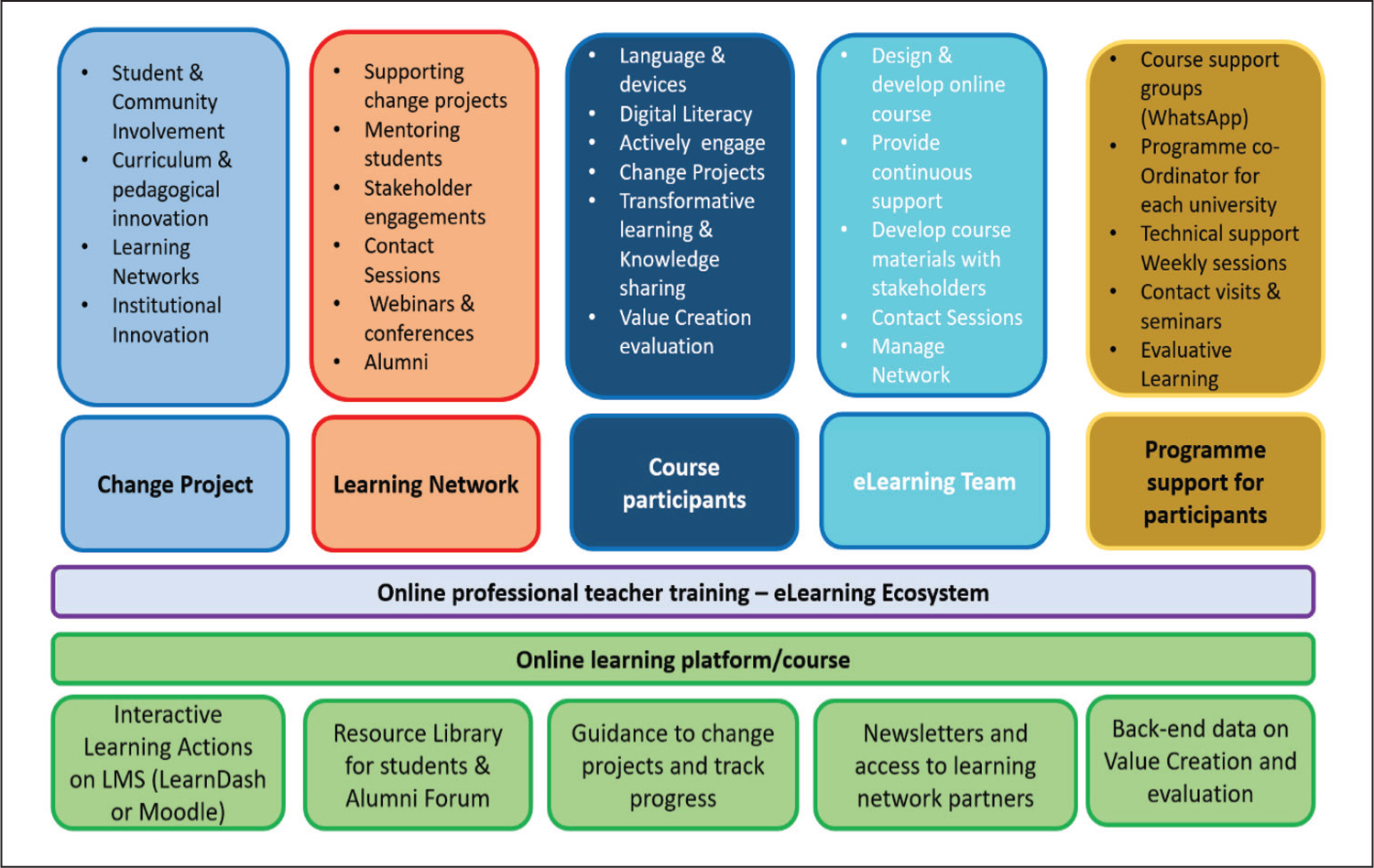
The other integral components of the e-learning ‘ecosystem’ include a grasp of the process of change involved. In the case of UNESCO-SST, a ‘change project’ was a key design feature that supported participants in enacting and reporting change. The change-project component is designed to ensure active participation and an arena for curriculum and pedagogical innovation by participating educators. It also supported participants to initiate the development of learning networks and to become engaged in the mediation of institutional change.
Across the exemplars reviewed, learning networks were all centred on the change project that various participants were supported to initiate. Here the course design provided mentoring opportunities and supported interactions with wider local stakeholders. The succession of courses in southern Africa also leads to the development of the alumni, who will take up mediating roles in future courses and contribute to contact sessions, webinars and conferences.
We found that a key component in an online or hybrid course design is the programme support for the participants. It was found that additional support was necessary for programme coordinators and participants. This included weekly technical support sessions, contact visits from course coordinating groups, additional seminars and evaluative review sessions for participants to reflect on their own value creation.
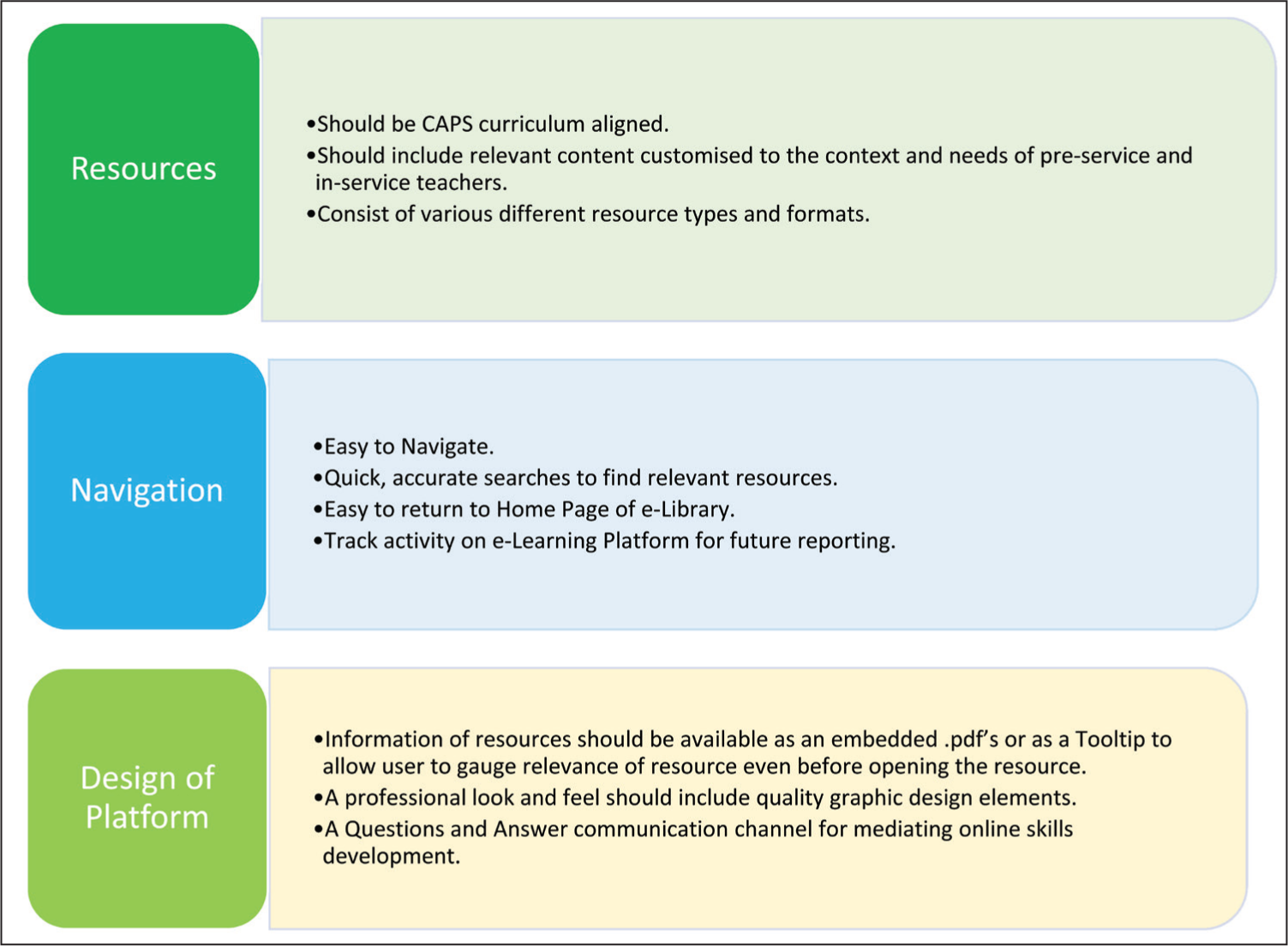
The review of the e-library allowed us to investigate and understand the challenges that are emerging when utilizing these resources. These insights and challenges have been synthesized in Figure 2 as a summary of key design components for an e-resource platform.
Key Design Components of an ESD e-Resource (e-Library).
Key Design Features of E-Learning Resource Platforms for ESD
Through the reviews of the different online courses and e-resource platforms, we identified and framed the key design components necessary to include in an ESD online learning course and e-resource platforms. We concluded that the only way to visualize and design an ESD online course platform is as a functioning e-learning ecosystem.
Through this analysis, we, as an online course and resource developers working on Handprints for Change as a teacher education initiative, realized that there is a need to frame the relevant platform component. However, we also noted that close attention to teachers’ identified challenges in online learning is essential to ensure a successful online course platform design and functionality. Therefore, we decided to explore the concept of an online learning resource platform that includes supported access to lesson exemplars with mediated access to an e-library (e-resource) of exemplar materials as an integral process.
The formative research reviews surfaced the contradiction that it is challenging to provide knowledge resources that speak to curriculum topics and that most of the materials on current e-libraries we reviewed are not oriented for or based on the curriculum. We realised that knowledge resources on ESD topics needed to be embedded in the course platform and that lesson design activities needed to reference teaching resources as curriculum-linked exemplars. Using our Handprint of Change as an online learning resource platform exemplar, we realized that mediating the selection of a suitable ESD pedagogy in ways that are aligned with curriculum specifications was a lot more demanding and challenging than we had initially imagined.
We deduced that the design components on the platform for Handprints of Change work in teacher professional development courses need to be centred around a core resource like the CEE Teacher Education Handbook (Sarabhai et al., 2022) and be developed as short topic-based resource units. The CEE Teacher Education Handbook 4 has been developed to support teacher educators in training and guide teachers in introducing ESD in school subject teaching. We then designed each course unit to be topic-specific, curriculum-aligned and consisting of three sections: subject knowledge, appropriate teaching practices and necessary assessment practices to chart learning and competence development. We concluded that a clear e-learning design strategy for professional teacher training needs to be developed. From our review, we were able to resolve the identified challenges or contradictions reported in the design and development of the reviewed online course and resource platforms. These are the challenges or contradictions that we aim to resolve in the online learning resource design for the Handprints for Change teacher education programme to introduce the resource Teacher Education Handbook.
Course Cost, Support and Time
The development of a successful ESD online course requires considerable effort, and time, as well as various types of support and unexpected costs (Figure 1). When developing an e-learning resource platform that includes the training component and the e-resources, it can be used by teacher educators to teach in class or develop professional pre-service and in-service teacher training programmes. Therefore, you eliminate all the components and processes required to run an online course by the course designers and developers. Teacher educators can incorporate resource learning units into their courses, lessons, etc. This design also allows teacher educators to access relevant resources quickly, and the learning units are short and designed for two-hour sessions.
Curriculum Alignment of Resources
Curriculum-aligned ESD topic teaching resources related to sustainability concerns are challenging to find. In-service and pre-service teachers struggle to integrate this new knowledge into their lesson plans. The e-learning resource platform’s design includes topic-based knowledge and activity resources that are curriculum-aligned through lesson planning. Exact teaching plans and assessment formats also bind teachers, and these system rules need to be considered.
Open-source Platform Design
Various challenges are mentioned around the navigation and accessibility of ESD online platforms. Our proposed e-learning resource platform is an ‘open source’ that you do not have to register to use. Therefore, you eliminate many of the technical issues any platform user might experience. The platform is also easy to navigate and mobile device friendly.
Accessing Curriculum-aligned Resources
It takes time for teacher educators to identify the relevant resources and integrate them into their teaching plans. Resources should align with the Department of Education’s approved teacher lesson plan designs but not consist of lesson plans. Resources are easily integrated into lesson plans. The e-learning resource platform’s resources should be aligned with the national curriculum and easily accessible and relevant to the specific topic and subject taught. Short YouTube videos are also used instead of long text, which teachers find hard to read.
Implicit Pedagogy
We have noted from feedback that teachers find it hard to integrate ESD learning progressions as part of their lesson planning. Each resource learning unit is structured so that it outlines an implicit but open pedagogy.
Uptake of ESD
With this framework, we are looking at the uptake of ESD through the mediation of knowledge, teaching practices and assessment. There are two streams in knowledge mediation, namely, knowledge of the subject concerning environmental and sustainability concerns, along with the recovery of indigenous heritage knowledge. Here, the real-world story in relation to issues and heritage can enable participants to engage with ethical questions around future sustainability and other Sustainable Development Goal (SDG) concerns. Here, teachers can grasp and recover capital for intergenerational knowledge insights for situated meaning-making.
The Course Content Design of an ESD E-Learning Resource Platform
Once we reviewed specific ESD online courses and e-resource platforms in the southern African region and clarified the key components and design features required to develop an ESD e-learning resource platform, we were ready to look at the design of a Handprint for Change e-learning resource platform as an exemplar of the type of required content and pedagogy needed. The Handprint CARE ethics-led action learning programme is a programme that builds education systems that support young learners to take up relevant concerns in ways that they can make personally meaningful contributions with the support of peers and their teachers. The formative research pointed to a need to clarify ESD in curriculum settings. To this end, we worked with the SDGs alongside real-world story exemplars as starting points for knowledge- mediated ESD in school subject teaching settings. Our work with teachers needed to be centred on course-supported lesson planning in school curriculum settings.
We developed the Handprint CARE e-learning resource platform, designed to introduce teacher educators to the Handprints for Change Teacher Education Handbook for knowledge-mediated learning that is curriculum-aligned to activate ethics-led action learning in school subjects. The online platform was developed as a resource-based learning process using a question-led strategy to open up the contours of a Handprint approach to ESD in school subject teaching settings.
The learning platform included some start-up materials that were developed alongside Fundisa for Change work with teachers in KwaZulu-Natal, South Africa. There were also exemplars in the handbook that were developed with partners in India, Mexico and Germany. Here, Handprint CARE learning progressions were clarified as action learning expansions of current subject discipline methodologies. Work with Mexico included a foregrounding of learning with indigenous heritage as a focus for the activation of better-situated intergenerational knowledge as a foundation for more inclusive and relevant learning in curriculum settings.
The Handprint Care 5 e-learning resource platform was developed to address many of the identified issues of learning platform design for a course-supported learning process with teachers. Watch the video 6 that describes the contours of pedagogy for a resource-based learning platform.
Figure 3 is an outline of the design of the Handprint CARE e-learning resource platform as a stage mediation tool with curriculum-aligned exemplars. This Handprints approach is embedded in the concept of ethics-led learner actions that are knowledge-informed towards a love of self, others and surroundings and informed by the SDGs as an open-ended agenda for social justice and future sustainability (Figure 3).
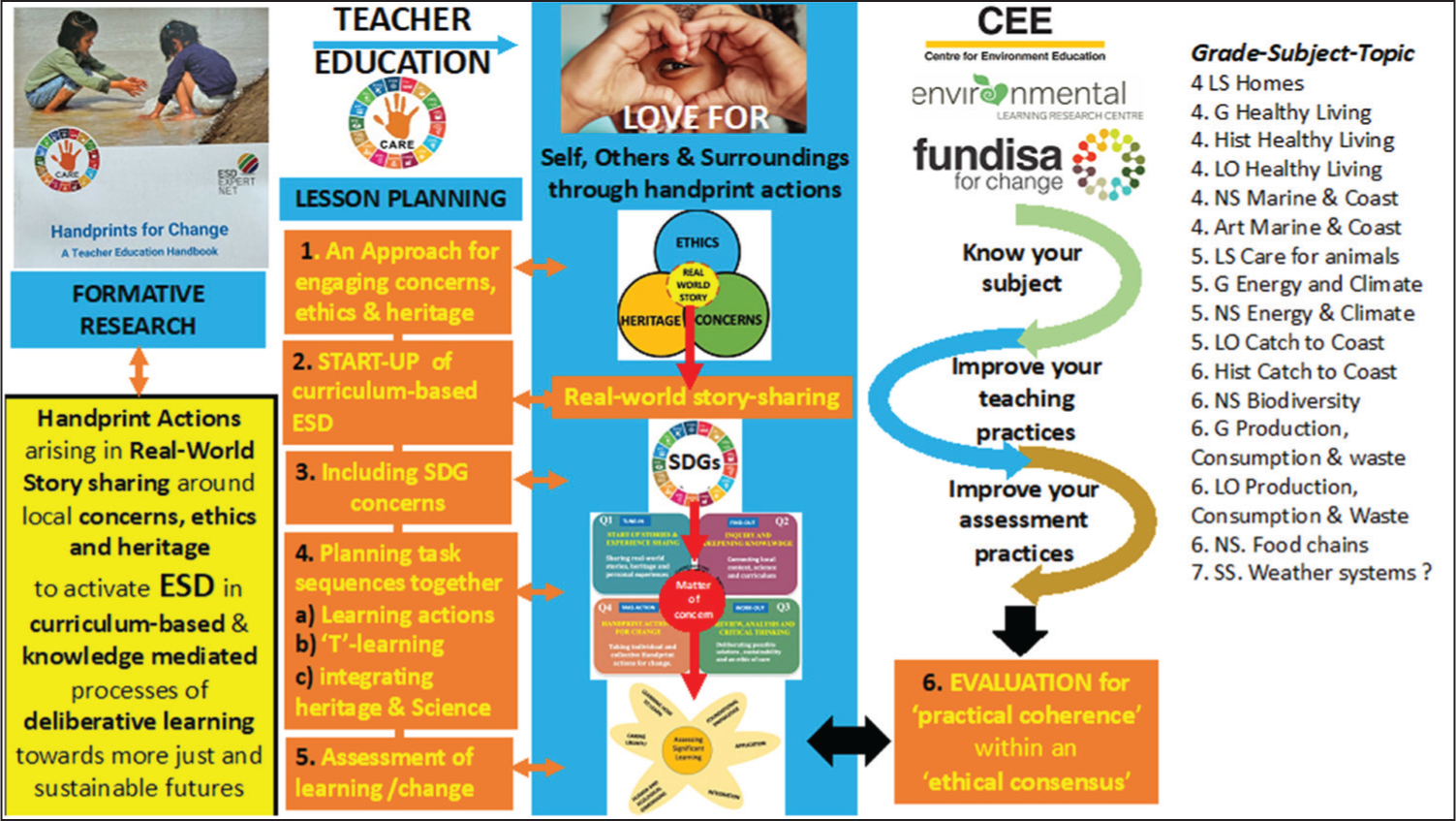
For this training programme design, a hybrid or an engaging online approach is used as a course-activated process of co-engaged teacher professional development within a developing community of practice. Pre-service and in-service teacher educators and their students will access the platform as part of their training to increase their skills, to know their subjects better, especially the new environmental knowledge, and to improve their teaching practices along with the challenge to innovate and to improve their assessment practices.
The Handprints for Change approach that we used during the development and design of our exemplar is centred on lesson planning in school subject teaching using an open-ended the four-quadrant learning task sequencing model of process, within which local matters of concern become a central focus as students look at how things were in the past, how they are today, and what does this mean to us? And, of course, what Handprint actions might enable us to do things better together. We concluded each unit with the assessment of significant learning, which is something that all teachers have to do in their school subject teaching.
From our initial Handprint for Change e-learning platform development, it became clear that there is a need for an e-learning resource mediating tool to clarify ESD and ESD resources as pedagogical processes in teacher education and school curriculum settings. As course designers, we face the challenge of developing online learning resource platforms through an ESD lens that activates learners’ social experiences towards learning to be and learning to live together (UNESCO, 2015). ESD course designers need to be able to design enabling online platforms for engaging and supporting teachers through course-activated online learning within professional communities of practice. One way to approach this objective is the Handprints for Change e-learning resource platform designed for teachers.
Some Concluding Insights on E-Learning Resource Platform Design for Mediating ESD using a Handprints Approach
The advent of e-learning platforms for ESD in the southern African region has provided us with new course design challenges, highlighting numerous axes of tension and contradictions that will need careful attention. Notable here is the advent of a ‘change-project’ design, the inclusion of the SDGs, the advent of curriculum-based learning actions and the alignment with subject curriculum topics. Recent research on teacher readiness for ESD (UNESCO, 2021b) highlighted the challenges that teachers are also experiencing in southern African subject-teaching settings.
We have proposed and are working to clarify a design research framework with a navigation tool (Figure 4). This tool consist of six focus areas for lesson planning for pedagogical deliberation as a model of process to activate a Handprints action learning approach (1) around real-world start-up stories, (2) working with the SDGs follows, (3) then there are three schematic open-ended pedagogical models of process (4) for mediating learning transactions using a four-quadrant action learning tool for planning lesson progressions to explore:
How were things in the past? How are things today? What does this mean for us today? How can we make things better together?
Mediating Tools for Teacher to Draw on for the Inclusion of ESD in Subject Teaching.
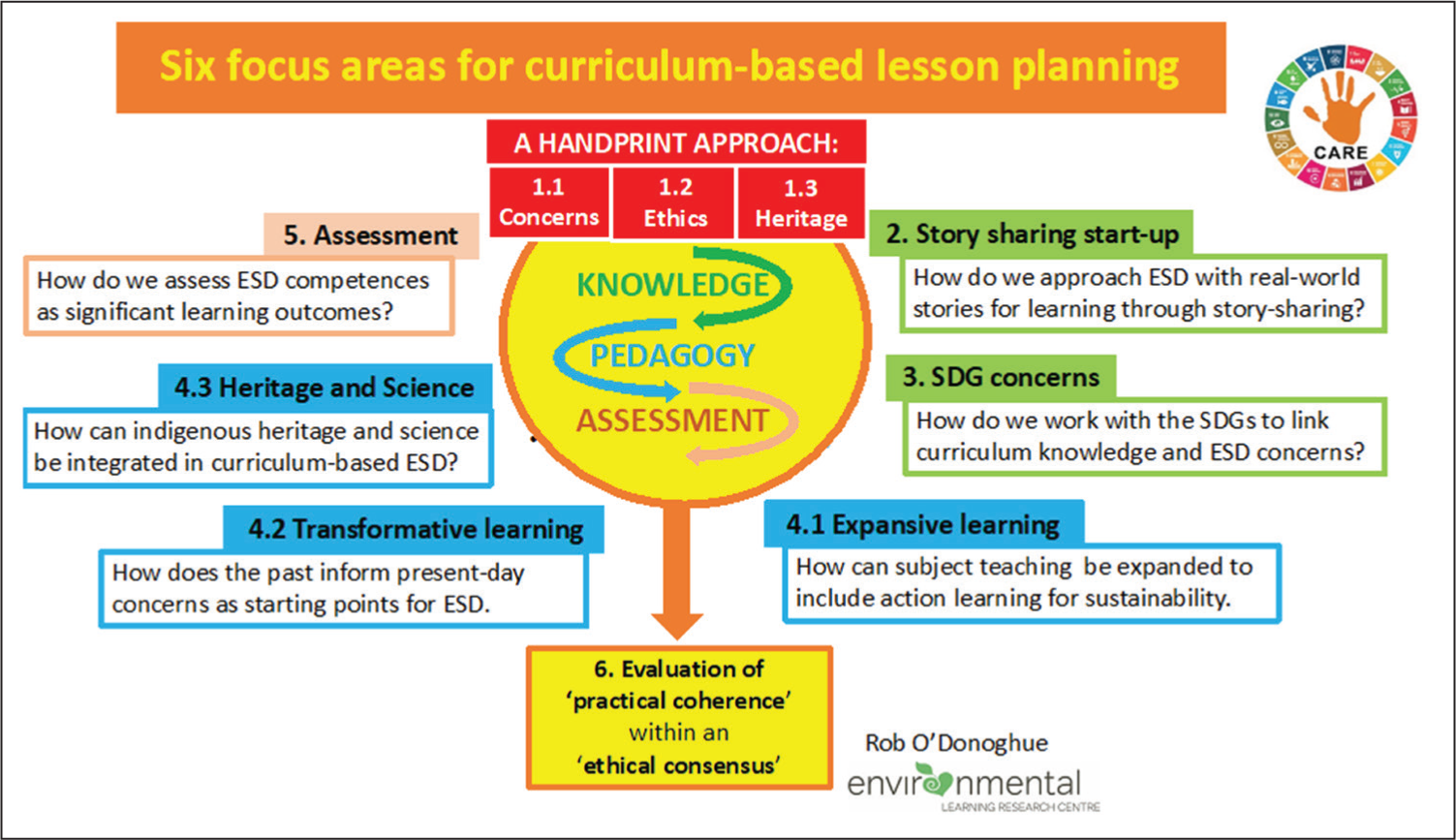
Assessment for and of learning (5) is commonly a starting point for lesson planning so that open-ended assessment criteria are specified for and aligned with learning progressions to develop ESD competencies and to evaluate learning-led change (6).
We will use exemplars from design research work with in-service and student teachers. These will need to be aligned with curriculum topics and will be developed as an action learning expansion of conventional learning progressions. Illustrative exemplars will need to be sourced and scaffolded with the SDGs enabling situated knowledge acquisition that can be aligned with and integrated in subject learning objectives and outcomes with an explicit assessment and evaluation process.
The embedded short topic-based resource units aim to translate ESD pedagogy and content for specific curriculum-aligned topics focused on enhancing a love of self, others and surroundings in co-engaged learning actions to understand and resolve local matters of concern together. The online platform of mediating tools and exemplars allows teachers to explore ethics-led learning in ways that develop around intergenerational knowledge practices, indigenous heritage and insights emerging in deliberative learning to support learning actions around related to curriculum-activated ESD.
Conclusion
This article reviewed a range of ESD-aligned e-learning mediating tools to investigate the possibilities of mediating more solution-oriented transformative learning approaches to engage teachers in the classroom with ESD matters of concern. We reviewed online courses and identified specific challenges experienced by online course design teams. These include low digital literacy levels of course participants, limited tutor engagement, lack of sound e-learning pedagogical knowledge and low course completion rate. During the review of e-libraries, some general challenges emerged, including resource curriculum relevance, lack of resources situated in the African context, and lack of time to do lengthy searches for relevant materials.
Through our analysis, we realized that in order for an online course or e-resource platform to address the existing teacher professional learning and uptake of ESD challenges in school-in-community settings, the platforms need to function as an e-learning ecosystem. We discovered different aspects to consider when designing, developing and implementing an ESD online training programme. We identified specific design components, design features, course content design and course pedagogy design that require clear planning and consideration when developing an ESD e-learning resource platform for ESD uptake in the classroom setting.
Figure 1 depicts an online course design component as an e-learning ecosystem and Figure 2 outlines the key e-resource design components. Looking at the design features of an e-learning resource platform, we conclude that online courses need to be centred around a core resource. Identifying the key design features allowed us to find solutions and address the contradictions reported in the design and development of the reviewed online courses and resource platforms.
We conclude that instead of working with online courses and e-resources, a teacher educator/trainer can access an e-learning resource platform that allows the trainer/educator to compile their own course structure and content according to the required training outcomes. The e-learning resource platform also has another function as it can be utilized by teachers and students alike. Figure 3 is a schematic presentation of the proposed navigation tool as a mediating process for mediating ESD lesson planning and curriculum-aligned exemplars that teachers and teacher trainers can engage with. In this way, does the e-learning resource platform functions as a mediating tool to be utilized by teacher educators, in-service and pre-service teachers?
Footnotes
Declaration of Conflicting Interests
The authors declared no potential conflicts of interest with respect to the research, authorship and/or publication of this article.
Funding
The authors received no financial support for the research, authorship and/or publication of this article.