




Abstract
Education for sustainable development (ESD) has for decades been a focus internationally and has been embraced in the Japanese curriculum since 2008. Given UNESCO’s emphasis on teacher training for ESD and well-established in-service teacher training programmes in Japan, the aim of this study is to explore whether ESD teacher training could help Japanese in-service teachers to implement ESD in school. Semi-structured individual interviews with 12 in-service teachers from primary to lower secondary schools were conducted via Zoom due to the COVID-19 pandemic. It was found that in-service teacher training for ESD had a positive impact on transforming the teachers in both their professional and personal lives. However, challenges remain regarding the promotion of ESD in schools because of lack of common ground with other teaching colleagues and time constrains. The implications of implementing global ESD in schools are discussed.
Keywords
Introduction
As globalization increasingly penetrates our social, economic, political and cultural spheres, individuals, societies and countries become more closely interconnected (Marshall, 2019, p. 257) and challenges like climate change are emerging to confront people in a global age. Equipping learners with essential skills to cope with today’s challenges via education is key (Kopnina, 2020, p. 281), and people need to learn how to tackle global issues by reforming existing paradigms (Casson, 2019, p. 32). To address the need for education for sustainable development (ESD), UNESCO called for a Decade of Education for Sustainable Development (DESD) from 2005 to 2014 (UNESCO, 2005a, 2005b) and then developed their Global Action Programme from 2015 to 2019 (UNESCO, 2014) and Education for 2030 from 2020 to 2030 (UNESCO, 2020). Today, ESD contributes to shaping a sustainable society and improving the quality of education in Japan (Oikawa, 2020, p. 75).
Both the role of in-service teachers and the quality of teaching are central components of student success (Tonga et al., 2019, p. 88). In particular, in-service primary school teachers fulfil a societal need through their direct contact with students who need to develop awareness of ESD in cross-curricular contexts (Lummis et al., 2015, p. 52). In Japan, ESD is an important topic at the national level; in 2008, the national curriculum for primary, lower secondary and upper secondary education explicitly mentioned ESD, and in 2009 included a cross-curricular sustainable society perspective (MEXT, n.d.). Despite this, little research has been conducted in Japan to investigate in-service teachers’ understanding of ESD (Oya et al., 2019, p. 151).
ESD requires participation and cooperation and is ideally co-constructed by students, teachers, local communities and external experts (Mathar, 2015, p. 23; Nagata, 2020, p. 7). The approach to ESD must be transformative so that learners can make informed decisions and cultivate critical thinking and problem-solving strategies to contribute to a more sustainable society and planet (Summers & Cutting, 2016, p. 3; UNESCO, 2005a; 2017, p. 7; n.d.). ESD requires both holism (Öhman, 2008, as cited in Pauw et al., 2015, p. 15696) and pluralism (Ichinose, 2017; Rudsberg & Öhman, 2010) if competencies and actions for a sustainable future are to be developed. Pluralism in the pedagogical context means ‘to acknowledge and engage different perspectives, views and values when dealing with various questions and problems’ through deliberative conversations (Rudsberg & Öhman, 2010, p. 97). Because ESD is a holistic concept incorporating multiple aspects, it requires a cross-curricular approach (Mathar, 2015, p. 24). In addition, ESD is not ‘just a little add-on to normal school education’, but should be developed in all subjects and at all educational levels (Jucker & Mathar, 2015, p. 4). Combining holistic and pluralistic approaches, Chang Rundgren and Rundgren (2010) developed a cross-disciplinary model called SEE-SEP for the teaching and learning of socioscientific issues like climate change and the use of nuclear power as an energy resource. The SEE-SEP model consists of six subject areas: sociology and culture (S), the environment (E), economy (E), science (S), ethics and morality (E) and policy (P) and the three dimensions of value, personal experiences and knowledge (Chang Rundgren & Rundgren, 2010). Just as ESD is characterized by a systematic and multidisciplinary approach, the SEE-SEP model provides a holistic view from multiple perspectives for making informed decisions on socioscientific issues. It is thus important to understand how holistic and pluralistic views are seen and implemented by in-service teachers.
The Challenges of Promoting ESD in School Contexts
Many researchers have investigated how in-service teachers put the environmental, social and economic dimensions of ESD into practice (Ichinose, 2019, p. 8). It appears to be demanding to deliver ESD to students because teachers have not fully understood what ESD is and what it entails. Sagdıç and S¸ahin (2016), looking at previous studies, reported that in-service teachers lacked knowledge about ESD but stressed that all in-service teachers should be responsible for addressing sustainability issues in their classes (Sagdıç & S¸ahin, 2016, p. 150). Borg et al. (2014) also revealed that Swedish in-service teachers did not fully understand all three aspects of sustainable development (SD) (environment, society and economy). Particularly, teachers rarely regarded economic priorities as an important dimension of SD (Borg et al., 2014, p. 542). However, 70% of respondents requested in-service teacher training for ESD, pointing to the demand (Borg et al., 2014, p. 526). Engaging the cross-disciplinary approach of enquiry- and context-based teaching in outdoor settings was found to be limited among in-service science teachers in Norway (Aksland & Chang Rundgren, 2020). Paige (2016) illustrated that, in particular, early-career teachers with three to seven years’ experience found it difficult to include ESD in their educational practice. The lack of ESD-relevant knowledge among both experienced and newly graduated teachers in Germany was concerning (Waltner et al., 2018, p. 12). In this regard, in-service teachers and school leaders need to share a common goal to facilitate consultation and cooperation around ESD in school (Kang, 2019; Sagdıç & S¸ahin, 2016).
In a survey by Borg et al. (2012), in-service teachers identified their most common challenges as: a lack of inspirational examples of how to integrate SD into their teaching (29%), a lack of knowledge about SD (27%), insufficient time to make necessary changes to their courses (15%), a feeling that the subject was irrelevant (14%) and inadequate support from school management (7%). Although many in-service teachers across the world are willing to enhance and contribute to their interdisciplinary teaching, they have limited time for that and instead persist with existing curricula (Borg et al., 2012). In fact, the research found that the subject-based curricula to which in-service teachers tended to stick hindered them from implementing ESD in an interdisciplinary way (Borg et al., 2012, p. 203). Sagdıç and S¸ahin (2016) also revealed that Turkish in-service teachers experienced difficulties preparing instructional materials, securing support and funding, and facing conflict with the curriculum as obstacles to implementing ESD. In South Korea, Kang (2019) conducted a survey with 221 secondary education teachers to understand their barriers to implementing ESD and how pre-service and in-service teacher training affected the teachers’ perceptions of ESD. With regard to barriers to implementing ESD, Korean secondary teachers said that they lacked information (89.5%), instructional materials (89.1%), knowledge regarding SD (87.1%) and pedagogical knowledge (PK) about ESD (87.1%); other barriers were related to excessive administration loads (82.2%), ambiguity and confusion about SD (75.9%) and lack of interest in ESD (74.5%) (Kang, 2019, p. 7). They also spoke about limited understanding of ESD, teaching practices and structures (Kang, 2019, p. 7). An important finding was that in-service teachers with few perceived barriers were more likely to implement ESD in their teaching practices (Kang, 2019, p. 2).
Teacher Professional Development for ESD
Teacher professional development activities aim to ‘update, develop and broaden the knowledge teachers acquired during initial teacher education and/or provide them with new skills and professional understanding’ (OECD, 2005, pp. 121–122). If current world issues are embedded in teacher education, this will allow teachers to better comprehend the connections between the three pillars of sustainability (Lummis et al., 2016, p. 147). Teacher professional development should not conclude with, but continue after pre-service teacher training. In-service teacher training is perceived as ‘a valuable continuation and complement of teacher education’ (Waltner et al., 2018, p. 12) which can be provided by schools, universities and organizations such as NGOs (Mamur, 2020, p. 24; Sagdıç & S¸ahin, 2016, p. 143). In-service teachers ‘are powerful agents of change for delivering the educational response to sustainable development’ but ‘must first acquire the necessary knowledge, skills, attitudes and values’ (UNESCO, 2014, p. 20). In ESD, in-service teachers should play the role of change agents and facilitators who guide learners to transform for a sustainable future (UNESCO, 2020, p. 30). Hence, in-service teacher training for ESD is important and should cover specific content for each SDG and transformative pedagogies that help learners to take responsible actions (UNESCO, 2020, p. 30).
According to Kang (2019), in-service teachers who have participated in in-service teacher training for ESD were about seven times more likely to be among the 10% of respondents who had experienced fewer barriers to implementing ESD than the group of around 43% who had faced many individual and structural barriers. This tendency indicates that those who have had in-service teacher training for ESD are more likely to be prepared for implementing it. However, in-service teacher training for ESD rarely takes place. Waltner et al. (2018) found only 0.6% of the 66,935 German in-service teacher training were assessed as highly relevant to ESD. This finding, that only a small number of in-service teacher training is highly oriented to ESD, can be observed in other countries too.
In-service teacher training for ESD clearly faces various challenges. Limited time is one of the most common issues that prevent teachers from participating in in-service teacher training. Systematic reforms are therefore needed to ensure that there is time for teacher professional development. Moreover, in-service teacher training requires changes to its content and structure if it is to develop competencies for ESD (UNESCO, 2017, p. 51). Another concern is the insufficient engagement of in-service teachers who do not have a particular interest in ESD. Generally, the more motivated the teachers are, the more likely it is that they seek in-service training activities (OECD, 2005, p. 128). In this sense, it is important to consider how to attract the attention of teachers who are scarcely even aware of ESD. For instance, policies can make it mandatory for all teachers to attend in-service teacher training for ESD. Atmaca et al. (2020) propose that in-service teacher training be provided to in-service teachers, particularly those who have worked for more than 21 years and are over 45 years old. This is because these teachers tend to respond inappropriately to the changing needs of education. Other authors maintain that in-service teacher training should be conducted to increase social studies and science teachers’ awareness of issues around environmental sustainability and economic sustainability (Atmaca et al., 2020, p. 355). Another opinion is that in-service teacher training should cover the philosophical aspect of ESD to help in-service teachers better understand what ESD is (Sagdıç & S¸ahin, 2016, p. 152). All this suggests that including the right content in in-service teacher training could compensate for teachers’ lack of knowledge about topics not covered in the subjects they teach (Borg et al., 2012) and that the teacher educator’s role is crucial for overcoming the challenges of integrating ESD into daily teaching practices (UNESCO, 2020, p. 30).
ESD in Japan
Many countries have promoted ESD by including it in national curricula. For instance, in Sweden, ESD is incorporated into most subjects from preschool through higher education (Öhman, 2011, p. 6). Likewise, sustainability bridges all subjects as a cross-curriculum priority in Australia (Lummis et al., 2016, p. 138). In South Korea, in-service teachers are encouraged to incorporate SD into existing subjects because it is integrated into the Korean curriculum as 1 of 10 cross-curriculum priorities (Kang, 2019, p. 1). Japan has been a leading country regarding ESD, especially during the DESD and Global Action Programme (Japanese National Commission for UNESCO, n.d.). ESD has roots in environmental education (EE), which spread widely in Japan in the 1960s (Tanaka, 2017). During this period, many people, especially in the areas of Kumamoto, Niigata, Gifu and Yokkaichi, were affected by pollution (Tanaka, 2017, p. 20). After the 1992 Earth Summit, the Japanese government correspondingly integrated EE into public schools, initially in science classes (Tanaka, 2017, p. 15). After the Ministry of Education revised the curriculum in 1997, all public schools incorporated pollution issues into social studies (Tanaka, 2017, p. 20). As a result, the Ministry of Education issued three books in this field, which first reflected on educational policies for EE at the national level, the issues of poverty and hunger in developing nations from the early 1980s and nature and recycling as the main content for EE in the 1990s (Tanaka, 2017, pp. 20–21). In the final year of the DESD in 2014, conferences in Nagoya and Okayama prefectures were jointly held by the Japanese government and UNESCO to sustain the promotion of ESD (Tanaka, 2017, p. 22). The number of UNESCO Associated Schools consequently increased from 20 in 2006 to 705 in 2014, as they aimed to incorporate ESD into the school curriculum (Tanaka, 2017, p. 22). Despite the development of ESD through UNESCO Associated Schools in Japan, Nagata (2017) criticizes the Japanese education system for not yet fully transforming to engage with ESD.
Compared with Sweden, Japan has a more centralized education system which strictly follows the national curriculum (Fredriksson et al., 2020, p. 15). The Japanese National Institute for Educational Policy Research (2012) authored the final report on ESD, which defined objectives for educating students towards a sustainable society and presented guidelines for teaching ESD to in-service teachers (National Institute for Educational Policy Research, 2012, p. 4; Oikawa, 2020, p. 75). When developing ESD, Japanese schools should collaborate with local and international experts inside as well as local communities, aiming at a global perspective (Oikawa, 2020, p. 76).
Ichinose (2017) investigated how Japanese primary and secondary teachers had understood ESD, using a questionnaire administered by school leaders in 469 UNESCO Associated Schools in Japan. In-service teachers generally recognized ESD in relation to the local community (Ichinose, 2017). However, Ichinose doubted that in-service teachers explicitly acknowledged themselves to be facilitators and change actors (Ichinose, 2017, p. 47). Previous studies suggest that few in-service teachers really understand ESD in a holistic way, while the environmental perspective is mostly associated with three dimensions—namely value, personal experiences and knowledge (Ichinose, 2017, p. 38). Many in-service teachers in the study raised the following points about transformation for ESD: the cross-curriculum, learner-centred learning and collaborative lessons, locality and critical thinking and democratic decision-making (Ichinose, 2017, pp. 43–44). The teachers also noted that ESD had led to transformation in their students, particularly with regard to increased agency and local engagement (Ichinose, 2017, p. 45). Students took initiative and began to address issues in their local communities after experiential activities had been conducted with them (Ichinose, 2017, p. 36). Later, Ichinose (2019) conducted a survey with in-service teachers in UNESCO Associated Schools to assess how they had implemented educational practices for ESD. The survey found that, because of its holistic and cross-curricular concepts, teachers found it demanding to implement ESD at their schools (Ichinose, 2019, p. 7). Since ESD emphasizes the importance of understanding the relationship between natural systems and future generations (Weiss, 1992, p. 20), in-service teachers were also encouraged to be aware of these relationships. The survey revealed the following challenges that in-service teachers had when implementing ESD: the difficulty in explaining the visions and objectives of ESD, the difficulty in distinguishing between regular learning and ESD learning which encompasses inclusive perspectives, the limited spread of ESD ideas among in-service teachers and the lack of time to prepare for implementing ESD (Ichinose, 2019, p. 10).
Oya et al. (2019) studied 419 home economics in-service teachers’ understandings of ESD. While only 6.0% of the respondents said that they understood ESD well, 33.2% said that they did not understand it (Oya et al., 2019, p. 152). On the other hand, 74.4% showed a positive interest in ESD, which suggests that while participants tended to have a low level of understanding of ESD, they had a high level of interest (Oya et al., 2019, p. 152). In terms of implementation, only 26.0% responded that they had incorporated ESD into their classes. Interestingly, 66.8% mentioned the need for in-service teacher training to promote implementation of ESD in their classes (Oya et al., 2019, p. 153).
UNESCO Associated Schools
In 1953, the UNESCO Associated Schools Network was established as the Associated Schools Project Network (ASPnet) (ACCU, n.d.-b), which aimed to actualize the visions of UNESCO’s Constitution (Sasaki, 2018, p. 57). ASPnet now comprises 11,700 educational institutions in 182 countries (UNESCO, 2019, p. 3) and focuses on three thematic action areas: global citizenship and a culture of peace and non-violence, sustainable development and sustainable lifestyles and intercultural learning and the appreciation of cultural diversity and heritage (UNESCO, 2019, p. 8). In Japan, the government supported the DESD (2005–2014), and the Ministry of Education, Culture, Sports, Science and Technology (MEXT) initiated the Basic Educational Promotional Plan of 2008 to advance ESD domestically by positioning UNESCO Associated Schools (ACCU, n.d.-b; Ichinose, 2017, p. 39). As of November 2019, Japan had 1,120 such schools (ACCU, n.d.-a), the most per country in the world (Matsui, 2020, p. 41). Since 2008, the Asia Pacific Cultural Centre for the United Nations Educational, Scientific and Cultural Organization (UNESCO) (hereafter called ACCU) has run the UNESCO Associated Schools office entrusted to MEXT (ACCU, n.d.-c, n.d.-d). The office helps schools apply for and renew UNESCO Associated Schools’ membership and connects them to other educational institutions to promote campaigns (ACCU, n.d.-c).
Since MEXT and the Japanese National Commission for UNESCO regard these schools as the focal point of ESD in Japan, the schools aim to develop educational content and pedagogical approaches to prepare youth for coping with global issues (Japanese National Commission for UNESCO, 2018, p. 37). In addition, they share information and ideas through their network with students, teachers and schools across the world (Japanese National Commission for UNESCO, 2018, p. 37). ASPnet provides teachers at UNESCO Associated Schools with various opportunities to develop their ESD knowledge and skills such as international exchange programmes and in-service training (ACCU, n.d.-b). Some UNESCO Associated Schools in Japan have attempted to closely align their educational environment with local communities to encourage students to think in terms of a sustainable society (Sasaki, 2018, p. 66).
An online survey of 679 Japanese UNESCO Associated Schools conducted by ACCU (2020) revealed that 96% of the schools had a manager in charge of ESD and almost every school had appointed a teacher as the ESD manager. However, only 31% of the schools sent their teachers to in-service teacher training for ESD outside the school; 60% of the schools collaborated with external experts, and 80% of these experts were locals. There appears to be a strong connection between the schools and local communities. Furthermore, 92% of the schools reported that their teachers were aware of the relationship between ESD and the SDGs; 98% of the schools said that their teachers were aware of the national curriculum statement about creating a sustainable society; 82% of the schools were able to describe the competencies to be nurtured in students through ESD activities. These figures indicate that teachers in UNESCO Associated Schools seem to understand the significance of ESD. But what about Japanese teachers who work in ordinary schools?
AIM and Research Questions
Given UNESCO’s emphasis on teacher training for ESD and well-established in-service teacher training programmes in Japan, the aim of the study is to explore whether ESD teacher training could help Japanese in-service teachers to implement ESD in school.
The research questions are:
What are the similarities and differences in in-service teachers’ understanding and implementation of ESD when comparing UNESCO Associated Schools and ordinary schools? How does in-service teacher training for ESD affect in-service teachers in UNESCO Associated Schools and ordinary schools in terms of their understanding and implementation of ESD? What challenges do in-service teachers currently face in promoting ESD at UNESCO Associated Schools and ordinary schools?
Method
As mentioned above, most studies on ESD and in-service teachers in Japan have been based on quantitative survey methods. For a more in-depth knowledge of in-service teachers’ understanding and implementation of ESD in Japan, we opted for a qualitative research methodology using semi-structured interviews.
The Participants
In order to reach out to Japanese teachers who had participated in in-service teacher training for ESD, the second author contacted several organizations—ACCU, Japan Council on Education for Sustainable Development (ESD-J), JICA (Japan International Cooperation Agency), the Chugoku Centre’s SDGs & ESD Promotion Division and City of Okayama—and professors at Nara University of Education, Ehime University and Toyama University. Participants were selected based on the following criteria: (a) they were Japanese speakers, (b) they had participated in in-service teacher training for ESD and (c) they were elementary or secondary school teachers. Primary schools comprise the highest proportion (about 50%) of UNESCO Associated Schools followed by lower secondary schools (Japanese National Commission for UNESCO, 2019). This study therefore focused on in-service teachers in primary and lower secondary schools so that the author was more likely to connect with in-service teachers in both ordinary schools and UNESCO Associated Schools. Twelve teachers were interviewed (six from ordinary schools and six from UNESCO Associated Schools). All participants had participated in at least one type of in-service teacher training specifically for ESD, including overseas training programmes, fieldwork, seminars and workshops.
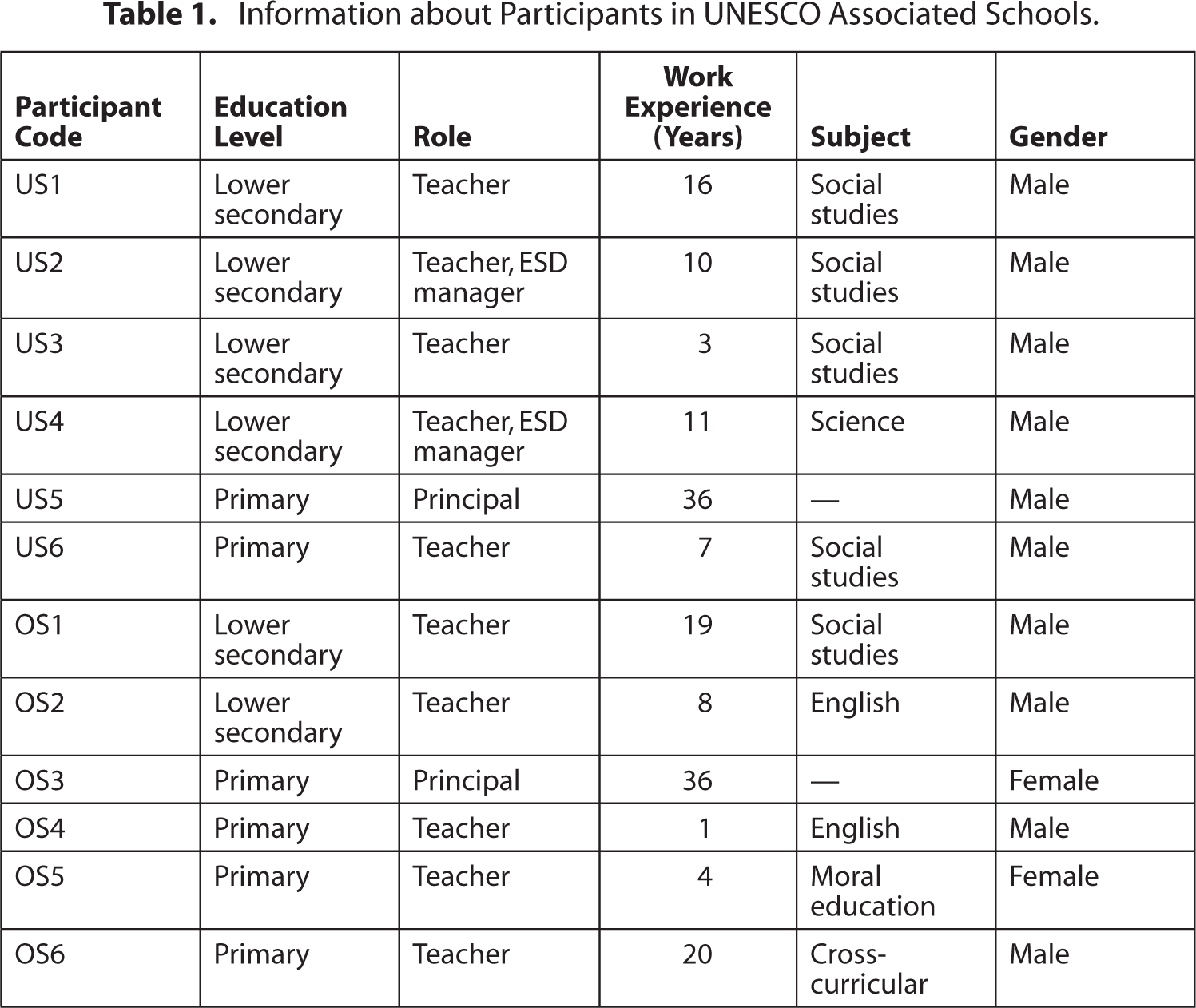
The participants were given codenames to guarantee their anonymity. Participants from UNESCO Schools were labelled ‘US’, and those from ordinary schools were labelled ‘OS’. The US group included in-service teachers from schools awaiting UNESCO Associated Schools’ approval. US2 and US4 worked as ESD managers. The author also interviewed two principals (US5 and OS3) who did not teach. The OS group consisted of in-service teachers in both public and private schools. OS2, OS3 and OS6 had previously worked for UNESCO Associated Schools. Table 1 provides information about the participants with their codenames.
Information about Participants in UNESCO Associated Schools.
Data Collection and Analysis
Semi-structured interviews were conducted via Zoom due to the COVID-19 pandemic. The interview guide (see Appendix A) was based on previous research (Hensley, 2017; Ichinose, 2019; Jakobsdóttir, 2021). It was designed in English and then translated into Japanese. Pilot interviews were conducted with two teachers outside this study. The interviews took between 25 and 30 minutes to conduct and were audio-recorded and transcribed for thematic data analysis.
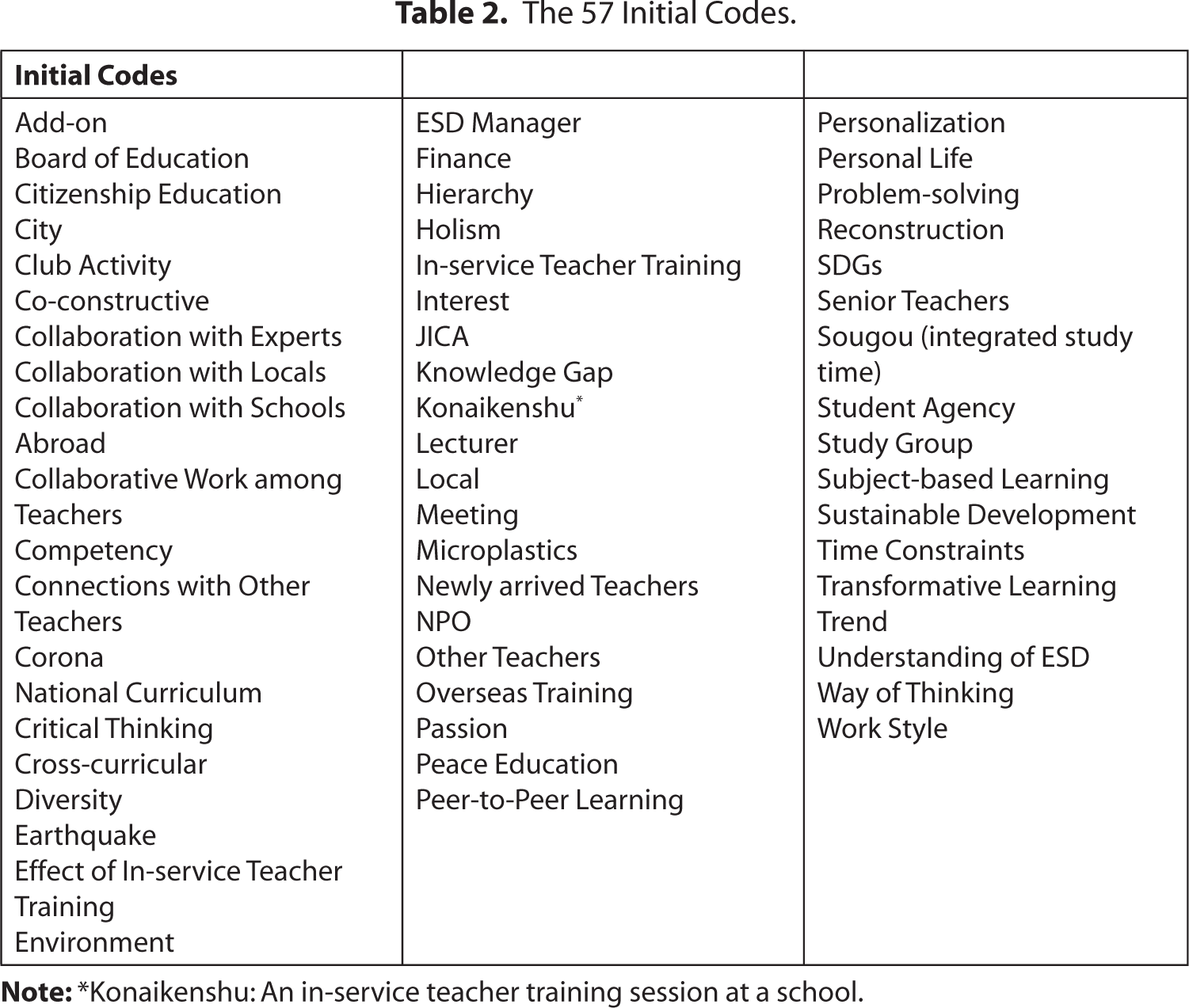
Thematic analysis, while commonly described as ‘a method for identifying, analysing and reporting patterns (themes) within data’ (Braun & Clarke, 2006, p. 79) and is one of the most common methods for exploring qualitative data, does not have a precise definition (Bryman, 2016, pp. 570, 584). The several steps of thematic analysis were identified to be followed (Braun & Clarke, 2006, pp. 87–93; Bryman, 2016, pp. 587–588). Coding is central to the process of thematic analysis (Bryman, 2016, p. 570), and we used NVivo software to code the interview transcripts. Fifty-seven initial codes were identified (see Table 2). Table 3 shows an example of how an initial code was identified. Thereafter, themes were defined and discussed by the authors to achieve consensus.
The 57 Initial Codes.
An Example of a Data Extract and Initial Code.

Results
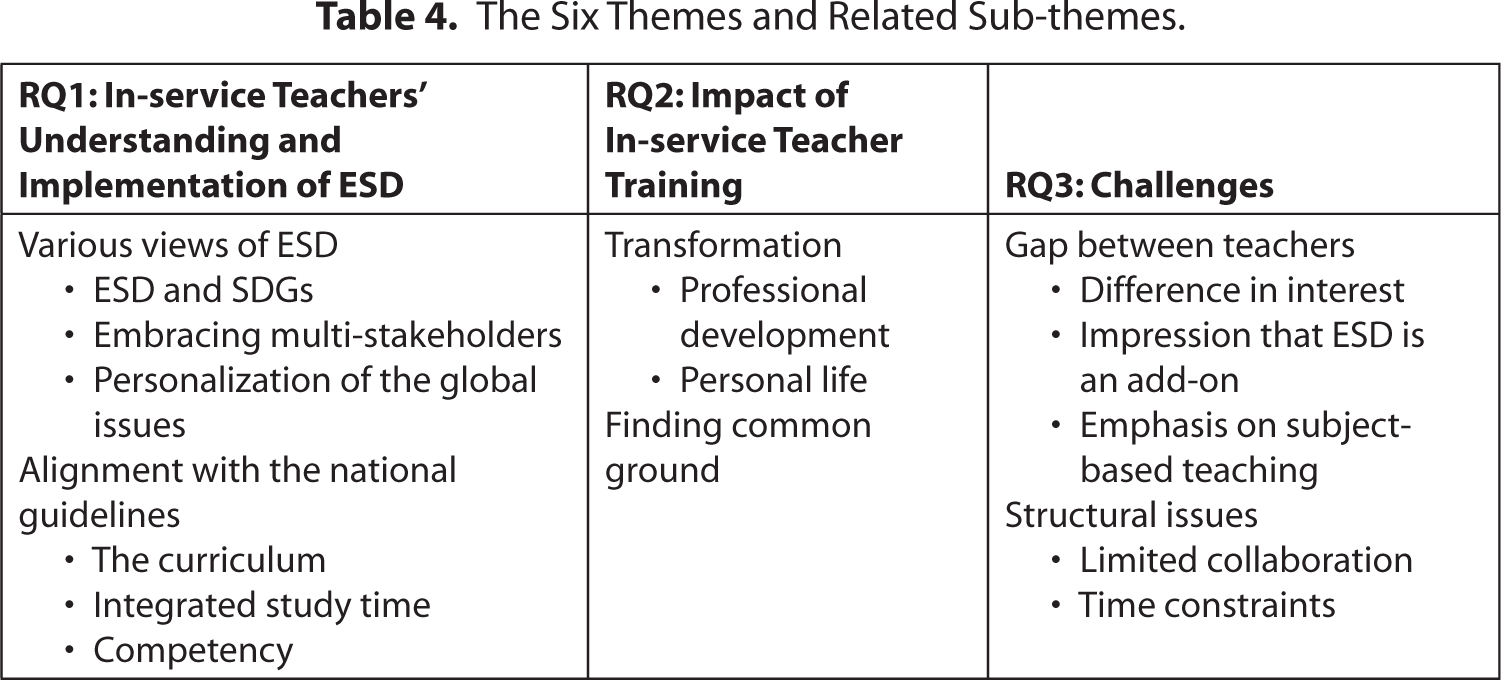
Six themes and their sub-themes were identified in relation to the three research questions (Table 4). The participants generally had various views on how they understood and implemented ESD and how ESD aligned with the national guidelines. In terms of the impact of in-service teacher training, the participants in both UNESCO Associated Schools and ordinary schools demonstrated transformation in both their professional development and personal life. The participants in UNESCO Associated Schools said that they shared a mutual understanding of ESD with one another in Konaikenshu (an in-service teacher training session at a school). The challenges with implementing ESD related mainly to differences between teachers in terms of their understanding of and interest in ESD and organization and leadership issues. Some of the detailed extracts for each theme are presented as follows.
The Six Themes and Related Sub-themes.
RQ1: In-Service Teachers’ Understanding and Implementation of ESD
In-service teachers from both groups of schools presented similar views and approaches to ESD, but just UNESCO Associated Schools created time and spaces to conduct ESD practices via integrated study time (Sougou classes).
Theme 1: Various Views of ESD
A variety of understandings of and implementation approaches to ESD were found in the interviews, including the sub-themes of ESD and SDGs, embracing multi-stakeholders and personalization of the issues.
ESD and SDGs
Participants frequently brought up SDGs when they talked about ESD. They clearly associated ESD with the SDGs, regardless of whether they taught at ordinary schools or UNESCO Associated Schools. For example, US2 mentioned the implementation of ESD in Sougou classes for SDG 17. The classes were about cultivating vegetables with a focus on connecting with the local community. OS1 was aware of the SDG deadlines and looked forward to a future where coming generations would be prepared to face different challenges. OS2 described how the SDGs supported him in comprehending the concept of ESD. OS3 argued that ESD was necessary for fulfilling the SDGs and helping learners to initiate something constructive in their local areas.
As we align with the vision of SDG 17, which is about the partnership, our purpose is not to cultivate vegetables but to connect with locals as partners through the means of cultivation. We expect that children will solve local issues as the local community faces a declining population… (US2).
In terms of ESD, I have an image of environmental education. Moreover, the reason we work on ESD is that students should be able to resolve current issues. The SDGs aim to be achieved by 2030, but students will be living in 2050 and 2060, where issues that will be different from today will emerge one after another. Then, I think that ESD helps students to equip themselves with the competencies to overcome any issues in any era (OS1).
There were very few teachers who passionately worked on ESD before SDGs were set…. As the concepts of the SDGs spread, it got easier [for teachers] to understand [ESD]. I myself found it easier to work on ESD, although I had [already] incorporated it into my classes and Sougou classes…. I think that many teachers raised awareness [of ESD] after the word SDGs emerged (OS2).
Although SDGs are often featured, I believe that SDGs will not be achieved without ESD. So, we need to reflect on the local region again. For instance, it is important to reaffirm local traditional heritage, recognize local issues, take action and connect with each other. In short, it is significant to consider how we can form the local community (OS3).
Embracing Multi-stakeholders
All participants acknowledged ESD as part of understanding the differences between people across generations and in the world. For instance, US1 was willing to study citizenship and multicultural coexistence in relation to ESD, while US1 found it valuable for his students to meet people with various perspectives in Sougou classes. US4 invited a speaker to help students learn about welfare, and OS4 used examples to deepen international understanding. OS6 had his students interact with elderly people to better understand the connection between them.
What I bear in mind is that it is necessary for society to embrace and tolerate diverse points of view…. I am researching citizenship education and multicultural coexistence education since I am interested in them…. In Sougou classes, I think that meeting people repeatedly allows students to see various role models of ways of life. I believe that this experience will be useful for students to develop their interests further even after they graduate (US1).
Students in the 1st grade researched human rights. We were supposed to visit the head of [a recuperation facility for leprosy patients] since he is a graduate of our school. Instead, he gave us a lecture online because of COVID-19. This was a perspective on human rights and welfare. As I learn various fields, I truly feel that there are issues that we have to be aware of (US4).
I am now in charge of the 6th grade, and we are currently studying international affairs in Social Studies. From the perspective of sustainability, we focus on the activities of [a Japanese doctor] in Afghanistan. While there is a lack of water, and children suffer because of that over there, in Japan water always comes out of the tap when children turn it on. It all depends on the situation. I am sorry that I cannot express myself well, but this is how I feel… (US6).
In Moral Education, for example, we not only read the textbooks but also talked about the friendship between Japan and Turkey, the speech by Martin Luther King and Cambodian culture … (OS4).
In terms of welfare, there are a lot of elderly people in this region. They form the community. While the 4th graders visited them, they discussed what they could do to make them happier and what they should do to connect people across generations… (OS6)
Personalization of the Global Issues
ESD can be about teaching learners to think of global problems as personal problems and take action in their local areas. For instance, US2 felt that his students extended their concerns to the whole of Japan and even to the world. US4 conducted enquiry-based learning to have his students look for an issue in relation to the SDGs and think about the perspective that they should have. OS3 highlighted the necessity of bringing an issue down to the personal level. OS4 placed importance on taking action to deal with local issues through ESD, and OS6 observed that ESD ignited his students’ agency to care about their local community.
You know, we have a concept of think globally, act locally. I think that students can feel this. Although there are differences according to each individual, I think that some students are looking for what actions they can take while looking not only at the region but also Japan and the world (US2).
For the 2nd grade, the biggest theme is that students seek the perspective they must hold while identifying a question linked to SDGs as a group (US4).
There are various issues. I think ESD is the same process as thinking about issues as being personal and taking action around you in order to solve them (OS3).
Not in the textbook, I believe that ESD is an educational activity where we learn with students what actions we can take to solve the issues in our local area and the world (OS4).
After this type of learning [Sougou classes], I see that students become concerned about their local community and what they can do to contribute to it when they grow up (OS6).
Theme 2: Alignment with the National Guidelines
Some participants closely aligned their understanding and implementation of ESD with the national guidelines. Three sub-themes were identified: the curriculum, integrated study time and competency.
The Curriculum
The participants all knew that ESD is covered in the curriculum. US3 and OS6 noted the specific statement about ESD in the curriculum. US6 and OS3 wanted to explain to fellow teachers how the curriculum emphasizes ESD.
After the national curriculum was reviewed, textbooks show the words [like sustainability or sustainable development] as important. I feel that I hear the words a lot, recently (US3).
I think that it is important to nurture global talents to deal with global issues. In addition, since the national curriculum describes the actors of a sustainable society, the perspectives of ESD should be appreciated in Japan (OS6).
If I can explain to other teachers that improving the class from the perspective of ESD leads to cultivating the competencies that the national curriculum requires, I think that the burden will be reduced. I cannot explain this link at my school well yet, so other teachers may see ESD as something added (US6).
Since the words [regarding ESD] appear in the national curriculum, I introduce the concept to other teachers for them to keep in mind…. I tell them to think of ESD as nothing special and to just look at what we have done from multiple dimensions (OS3).
Integrated Study Time (Sougou)
Since the curriculum first established integrated study time (Sougou), this has often contributed positively to the implementation of ESD and all participants utilized this time for ESD. For instance, US1 talked about fieldwork where his students investigated certain topics, and US3 taught peace studies, local studies and disaster prevention. OS3 said that her school focused on different areas for ESD by grade.
We had fieldwork in Sougou classes. It is a type of workshop where one teacher is in charge of about 20 students. For example, students researched charcoal, foreigners, deer and forests. They also conducted interviews. This is a whole-school activity, and students in the 2nd grade teach ones in the 1st grade. I think that this contains a perspective of ESD… (US1).
I am in charge of Sougou classes and promote peace studies, local study and disaster prevention under SDGs. I think that the words of the SDGs and ESD have begun to be recognized at my school (US3).
We started with SDGs because they were easy for both children and teachers to grasp. I called for a review of the curriculum and worked on raising awareness [on SDGs] in Sougou classes. In particular, students over the 3rd grade worked on the themes, the local community for the 3rd grade, the environment for the 4th grade, coexistence for the 5th grade and international understanding for the 6th grade, respectively (OS3).
An additional point is that ESD contributes to understanding the local community. Sougou classes allowed students to realize the importance of relationships with people in their local community. US2 touched upon the connections with locals through Sougou classes. As OS6 addressed ESD in Sougou classes, so his students enhanced their agency to contribute to their community.
The connections with locals. In short, students feel that they can ask locals when they need help. After all, feeling the connections keeps students attached to their local community even after they graduate (US2).
We learned disaster prevention and welfare in Sougou classes. In terms of disaster prevention, students in the 6th grade thought about disaster prevention and what actions they could take to spread [what they had learned]. As for welfare, since there are many elderly people living in our city, students in the 4th grade discussed how they could communicate with them and what they could do to have them stay healthy by visiting the place…. After this type of learning, I see that students become concerned about their local community and what they can do to contribute to it when they grow up (OS6).
Competency
In this study, some participants were aware of the seven competencies that learners are expected to acquire through ESD—as recommended in the guidelines from the National Institute for Educational Policy Research (2012). For example, US4 wanted his students to cultivate systems thinking competency in science classes, and as a principal, US5 took initiatives to enhance these competencies in his school.
When it comes to ESD, I think that it is always incorporated into each subject as well as Sougou classes. We conduct implementation in an interchangeable and cross-curricular way. In each subject, we focus on a competency. As for Science classes, we raise systems thinking competency in particular. From the 1st grade to the 3rd grade, students systematically learn about climate change and the carbon cycle while systems thinking competency is nurtured among them. (US4).
We integrated the concepts of UNESCO Associated schools and the competencies and behaviours that we wanted [our students] to develop into the curriculum of each subject. Meanwhile, six visions, four competencies and three behaviours sounded like too many and it was hard to see how they connected with one another. Then, we sorted out the main objectives for the entire year (US5).
RQ2: Impact of In-service Teacher Training
Theme 3: Transformation
The participants reported that in-service teacher training had transformed them in both their professional and personal lives and said that their awareness of environmental issues had been particularly enhanced.
Professional Development
According to the majority of participants, in-service teacher training for ESD helped them transform their pedagogy and how they organized the content of their classes. For instance, US1 changed his way of teaching to address competencies in his class, while OS1 realized that ESD did not merely deal with environmental issues. OS2 found in-service teacher training useful for developing his way of thinking.
As a Social Studies teacher, I tended to teach the system and rules, just as they were. I now keep critical thinking in mind in my class, as ESD promotes such a competency. I think that I have changed. When I teach in my class, I now focus on finding problems and thinking about how to solve them. Also, my teaching style appreciates more collaborative learning and diverse opinions rather than [only] teaching in my class (US1).
In the first in-service teacher training [for ESD], I went to [country] through [programme]. At that time, I did not understand ESD well, to be honest. But I understood that ESD is not only about the environment, although it often addresses the environmental aspect. We learned about SDGs and implementation across the world … (OS1).
Teachers with passion gather at this type of [ESD] in-service teacher training. After I discussed with them, my view of the world and way of thinking expanded. After I visited [country] [as part of in-service teacher training], I became interested in the country and international cooperation… (OS2)
Practical examples of ESD were presented by other teachers during in-service teacher training. The participants said that they were inspired by those examples. For example, US6 wanted to improve his class by incorporating other educational practices and OS6 thought it was important to have his students understand their relationship with their local community.
I learned how other teachers designed and implemented classes through in-service teacher training. Then, I wanted to make use of the practical examples in my class. Moreover, I see that many practices have their regional characteristics. Although the region is different, I want to incorporate an essence of them [into my class]. In that sense, I enhanced my motivation (US6).
I was keen on the concrete ideas of classes [from other teachers] in in-service teacher training. This experience broadened [my view] and I learned that instead of only transmitting knowledge, it is important to nurture children who care about the local community and look at the world. Also, I learned that it is important not only to claim one’s own opinion but also embrace various perspectives (OS6).
Some participants indicated that they learned the significance of transformation from in-service teacher training. After his training, US2 gave a presentation to his fellow teachers so that they could better understand ESD and the SDGs. This is an example of how in-service teacher training inspired a teacher to take action. US4 emphasized how transformation played a central role in ESD.
After I participated in in-service teacher training, I made a presentation and gave it to other teachers at my school because many of them were uncertain about ESD and SDGs. I presented what ESD and SDGs are and how to work on them. Although this sounds harsh, I indirectly told them that schools were behind the times. I wanted to express that schools should follow the trend in society. Then, I got about 20 minutes in the meeting and gave a presentation (US2).
Although some teachers find ESD similar to SDGs, ESD and SDGs are not the same. It is not about gaining knowledge. Instead, my takeaway from in-service teacher training was that transformation is essential. ESD is a way to achieve transformation. ESD promotes transformation in everyone’s way of thinking (US4).
Personal Life
We found that in-service teacher training also affected some participants in their personal lives. They spoke about how in-service teacher training for ESD moved them to adopt more eco-friendly attitudes and behaviours. After in-service teacher training, US1 came to care more intuitively about preserving the environment for future generations and US2 was concerned about the environment where his children would continue to live. OS1 attempted to save energy and asked his students about their behaviours at school. Although OS6 had been familiar with ESD, he continued reading materials to deepen his understanding of it in his personal life.
I used to be one-track minded in many cases. After the fieldwork [as part of in-service teacher training], I changed to cherish more senses and feelings. In addition, the feeling that we must conserve the earth and leave this sound environment for tomorrow and the next generations emerged from inside my heart. I myself sense that my values transformed after meeting different people and seeing their way of life (US1).
Additionally, I became concerned about microplastics in the ocean. I have two kids and sometimes take them to the beach. It [trash] was visible there. I remember talking to them about fish feeling sick when they eat plastics by accident, so it is better not to throw away trash … (US2).
I thought about the costs when I used electricity before. I now think about the environment and the earth, and I try to save energy. Otherwise, it would be bad for the earth. In this regard, I ask children from time to time, would it [something questionable] be bad for the environment?… (OS1).
I was not familiar with the word ESD as much before, but I became keener on it while reading educational magazines and newspapers (OS6).
Theme 4: Finding Common Ground
The participants in UNESCO Associated Schools often talked about Konaikenshu for ESD, where they could gain a mutual understanding of ESD with other teachers in the school. For instance, US1 mentioned that his school organized in-service teacher training for ESD several times a year. According to US4, all teachers at his school were invited to training at the school offered by a university professor. US5 acknowledged the difficulty for novice teachers in understanding ESD and found training within the school enhanced his comprehension. During monthly training at the school, US6 discussed with his fellow teachers how to conduct ESD in practice. In contrast, only principal OS3 had Konaikenshu for ESD in the ordinary schools.
Since my school promotes ESD as a whole, we discuss it on a daily basis. In terms of Konaikenshu, especially for ESD, I guess that it is held two or three times per year at my school (US1).
Basically, at my school, all teachers take in-service teacher training taught by [the professor] from [the university] at the beginning of every year. So, they should have an opportunity to understand ESD correctly (US4).
I think that ESD seems difficult for novice teachers to grasp, and they may wonder what they should do at school. So, I often talk with teachers about how we can comprehensively view ESD on some occasions, including Konaikenshu (US5).
Since my school researches ESD as a whole, we talk about classes from the perspective of ESD on a daily basis. We have Konaikenshu about once a month, and we discuss how we implement [ESD] and evaluate students. After the discussion, teachers in each grade discuss further (US6).
As the principal, I presented to other teachers how we want to nurture our students at our school last July. At that time, I highlighted what I wanted to do in terms of ESD and SDGs (OS3).
RQ3: Challenges
Theme 5: The Gap Between Teachers
The gap between our participants and their fellow teachers with regard to understanding and implementing ESD presents a challenge in that it hinders them from promoting ESD as a whole school. We identified three sub-themes related to this perceived gap:
Difference in interest: in-service teachers do not have the same interest in ESD Impression that ESD is an add-on: some in-service teachers perceive ESD as add-on content Emphasis on subject-based teaching: some teachers argued that subject-based teaching prevents in-service teachers from promoting ESD
Difference in Interest
Overall, the participants felt that their fellow teachers did not share their interest in ESD to the same degree. Since the participants had attended in-service teacher training for ESD, they were relatively familiar with ESD, while it was observed that other, senior teachers tended to have limited awareness of or interest in ESD (see remarks by US3). OS1 complained that other teachers tended to have more interest in other activities, such as clubs and student counselling, while OS5 mentioned that few teachers at her school were familiar with ESD. OS5 even spoke about the peer pressure she felt at school, which can discourage teachers from learning current topics, such as ESD.
I feel that teachers who are interested in SDGs and ESD stay interested. On the other hand, there are some elderly teachers who barely understand [these concepts] (US3).
There are many teachers who lack understanding of ESD and think that it will be good enough to collect the caps of plastic bottles for environmental education. Lower secondary schools have club activities. It cannot be helpful that teachers tend to place a focus on club activities and student counselling (OS1).
The majority of teachers would say, what is it [ESD]? Probably because my school is in the countryside and very small (OS5).
You need to leave school earlier so that you can do in-service teacher training. This is not a good thing in Japan, where the culture that you do not leave before your boss remains. So, when I said to my boss, ‘excuse me, I will leave earlier today because I have in-service teacher training’, he replied, ‘woo, you work so hard’ [in a facetious way]… (OS5).
Although the SDGs are closely connected with ESD, this may inadvertently disguise ESD. The impression was that the SDGs are much better understood than ESD. OS2 felt that few teachers were aware of ESD despite the spread of knowledge about the SDGs, while the principal, OS3, reported fielding many questions from her teachers about ESD. Many teachers appear to be still in the process of understanding what it is.
After the SDGs came out, I think that the number of teachers who became aware of ESD increased more and more. However, they still seem like a minority group. There are some teachers who know about the SDGs but know little about ESD (OS2).
Since about three years ago, the word SDGs has often appeared in TV and media. Now, teachers ask me, ‘how are ESD and SDGs different? How do they relate to each other?’ I talked with teachers a little bit about this. And they asked me, ‘is it correct that the SDGs show the goals, while ESD deals with the goals in education?’… (OS3)
When it comes to promoting ESD, the gap between in-service teachers in ordinary schools becomes more apparent. This is what some participants had felt throughout their careers. US4 used to work for an ordinary school where teachers rarely understood ESD, and US4 talked about the urgency of transformation in teachers, considering the time limit for SDGs. OS4 found that the difference between teachers lay in their level of interest in ESD and felt that few teachers were interested.
I worked in an ordinary school before. The understanding of ESD was inadequate among teachers (US4).
It [a challenge] is teachers’ awareness. It has truly changed over the last 10 years. However, an urgent issue is still the reform of teachers’ awareness if we take into account the deadline of 2030 (US4).
I think it is difficult to involve teachers who are not interested in ESD in the first place. I think that teachers who are interested in it work hard to make their classes better, but again, it is difficult to involve teachers who are not interested in it (OS4).
If I am asked if there are many teachers [who are interested in ESD], I would say no. Now, there are some teachers [who are interested in ESD] at my elementary school, but I recall that there were none at all when I was working in a high school (OS4).
Impression That ESD Is an Add-on
Although ESD has recently spread among in-service teachers, some may still consider it additional to existing educational activities. While US3 linked his teaching to ESD, it appears that other teachers did not. US6 talked about different groups of teachers in terms of their approach to ESD, and OS2 suggested redefining teaching in relation to ESD. OS4 highlighted the feelings that in-service teachers probably had about ESD. OS6 explained that there were many teachers who were curious about ESD when he worked at a UNESCO Associated School and compared this with his current school.
My understanding is that educational activities that I have conducted so far are part of ESD. I believe that we are already doing ESD through the reconstruction of education that we have done. Yet, some teachers separate their current teaching from ESD and say that they do not understand the new thing [ESD]… (US3).
At the practical level, honestly speaking, I think that many [teachers] find ESD burdensome. On the other hand, I feel that some perceive this [ESD] positively and are willing to try it in my school as well as other schools. I myself like it [ESD], so I do not find it burdensome. However, as I already mentioned, those teachers who feel burdened may think that they must do something extra in addition to the current educational activities (US6).
I think there are many teachers who find ESD new even though they have already worked on it in Sougou classes. It is important to review and understand again what they have done from the perspectives of ESD and SDGs … (OS2).
I think that teachers who have studied ESD deeply view it holistically, including the national curriculum, environmental education, leaning about disaster and human rights. In contrast, other teachers who have recently heard about ESD regard it as something new to be added and feel burdened with self-study and participation in in-service teacher training for it (OS4).
In fact, there were many colleagues who had an interest in ESD itself and what ESD actually meant when I worked for a UNESCO Associated School. At my school, which is not registered as a UNESCO Associated School, however, ESD seems difficult [among teachers]. I think teachers feel a little uncomfortable [with ESD] because they think that they need to teach new content (OS6).
Emphasis on Subject-based Teaching
When in-service teachers focus exclusively on their core subjects, they may not incorporate ESD into their classes. US2 thought that some teachers persisted with subject-based teaching and barely understood the connections between their subjects and ESD, while US4 was concerned about whole-school education based on core subjects.
I think that other teachers recognize ESD as important. Although they understand the word ESD as education for building a sustainable society, they are not sure what their educational activities can do for it. In addition, in the case of lower secondary schools, teachers often see teaching their subject as the main task and can barely link it to ESD. They may not grasp the essential elements of ESD, so they end up not utilizing them in their class. … in short, I think there are many teachers, especially senior teachers, who are aware of ESD but do not know it well (US2).
In school education, especially secondary education, the element of teaching subjects seems paramount. In Japan, there is still a stereotype that students are expected to get a high score, go to a good university and work for a good company (US4).
Theme 6: Structural Issues
Participants faced structural issues that hindered them from implementing ESD and participating in in-service teacher training so that they could learn more about it. It was about limited collaboration—between schools, with experts from the private sector, with other in-service teachers—while in-service teachers are in addition constrained by participation in normal school activities, which leaves little preparation time for ESD and participation in ESD training.
Limited Collaboration
Schools need to collaborate with other actors because they cannot promote ESD alone. However, according to the participants, collaboration—mainly in ordinary schools—was still limited. For example, US4 mentioned challenges related to newly arrived teachers from ordinary schools, whereas US5 stressed that transferring teachers prevented schools from sharing information about ESD inside schools. OS5 was cynical about a system which regularly transfers teachers.
Public schools do not share the perspectives of ESD among teachers as much. It looks like newly arrived teachers have a question mark in their minds regarding ESD and SDGs. So, not in my school, but I think the whole education sector in Japan has a limited understanding of ESD (US4).
I think it is difficult to promote awareness (of ESD among teachers) because some teachers transfer every year (US5).
Teachers switch through the 1st to 6th grade and even transfer. I am pessimistic about this system that prevents teachers from passing on information [about students and schools] to the next ones (OS5).
Collaboration between various actors is important for supporting schools in implementing ESD. This is because locals and representatives from companies can share with schools their expertise and experiences around sustainability. Although OS2 wanted to cooperate with outside organizations, OS1 felt that teachers rarely interacted with people outside schools. However, generally speaking, it can be demanding for in-service teachers to manage collaboration on their own—OS3 spoke about the lack of school funds for educational activities related to ESD partnerships with the private sector.
For example, Social Science teachers are good at the subject of Social Science. However, they know little about other fields. Teachers move only from school to school. As a result, they may not be aware of changes and issues in society. For the sake of students, it is very important for teachers themselves to communicate with the local communities and companies (OS1).
I want to collaborate with various organizations, such as NPOs and companies. As SDG 17 states, it is not only one person or school but also various stakeholders who should collaborate. However, it is maybe difficult for schools to connect with companies. It would be nice if we had such an occasion [to meet] (OS2).
I think it is important to cooperate with others for ESD. Now, the number of novice teachers is increasing. Since they have not experienced management along with the private sector, they feel the difficulty and need to overcome it. … When you think about the collaboration between the school and a company, it must be a win-win relationship. Otherwise, it will not last. Then, I think we have a big obstacle when it comes to thinking about how we provide benefit to both the school and the company. … Honestly speaking, since schools do not have much money, we need to collaborate effectively with the private sector. … (OS3).
Time Constraints
Japanese in-service teachers have on average longer working hours than teachers in other OECD countries (OECD, 2015, p. 10), which hinders them from developing themselves professionally. US1 scarcely had time for participating in in-service teacher training, while US2 felt that schools allowed very limited time for this. US4 explained how extracurricular responsibilities leave in-service teachers with little time for professional development, while US4 confirmed that elementary school teachers generally worked very long hours. US5 admitted that overwork was a challenge for in-service teachers, and OS1 emphasized how busy in-service teachers usually are.
I feel that it is difficult to take time [for in-service teacher training] … (US1).
Not limited to in-service teacher training for ESD, [in general] participating in training means teachers need to spend time on it within the working hours. I think there are few schools that allow them to do so adequately (US2).
They [teachers] instruct their students in club activities and have student counselling sessions, which often requires overworking. Many teachers are uncomfortable familiarizing themselves with ESD since they already feel burdened with existing tasks (US4).
Teachers in elementary schools work constantly from morning to night, and sometimes bring work back home and do it even overnight. So, it is difficult for them to self-study (US4).
There is a situation that teachers work far more than [normal] working hours. As international surveys show, the hours of overwork commonly reach 70 or 80 hours per month at my school (US5). Now, we are striving to reduce it, but this gives teachers less time to prepare for Sougou and activities as a UNESCO Associated School. … It looks like teachers struggle in terms of time (US5).
Teachers have many tasks in lower secondary schools, including club activities, student guidance, dealing with truants and visiting students’ homes. So, I think that they can hardly add time in this situation … (OS1).
In-service teacher training tends to focus on existing subjects rather than on ESD. US6 said that tight schedules scarcely allowed teachers time to attend in-service teacher training for ESD within working hours. OS5 pointed out the difference between core subjects and ESD in terms of in-service teacher training, while OS6 felt that ESD was seen as something outside the mainstream that required teachers to learn privately.
Working hours are from 8:30 to about 17:00. It is very hard to take in-service teacher training for ESD within working hours. We could do it maybe once or twice a month as class research. Or else, we need to voluntarily participate in it outside work on weekends (US6).
Teachers can leave for in-service teacher training for the curriculum or the subject, for example, Japanese language, while students are still at school. When it comes to a subject which is additional or not mentioned enough in the national curriculum, they may feel burdened by participating because they need to make time for it in the evening or on weekends on their own … (OS5).
If in-service teacher training takes place within the school, teachers can spare time for it. However, ESD is understood as self-development or a new perspective. It is difficult for teachers to attend it within working hours. If a teacher has a family, I think that he can rarely participate in it. In addition, lower secondary schools have club activities … (OS6).
Aside from time constraints, a notable problem is that in-service teachers have different levels of interest in ESD. Individual teachers’ interest in ESD is what drives them to participate in in-service teacher training. US3 claimed that it was not about time, but about individual teachers’ interest, while OS3 took a different perspective, suggesting that in-service teacher training be conducted online to make it more time efficient.
I think that teachers can take time for in-service teacher training. Rather, it is a matter of interest. I mean. How can I say? If they do not regard in-service teacher training as necessary, I think that the quality of it will not increase much. In this sense, time is not an issue, but it is about whether they have interest [in ESD], or not. (US3).
Since teachers now have laptops, it would be good to attend in-service teacher training for 30 minutes on Zoom or Meet. It should not exceed one hour. I believe that this would allow many teachers to participate in many types of it in an arbitrary way (OS3).
Discussions
The aim of this study was to explore whether ESD teacher training could help Japanese in-service teachers to implement ESD in school. After their teacher training, the participants had differing views about ESD, which may be related to there being no fixed definition of the concept itself (Jickling, 1992, p. 5; UNESCO, 2005b, p. 30). Moreover, they tended to relate their understanding and implementation of ESD to the national guidelines. The curriculum provides important guidelines for teachers, motivating them to align their practices to the curriculum (Jakobsdóttir, 2021). Since 2015, ESD has been a crucial component of meeting the SDGs—see SDG 4.7 (UNESCO, 2017, p. 8). In this study, nearly all the participants were aware of the relationship between ESD and the SDGs and kept the SDGs in mind when talking about ESD implementation. ESD and the SDGs share a similar goal in seeking a sustainable society (Nagata, 2020, p. 7), which was also reflected in the participating teachers’ understanding of ESD in this study. The SDGs clearly play a role in supporting in-service teachers when implementing ESD in their teaching.
Integrated study time (Sougou) was frequently discussed as a likely space for engaging with ESD. While every participant in UNESCO Associated Schools mentioned the suitability of these Sougou classes for this purpose, four participants (OS2, OS3, OS4 and OS6) in ordinary schools also mentioned them. ESD can be addressed in these study times because of the interdisciplinary character of the sessions (Sagdıç & Şahin, 2016, p. 150). Sougou classes are a place where teachers are expected to follow good practice. According to the participants, the content in Sougou classes aligned with the areas identified by the Japanese National Commission for UNESCO (n.d.). Just as Ichinose (2017) concluded, it is also remarkable that US2 and OS6 emphasized the connection between their students and local people since connections with local people are crucial in ESD (National Institute for Educational Policy Research, 2012).
Some participants (US2, US4, OS3, OS4 and OS6) suggested that ESD was a means of enabling their students to regard an issue as personal. The participants also understood that it was important to act locally, as debated by the Japanese National Commission for UNESCO (n.d.). US2 and OS6 also mentioned that ESD inspired their students to take action in their local communities, which aligns with Ichinose’s (2017) results. As regards cosmopolitanism, students should keep in mind a partial responsibility for engaging with global issues while taking local action (Sund & Öhman, 2011, p. 14). In this regard, transformative learning is required. Although global issues seem overwhelming, transformative learning allows both teachers and learners to reflect on and recapture such issues at the personal level (Mezirow, 1997, p. 5).
Many participants in UNESCO Associated Schools (US1, US3, US4, US5 and US6) raised the social dimensions of ESD, such as welfare, human rights and international understanding—dimensions highlighted by the Japanese National Commission for UNESCO (n.d.)—while other participants (OS2, OS3, OS4 and OS6) also mentioned the social dimension of ESD in passing. The topics were categorized into engaging multi-stakeholders. This suggests that participants in both UNESCO Associated Schools and ordinary schools were amply aware of the social dimensions of ESD.
Through ESD, in-service teachers should enable their students to acquire different perspectives, values and competencies for a sustainable society (Ichinose, 2017, p. 37; Rudsberg & Öhman, 2010, p. 97). To attain this pluralistic aspect of ESD, in-service teachers need to develop teaching strategies for ESD (Kang, 2019, p. 3). In this study, two participants in UNESCO Associated Schools (US4 and US5) specifically talked about the competencies set out in the educational guidelines for ESD established by the National Institute for Educational Policy Research (2012). Interestingly, none of the participants in ordinary schools talked about these competencies.
The Impact of In-service Teacher Training
We found that in-service teacher training for ESD led to transformation for the participants from both UNESCO Associated Schools and ordinary schools. The participants talked about positive changes in both their pedagogical approach and interest in ESD. We found that in-service teacher training contributed usefully to their learning about their teaching and their educational activities (see also Nakazawa, 2018). The teacher training improved participants’ ESD teaching and led to an action that facilitated the enhancement of other teachers’ understanding of ESD. Teachers are influential agents of change aimed at building a sustainable society (Karatekin, 2019, p. 55; UNESCO, 2014, p. 20). This study reveals that in-service teacher training brought about transformative learning—which has been shown to affect both personal and social dimensions (Dirkx, 1998, p. 3)—and participants were inspired to take daily actions to protect the environment.
However, this study disclosed a difference between UNESCO Associated Schools and ordinary schools regarding in-service teacher training. Only one ordinary school participant talked about Konaikenshu for ESD. This indicates that they rarely had an opportunity to discuss ESD in their schools. In contrast, many participants in UNESCO Associated Schools (US1, US4, US5 and US6) had had talks with their fellow teachers about ESD on a daily basis. In addition to casual talks, US4, US5 and US6 recognized Konaikenshu as a place for teachers to discuss how to conduct ESD, which implies that Konaikenshu for ESD is an opportunity for in-service teachers to share understandings and teaching strategies that they accumulate at school. All schools, UNESCO Associated or ordinary, need to evaluate their practices for promoting ESD (Nakazawa, 2018, p. 5). It is vital for teachers to find common spaces for ESD in the school culture.
Challenges with ESD
The significant challenges to the implementation of ESD in schools are related mainly to differences between teachers in terms of their understanding of and interest in ESD and structural issues (see also Kang, 2019). The participants in this study had attended in-service teacher training for ESD and developed their understanding of ESD, so it is likely that they were more interested in ESD than other teachers even before training. As a result, they felt a distance between themselves and other teachers, particularly the participant teachers in ordinary schools. Some teachers were still uncertain about the difference between ESD and the SDGs. US4 and OS4 had worked for both UNESCO Associated Schools and ordinary schools so were able to make informed comparisons which highlighted the differences in teacher interest, understandings and approach to ESD. In general, teachers with passion tend to participate in in-service teacher training voluntarily (OECD, 2005, p. 128), while a lack of interest in ESD discourages teachers from participating to develop their knowledge and skills. Consequently, the quality of ESD likely remains poor, with teachers having limited teaching strategies for ESD (Kang, 2019, p. 3).
ESD is not add-on content, but a new perspective towards a sustainable society (Jucker & Mathar, 2015, p. 4). Although this challenge to ESD implementation is rarely mentioned in previous research, this study revealed that several teachers may consider ESD to be an add-on subject. In this regard, it is important for in-service teachers to recapture their teaching through the perspective of ESD, as OS2 suggested. Participants felt that other teachers tended to focus on subject-based teaching—US2 mentioned that although his fellow teachers recognized the importance of ESD, they did not seem to understand ESD in relation to their teaching subjects, while US4 raised the point that teachers tended to focus exclusively on teaching the core subjects because of the fixed mindset in Japan. These teachers probably find it difficult to incorporate ESD into their teaching subjects, as discussed by other researchers (see Borg et al., 2012, p. 203; Ichinose, 2019, p. 10). In-service teachers need to develop their understanding of the links between their subjects and ESD and related teaching strategies so that they can connect ESD to their subjects. A lack of teaching materials and strategies has been noted in a number of studies (Borg et al., 2012; Kang, 2019). However, this study revealed that structural issues prevented in-service teachers from participating in training. We found limited collaboration both within schools and between schools and outside entities, even though in-service teachers are encouraged to cooperate with each other to promote ESD at school (Ichinose, 2017, pp. 43–44; Kang, 2019, p. 3; Sagdıç & S¸ahin, 2016, p. 150). In relation to collaborative work among in-service teachers, some participants (US4, US5 and OS5) pointed out that in-service teachers were frequently transferred from one school to another. It is usually demanding for newly arrived teachers to adapt to educational activities at their new school, and they initially tend to be less knowledgeable about ESD than other teachers. US4 reported that this was especially true for in-service teachers transferring from an ordinary school to a UNESCO Associated School. Hence, the welcoming schools should be better at sharing their existing good practice with new teachers, which would result in better collaboration towards promoting ESD. In addition, schools should collaborate with different stakeholders such as NGOs, companies and local people (Mathar, 2015, p. 23; Nagata, 2020, p. 7; Oikawa, 2020, p. 76). In our study, some participants from ordinary schools (OS1, OS2 and OS3) acknowledged the significance of collaboration with experts from companies.
Japanese teachers experience time constraints when it comes to in-service teacher training for ESD as well as preparation for implementing ESD (Ichinose, 2019, p. 10). In this study, every participant from UNESCO Associated Schools and most participants from ordinary schools described how busy teachers were. Teachers in Japan have multiple responsibilities, including administrative work, club activities and student counselling sessions (Watanabe et al., 2013, p. 24). Their tight schedules deprive them of time for class preparation as well as participation in in-service teacher training (OECD, 2015, p. 10). As a result, in-service teachers may end up persisting with existing content at the expense of transforming their teaching strategies (Borg et al., 2012, p. 191). Teachers’ ways of working must therefore be reformed. Finally, compared to the average teacher in OECD countries (OECD, 2020, p. 4), in-service teachers in Japan rarely take part in online courses or seminars. To make in-service teacher training more accessible, OS3 proposed introducing online training, which would more efficiently allow in-service teachers to develop their teaching strategies for ESD (Atmaca et al., 2020, p. 355; Borg et al., 2012, p. 203).
Conclusion and Implications
This study investigated Japanese in-service teachers’ understandings of ESD and challenges related to implementing ESD after in-service teacher training. After in-service teacher training for ESD, the Japanese in-service teachers in this study demonstrated holistic and pluralistic views of ESD and the related implementation approaches. The teachers in the study also expressed the experiences of transformation in both professional and private lives for ESD. However, challenges remain, and they are about the lack of common ground among the ESD trained teachers and non-trained teachers. Negative attitude towards ESD and different value on subject-based teaching were identified in the study. Besides, lack of time and space for teachers to cooperate on ESD in the same school and among schools was also revealed as challenge. Based on the findings of the study, implications on global ESD from the challenges which Japanese in-service teachers faced are delineated as follows. It is necessary to provide ESD in both pre- and in-service teacher training, which can have a positive impact on their development of teaching competence on ESD including knowledge, attitude and skill. Their personal lives might also be transformed, providing good examples of transformative learning and proving the importance of transformative learning for ESD (Balsiger et al., 2017; Dirkx, 1998; Mezirow, 1997). To address the challenges of promoting ESD in schools, the leadership needs to be responsible for ESD and necessarily take ESD training (Kang, 2019; Sagdıç & S¸ahin, 2016). The whole education system needs to be transformed (UNESCO, 2020) to create time and space for teachers to discuss and develop ESD in the same school and among different schools. Konaikenshu (an in-service teacher training session at a school) and Sougou classes (integrated study time) were addressed as helpful by the participating teachers in the study. These can be good examples to implement in schools globally. Finally, where school leadership and teachers do not value ESD equally, a policy-driven approach (UNESCO, 2020) could be a first step in the right direction to strive suitability globally.
Footnotes
Declaration of Conflicting Interests
The authors declared no potential conflicts of interest with respect to the research, authorship and/or publication of this article.
Funding
The authors received no financial support for the research, authorship and/or publication of this article.
Appendix A: Interview Guide
General questions:
Please introduce yourself:
What level do you teach? What is your role? What subject do you teach? How long have you worked as a teacher? What is your understanding of sustainable development? What do you think about ESD? Do you discuss ESD with other teachers at your school? Does your school have a special time for it? How do other teachers perceive ESD? Have you incorporated ESD into your class or at school? Could you give me an example? How have your students changed? What are the challenges to implementing ESD? In-service Teacher Training: Have you participated in in-service teacher training for ESD? What made you participate in the training? Could you describe the training? (e.g., host, content, structure and activity) What did you learn from the training? What changes do you see in yourself after the training? How did your understanding of ESD change after the training? How did the training affect your attitude and behaviours in your daily life? How have you incorporated learning from the training into your class? Could you give me an example? What challenges do you think in-service teacher training for ESD has? (e.g., teaching style, content and time constraint)
What do you suggest for improving in-service teaching for ESD? Have you become more interested in ESD since the training? What else would you like to know regarding ESD?