




Abstract
This research is a synthesis of studies carried out in 18 countries to identify contributions of education for sustainable development (ESD) to quality education. Five common questions were used for the interviews in each country to solicit education leaders and practitioners’ views on the outcome and implementation of ESD. The analysis revealed that major themes repeated across the 18 studies, showing that ESD contributes in many ways to quality education in primary and secondary schools. Teaching and learning transforms in all contexts when the curriculum includes sustainability content, and ESD pedagogies promote the learning of skills, perspectives and values necessary to foster sustainable societies. The research also identified the need to integrate ESD across all subjects, to provide professional development for teachers to ensure ESD policy implementation and to adopt ESD management practices to support ESD in the curriculum in order to broaden ESD across countries.
Keywords
Context and Background Information
At the end of the United Nations Decade of Education for Sustainable Development (2005–2014) (aka the Decade) and the beginning of the United Nations Educational, Scientific and Cultural Organization (UNESCO) Global Action Programme (GAP) on Education for Sustainable Development 1 (ESD), many nations are poised to begin scaling up ESD (UNESCO, 2014). During the Decade, ESD matured and grew. Efforts began with raising awareness, moved to capacity building, then to experimentation and finally, implementation of good practice. In effect, the Decade provided proof of concept for formal education and non-formal educational settings, including public awareness and training. Now, with the advent of the GAP, UNESCO and the ESD community are aiming towards expanding successful projects and involving more schools and institutions in ESD. In spite of widespread implementation and success of ESD, the expansion of ESD in primary and secondary education will require the ESD community to provide evidence that ESD is effective and contributes to the overall quality of education.
In today’s interconnected world, information is easily acquired. Facts that professionals once collected as a result of years of study are now readily available on the Internet. Today’s education requires knowing what to do with information, that is, how to analyze it; make sense of its abundance and complexity; cooperate with others to synthesize information; and communicate the results. Consequently, quality education is no longer based primarily on fact acquisition.
As education based on fact acquisition becomes increasingly outdated, policymakers debate the basis for transforming their education systems. Yet, these transformations require more than a vision of what is possible: they require evidence that will justify such changes (Cooper, Levin & Campbell, 2009). Evidence-based decision making is both encouraged and of growing importance in the formal education community (Organisation for Economic Co-operation and Development [OECD], 2007). The goal of this study is to provide evidence that ESD contributes in many ways to a quality education.
Literature Review
Definition and Models of Quality Education
The concept of quality recurs frequently in international educational discourse. For example, the World Educational Forum on Education for All (EFA) has addressed quality education in its EFA framework and goals. The framework has six goals; Goal 6 calls for: ‘Improving every aspect of the quality of education, and ensuring...excellence so that recognized and measurable learning outcomes are achieved by all, especially in literacy, numeracy and essential life skills’ (UNESCO, 2000, p. 17). The importance of quality in education goes beyond international discussions and documents and is relevant at the country level. Every ministry of education and school jurisdiction around the world struggles with the same issue: how to provide quality education in a cost-effective manner? Providing quality education is a complex undertaking partially because the concept of quality in education is continuously evolving.
Yet, the definition of quality education is constantly evolving and is always contextual. There is no one definition, list of criteria, definitive curriculum, or list of topics that comprise a quality education. Quality education is a dynamic concept that changes and evolves with time and is modified according to the social, economic and environmental contexts. Because quality education must be locally relevant and culturally appropriate, quality education will take many forms around the world. (UNESCO, 2005, p. 1)
Furthermore, there is little or no agreement on the definition of quality and it is contested (Barrett, Chawla-Duggan, Lowe, Nikel & Ukpo, 2006; Kumar, 2010; Nikel & Lowe, 2010; Tikly & Barrett, 2013; UNESCO, 2004). In spite of definitional difficulties, UNESCO (2004, p. 17) has identified basic principles underlying quality education:
Two principles characterize most attempts to define quality in education: the first identifies learners’ cognitive development as the major explicit objective of all education systems. Accordingly, the success with which systems achieve this is one indicator of their quality. The second emphasizes education’s role in promoting values and attitudes of responsible citizenship and in nurturing creative and emotional development.
UNESCO (2004, p. 19) has also identified ‘common ground’ in the discourse around quality to include ‘respect for individual rights, improved equity of access and of learning outcomes, and increased relevance’.
This article uses an ‘international’ perspective for the term quality education. In North America and Europe, the term quality education has many interpretations and is sometimes synonymous with school improvement or school effectiveness. Nevertheless, large international organizations like the World Bank and UNESCO use other approaches to quality education, as described next.
Three models of quality education are predominant in the international educational literature:
The economic model of education deals with inputs and outputs.
The ‘economist’ view of education uses quantitative measurable outputs as a measure of quality. For example, enrolment ratios and retention rates, rates of return on investment in education in terms of earnings and cognitive achievement as measured in national or international tests. (Barrett et al., 2006, p. 2) This model is philosophically based on human capital theory which posited that education was important to economic development and reduction of poverty (Kumar & Sarangapani, 2004). The humanist tradition emphasizes education as a process, with the student at the centre of that process. Goals of education include wider social goals (e.g., human rights, social justice and democracy) and personal goals. The humanist tradition is based on the observation that children have an innate interest and ability to learn. It aims to develop the whole personality as well as creativity and problem-solving abilities. Currently, humanist approaches are described with terms such as learner centred, participative and democratic. Furthermore, they embrace contemporary concerns of human rights and environmental sustainability (Barrett et al., 2006; Kumar & Sarangapani, 2004). The ‘learning as connection’ model of quality arose from sub-Saharan Africa in the past decade. The learning as connection model of quality education stresses the importance of connecting existing learner knowledge of local context to the process of learning abstract concepts (Lotz-Sisitka, 2013). A group of researchers in Southern Africa found that issues that threaten sustainability are essential to quality education in the African context.
2
Incorporating local issues is part of the learning as connection model of quality education in which everyday knowledge is brought into relationship with abstract and academic concepts so that both can grow together. The learning as connection model is grounded in a constructivist perspective of education.
Nikel and Lowe (2010), synthesizing many studies on quality education, proposed a framework of seven dimensions of quality that are held in dynamic tension. The seven dimensions are:
Effectiveness: the extent to which stated educational aims are met. Efficiency: economic considerations, such as ratio of outputs to inputs, to maximize the use of resources. Equity: issues of access to education for all people regardless of gender, ethnicity, disability, sexual orientation, etc. Responsiveness: meeting the needs of the individual learners in classroom interactions by taking into consideration the uniqueness of the learner’s abilities. Relevance: the usefulness of education to the life of the learner immediately; when the learner comes of age; and to more distant future later in the learner’s life. Reflexivity: the ability to adjust to change, especially rapid change, which is important to engaging with an uncertain future. Sustainability: ‘focuses on behaviour change and acceptance of responsibilities…in a process of goal-setting, decision-making, and evaluation’ (Nikel & Lowe, 2010, p. 599). This dimension attends to ‘the longer-term future over the present and to the global as much as the local’ (p. 599).
The seven dimensions incorporate aspects of the three models of educational quality mentioned previously. The Nikel and Lowe (2010) framework acknowledges important aspects of well-known models of quality in education. Furthermore, the framework is useful to this research study on the contributions of ESD to quality education.
Sustainability as a Purpose of Education
The concept of quality education is based on the premise that educational aims are met and purposes fulfilled. In the Foreword to the 2005 Global Monitoring Report for EFA, UNESCO Director General Koïchiro Matsuura wrote, ‘Quality must be seen in light of how societies define the purpose of education’ (UNESCO, 2004). For years, the purpose of education in the United States (US) and in other industrialized countries was to educate a workforce. Then, the purpose of education shifted within the economic realm to international economic competitiveness. Although economic well-being remains an important outcome of education for countries, communities, families and individuals, the focus seems to be drifting away from economic competitiveness and towards global citizenship, social justice and sustainability. Four examples of this change by senior leaders are:
Matsuura also wrote, ‘Primary and secondary education…are expected to ensure that all pupils acquire the knowledge, skills and values necessary for the exercise of responsible citizenship’ (UNESCO, 2004, foreward). ‘I have been left with a greater sense of urgency about the necessity to improve the education of our children by better supporting the development of their higher order thinking skills and their ability to apply these skills effectively to a broad range of problems. It is, in part, these skills that will enable them to invent and contribute to the new world’ (Wilhoit, 2011, p. viii). The Minister of Education and Advanced Learning of the Province of Manitoba in Canada wrote in his online letter to the public: ‘We are committed to providing Manitoba students with engaging and high quality education that prepares them for lifelong learning and participation in a socially just, democratic and sustainable society’ (Allum, 2012). Ban Ki-moon, Secretary General of the United Nations (UN), launched the Global Education First Initiative (UN, 2012). This initiative seeks to answer the call of parents everywhere for the schooling their children deserve—from the earliest years to adulthood. The Global Education First Initiative focuses on three priorities:
Putting every child in school. Every child—regardless of gender, background or circumstance—must have equal access to education. Improving the quality of learning. Many children are in school but are learning very little year after year. Also, too many young people graduate without the tools and skills for today’s job market. Children need to acquire relevant skills to participate successfully in today’s knowledge-based society. Fostering global citizenship. Education is more than literacy and numeracy and preparation for entry to the job market—it is also about citizenry. Education has the power to shape a sustainable future and a better world. It must fully assume its central role in helping people to forge more just, peaceful and tolerant societies (Ki-moon, 2012).
The following analysis of studies in 18 countries on ESD’s contribution to quality education reaffirms these trends to shift the purpose of education from the decades-long focus on economics.
ESD Pedagogies
Research results show that primary and secondary education is transformed by ESD pedagogies as much as it is by the sustainability content. Pedagogies associated with ESD stimulate students to ask questions, analyze, think critically and make good decisions. Such pedagogies move from teacher-centred to student-centred lessons and from rote memorization to participatory learning (UNESCO, 2012a).
ESD pedagogies are often place-based or issue-based. They encourage critical thinking, social critique, and analyses of local contexts. They involve discussion, analysis and application of values. ESD pedagogies often draw upon the arts, using drama, play, music, design, and drawing to stimulate creativity and imagine alternative futures. They work towards positive change and help students to develop a sense of social justice and self-efficacy as community members. (UNESCO, 2012a, p. 15)
Tilbury (2011, p. 29), in an international literature review, has identified essential ESD learning processes that encourage learners to: ‘ask critical reflective questions, clarify values, envision more positive futures, think systematically, respond through applied learning, and explore the dialectic between tradition and innovation’. Some ESD pedagogies promote cooperation and collaboration, issues investigation, using multiple perspectives and real-world problem solving, as well as equity in the classroom by meeting all student needs (McKeown & Hopkins, 2010; Kappa Delta Pi, 2015; Nolet, 2016; Tilbury, 2011; UNESCO, 2012b). Admittedly, many ESD pedagogies have been in practice within different disciplinary traditions for years. These pedagogies are now in use in interdisciplinary contexts and applied to pressing issues of sustainability. This study shows that ESD pedagogies do more than facilitate learning of knowledge—they promote learning of skills, perspectives and values that sustainable societies require.
The need for Research
In spite of widespread implementation and success of ESD during the Decade, ministries of education require evidence that ESD contributes to quality primary and secondary education so that they can write and implement new policies that incorporate ESD. UNESCO has documented this need.
More research is needed to document that ESD is quality education. Much anecdotal evidence exists that ESD is related to academic gains as well as boosting people’s capacities to support sustainable development. Research will provide a solid evidence base and firmly establish that ESD is quality education. (UNESCO, 2012c, p. 5)
The research reported here directly addresses this need.
Research Method
Common questions were used to solicit education leaders and practitioners’ views on the outcome and implementation of ESD across countries. The questions were broad and open-ended to capture the breadth of ESD. Countries produced a report based on interviews conducted in their countries, and this research synthesizes the findings across the 18 reports. In April 2013, the UNESCO Chair in Reorienting Teacher Education to Address Sustainability at York University (Toronto, Canada), in collaboration with the Working Committee on ESD of the Chinese National Commission to UNESCO, invited researchers from primarily high-scoring Programme for International Student Assessment (PISA) countries to conduct research related to ESD’s contributions to a quality education in their respective countries. PISA tests are designed to assess to what extent 15-year-old students can apply their knowledge and skills to real-life situations and are equipped for full participation in society. The reason high-scoring PISA countries were selected for this study is that their methods of education are often studied and emulated by education officials and leaders from low-scoring PISA countries.
Researchers were asked to study ESD implementation in their respective jurisdictions and to report their findings based on the following five essential questions:
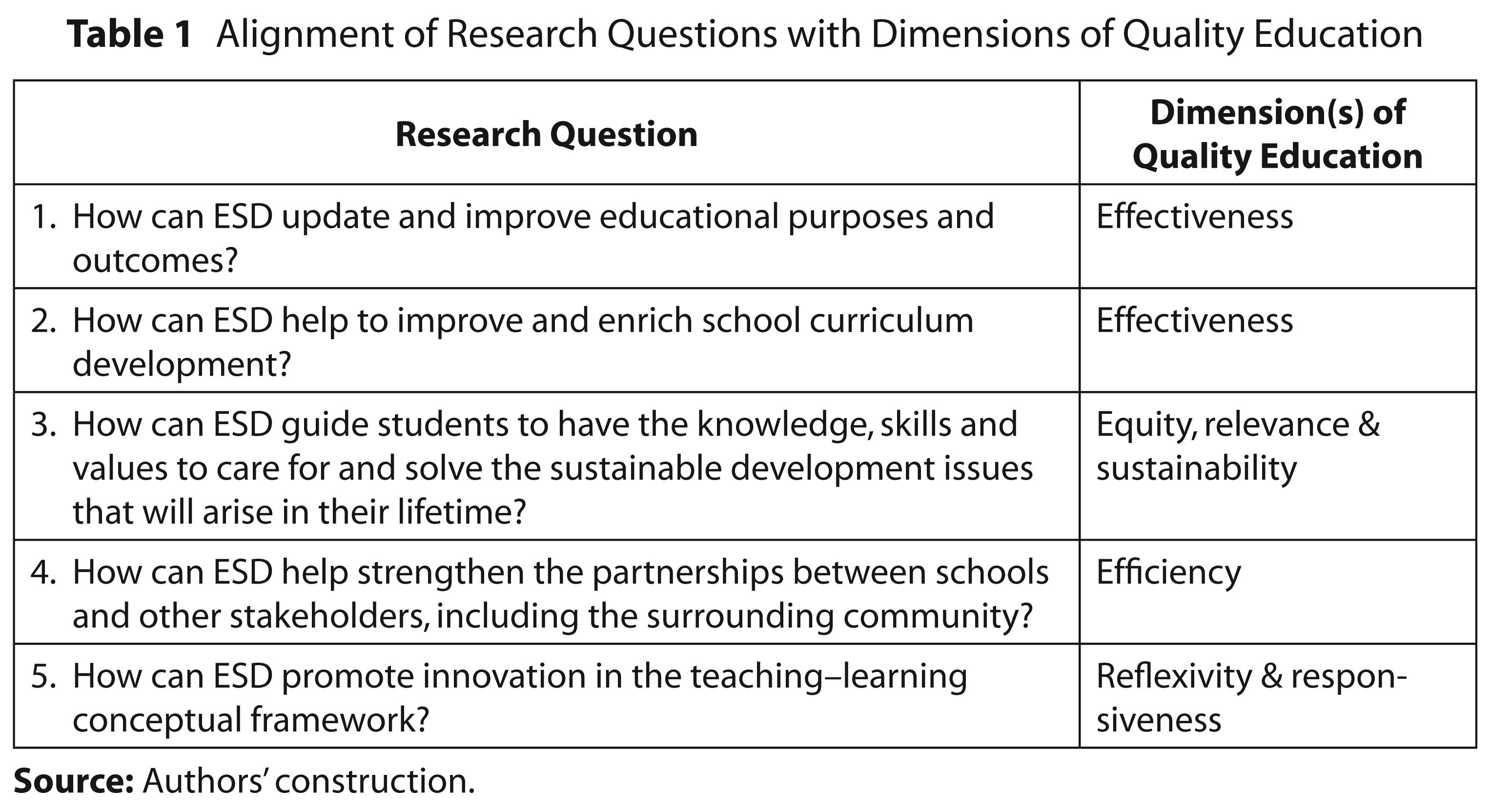
How can ESD update and improve educational purposes and outcomes? How can ESD help to improve and enrich school curriculum development? How can ESD guide students to have the knowledge, skills and values to care for and solve the sustainable development issues that will arise in their lifetime? How can ESD help strengthen the partnerships between schools and other stakeholders, including the surrounding community? How can ESD promote innovation in the teaching–learning conceptual framework?
High-ranking ministry of education officials in five countries (Canada, China, Finland, Latvia and Scotland) ensured the question’s relevance and usefulness.
These five questions correspond to three main models of quality in education described in the ‘Literature Review’. Because ministries of education around the world use different models of quality, the research design reflected that diversity by asking questions that are aligned to different models and dimensions of a quality education. Table 1 shows how the five research questions align with dimensions of quality education from the Nikel and Lowe model (2010).
Alignment of Research Questions with Dimensions of Quality Education
Data
The data for this study are the reports from the countries based on the above-mentioned five questions. In May 2014, the researchers presented their preliminary findings from the past year at the research seminar on ‘ESD and Quality Education’ (Beijing, China). The presentations were based on interviews with senior education leaders and practitioners who had significantly embedded ESD in schools within their jurisdictions. After the seminar, the presenters submitted written reports. Additionally, other researchers who could not attend the meeting submitted written reports. In total, findings from 18 countries 3 were included in the research project. It is important to note that these reports feature a small number of schools or participants within each country; they do not necessarily represent all primary and secondary schools in each participating country.
When studying the daily operations of schools and education systems, some overlap in the answers to some of the questions arose. Such lack of compartmentalization is indicative of ESD content and pedagogies when interdisciplinary approaches are used. Indeed, the lack of compartmentalization emerges in some reports; researchers sometimes present somewhat similar results under more than one question. In synthesizing the reports, we have taken the liberty to place the research results under only one of the five questions. In addition to answering each of the five questions, several reports highlight specific challenges in implementing ESD in schools. In presenting these challenges, it is our intention to inform educators, administrators and other stakeholders on important aspects that require specific attention in further implementing ESD approaches in schools and school systems.
Research Questions and Findings
How Can ESD Update and Improve Educational Purposes and Outcomes?
This question pertains to traditional perceptions of quality and better outcomes. Researchers provide evidence showing that ESD improves test scores and helps achieve other desired outcomes, such as improved student attendance and problem-solving skills—outcomes typically associated with schooling. Some of these outcomes are academic in nature and are sometimes measured by local, provincial/state, national and international standardized tests.
Eight countries report increased academic performance in ESD schools (Australia, China, England, Estonia, Peru, Sweden, the Netherlands, and the United States of America), although no country claims a cause and effect relationship between ESD and test scores. In fact, several reports indicate that a strong link between ESD implementation and student performance cannot be considered causal due to lack of evidence. Yet, researchers in 14 countries (Australia, Belgium, Canada, China, England, Estonia, Finland, Germany, Japan, Mongolia, Peru, Scotland, Sweden, and the Netherlands) report that students of ESD schools develop stronger critical thinking skills, deeper understanding of the topics under study and better research skills. In addition, one country (Latvia) reports students are better prepared for the job market. Students also demonstrate excellent communication, writing and mathematical skills (Finland, Germany, Scotland), problem-solving skills (Korea) and abilities in forming and defending their opinions (Estonia). University professors also state that ESD school graduates enter university with excellent post-secondary studies preparation (Sweden); that ESD students contribute to creativity and character education (Korea); and that student attendance rates increase in ESD schools (Australia, Belgium, Canada, the US). No reports mention negative relations between ESD implementation and student performance.
Selected researchers’ quotes:
‘ESD has a positive influence on learning and possibilities to take part in school affairs.’ Finland ‘ESD allows students to improve their problem-solving skills as it focuses on actual practices as opposed to only learning theories. This is in my opinion because Korean ESD tends to be accompanied by students’ projects and campaigns.’ Korea ‘The students are excited; they get far in terms of knowledge development and appreciate the contacts with the surrounding society. They work on something they perceive as important and real.’ Sweden ‘ESD is part of a larger process for “growing great people”.’ the US ‘I have seen test scores rise, student attendance improve, and children who for disciplinary reasons are normally on the radar go off the radar.’ Australia
How Can ESD Help to Improve and Enrich School Curriculum Development?
This question pertains to the relevance of current curricular content as well as student intellectual engagement with the content. The focus here is on outcomes other than student performance, both of which are very often the stated goals of education systems. While outcomes such as curricular relevance and student engagement are rarely formally measured, their importance is well established. Hence, they are included in this study.
Observations include student, school or systemic level. At the student level, 11 reports (Australia, Belgium, Canada, China, England, Mongolia, the Netherlands, Peru, Scotland, Taiwan, and the US) state that students find the ESD approach increases the relevance of their learning content. ESD is reported to give more meaning to school curriculum that is well adapted to local themes and priorities. ESD creates a more interesting learning context for students (Australia, Belgium, the Netherlands, Scotland, Sweden, the US) and helps students recognize their roles in society (Korea). Increased curricular relevance associated with ESD leads to increased student engagement and commitment (Canada, China, Germany, Japan, the Netherlands, Peru, Scotland, Sweden, the US), self-confidence (Germany), self-esteem (Finland, Korea) and self-awareness (Estonia, Korea). ESD perspectives foster further engagement with ESD topics in students’ private lives, including lifelong learning, informal learning and social entrepreneurship (Finland, Germany). In addition, ESD promotes students’ spiritual development and helps them treat their surrounding world and cultural heritage with sensitivity, care and respect (Latvia). ESD perspectives also increase student influence on their education (Scotland, Sweden), while projects such as twinning schools in different countries increase empathy, understanding, stewardship and intellectual engagement (Canada).
ESD approaches lead schools and school systems to a comprehensive focus in school education and management plans, as well as to a framework of competencies (Finland, Japan). In some cases, ESD is integrated and prescribed in the overall curricula and several syllabi throughout the basic education programme (Scotland, Sweden); and in others, an increase in the number of school projects related to ESD is indicated (Japan, Sweden). The Netherlands is considering integrating the four UNESCO competencies (learning to know, learning to do, learning to be and learning to live together) (Delors et al., 1996) into its curriculum. Elsewhere (Australia, Canada, Estonia, Latvia, Peru, the US), ESD curricular outcomes are integrated within school curricula and not forced on schools as ‘add ons’. This approach leads to a greater impact than a simple supplement to the prescribed curriculum. In Mongolia, integration is uneven, more in some subject areas than others. Integrating ESD into school curricula leads to a focus on outcomes other than student performance, such as students’ well-being (China, Germany, Korea, Latvia, the Netherlands, the US), and provides reason and purpose for developing historical and geographical knowledge and skills (Peru). Global environmental issues such as climate change adaptation, disaster preparedness, green economy, social justice and global partnerships are the main suggested topics for inclusion in curricula (Taiwan).
Selected researchers’ quotes:
‘ESD can provide a rich, exciting, engaging and relevant school curriculum by educators choosing contexts, choosing themes, choosing problems for kids to solve that are local and real.’ Australia ‘The core idea and the practice of ESD will become the standards of quality education and quality learning, which are necessary for the sustainable future.’ China ‘ESD improves the outcomes of education by putting emphasis not only on cognitive aspects of teaching but on developing the spiritual [so that] a person…treats the surrounding world, people, and cultural heritage with sensitivity, care, and respect.’ Latvia ‘ESD encourages interdisciplinary and cross-curricular work, and when developed through the use of Inquiry Based Learning strengthens research skills, questioning, risk-taking, critical thinking and collaborative learning.’ Peru ‘Staff and pupils reflect on and debate the purposes of education and schooling and contribute to formulating and taking forward the school’s vision and values.’ Scotland ‘Education for sustainability entails a very different approach than education about sustainability.’ the US
How Can ESD Guide Students to Have the Knowledge, Skills and Values to Care for and Solve the Sustainable Development Issues that Will Arise in their Lifetime?
This question pertains to educating today’s students for an uncertain future and to face the complexity of future challenges to global sustainability. ESD provides students with opportunities to identify relevant issues and work through the process of finding appropriate solutions. It is feasible to implement strategies that help students to observe the complex connections between local and global issues, appreciate entire systems and question and engage in focused inquiry. The more practice students have in facing today’s real-world issues, the more likely they will be able to address the problems they face in the future.
ESD contributes to developing student’s abilities and confidence. Students learn to adapt to evolving complex situations (Finland, Latvia, the Netherlands, Mongolia, Scotland, Korea, Sweden) and develop better systems thinking skills (Finland, Japan, Mongolia, Sweden, the US), problem-solving skills (Australia, China, England, Estonia, Finland, Korea, Sweden) and values for sustainable development (Taiwan), while understanding that sustainability is not just about the environment but primarily about the reconciliation between environmental sustainability and human development (Peru). ESD helps students develop competencies (knowledge, skills and attitudes) through constant interaction and evolvement (Germany, Sweden). ESD also helps students recognize interrelations and interconnections in ESD issues and positions, and to incorporate such perspective when solving problems and addressing issues (Australia, Belgium, England, Finland, Germany, Japan, Latvia, Peru, Scotland, Sweden, the US). Students who follow ESD curricula become attentive to global issues (Korea), learn to act as responsible citizens locally and globally with respect to ESD issues (England, Germany, Latvia, Peru, Scotland, Sweden), build an empathetic outlook and commitment (Peru) and participate in democratic decision making (Mongolia). ESD also inspires students to create solutions for the future (Australia, Belgium, Latvia, Korea, the Netherlands, Sweden); to become future leaders and managers (England), and to foster a sense of hope, appreciation and respect for humans and nature (the Netherlands, Sweden). Mongolia reports that curriculum and textbook analyses show that ESD has led to an increased emphasis on skills and competencies rather than values.
Selected researchers’ quotes:
‘ESD helps prepare our students for a sustainable future by ensuring that they are environmentally responsible, globally aware, economically astute, socially responsible, and technologically proficient citizens who are capable of coping with the emerging challenges and opportunities we are facing now and will continue to face in the future.’ Canada ‘Education for Sustainable Development (ESD) is the way students change their own lifestyles, values, and behavior toward building a sustainable future.’ Japan ‘ESD provides students with opportunities to face complex issues dealing with a wide range of projects, especially in middle and high schools. With club activities and other extra-curricular activities, students can further develop problem-solving skills and values.’ Korea ‘ESD shares many similarities with entrepreneurial pursuits. The ability to deal with problems from different perspectives, to creatively find solutions and move forward are common features.’ Sweden ‘In addition to knowledge which is emphasized by most subjects, ESD highlights the importance of skills for action and values for SD.’ Taiwan ‘ESD can provide knowledge that is driven towards taking action on issues; it can also provide knowledge that allows kids to look at the reality of what’s going on around them, the complexity of decisions that they’re hearing at the political level.’ Australia ‘Society does not need people that know how to save water. It needs people that actually do save water.’ the Netherlands ‘The more practice students have with solving real world problems today, the more likely they will be able to address the problems they face in the future.’ the US
How Can ESD Help Strengthen the Partnerships between Schools and Other Stakeholders, Including the Surrounding Community?
This question pertains to the usefulness of the school to its local community and vice versa. Students need opportunities to become meaningfully and authentically engaged with community issues. Schools focusing on ESD can help create these opportunities and foster strong collaborative ties between schools and their community. When students are offered meaningful and relevant learning opportunities, they become increasingly engaged, which often increases attendance and academic achievement. This logical sequence exemplifies the strong link between the five questions in this report.
Research shows that ESD helps connect schools and stakeholders within the community. When students engage in local issues, opportunities arise for them to learn more about their community. In turn, this provides a way for community members to become directly involved with the school. When students engage in community issues, communities often invest better in solutions. Such evidence is shown with respect to local communities, organizations, universities, local governments and UNESCO (Belgium, Canada, Germany, Japan, Latvia, Mongolia, Peru, Korea, Scotland, Sweden, the Netherlands, the US). Further, reports show that ESD schools contribute to their communities (Australia, Sweden, Korea) and have become role models for other schools (Germany). In some cases, they also strengthen collaboration between schools (Estonia, Peru), help reinforce relations between schools and parents (Latvia, the Netherlands, Peru, Korea) and improve principals’ philosophies of school management (China). ESD school projects are increasingly mentioned in local media (Sweden) and more student exchanges are occurring between countries (Belgium).
Selected researchers’ quotes:
‘ESD makes students understand the importance of relationships, and how everyone and everything is connected. When we know each other and know our environment, the commitment to each other improves.’ the Netherlands ‘ESD must be locally relevant. In this way, schools are no more institutions separated from the real world, proposing abstract general knowledge, but become institutions active in the society, recognized as relevant stakeholders in the development of the community.’ Finland ‘Educational institutions can be role models with regard to sustainable action and management.’ Germany ‘ESD motivates students to participate in community-oriented activities…involving them actively in the community activities.’ Latvia ‘Staff demonstrate a highly developed understanding and awareness of the needs of their communities. Members of the community see the school as central to community life.’ Scotland ‘Students work in local civil society organizations or autonomously organize voluntary group activities. There has recently been an active movement to establish more networks between schools and local communities, but there are still not enough of them. These partnerships can partially be supplemented with smart applications.’ Korea ‘Activities involving museums and local communities are good opportunities for students to better understand local society and environments. ESD activities involving local community role-players, led to reciprocity by helping improve partnerships between schools and local societies.’ Korea
How Can ESD Promote Innovation in the Teaching–Learning Conceptual Framework?
This question pertains to improving our understanding of how teachers learn to teach throughout their careers and how to engage learners in a way that helps them master the curricula. Education systems strive to have students perform at very high levels regardless of the measure used to determine student performance. It is well known that the most important factor in student learning is quality teaching. Therefore, having ESD contribute to improved teaching makes a strong argument to maintain and even augment its role in education systems. Research results presented here support this view.
ESD has prompted innovative teaching approaches and methodologies, such as project-based learning, experiential education, cooperative and peer learning and teaching and feedback (Australia, Belgium, Canada, China, England Germany, Japan, Latvia, Mongolia, Peru, Korea, Sweden, Taiwan, the US). ESD has also increased the use of information and communication technologies (Estonia, Japan, Latvia, Sweden). In some cases, incorporating ESD into education systems has developed and increased the use of new educational materials (Belgium, Japan). The implementation of innovative teaching approaches and materials has, in turn, increased the variety of assessment methods (Canada, Estonia, Peru, Sweden, the US), including the assessment of competencies and deeper knowledge. In some countries (China, Germany), this has led to new standards for evaluating schools. The focus in many ESD schools is changing from teaching to learning (Australia, Germany), as teachers understand their role as coaches and change agents and are no longer constrained to their traditional role (Australia, Belgium, Latvia). Teachers report authentic learning experiences for themselves and their students (Canada, Korea, the US), and also report learning from their students (England). Cases of teachers and students designing school activities collaboratively are also reported (Finland). Such evolutions have prompted more enthusiastic and engaged teachers (Peru), increasingly aware of their lifelong learning opportunities (Germany).
Research shows ESD is best implemented when issues are addressed in multidisciplinary ways and across curricula. Teachers confirm the holistic paradigm as more efficient to reach curriculum goals and promote broad knowledge (Belgium, Peru, Sweden, the US). When collaborating on interdisciplinary projects, multidisciplinary approaches enable teachers to learn about curriculum content in areas outside of their specialty (Belgium, Germany, Sweden). Because ESD issues are multidisciplinary and value laden, several countries have identified and addressed the need for improved teacher training regarding values and awareness about sustainability and sustainable development (Germany, Latvia, Korea). ESD pedagogy and its associated training show development in teacher ability to cultivate student values towards sustainable development (China). ESD is the driving force in Beijing’s Shijingshan Education Commission alignment of its educational vision, curriculum, teacher training and creation of a ‘campus culture’ that leads to better educational outcomes. Another country reports analyzing textbooks, which include elements of the five questions used in this study, and then developing numerous ESD-related policy documents (Mongolia).
Selected researchers’ quotes:
‘As with any new initiative, the key to success lies in teacher capacity.’ Canada ‘Including ESD in teaching requires constant updating, which creates a need and inspiration in continuous professional development of knowledge and pedagogy.’ Sweden ‘The implementation of ESD promotes and supports the collaboration of science and practice (e.g. action research).’ Germany ‘ESD provides an integrated perspective on education. However, teacher capacity is important when it comes to adopting the ESD approach in classes.’ Korea ‘The teachers believe in us, they look at us as competent adults and not as incompetent 17-year-olds. That gives you confidence.’ Sweden
Future Challenges
The results of this preliminary international research have identified a number of challenges to implementing and broadening ESD across countries. The challenges highlighted in the reports can be summarized as a framework for next steps in ESD:
Integrate ESD across the primary and secondary curriculum: It is important to fully integrate ESD in curricula across all subjects (Australia, Japan, Mongolia, Korea, the US) and within a clear framework (Sweden). Failure to do so could prompt ESD to be considered as one of several competing priorities (Japan), as deviating from already existing priorities (Peru) or to be perceived as imposed on schools (Germany). Provide professional development for teachers to ensure ESD policy implementation: Student learning suffers if teachers fail to understand ESD. ESD involves knowledge in several disciplines, often beyond teachers’ areas of specialization (Canada, the US). Some teachers may reduce ESD to recycling and green projects (Australia, Peru) and may not emphasize sustainability in broader contexts. Others understand its complexity and the need for systems thinking, but they view ESD as an overwhelming challenge and responsibility (Germany). However, others do not understand it as important to their courses (Japan, Peru). These challenges underscore the difficulty in changing teachers’ values and behaviours. Thus, there is a need for a coherent system of professional development aligned with teacher education programmes (Germany, Mongolia, Peru, the US), accompanied by quality teacher resources (the US). School leaders should adopt ESD management practices to complement and support ESD in the curriculum: With teacher education and training opportunities in place, there is also a need for strong educational leadership of principals and teachers, including high expectations towards teachers and management support (Sweden). School administrators also need to adopt new management practices and structures, such as different time schedules in schools (Germany, Korea).
ESD can have a positive impact on academic outcomes but more research is needed to identify best practices. The three challenges noted here are typical for new educational domains such as ESD; and none are impossible to address. In fact, what is reported as challenging in some countries is reported as strength in others. Thus, opportunities abound for the worldwide ESD community to share and learn from each other’s experiences and expertise.
Conclusion
The results of this international research project provide abundant qualitative evidence that ESD contributes in many ways to a quality education. When the curriculum includes sustainability content—delivered in terms of local, social, economic and environmental contexts—teaching and learning transforms primary and secondary education in all contexts. Research also provides evidence that ESD pedagogies facilitate the learning of knowledge, and promote the learning of skills, perspectives and values necessary to foster and maintain sustainable societies. Nevertheless, the authors recognize the need for more research which clearly demonstrates the contributions to quality education and the extent of those contributions.
Footnotes
Acknowledgements
This research synthesis report was based on research projects carried out in 18 countries. The authors include: Australia: K. Malone & M. Sommerville; Belgium: W. Van Buggenhout; Canada: A. MacDiarmid, H. Creech; China: Shi Gendong, Wang Guiying, Wang Qiaoling and Sun Yun; England: A. Finlayson; Estonia: M. Viesson; Finland: P. Immonen and A. Nuutinen; Germany: U. Stoltenberg, V. Holz and K. Bruhn; Japan: T. Ichinose; Korea: S. K. Lee and S. Baek; Latvia: D. Iliško and I. Salite; Mongolia: J. Badrakh and T. Baljir; Netherlands: A. De Hammer, G. Devries, J. Bot, H. Schweitzer and J. Kenter; Peru: J. Perrin and C. Stayte; Scotland: B. Morton, B. King, I. Menzies, M. Watson, M. Mackenzie and P. Higgins; Sweden: M. Persson, U. Lindquist, T. Almgren and M. Bengtsson; Taiwan: T. C. Chang and J. Wang; and US: V. Nolet. The authors thank the John Dearness Environmental Society for making this publication free for all.