




Abstract
Most people’s historical perspective begins with the day of their birth.
—Rush Limbaugh
The year of grace 1999 was the penultimate year of the 20th century and started on a Friday. That year was notable for the award of the Nobel Peace Prize to Médecins Sans Frontières (Doctors Without Borders). It was also the year in which the first edition of the Manual, published by the Indian Rheumatology Association, saw the light of day. As the Manual now celebrates its 6th edition and 25th anniversary, it is an opportune moment to look back at this initiative of the Indian Rheumatology Association (IRA) through the lens of history.
Rheumatology in India came into being in 1959 when the late Dr M. M. Desai established the first Rheumatology clinic at TN Medical College and B.Y.L. Nair Hospital in Bombay, now Mumbai. The college itself has a chequered history. It was established as the National Medical College in 1921 through donations from the Tilak Swaraj Fund established by Mahatma Gandhi in memory of Bal Gangadhar Tilak as part of the Non-Cooperation Movement against the British. A generous grant of ₹5 lakhs by a local philanthropist, Mr M. N. Desai (different from Dr M. M. Desai), popularly commonly known as ‘Topiwala Desai’, allowed for the upgrading of the college in 1946 and its renaming as Topiwala National (TN) Medical College. The B.Y.L. Nair Hospital is named after another benefactor, Dr A. L. Nair, who donated two acres of land to establish a hospital named after his mother, Bai Yamunabai Laxman Nair. As chronicled by Professor V. R. Joshi, around the same time, the Indian Rheumatism (now Rheumatology) Association was formed, with its head office in Mumbai. Four years later, in 1963, SEAPAL (South East Asia and Pacific Area League against Rheumatism) was launched, with India as one of the founding members along with Japan, Australia and New Zealand. SEAPAL was the forerunner of APLAR (Asia Pacific League of Associations for Rheumatology). The first SEAPAL conference was organised in Mumbai by Dr M. M. Desai in 1968, and in 1971, the first national conference of the IRA was held in Mumbai under the chairmanship of Dr M. M. Desai, with Dr C. V. Vanjani as the organising secretary. The IRA head office shifted to New Delhi in 2004 and was formally registered with the Registrar of Societies on 11 May 2004. The membership count in 1999 was around 400. It currently approximates 1,600.
In the earlier years, the thought leaders of IRA held innumerable CMEs (continuing medical education) and countless meetings to propagate the discipline of Rheumatology, despite facing numerous hurdles. Therapeutic nihilism amongst doctors and resigned acceptance by patients were commonplace. Rheumatology was nothing more than physiotherapy, nonsteroidal anti-inflammatory drugs and steroids. Drugs like methotrexate were shunned, hydroxychloroquine was not available in the country and leflunomide was still to be launched. The term DMARD (disease-modifying antirheumatic drug) was yet to enter the lexicon of physicians who, for want of anything else, often encouraged patients to explore alternative systems of medicine while confessing modern medicine had nothing to offer for arthritis. The undergraduate and postgraduate exposure to Rheumatology was next to none. Rheumatology did not figure in the exit examinations. However, in real-world practice musculoskeletal conditions were common. The orthopaedic surgeons, by default, were the port of call for the patients. Physicians would refer all patients with any hint of joint pain to the orthopaedic surgeons. One of the bottlenecks was the availability, or rather the non-availability, of Rheumatology books. A recurring question at CMEs in those days was ‘Can you recommend a concise book I can read’? This was the pre-internet era.
The book universe of Rheumatology in the 1980s was dominated by McCarty and Kelley. It was not until around 1995 that The Oxford Textbook of Rheumatology and Klippel & Dieppe’s Rheumatology made their debut, with the EULAR Textbook on Rheumatic Diseases arriving much later, in 2015. All these books were authoritative texts covering almost all aspects of Rheumatology, but they failed to meet the requirements of busy practitioners seeking basic, easily implementable knowledge. The cost and the volume of information were a deterrent to the non-rheumatologists in India, who often found these books intimidating. Each successive edition meant more pages, more contributors, and single-volume books becoming two volumes—referred to as ‘Cushingoid weight gain’ by Janet McDonagh when reviewing the Oxford Textbook of Rheumatology in the Annals of Rheumatic Diseases in 1999. The Primer on the Rheumatic Diseases by the Arthritis Foundation attempted to provide more concise information but was not easily available in India.
Recognising the perceived need for educational resources targeting Indian doctors, the IRA leadership commissioned a slide compendium and a Manual of Rheumatology. Dr V. R. Joshi was the Editor-in-Chief of the first Rheumatology Slide Compendium, with Dr Nimish Nanavati and Dr N. E. Borges as the Associate Editors. The Compendium featured clinical photographs and teaching slides covering common rheumatic diseases, and was supported by Pfizer. Two editions were published, in 2000 and 2006. The inaugural edition of the Manual had Dr P. K. Pispati as the Editor-in-Chief, with Drs N. E. Borges and S. S. Uppal as the Associate Editors. The foreword was provided by the then IRA President, G. S. Sainani. It also included messages from the then President of the International League of Associations for Rheumatology, Dr Jan Dequeker of Belgium, and the then President of APLAR, Dr Mongkol Vatanasuk of Thailand. The print run was a modest 5,000 and was funded by Pfizer. In keeping with the ethos of a manual—which is defined as ‘a book that gives you practical instructions on how to do something’—the Manual contained 23 practically oriented chapters. In a first of its kind for India, a chapter was devoted to Patient Education—Problems and Prospects.
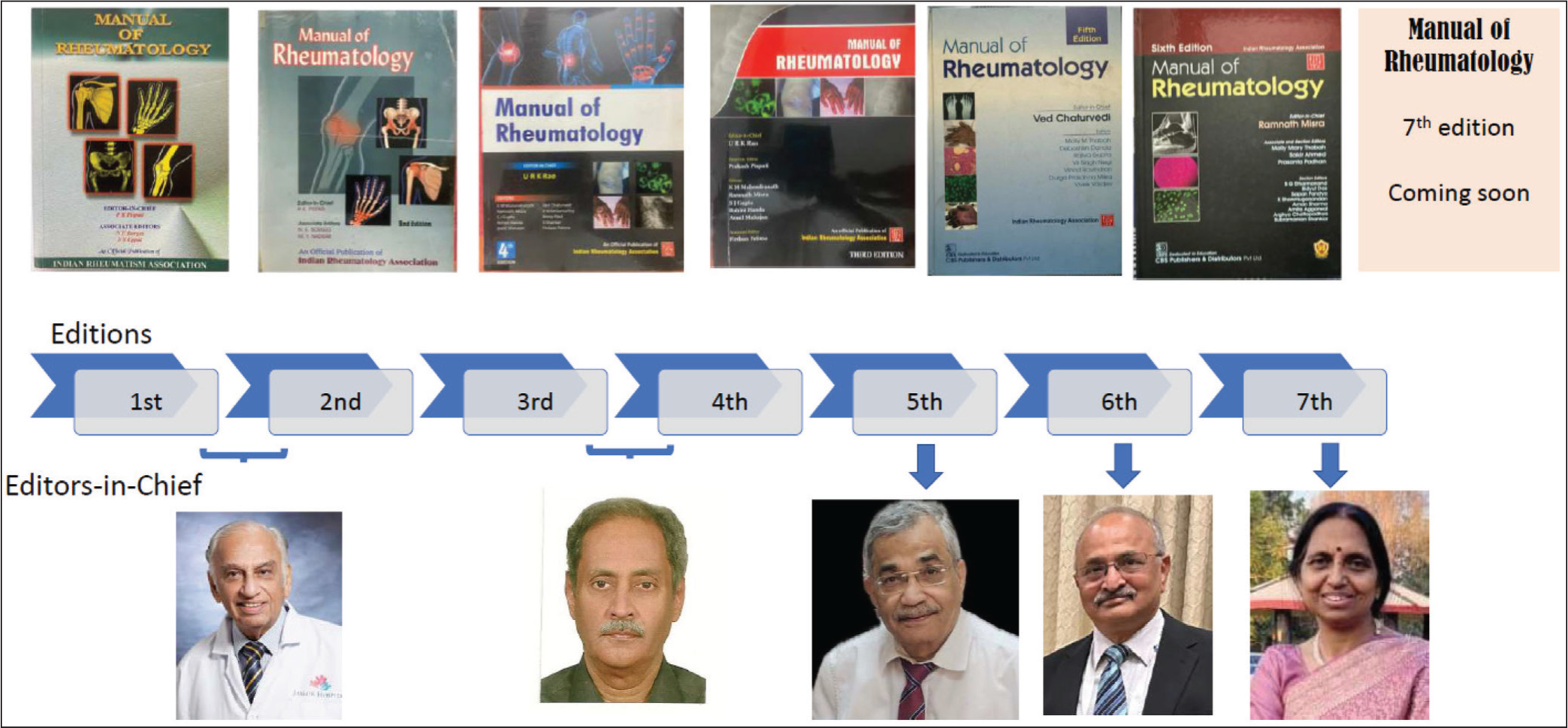
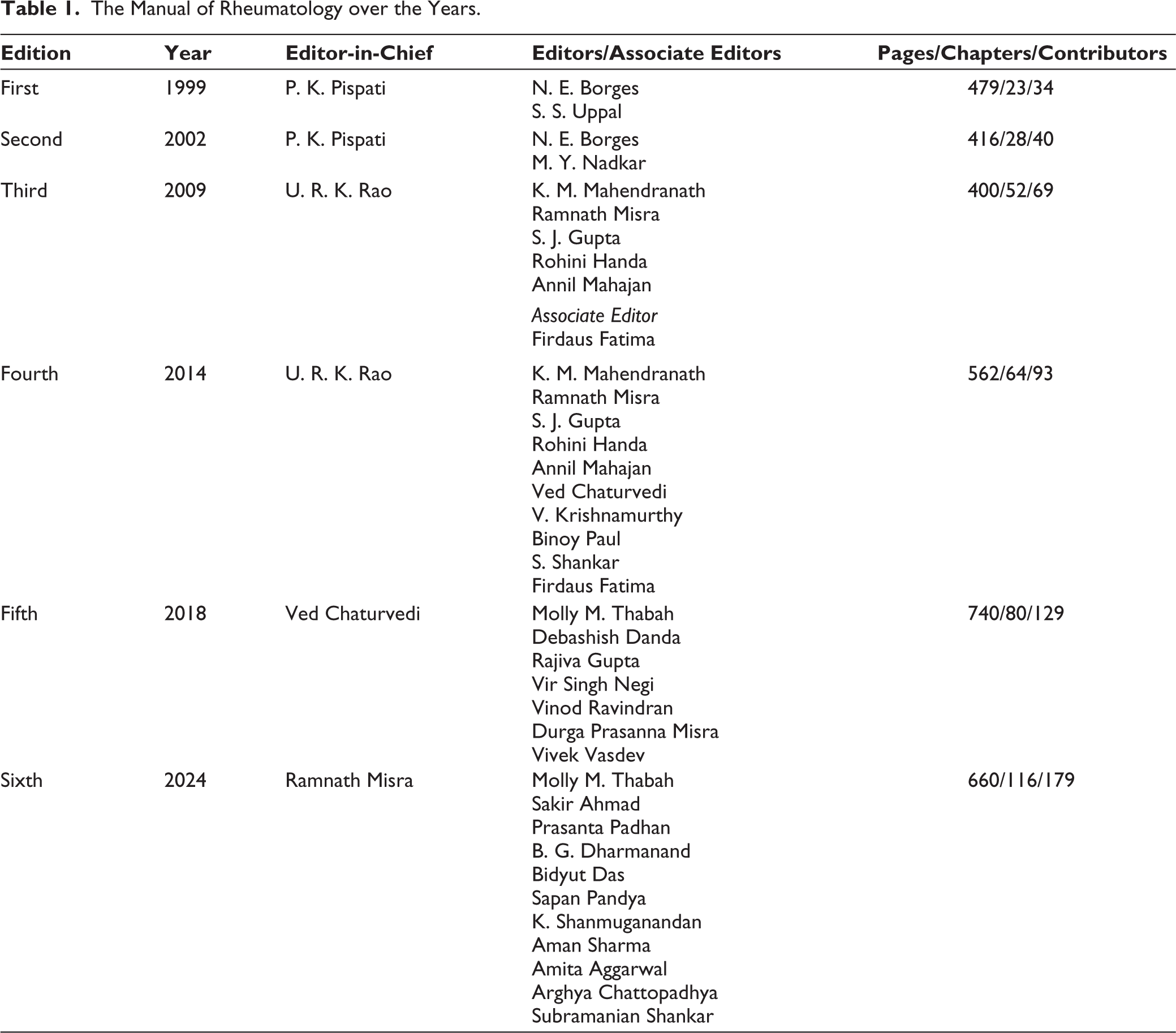
The Manual was received enthusiastically by the busy practitioners who, finally, had a concise book that met their educational needs. The Manual has now witnessed six editions, and the seventh, helmed by Professor Amita Aggarwal, is on the cards (Figure 1). The first two editions were single colour. The subsequent editions were in colour, and the fifth and sixth editions were hardbound. Each Editor-in-Chief has imparted his/her own flavour to the tome. Over the years, the Manual has grown (Table 1), as also its readership. However, the ethos has remained the same. Contemporary scientific information relevant to the practising physician is presented in an easy-to-comprehend format. The metamorphosis continues to reflect the philosophy of the first editor—The Manual of Rheumatology: a book to read and a book to keep!
Manual of Rheumatology—Editions and Editors-in-Chief.
The Manual of Rheumatology over the Years.
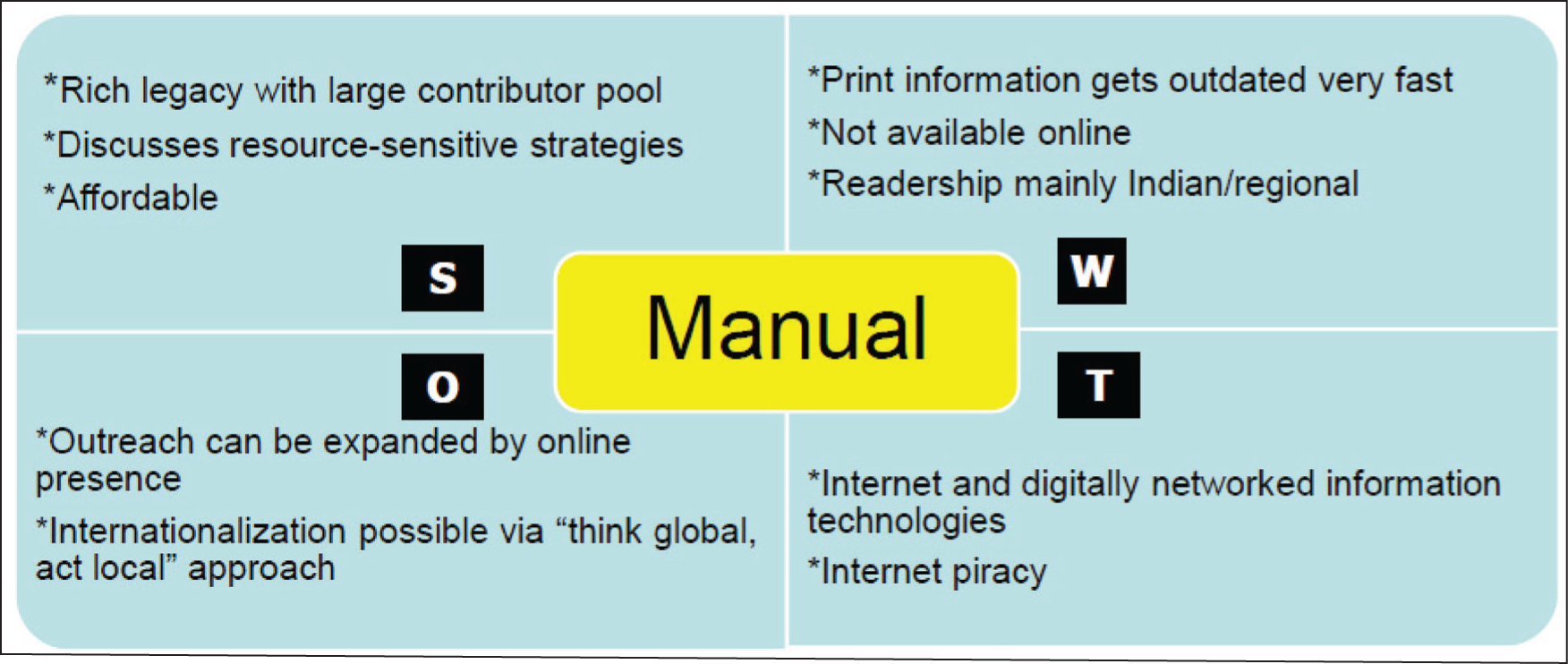
What might be the future of the Manual? As Robert Penn Warren said, ‘History cannot give us a program for the future, but it can give us a fuller understanding of ourselves, so that we can better face the future’. Rheumatology as a discipline has undergone a profound transformation—and so too have the techniques of pedagogy. The juggernaut of digitally leveraged information technologies has called into question the very relevance of the printed word, with some even writing a requiem for the traditional ‘book’. Yet, rather than viewing print and digital media as adversaries, we must embrace their coexistence. The Manual, far from becoming obsolete, can evolve into a hybrid resource—both in print and online. A SWOT analysis is presented in Figure 2. Much like ‘living guidelines’, the digital version can be continuously updated and enriched with downloadable slide decks, visual summaries and graphical abstracts to meet the needs of modern learners. Potential avenues for exploration include a searchable online platform, a mobile application and interactive e-learning modules.
Notwithstanding the digital explosion, there still remains something irreplaceable about the tactile experience of a well-thumbed book—the feel of the pages, the permanence of print and the quiet focus it affords. In a world of fleeting digital interactions and flickering screen colours, the enduring presence of a physical book offers a depth and continuity that scrolling on a screen often lacks. I hope the Manual of Rheumatology continues to see many more editions in the years to come.
Vive la Manual of Rheumatology!
Footnotes
Acknowledgements
I would like to thank Dr S. J. Gupta and Dr U. R. K. Rao for their help in preparing this article. The IRACON 2024 souvenir carried a small piece on Manual of Rheumatology written by me.
Declaration of Conflicting Interests
The author declared no potential conflicts of interest with respect to the research, authorship and/or publication of this article.
Ethical Approval and Informed Consent
Not applicable.
Funding
The author received no financial support for the research, authorship and/or publication of this article.