




Abstract
The challenges of marketing taboo-related products call for innovative communication strategies. To explore the application of storytelling in this context, this study analyses the use of the 12 storytelling archetypes and three typologies of endorsers (celebrity, expert and consumer) in the marketing of sensual products. The content of 22 Instagram posts of the five largest Brazilian brands of sensual products was analysed. The results highlight the predominant use of female endorsers, particularly acting as experts. The most used storytelling archetypes are the caregiver, the jester and the innocent. Based on practice-based knowledge, the results contribute to the formulation of theoretical conceptions of marketing in taboo-related products, guiding the design of future storytelling campaigns. Findings pave the way for research on storytelling effectiveness in sensual products.
Introduction
Instagram is a social media platform with privileged effectiveness in consumer involvement and purchase behaviour (Prasojo & Aliami, 2024), considering the impact of Instagram content on audience awareness, engagement and loyalty (Ibrahim & Aljarah, 2024; Saikia & Bhattacharjee, 2024). Instagram has been used for product marketing by firm-generated and user-generated content (Ibrahim et al., 2024; Prasojo & Aliami, 2024) and Instagram content analysis has been conducted in various contexts to understand information dissemination, social trends and user behaviour (Ares et al., 2024; Gonzalez et al., 2024), becoming an adequate context to evaluate digital communication effectiveness (Luarn et al., 2024). The use of digital influencers/endorsers on Instagram also contributes to the credibility of the communication process, and research has analysed consumer reactions towards different types of content, particularly Instagram storytelling (Kaczorowska et al., 2024) and the interactions between consumers and endorsers and the effects on brand preference and purchase intention (Conde & Casais, 2023; Hussain et al., 2023).
Storytelling is the act of telling stories with emotional elements in narratives (Menon et al., 2024). Storytelling narratives raise consumer emotions, attitudes, engagement and identification with brands (Kaczorowska et al., 2024; Kang et al., 2020) through a dynamic construction of symbolic meanings (Aimé, 2023) and archetypal myths (Cooper et al., 2023) to define each story’s characters, their behaviours, actions and reactions. Archetypes are elements of common imagination and collective unconscious that immediately affect individual motivations. Archetypes are sets of primordial images innate in any person’s psyche. They are part of the collective memory to identify the characteristics, motivations, values, and personality traits conveyed by those images/archetypes (Siraj & Kumari, 2011). Mythologic heroes are commonly used as archetypes to express the power of brands’ performance (Cooper et al., 2023), but recent research has also found the importance of archetypal blending in the hero’s journey (Kelsey et al., 2023) and the use of multiple archetypes in storytelling (Merlo et al., 2023).
Storytelling has been widely used in advertising to foster strategic brand communication and promote brand personality (He et al., 2021; Zayer, 2021) and brand preference (Cooper et al., 2023; Kelsey et al., 2023), influencing purchase behaviours (Júnior et al., 2023; Kang et al., 2020). Marketers explore stories to make their products seem familiar and authentic (Yang & Kang, 2021). Storytelling is an effective technique to bring up memories and experiences by inspiring narratives and feelings such as desire, admiration, and identification (Lundqvist et al., 2013), for example, through archetypes of figures living in such places through storytelling city branding (Majzoub et al., 2024). These stories allow proximity to the public (Kılıç & Okan, 2021), leading to customer loyalty (Hsu, 2008; Van Laer et al., 2014; Woodside & Megehee, 2009) by emotional power (Menon et al., 2024).
Communication managers also resort to the use of endorsers to affect customer purchasing decisions through advertising campaigns (Guido et al., 2011). Endorsers are people used to impart privileged knowledge regarding the advertised product, influencing attitudes and purchase intention towards such product, considering the credibility and attractiveness that the endorser integrates into the advertisement (Amos et al., 2008; Chan & Fan, 2022; Gräve et al., 2021). Endorser types differ based on their credibility or the endorser-product fit, the opinion leadership based on the popularity towards the audience or expertise towards the product, or even the parasocial relationship (Conde & Casais, 2023). Endorsers may be, for example, a celebrity, an expert or a consumer (Gräve et al., 2021).
Taboo is an important topic in consumption research, considering that stigma associated with consuming certain products may hinder marketing communications (Gebreselassie & Bougie, 2024). Consumer purchase behaviours tend to crystallise conformity with social structures (Meenakshi, 2020), and that is particularly identified in the consumption of erotic or sensual products (Dubé et al., 2023).
Research on the use of archetypes in storytelling is scarce (Cooper et al., 2023; Kelsey et al., 2023; Merlo et al., 2023), and there is no evidence on the effectiveness of endorser types in the use of each archetype. Further, the application of storytelling techniques to the case of marketing of products with associated taboos is limited (Sabri, 2012), and the existing literature reinforces the challenges in this context (Anam, 2024; Sredl et al., 2024). Therefore, the present study aims to understand the use of archetypes and endorsers in storytelling in sensual product marketing. The study of sensual products is a good example to understand the use of archetypes and endorsers in storytelling because both mediate between brands and consumer motivation by converting the strange and potentially threatening into something familiar and safe, which then facilitates the act of purchasing and understanding of the functionalities of each sensual product (Ogunsiji, 2012; Saunders & Skar, 2001). Thus, considering the challenges of taboo advertising (Kumar et al., 2024; Myers et al., 2020), this study explores the use of storytelling as a communication strategy to break the market barriers regarding these taboo-labelled products, minimising the constraints on audience when shopping.
To achieve the stated objectives, the authors conducted a content analysis on Instagram posts of brands acting in the market of sensual products to find which storytelling techniques are predominant and thus contribute to the creation of theoretical conceptions on storytelling in the marketing of taboo-related products aimed to attract and persuade consumers. The research follows the assumption that the analysis of practices in marketing communication may help the construction of theoretical frameworks and may provide guidance for practitioners based on previous evidence (Casais & Pereira, 2021; Casais & Proença, 2022).
Literature Review
Storytelling is a communication tool for stimulating sensations in consumers (Júnior et al., 2023), aiming to build relationships with the target audience (Hsu, 2008; Kaczorowska et al., 2024; Menon et al., 2024). Storytelling can be analysed under the lens of communication theories that provide the fundamentals of the construction of meaning with semiotic elements connected by social referential that provide symbolic understanding. This theoretical framework is expressed by interpretative theories such as social constructionism and symbolic interactionism, proposed by George Herbert Mead and Herbert Blumer (Bula, 2023). The role of storytelling is to be creative to engage the audience’s attention through emotional stories (Kang et al., 2020; Yang & Kang, 2021) that can take longer than usual advertisements but that retain the audience’s attention (Dhote & Kumar, 2019). Storytelling is an effective way to sell ideas or products by engaging consumers and seducing them to create bonds with brands (Hsu, 2008; Júnior et al., 2023; Woodside & Megehee, 2009; Van Laer et al., 2014).
Transmedia storytelling consists of building multichannel communication aimed at creating a unique and coordinated experience for the story (Javanshir et al., 2020). Some authors state that transmedia storytelling is able to influence both communication content production and human behaviour itself. This narrative structure expands across different languages (e.g., verbal and iconic) and media (cinema, comics, television, video games, among others) and is far from being just an adaptation from one media to another (Dionisio et al., 2016; Scolari & Ibrus, 2014). Storytelling has gained particular interest on social media (Menon et al., 2024), as is the case of Instagram stories (Villaespesa & Wowkowych, 2020), as this platform is effective in sponsored emotional storytelling (Kaczorowska et al., 2024), especially when endorsed by micro-influencers (Gross et al., 2023).
Marketers strategically use storytelling more and more because of the transforming context of corporate communication through social media, which is becoming more interactive and conversational, favouring the characteristics of storytelling to enhance consumer brand attitudes (He et al., 2021). Rather than a simple informative advertisement of a product’s qualities, storytelling is a discourse that seeks to relate lives, to show the life stories of consumers who perceive themselves as living in a paradise for having purchased certain products (Pera et al., 2016).
Advertising uses fictional characters, places and situations to engage and interest the consumer, communicate brand attributes and benefits (physical and emotional), and position the brand in their minds. All images, symbols, feelings and associations become parts of a brand’s perceptual inventory. Ads and commercials should be designed as an individual advertising mythology because they ultimately affect global mythology, brand’s image and personality (Connan & Sarantoulias, 2013; Siraj & Kumari, 2011). Thereby, brands, products and services tap into communication channels to spread cultural mythologies, values and sensibilities to shape behaviours and cultures (Richter et al., 2016).
Storytelling advertising campaigns use archetypes to define the characters, their behaviours, actions and reactions, and endorsers to provide insider knowledge regarding the advertised product, with the main purpose of subtly drawing consumer attention (Cooper et al., 2023). Endorsers tend to incorporate the character of a hero, although the hero’s journey may be combined with other archetypes of the collective memory (Kelsey et al., 2023). Characters in stories have personalities based on archetypes, which are sets of primordial images that are part of the collective unconscious knowledge and imaginary (Cooper et al., 2023). This occurs because the audience can easily identify the characteristics, motivations, values and personality traits conveyed by those images/archetypes (Siraj & Kumari, 2011). All individuals share a similar psychic structuring because archetypes access the same emotional content, even in individuals from different cultures throughout the world (Roesler, 2012). Archetypes are used in marketing through narrative structures of storytelling because of the easy identification of the character and its values, thus converting a strange and potentially threatening product into something familiar and safe (Kelsey et al., 2023). Thus, all forms of narrative, such as myths and short stories, are based on archetypal realities, which everyone may encounter throughout their lives. Therefore, marketers exploit familiar stories to make their products seem familiar, using archetypes to define each story’s characters, behaviours, actions and reactions (Lloyd & Woodside, 2013).
Talking about archetypes entails recognising behaviours and experiences that represent the will to dominate, courage or heroism, love, hate and faith (Roesler, 2012). Therefore, it is understandable that their use allows eliciting greater cognitive and emotional interaction and participation from the consumer (Lloyd & Woodside, 2013). The complexity of an archetype is demonstrated in the ‘hero’s journey’, where the 12 characters (archetypes) found at the root of human imagination appear regardless of country, culture, religion and customs (Connan & Sarantoulias, 2013; Saunders & Skar, 2001). Figure 1 shows the 12 archetypes stated in the literature.
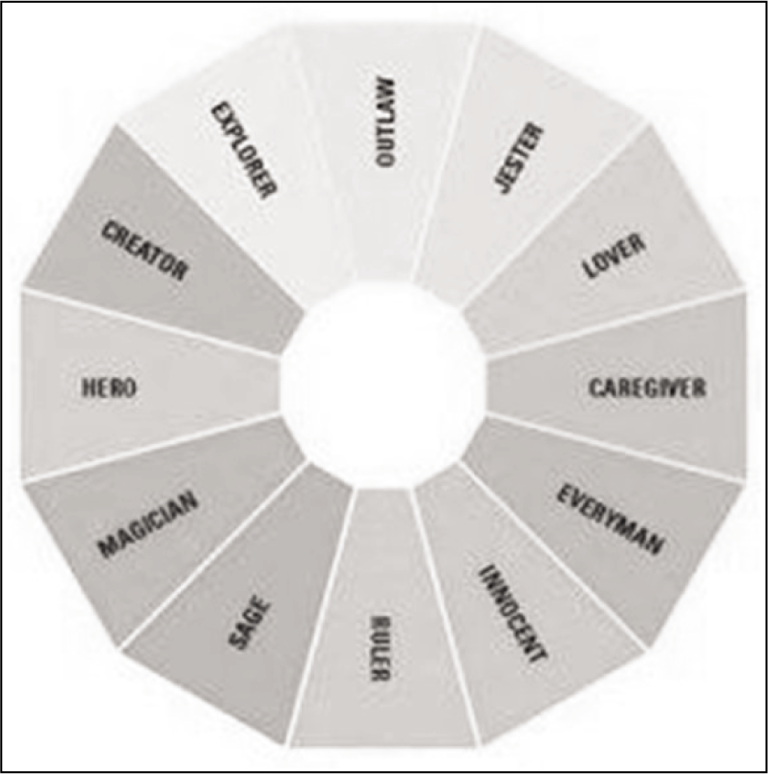
The 12 archetypes are organised into four blocks of strategies: (a) searching for a better place: they seek personal achievement and value their independence and the archetypes in the thick block are the innocent, the explorer and the sage; (b) leaving a mark on the world: they seek skill mastery and want to change the world; (c) no one is an island: they interact with others and want to belong to something; (d): they structure the world: they are stable, viewed as pillars supporting ideas and actions. Table 1 organises the 12 archetypes by the four blocks of storytelling strategies.
Organisation of Storytelling Archetypes by Four Block of Strategies.
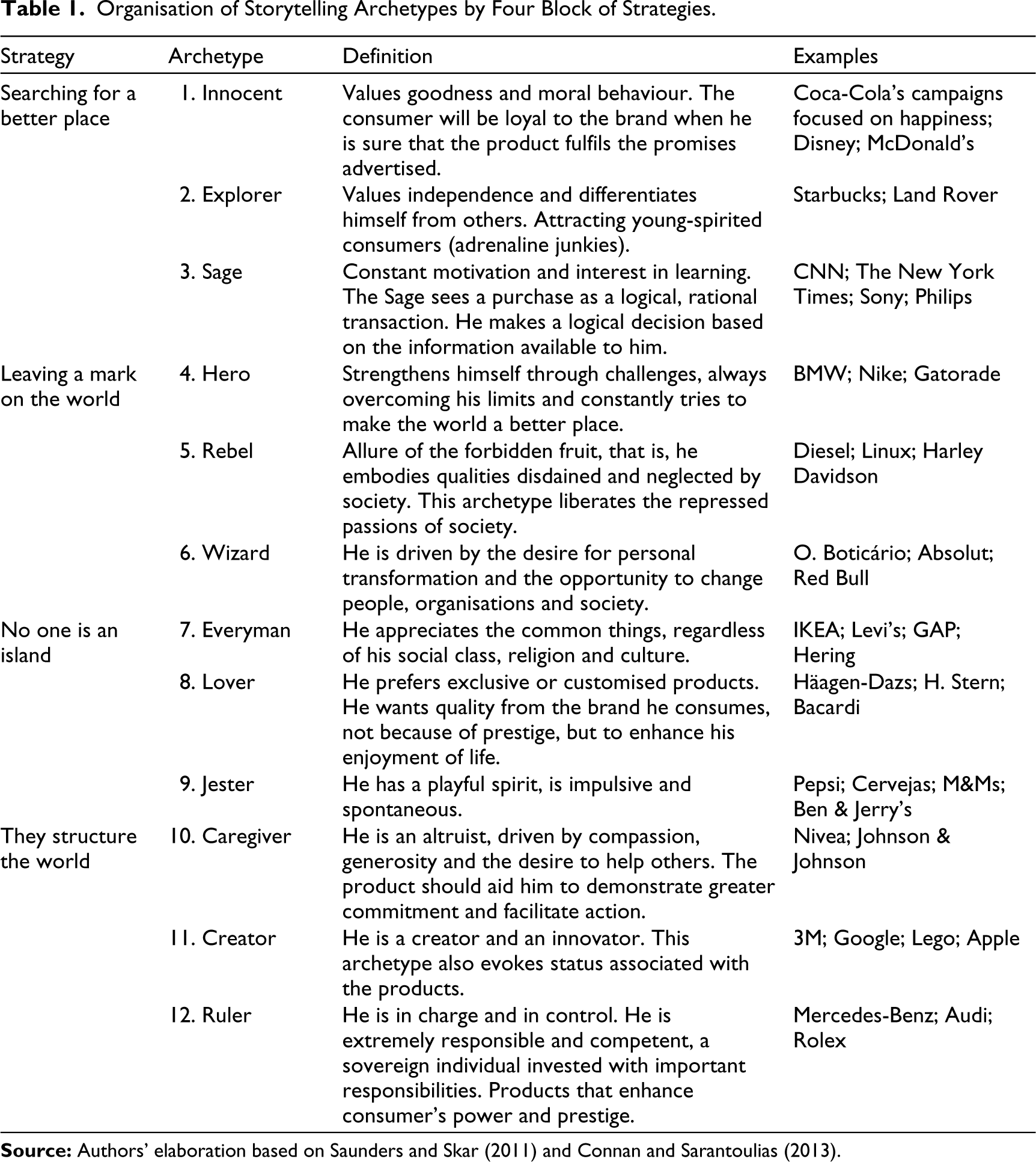
From this categorisation, using archetypes can facilitate perception by creating mental structures that help differentiate brands in the consumers’ mind. Companies understand how archetypes in brand storytelling need to be directed towards a process of humanisation that grants relevance in interpersonal relationships (Connan & Sarantoulias, 2013; Saunders & Skar, 2001). The authors point out that archetypes provide an accessible language to describe the essence of a brand. One of the benefits derived from the use of archetypes is brand personification, which acts as a persuasive tool for building its success, besides directly influencing the behaviour of individuals. Once the archetypes make sense, they will be recognised and ‘activated’ by the public, in a dynamic construction of meaning’s co-creation from consumers (Aimé, 2023). Archetypes also mediate between products and consumer motivation by offering an intangible experience of sense or meaning. Archetypes ensure that constructing an articulated narrative provides deep motivation and experience for the viewer, who, when engaged by fantasy, does not separate the real from the imaginary (Lloyd & Woodside, 2013). Recent literature tends to suggest a trend of archetypal blending in storytelling, combining the use of heroism with other collective journeys as the magician, the warrior or the king, reflecting changing societal values and dynamics (Kelsey et al., 2023; Merlo et al., 2023).
Endorsers are figures that influence consumer attitudes and purchase intention towards products and brands (Chan & Fan, 2022; Purohit & Arora, 2022). Many studies support the use of celebrities in marketing communication (Purohit & Arora, 2022), arguing that they increase brand/advertising recall, attitude towards the brand, advertisements credibility, likelihood of purchase, brand loyalty and word-of-mouth (Koernig & Boyd, 2009; Lacap et al., 2024). For Seno and Lukas (2007), celebrity endorsement is one of the most recurrent ways of promoting products and services. Celebrities can add value to a brand due to the combination of their physical/attractive characteristics and their status, in addition to transferring cultural meaning to the products/brands they are associated with and promotes customer imitation behaviour (Awasthi & Choraria, 2015). Table 2 shows the use of celebrities to promote products or services.
Types of Celebrity Uses.
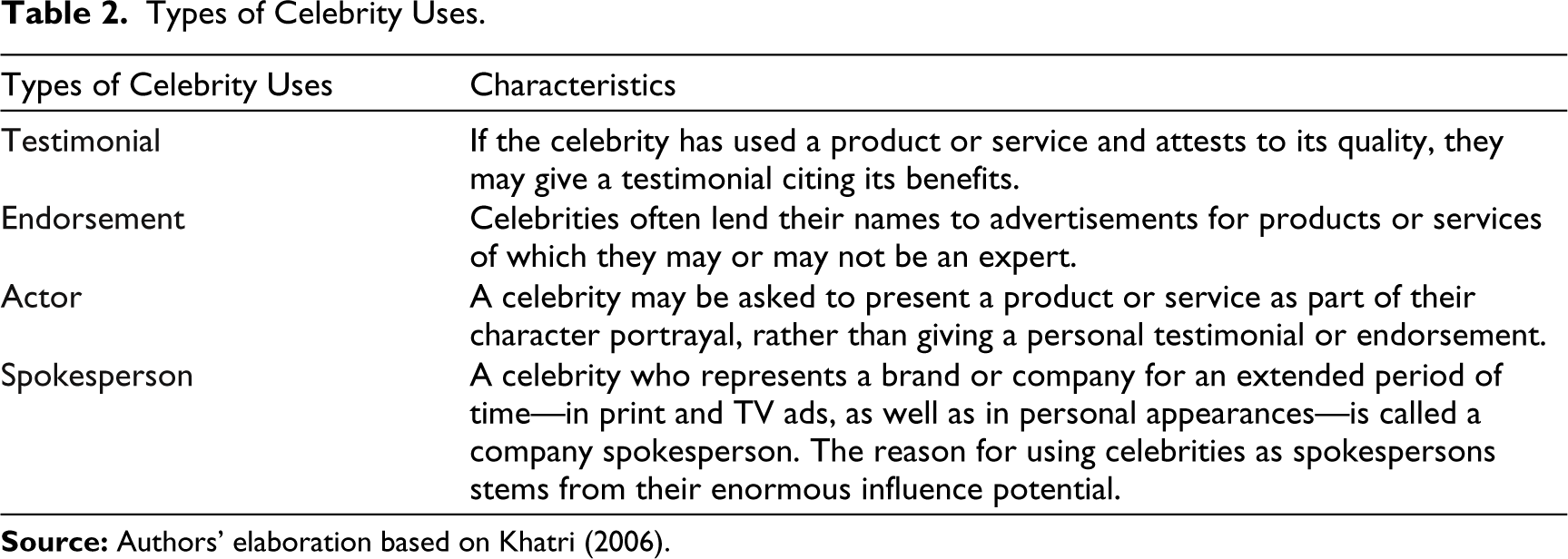
According to Friedman and Friedman (1979), there are three types of endorsers: (a) public figures, (b) professionally recognised experts and (c) ordinary consumers. Public figures are people known to the public, mainly for their area of activity/practice, and are not associated with the class/status of what they advertise. Experts are individuals with privileged knowledge regarding the advertised product. Finally, the ordinary consumer has contact with the class/status of the product after purchasing and using it. The celebrity type would be most effective in the dimensions of competence, trust, empathy and persuasion. Considering the different types of celebrities, consumers are likely to form a strong relationship with actors. According to Knoll and Matthes (2017), the importance of movie characters also includes the sense of having personal relationships with the characters, deep concern for what happens in their lives, and/or a desire to become like them (Hoffner & Buchanan, 2005). This exact type of relationship makes consumers accept celebrities’ influence more easily and is connected to parasocial relationships (Conde & Casais, 2023; Lacap et al., 2024). The use of celebrities as a form of endorsement is increasingly common in marketing, either to advertise products and brands or to promote organisations (Purohit & Arora, 2022). Biswas et al. (2006) list five benefits of using celebrities as brand endorsers: (a) they draw attention, (b) they manage crises, (c) they help in brand repositioning, (d) they ensure a global marketing dimension and (e) they boost sales. In fact, celebrity endorsers promoted customer imitation behaviours (Awasthi & Choraria, 2015) through their attractiveness and credibility. Celebrities can work as the personification of a brand when the brand is associated with their positive characteristics, creating bonds and facilitating connections between consumers and their fans (Flores-Zamora, 2023). Celebrity association consists of an agreement between an individual who enjoys public recognition (celebrity) and an entity (brand) to promote it (Bergkvist & Zhou, 2016) and improve the brand’s competitive position (Jaiprakash, 2008).
It is necessary to differentiate between celebrities and influencers (vloggers and instafamous), and companies increasingly rely on social media influencers to capture the attention of social media-savvy audiences (Cocker et al., 2021; Marwick, 2015). These influencers are seen as more credible and relatable endorsers, and their product reviews have a more significant impact on young women’s buying behaviour than traditional female celebrities (Djafarova & Rushworth, 2017; Khamis et al., 2017). Influencers tend to directly address their followers in their posts, which denotes a certain proximity and makes followers see them as peers (Erz & Christensen, 2018; Gannon & Prothero, 2018). Moreover, influencers present themselves as ordinary people, as approachable and authentic personalities (Chapple & Cownie 2017), which makes people feel more identified with them and consequently more prone to try their products (Uzunoglu & Kip, 2014). Therefore, influencers can be seen as more credible product endorsers than celebrities themselves (Evans et al., 2017).
In advertising, celebrities, consumers, experts and company CEOs are used as spokespersons for certain brands and they seem to have a positive effect on advertisement effectiveness (Jaiprakash, 2008). Famous people draw a higher degree of attention and recall, creating positive feelings towards brands, which consumers then perceive as being more entertaining. Therefore, using celebrities in advertising will positively affect consumers’ brand attitudes and purchase intentions (Chan & Fan, 2022; Friedman & Friedman, 1979). Via celebrity endorsement, consumers are expected to be more interested in the endorsed object because it is endowed with the celebrity’s status. These endorsements are also expected to influence the meaning of the endorsed object (Miller & Allen, 2012), as well as perceptions regarding its price, taste level, risk of buying or the perceived value of the endorsement information (Biswas et al., 2006). Celebrity endorsements are expected to draw attention, interest and awareness, and therefore companies are increasingly investing in endorsements to persuade consumers (Zahmati et al., 2023).
There are many risks associated with the use of endorsers, and a brand can fall as quickly as it has risen in the minds of consumers. Many brands fail in the market despite celebrity endorsement (Biswas et al., 2006; Khatri, 2006). In general, celebrity endorsements are an effective way of marketing communication because they enhance attitudes and reinforce behavioural intentions. However, these choices must be carefully processed because associating with celebrities can result in negative outcomes (Amos et al., 2008; Patel, 2009). Marketers are therefore advised to support these decisions with market research (Sherman et al., 1997). Celebrity endorsements as an advertising strategy, if combined correctly, can justify the associated high cost. However, it should be ensured that this endorsement has enough credibility and attractiveness to overcome the associated risks, since a celebrity endorsement does not per se guarantee sales (Chan & Fan, 2022).
Taboos significantly impact consumption and marketing through social structures, morality and gender norms that constrain consumer’s choices, based on cultural beliefs (Meenakshi, 2020; Michelson & Miller, 2019). Marketing campaigns have historically attempted to challenge or reinforce taboos (Larsen & Patterson, 2018) and remain a challenge for marketing managers who are focused on promoting the consumption of products with taboos associated (Kumar et al., 2024; Sredl et al., 2024), as in the case of menstrual products (Meenakshi, 2020) or sex toys (Dubé et al., 2023; Piha et al., 2018). In fact, the taboo nature of certain topics hiders marketing communication and humour is a communication form more appealing in this case rather than rational appeals (Gebreselassie & Bougie, 2024; Porter et al., 2024). That is why the use of storytelling in sensual product marketing may facilitate the process of communication (Sredl et al., 2024) because of the stigma, intimacy or taboo associated (LaMarre et al., 2022). The use of archetypes and endorsers has not yet been studied in the case of sensual product marketing. This is a relevant topic of analysis, because storytelling provides an alternative communication strategy that can overcome the taboo associated with these products (Sabri, 2012).
Methodology
This article adopted interpretivism as a research philosophy, using an inductive approach to comprehend how brand advertisers promote and use storytelling of real sensual products. To achieve the proposed objective, it was necessary to understand the use of archetypes and endorsers in storytelling, because both figures mediate between brands and consumer motivation, converting the strange and potentially threatening into something familiar and safe, which then facilitates the act of purchasing and the understanding of the functionalities of each sensual product (Ogunsiji, 2012; Saunders & Skar, 2001). Considering the advantages of content analysis on Instagram to understand marketing techniques (Ares et al., 2024; Gonzalez et al., 2024), we conducted a content analysis of brand online communication about sensual products on Instagram in order to characterise storytelling practices in this specific context.
Five cosmetic industries were chosen from the segment of sensual products, all of them headquartered in Brazil. They were selected based on two criteria: (a) ranking in the 2019 Best of the Erotic and Sensual Market Award and (b) market share of the segment. We chose the top five winners of the 2019 awards, as well as the top positions in the national market share (ABEME, 2018).
Instagram was selected for being a social network of great interaction and dynamics, for quickly and objectively reaching users through storytelling and endorsers (Gross et al., 2023; Hussain et al., 2023; Pozharliev et al., 2022). The authors analysed these organisations’ publications on Instagram from 2016 to 2020 and selected those that (a) used storytelling techniques with archetypes (even without endorsers) and (b) had the highest number of likes and/or comments.
The 12 archetypes explored in the literature review were used for analysis in the posts: innocent, explorer, sage, hero, rebel, wizard, everyman, lover, jester, caregiver, creator and ruler. The exclusion criteria of posts were based on the degree of interaction with their followers: (a) low number of likes and/or comments and (b) no storytelling techniques using archetypes.
In this stage, we obtained 22 publications, all of them in video format, with the following distribution: (a) five posts from company A; (b) four posts from company B; (c) three posts from company C; (d) five posts from company D; and (e) five posts from company E.
Data Classification
Selected posts were submitted to a coding jury of three external people and one of the researchers of this study. The jury’s main function was to assure impartiality and diversity regarding the coding process. The criteria for the invitation of external coders were that all of them had knowledge of storytelling/archetypes and become to academia.
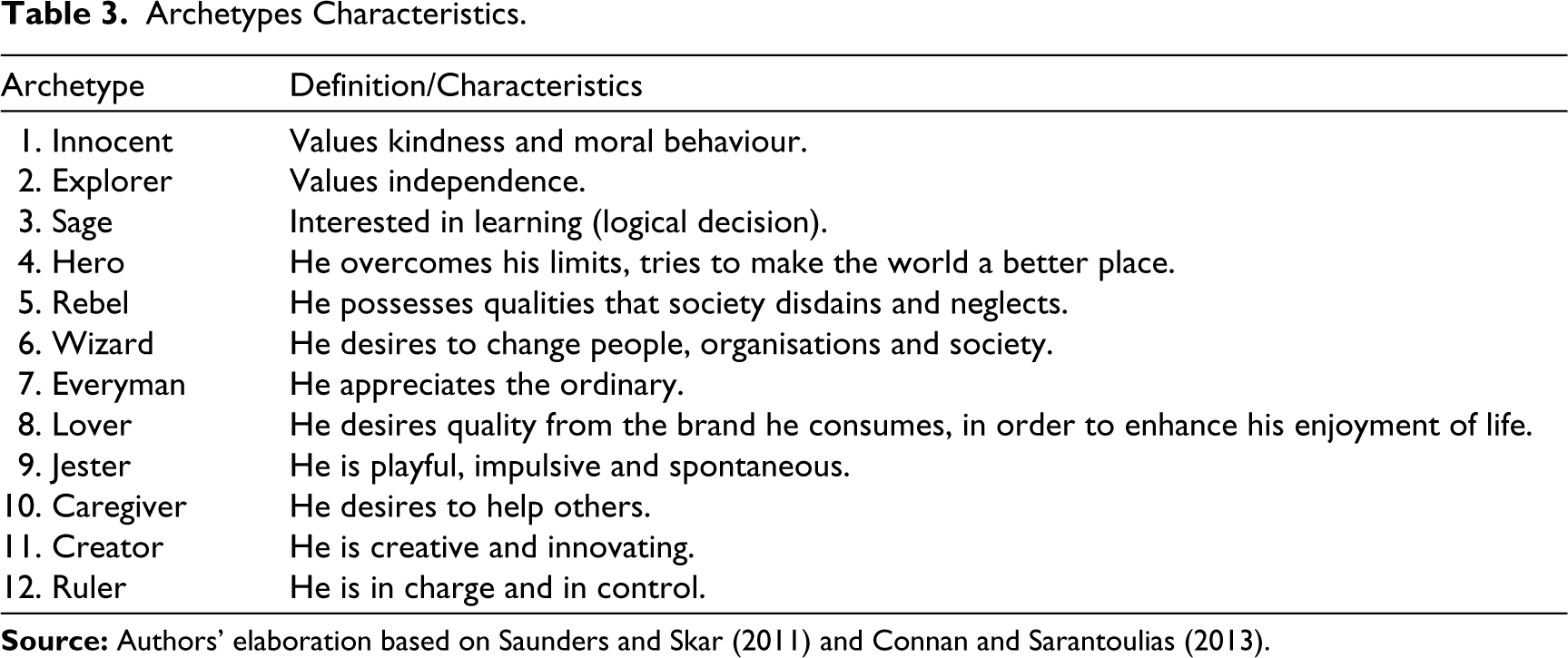
The four-judge jury was exposed to Table 3, which contains the main characteristics of the 12 archetypes, to further clarify the main differences among the archetypes.
Archetypes Characteristics.
The 22 posts were displayed once and per company for the judges to choose which of the 12 archetypes most closely fitted or resembled the story presented in the post. The authors followed the procedures used to find the Proportional Reduction in Loss (PRL), proposed by Rust and Cooil (1994), calculating the judges’ reliability responses in the qualitative judgement data. We obtained 81.8% agreement (18 posts) versus 18.1% disagreement (4 posts) out of a total of 22 posts. Considering this result, it can be said that there was no consensus in all answers, with 49 agreements out of a universe of 132 possible agreements. This means a 0.371% proportion of agreement among the four judges, with 0.69% PRL reliability for the 12 categories with the four judges. The reliability calculation further demonstrated that the ratings made in this exploratory analysis are reliable, for the closer to the number 1, the more the agreement is perfect (Rust & Cooil, 1994).
After viewing the 22 video posts, each judge answered a questionnaire for each post to identify the archetype that he/she believed to correspond to the post presented. Each questionnaire consisted of 16 close-ended (yes/no) questions designed and tested by Woodside and Sood (2016) that looked for evidence in various historical facts to characterise each type of archetype. The authors analysed the questionnaires, totalling 86 questionnaires, to verify whether the archetypes chosen by each judge possessed the historical characteristics defined by the method. For the answer to be viable, the number of YES answers had to be greater than the NO answers. In case of a tie (e.g., eight YES answers and eight NO answers), or in case the number of NO answers was greater than the number of YES answers, the answer was considered not viable, because it showed that in the post story there is no minimum necessary evidence (characteristics) that matched the descriptions of this archetype contained in the questionnaire with those in the video—this rule was defined by the researcher. Due to the non-consensus on all the answers in the previous stage, a second meeting was held with the panel of judges to reach a consensus regarding the most predominant archetypes in each of the 22 posts. In the second meeting, the researchers were informed about non-viable answers and the actual reasons for this non-viability. Subsequently, the four judges discussed all the non-viable answers again, with each judge demonstrating the proper evidence for the archetype that he found in each story, aiming at addressing doubts and reach a consensus regarding the 22 posts. Endorser classification was as follows: retailer (1), celebrity (5), expert (12), consumer (1), with one post lacking an endorser, totalling 22 posts.
Results and Discussion
This research analysed 22 marketing campaigns. Table 4 shows the results of the content analysis regarding the storytelling archetype followed and the type of endorser.
Endorsers and Archetypes by Instagram Post.
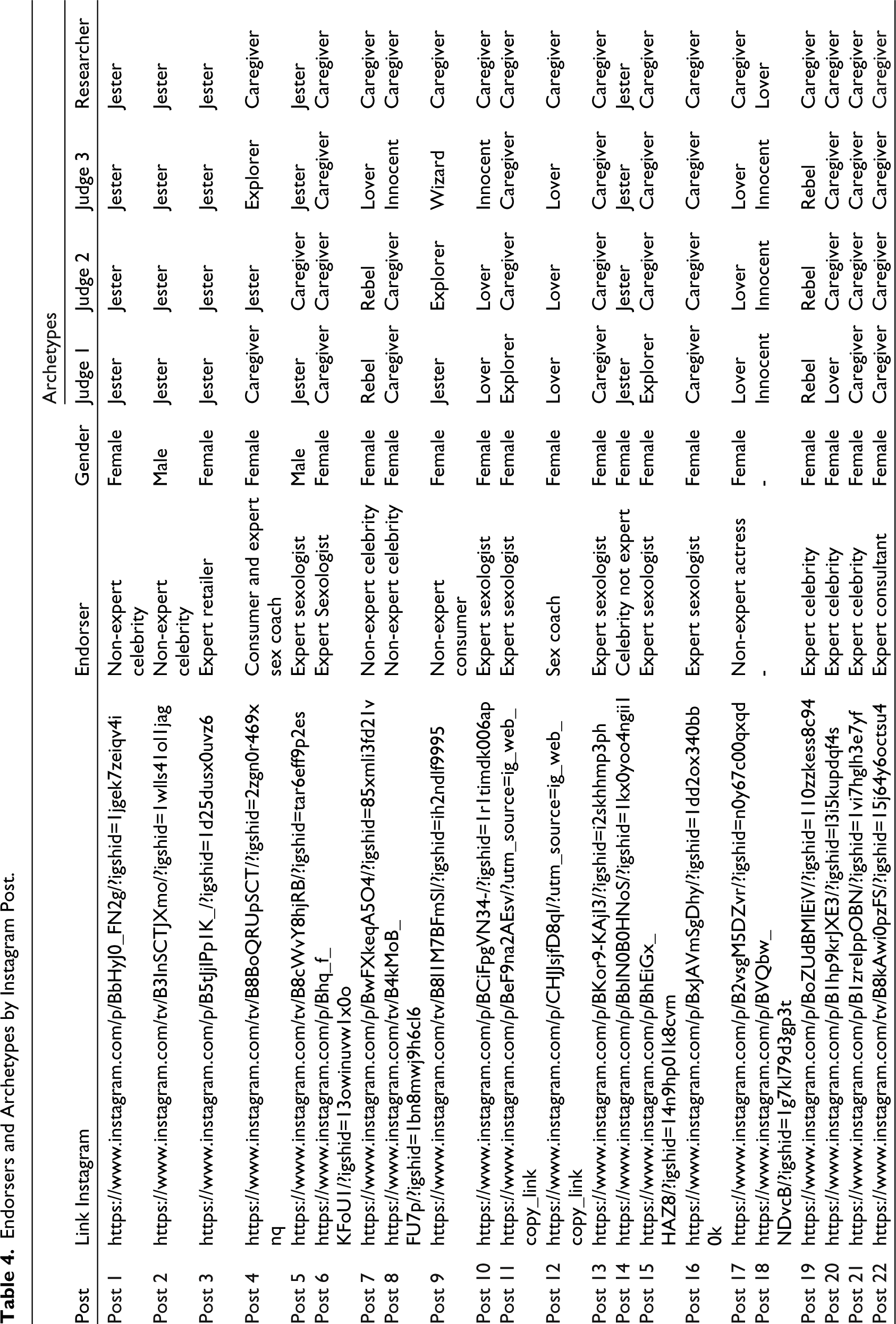
Archetypes mediate between products and consumer motivation because they offer an intangible experience of meaning and are an indispensable tool for understanding the purpose or function of characters in a narrative (Lloyd & Woodside, 2013). This research found 16 archetypes of the caregiver type, five of the jester, and one of the innocent, which points to the conclusion that the most prevalent storytelling archetype was found to be caregiver followed by jester. Caregiver is characterised by the desire to help others and is part of the block ‘Structure the World’. It is used to demonstrate greater commitment to provide ease of use of the product. It aims to teach and/or give tips on products to deliver a sense of security to customers, which is justified by the difficulties and taboos associated with these products. Endorser jester, on the other hand, connects consumers to other people through playfulness, impulsiveness and spontaneity to minimise the shame attached to taboo-labelled products by most of society—that is, this subject still impacts society (Connan & Sarantoulias, 2013; Saunders & Skar, 2001). Innocent was the least prevalent in the 22 videos analysed, used by companies operating in this market segment. The innocent values belonging more than authenticity, because he prizes goodness and moral behaviours, and the consumer will be loyal to the brand if he is sure that the product fulfils its promises (Connan & Sarantoulias, 2013; Pera et al., 2016; Saunders & Skar, 2001). This vision allows understanding of the relationship established between stories and their mechanisms and brands and the meanings that they can create (facilitate perception) (Connan & Sarantoulias, 2013; Saunders & Skar, 2001). In the case of sensual products, this research shows that the hero is not the more archetypal myth used, as in most storytelling campaigns (Cooper et al., 2023), which enhances the debate about the hero’s journey in storytelling and the importance of reflecting other societal values in the collective journey, as reflected by Kelsey et al. (2023). As previous literature also points out (Kelsey et al., 2023; Merlo et al., 2023), a brand must not limit itself to just using one archetype, for it is possible to generate combinations that can better express what the brand thinks, but this requires careful attention to avoid creating confusion regarding the intended image (Siraj & Kumari, 2011).
The most predominant use of endorser in the posts (13 campaigns) was found to be the expert endorser (sexologist, sex coach, retailer and consultant). Celebrities (actor, actress, ex-Big Brother Brazil contestant and chef) are present in six campaigns and in only two campaigns the consumer is present. It should be noted that the campaign of company A (dating from 2 February 2020) was categorised as using consumer endorsement, but the consumer’s statement may have more influence because she is also a sex educator. In this analysis, it was also possible to find 20 female endorsers versus one male endorser out of the 22 campaigns studied.
The use of endorsers in the posts has shown that companies in this segment have used them quite frequently, with the purpose of associating their credibility with their products when advertising them (Ogunsiji, 2012). Endorser exposure in advertising campaigns influences brand trust and brand affection, both of which are positively related to brand loyalty (Özer et al., 2022). Furthermore, endorsement significantly boosts effectiveness (Amos et al., 2008; Bergkvist & Zhou, 2016; Chan & Fan, 2022), the share rate of content in social media (Zhu et al., 2022), and the purchase intention. The use of expert endorsers was found to be the most frequent in this research, which means that the main purpose of using expert endorsers is to attest to the quality of the product associated with their degree of credibility. It is worth noting that endorsement effects have been increasingly used in advertising to persuade consumers (Knoll & Matthes, 2017).
Regarding endorser gender as an influencing variable, the literature was scarce. Zahmati et al. (2023) did not find statistical significance in gender regarding advertisement endorsements and Zhang et al. (2020) found the effect of warmth in male endorsers that does not occur in female endorsers. Other research has revealed that women rate higher on goodwill and fairness, while men outperform women on the other dimensions (prestige–power/status, knowledge–competence and self-presentation– confidence) (Kenton, 1989). As a result, male spokespersons were often more persuasive than female spokespersons (Cabalero et al., 1989). Scarcity of research on the effects of endorser gender is somewhat surprising, as persuasion research shows that men and women respond differently to male and female communicators (Bergkvist & Zhou, 2016). In this research, the number of female communicators is greater (90%) than the number of male spokespersons in campaigns related to sensual products. At the same time, there is a debate about gender binaries in advertising, calling for further research on this topic (Eisend & Rößner, 2022).
Conclusions
The use of storytelling as a communication technique in taboo marketing was a topic with a dearth of research. Also, there is a debate about the use of multiple archetypes besides the preponderance of the hero in storytelling advertising. This article analyses the use of archetypes and endorsers in storytelling in the context of sensual products marketing. The findings show that the archetypes caregiver, jester and innocent are the most prevalent storytelling archetypes. Furthermore, the expert endorser (sexologist, sex coach, retailer and consultant) and the female gender are predominant in the posts. The results contribute to the debate about the narratives that should be used in social media storytelling, particularly considering the peculiarities of sensual products, which are usually associated with taboo. This is the first study analysing the predominant use of storytelling techniques in the marketing of sensual products and contributes to creating theoretical conceptions about storytelling in marketing products associated with taboos aimed to attract and persuade consumers. The knowledge about previous practices of storytelling communication on this topic may help practitioners in the development of future campaigns, although it is missing an effectiveness analysis of such campaigns.
Limitations and Future Research
The study focused only on Brazilian companies operating in the sector of sensual products and analysed communication strategies of a single social network, Instagram. No relationships between the use of endorsers and archetypes and sales effectiveness are presented. Future research should measure the effectiveness of the storytelling techniques most prevalent in the marketing of sensual products to assist in the creation of theoretical conceptions about storytelling in the marketing of products associated with taboo and provide guidance for practitioners. It is further recommended to conduct studies with companies headquartered in other countries and to analyse more campaigns (posts) in different social media.
Footnotes
Declaration of Conflicting Interests
The authors declared no potential conflicts of interest with respect to the research, authorship and/or publication of this article.
Funding
The authors disclosed receipt of the following financial support for the research, authorship, and/or publication of this article: This work is financed by national funds through FCT, Foundation for Science and Technology, I. P., within the scope of the project ‘UIDB/04647/2020’ of CICS.NOVA, Interdisciplinary Centre of Social Sciences of Universidade Nova de Lisboa.