




Abstract
This study investigates how eight higher education (HE) faculties located in Japan perceive and implement Global Citizenship Education (GCE) as a critically oriented pedagogy in the online course ‘Perspectives on Global Citizenship Education’. The main instruments of the study were questionnaires and interviews. The data collected were scrutinised with the use of the grounded theory and constant comparative method. Four notions of GCE surfaced from the data. According to the HE faculty, a critically oriented GCE should: (a) develop students’ empathetic identification, (b) cultivate students’ critical agency, (c) foster students’ self-confidence and inclusive mindset and (d) encourage students’ community participation. Building on the findings, this article concludes by advancing a proposal for a critical pedagogical framework for GCE online teaching and learning in Japanese HE.
Introduction
The past decade has seen a renewed importance in Global Citizenship Education (GCE) as a way of developing ‘the knowledge, skills, values and attitudes that learners need to be able to contribute to a more inclusive, just and peaceful world’ (UNESCO, p. 15). A variety of GCE theoretical viewpoints have been embraced, ranging from neoliberal (economic-oriented) to humanistic, ethical, transformative and critical (Bosio, 2021a; Bosio & Olssen, 2023; Bosio & Waghid, 2023; Giroux & Bosio, 2021; McLaren & Bosio, 2022; Pashby et al., 2021; Torres & Bosio, 2020; Veugelers & Bosio, 2021). Concurrently, the breakthroughs in information and communication technologies (ICTs) that continue to transform our lives, alongside the major adaptations that educational institutions have had to overcome to continue making an impact during pandemic lockdown, have opened up a new landscape for inspiring intellectual development and academic collaboration via digital networks (such as online teaching and learning). This transformation is evident in both the local and global contexts.
The majority of extant GCE literature on higher education (HE) online teaching and learning originates from the Anglo-Saxon/Western domain (both empirical and theoretical), hence, focusing on Western HE faculty. 1 In this article, I add the case of Japan, where leveraging ICTs to foster concepts of global citizenship and GCE through online teaching and learning is becoming slowly yet widely recognised within scholarly pedagogical discourses and literature. Over the last few years, the Japanese government has been taking strides to ensure that ICTs become more integrated in HE by encouraging faculty based in Japan to employ online teaching and learning more frequently and effectively in their pedagogical approaches. Hence, online spaces for critical and reflexive dialogue on key local and global issues of our time (e.g., gender, race, sexuality, religion, ethnicity, privilege, climate change and sustainability), global citizenship, 2 and GCE can be created out of the resolve of individual HE faculty (Bosio, 2023b).
Yet, there has been a lack of discussion on how HE faculty based in Japan understand and implement GCE into online university courses. It is not fully clear what values and knowledge faculty intend to cultivate in their students when they foster GCE through online courses in Japanese HE. In this study, I investigate how eight HE faculty located in Japan perceive and implement GCE as a critically oriented pedagogy in the online course ‘Perspectives on Global Citizenship Education’. The main instruments of the study were questionnaires and interviews. The data collected were scrutinised with the use of the grounded theory and constant comparative method. Four notions of GCE surfaced from the data. The HE faculty expressed the opinion that a critically oriented GCE should: (a) develop students’ empathetic identification, (b) cultivate students’ critical agency, (c) foster students’ self-confidence and inclusive mindset, and (d) encourage students’ community participation. Building on the findings, I conclude this article by advancing a proposal for a critical pedagogical framework for GCE online teaching and learning in Japanese HE.
Theoretical Framework: Global Citizenship Education Rooted in Critical Pedagogy and Social Justice
GCE is a multifaceted pedagogical platform. Its versatility allows for a variety of interpretations and theoretical approaches, which could be neoliberal (economically motivated) on the one hand, or critical (inspired by critical pedagogy and social justice) on the other (Bosio, 2022a). HE faculty who rely on a neoliberal approach to GCE based on ideals of market competition and economic neoliberalism (e.g., extreme emphasis on students’ job readiness, a narrow focus on standardised testing) will be inclined to impart a GCE vision that fulfils such an ideology, reliant on the promotion of market fundamentalism and the drive to nurture ‘global human resources’, as opposed to ‘critical and ethical global citizens’ (Bosio, 2021b; 2021c). Inversely, a HE faculty who considers their GCE vision to depend upon ethics derived from a more critical pedagogy will approach GCE in a manner that places social justice as central to the development of critical global citizens. In this article, I frame the debate on GCE online teaching and learning within a critical framework based on critical pedagogy and social justice and entrenched in the three principles of decolonialism, caring ethics and eco-critical views (Bosio, 2023a) (Figure 1).
GCE Critical Theoretical Framework for Online Teaching and Learning.
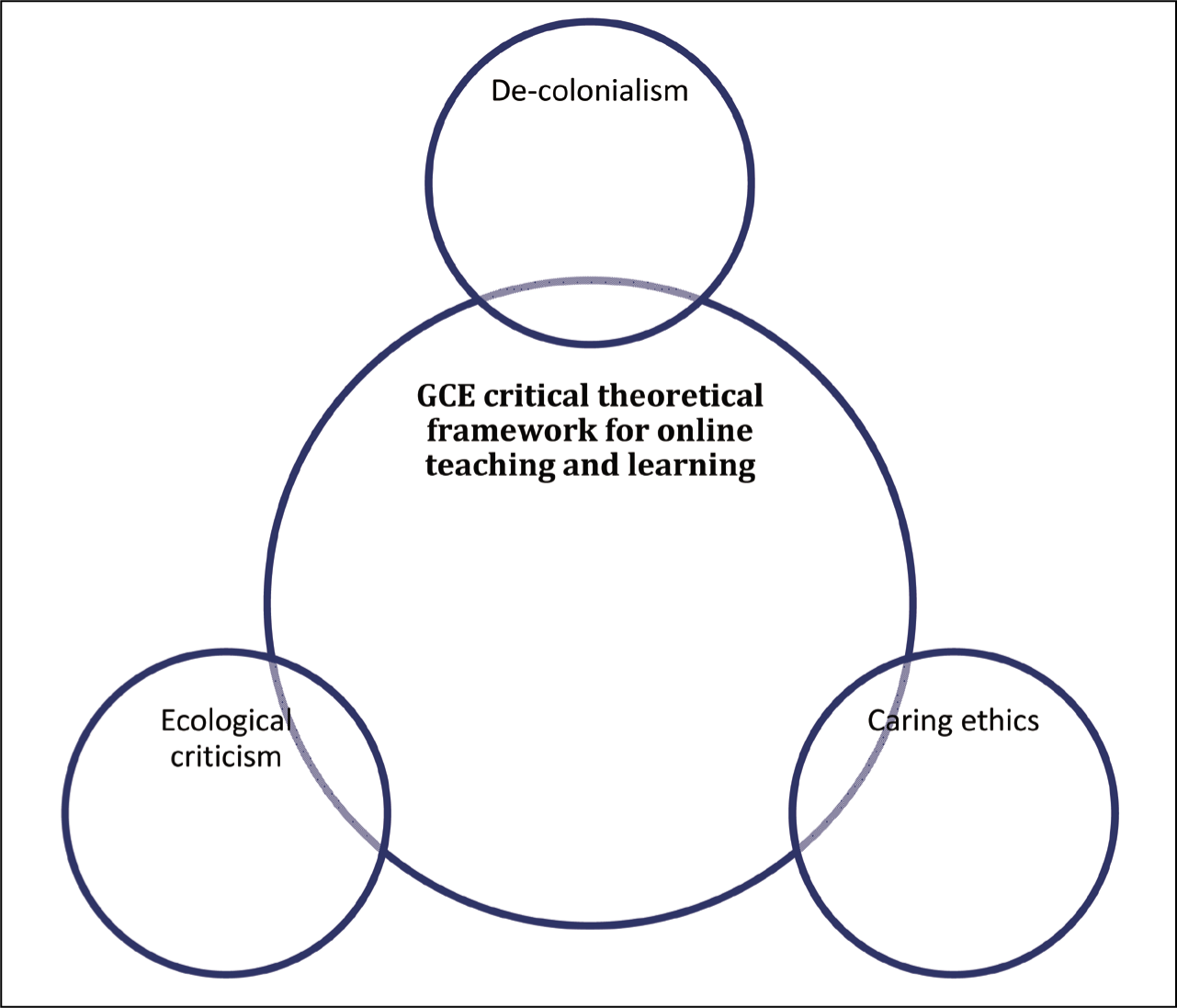
As Figure 1 highlights, critical GCE for online teaching and learning can be interpreted as a form of pedagogical practice that blends content focused on the challenges of local and global citizenship with those integral to ethics of critical and social justice. Realising such a perspective requires (at least) three key subject categories: de-colonialism, caring ethics and ecological mindfulness (Bosio, 2023a). It entails, as Noddings (2012) points out, an academic debate on the core elements needed to establish a ‘caring relation in teaching’. It comprises, for instance, engaging students with critical consciousness development, reflective dialogue and humanity empowerment. In this respect, critical GCE for online teaching and learning is entrenched in social justice, with the priority of supporting decolonisation and advancing diversity (de-colonialism). To meet these objectives, learners are required to analyse any opinions, viewpoints and impressions of identity they may not have questioned previously, which is necessary for both local and global contexts. Crucially, an ethics of care is central to this approach, backed up by an awareness that safeguarding human rights is always a leading priority (caring ethics). Concurrently, this approach emphasises an appreciation for ecology, placing learners within contexts in which they need to consider the damage to the natural world that results from humans considering themselves as the rulers of this planet we live on (ecological criticism). By furthering such principles, I posit that a key objective of critical GCE for online teaching and learning is to establish a robust pedagogical philosophy according to sound ethics, humanitarian and democratic principles. Hence, critical GCE for online teaching and learning places students within networks and environments that allow for intense engagement with both local and global issues, enabling them to question their own roles and contributions. The range of ethical values to be merged with such curricula includes responsibility, morality, diversity, inclusion and respect, in particular with a focus on how learning allows students to develop such values (Bosio, 2022b, 2022c).
The notion of ‘values’ in this study is based upon a model of critical pedagogy, as opposed to being reliant upon market perceptions. The theoretical proposals of John Dewey (1939, 1944), for example, stress differentiating between means and ends—in terms of recognising values that are intrinsic and those that are instrumental. Such directions have been incorporated into HE pedagogy to assess how educational priorities can be formulated and how adopting a set of objectives affects a learner’s motivation. One dilemma that often arises is the extent to which learners are pressured to focus exclusively on particular achievements—most obviously exam grades and job qualifications—and whether this may impact negatively on overall learning capacity, knowledge base and analytical thinking abilities. Biesta (2021) proposed the ‘learnification of education’ as a means of summarising this dynamic. This notion looks to address the issue of when teaching and learning (online but also face-to-face) move away from more expansive curriculum content and the nurturing of critical intellect to focus on the practicalities of ‘economic survival’. When there is an overreliance on the achievement of qualifications, then GCE content online becomes restricted to specific job market avenues, subjecting GCE to a narrow-minded outlook.
Yet, there are still pedagogical spaces where leveraging online teaching and learning makes it possible for HE faculty and students to discuss key local and global issues of our time constructively and critically. I describe a concrete example of this in the following section.
The Online Course ‘Perspectives on Global Citizenship Education’
At a leading Japanese (Tokyo) private university, in 2022, eight faculty took part in a project based on offering the team-taught online undergraduate course ‘Perspectives on Global Citizenship Education’ to a select group of Japanese undergraduate students (n = 18). Conducted in English-language teaching, the online modules offered the prospect of utilising ICTs to establish a dialogic and critical pedagogy that incorporated a range of contemporary local and global issues. The content, for example, included having HE faculty and students take part in thought-provoking Zoom debates concerning a range of pressing subjects (e.g., worldwide healthcare and a pandemic lockdown, discrimination and social unfairness, gender identity, race, sexuality, ethnic background, socio-economic standing, privilege, environment factors, climate change, sustainability, ecological integrity and multiculturalism). Crucially, there was a particular emphasis on understanding these issues in relation to the Global South rather than adhering to a reliance on Global North—or Western—perspectives to understand global affairs.
Overall, the course modules consisted of 15 key areas of subject matter, carried out weekly in order to progress through the content set out above. Each class lasted 90 minutes. Classes entailed small virtual group discussions (via Zoom), and attentive teacher–student interactions. Students actively participated in and contributed to discussions on wide-ranging topics (e.g., diversity, poverty, racism, sexism, resource access, equity, community involvement, human rights), assisted by the course faculty. One faculty at the time participated in each of the classes. The course also included two short written projects and students were given access to ‘Moodle’. An open-source learning management system, Moodle, served as a convenient platform for setting out the course details and content, such as lecture notes, assessment requirements and any key news or communication, prior to allowing papers to be submitted and grades to be returned. Online course assessment was ongoing, including for both written papers and debate hubs. Ongoing assessment allowed students to have regular and convenient access to valuable advice, mentoring and learning avenues for academic enhancement (Dodge et al., 2004).
Initially, the objective behind the course ‘Perspectives on Global Citizenship Education’ was based on establishing a firm appreciation for local and global issues. Launched under the concept of global citizenship, the instructors combined their efforts to lead its organisation and compile the relevant materials and resources so that the modules could progress online. Throughout, the learners were directed towards analysing their own accountability for both local and global issues, with the vision of developing ‘critical global citizens’ capable of appreciating the many complex facets of social dynamics and culture. The way local and global issues are interconnected was also explored, always against a background of ‘glocalisation’ 3 as a critical paradigm, together with the benefits of reflexive dialogue. In doing so, the HE faculty took their cue from the Aristotelian concept of ‘phronesis’, which is theorised to serve as ‘practical wisdom’ for fairness and democracy. From this perspective, GCE provides a means by which to analyse how justice-driven curricula can work in practice. Hence, the capability for online debate allowed both HE faculty and learners to take part in reflexive dialogue concerning numerous local and global subjects, through which they were able to present their own findings and life experiences where relevant. Undertaking this setup allowed for filtering out any ‘orientalism’ and ‘othering’ that may otherwise have produced biased results. Encouraged by the course instructors to be candid and sincere, the students involved expressed themselves as part of a robust and dynamic ‘discussion table’ which, in turn, allowed for self-analysis and the reconsideration of values and ethics perhaps taken for granted.
A key aim of the content was to see certain debates flourish as part of an empathetic online dynamic that recognised the worth of vigorous conversational analysis at the same time as promoting tolerance and understanding. For subjects like this that may be delicate, it was vital that instructors were placed to prevent matters ever slipping into disrespectful rhetoric or becoming reliant on ‘othering’. With every avenue of online debate that took place, instructors ensured that certain critical themes (e.g., cultural and linguistic diversity, decentring Wester-centric modes of thought, and resources authored by indigenous intellectuals) were key topics of discussion (Bosio & Waghid, 2022). This was made possible by motivating conversations in a manner that allowed learners to mature an understanding of how issues of social fairness and mistreatment can be addressed, prevented and improved at a community level thanks to an approach based on both individual and collective actions.
As the online modules advanced, a discussion emerged among the eight HE faculty based on what were the most important aspects of the course for teaching the content, although holding back from rigid classifications in favour of versatility. For instance, some HE faculty suggested the course to be more focused on fostering students’ empathy and sense of agency, and others stressed developing students’ confidence and sense of inclusion. Yet, other HE faculty highlighted the need for more discussion on the relationship between global citizenship and community participation. Consequently, a shared research project (consisting of questionnaires and interviews) was established under the leadership of this author. The position required a critical examination of the debate material all eight HE faculty had gathered as part of reaching a firmer appreciation for the online course material’s potential to transform a learner’s outlook thanks to utilising co-teaching strategies and the benefits of ICTs.
Methodology
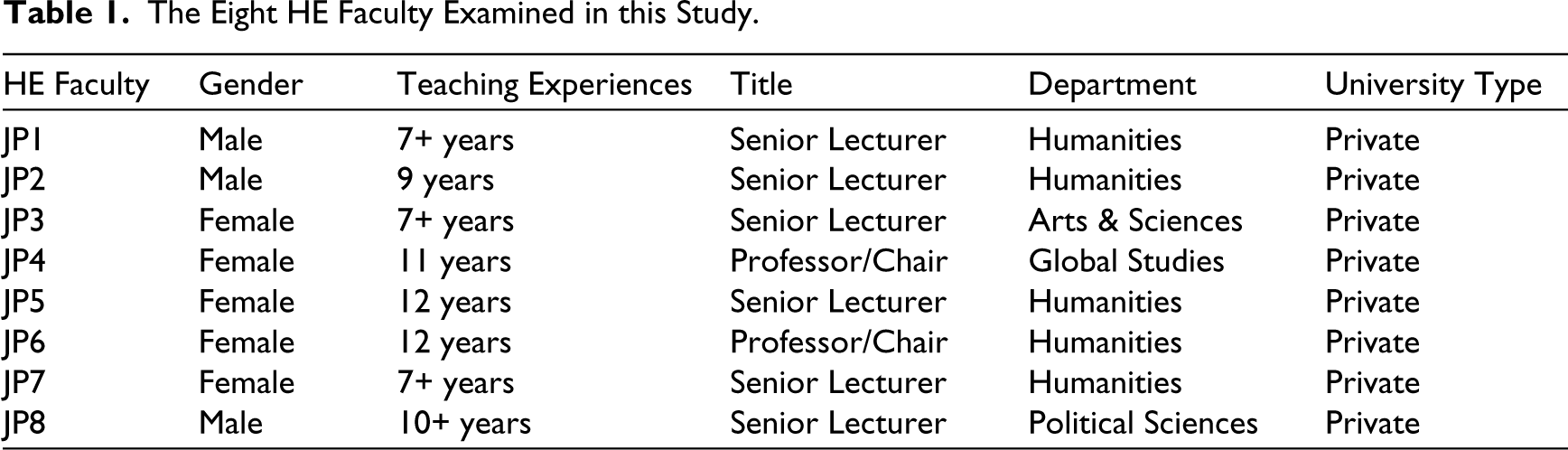
I employed intentional non-probabilistic sampling to choose the eight HE faculty from a major private HE institution in Japan (Tokyo). The key criterion I utilised to choose the university 4 was that each HE faculty running the online course focused on GCE. Participation was entirely voluntary. The participants consisted of five women and three men who co-taught the online course. They all possessed seven or more years of experience in HE teaching and had been educated to doctorate level (e.g., PhD, EdD). To maintain confidentiality, I assigned to each participant a code number; for example, JP1 denotes one of the HE faculty (see Table 1 for participant HE faculty profiles).
The Eight HE Faculty Examined in this Study.
I obtained data in two phases. The first required the study participants to fill in a questionnaire consisting of 15 items, which they received via email. The aim of this questionnaire was to frame the GCE subject among those contributing to HE faculty so as to accrue some standard insights and judgements on how GCE performs within this online course material as critical pedagogy. The second phase saw the study participants receive an invitation to take part in a responsive interview (Rubin & Rubin, 2005). This interview form consisted of two-way interactions between the interviewer and interviewees, an approach that offered the ability to analyse a range of feedback. It allowed me to reach a more informed appreciation for the GCE online teaching challenge itself.
I utilised the grounded theory method of Glaser and Strauss (1967) to analyse the data. For qualitative research, this strategy is essential for interpreting data and developing theories. This method allowed me to exhibit the opinions of the participating HE faculty on GCE while, crucially for content analysis, also accepting interpretation. Using this approach, I identified those areas of the participants’ perspectives that were pertinent to the research topic and recognised a set of preliminary overlapping categories using a constant comparison method (CCM)—which is an amalgamation of systematic data collection, coding and analysis, as well as theoretical sampling—to generate hypotheses that can be derived from the data and provided in a format that is clear enough for further testing (Conrad et al., 1993). As Glaser (1965) indicates CCM features four components ‘(1) comparing incidents applicable to each category, (2) integrating categories and their properties, (3) delimiting the theory, and (4) writing the theory’ (p. 439).
These procedures aided me in identifying and organising significant passages and information, as well as drawing links between the data and the categories (Merriam & Grenier, 2019). The study’s findings are organised into themes derived from the data, as shown below. I included direct quotes from the HE faculty to substantiate and illustrate the concepts.
Findings
The following results reveal how the Japanese HE faculty (n = 8) perceived and implemented GCE as a critically oriented pedagogy in the online undergraduate course ‘Perspectives on Global Citizenship Education’. I begin by discussing the first theme: the necessity of using GCE for the development of students’ empathetic identification. Then, I address the second and third themes: the use of GCE in cultivating students’ critical agency and the use of GCE for fostering students’ self-confidence and an inclusive mindset. Lastly, I consider the fourth and last theme: the use of GCE for encouraging community participation.
Theme 1: Empathetic Identification
HE faculty JP1 and JP2 believed that a key objective of a critically oriented GCE is to help students to evolve into ‘empathetic global citizens’ who play an active role in a global society. For instance, HE faculty JP1 stressed how
as a minimum, students should be helped to see GCE as not only telling them that they are citizens of the wider world but also that they are responsible to that world, and empathy and identification should be part of their worldview. Different students may choose different ways of expressing their empathy and identification, but they should all be given support and told that they have responsibilities to the local and global community.
HE faculty JP1 added that being able to empathetically identify with the needs of the global community had a beneficial impact on his students’ priorities and values and, as such, could facilitate their progression to individuals who had a positive impact on society. ‘A global citizen who is able to empathetically identify with others can potentially understand situations from the perspectives of others’, says HE faculty JP1. He added:
Put him or herself in someone else’s shoes. This could later evolve into a desire to pursue social justice in a way that serves the common good. In this view, a global citizen who possesses empathetic identification will be more likely to hold state actors responsible for their actions and put pressure on governments to do more.
HE faculty JP1 believes that developing students’ sense of empathy represents something that occupies a central role in GCE.
Similarly, HE faculty JP2 highlighted that: ‘It is imperative to support a focus on empathy in GCE. Empathy may lead students to engage with societal issues and appreciation for social justice’. Then he added that a global citizen is ‘fundamentally engaged and has a sense of social justice’. Additionally, HE faculty JP2 highlighted ‘the need for students to demonstrate empathy for diversity. For example, the dilemma of members of the LGBTQ community and to actively stand up against the anti-LGBTQ measures that are in place in many areas of the world, including Japan’. Lastly, HE faculty JP2 argued that ‘adopting an empathetic approach enables students to join forces to fight for equality and a better life for all’. Be it in the form of social justice groups fighting for fair wages or unions highlighting the need for safe working conditions, empathetic global citizens embrace the struggles that the vulnerable encounter in their daily lives as their own.
HE faculty JP2 concluded that empathetic identification also ‘plays a fundamental role in how people behave in a social setting. When students are able to empathetically identify with others, they profoundly understand their beliefs’. Essentially, HE faculty JP1 and JP2 agreed that empathetic identification involves developing a deep understanding of others. It might simply start by putting oneself in the shoes of others and, through doing so, developing the ability to see their situation from a different perspective.
Theme 2: Critical Agency
HE faculty JP3 and JP4 emphasised how an important goal of GCE is to help students to develop critical agency so that they can operate effectively on local, national and trans-national dimensions, as well as virtually. In this regard, these HE faculty called for the implementation of a GCE that focuses on the way in which learners conduct themselves and identify with others. For instance, HE faculty JP3 commented:
GCE should allow students to focus on a critical view of life and the way they view the world, both locally and globally. The world is waiting for them to contribute. I believe that they are inherently ready to make a critical contribution to addressing social inequality and injustice.
HE faculty JP4 offered support for this perspective, saying: ‘GCE needs to educate young people to contribute with both respect and love. Simultaneously, students need to develop critical perspectives regarding social injustices. Students should also be taught that everything is “reciprocal”; GCE should show them that when they give, they will also receive’. He added: ‘Critical agency is central to developing as a human being and vital in the fight against all forms of inequality’. Critical agency represents a student’s capacity to engage in a critical analysis of his or her social situation in a manner that facilitates his or her agency to take positive action to modify that situation.
Aligned with this view, HE faculty JP4 emphasised implementing a type of GCE that encourages students to take an active role in their personal development as opposed to passively developing according to the views and instruction of others. HE faculty JP4 believed GCE should help students understand ‘the value in being critical agents of their personal development’, as opposed to being passive recipients of educational development plans outlined by others. HE faculty JP4 stressed how GCE must encourage in students a ‘sense of critical agency’ on several levels. For example, she discussed ‘existential agency’, as it exists according to her ‘students’ capability for exerting influence on their environments’. Another element emphasised is ‘identity agency’, which is defined as ‘what students believe about themselves and the ways that they wish to be perceived by others’. A final element is ‘life-course agency’, described as ‘the actions that students take to affect future outcomes in a positive direction’.
From this perspective, HE faculty JP3 and JP4 agreed that GCE should offer students support so they can be ‘proactive’. For instance, HE faculty JP3 describes this as implementing a type of GCE aimed at ‘putting the students in the driving seat’. Concurrently, HE faculty JP4 viewed GCE as a pedagogical approach that develops in learners ‘the ability to judge agency on a high conceptual level, with students explicitly attributing agency to themselves or others. This helps students to learn to construct a solid identity. Their sense of agency expands via tension related to their identity as global citizens’. For instance, HE faculty JP4 suggested that students should recognise their ‘global citizenship/ness’ and that ‘they are part of a network that extends beyond their local community; that students should have a personal identity driven by sound values they have formed through a GCE’. HE faculty JP4 also suggested that ‘if students recognise that they are part of a wider community, there is more chance that they will develop critical agency and feel a responsibility to said community’. HE faculty JP4 concluded that
GCE can never be separated from social issues; that students should be shown that they cannot regard themselves as external to the problems of society and simply view the world from a distance, criticising it. Thus, GCE must develop a sense of critical agency so that students can become drivers of change.
Theme 3: Self-confidence and an Inclusive Mindset
HE faculty JP5 and JP6 suggested that the development of self-confidence and an inclusive mindset for students is central to GCE. HE faculty JP5 maintained that students can often feel disempowered when they face complex global issues (e.g., pollution, gun violence, unemployment, malnourishment and hunger, and pandemics). For instance, HE faculty JP5 explained that her students most frequently ask ‘What can I possibly do?’ HE faculty JP5 believes that GCE must support students to feel confident that ‘they have the power to actively intervene on such issues starting from where they are right now’. In one example, HE faculty JP5 prided herself on being able to encourage students to participate in change processes, saying that students were ‘unbelievably charged up and very active in class when I asked them to propose a small/sustainable change on campus. They organised and petitioned to make things happen.’ This included ‘proposals for reducing single-use plastic waste, proposals for “Dump and Run” sales where students can dump clothing, furniture, household items, and electronics when they move out, and proposals for automated light switches within universities that turn off when students leave the classroom’ (HE faculty JP5). Yet, HE faculty JP5 recognised that it is seldom complicated to inspire students to be self-confident and to intervene proactively, sometimes right up to their final year. Often, it necessitates students to go through challenging life experiences.
On a similar note, HE faculty JP6 described:
We asked students from several different classes to come together and have a series of informal dialogues regarding how online and face-to-face discussions on global citizenship can increase their self-confidence. A number of them were senior students, about to graduate and highly intelligent, and one was discussing his experience both at home and abroad. In one instance, he had undertaken comparative studies of how refugee children were provided for in primary and secondary education, and this changed a lot for him. In fact, it changed his identity, changed his perceptions of his own spiritually and, ultimately, meant he decided to choose a different path. He became a United Nations officer focused on themes related to global citizenship and sustainability.
From this perspective, HE faculty JP6 suggested that a pivotal role of GCE pedagogy is offering students a type of self-assurance that would aid them in appreciating their duty towards the planet and their environment. As HE faculty JP6 explained, for some learners, this might involve ‘changing the types of activities or clubs they choose to join, switching to a different discipline, or maybe even rejecting particular forms of employment when they graduate’.
Lastly, HE faculty JP6 made the point that developing students’ self-confidence means also fostering an inclusive mindset. HE faculty JP6 defined an inclusive mindset as ‘the pursuit of diversity, inclusion, belonging, and equity’. She explained that, based on her experiences when students increase their self-confidence levels, they become
more open to people from other cultures and nations, demonstrating respect for other people’s beliefs, and acting in the knowledge that we are all citizens of the world and, therefore, have the commitment to act in the best interests of the global society and the environment as a whole.
Thus, HE faculty JP6 believes that demonstrating an inclusive mindset involves exhibiting sensitivity towards people of different cultures, developing a genuine interest in learning about their traditions and perspectives, and actively seeking opportunities to engage with people from different backgrounds. A further trait that is inherent within ‘inclusive learners’, HE faculty JP6 says, is their willingness
to put their own beliefs and assumptions to one side when interacting with people from different backgrounds to their own. This enables them to be open to views of others and have a genuine interest in learning about other cultures beyond the scope of any superficial aim to experience the ‘exotic’ as a means of extending one’s own personal enjoyment.
In closing, HE faculty JP5 and JP6 agreed that the two elements of self-confidence and inclusive mindset are both needed in a type of GCE aimed at fostering critical global citizens who value fairness, respect, emotional and cultural intelligence, but also empowerment and growth.
Theme 4: Community Participation
HE faculty JP7 and JP8 concurred that one objective of GCE should be to promote community participation as this fundamentally represents exercising one’s right to democracy. When HE faculty employ GCE to encourage community participation both locally and globally (e.g., volunteering for local schools, government and non-profit organisations and neighbourhood associations), this provides students with an opportunity to contribute to the development of social changes that will potentially impact numerous lives. For instance, HE faculty JP7 described how providing female students with a chance to contribute to decision-making can serve to transform the relationships that exist between men and women within a specific community context, ‘be it the classroom setting, a virtual environment, the university campus or the local community itself’ (HE faculty JP7). Besides, according to HE faculty JP7: ‘When students are involved in community initiatives, they tend to develop a stronger willingness to influence the values and cultural norms that lead to discriminatory practices’. For example, HE faculty JP7 suggested: ‘Under my leadership, a group of female students helped our university to create and advance innovative ideas to fund girls’ scholarships, construct schools with girls’ bathrooms, tutor literacy, and numeracy in several communities in developing countries’.
A further benefit of encouraging community participation through GCE that was described by HE faculty JP8 concerned the fact that developing an in-depth understanding of the issues that impact communities can often support students to find creative ways to the development of more feasible solutions. Specifically, HE faculty JP8 believes that ‘for students, issues can often seem too complex at a national level; however, they can be more manageable at the local level. In this regard, students can develop confidence that change is possible and that they are capable of being agents of that change’. According to HE faculty JP8: ‘A further benefit of community participation is that it nurtures local ownership, which subsequently enhances the extent to which initiatives will be sustainable over the long term’. On a similar note, HE faculty JP8 believed universities place an impetus on community participation because they understand the importance that such engagement can have in the future lives of their students, particularly when it comes to fostering notions of ‘global citizenry’. Specifically, HE faculty JP8 suggested that
students who acquire local ownership will adopt a culturally sensitive attitude to the university’s life and this will ultimately engender a greater degree of support from their parents. They will have a higher propensity to support the university, including the HE faculty, teaching methods, course content, and syllabus, if they believe that the educational interventions deliver changes that are positive for their lives on the community level.
In this context, HE faculty JP8 concluded that GCE must support students in having a greater awareness of how complex it is to develop a connection with ‘the Other’ (e.g., the individual and/or the community). According to the HE faculty JP8, students with awareness generally have a greater level of social consciousness regarding servicing the community and when they graduate, they are more likely to undertake service employment for the local or global community than those who have not participated in GCE courses (although this is not always the case). In closing, HE faculty JP8 suggested that
those students who could be identified as self-aware global citizens were those who were still open to changing their mind about their decisions, even when they had been actioned, and had a will to engage with new situations and experiences, even if challenging to them.
This might suggest that ‘self-awareness’, as an important element of GCE, does not evolve in a vacuum and cannot be fostered without meaningful experiences such as community participation.
Advising a Critical Pedagogical Framework for GCE Online Teaching and Learning in Japanese Higher Education
The purpose of this study was to examine how a group of HE faculty (n = 8) located in Japan perceive and implement GCE as a critically oriented pedagogy in the online course ‘Perspectives on Global Citizenship Education’. The responses from the eight HE faculty revealed four major implications. First, GCE supports empathetic understandings that may continue to prove beneficial as students move on to encounter various collective issues relating to social justice. Second, GCE needs to nurture a learner’s critical agency in a manner that is supportive, meaning their intellectual development is backed up by guidance that makes sure their approach remains both ‘reactive’ and ‘proactive’. Third, GCE should prioritise the development of a learner’s self-confidence within the context of an inclusive mindset, which should also adhere to principles of diversity and belonging. Self-confidence is important as the HE faculty in this study suggested to enhance students’ individual attitudes towards other nationalities, beliefs and cultures, which also serves to promote ecological awareness. Fourth, GCE should involve a strong drive to encourage community participation; for instance, contributing to neighbourhood organisations, non-profit enterprises and government initiatives as doing so allows for the possibility of witnessing a social transformation in practice, and hence, coming to understand the difference an individual can make through experience. These implications suggest that the eight HE faculty’s approaches to GCE are broadly geared towards fostering the ‘critical global citizen’—one who is proactively involved in contributing to social fairness and the common good (Bosio, 2021b).
Looking ahead to the online content required for Japanese universities to teach GCE, the four key themes highlighted (empathetic identification, critical agency, self-confidence and an inclusive mindset, and community participation) by the experience of the eight HE faculty co-teaching ‘Perspectives on Global Citizenship Education’ as an online undergraduate course, can be considered against the tri-dimensional critical theoretical framework (de-colonialism, ecological criticism, caring ethics) explored previously to develop a seven-dimensional critical pedagogical framework for GCE online teaching and learning centred on critical pedagogy and social justice. Merging the seven key attributes into a combined—though not all-inclusive—interpretation of a critical pedagogical framework for GCE online teaching and learning might produce a range of outcomes, as HE faculty are likely to make numerous different choices within the task of blending empathetic identification, critical agency, self-confidence and an inclusive mindset, community participation, de-colonialism, ecological criticism and caring ethics within university online course programmes in Japan. HE faculty involved are required to merge the unique aspects of each dimension into their own teaching practices, with each dimension subjected to its own developmental pathway. Crucially, this task should have a circular approach, as a linear methodology dependent upon firm rules and goals will prove too rigid.
As suggested in Figure 2, a critical pedagogical framework for GCE online teaching and learning will encourage students to develop empathy, thereby potentially enabling them to understand situations from the perspectives of ‘others’ (empathetic identification). Undertaking such an empathetic outlook allows students to combine their efforts to appreciate values such as equality and fairness, in pursuit of enhancing the ‘Planet’ we live in for the most disadvantaged. This approach may take different nuances, such as via social fairness organisations campaigning for wages that reflect the challenges of the world we live in, or unions focused on enhancing workplace safety. Regardless of the form, however, a ‘critical global citizens’ should place themselves within the struggles that people face and treat them as their own. Furthermore, students will not be able to accept or overlook social inequalities in a GCE online teaching and learning oriented towards critical pedagogy. Conformism is intolerable in this context. Rather, students should be expected to be outraged when confronted with the suffering of their peers. Students will gain self-confidence from HE faculty who leverage this critical online GCE pedagogy within an academic context that fosters decision-making, risk-taking and learning from mistakes. Students who sincerely aspire to take action in shaping a fairer society will be supported to act accordingly (critical agency).
A Critical Pedagogical Framework for GCE Online Teaching and Learning in Japanese Higher Education.
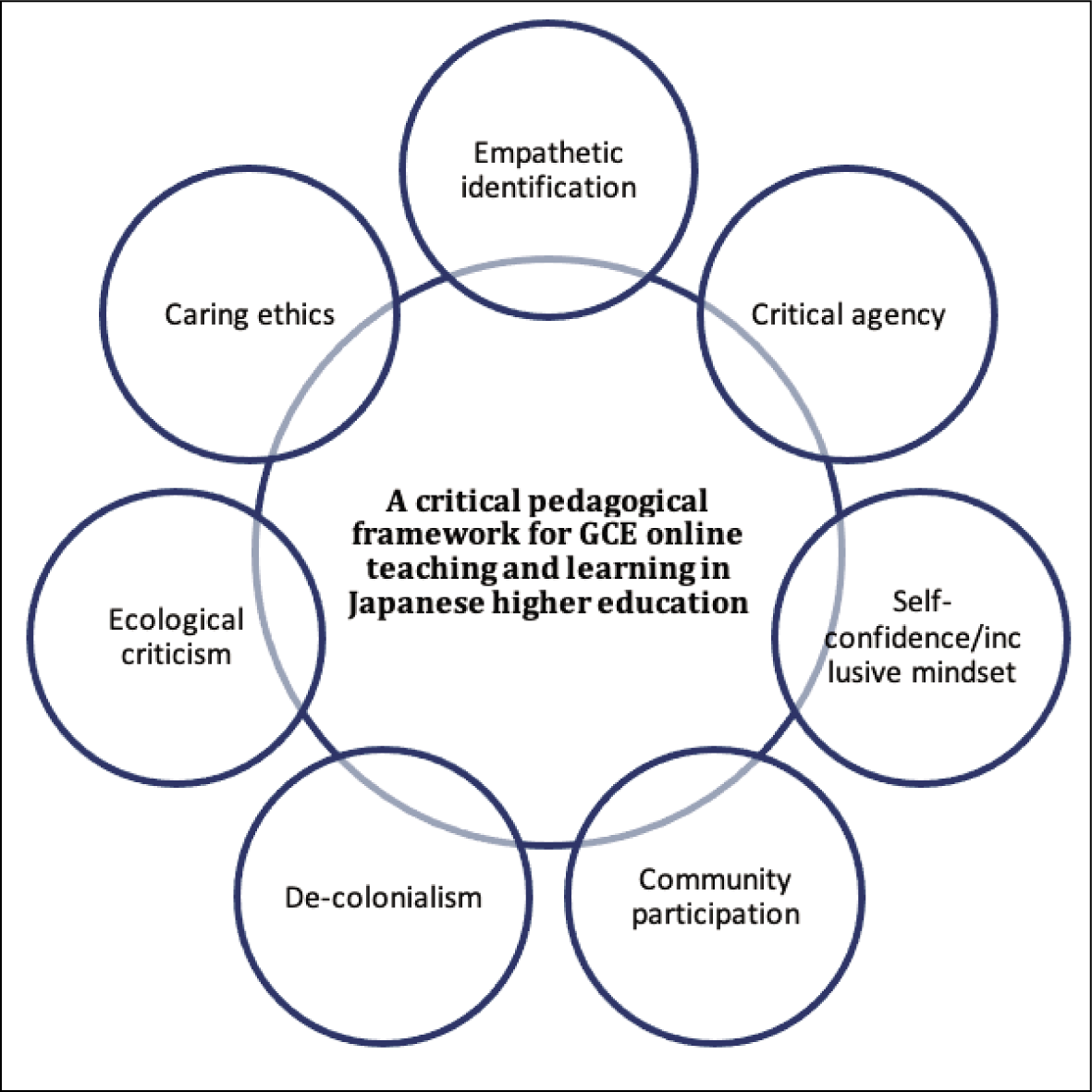
As a fundamental aspect of its philosophy, critical GCE online teaching and learning promotes trust in students’ abilities. This strong sense of authenticity acts as a source of empowerment for students, leading to a tolerant and receptive mindset (self-confidence and inclusivity). Aspects of self-confidence and an inclusive mindset are both required to realise a type of critical GCE online teaching and learning aimed at fostering global citizens who value fairness, respect, emotional and cultural intelligence and concern for both individual and human rights. Accordingly, critical GCE online teaching and learning should inspire students to engage in more meaningful and responsible exchanges with their local and global community (community participation). Community participation (e.g., volunteering for or donating to local schools, neighbourhood associations, government and non-profit organisations), fosters ‘self-awareness’. Yet, self-awareness cannot emerge from a void or be nurtured beside personal experience that lacks relevance for being constrained to any particular teaching setting or community. Hence, an effective approach to a critical pedagogical framework for GCE online teaching and learning must also utilise community involvement as an instrument for discovering students’ reliance on democratic values.
This might involve infusing in an online learning experience elements of de-colonialism, ecological criticism and caring ethics. For instance, the proposed critical pedagogical framework for GCE online teaching and learning will support learners in comprehending how capitalist organisations sustain the inequalities of colonialism. Hence, HE faculty involved need to support learners in processing the many factors behind such a reality, which can be furthered to help them understand how the various values and mindsets involved then come to impact on various contexts (e.g., political discrimination, economic hardship and social injustices). Possessing certain empathies and principles will support learners to exhibit the varied facets of globalisation and develop a firmer understanding of the manner in which neoliberal and colonial interpretations succeed in defining many political, sociocultural and economic outlooks (de-colonialism). The GCE online course material also requires a firm focus on developing learners who understand the importance of their human rights, together with their capacity to act as ‘change makers’. HE faculty overseeing this type of critical pedagogical framework for GCE online teaching and learning need to utilise a pedagogy designed to stimulate a dialogue that is both reflective and ethical (Mikulec & Ramalho, 2022), and at the same time as further relating to students their ability to become influential in directing social transformation as they develop their own ethical consciousness (caring ethics). HE faculty’s outlook based on these priorities will support learners to assess the wrongs that result from ‘anthropocentric’ perspectives and motivate them to be ecologically aware. Consequently, learners will be more effectively prepared to understand the dynamics of an anthropocentric philosophy—a worldview based on taking humans as the only reference point. From this perspective, in a critical pedagogical framework for GCE online teaching and learning students should be helped to understand that tackling societal inequalities serves as a precondition for safeguarding the environment and supporting biodiversity, and at the same time as recognising that anthropocentrism needs to be confronted via sustainable actions and philosophies (ecological criticism).
To conclude, although the critical pedagogical framework for GCE online teaching and learning discussed in this article should not necessarily be understood as a form of ‘panacea’ for social unfairness, I am optimistic that this approach can serve as a critically oriented GCE model to offer (at least ideally) greater educational achievement in the context of online interactions between HE faculty and learners, and HE faculty’s approaches to critical aspects of online teaching and learning in Japanese HE (e.g., reflective dialogue, critical consciousness, social transformation, decolonialism and ethical values).
Conclusion
The goal of this study was to examine how eight HE faculty located in Japan perceived and implemented GCE employing a critically oriented pedagogy via the online course ‘Perspectives on Global Citizenship Education’. The HE faculty co-teaching the online course highlighted how GCE should enhance students’ empathetic identification, nurture critical agency, enrich self-confidence and inclusive mindsets and inspire community participation. GCE is viewed by the HE faculty as a forward-thinking framework that encourages students to realign their duties to both the local and global communities based on the principle that ‘knowledge without action is insufficient’ (see Bosio, 2021c).
As the perspectives offered by the eight HE faculty examined in this study implied, space for critical debate oriented to foster empathetic identification, critical agency, social contribution, self-confidence, inclusive mindset and community participation should encompass not only physical sites (e.g., the classroom) but also online/virtual settings (e.g., Zoom) where knowledge and values can be democratically shared, students can debate and mobilise, and where social networks can be created both locally and globally with other students, universities, social movements, community groups and other public entities across the world so that collective social activism for the common good can flourish (Bosio & Torres, 2019). This vision for a ‘GCE critical digital space’ represents (at least theoretically) the springboard for the dissemination of awareness and knowledge that will lead to ‘sustainable digital communities’.
Based on the findings, this article concludes by proposing a seven-dimensional GCE paradigm informed by critical pedagogy rooted in social justice for teaching GCE online in Japanese HE institutions. HE faculty can use this model as a basis to help students feel more connected to humankind as a global community and appreciate diversity and the interconnected nature of all life on the ‘Planet’, for, as Paulo Freire (2014) explains, pedagogues must think critically about the employment of technology in teaching and learning ‘to create new channels of knowledge, new methodologies, new relationships between the subjects who seek knowledge and the most advanced technological innovations that we have at our disposal’ (pp. 74–75).
Footnotes
Declaration of Conflicting Interests
The author declared no potential conflicts of interest with respect to the research, authorship and/or publication of this article.
Funding
The author received no financial support for the research, authorship and/or publication of this article.