




Abstract
Background:
Healthcare workers (HCWs) are at greatest risk of acquiring infection in times of global pandemic of COVID-19 disease. There is an unprecedented demand of several forms of personal protective equipment (PPE) for HCWs leading to possible acute shortage of these equipment. This has paved way for development of local innovative PPEs.
Objective:
To test feasibility of a low cost, indigenous three-in-one face protective gear (FPG) in HCWs of a neonatal unit of a tertiary care institute in northern India.
Methodology:
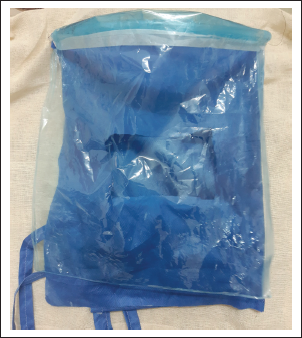
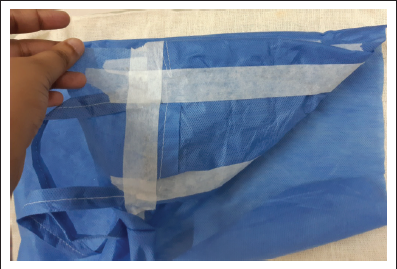
A three-in-one FPG was developed using the commonly available items in a ward or intensive care and few trash items. Items used were sterile surgical sheet, cling wrap piece/transparency sheet, cover of umbilical catheter/any sterile hollow plastic pipe, or straw and adhesive tape. The FPG was tested in 17 HCWs regarding its ease to use, comfort, and feasibility with the help of questionnaire.
Results:
A total of 17 HCWs participated in this study. Majority (10, 58.8%) were doctors. Eight (47%) participants have never used any form of PPE previously. Thirteen (76.4%) participants found the FPG comfortable to wear; 12 (70.5%) found it comfortable to wear up to 8 h. Three HCWs found it difficult to work when wear the FPG; 1 out of 3 found it suffocating.
Conclusion:
Three-in-one FPG is an indigenous, low cost, and may be a feasible alternative in low-risk situations when there is scarcity of conventional protective equipment.
Keywords
Introduction
COVID-19, the disease caused by novel corona virus SARS CoV-2, has led to an unparalleled global contagion involving more than 200 countries and still dispersing speedily. The virus seems to affect people of all age groups with varying severity. Clinical illnesses range from asymptomatic viral shedding, to mild sickness resembling the common cold, to severe influenza-like disease and viral pneumonia. Amongst the worst affected are elderly persons and those with risk factors. Healthcare workers (HCWs) due to nature of their job are at greatest risk of COVID-19 transmission. Droplet transmission can occur during any of the aerosol-generating procedures like endotracheal intubation, suctioning, and surgical procedures of upper airways. The solitary tool which may prevent transmission from affected patients to HCWs is appropriate use of personal protective equipment (PPE). Quality of care provided will also suffer in the unfortunate event of loss of manpower in the healthcare sector. Hence, HCWs should wear tested N95 respirators and protective suits, goggles, and face shields. 1 Face shields and masks are partial PPE which are absolutely essential especially in this pandemic which primarily spreads via droplet spread. The utility is mainly in non-Covid areas of hospital where full PPE for all is not practical. With increasing number of affected patients, there is likely shortage of these kits thereby compromising on availability of preventive tools for doctors. Local innovations are needed to meet the shortage of protective tools. This has led to design a low-cost reusable three-in-one face protective gear (FPG) which comprise of mask, cap, and face shield using locally available items.
Material and Methods
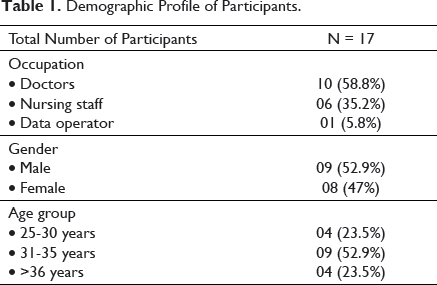
Demographic Profile of Participants.
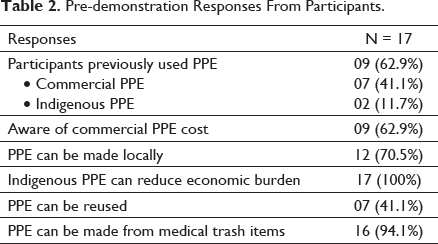
Pre-demonstration Responses From Participants.
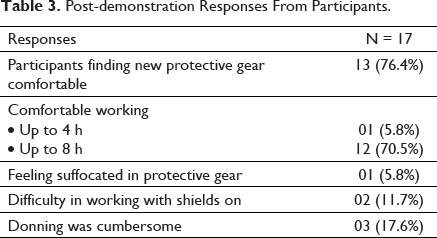
Post-demonstration Responses From Participants.
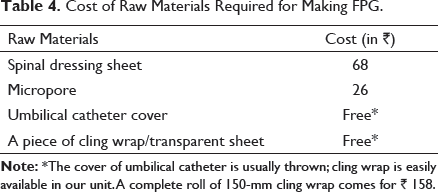
Cost of Raw Materials Required for Making FPG.
Results
A total of 17 HCWs participated in this study. The basic demographic details and level of experience of the participating HCWs are being given in Table 1.
The pre- and post-demonstration responses from participants are shown in Tables 2 and 3. Eight (47%) participants have never used any form of PPE previously. Thirteen (76.4%) participants found the FPG comfortable to wear; 12 (70.5%) found it comfortable to wear up to 8 h. Three HCWs found it difficult to work when wear the FPG; 1 out of 3 found it suffocating. The total cost of making FPG was ₹ 94 (Table 4).
Front Part of FPG With Plastic Shield.
Inner Side of Mask Showing Additional Layers Attached.
Discussion
With increasing number of cases, there is expected shortage of supplies of PPE which in turn makes the HCWs prone to infection. Innovative indigenous solutions are helpful in finding out ways to create personal protective gear with locally available materials and use them judiciously. The three-in-one FPG is made up of locally available materials and may serve as a useful tool during this pandemic crisis. Cost of manufacture is minimal and this protective gear can even be reused. Majority of participants agree that indigenous PPE can be made and thus reduce economic burden on the country. The survey showed that HCWs have substantial knowledge of how to make innovative knowledge and believe that local solutions for local problems are feasible. Difficulty in using PPE is well known and spans across various designs and types. In previously published studies, healthcare personnel believed that PPE was hot, difficult to breathe through, interfered with patient communication.2-4 Till date, no PPE is completely comfortable and research is going on to form effective strategies for sustaining PPE. The findings were similar with our FPG as well.
The limitations of study were single department use and less number of participants. The participants are from a tertiary care unit with attitude toward innovations, access to knowledge, and opportunity for development. We did not study the efficiency in terms of prevention of transmission of microbes.
Conclusion
Three-in-one FPG is an indigenous, low cost, and may be a feasible alternative in situations of scarcity of conventional protective equipment. More local solutions should be encouraged keeping in line with nation’s policy of “vocal for local.” Efficiency of this FPG needs to be further evaluated.
