



Abstract
Researching with the Bharia in Central India was a rare opportunity as it is perhaps the only tribal community in the region who are not dispossessed from their habitat in Madhya Pradesh, the Indian province with the largest number of tribal people. Dominant debates rarely take cognisance of the perceptions of the tribal communities. The article tries to map the Bharia voices, their worldview and knowledge that counter the processes of hegemony thrust upon them by the state, the market and non-state players.
Introduction
The dispossession of tribal communities from their habitats by development and conservation projects has largely made them landless. The loss of land for these communities also means loss of community life, culture and language. The tribal society is perceived to be backward, and their assimilation with the non-tribal society is generally understood as holding the key to their welfare. But this is a contested issue.
Historically, the tribal society has either been romanticised as a fictive paradise without the inequalities of civilised living and, on the other hand, has been seen as a fearful habitat of demons. Folk versions offer images that contradict texts. Therefore, collecting oral traditions is crucial to obtaining a view from the other side (Thapar, 2001). The self-images of the forest peoples, through a juxtaposition of the other images, she notes, could encourage a dialogue on perceptions.
Sources based on written traditions are scarce in the tribal society. Ratnagar (2004) underlines that literacy was not a requirement in tribal society in the way in which it was crucial in stratified societies where particular kinds of state institutions emerged under certain social circumstances.
The perceptions, knowledge and voices of the tribal peoples overwhelmingly remain outside the dominant discourses of society. Such a process of dominance by the powerful class in society is termed as the hegemony of the ruling class by Antonio Gramsci (Hoare & Smith, 2009). The social groups/classes that include the peasants, workers, the Dalits, women, the tribal communities, and so on are collectively termed by Gramsci as the subaltern. But how does hegemony operate? He broadly identifies two inter-related levels of operation—through the state, and the civil society (non-state actors-an ensemble of organisms commonly called ‘private’, which includes the church, the trade unions, and so on). While direct domination is exercised by the state, the civil society operates through consent. The processes of hegemony acting in this way create what Gramsci terms ‘common sense’, the uncritical and unconscious perceptions held in society.
Intellectuals who are engaged with knowledge creation believe that ‘one can know without understanding and even more without feeling impassioned’ (Hoare & Smith, 2009, p. 418). This applies not only to knowledge in itself but also to the object of knowledge. There is a disconnect between the intellectuals who do not feel and the people who are impassioned. As long as the disconnect remains, their mutual relationship gets reduced to one of a purely bureaucratic and formal order. ‘The intellectuals as the dominant group’s “deputies” exercise the functions of social hegemony’ (Hoare & Smith, 2009, p. 12).
The intellectuals, as noted by Gramsci, are professionals who work in, among other fields, the literary or the scientific. Their intellectualism does not address the hegemony. On the other hand, those intellectuals who use their intellectual capacities to address the hegemony, have an important role to play in society, and he terms them as ‘organic intellectuals’. They are distinguished less by their profession, and more by their thinking and organising element of a particular fundamental social class….’ by their function in directing the ideas and aspirations of the class to which they organically belong’ (Hoare & Smith, 2009, p. 3).
Gramsci and Paulo Freire had examined the politics of knowledge in the capitalist society. Freire (1972) articulated how schools coach students to store and reproduce the information that teachers relayed to them, which reproduces the status quo of hegemony. He evolved a pedagogy that incorporates critical consciousness as the most important tool. By questioning the historical and social situation in which one is located, learners can liberate themselves, which Freire calls the reading of the world. Such learners become humanised because, in the hegemonic order, both the oppressed and the oppressor are de-humanised. Processes of humanisation, and of people naming the world, thus become powerful sociopolitical tools.
Contextualising the Field
A number of tribal communities live along the valleys of the Narmada River, which flows between Satpura and Vindhya ranges in Madhya Pradesh (MP). Development projects have dispossessed tribal communities. In more recent times, conservation projects that seek to do away with human settlements in National Parks and wildlife sanctuaries, have further forced the people out of their lands. These have been the prime cause of the deprivation of such communities. 1
During the fourth five-year plan, a subcategory called ‘primitive tribe’ was made within the ‘scheduled tribe’ classification, based on the Dhebar Commission (1960–1961). The nomenclature was later changed to ‘particularly vulnerable tribal group’ (PVTG), denoting those groups who do not have access to modern development such as roads, electricity, schools and piped water.
In MP, the Saharia community, the most deprived PVTG, record illiteracy, poverty and malnutrition. 2 Rajak (2016) points out the situation as having arisen from landlessness, dispossession and rehabilitation of the community by development projects. Being forced to survive on wage labour, their transition relocates them to the most deprived rungs of the stratified non-tribal society.
In contradistinction to the Sahariya, the Bharia of Patalkot in Chindwara district, also a PVTG, have good nutritional levels (Tiwari et al., 2007) and above average literacy rate 3 within the tribal communities in MP. They have not been dispossessed, and retain their forests and habitat in the Patalkot valley. The valley formed by River Doodhi, surrounded by steep rocks, is part of the catchment of the Narmada River in the Satpura range. Spread over 79 km2 at an average elevation of 838–991 metres above mean sea level, it is 78 km from Chindwara, the district headquarters. The valley lies 400 metres below the elevation of Tamia, the nearest town.
The fort-like formations of rocks from the Archaean era, nearly 2,500 million years old, ring the deep valley, implied in the name Patalkot (Patal—abyss/ netherworld, kot—fort). Most of the villages of Patalkot, totalling 12, can be reached only by foot while some can be reached by road. People have made pathways to reach marketplaces. Students walk several kilometres to reach schools. The literacy rate is 58.14%, with 4,824 Bharia people living in Patalkot (Census of India, 2011).
Methodology
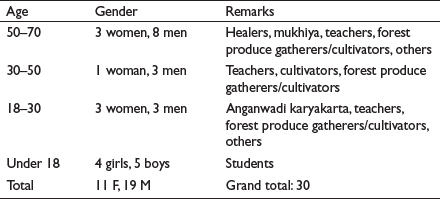
The article derives from a study done with the Bharia community in 2021–2022 on redefining sustainable development. 4 A qualitative approach to research attempted to capture the reflections, worldviews, anxieties and agency of the Bharia community. The Bharia represents a homogeneous group, in the sense that it is a non-stratified community. A purposeful selection was made to include different age groups, genders, livelihoods and employments. Efforts were made to converse at different sites such as that of home, cultivation, gathering of forest produce, schools, ashramshalas and anganwadis—in two villages, Rated and Gaildubba, both located around 21 km (in different directions) from Tamia. Other sites included those of tourism perched on the higher elevations of the valley, and a tribal residential school in Tamia town. A few Bharia people from Tamia also became part of the research.
The lived experiences of the people form the source of primary data. An effort was made to co-create knowledge through the coming together of researchers with the people for mutual sharing of information and reflections. Livelihoods, ecological and social relations, memories and oral histories, and state policies and institutions formed important themes.
The Bharia people speak the Bharioti language. But in their relations with the market, the school and other institutions, they speak and write in Hindi, the language we used in our interviews. Discussions were video documented with prior permission from participants. After the initial round of field visits, the recordings were transcribed in Hindi. Emerging themes were noted and conversations clubbed together. Relevant portions were translated into English for the research writings. Further questions were pursued in the proceeding field visits. A documentary film on the Bharia, made as part of the research, was watched and discussed along with all the participants.
The conversations of the people portrayed their lived experiences and reflections. The outcomes of the research are envisaged to benefit the people by (i) enhancing their voices, (ii) showcasing the Bharia agency through a collective forum/meeting and (iii) attempting to impact the dominant perceptions of society through the documentary film and research writings.
To give a brief idea of my own location as a researcher, I have been engaged with educational innovations in MP for more than two and a half decades. My academic pursuits are based on nature–society relationships. Across the years, I have interacted with the struggles of tribal/Adivasi communities in the state, and also with the challenges that education poses for these communities.
Sample Design
Bharia Articulations
The oral histories of the Bharia, the documentations of gazetteers (Russell, 1907, p. 70) and studies by scholars (Kurup, 1985, p. 9) point out that the Bharia sought shelter in the deep valley of Patalkot to escape the hegemonies of caste society and the state. Oral traditions indicate their migration from the Nagpur region to escape sexual exploitation by caste society. Taxation by the Marathas 5 in Bhardagarh (Jamai tehsil in Chhindwara district) and other parts of the jagir area is noted by Kurup (1985) as the reason for the Bharia receding into Patalkot. Possibly, there could have been more than one phase of forced migration.
The Bharia people revere the valley, where their knowledge and spirituality are based, which, like other tribal cultures, has a deep connect with nature. Their spirituality manifests itself in the form of Bada Dev, symbolised by the Saaj tree. Given below is a narration by Madhura in Rated village:
Everything we need are in the forests. Our devi-devtas are in the forests- in our rivers, and in the rocks. The Saaj tree holds the Bada Dev. We believe that the devi-devtas take care of us. We take things from the forests, and we protect the forests.
What do they ask from Bada Dev? He responded as follows:
Bada Dev is in our houses. We offer coconut in our worship, and then offer that to our mother and father. We tell Bada Dev that we should live good, our children should live good, our cattle should be taken care of, and we should be protected from diseases. These are the sort of things that we ask of Bada Dev.
Oral History
In Bharia history, as narrated by Madhura, the landscape invokes the metaphors of a seamless, yet distinct valley and the ‘uphill’:
When our mother was pregnant, our father had gone uphill from Patalkot, and he did not come back to us. Our mother gave birth to a child, and she continued to live in Patalkot. What was the use of going uphill? Our father had other children through another woman. The children of the mother in Patalkot are the Bharia, and the children of the mother uphill are the Gond.
6
Both the people worship Bada dev, and both revere the Saaj tree, but there is a difference. The Gond pluck its leaves and worship, while the Bharia worship the tree. We are older than the Gonds, and we worship the living tree. The Gonds worship the leaf that flies away from the tree and has lost its life. We are in Patalkot which is down and grounded like the Saaj. They have gone higher up and associate with the leaves growing up on the tree. We are still at the roots; they have gone up to the leaves. Unlike the Bharia, there are some ‘Patels’ among the Gonds. The five fingers of the hand do not remain equal. But we dance, holding hands.
There are no marriages traditionally happening between the two tribes, but if that happens there are community traditions that address them and actually let them be.
The Lived Experiences with the ‘Uphill’
The ‘uphill’ holds both the memories of their forced migration into the valley and the contemporary lived experiences. The Bharia people gather forest produce such as chironji, awla, musli, harra, mahua, honey and medicinal herbs and sell them in the markets uphill. The sahookar, who is both a trader and money-lender, has become a synonym for cheating, as observed by Shubhraj in Rated:
The sahookars come to the villages to buy from us. We are often not aware of the market rates of each and every item, and they decide the price. They always keep in touch with the people, and offer monetary help when anyone has a problem. During the proceeding season, they take back in kind, and at rates of the previous year! We are at a loss. Moreover, they cheat while weighing the produce.
In Rated, people pointed out the threat to the forests from timber smugglers who come from uphill. They are concerned about the loss of forests. Deforestation by the uphillers, including the forest department, is in stark contrast to the Bharia practice of clearing of forests for cultivation, as pointed out by Hemvati in Tamia:
The Bharia takes only small quantities of wood for making of a door or a window of the house.
The Bharia community meetings have discussed the issue, but they fear repercussions if they try to stop the timber smugglers, as Bharti noted:
They are more powerful!
The Mukhia of Gaildubba village, Chalatia, observed that forests have been degraded through selective felling by the forest department. The forest officials say that the stronger trees thrive well if the weaker ones are felled. But the Mukhia told them that trees grow through mutual support. Moreover, those flora that are cut down by the forest department, yield fruits and flowers which are eaten by the people of the valley, as well as by birds and animals. But the Mukhia says that the officials do not listen, especially since he is employed by them as a labourer. He observed:
What we need to do is to plant trees without considering whether they yield something for us to eat. This is what we do because trees are like our parents, our sisters, and brothers. I am a person who is not educated, I have only passed the 5th grade. But I understand the trees and plants.
He said that tree felling has caused a loss of moisture in the soil, shortage of drinking water and an increase in temperature. Since 2012, people in Gaildubba have been planting trees.
Many years back we started to plough the land, and the soil has been washed away exposing the rocks in many places. But in some niches, you can see soil. That is where planting needs to be done. Otherwise, we will lose greenery and also lose cultivation.
The Mukhia and others had travelled to different parts of MP and met tribal communities such as the Baiga in Mandla and the Bhil in Western MP. He narrated how these journeys helped to understand tribal organisations’ struggle for their rights. The Baiga community, which is also a PVTG, had procured habitat rights (on the basis of the Forest Rights Act, 2006) 7 in 2015. Baigachak, which comprises seven villages where the Baiga tribe lives, was the first area to receive habitat rights.
The Bharia people led by some Mukhias and others worked at two levels: of procuring solidarity from outside the valley and of uniting the Bharia people to engage with the issue. Signatures were collected from the people to demand claims to their habitat. The Bharia community procured habitat rights of Patalkot in November 2022.
Food and Healing
In 1954, the government banned shifting cultivation which the Bharia people had been practicing in the valley (Kurup, 1985). Later, the Wildlife Act, 1972, put a brake on hunting for meat. Today the people fish from the river and keep poultry, and meat is bought from the market. Lands of cultivation are not commonly owned but have been documented in individual names about 10–12 years ago. Maize, lentils, wild rice and millets such as Kodo, Kudki and Sama are cultivated.
A staple food drink called peja, made from maize, is mixed with a particular herb and buttermilk. Tubers, greens and fruits from the forests form important ingredients of food. Mango grows abundantly in the valley, and the kernel of its seeds, used to make flat bread, are considered highly nutritious. Alcohol is made from mahua, and the chilum 8 is used to smoke. Wheat, in more recent times, is bought from the market.
The Bharia have a tradition of healing with medicinal plants. The padyar or bhumka is the traditional healer, even as all people in the community have some knowledge of healing, passed on through generations. Rajkumar, who was at home in Rated because he had sprained his leg while ploughing the field, narrated:
I treat myself with herbs from the forest. That heals me in the long run. If I have a tablet bought from the shop, it might give me instant relief, but that does not last long.
The Bharia, who live outside Patalkot like the town of Tamia, depend on their traditional healing too. They visit the healer whenever the need arises. The healers dedicate their lives to the development of the knowledge. They diagnose health problems by feeling the naadi (pulse). They usually spend around an hour each in the morning and in the evening to gather medicinal herbs. These are then dried and prepared for use in medicines. Bhatulal, a healer, said he sells each packet for ₹20 in the market in Chindi:
That way people get healed spending less money. Healing should not be an expensive process. But many people now-a-days think that serious ailments can be treated only through expensive treatments. But that is not true. Naadi (pulse) tells us where the problem lies — sometimes in food deficiencies, or in matters related to water and air. Through medicines and healing, the person gets back to normal.
A Bharia youth observed that when he harvests tubers from the forest, he replants those that are not fully grown: ‘There has to be continuous growth for the needs of tomorrow.’
Community Meetings
The Bharia community holds meetings prior to festivals, the sowing of seeds, harvests and weddings or for settlement of disputes. A couple of persons from each home, both women and men, attend the meetings, referred to as ‘sehmati banana’ (to make consensus). Each of the 12 villages has a mukhia or headman. The Mukhia of Gaildubba narrated that in the month of May/ June, they worship the deity, Bhimsena for which coconuts, chicken and other ingredients are commonly pooled in, after which they sow kodo-kudki.
People contribute rice, oil and other ingredients for wedding feasts, ‘to koyi khabaraye nahi’ (so that no one feels troubled). The Mukhia narrated that for settling disputes, a mediator is selected as the Patel for the meeting, who hears out both sides and makes suggestions. If everyone claps and agrees, it becomes a decision. Otherwise, the issue is further discussed to reach a consensus. Some money, he said, is taken from both the parties concerned and a document is made. Then they eat together and return to cordial relationships.
The School
Shubhraj in Rated made the following observations about the school:
The education system is one in which the students are guided to move away from the village, towards the city. What is written in the books and what is taught in the classes, are all to do with matters of the towns and cities. The children of our villages are not familiar with those things. If you ask me, the matters and knowledge of the villages should be the contents of at least 50 per cent of the course, so that the children of the villages can stand on par with the others.
Laxman who studies in grade 11 with agriculture as his specialisation said that in his course he learns about the cultivation of wheat. Many of his peers had also chosen agriculture, but he observed that there is nothing about kodo-kudki and the cultivation of crops like beans (ballar), corn and lentils (tuar) that they grow in Patalkot. Does he think that his schooling could help him to innovate or improve upon the cultivation that is being done in Patalkot? He remarked that what is taught in his course demands resources to buy inputs such as pesticides and fertilisers.
Rambai from Rated observed:
Jobs obtained by Bharia persons on the basis of their education, are mostly those like serving drinking water to people (in offices). While on jobs, they are often seen to be intoxicated. The reason lies in the inferiority that develops inside them.
Eklavya residential school
9
was started in Tamia in 2019. It is an English medium, co-education school under the Central Board of Secondary Education. The students belong to the Bharia and Gond tribes. We visited the school during the annual inter-school art competitions. Having spent around five hours in the school, we experienced cordial teacher–student relations of cooperation and love. It was a culture distinctly different from the schools I have ever seen. For instance, after her dance performance, a student asked a teacher seated next to me:
‘Did I do well? Was it good?’
This was asked so simply without any fear or anxiety, like one would ask a friend.
Later, we gathered from teachers that the school used to function like all schools, where teachers exercised disciplinary actions. The students had then refused to continue their studies and returned to their villages. Their parents also complained that they did not want their children to continue in unpleasant conditions. All the permanent teachers in the school are from tribal communities. The school was forced to make decisions to stop scolding or beating students. One of the teachers, Mohan remarked:
Jo mara se na seekha, vo prema se seekha. (What could not be learnt through pressure, is being learnt through love)
Mohan and Vinod are two teachers from other schools, with whom we had several interactions. On other occasions, we planned to meet them for interviews and for the documentary film we were making. From them, we gathered that even other schools in the area practiced friendly relations with students.
These teachers were passionate about teaching and their relationships with students. While Vinod writes songs and articles on the Bharia of Patalkot, Mohan records Bharia songs and dances, and makes them publicly available, like through YouTube.
Bharioti Language
Kata jaasast tu? (Where are you going?)
Bahu-dada ko kata jayis? (Where have bahu and dada gone?)
Mora ghar me he (They are in my home)
Madhura wrote these in my diary in Devanagari script. He has studied up to grade 5.
-Do they teach the Bharioti language in school?
No, they teach ka, kaa, ki, kee (he laughs)
-Do your children speak Bharioti?
-No
Shubhraj observed: ‘Everyone speaks Bharioti, but they will say that they do not.’
Mohan, the teacher, used to teach Bharioti in government schools of Patalkot. Teachers had then been instructed to translate Hindi texts, with no effort to adopt or create Bharia literature from the valley. The government closed down the teaching of Bharioti in 2011. Upon our request, the teacher talked in Bharioti, which we recorded. The Mukhia of the village said that his daughters-in-law speak Bharioti, so he is happy to be conversing with them, while his sons speak less of it. A senior woman who was selling corn rotis at a tourist site remarked: ‘We have so many words to describe the flowers, fruits, streams, food, medicines and so on.’
A few youths from Rated have initiated a process of teaching Bharioti to the younger generation. In the meeting we held by the end of the research, there was unanimity on the need to reclaim Bharioti as an important part of their culture and identity.
Discussion
The stories of the Bharia people bring together their history, the bonding with the valley, the relationships with the Gond people, and the outside world, and the metaphors of non-hierarchical relationships in the Bharia community.
Bharia’s social life portrays a richness of ‘humanised’ practices (a la Freire) like the collective community decisions in which the Mukhiya is a facilitator of non-hegemonic practices, and not an assertive leader. There are conspicuous sensibilities on people’s troubles, as well as practices of amicable solutions to disputes. Bharia spirituality, through a direct link with nature, is contra-distinct from dominant religions structured through hegemonies of middlemen like priests and of built spaces.
Satellite imageries from 2003 to 2022 10 show negligible deforestation in the deeper parts of the valley, but the outskirts, more accessible to the uphillers, have been cleared or degraded. The Bharia evolves the nutritional and healing potentials of flora, which falls in a framework of human well-being and survival. But forest management based on capitalist production, sidelines the knowledge of the Mukhia and emphasises his status as a labourer. These bring out the duality of perception between the tribal and the non-tribal society (as noted by Thapar, 2001). The knowledge developed for capital’s extraction of natural resources becomes the dominant and legitimate knowledge. This theoretically links to the senior Bharia person’s observations on the exclusive nature of the school curriculum.
The duality of perceptions creates a set of beliefs in the dominant society that becomes its ‘common sense’, the term as used by Gramsci (Hoare & Smith, 2009). For instance, they perceive the Bharia as deprived of food because they do not eat roti (wheat bread) like them. But in fact, they eat a large variety of food, along with wild rice. They make very little rotis, whose numbers do not decide the sumptuousness of their food.
Sexual exploitation is not mentioned in any official records and studies, but is articulated by the Bharia people. This could be a continuing story in spaces where the community is juxtaposed with the dominant society in the form of wage labour, an example of undocumented histories of oppression. This turning of the tables through the Bharia voicing their own history emerges from oral traditions and the dialogues on them.
Cultural Hegemony
In the juxtaposition of the Bharia with the dominant society, they are portrayed as people of lesser intellect. The ‘common sense’ of the dominant society culturally pushes the Bharia people to a ‘lowly’ position, which operates through the hegemonic practices of class–caste–gender. Gramsci articulated cultural hegemony as the dominance of a culturally diverse society by the ruling class that manipulates the culture of that society, the beliefs, meanings, perceptions and values (Hoare & Smith, 2009).
Cultural hegemony mostly impacts those youth who access schools and higher education. The hegemonic reinforcements are reflected in those Bharia youth who tend to disown Bada Dev, and to adopt the dominant religion and language. Thus, both state and non-state actors like religion, make tribal knowledge and spirituality subaltern.
The closure of the teaching of Bharioti in the schools of Patalkot adds to the process of cultural hegemony. Language is an important carrier of knowledge, as observed by a Bharia woman, on the multiple words that they have for different flora and its produces. But there is a feigning of ignorance of the language, especially by those in formal employment, the outcome of the making of the subaltern by the institutions and the dominant society.
Counter-hegemony
Given the above-mentioned contexts, it is not surprising that mostly the less educated persons (senior persons like the Mukhia and others, and youth who are cultivators and forest produce gatherers) emerge as the ‘organic intellectuals’, a la Gramsci (Hoare & Smith, 2009). The visioning of and acting upon their ecological and social knowledge, like the identification of niches and the planting of saplings, the replanting of young tubers, and conserving the soil and its moisture are some of the pointers. The efforts, struggles and negotiations to procure habitat rights are exceptionally notable counter-hegemony. This has laid the ground for enhancing critical consciousness in the community, in which some Mukhias have been playing very important roles.
At another level, and also linked to the above, is the consciousness operating through some teachers. Their cultural searches and innovations reinstate the Bharia identity and reclaim the tribal cultural expressions and seek refinement. A duality of the location of the teachers arises from having to make a bridge between their government service that delves into caste–class–gender as the universal, and their community-based practices in Patalkot. The ‘counter-hegemony’, a term used by Gramsci (Hoare & Smith, 2009) evolved through the students of Eklavya school, has been enhanced also because of the presence of teachers from tribal communities. The voluntary efforts by some youth to reinstate Bharioti in the valley is another act of counter-hegemony.
Conclusions
The politics of knowledge, through the creation of ‘common sense’ in the dominant society, relegates tribal knowledge to a subaltern location, enhancing the educated Bharia youth to abandon Bharia knowledge. This illustrates a distinct ethos of colonialism.
Decolonised methodologies of research reveal the duality of perception/knowledge between the subaltern and the dominant society. This article makes audible the voices of the Bharia who, unlike other tribal communities of MP, are not dispossessed from their habitat. Their voices bring forth the counter-hegemony of the Bharia organic intellectuals. Their voices that name the world, demonstrate ‘humanised’ social relationships. Hence, their ‘counter-hegemony’ challenges the dominant view of capitalism as being the only viable economic–political option.
Footnotes
Acknowledgements
The author would like to thank Yogesh Diwan for inputs and Syed Moobin for the documentation.
Declaration of Conflicting Interests
The author declared no potential conflicts of interest with respect to the research, authorship and/or publication of this article.
Funding
The research was done as a project of the TESF India Project, IIHS, Bengaluru. The author acknowledges the support received from the Economic and Social Research Council (UK; award title: ‘UKRI GCRF Transforming Education Systems for Sustainable Development [TES4SD] Network Plus’).
