



Abstract
Drawing on the ecologically unequal exchange theory, we assess whether palm oil exports from peripheral nations to India are related to increased forest loss in the peripheral nations in the context of petty and grand corruption, which has not been done before. We go on to build upon previous cross-national work by examining if petty and grand corruption interacts with the ecologically unequal exchange of palm exports from peripheral nations to India. We test this hypothesis using ordinary least squares regression for a sample of 78 peripheral nations and find that palm oil exports to India are related to more forest loss in peripheral nations with higher rather than lower levels of petty and grand corruption. We conclude by discussing the theoretical, methodological and policy implications that follow from our findings.
Introduction
In the early 1990s, India put into place neoliberal economic reforms to avoid a balance of payment problem that followed the collapse of the Soviet Union, which was India’s largest provider of foreign aid (Dasgupta et al., 2021). The reforms led to unprecedented economic growth and industrialization with India moving from a peripheral to a semi-peripheral nation (Downes, 2009) and, in the process, having a mixture of characteristics of core and peripheral nations—see Wallerstein (1979), Arrighi and Drangel (1986), Terlouw (1993), Chase-Dunn and Hall (2006) and Cairó-i-Céspedes and Palacios Cívíco (2022) for more on the characteristics of semi-peripheral nations. In this regard, India has experienced development in part due to access to and consumption of natural resources and agricultural commodities that they import from peripheral nations (Karataşlı, 2017). However, India’s development has been uneven because it also produces goods and services for core nations using the same natural resources imported from the periphery to support its own industrialization—see Karataşlı (2017) for a general discussion of this point and Downes (2009) for a specific discussion related to India.
For instance, the percentage of people living in ‘extreme poverty’ or living on less than $2 per day fell from 46% to 21% from 1990 to 2015 (World Bank, 2020). Further, India’s middle class—individuals earning $10 or more per day—increased from 300 million to 600 million people during the same period (World Bank, 2020). These improvements have corresponded with changing consumption patterns with people eating more food and deriving larger portions of their diets from meat, dairy and processed foods (Sachdev & Misra, 2022). However, poverty remains pervasive in India. In 2015, 175 million people—mainly women and members of lower castes and tribes—continued to subsist on less than $2 per day (World Bank, 2020). The number of people living in extreme poverty ensures an abundant supply of cheap labour for foreign firms producing goods and services for sale to core nations (Downes, 2009). It also keeps wages lower than would otherwise be the case in India, which, in turn, means poverty and a corresponding demand for cheap foodstuffs, like palm oil, persist (Gonsalves, 2006).
To meet their food needs, India has become the world’s largest consumer of palm oil using 9.5 million tons annually (Mishra & Tapsall, 2017), but it cannot produce enough palm oil domestically to meet its demands, which is largely the result of increased consumption of processed foods along with demands from the poor for access to cheap cooking oil, which resulted from moving into the semi-periphery (Gonsalves, 2006). Accordingly, India imports 15% of the global supply of palm oil (Mishra & Tapsall, 2017).
Sommer et al. (2021) argue that India has been able to use its semi-peripheral status to exert influence and establish ecologically unequal trading relationships with peripheral nations to meet this demand. India does so by offering peripheral nations bilateral financing to build infrastructure (Fuchs & Vadlamannati, 2013), helping to build institutional capacity (McCormick, 2008), signing free trade agreements that eliminate tariffs and promoting investment by Indian firms abroad, and providing Indian Export-Import Bank lines of credit to peripheral nations that partner with Indian firms in the agricultural sector (Ratna & Kallummal, 2013). Towards this end, Sommer et al. (2021) find that the unequal ecological exchange of palm oil exports from peripheral nations to India is related to increased forest loss in peripheral nations.
Another line of cross-national research examines the impact of corruption on forest loss. There are several ways to conceptualize corruption and, as a result, several ways to think about how it may impact forests. We follow Sommer (2017), who uses the Varieties of Democracy (2022)’s classification of corruption as ‘petty’ or ‘grand’ in our study.
1
According to the Varieties of Democracy (2022) database, petty corruption involves the extent that ‘public sector employees grant favours in exchange for bribes, kickbacks or other material inducements’ along with ‘how often do they steal, embezzle, or misappropriate public funds or other state resources for personal or family use’. Grand corruption involves
members of the executive or their agents (excluding public sector employees) granting favours in exchange for bribes, kickbacks or other material inducements, and how often members of the executive sector steal, embezzle or misappropriate public funds or other state resources for personal or family use.
See Geist and Lambin (2002) and Sundström (2016) for more on the petty and grand corruption classification scheme.
Contreras-Hermosilla (1997) identifies several forms of petty corruption in the forestry sector. They tend to involve public sector employees, low-level military personnel or local government officials taking a bribe or kickback from a company to falsify declarations of volumes or species harvested, falsify export documentation, avoid the reporting of prohibited species, overlook non-compliance with reforestation rules, permit the illegal movement of timber and allow timber to be processed without necessary approvals.
In terms of grand corruption in the forestry sector, Contreras-Hermosilla (1997) sees companies providing financial incentives to political parties, high-level government officials or military officers, to obtain forest concessions, extend existing concessions, obtain approval for processing ventures, avoid paying fines and other fees, and negotiating favourable investment agreements that include economic incentives and regulatory concessions, in some instances. In other instances, high-ranking government or military officials use their positions to accomplish the same results noted above, but it may not only be in their interests but also the interests of companies from which they (along with their relatives or political allies) may gain (Contreras-Hermosilla, 1997). Thus, we use ecologically unequal exchange theory and previous empirical research as the starting point for this study. Nevertheless, we move the research frontier forward in two ways. First, we apply ecologically unequal exchange theory to a semi-peripheral nation. Specifically, we empirically evaluate if palm oil exports sent from peripheral nations to India adversely affect forests in the peripheral nations. Second, we evaluate arguments related to ecologically unequal exchange with India in context the of other theoretically relevant predictors of forest loss. We pay special attention to the impact of petty and grand corruption on forest loss like Sommer (2017).
While the cross-national research reviewed offers important insights into why forest loss is increasing in peripheral nations, we also argue that it offers an incomplete explanation. This is the case because it considers how ‘external’ or ‘international’ factors related to ecologically unequal exchange and ‘internal’ or ‘intranational’ factors like corruption impact forest loss separately. Writing about cross-national research that treats political-economic theory (with its emphasis on external factors) and modernization theory (with its emphasis on internal factors) in this way, Bradshaw (1987) points out that cross-national research of this sort tends to avoid ‘current theoretical and ideological particularism’ by including predictors from competing perspectives in the same model ‘without giving logical priority to either paradigm’ (p. 235). Smith (1996, p. 145) goes on to note, ‘More critically, it represents a retreat to eclecticism. It sidesteps the real challenge, which is to construct a synthetic theoretical approach that melds the useful elements of competing approaches into coherent guiding principles and explanations’.
With this critique in mind, we draw on Evans’s (1979) idea of a ‘triple alliance’ regarding how the Brazilian military dictatorship created a ‘good business climate’ for foreign firms investing in the country by offering them various economic incentives (i.e., tax holidays) and regulatory concessions (i.e., environmental law exemptions). Diverging from Evans’s (1979), we do not discuss military dictatorship, but instead, focus on how corruption within a nation, specifically, reduces its ability to defend against exploitative trade relationships. Supplanting Evans’s focus on military dictatorship with corruption within a nation, we argue that peripheral nations with higher rather than lower levels of petty and grand corruption create institutional contexts that facilitate the ecologically unequal exchange of palm oil from peripheral nations to India.
We believe that this is the case because corrupt public officials and military personnel at both lower and higher levels of government prioritize consumptive practices in the short term rather than advocating for long-term investments (Evans, 1996). Towards this end, we extend the existing cross-national research literature in a novel way. We examine if an interaction effect exists between corruption and palm oil exports to India and, in turn, expect that exports of palm oil to India should increase forest loss more in peripheral nations with higher rather than lower levels of petty and grand corruption.
We now turn to a review of the theory of ecologically unequal exchange and the ways that India engages in it to facilitate palm oil imports from peripheral nations. We follow with a discussion of how corruption may impact forests in peripheral nations. We go on to discuss why corruption should interact with the ecologically unequal exchange of palm oil to India to increase forest loss more in peripheral nations with higher rather than lower levels of corruption. We then describe our research methodology including our sample, variables, modelling strategy and findings. We conclude with the theoretical, methodological and policy implications of our findings along with the limitations of the study and corresponding directions for future research.
Ecologically Unequal Exchange and Forest Loss
Writing from a world-systems perspective, Bunker (1985) applies Wallerstein’s (1979) concept of unequal exchange to demonstrate how global resource exchanges adversely impact the natural environment in semi-peripheral and peripheral nations while reducing such impacts in core nations. Towards this end, core nations are advantageously situated within the global economy and can secure favourable terms of trade (Hornborg, 2003). This advantageous position is the result of export prices from semi-peripheral and peripheral nations, mainly crops and natural resources, falling relative to the prices of manufactured goods and services from core nations (Frank, 1967). The declining value is the result of several factors. They include many semi-peripheral and peripheral nations pursuing their comparative advantage (Emmanuel, 1972), a large workforce working for low wages (Frank, 1967) and peripheral and semi-peripheral nations failing to create their own manufacturing and service sectors (dos Santos, 1970). It has been reinforced by other factors including the International Monetary Fund and World Bank structural adjustment lending (McMichael, 2004), multinational corporations engaging in a ‘race to the bottom’ (Frey, 2012) and core nations’ export credit agencies (Restivo et al., 2020).
In the end, it takes peripheral and semi-peripheral nations more agricultural and natural resource exports to buy manufacturing and service imports from core nations (Muradian & Martinez-Alier, 2001). A peripheral or semi-peripheral nation can be successful at increasing its extractive exports, but, in return for the sale of its exports, it gets fewer, not more, manufacturing and service imports from core nations (Giljum & Eisenmenger, 2004). Thus, forest loss increases in semi-peripheral and peripheral nations because they expand exports in extractive sectors just to keep manufacturing and service imports from core nations from decreasing (Hornborg, 2003).
Givens et al. (2019) conduct an extensive review of the empirical literature on ecologically unequal exchange theory. We highlight the cross-national research on forest loss. Jorgenson (2006) published the first study that linked ecologically unequal exchanges to forest loss. Jorgenson et al. (2010) followed by finding a similar effect of exports in extractive sectors. Shandra et al. (2009) refine the measurement of ecologically unequal exchange theory by considering how forestry exports impact forest loss. The ecologically unequal exchanges of specific exports have also been linked to forest loss including beef (Austin, 2010a), soy (Austin, 2010b), coffee (Austin, 2012), palm oil (Henderson & Shorette, 2017) and chocolate (Noble, 2017).
Ecologically Unequal Exchange and Semi-Peripheral Nations
The preceding discussion of the theory and empirical research on ecologically unequal exchange describes how core nations go about externalizing their forest loss to semi-peripheral and peripheral nations. However, a nascent but burgeoning literature exists that considers how semi-peripheral nations may be promoting ecologically unequal exchange with peripheral nations.
Burns et al. (2003) describe and document a pattern of ‘recursive exploitation’ whereby core nations externalize their forest loss onto semi-peripheral and peripheral nations. However, Burns et al. (2003) go on to note that semi-peripheral nations may be using their position in the world system to gain access to natural resources in peripheral nations and, in turn, facilitate forest loss in those nations. According to Burns et al. (2003), this process is increasingly characterized by a company from a semi-peripheral nation supporting logging in peripheral nations of Southeast Asia or Sub-Saharan Africa, which tend to have less stringent forestry regulations.
Along the same lines, Wiebe et al. (2012) quantify the extent to which India exports carbon dioxide emissions and forest loss to peripheral nations while importing such problems by producing goods for core nations. The authors also analyse other semi-peripheral nations including China, South Africa, Russia and Brazil. Frame (2019) also seeks to understand and quantify the extent to which this process may be playing out in peripheral nations. The author begins by demonstrating that during industrialization China, Malaysia, Thailand and Vietnam were increasingly consuming minerals, fossil fuels, wood and construction materials. The author then shows the degree to which each semi-peripheral nation meets its consumption of these goods by importing them from Cambodia, a peripheral nation. Frame (2019) goes on to describe how companies from semi-peripheral nations via ‘land grabs’ gain access to Cambodia’s natural resources and, at the same time, cause forest loss.
Drawing on insights from the preceding articles, Sommer et al. (2021) apply similar arguments to India and theorize how India engages in ecologically unequal exchange to gain access to palm oil in peripheral nations. The authors describe three possible ways in which this process occurs. First, India provides bilateral financing to peripheral nations to support their industrialization (Fuchs & Vadlamannati, 2013). The financing involves a combination of grants and loans to build infrastructure, which is often coupled with technical assistance (Fuchs & Vadlamannati, 2013). In relation to palm oil, this infrastructure involves roads and ports, which allows peripheral nations to increase exports, while the technical assistance includes engineering services along with expert advice relating to new varieties of palm fruit, improving the competitiveness of small-scale landholders producing palm for export, and creating agricultural markets and distribution networks (Mishra & Tapsall, 2017). 2
Second, India has adopted neoliberal economic reforms that were largely the result of joining the World Trade Organization and signing various free trade agreements (Persaud & Landes, 2007). In doing so, India eliminated trade restrictions and put into place low or no tariffs on palm oil and palm fruit depending on the nation’s income level (Persaud & Landes, 2007). Third, Indian companies have taken advantage of the lower cost of doing business in peripheral nations after India signed various free trade agreements and joined the World Trade Organization (Ratna & Kallummal, 2013). Regarding palm oil, Indian companies may purchase fruit or oil from a domestic firm, enter into public–private partnerships to produce palm oil or purchase forest concessions to establish their own palm plantation (Malone, 2011). The Export-Import Bank of India supports these ventures by offering Indian companies discounted risk insurance and below-market rate loans (Clapp & Dauvergne, 2011).
In the end, Sommer et al. (2021) find support for ecologically unequal exchange theory with higher levels of palm oil exports to India from peripheral nations being related to increased forest loss in the peripheral nations. However, Sommer et al. (2021) do not control for either petty or grand corruption in their models. This calls into question their findings since previous cross-national research has documented corruption as an important predictor of forest loss—see Sommer (2017). We now turn to a discussion of why petty and grand corruption should impact forest loss in peripheral nations.
Corruption and Forest Loss
In recent years, there has been increasing attention directed at how corruption impacts forests—see Sommer (2022), Fischer et al. (2020) and Sundström (2016) for recent reviews of the literature. From such reviews, there are several reasons emerge for why corruption may be related to increased forest loss. These factors have been classified in a variety of different ways—see Zimelis (2020), Mungiu-Pippidi and Heywood (2020) or Slingerland (2021) for recent examples. As noted earlier, we follow Sommer (2017) and consider how petty and grand corruption impacts forests.
How do petty and grand corruption impact forests? Let us start with a discussion of petty corruption. At the local level, Sommer (2017) notes that public sector employees in the forestry sector engage in corruption in an attempt to supplement their low pay (Sundström, 2016). This form of corruption may involve public sector employees accepting a bribe in return for overlooking various illegal practices in the forestry sector (Sundström, 2016).
The most common practices involve illegal logging, which can take several forms. Contreras-Hermosilla (1997) notes that such practices include logging of protected species, logging without authorization, removing over- or under-sized trees and logging on steep slopes, riverbanks or water catchment areas. Once illegally removed, public sector employees may also help companies, communities or individuals engage in timber smuggling or other forms of illegal transport (Contreras-Hermosilla, 1997). The illegal transport of timber may also involve exporting species banned under the Convention on International Trade in Endangered Species or in contravention of national bans (Contreras-Hermosilla, 1997).
The transport of illegally harvested wood tends to be accompanied by public employees engaging in illicit accounting practices. Contreras-Hermosilla (1997) notes that a customs official may declare lower values or volumes being exported along with undegrading, undervaluing, under-measuring or misclassifying species being exported or marketed locally (Food and Agriculture Organization, 2015).
In terms of grand corruption, Sommer (2017) describes how high-level government officials in the executive branch including presidents, prime ministers and cabinet officials, along with high-ranking military officers seek to benefit from illicit activities (Sundström, 2016). We should also note that high-level government officials and high-ranking military may use their status to engage in grand corruption to see their own companies or those of relatives or political allies prosper through illicit activities.
In some instances, grand corruption involves a company or wealthy individual receiving preferential treatment in return for a bribe or kickback (Miller, 2011). In turn, the company or individual receiving the preferential treatment may engage in illegal logging, transport, or processing of timber. However, it tends to be on a much larger scale. For example, the company or individual receiving the preferential treatment may be given access to a large number of forest concessions for an indefinite period, access to forests previously off-limits to logging, or waivers to log endangered species throughout an entire country (Geist & Lambin, 2002). A variation of this process involves high-level elected officials firing lower-level government employees in enforcement positions, who do not support them and replacing them with political supporters or not replacing them at all (Brinkerhoff & Goldsmith, 2004).
In other instances, a company or individual may obtain approval to build a timber processing facility near newly obtained concessions while also negotiating favourable economic incentives (i.e., tax holidays) or regulatory concessions (i.e., exemptions to forestry regulations) that cannot be granted by lower-level public sector employees (London & Ross, 1995). Similarly, grand corruption may entail embezzlement or misappropriating funds that should end up in government accounts via ‘transfer pricing’ by foreign firms with help from high-level government officials (Haines, 2019).
Similarly, a high-level government official may redirect funds in other ways. For instance, funds set aside for environmental protection may be reallocated to other programs in an effort to ensure political support at the local level (Hicken, 2011). In the most extreme case, leaders may embezzle or misappropriate funds for conservation in order to pay for votes or to fund other projects in a region where they are looking to secure political support (Sommer, 2020).
Connecting Corruption and Ecologically Unequal Exchange
The theoretical discussions and reviews of the empirical research related to ecologically unequal exchange and corruption emphasize how each factor uniquely and separately impacts forests. However, we note above that such research may offer a partial understanding of why forests are cleared in peripheral nations. Thus, we draw on insights from Evans (1979) regarding the importance of considering how characteristics of governments (i.e., petty and grand corruption) shape international trade relationships (i.e., ecologically unequal exchange) that, in turn, may impact the natural environment. Towards this end, we seek to move the theoretical and empirical research frontier forward by arguing that petty and grand corruption interacts with the ecologically unequal exchange of palm oil from peripheral nations to India to affect forests. We hypothesize that palm oil exports to India from peripheral nations should be related to more forest loss in peripheral nations with higher rather than lower levels of petty and grand corruption.
Why may this be the case? A peripheral nation with higher levels of petty or grand corruption creates an institutional context in which corrupt government officials lead to prioritizing consumptive practices in the short term rather than advocating for long-term investments (Deacon, 1994). In relation to the natural environment, it translates into peripheral nations with higher (rather than lower) levels of petty and grand corruption being less likely to put into place and enforce policies that promote the conservation of forests (Evans, 1996).
We note above that petty corruption often involves failing to monitor and enforce forestry regulations in return for a bribe or other forms of illicit compensation (Deacon, 1994). In regard to palm, petty corruption may involve a low-level forestry official not reporting or imposing fines for clearing trees and planting palm in forests not designated for that activity (Hayes & Persha, 2010). In terms of grand corruption, a company or wealthy individual may bribe a president, prime minister or cabinet official in return for access to forest concessions that can be converted to palm plantations. There may also be embezzlement when a high-ranking government official or military provides a company or wealthy individual with access to forest concessions at a below-market rate (Butler, 2013).
At the same time, petty and grand corruption erodes trust between the government and its citizens (Murtazashvili et al., 2019). Thus, the government is not seen as an ‘honest broker’ or ‘trustworthy partner’ that provides stability to make long-term investments not only feasible but profitable (Evans & Rauch, 1999). Towards this end, companies, indigenous communities, households and individuals, avoid making commitments that promote reforestation and environmental protection as citizens see the government from the top down as diverting public funds for other activities (Sommer, 2022). When this is the case, actors are more likely to exploit forests in the short term to maximize profits. In peripheral nations that produce palm oil, it may involve clearing forests, selling off timber and creating palm plantations that export to India.
We can see how petty and grand corruption may exacerbate the harmful effects of palm oil exports to India on forests in Papua New Guinea. A recent investigation by Global Witness (2021) details how employees for the East New Britain Resource Group engaged in both grand and petty corruption in Papua New Guinea in order to increase exports of palm oil to India.
According to Global Witness (2021), there are several instances of grand corruption that have taken place. First, the company allegedly paid bribes ranging from $14,000 to $28,000 to high-ranking government ministers and cabinet officials. These bribes helped to secure new logging permits or to renew existing permits that allowed the company access to forest concessions to create palm plantations (Global Witness, 2021; World Resources Institute, 2016). Second, the company was able to secure permission from these officials to clear forests owned by indigenous communities to grow palm trees (Global Witness, 2021). The majority of palm oil produced from these newly created plantations ended up being exported to India (Global Witness, 2021). Third, the East New Britain Resource Group allegedly engaged in a scheme that allowed it to avoid paying taxes to India.
Under a free trade agreement, Malaysian crude palm oil can enter India duty-free, but crude palm oil from elsewhere is taxed at 44% of its value. However, in exchange for payments from the company, high-ranking officials in Papua New Guinea allegedly provide documentation that palm kernel oil was being sent to Malaysia for processing before being sent to India. However, in reality, the palm oil from Papua New Guinea was sent directly to India without the company paying any taxes (Global Witness, 2021).
There is also petty corruption at work in Papua New Guinea. The East New Britain Resource Group, for example, allegedly offered local police officials money to coerce community members into signing their use rights of forests that they have been managing for decades over to the firm (Global Witness, 2021). In one instance, police may have ‘forced the men into a shed at gunpoint and held them there for hours and threatened the women at gunpoint’ until agreements were signed transferring their land rights to the company (Global Witness, 2021, p. 56).
In the end, forest loss increased in Papua New Guinea as a result of the interaction between corruption and palm oil exports to India. In particular, Global Witness (2021) estimates that East New Britain Resource Group’s grand and petty corruption allowed it to clear 18,900 hectares of forests and convert them to plantations in Papua New Guinea that produce palm oil mainly destined for India.
From the preceding discussion, we argue there is an interaction effect between the level of petty and grand corruption and the ecologically unequal exchange of palm oil exports to India. As such, we hypothesize that palm oil exports from India should be related to forest loss more in peripheral nations with higher rather than lower levels of petty and grand corruption. We now turn to a discussion of our methodology, variables and sample.
Methodology
Statistical Modelling
We analyse the data using ordinary least squares regression in Stata 14.
3
It is denoted by the following formula:

where
yi = dependent variable for each country,
a = the constant,
b1 to bk = unstandardized coefficients for each of the independent variables,
xk = independent variables for each country, and
ei = error term for each country.
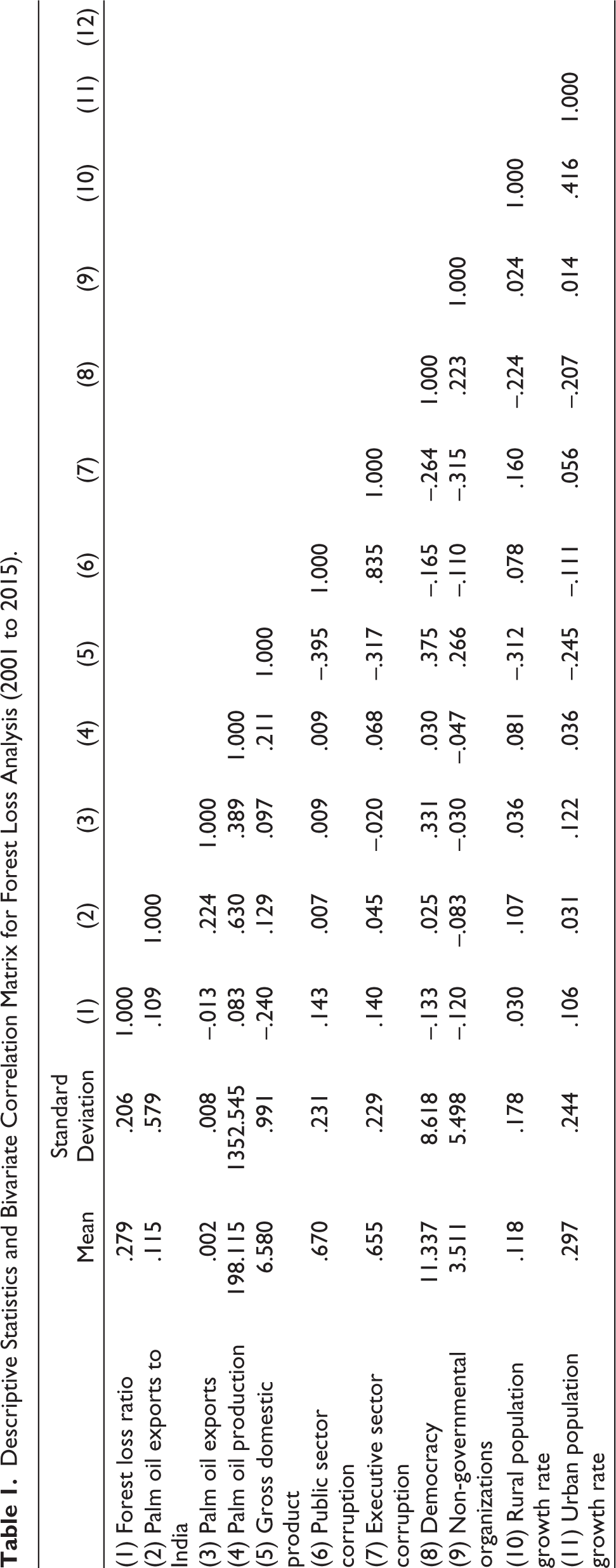
We must ensure that we are not violating any regression assumptions. We provide the correlation matrix and descriptive statistics in Table 1. First, we calculate the mean and highest variance inflation factor scores for each model. We report the values in Table 2. There do not appear to be any potential problems with multicollinearity with mean and highest variance inflation factor scores not exceeding a value of 2.5 in the additive models (Tabachnick & Fidell, 2013). In the models including the interaction term, we find the highest variance inflation factor score increases above 10. This is not unexpected as the interaction term is calculated by combining the linear variables.
Descriptive Statistics and Bivariate Correlation Matrix for Forest Loss Analysis (2001 to 2015).
Second, we use Stata 14’s ladder and gladder commands to determine if a variable is normally distributed or needs to be transformed. The ladder command reports a chi-square test for eight different transformations. The null hypothesis for the chi-square test is that a specific transformation approximates normality (Tukey, 1977). If the chi-square statistic is statistically significant, then we reject the null hypothesis and conclude that the specified transformation does not approximate normality (Tukey, 1977). We confirm the statistical tests by visually inspecting graphical distributions for each variable using the gladder command. We transform variables based on the results of this procedure and note any transformations below (Tabachnick & Fidell, 2013).
Third, we calculate standardized residuals to determine if outliers are a problem. We identify Gambia and Sudan as multivariate outliers because their standardized residuals exceed an absolute value of 2.5 (Tabachnick & Fidell, 2013). We removed them from the analysis and report results based on their exclusion. We also examined Cook’s distance statistics to detect influential cases. The results indicate no potential problems with them.
Fourth, we calculate Breusch–Pagan heteroskedasticity tests for each model. The null hypothesis for this chi-square test is that the error variances are homoscedastic or equally distributed (Tabachnick & Fidell, 2013). The coefficients for the chi-square statistics reach a level of significance in every model, indicating potential problems with heteroscedasticity (Tabachnick & Fidell, 2013). We report robust standard errors to help address the issue.
Dependent Variable
Forest loss ratio: Until recently, cross-national researchers have used data on forest loss from the United Nation’s Food and Agriculture Organization’s Global Forest Resources Assessment (e.g., Shandra et al., 2016). In recent years, researchers have pointed out that these data are gathered using methods that vary from nation to nation, questioning their reliability (Grainger, 2008). In some nations, forestry statistics are highly reliable because they are based on remote sensing surveys (Food and Agriculture Organization, 2015). In other nations, estimates may be of low reliability because they are based on expert opinions or extrapolated from an outdated forest inventory (Grainger, 2008). Thus, we use newly available data on forest loss derived from high-resolution satellite imagery (30 × 30 meters) to eliminate this potential source of error. Please note that Hansen et al. (2010) article for more information concerning the methodology used to arrive at the estimates from the World Resources Institute’s (2016) Global Forest Watch web page.
We calculate forest loss in the following way. First, we set the minimum tree cover canopy density level upon which to base the estimates. We follow Rudel (2017) and set the minimum tree cover canopy density equal to 75% or greater to represent a loss of forests. The tree cover density for a nation represents the estimated percentage of a pixel taken from satellite imagery that is covered by tree canopy (World Resources Institute, 2016). Second, we obtain the amount of a nation’s land area in hectares with the corresponding minimum tree cover canopy density (i.e., 75%). These data are measured for 2000. Third, we gather the number of hectares cleared from 2001 to 2015 in the preceding area. Fourth, we divide the total amount of hectares cleared by the total forest size to compute the rate of forest loss (Rudel, 2017). We take the square root of the forest loss rate because it is skewed.
Independent Variables
We are interested in the impacts of ecologically unequal exchanges of palm oil to India and corruption on forest loss. However, we draw upon other theoretical perspectives to inform our model specifications. These include dependency theory, ecological modernization theory, world polity theory and neo-Malthusian theory. We provide a brief discussion of each theory and how they relate to a given independent variable below.
Main Independent Variables
Palm sector exports to India: We include flows of palm exports from peripheral nations to India to test if the ecologically unequal exchange of palm is adversely impacting forests in the peripheral nations. The data are measured for 2000 and may be obtained from the United Nations Commodity Trade Statistics Database (2017). This database reports export statistics in constant United States dollars for each nation by commodity and trading partner (United Nations Commodity Trade Statistics Database, 2017). We specify India as the trading partner for each low- and middle-income nation. We then use the third revision of the Standard International Trade Classification of palm exports to India. These codes include 4222 for palm oil and its fractions and 4224 for palm kernel oil and its fractions (United Nations Commodity Trade Statistics Database, 2017). We also obtain data on total palm and palm kernel oil and their fractions exports for each nation, which we use as the denominator for this variable. According to ecologically unequal exchange theory, we hypothesize that higher levels of palm exports sent from peripheral nations to India are associated with higher rates of forest loss in peripheral nations.
Petty corruption: We use data from the Varieties of Democracy (2022) database to measure petty corruption in 2000. This measure is the average of the public sector bribery and public sector embezzlement variables. The public sector bribery measure involves the degree to which public sector employees grant favours in exchange for bribes, kickbacks or other material inducements (Varieties of Democracy, 2022). The public sector embezzlement measure captures how often do public sector employees steal, embezzle or misappropriate public funds or other government resources for personal or family use (Varieties of Democracy, 2022).
It is important to note that the data are based upon expert opinions and, therefore, assess the perception of corruption in a nation—see below for a discussion of the limits of such data. The data are originally collected at the ordinal level. However, they are then converted into an interval-ratio level variable via a Bayesian item response theory measurement model. In doing so, the variable ranges from zero to one and are normally distributed making them suitable for use in ordinary least squares regression—see below for other advantages of this methodology.
Given that the data are based on expert opinions, their validity and reliability have been subject to criticism. In particular, Boese (2019) discusses several issues that emerge when cross-national data are collected in this manner. First, it is often easier to find experts for certain nations and specific time periods. For example, Munck (2009) notes that organizations have difficulty identifying experts in highly repressive nations because participation is dangerous for them and their relatives. Second, experts may disagree on how to classify a nation with regard to a specific concept. For instance, Bush (2017) argues that the opinions of experts tend to correspond to a large extent with the perceptions of how scholars in the United States and Europe define corruption. Third, experts may have different thresholds for how to classify the level of corruption in a nation. In this regard, Bollen and Paxton (2000) found that experts systematically rate Marxist-Leninist nations higher than other nations on the level of corruption.
There are issues with equivalence across experts and nations that may compromise the corruption data. These are serious concerns that can undermine our findings. However, the scholars working to collect the Varieties of Democracy (2022) data have taken several steps to address such problems. These steps include having a network of more than 3,500 country experts with a minimum of 5 experts for any given nation, with approximately two-thirds being citizens or residents of the nations for which they provide information (Varieties of Democracy, 2022). Further, the identities of country experts are held confidential and are not publicly revealed (Varieties of Democracy, 2022). Additionally, experts come from diverse backgrounds and include not only academics but other professionals with specialized knowledge about a given nation (Varieties of Democracy, 2022). Finally, Boese (2019) noted that Varieties of Democracy (2022) uses a Bayesian item response theory estimation strategy to calculate its estimates, which allows for the possibility that experts have different thresholds and classifications for their ratings. These thresholds are estimated based on patterns in the data and then incorporated into a final estimate of a latent concept being measured like petty corruption. This makes it possible to correct for the concern that one expert may respond with ‘never’ while another expert may respond ‘always’ to a given question (Varieties of Democracy, 2022). At the same time, the item response estimation strategy allows the reliability of the experts to idiosyncratically vary based on the degree to which they agree with other experts. The experts with higher reliability have a greater influence on concept estimation, thereby considering the concern that not all experts are equally knowledgeable (Varieties of Democracy, 2022). This methodology also calculates a discrimination parameter that assesses the degree to which expert opinions agree or disagree with one another and is used to provide a range of plausible values (i.e., confidence intervals) in which an estimate may fall that allows for assessment of variation across nations and experts (Varieties of Democracy, 2022).
Grand corruption: We measure grand corruption using the average scores of executive bribery and executive embezzlement variables from the Varieties of Democracy (2022) database. According to this database, executive bribery measures how routinely do members of the executive branch, or their agents, grant favours in exchange for bribes, kickbacks or other material inducements (Varieties of Democracy, 2022). Executive embezzlement involves how often do they steal, embezzle, or misappropriate public funds or other state resources for personal or family use (Varieties of Democracy, 2022). Note that the grand corruption data are collected in the same way as petty corruption, so they have similar disadvantages and advantages.
Other Theoretically Relevant Independent Variables
Total palm exports: According to dependency theory, it is not necessary where exports are destined for that lead to forest loss but overall exports in general. Therefore, we include total palm exports as a percentage of total agricultural exports. The data may be obtained from the United Nations Commodity Trade Statistics Database (2017). We expect that higher levels of palm exports correspond with more forest loss.
Gross domestic product: The ecological modernization perspective argues that a unique relationship exists between gross national product per capita and forest loss within nations in which forest loss increases in the early stages of development but levels off and declines as economies mature. This hypothesis is known as the environmental Kuznets curve, named for economist Simon Kuznets (1955), who demonstrated this type of relationship between economic growth and income inequality.
Ehrhardt-Martinez et al. (2002) hypothesize that this relationship exists because of a nation’s predominant form of economic activity. In terms of this sectoral change, they argue very poor nations have limited production functions based on primitive technologies and spiritual attitudes towards the physical world. These factors place a ceiling on productivity and largely limit the poorest nations to subsistence agriculture (Ehrhardt-Martinez, 1998). With economic activity limited predominantly to this form of agriculture, deforestation should be relatively low (Grossman & Krueger, 1995). As nations begin to industrialize, the extraction of natural resources, export of agriculture and the building of infrastructure play central roles in increasing a nation’s level of gross national product per capita (Grossman & Krueger, 1995). These practices often increase forest loss because they are highly dependent upon extractive activities including logging, mining and export agriculture (Ehrhardt-Martinez, 1998). During this period, timber for construction and charcoal for household and industrial use is also in high demand (Ehrhardt-Martinez et al., 2002). At high levels of level of gross domestic product per capita, however, there are improvements in energy efficiency and growing service-based economic activities (Ehrhardt-Martinez, 1998).
From this discussion, we include gross domestic product per capita for 2,000 in our models. Because our sample only includes peripheral nations, we expect that gross domestic product per capita should be related to increased forest loss.
Total palm oil production: To further assess ecological modernization theory arguments regarding the predominant form of economic activity within a nation, we also include the total of palm oil produced by peripheral nations for 2000. These data may also be obtained from the United Nations Commodity Trade Statistics Database (2017). We expect that low- and middle-income nations with higher levels of palm oil production should correspond with increased forest loss. We hypothesize that higher levels of palm oil production should lead to more forest loss because it results in more forests being cleared with machinery or fire to increase production.
Democracy: It has also been suggested by ecological modernization theory that democracy may be associated with less forest loss (Li & Reuveny, 2006). This is based on several factors. First, democratic nations have higher levels of activism than repressive nations because they provide their citizens with ways to engage in public dialogue (Crenshaw & Jenkins, 1996). This occurs by granting the freedoms of speech, press and assembly (Murphy, 2000). Second, democratic nations must be more responsive to political activism because of electoral accountability (Midlarsky, 1998). The responsiveness of leaders in a democracy is partially based upon the need for public officials to win popular elections to maintain their positions. The officials, who fail to address the needs of citizens or at least give the impression of concern, face the risk of losing their positions in subsequent elections. Third, greater freedom of the press leads to the wider diffusion of information, which, in turn, raises public awareness and combats corruption including illegal logging, transport and processing of forest products (Sommer, 2017).
To measure democracy, we include an average of Vanhanen’s (2014) political competition index and political participation index. According to Vanhanen (2014), political competition captures the representation of smaller parties in national elections, and political participation measures how many people voted in national elections relative to the population (Vanhanen, 2014).
International non-governmental organizations: The world polity perspective holds that international non-governmental organizations play an important role in creating and reinforcing world cultural norms on issues like human rights, gender equality and environmentalism among others (Boli & Thomas, 1999). In terms of environmentalism, international non-governmental organizations involve themselves in global political processes by helping shape the language of international treaties dealing with the environment, thereby influencing the normative content of global institutions and governments (Smith, 1996). In the absence of resources and formal mechanisms of enforcement, international non-governmental organizations monitor the adoption and compliance with environmental agreements by governments (Shandra, 2007). Thus, they are able to point out embarrassing failures and hypocrisies of nations, putting pressure on governments to ratify treaties, adapt their behaviours to international norms and meet their treaty obligations (Hafner-Burton & Tsutsui, 2005).
They also help mobilize support for solutions to environmental problems when national avenues are either inadequate or blocked (Keck & Sikkink, 1998). It has become common for them to provide support for conservation efforts at local levels (Schofer & Hironaka, 2005). In this regard, international non-governmental organizations fund sub-national environmental protection efforts and social movement activity around the environment (Smith & Wiest, 2005). In such instances, governments are ‘squeezed’ from above and from below to conform to world cultural norms and attend to forest loss (Schofer & Hironaka, 2005)
Thus, we include the number of international non-governmental organizations working on environmental and animal rights issues in a nation for 2000 from the Yearbook of International Associations (Smith & Wiest, 2005). We divide it by a country’s population size to standardize the variable. We expect that higher levels of non-governmental organizations per capita should be associated with less forest loss (Schofer & Hironaka, 2005).
Rural and urban population growth: According to neo-Malthusian theory, demographic factors are important determinants of forest loss (Ehrlich & Ehrlich, 2009). Jorgenson and Burns (2007) find that higher rates of rural population growth are associated with increased forest loss while higher rates of urban population growth are associated with lower rates of deforestation. They argue that expanding urban centres creates economic opportunities other than agriculture, which leads to increased rural to urban migration. This must be accompanied by the importing of food, which reduces pressure on forests (Rudel, 2017). Given the potentially differential effects on forest loss, we also examine how the average annual percentage change in rural and urban populations from 1990 to 2000 impacts forest loss. The data may be obtained from the World Bank (2020).
Findings
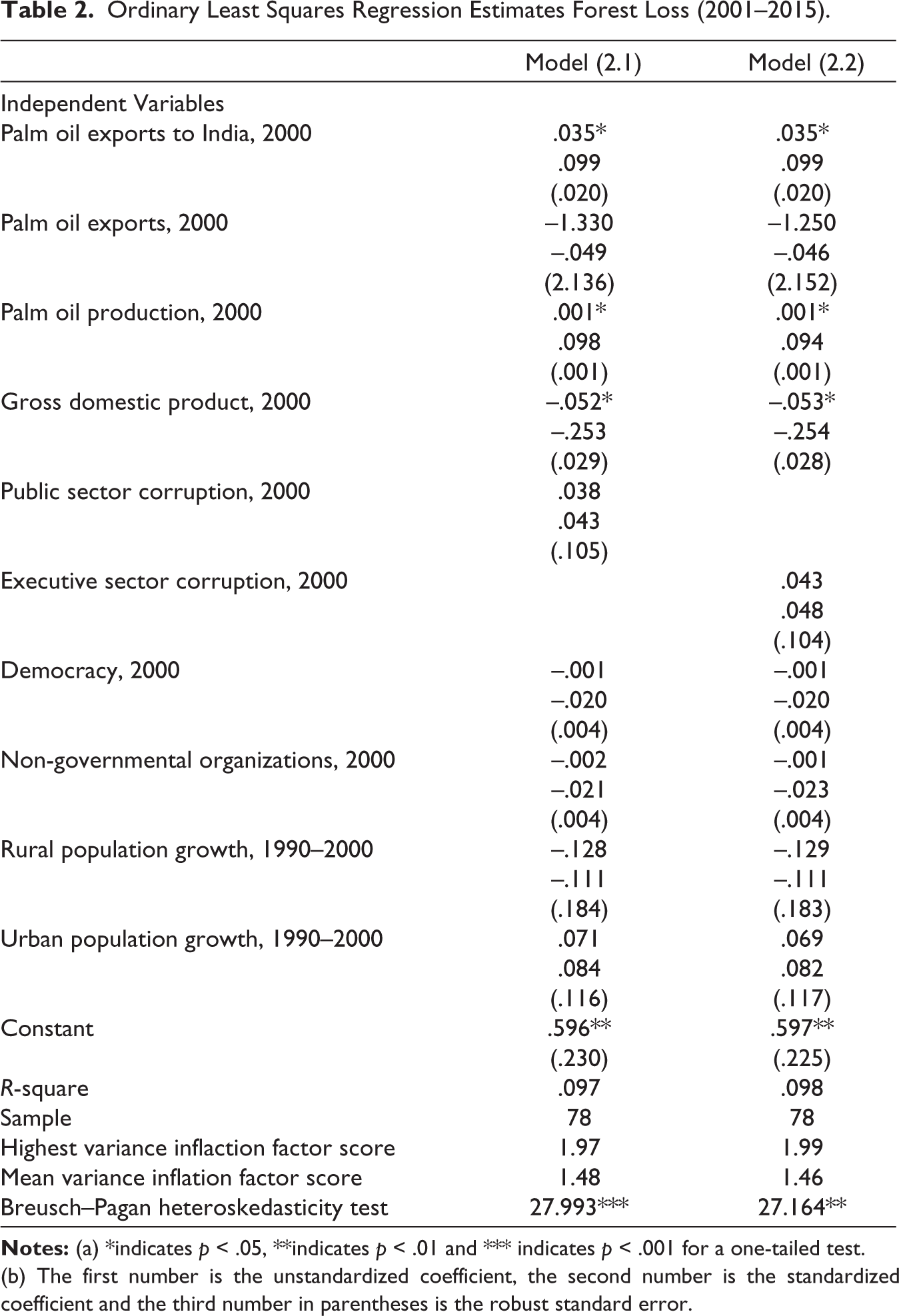
In Table 2, we present the ordinary least squares regression estimates of forest loss in peripheral nations. The first number presented is the unstandardized coefficient, the second number is the standardized coefficient and the third number in parentheses is the robust standard error. We report one-tailed significance tests because of the directional nature of the hypotheses.
In every model, we include palm oil exports to India from peripheral nations, total palm oil exports, total palm oil production, gross domestic product per capita, democracy, international non-governmental organizations, rural population growth and urban population growth. In Model (2.1), we include petty corruption or corruption among public sector employees. In Model (2.2), we include grand corruption or corruption among high-ranking executive and military officials.
Let us begin by examining the variables related to ecologically unequal exchange and corruption. First, we find support for the ecologically unequal exchange theory with higher levels of palm oil exports from peripheral nations to India being related to increased forest loss in peripheral nations. The coefficients for this measure are positive and significant in both models in Table 2. However, we do not find that either petty or grand corruption is related to forest loss. The coefficients for neither petty nor grand corruption reach a level of statistical significance in Models (2.1) and (2.2) respectively.
We find other factors are also related to forest loss. First, we find that total palm oil production is related to increased forest loss. The coefficients for this variable are positive and significant in Table 2. This finding supports ideas from ecological modernization theory regarding extractive economic activity in peripheral nations being related to forest loss. Second, we find that higher levels of gross domestic product per capita correspond with less forest loss in peripheral nations. The coefficients for this variable are negative and significant in both models. This finding contradicts expectations from ecological modernization theory.
We also describe the non-significant findings. First, we find that total palm oil exports are not related to increased forest loss. The coefficients for this variable do not reach a level of statistical significance. Second, we do not find that the remaining variable related to ecological modernization theory is related to forest loss. The coefficients for democracy do not reach a level of statistical significance in Table 2. Third, we do not find support for world polity theory. The coefficients for international non-governmental organizations do not reach a level of statistical significance. Fourth, we do not find support for neo-Malthusian theory. The demographic factors—rural and urban population growth—do not significantly predict variation in forest loss.
Ordinary Least Squares Regression Estimates Forest Loss (2001–2015).
(b) The first number is the unstandardized coefficient, the second number is the standardized coefficient and the third number in parentheses is the robust standard error.
Up to this point, we find that palm oil exports from peripheral nations to India are related to increased forest loss in the peripheral nations similar to findings observed by Sommer et al. (2021). At the same time, we do not find that either petty or grand corruption exhibits a direct effect on forest loss in peripheral nations like Sommer (2017). However, this does not mean that petty or grand corruption does not play a role in explaining forest loss.
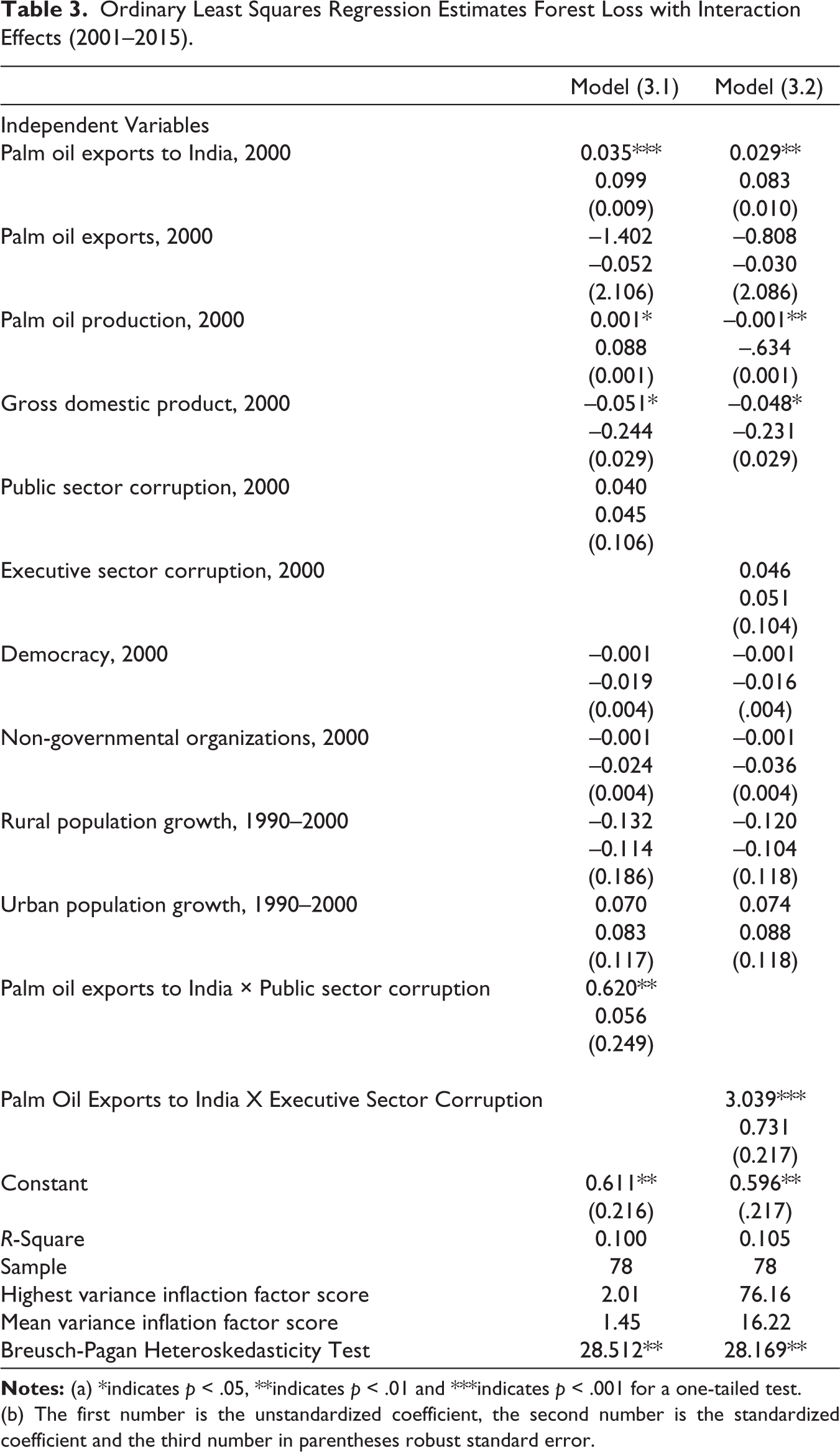
However, we have yet to examine if petty and grand corruption exacerbates the harmful impacts of the ecologically unequal exchange of palm oil to India. In Table 3, we test this hypothesis by including an interaction term between the corruption variables and palm oil exports from peripheral nations to India. We organize Table 3 in the same way as Table 2, but Table 3 includes the interaction terms.
Ordinary Least Squares Regression Estimates Forest Loss with Interaction Effects (2001–2015).
(b) The first number is the unstandardized coefficient, the second number is the standardized coefficient and the third number in parentheses robust standard error.
In Table 3, we find support for the hypothesis that petty and grand corruption create an institutional context that exacerbates the harmful impacts of ecologically unequal exchanges on forest loss. In Model (3.1), the coefficient for the interaction term between petty corruption and palm oil exports from peripheral nations to India is positive and significant. In Model (3.2), we find that a similar effect exists for the interaction between grand corruption and palm oil exports to India. 4
To ease interpretation of the interaction term, we calculate predicted values of forest loss at low (i.e., one standard deviation below the mean, medium (i.e., at the mean), and high (i.e., one standard deviation above the mean) values of corruption for each of the models with all other independent variables held at their means. Note that we centre the moderator variables—petty and grand corruption—to reduce issues with multicollinearity. Because we do this, the effect at mean levels of petty and grand corruption is equal to the coefficient for the focal variable or exports of palm oil to India.
The calculations reveal that palm oil exports to India increase forest loss more in peripheral nations with higher rather than lower levels of petty and grand corruption. In Model (3.1), the predicted value of forest loss controlling for palm oil exports to India at low levels of corruption is equal –0.109 = (0.03) + (–0.23 × 0.62), the predicted values of forest loss controlling for palm oil exports to India at medium levels of corruption is equal 0.03, and the predicted value of forest loss controlling for palm oil exports to India at high levels of corruption is equal to 0.17 = (0.03) + (0.23 × 0.62). In Model (3.2), a similar pattern emerges but the predicted values are larger. The predicted value at low levels of grand corruption is equal to –0.66 = (0.02) + (–0.23 × 3.04), 0.03 at medium levels of grand corruption, and 0.724 = (0.03) + (0.23 × 3.04) at high levels of grand corruption.
We contextualize the findings for the interaction term by considering how much forest would be cleared in a peripheral nation using estimates from our models. Let us consider data from the Solomon Islands for this purpose. We use data on the Solomon Islands because it has a forest loss rate equal to the effect of palm oil exports from peripheral nations to India at medium levels of corruption (i.e., 0.03 = 84,537 cleared from 2001 to 2015 / 2,682,009 hectares of forest in 2000). As such, palm oil exports to India would be responsible for 84,537 hectares of forest being cleared based on the estimates from Model (3.1).
If a country like the Solomon Islands had a high level of petty corruption, then forest loss from palm oil exports to India would be higher than at mean levels of petty corruption. The predicted value of forest loss estimating the effect of palm oil exports to India at a high level of petty corruption is equal to 0.17. This is a 142% increase in the forest loss ratio, which is equivalent to a country like the Solomon Islands clearing 120,042 hectares of forest from 2001 to 2015 (142% of 84,537 hectares). However, the predicted value of forest loss including the effect of palm oil exports to India at low levels of petty corruption is equal to –0.109. This is a 464% decrease in the forest loss rate compared to the amount cleared at medium levels of petty corruption. It would be equivalent to a country like the Solomon Islands only leaving 306,869 hectares of forest standing (464% of 85,5537 = 391,406 hectares).
We can also use the data on the Solomon Islands to demonstrate how much forest would be cleared (or not cleared) at various levels of grand corruption. At mean levels of grand corruption, 84,537 hectares of forest would be cleared as a result of palm oil exports to India based on the estimates from Model (3.2)—see above for where this value comes from. If a country like the Solomon Islands had a high level of grand corruption, however, then forest loss from palm oil exports to India would increase. The predicted value of forest loss from palm oil exports to India at this level of grand corruption equals 0.72. This is a 2,300% increase in the forest loss ratio, which is equivalent to a country like the Solomon Islands clearing 1,944,351 additional hectares of forest from 2001 to 2015 (2,300% of 84,537 hectares).
Discussion and Conclusion
We begin this study by seeking to move the research frontier forward in two ways. First, we apply ecologically unequal exchange theory to a semi-peripheral nation, India, and empirically consider if palm oil exports sent from peripheral nations to India adversely affect forests in the peripheral nations. Second, we evaluate arguments related to ecologically unequal exchange with India in context the of other theoretically relevant predictors of forest loss with an emphasis on petty and grand corruption.
We find that support for ecologically unequal exchange theory with higher levels of palm oil exports from peripheral nations to India being related to increased forest loss in peripheral nations. However, we do not find that either petty or grand corruption predicts significant variation in forest loss alone. This is somewhat surprising given previous cross-national research, though it makes sense when considering how petty and grand corruption interact with palm oil exports sent from peripheral nations to India, which we address again below.
While considering ecologically unequal exchange and corruption in the same models marks a notable advancement in the cross-national study of forest loss, we add to the literature in another important way. We hypothesize that palm oil exports from peripheral nations to India increase forest loss more at higher rather than lower levels of petty and grand corruption.
This may be the case because peripheral nations with higher levels of petty and grand corruption create institutional contexts where bribes, kickbacks and embezzlement by government officials translate into the prioritization of consumptive practices in the short-term rather than advocating for long-term investments involving conservation. We test this idea by including an interaction term between these variables in Table 3. The coefficients for the interaction terms are statistically significant in every model. We go on to calculate that palm oil exports to India are related to increased forest loss in peripheral nations with higher rather than lower levels of petty and grand corruption.
It is important to note that the effect of palm oil exports on forest loss is more pronounced for grand rather than petty corruption. We argue that it most likely has to do with the scale and scope of corruption that occurs among high-level executive and military officials. We see this at work in the example from Papua New Guinea where grand corruption allowed for the clearing and export of large amounts of palm oil to India while petty corruption, taking the form of payments to local police officers, led to the clearing of a small number of plantations that export to India (Global Witness, 2021).
From these findings, we offer some theoretical and methodological implications. First, we agree with Frame (2019) and Ciplet and Roberts (2019) that it is essential for social scientists utilizing ecologically unequal exchange theory in their research to consider if semi-peripheral nations, such as India, may be impacting the natural environment in other low- and middle-income nations in pursuit of their own industrialization. This can occur when they externalize environmental harm by importing various natural resources from elsewhere (Burns et al., 2003). In the end, such scholarship has the potential to refine thinking around ecologically unequal exchange and move beyond considering only how trade with core nations impacts forests of semi-peripheral and peripheral nations.
Second, we agree with Smith (1996) about the need to consider how competing factors like ecologically unequal exchanges and corruption impact forest loss in tandem. This is because such ‘allegedly antithetical’ factors ‘are related to each other in a specifiable and meaningful manner’ (London & Smith, 1988, p. 41). Thus, London and Williams (1988) are current when the note, ‘Intranational and international…dynamics are so interwoven in the modern capitalist system that any analysis that does not specify how effects of both sets of factors interact is seriously deficient and offers at best a partial explanation’ (1990, p. 288).
In terms of methodological implications, it is now easy to obtain data from the United Nations (2017) on export flows by sector (Stretesky & Lynch, 2009), commodity (Henderson & Shorette, 2017) and trading partners (Huang, 2018). The same is true for the corruption data as we demonstrate by using estimates of petty and grand corruption for peripheral nations from the Varieties of Democracy (2022) database. The availability of such data means social scientists can assess theoretical propositions with more specificity than has been possible. We demonstrate the utility of this approach here by considering a specific commodity (i.e., palm) flowing from peripheral nations to a specific semi-peripheral trading partner (i.e., India) at different levels of petty and grand corruption. We hope that others follow our lead and use these detailed data to refine how ecologically unequal exchange theory and corruption impact forests in peripheral nations.
We conclude with the limitations of our study and directions for future research. We rely on cross-sectional regression models because comparable satellite imagery data for forest loss are not available over multiple time periods (Rudel, 2017). It is imperative that scholars revisit this analysis when panel data become available. The availability of such data will allow for the inclusion of country- and period-specific fixed effects, thereby allowing for more stringent control over invariant characteristics of peripheral nations (i.e., topography and climate) and time (i.e., economic recessions and expansions) (Wooldridge, 2015). Further, we argue that it is important to supplement this work with qualitative research on the ground to get a better understanding of the ways in which peripheral nations with differing levels of corruption put (or do not put) policies into place that mitigate the harmful impacts of palm oil exports sent to India from peripheral nations (Gellert & Shefner, 2009). Moving forward, research could also be expanded to see if the findings hold for other semi-peripheral countries besides India.
Footnotes
Declaration of Conflicting Interests
The authors declared no potential conflicts of interest with respect to the research, authorship and/or publication of this article.
Funding
The authors received no financial support for the research, authorship and/or publication of this article.