




Abstract
Background:
Trait emotional intelligence (TEI) is an essential aspect of adolescent well-being, about which little is known, including its heterogeneity in Bangladeshi adolescents. This study applied a person-centered approach to identify TEI profiles among secondary school students in Dhaka City.
Methods:
A sample of 490 students completed the short form of the Adolescent Trait Emotional Intelligence Questionnaire (TEIQue) and the Mental Health Continuum. Four TEI dimensions were examined with latent profile analysis (LPA). Demographic correlates (sex, age, grade, family structure) were examined via chi-square test with Fisher’s exact test or Monte Carlo simulation where appropriate. Group differences in well-being outcomes were analyzed using analysis of variance (ANOVA) and were supplemented by Welch’s corrections where the assumption of equal variance was violated.
Results:
Latent profile analysis identified a four-class solution as the best-fitting model with the lowest Bayesian Information Criterion (BIC) (12820.40), highest entropy (0.7402), and significant bootstrapped likelihood ratio test (BLRT) (P = .0099) results. Four distinct profiles were: High TEI/emotionally flourished (18.8%), moderately high TEI/emotionally resilient (38.8%), moderate TEI/average functioning (40.6%), and low TEI/vulnerable (1.8%).
Profile membership varied significantly by age, grade level, and family structure, but not sex. Well-being indicators differed significantly across TEI profiles with medium to large effect sizes (η² = 0.135-0.248). Students in higher TEI profiles (profiles 2 and 4) stated greater emotional, social, psychological, and overall well-being. Students in profile 3 (low TEI) showed the lowest well-being. Profile 2 (high TEI/flourishing) exhibited the highest well-being across all domains.
Conclusion:
The results provide evidence of adolescents’ TEI heterogeneity and the need for incorporating social-emotional learning to be included in curricula and targeted interventions, particularly for vulnerable teenagers, and those with resilience deficiencies.
Introduction
Among the three models of emotional intelligence, trait emotional intelligence (TEI) has gained increasing attention for its focus on how individuals perceive and appraise their own emotional abilities, which may significantly impact health and lifestyle outcomes. 1 While ability Emotional Intelligence (EI) focuses on cognitive skills that performance tests can measure, TEI is derived from personality theory and is posited to be a personality trait that can be assessed with self-report questionnaires, such as the Trait Emotional Intelligence Questionnaire (TEIQue). 2
TEI encompasses four key factors: Self-control, emotionality, and sociability, which together are critical for influencing an individual’s psychological adaptation, social interaction, and academic achievement.3–5 Adolescents with higher levels of TEI have lower stress levels, better peer relationships, higher resilience, and improved well-being.1,6,7 These results endorse the idea of studying EI not only as a trait but also in terms of its distribution across adolescent subgroups. In crowded areas such as Dhaka City, secondary school students, representing this adolescent population, face stressors such as academic competition, social expectations, and family responsibilities that may further shape their emotional experiences and overall well-being.
To achieve a more nuanced level of understanding of heterogeneity in psychological traits such as TEI, researchers have started to move toward the traditional variable-centered approach to the person-centered approach, which enables us to understand individual differences in greater depth. 8 One such “analytic strategy” 9 that has gained more attention in recent years, 10 is that of latent profile analysis (LPA), which is used to identify and describe unobserved or hidden subgroups in data, on the basis of responses to a number of continuous variables. 11 LPA categorizes individuals into latent profiles that describe population-level heterogeneity in terms of common response patterns, thereby surfacing meaningful subgroups that would not be identified through aggregate analysis. 12 These profiles are used to contrast those elements that have been shown to combine as a function of the variables and that have been differentially related to proximal and distal predictors and outcomes,13,14 for example, demographic correlates, or psychopathology indicators. Accordingly, the use of LPA in exploring TEI in adolescence is a promising path for developing theoretical knowledge and practical strategies in the field of education and psychology.
To select the best-fitting model, researchers utilize information criteria such as Bayesian Information Criterion (BIC), sample size adjusted BIC (SABIC), Akaike Information Criterion (AIC), consistent AIC (CAIC), and approximate weight of evidence. 12 Smaller values of these indices suggest a better goodness of fit of the model. An alternative method of assessing model fit is likelihood-based tests such as the Vuong-Lo-Mendell-Rubin adjusted likelihood ratio test (VLMR-LRT) and the bootstrapped likelihood ratio test (BLRT), which test whether adding one more class significantly improves model fit. 12 Such tests compare neighboring models (i.e., a 2-class versus a 3-class solution), and yield P values that allow one to determine whether having one additional class leads to a significantly better-fitting model. 12 In their review, Spurk et al. (2020) indicated that most studies used either the BIC (78.3%) or the SABIC (71.7%) to determine the number of profiles. 9 The use of AIC (applied in 58.7% of models) and CAIC (30.4%) was comparatively less. Regarding comparisons between models, the BLRT was used in 60.9% of the studies, and the VLMR-LRT test in 58.7%. For assessing classification performance, 67.4% used entropy values, 47.8% suggested posterior classification probabilities, the majority of which exceeded the recommended threshold of 0.80. 15 . A value near one for entropy corresponds to a clearer identification of persons as belonging to separate classes. 8
Around the world, the application of LPA has increased in psychology and education to explore latent subgroups in areas such as emotion regulation, motivation, well-being, flourishing, and burnout.16–18 Although literature in this field has grown considerably, the use of LPA to study emotional intelligence in particular is somewhat inadequate. Most of what has been done has focused on university or college populations or working populations in Western and Asian countries. Different EI profiles were meaningfully related to academic performance 19 ; communication readiness 20 ; adaptation, urge, and engagement 21 ; well-being, decision-making, and work efficiency22,23; and conflict resolution. 24 These findings highlight the utility of a person-centered perspective in understanding the heterogeneity of EI and its implications.
Despite this evidence, little is known about how TEI profiles manifest in adolescents of South Asian countries. In Bangladesh, mental health challenges among school-aged youth are increasing, and most studies have taken variable-centered approaches. To date, no study has systematically explored whether distinct profiles of TEI emerge among Bangladeshi adolescents, nor how these profiles relate to their well-being. Also, little is known about whether such profiles differ by adolescents’ sex, age, grade level, or family structure, leaving a critical gap in understanding the socio-emotional needs of Bangladeshi school students. As an effective tool for detecting meaningful subgroups of emotional intelligence across different contexts, LPA is a suitable method to address this gap. Therefore, the present study applies LPA to identify TEI profiles among secondary school students in Dhaka City and to examine their relationships with socio-demographic features and well-being indicators.
Objectives of the Study
The present study aimed to identify latent profiles of TEI among secondary school students in Dhaka City using LPA. It also sought to observe profile differences across TEI factors and quantify the magnitude and pattern of these differences. Additionally, the study intended to investigate how socio-demographic variables such as sex, age, class level, and family background relate to these profiles and to explore the association between well-being outcomes and TEI profile membership.
Material and Methods
Materials
Trait Emotional Intelligence Questionnaire for Adolescents-Short Form (TEIQue-ASF)
Participants’ TEI was assessed using the translated Bangla version of TEIQue-Adolescent Short Form (ASF), originally developed by Petrides et al. (2006). 1 It includes 30 brief items to assess global TEI, and its four domains: Well-being, self-control, emotionality, and sociability. The intended population of the TEIQue-ASF is the 13-17-year-olds age range, but it has also been used successfully with younger groups down to 11. Participants answered all of the items on a seven-point scale (1 = disagree, 7 = agree). The internal consistency of the translated scale in this sample was 0.82, and it was 0.80 for the original version.
Mental Health Continuum-Short Form
Mental health of the participants was assessed using the adapted and validated Bangla version 25 of the Mental Health Continuum-Short Form (MHC-SF) originally developed by Keyes (2005). 26 MHC-SF is a 14-item scale that assesses three core aspects of individuals’ well-being: Emotional, social, and psychological, as well as overall well-being. Participants respond on a six-point Likert scale ranging from 0 (never) to 5 (every day), indicating how often they experienced each feeling in the past month. Higher scores represent greater mental well-being. The Bangla version of the MHC-SF has demonstrated strong psychometric properties, including good internal consistency, convergent validity, and factorial validity. 25 The Cronbach’s alpha of this scale in the present sample was 0.90, and that in the original version was greater than 0.80.
Personal Information Form
Students’ demographic information, such as sex, age, class level, and family structure, was collected through the Personal Information Form.
Study Design
This study employed a cross-sectional survey design and utilized baseline data drawn from a school-based intervention project. Data were collected through self-report instruments administered before the implementation of the intervention.
Participants
Participating schools. The study was conducted between April and June 2025 in four Bangla-medium secondary schools in Dhaka City (two from Dhaka North City Corporation and two from Dhaka South City Corporation). Schools were selected using convenience sampling based on administrative accessibility, willingness to participate, and permission from school authorities. All participating schools were privately managed, followed the National Curriculum and Textbook Board syllabus using Bangla as the medium of instruction, and had comparable fee structures. Classroom facilities were generally similar, including class size and basic instructional resources (e.g., benches/desks and blackboards/whiteboards), with no advanced digital infrastructure. Based on these observable characteristics, no apparent systematic differences in socioeconomic composition or school resources were noted. No formal socio-emotional or emotional intelligence programs were in place before data collection.
Sample and demographic characteristics. The initial sample comprised 506 students. During preliminary data screening, 10 cases were excluded due to incomplete questionnaire responses, resulting in 496 cases. An additional six cases were identified as extreme low-end outliers on the global TEI score and excluded before conducting the LPA. Outliers were identified through visual inspection of boxplots generated in Statistical Package for the Social Sciences (SPSS) using the interquartile range (IQR) criterion. Specifically, cases with global TEI scores falling below Q1 − 1.5 × IQR or above Q3 + 1.5 × IQR were classified as outliers and removed from further analyses. After data cleaning, the final analytical sample consisted of 490 students (34.1% boys, 65.9% girls), aged between 12 and 17 years (M = 14.21, SD = 1.26). Participants were enrolled in grades 7–10, with 16.9% in grade 7, 28.0% in grade 8, 27.6% in grade 9, and 27.6% in grade 10. Regarding family structure, 65.7% of students reported living in nuclear families, whereas 34.3% reported joint family arrangements. With respect to perceived socioeconomic status (SES), 4.3% reported very low SES, 23.7% low SES, 50.4% average SES, 19.6% high SES, and 2.0% very high SES.
Procedure
Before data collection, approval was obtained from the school authorities. The purpose and procedures of the study were explained to students in their classrooms in the presence of teachers. Written informed consent was obtained from parents or legal guardians before participation, and written assent was obtained from all participating students. Both parents or guardians and students were informed that participation was voluntary and that all personal information would remain confidential. Participants were allowed to pause or discontinue participation at any time. To support well-being, up to two free support sessions were offered upon request, along with a list of accessible mental health organizations for all participants. The questionnaires were administered during regular school hours in classrooms under the supervision of the researchers and research assistants, and a friendly and supportive atmosphere was maintained.
Results
LPA was employed on the sample of secondary school students (N = 490) using the four core TEI factors (i.e., well-being, self-control, emotionality, and sociability). Models specifying between 2 and 6-class solutions were assessed using the tidyLPA package in R. 27
Model Selection
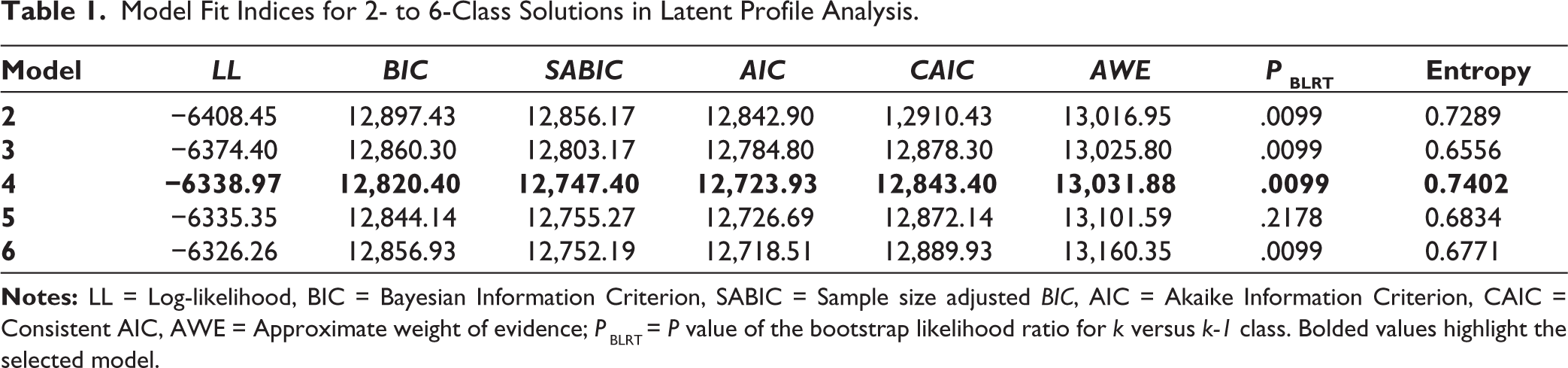
Model fit indices for the 2-6-class solutions are reported in Table 1. The four-class solution demonstrated the best overall fit, with the lowest BIC (12820.40) and the highest entropy (0.7402), indicating clear classification. BLRT results further exposed that the four-class model significantly improved fit over the three-class model (P = .0099), whereas the five-class model did improve upon the four-class model (P = .2178). Though the six-class model significantly improved over the five-class model (P = .0099), it yielded lower entropy (0.6771) and a higher BIC, indicating potential overfitting. The four-class solution was selected for interpretation based on the simulation evidence that BIC is a reliable indicator of model adequacy. 8
Model Fit Indices for 2- to 6-Class Solutions in Latent Profile Analysis.
Profile Description
LPA identified four distinct profiles based on the TEI Factors: Well-being, self-control, emotionality, and sociability. The mean scores across the four TEI factors for each profile are presented in Table 2.
Mean Scores on Four TEI Factors by Latent Profile.

According to the mean scores, four meaningful profiles were emerged: Profile 1 (moderate TEI/average functioning group; 40.6%), this group exhibited moderate scores in all TEI factors; profile 2 (high TEI/emotionally flourishing group; 18.8%) reported high scores for the TEI factors, representing a strong emotional functioning, resilience, and psychosocial adjustment; profile 3 (low TEI/vulnerable group; 1.8%) with consistently low scores on all dimensions representing high emotional and social risk; and profile 4 (moderately high TEI/emotionally resilient group; 38.8%), a group with relatively strong well-being and emotionality but weak self-control and sociability compared to the flourishing group.
Profile Differences Across TEI Factors
Differences in the latent profiles on the combined dependent measures (well-being, self-control, emotionality, and sociability) were tested with a one-way multivariate analysis of variance (MANOVA). Profile membership (four classes) was the independent variable, and the four TEI factors were the dependent variables. Results revealed a significant multivariate effect of profile membership, Pillai’s trace = 0.995, F(12, 1455) = 60.13, P < .001. This very high Pillai’s value indicates a strong multivariate association, suggesting that the four profiles represent distinct configurations across the TEI dimensions and support the adequacy of the selected four-class solution.
Univariate Effects and Post-hoc Comparisons
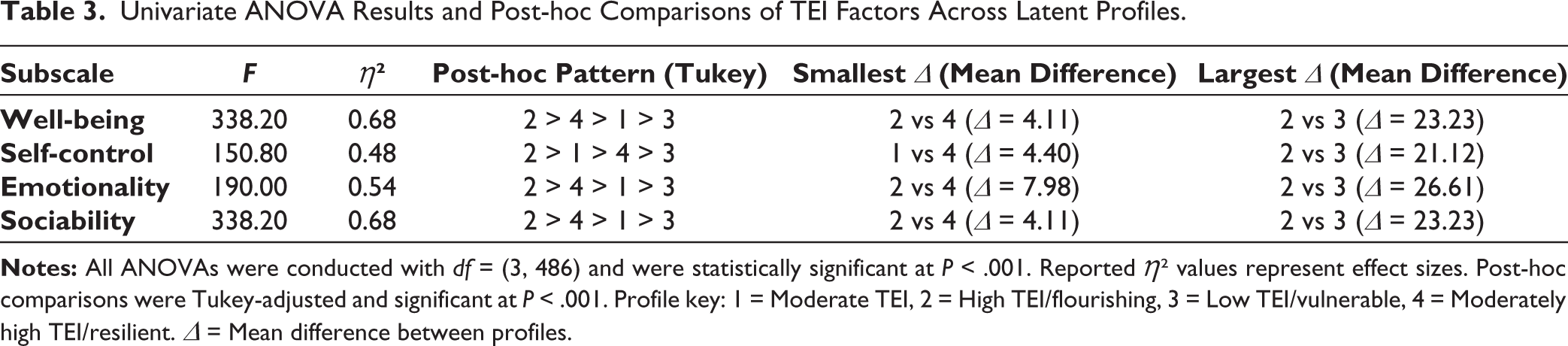
Follow-up univariate ANOVAs showed statistically significant differences among the four latent profiles on all TEI factors (see Table 3). Profile membership explained a large proportion of variance in well-being, F(3, 486) = 338.20, P < .001, η² = 0.68; self-control, F(3, 486) = 150.80, P <.001, η² = 0.48; emotionality, F(3, 486) = 190.00, P < .001, η² = 0.54; and sociability, F(3, 486) = 338.20, P < .001, η² = 0.68. Post-hoc comparisons (Tukey-adjusted) were consistent for all TEI factors: Profile 2 (high EI/flourishing) had the highest mean scores, followed by profile 3 (low EI/vulnerable), and profiles 1 (moderate EI) and 4 (moderately high EI/resilient) had intermediate scores. For well-being, all pairwise contrasts were significant, with the widest difference between profiles 2 and 3 (Δ = 23.23). For self-control, the ordering was profile 2 > 1 > 4 > 3, with the greatest contrast between profiles 2 and 3 (Δ = 21.12). Emotionality and sociability followed the ordering profile 2 > 4 > 1 > 3, with particularly large differences between profiles 2 and 3 (Δ = 26.61 for emotionality; Δ = 23.23 for sociability). In general, these results demonstrate that the four profiles exhibit meaningful variations in TEI, with profile 2 showing the greatest emotional and social adjustment and profile 3 showing the lowest in all areas.
Univariate ANOVA Results and Post-hoc Comparisons of TEI Factors Across Latent Profiles.
Associations Between Latent Profile Membership and Demographic Characteristics
Associations between latent profile membership and demographic variables (i.e., sex, age, class level, and family structure) were examined using chi-square tests, with Fisher’s exact test, or Monte Carlo simulation, where expected cell counts were low (see Table 4). Results indicated that sex distribution did not differ significantly across the four latent profiles, χ² (3, N = 490) = 5.20, P = .158, and were confirmed by Fisher’s exact test, P = .165. In contrast, age, class level, and family structure were significantly associated with latent profile membership. Age groups varied significantly across profiles, χ² (15) = 33.12, P = .005 (Monte Carlo P = .006). Similarly, students were unevenly distributed across profiles by class level, χ² = 63.86, P <.001, and family structure, χ² = 12.43, P = .005 (both based on Monte Carlo simulation). These findings suggest that while sex was not a differentiating factor, other demographic characteristics (age, class level, family structure) were meaningfully associated with students’ latent profile membership.
Chi-square Tests of Associations Between Latent Profile Membership and Demographic Variables (N = 490).

Group Differences in Well-being Indicators Across TEI Profiles
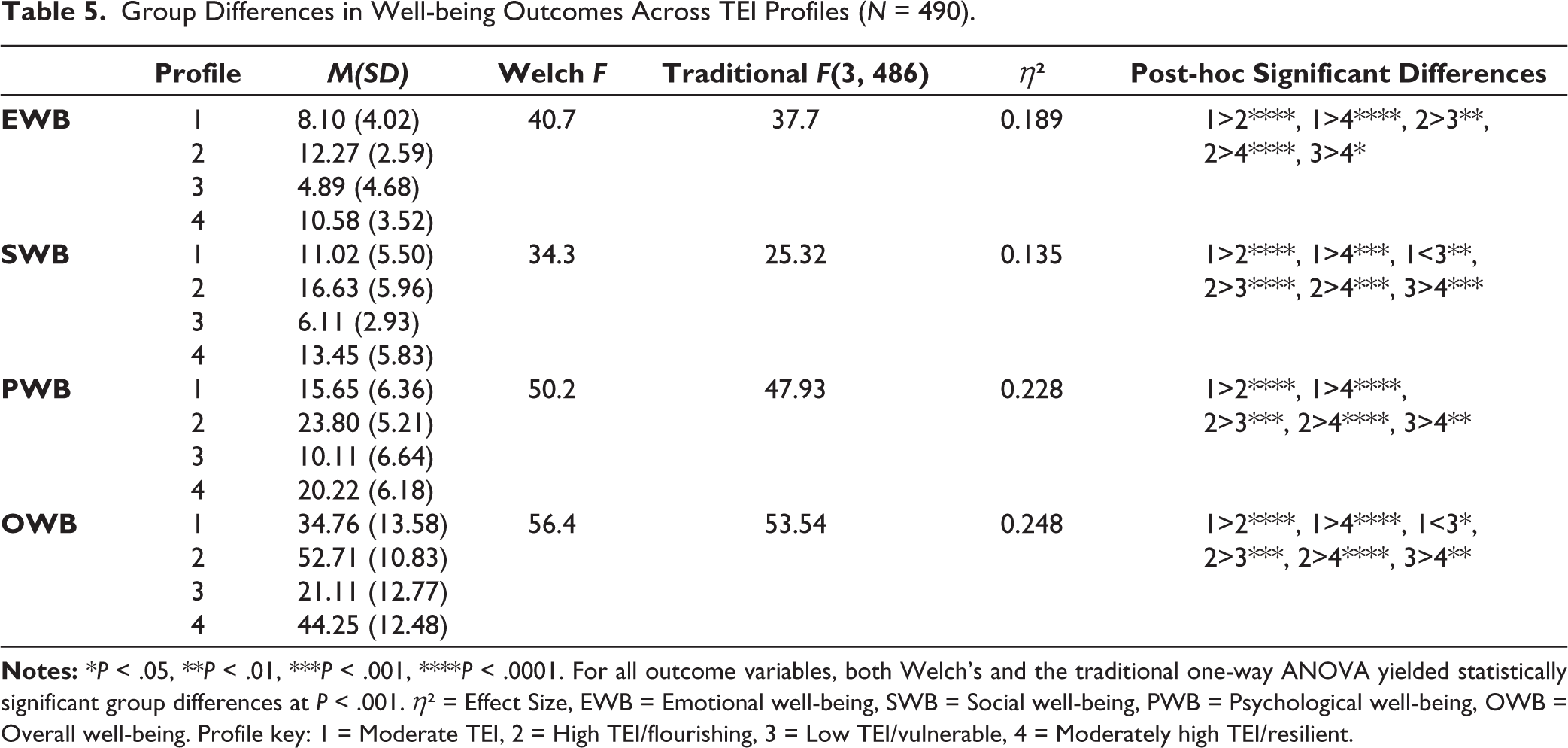
Levene’s tests indicated that the assumption of homogeneity of variance was violated for emotional well-being (P < .001) but met for social (P = .088), psychological (P = .062), and overall well-being (P = .061). To account for this, both Welch’s ANOVA (robust to variance heterogeneity) and the traditional one-way ANOVA were conducted; both revealed statistically significant group differences across all well-being outcomes (P < .001). Effect sizes were medium to large (partial η² = 0.135-0.248), suggesting substantial differences among profiles.
Post-hoc comparisons were performed using Tukey’s Honestly Significant Difference (HSD) and Games-Howell tests, which produced identical results; only significant comparisons are reported. Students in higher TEI profiles (profiles 2 and 4) consistently demonstrated greater emotional, social, psychological, and overall well-being compared to those in lower TEI profiles (profiles 1 and 3). Notably, profile 2 exhibited the highest well-being across all domains, while profile 3 showed the lowest, underscoring the protective role of elevated TEI in promoting positive mental health.
Discussion
The present study employed LPA to identify latent TEI profiles of secondary school students in Dhaka City to build a person-centered view of adolescent emotional functioning. Although the use of LPA has been well established in academic psychological research, the uniqueness of this study lies not in the method itself, but in its implication with Bangladeshi youth, a group that has been overlooked in person-centered EI research. This work extends such literature, providing the first evidence of TEI profiles in this context.
The four TEI profiles, moderate/average functioning, high/emotionally flourishing, low/vulnerable, and moderately high/emotionally resilient, are in line with patterns of prior studies across different age groups and professional contexts (e.g., Haag et al., 2024, 2025; Gao et al., 2025; Keefer et al., 2012; Thomas and Heath, 2022; Toyama and Mauno, 2016; Zhou et al., 2025). With the highest scores across all TEI aspects, the emotionally flourishing group (profile 2) exhibits stronger psychological traits, more resilience, and improved positive psychosocial outcomes. Conversely, the vulnerable group (profile 3; a very small group, n = 9) had the lowest score on all TEI factors, indicating that they may be a particularly vulnerable minority of students who are more likely to experience emotional and social challenges. The emotionally resilient group (profile 4), which has comparatively high levels of emotionality and well-being but lower levels of self-control and sociability, suggests that targeted support focusing on self-regulation and social skills may be relevant for this subgroup. Thus, the largest part of the sample (profile 1) consisted of the average functioning group, reflecting a functional but non-optimal level of TEI. Such students may represent an important target group for future school-based EI enhancement initiatives, the efficiency of which should be evaluated using longitudinal or experimental designs.
Profile membership was statistically related to the students’ age, grade in school, and family structure, but not to their sex (see Table 4), indicating that contextual and structural factors, rather than gender differences, seem to be more important for adolescents’ emotional functioning. The uneven distribution of students across TEI profiles by age and grade level may reflect developmental and educational differences in emotional skill acquisition, while the association with family structure highlights the role of family dynamics and expectations in adolescent emotional development in the Bangladeshi sociocultural context, in which extended family norms and traditional parenting practices are dominant. These results suggest that future intervention efforts may consider students’ age, educational stage, and family structure, rather than focusing solely on gender differences. As expected, higher TEI profiles (i.e., flourishing and resilient) were related to better emotional, social, psychological, and overall well-being compared to the low TEI/vulnerable group (see Table 5). Hence, some post-hoc comparisons notably yielded higher scores for the vulnerable group (profile 3) than for the emotionally resilient group (profile 4), likely due to the tiny sample size and high variability within profile 3; these results should be considered with caution. This overall pattern is consistent with the expected hierarchy in emotional functioning across profiles.
Group Differences in Well-being Outcomes Across TEI Profiles (N = 490).
The present study adds to the growing literature that has used a person-centered approach to examine TEI and extends this work to the adolescent population in South Asia, which has received very limited research attention. The ability to identify four unique TEI profiles, along with their relationship with demographic variables and well-being outcomes, provides a more nuanced picture of how competencies are distributed among adolescents in Dhaka City. These results conceptually indicate the heterogeneity of TEI within a South Asian youth context and underscore the utility of LPA for revealing meaningful subgroups that may not be noticeable in variable-centered approaches.
Insights from these findings may be critical for educators and policymakers in Bangladesh. In particular, the low-or vulnerable-cluster adolescents, though a small proportion of the total sample, may represent a potentially at-risk subgroup for whom future preventive efforts could be explored (e.g., emotional literacy programs, peer mentoring, school-based mental health programs) in applied research. At the same time, interventions targeted at building resilience in students with a moderately high TEI profile could support movement toward flourishing profiles, pending empirical evaluation. More broadly, the results emphasize the potential relevance of socio-emotional learning in secondary education and teacher training, which warrants future assessment.
The study findings should be interpreted with caution. While the vulnerable group (profile 3) was relatively small (1.8%) in terms of percentage of the sample, its existence has theoretical relevance, as it suggests that there are adolescents at-risk for socio‐emotional challenges even within a high‐functioning school population. However, given its small size, replication in larger, more diverse samples is necessary to confirm the stability of this subgroup. Several limitations should be acknowledged. First, because the study is cross-sectional, no causal inferences can be made about TEI profiles and well-being indicators. Second, reliance on self-report assessments may lead to response biases, such as social desirability bias. Third, as the study was conducted in urban schools in Dhaka City, the findings may not be generalizable to adolescents residing in rural areas who have different sociocultural, educational, and familial contexts. In addition, a methodological limitation related to the analytic approach should be noted. Although meaningful latent profiles of TEI were identified, subsequent group comparisons using MANOVA/ANOVA and chi-square tests were based on individuals’ most likely class membership. This classification-analyze approach does not explicitly account for classification uncertainty inherent in LPA, which may lead to attenuated associations and downwardly biased standard errors. The reported group differences should be interpreted carefully.
Future research directions include the use of longitudinal designs to examine the developmental stability of TEI profiles and possible transitions from vulnerable to flourishing profiles, especially in response to school-based interventions. Furthermore, by taking classification error into account, using three-step methods (such as Bolck, Croon, and Hagenaars method [BCH] or Three-Step approach for including covariates in latent class/profile analysis [R3STEP]) might enable a more accurate analysis of distal outcomes. Final, mixed-method designs that integrate quantitative profiles with qualitative examination of adolescents’ experiences within each profile may offer vibrant insights regarding how socio-emotional competencies are reflected in everyday life.
Consent to Participate
Parents or guardians of the secondary school students provided written informed consent, and participating students provided assent. All participants were informed about the objective of the study, procedures, and protection of confidentiality. Participation of the students was completely voluntary. They could withdraw at any time. A supportive atmosphere was ensured through offering when necessary.
Supplemental Material
Supplemental material for this article is available online.
Footnotes
Data Availability
The data, materials, and analysis code for this study are not publicly available but can be obtained from the corresponding author upon reasonable request.
Declaration of Conflicting Interests
The authors declared no potential conflicts of interest with respect to the research, authorship, and/or publication of this article.
Funding
The authors disclosed receipt of the following financial support for the research, authorship, and/or publication of this article: The present study is an ongoing segment of doctoral research that is supported by a grant from the Science and Technology Fellowship Trust (No. 39.09.0000.000.99.11.23-96) awarded to Jannatul Ferdous.
Patient consent
Patient consent for publication is not applicable. However, informed consent was obtained from all participants prior to data collection.
Statement of Informed Consent and Ethical Approval
Ethical approval was obtained from the Ethical Review Committee of the Faculty of Biological Sciences, University of Dhaka (study title: Promoting Mental Health of Secondary School Teachers and Students through Enhancing Their Emotional Intelligence in Dhaka City; (Ref. No. 217/Biol. Scs., August 30, 2023). All participants provided informed consent in accordance with the Declaration of Helsinki.
References
Supplementary Material
Please find the following supplemental material available below.
For Open Access articles published under a Creative Commons License, all supplemental material carries the same license as the article it is associated with.
For non-Open Access articles published, all supplemental material carries a non-exclusive license, and permission requests for re-use of supplemental material or any part of supplemental material shall be sent directly to the copyright owner as specified in the copyright notice associated with the article.
