




Abstract
Introduction:
Adolescents categorized as children in conflict with the law or children involved in legal conflicts (CCL) often present with social and behavioral difficulties that may increase vulnerability to delinquent conduct. This study examines how social intelligence (SI) relates to delinquent and problem behaviors by comparing CCL with typically developing adolescents (TDA) in Karnataka, India, and identifying the SI domains most strongly associated with behavioral concerns.
Materials and Methods:
A comparative cross-sectional design was used with 143 male adolescents aged 12–18 years (CCL = 68; TDA = 75). SI was measured using the Social Intelligence Scale (SIS), and behavioral difficulties were assessed using the Child Behavior Checklist (CBCL). Between-group differences were examined to determine the nature and extent of SI deficits and their links with behavioral outcomes.
Results:
Compared with the TDA group, adolescents in the CCL group obtained significantly lower scores across SI domains, including social insight, cooperativeness, sensitivity, and confidence (P < .001). Notable weaknesses were also observed in recognition of social environment, tactfulness, sense of humor, and memory. CBCL findings indicated that reduced SI was strongly associated with greater social problems, elevated aggression, and increased rule-breaking tendencies among CCL participants.
Discussion:
Deficits in SI appear to be an important contributor to delinquency-related behavior among CCL. Rehabilitation efforts may benefit from structured interventions that strengthen empathy, interpersonal skills, and relational functioning. Integrating SI-focused training into juvenile rehabilitation services may support pro-social development and potentially reduce recidivism.
Keywords
Introduction
Children classified as children involved in legal conflicts (CCL) constitute a substantial proportion of the global juvenile justice population. Their involvement in unlawful or rule-breaking activities is rarely the result of a single factor; rather, it reflects an interaction of adverse socio-environmental conditions, developmental vulnerabilities, and behavioral dysregulation. Empirical evidence consistently indicates that delinquent behavior during adolescence is closely associated with impairments in social, emotional, and cognitive functioning. 1 Within this framework, social intelligence (SI) has emerged as a critical construct for understanding how adolescents navigate interpersonal situations and regulate their behavior in social contexts.
SI broadly refers to an individual’s capacity to interpret social cues, understand others’ emotional states, and respond in a socially appropriate manner. Early conceptualization by Thorndike 2 described SI as the ability to act effectively in human relationships, highlighting its role in adaptive social functioning. Subsequent theoretical developments have expanded this construct to include multiple interrelated components. Goleman, 3 for instance, conceptualized SI in terms of social awareness, empathy, and social skills. Social awareness involves the ability to perceive and interpret interpersonal signals; empathy reflects sensitivity to others’ emotions and perspectives; and social skills facilitate communication, cooperation, and conflict resolution.
Deficits in SI, particularly in empathy and social skill domains, have been repeatedly linked to antisocial and delinquent behaviors. 4 Adolescents with limited SI may struggle to recognize the consequences of their actions, regulate emotional responses, or maintain positive peer relationships. These difficulties can impair adjustment to social norms and increase vulnerability to aggressive or rule-breaking behavior. Research suggests that such impairments may present differently depending on the nature of offending. Youth involved in violent offenses often display pronounced difficulties in emotional regulation and empathic responding, which may contribute to impulsive and reactive aggression. In contrast, adolescents engaged in non-violent offenses may exhibit weaker social awareness and interpersonal skills, increasing the likelihood of behaviors such as truancy, theft, or persistent rule violations without heightened emotional arousal.
CCL frequently experience challenges in managing complex social situations, which may result in misunderstanding, frustration, and ineffective conflict resolution. These difficulties are commonly expressed as externalizing behaviors, including defiance and aggression. Cooke and Michie 4 noted that reduced empathic capacity can limit adolescents’ understanding of the impact of their actions on others, thereby increasing the likelihood of callous or unemotional traits that intensify delinquent tendencies.
In addition to individual-level social deficits, many CCL are exposed to adverse environmental conditions that further compromise social development. Previous research has highlighted the role of family instability, economic hardship, and exposure to violence in increasing the risk of delinquent behavior. 5 In the Indian context, particularly in states such as Karnataka, socio-economic stressors and limited access to supportive developmental resources may exacerbate existing vulnerabilities in SI. Such conditions can disrupt normative cognitive and social development, heightening susceptibility to behavioral problems. Moreover, CCL are more likely to exhibit callous, unemotional characteristics, which are associated with diminished empathy, impaired emotional regulation, and manipulative or antisocial interpersonal styles. 6 When combined with SI deficits, these traits can significantly hinder the formation of healthy relationships and adherence to social norms.
Evidence also indicates that adolescents with lower empathic abilities are more prone to proactive aggression, characterized by deliberate, goal-oriented behavior aimed at personal gain. 1 Conversely, reactive aggression, marked by impulsive responses to perceived threat or provocation, is often associated with poor emotional regulation and limited social understanding. Both forms of aggression are frequently observed among CCL and are closely linked to deficits in SI, particularly in empathy and social awareness.
In contrast, typically developing adolescents (TDA) generally demonstrate more advanced social and cognitive competencies. Higher levels of SI enable these adolescents to manage peer interactions effectively, regulate emotions, and resolve interpersonal conflicts in adaptive ways. 3 SI functions as a protective factor by supporting pro-social decision-making, resistance to negative peer influence, and compliance with social norms. Adolescents with stronger SI are less likely to engage in aggressive or rule-breaking behavior and are more capable of understanding the long-term consequences of their actions. 7
Despite extensive research on emotional and cognitive correlates of juvenile delinquency, relatively limited attention has been directed toward the specific role of SI in shaping delinquent behavior. Deficiencies in empathy, social awareness, and interpersonal skills may contribute to social withdrawal, frustration, and escalating antisocial conduct. Recent findings indicate that lower SI is associated with both reactive and proactive aggression in adolescents. 1 These patterns are particularly concerning in CCL populations, as repeated conflicts with peers and authority figures can reinforce delinquent trajectories and increase the risk of recidivism.
The present study aims to examine differences in SI between CCL and TDA and to explore how deficits in specific SI domains relate to behavioral and aggressive outcomes. By identifying patterns of SI impairment, this research seeks to inform targeted intervention strategies within juvenile rehabilitation settings. Understanding the role of SI may contribute to the development of effective prevention and rehabilitation programs designed to reduce delinquency and promote positive social adjustment.
Methodology
Study Design
The present study adopted a comparative cross-sectional design to examine differences in SI between CCL and TDA. The primary objective was to identify specific domains of SI that differ between the two groups and to explore how these differences relate to behavioral and aggressive tendencies.
Study Setting and Participants
The study comprised a total sample of 143 male adolescents aged between 12 and 18 years, divided into two groups.
Participants in this group were recruited from observation homes across the state of Karnataka, including urban centers in Bengaluru as well as rural and semi-urban districts such as Kolar, Hassan, Kalburgi, Ballari, and Mysuru. All adolescents in this group had documented involvement in legal conflicts related to delinquent behavior.
This comparison group consisted of adolescents with no known history of delinquency or legal involvement. Participants were selected from urban schools governed by the Bruhat Bengaluru Mahanagar Palike (BBMP) and from rural community centers in Bengaluru district.
Only male adolescents were included in the study, as boys constitute the majority of juveniles involved in legal conflicts, making them a key population for examining delinquency-related factors. 8 Female CCL were excluded due to their placement in separate facilities with restricted access, which made comparable recruitment impractical within the study timeframe. Furthermore, preliminary inquiries with relevant authorities indicated that the number of eligible female CCL in Karnataka during the data collection period was extremely limited, precluding meaningful representation.
Sample Size Justification
An a priori power analysis was conducted to determine the required sample size for detecting a medium effect size (Cohen’s d = 0.50) with a significance level of α = 0.05 (two-tailed) and 80% statistical power in an independent-groups design. The analysis indicated a minimum requirement of 64 participants per group. Allowing for potential non-response or attrition, a target sample of approximately 140 participants was set. The final sample of 143 participants (68 CCL and 75 TDA) exceeded this requirement.
Inclusion and Exclusion Criteria
Adolescents in the CCL group were eligible for inclusion if they had documented legal involvement and did not present with diagnosed intellectual disabilities or severe psychiatric conditions that could interfere with assessment procedures. Screening for severe psychiatric disorders was conducted using the Child Behavior Checklist (CBCL) in combination with clinical interviews administered by trained psychologists. Participants exceeding established thresholds for conditions such as psychosis or severe mood disturbances were excluded to maintain focus on typical developmental profiles within the delinquent population.
Participants in the TDA group were included based on the absence of any history of delinquent behavior or legal conflict, as well as the absence of known intellectual disabilities. Written informed consent was obtained from all participants and their legal guardians prior to data collection.
Confidentiality
Participant confidentiality was ensured by assigning unique identification codes to all individuals. Separate coding systems were used for participants from observation homes and those recruited from schools or community centers. Personal identifiers were removed from all data files, which were stored in password-protected systems accessible only to authorized members of the research team. Guardians and institutional authorities were informed about the confidentiality procedures and their scope before consent was obtained.
Instruments
The following standardized instruments were employed to assess SI, behavioral problems, and aggression:
Social Intelligence Scale (SIS)
The SIS, developed by Dr NK Chadha and Ms Usha Ganesan, was used to assess eight dimensions of SI: patience, cooperativeness, confidence, sensitivity, recognition of social environment, tactfulness, sense of humor, and memory. The scale demonstrated good internal consistency in the present study (Cronbach’s α = 0.82). To ensure cultural relevance, the instrument was adapted for the Indian context through expert consultation and pilot testing.
A preliminary pilot study was conducted with a small sample of adolescents (n = 15, including both CCL and TDA) to evaluate clarity, cultural appropriateness, and feasibility. Minor linguistic adjustments were made in the Kannada version for idiomatic clarity without altering the underlying constructs. The average administration time ranged from 30 to 45 minutes, and internal consistency estimates were acceptable across instruments (SIS α = 0.82; CBCL-SP α = 0.87; RPAQ α = 0.85). Pilot data were not included in the main analyses.
Child Behavior Checklist (CBCL)
The CBCL was used to assess behavioral difficulties, with particular emphasis on the social problems subscale (CBCL-SP), which captures interpersonal difficulties, rule-breaking behavior, and aggression. The adapted version demonstrated strong reliability in the present sample (Cronbach’s α = 0.87).
Reactive-proactive Aggression Questionnaire (RPAQ)
The RPAQ was administered to assess both reactive (emotion-driven) and proactive (goal-oriented) forms of aggression. The scale showed satisfactory internal consistency (Cronbach’s α = 0.85) and was reviewed for linguistic and contextual suitability for Indian adolescents.
Procedure
Data collection was conducted in two stages. In the first stage, participants completed the SIS individually in a quiet and controlled environment to minimize distractions and peer influence. Standardized instructions were provided to all participants, and trained researchers were available to clarify queries. Assessments were administered in either English or Kannada, depending on the participants’ language preference and proficiency.
In the second stage, participants completed the CBCL and the RPAQ under researcher supervision. Although self-report measures were used, efforts were made to ensure comprehension and reduce response bias. Independent assessors who were blinded to group membership were involved to further minimize potential bias.
Data Analysis
Preliminary assessment of data distribution using the Shapiro-Wilk test indicated significant deviations from normality across measures. Consequently, non-parametric Mann-Whitney U tests were employed for group comparisons. Statistical significance was set at P < .05, with additional thresholds of P < .01 and P < .001 used to denote higher levels of significance. Effect sizes were calculated to estimate the magnitude of between-group differences. All analyses were conducted using Jamovi software.
Missing data were minimal. In accordance with scoring guidelines, subscales with one or fewer missing items were prorated, whereas cases with more than one missing item were excluded from analyses of the affected subscale. No data imputation procedures were applied. Sensitivity analyses confirmed that results were consistent when prorated cases were excluded.
Ethics
Ethics approval was obtained from the Ethical Research Committee of the Department. Formal permission was granted by the appropriate government departments. Written informed consent was obtained from the guardians (i.e., superintendents of the observation homes) and study participants themselves.
Results
Participants’ Characteristics
Descriptive statistics for the participants in the study are summarized in Table 1.
Descriptive Statistics for Age of Participants.
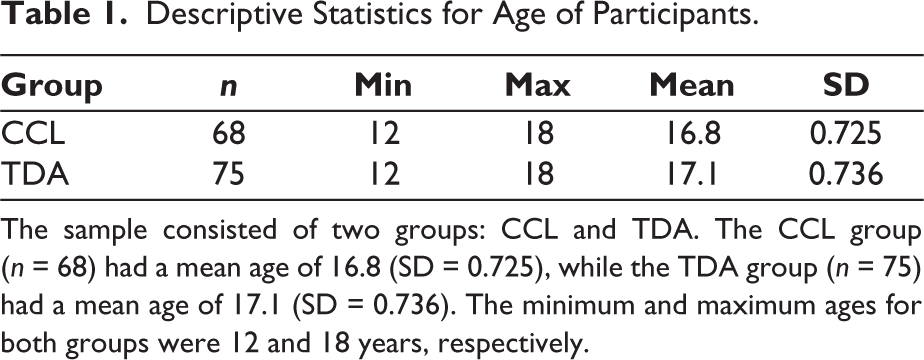
The sample consisted of two groups: CCL and TDA. The CCL group (n = 68) had a mean age of 16.8 (SD = 0.725), while the TDA group (n = 75) had a mean age of 17.1 (SD = 0.736). The minimum and maximum ages for both groups were 12 and 18 years, respectively.
Discussion
The present study provides important evidence highlighting differences in SI and behavioral functioning between CCL and TDA. Consistent with expectations, adolescents involved in legal conflicts demonstrated pronounced deficits across multiple domains of SI alongside significantly higher levels of behavioral problems and aggression. These findings underscore the role of SI as a key psychosocial factor associated with delinquent behavior during adolescence. 10
Participant Characteristics
The two groups were comparable in terms of age distribution, with participants ranging from 12 to 18 years. This age homogeneity reduces the likelihood that observed group differences are attributable to developmental or maturational factors, thereby strengthening confidence that variations in SI and behavioral outcomes are related to group status rather than age-related effects.
Distributional Characteristics of the Data
Results of the Shapiro-Wilk test indicated significant deviations from normality across all measured variables (see Table 2). Given these violations of parametric assumptions, the use of non-parametric statistical techniques was appropriate. The Mann-Whitney U test provided a robust method for examining group differences without compromising statistical validity. 12
Test of Normality of Participants on Social Measures.
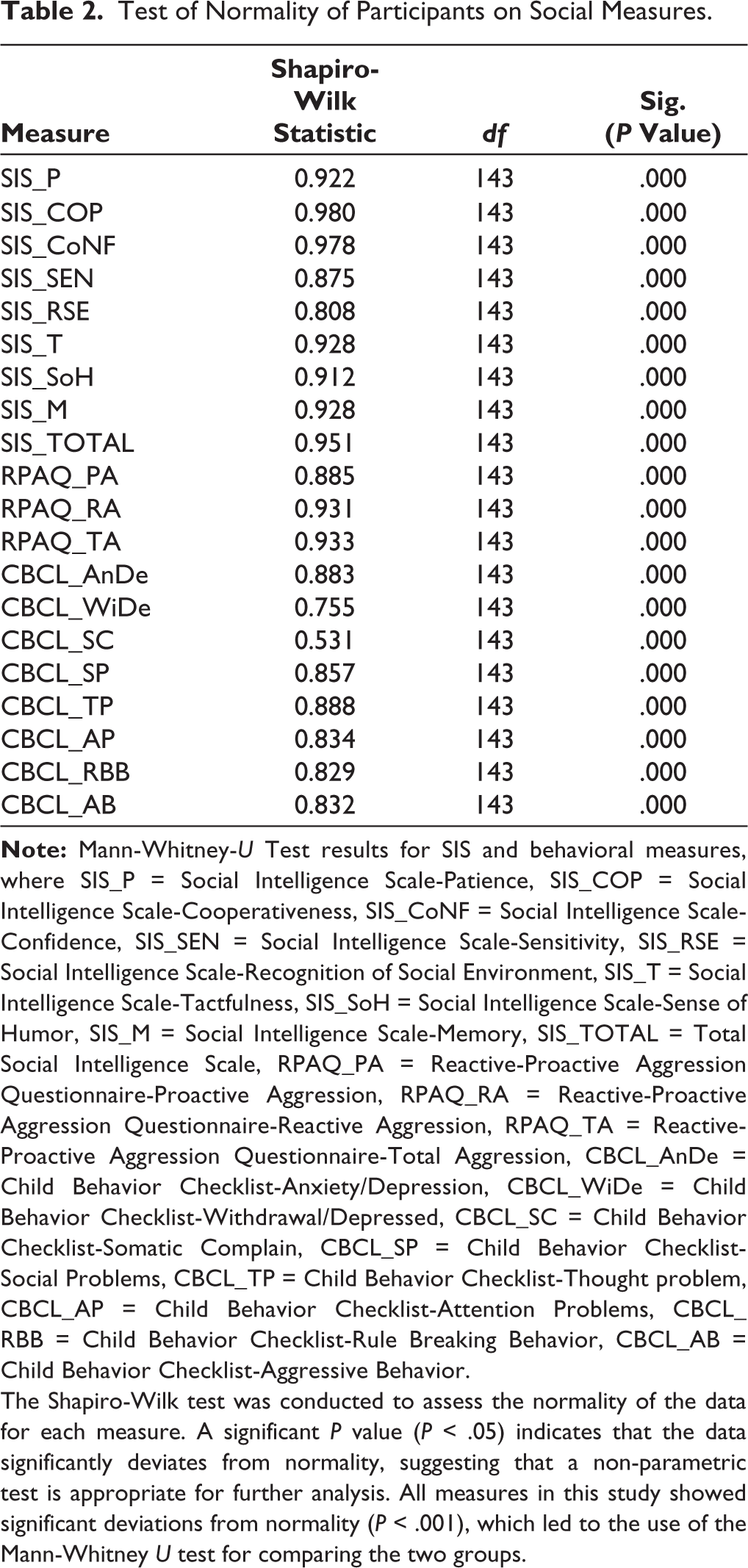
The Shapiro-Wilk test was conducted to assess the normality of the data for each measure. A significant P value (P < .05) indicates that the data significantly deviates from normality, suggesting that a non-parametric test is appropriate for further analysis. All measures in this study showed significant deviations from normality (P < .001), which led to the use of the Mann-Whitney U test for comparing the two groups.
SI Deficits Among CCL
Findings revealed that adolescents in the CCL group scored significantly lower than TDA on all assessed dimensions of SI (see Table 3), including patience, cooperativeness, confidence, sensitivity, tactfulness, humor, memory, and overall SI. These deficits suggest substantial difficulties in regulating emotions, interpreting social cues, and engaging in adaptive interpersonal interactions. Lower levels of cooperativeness and confidence may reflect challenges in group participation and trust formation, while reduced sensitivity and social memory indicate problems with recognizing and retaining socially relevant information. Such impairments can limit effective social functioning and increase vulnerability to maladaptive behavior, as previously reported in adolescent delinquency research.1–20
Mann-Whitney U Test Results for SI and Behavioral Measures.
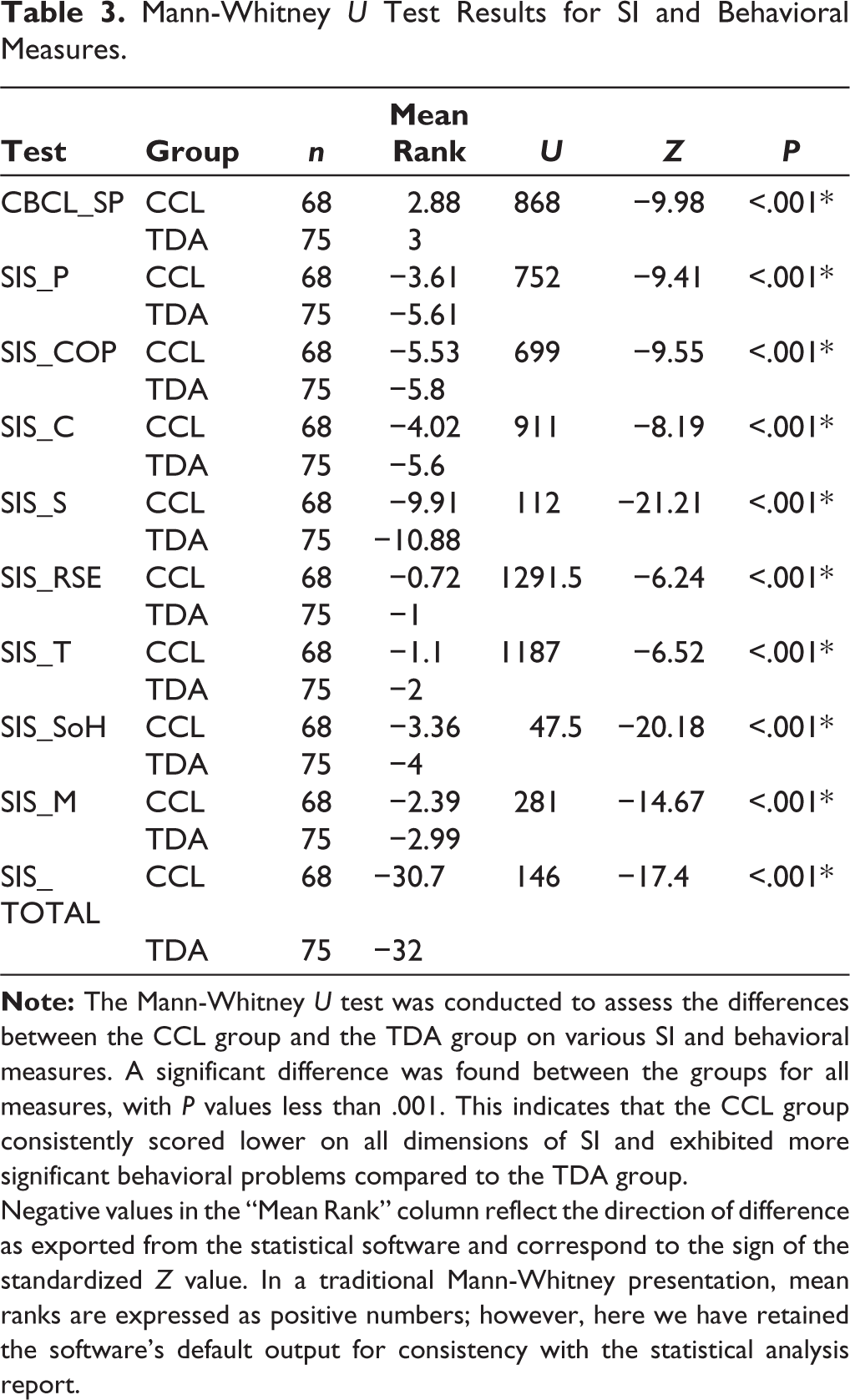
Negative values in the “Mean Rank” column reflect the direction of difference as exported from the statistical software and correspond to the sign of the standardized Z value. In a traditional Mann-Whitney presentation, mean ranks are expressed as positive numbers; however, here we have retained the software’s default output for consistency with the statistical analysis report.
The diminished SI observed among CCL may be partially explained by chronic exposure to stressors such as family dysfunction, socio-economic disadvantage, and community violence. These adversities can disrupt normative emotional and social development, hindering the acquisition of interpersonal skills essential for adaptive functioning.5–24
Behavioral Problems and Aggression
In addition to SI deficits, adolescents in the CCL group demonstrated significantly higher levels of social problems, rule-breaking behavior, and aggression. Elevated scores on the CBCL_SP subscale and aggression measures indicate persistent interpersonal difficulties and maladaptive behavioral patterns. These findings align with existing evidence linking reduced SI to impaired emotional regulation and increased externalizing behavior (Cooke and Michie, 2018). 33
Both reactive and proactive forms of aggression were more pronounced among CCL participants. Reactive aggression, characterized by impulsive responses to perceived threat, may stem from poor emotional regulation and limited social understanding. Proactive aggression, which is more deliberate and goal-oriented, has been associated with deficits in empathy and social awareness.7–34 The presence of both aggression types suggests that SI impairments may influence multiple pathways to delinquent behavior.
Study Limitations
Several limitations should be considered when interpreting the findings. First, the exclusive inclusion of male participants limits generalizability to female adolescents. Future research should aim to include both genders to explore potential sex-based differences in SI and delinquency. Second, socio-economic status, trauma exposure, and family variables were not included as covariates due to practical constraints, which restricts causal inference. Third, reliance on self-report measures introduces the possibility of response bias, including social desirability effects. Incorporating multi-informant or observational assessments in future studies may enhance measurement accuracy.
Alternative Contributing Factors
While SI deficits were strongly associated with delinquent behavior, other factors may interact with these deficits. Experiences of trauma, substance use, and educational disadvantage can impair emotional regulation and social skill development, further exacerbating behavioral difficulties. These factors likely operate in combination rather than isolation, highlighting the need for multidimensional assessment and intervention approaches.
Implications for Intervention
The findings emphasize the importance of addressing SI within juvenile rehabilitation programs. Interventions targeting empathy development, emotional regulation, and interpersonal competence, such as Social and Emotional Learning (SEL) programs may be particularly effective. Evidence from prior research indicates that SEL-based interventions can reduce aggression and improve social functioning in adolescents. 9 Early and sustained implementation of such programs may interrupt delinquent trajectories and support positive developmental outcomes.
Cultural Context
SI deficits may manifest differently in collectivist cultures like India compared to individualist Western cultures. In collectivist societies, the emphasis on family and community relationships may mean that deficits in SI are more closely associated with issues in interpersonal harmony and group cohesion.
Future Research Directions
Future research should include longitudinal studies to assess whether SI training reduces recidivism among CCL. Additionally, studies should include female CCL to explore gender differences in SI deficits. Research could also examine the interaction of SI with socio-environmental factors to gain a more comprehensive understanding of delinquency.
Conclusion
The present study provides compelling evidence that CCL exhibit significant deficits in SI alongside elevated behavioral and aggressive problems when compared with typically developing peers. These findings suggest that impaired SI represents an important psychological mechanism underlying delinquent behavior.
From a policy and practice perspective, integrating SI training into juvenile justice and rehabilitation frameworks may enhance pro-social development and reduce the likelihood of recidivism. Strengthening adolescents’ capacity for empathy, social awareness, and interpersonal engagement has the potential to improve reintegration outcomes and contribute to broader societal benefits, including reduced justice system burden and enhanced community safety.
Future research should investigate the long-term effectiveness of targeted SI interventions through longitudinal designs and expand examination to include female adolescents and diverse socio-cultural contexts. Addressing SI deficits early may play a critical role in improving life trajectories for youth involved in the juvenile justice system.
Footnotes
Data Availability
The data used in this study will be made available by the corresponding author upon reasonable request.
Declarations of Conflict of Interest
The authors declared no potential conflicts of interest with respect to the research, authorship, and/or publication of this article.
Funding
The authors received no financial support for the research, authorship, and/or publication of this article.
Statement of Informed Consent and Ethical Approval
The study received approval from the Ethics Committee (Ethics Committee No. KSICPS/JCL/Permission-05/2016-2017) on December 21, 2022. All stipulated conditions were adhered to, including the maintenance of confidentiality and compliance with ethical requirements outlined by the Directorate.
Written or verbal informed consent was obtained from all participants prior to their inclusion in the study. The study was conducted in accordance with the principles of the Declaration of Helsinki, ensuring confidentiality and adherence to ethical guidelines as prescribed by the Directorate.