




Abstract
Background:
Experiencing childhood maltreatment can have different mental health outcomes. This study aimed to explore how childhood abuse and forgiveness are related, considering the mediating influence of early maladaptive schemas (EMSs).
Methods:
A total of 427 students were selected using random cluster sampling from three different universities in Tehran, Iran. This study utilized three instruments: Self-reported Experience of Childhood Abuse (Nourbakhsh, 2012), The Young Schema Questionnaire (Young, 1998, Young Schema Questionnaire Short Form), and the Forgiveness Scale (Mauger et al., 1992, J Psychol Christ., 11, 2, 170-180).
Results:
Data analysis was conducted using statistical package for the social sciences (SPSS) and PLS software, applying partial least squares structural equation modeling to examine the relationships among variables. Findings yielded a good model fit (standardized root mean square error of approximation [SRMSEA] = 0.08, goodness of fit [GOF] = 0.401, Q2 of EMSs = 0.095, Q2 of forgiveness = 0.088, R2 of EMSs = 0.187, R2 of forgiveness = 0.136). Direct path coefficients and indirect path coefficients yielded statistically significant results.
Conclusions:
This research supports the role of EMSs as a mediator between experiences of childhood abuse and the capacity for forgiveness.
Introduction
Based on the World Health Organization definition, child abuse refers to physical or mental damage or threats to children or ignoring their prosperity or welfare. 1 Child abuse and neglect are widespread and complex issues across all societies, taking forms such as emotional neglect, physical violence, and sexual exploitation. 2 In 2015, according to the National Children’s Alliance, 205,438 children divulged information about being sexually abused, and 60,897 children disclosed physical abuse in the United States. Several studies that have been conducted in Iran reveal that child abuse manifests in emotional and physical harm displayed mainly by shouting, scolding, and slapping. 3 Offenders included relatives of the child (51%), parents (39%), and those known by family but not part of the family (10%). A systematic review of childhood abuse in Iran found that the rate of physical violence ranged from 9.7% to 67.5%, emotional abuse from 17.9% to 91.1%, and neglect ranged from 23.6% to 80.18%. The overall estimated prevalence of physical abuse among children of both genders was 43.59%, while emotional abuse was estimated at 64.53%. In terms of neglect, the combined prevalence rate was 40.95%. Based on these findings, researchers have emphasized the importance of addressing child abuse in Iran. They recommend that healthcare providers, mental health professionals, educators, and policymakers prioritize this issue by increasing public awareness, implementing targeted intervention programs, and developing effective strategies for prevention.4,5
Over the past few decades, the psychological impact of child abuse has been studied more systematically. Several studies have investigated the long-term and short-term psychological impact of child abuse on anxiety, depression, and post-traumatic stress disorder. 6 Additionally, a connection has been established between child abuse and self-destructive behavior, sexual dysfunction, and psychosomatic issues. 7 Survivors of child abuse have also shown a higher prevalence of relationship dysfunction, inadequate mental health, diminishing cognitive and social functioning, distress, and higher rates of suicidal ideations. 8 Studies have also shown that survivors have diminished quality of life and enhanced probability of being abused as adults. 9
Research has shown that individuals who have experienced more significant abuse or neglect are less capable of forgiving.10-12 Studies in Iran have also indicated that childhood abuse is related to a lower level of forgiveness.13,14 Forgiveness refers to “a willingness to abandon one’s right to resentment, negative judgment, and indifferent behavior toward one who unjustly injured us, while fostering the undeserved qualities of compassion, generosity, and even love toward him or her” (p. 47). 15 On the other side, unforgiveness can be defined as the combination of a set of negative feelings toward an injurer, an inability to let go of these, and a desire for the partner, or something else, somehow to change the past.Greenberg et al. (2008) in their study of the impact of emotion-focused therapy on forgiveness discuss the role of forgiveness in emotional recovery after interpersonal injuries promoting positive physical, relational, mental, and spiritual health, contrasting it with the distress caused by unforgiveness.16,17
Forgiveness is perceived as a human’s ability to see self and others as worthy of love and positive interactions. However, when children are exposed to different types of abuse impacting their social, mental, and emotional development, they react negatively and destructively toward themselves and others and have a hard time with the process of forgiveness.18,19
Moreover, since these children often do not have a positive parental role model, developing a sense of empathy for others becomes very challenging. 20 For example, college students who were abused as a child had a more challenging time forgiving themselves and others than those who were not abused, indicating at least an indirect relationship between experiencing childhood abuse and developing a positive sense of forgiveness. 10 Nevertheless, the direct connection between child abuse and forgiveness is still unclear. Children who have experienced childhood neglect and abuse develop a more inflexible and negative perception of self, others, and the world around them and have a much harder time with adaptability and change. These children develop a set of fundamental beliefs that are highly persistent, preventing them from developing more adaptive skills to manage their emotional health. They also have a much harder time trusting others to help them. 20 Their developmental schemes are perceived as facts and do not readily change even when they are exposed to positive relational experiences. 21
The so-called early maladaptive schemas (EMSs) are broadly defined as pervasive life patterns that influence cognitions, emotions, memories, social perceptions, and interaction and behavior patterns. EMSs are thought to develop during childhood. Depending on the life situation, individual coping mechanisms, and interpersonal patterns of an individual. EMSs may fluctuate throughout life, and often they are maintained by these factors. When an existing schema is activated, intensive negative emotions appear, such as anxiety, sadness, and loneliness. 22 Young et al. (2003) examined five so-called “schema domains” of EMSs. The first one is Disconnection and Rejection, revealing an inability to develop safe, enjoyable, and fulfilling connections with others. This is based on their traumatic childhood experiences of not receiving nurturance and love, and not developing a sense of safety and belonging. The next domain is Impaired Autonomy and Performance, indicating a lack of independence and differentiation from parental figures preventing them from functioning autonomously. The third schema domain is Impaired Limits showing a lack of internalized personal limit settings, having difficulty in reciprocal relationships, not using self-discipline to meet individual goals, respecting others’ boundaries, and honoring commitments. The fourth schema domain is Other-Directness, which indicates a disproportionate focus on the needs of others as opposed to personal needs and desires since, as children, they were not able to act on their own innate decisions. This schema domain helps them create and maintain a sense of connection, receive support, maintain emotional connection, or circumvent retribution. Lastly, the fifth schema domain is Overvigilance and Inhibition which conceals their instinctive emotions and desires. They habitually struggle with being flexible and use old internalized schemas instead of allowing themselves to experience joy and healthy relational connections. They also try to adhere to strict, internalized rules regarding their performance, often at the cost of their joy, personal expression, leisure, intimate connections, and mental or physical health. 21
Multiple cross-sectional studies have found significant connections between childhood abuse and EMSs23-29 The results of these studies show that the EMSs with all four subscales of child abuse (physical, sexual, neutral, and emotional) have a significant positive association. Other studies show that a strong positive relationship has been found between experiences of child abuse and EMSs in Iran. 30 On the other hand, the studies indicate a correlation between EMSs and forgiveness. Brock (2014) conducted a study in the United States to assess the link between EMSs, forgiveness, and revenge and concluded a negative relation between EMSs and forgiveness. This study’s findings indicate that EMSs of emotional inhibition and vulnerability to harm or illness can predict forgiveness. The EMSs of emotional deprivation, mistrust/abuse, and insufficient self-control/self-discipline may serve as predictors of revenge. 31 Research carried out in Iran showed a negative correlation between EMSs and forgiveness, and there is a positive correlation between EMSs and avenge. 32
The literature indicated that childhood abuse is linked to EMSs; EMSs are related to forgiveness, and childhood abuse is linked to forgiveness. Still, to our best knowledge, there is a gap in the literature regarding EMSs as a possible mediator in the childhood maltreatment-forgiveness association among college students in Iran. The current research explores the relationship between childhood abuse and forgiveness, with the mediating role of EMSs. More specifically, the study sought to examine the following research hypothesis: (a) There is a direct path leading from childhood abuse experiences to EMSs. (b) From EMSs, a direct path extends to forgiveness. (c) Childhood abuse experiences influence forgiveness through an indirect path with EMSs as the mediator.
Materials and Methods
Participants
The research was carried out in Tehran, Iran’s capital city, with a city population of 8.8 million and a metropolitan population reaching 15 million. Ranking among the most densely populated cities in Iran and Western Asia, Tehran’s metropolitan area is the second largest in the Middle East. Participants were drawn from the student population at Tehran University. Three out of 34 universities were chosen randomly by the cluster sampling method, and questionnaires were randomly distributed among these universities’ students. A total of 427 questionnaires were obtained.
Procedure
All questionnaires were distributed among students of Tehran’s universities with the permission of the university authorities. This study received ethical approval from the Institutional Review Board (IRB) at the first author’s university. After providing instructions and informed consent, all respondents completed the questionnaires. Statistical package for the social sciences (SPSS) and PLS software were used to analyze data, and path coefficients and their significance were derived via partial least squares structural equation modeling (PLS-PM, PLS-SEM). We applied PLS-SEM to assess the measurement model and examine the hypothesized linkages between constructs. 33
Instruments
Self-report Childhood Abuse Questionnaire
This questionnaire contains 25 items with a Likert scale rated 1-5 (1 = very little, 5 = very much) assessing five abuse domains: Physical abuse (e.g., hitting, slapping, kicking, and biting); Sexual abuse (e.g., rape, attempted rape, and inappropriate touching); Neglect (e.g., deprivation of shelter, clothing, or medical care); Nutritional neglect (e.g., inadequate food provision); and Emotional abuse (e.g., threats, humiliation, and verbal aggression). The tool demonstrates strong psychometric properties. Content validity was established via three expert reviews, and internal consistency (Cronbach’s α > 0.7 per dimension) was confirmed in prior research. 34 Additional study further support its reliability. 35
Young Schema Questionnaire Short Form (YSQ-SF)
Developed by Young (1998), the YSQ-SF is a condensed 75-item version of the original 205-item Young Schema Questionnaire (YSQ), which assesses 16 EMSs based on clinical expertise. This self-report tool evaluates 15 EMSs across five domains using a 6-point Likert scale (1 = totally false about me, 6 = totally true about me). Each schema is measured by five items, with higher subscale scores indicating stronger schema endorsement. The five domains include (a) Disconnection and Rejection, (b) Impaired Autonomy and Achievement, (c) Impaired Limits, (d) Other-Directedness, and (e). Overvigilance/Inhibition. 36
Waller et al. 37 demonstrated strong reliability for the scale, with an internal consistency of α = 0.96. All subscales showed high internal equivalence, exceeding α = 0.80. Test–retest reliability coefficients ranged from 0.50 to 0.82 across subscales. 34 Psychometric evaluation by Sadoughi et al. (2008) 38 yielded subscale Cronbach’s α values ranging from 0.62 to 0.90, with a composite reliability of 0.94 for the full scale. 35 In their 2009 validation study, Divandari et al. established the instrument’s reliability through dual approaches: internal consistency (Cronbach’s α) and test–retest reliability, with both methods indicating psychometrically sound results. 39
Mauger Forgiveness Scale
Mauger Forgiveness Scale (1992) contains 30 questions with two subscales of self-forgiveness and other-forgiveness. The first 15 questions are related to forgiving others, and the second 15 questions are related to forgiving self. This scale is based on the Likert style (completely disagree = 1 to completely agree = 5). Both subscales have internal consistency (other-forgiveness α = 0.67 and self-forgiveness α = 0.82). Test–retest reliability is equal to r = 0.94 for other-forgiveness and r = 0.67 for self-forgiveness. Mauger et al. (1992) reported that these two subscales are relatively vertical. 40 The scale showed high reliability for measuring self-forgiveness in the Iranian population, with a Cronbach’s α of 0.87. 41
Results
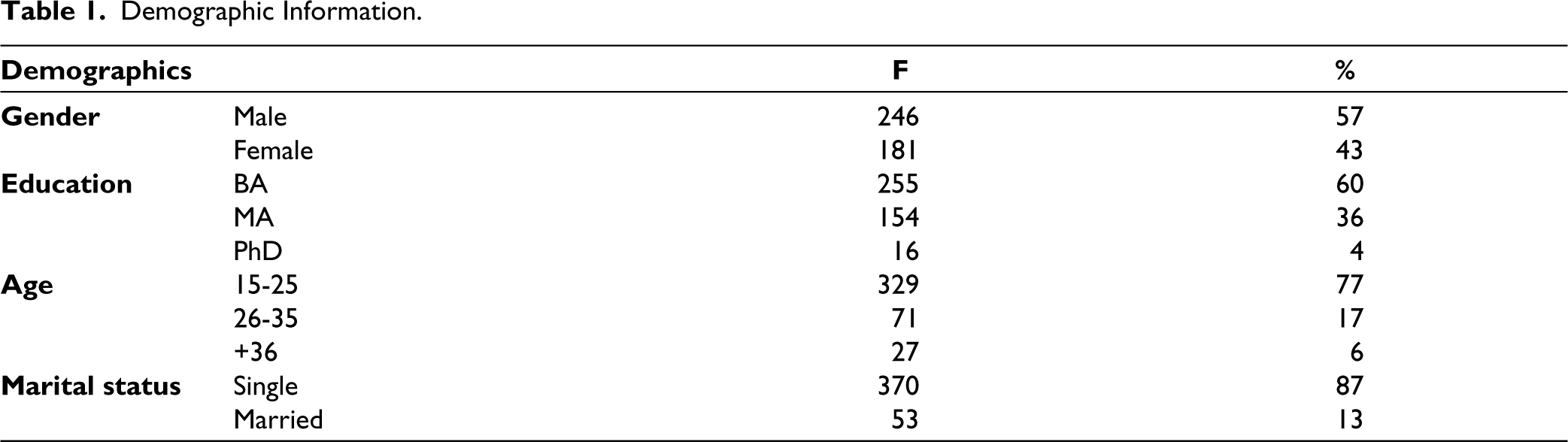
Males represented 57% of participants, while females accounted for the remaining 43%. Sixty percent of participants were undergraduate students, 36% were graduate students, and 4% were doctoral students. Their age varied, with 77% in the age range of 17-25 years, 17% between 26 and 35 years, and 6% more than 36. Eighty-seven percent of participants were single, and 13% were married (see Table 1).
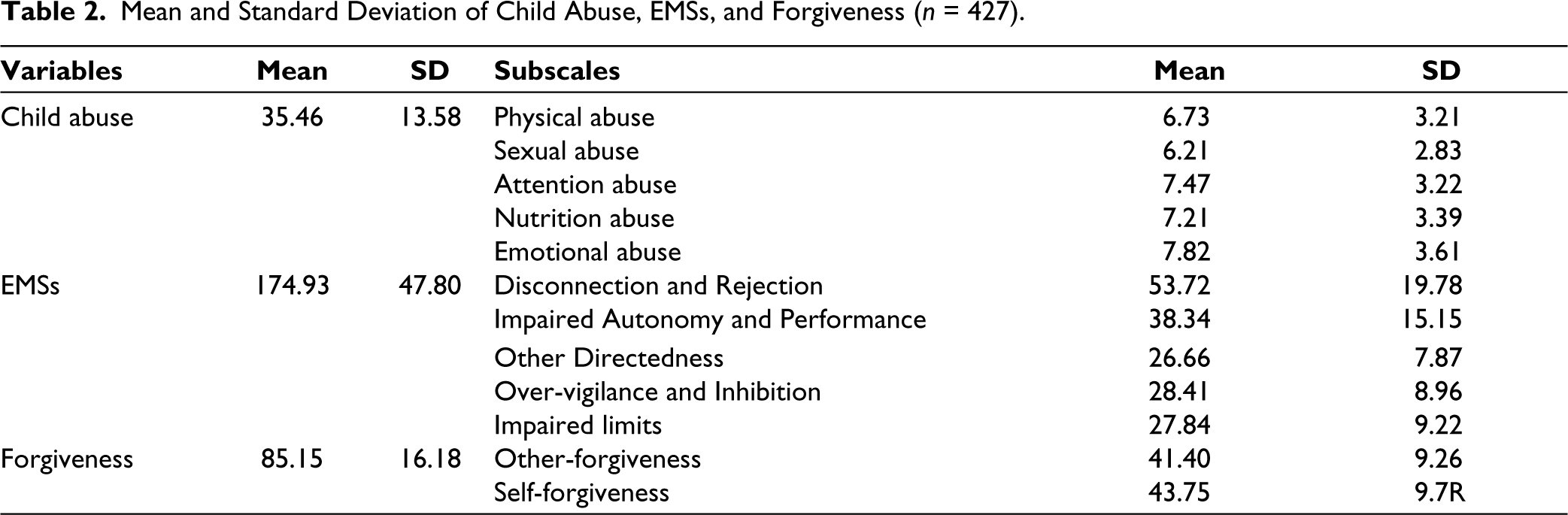
The mean and standard deviation among the variables are presented in Table 2.
Demographic Information.
Mean and Standard Deviation of Child Abuse, EMSs, and Forgiveness (n = 427).
Testing the Normality of Variables
The Kolmogorov–Smirnov test was used to test the normality of the variables. The results of the Kolmogorov–Smirnov test statistics were child abuse experience (Z = 0.22. P = .000), EMSs (Z = 0.066, P = .000), and forgiveness (Z = 0.037, P = .193).
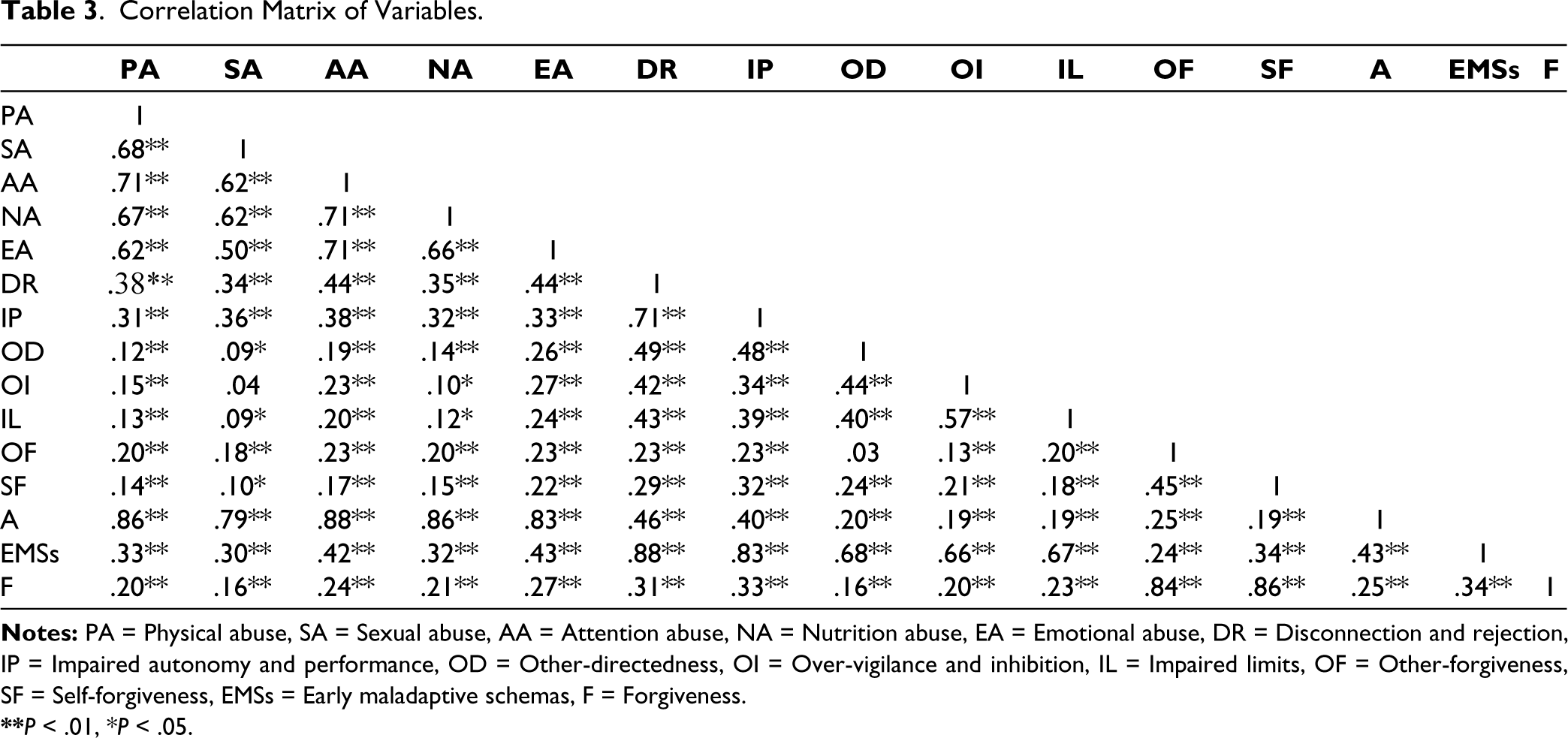
Correlation Among Variables
The correlation between variables is indicated in Table 3.Physical abuse showed significant positive correlations with all schema domains: Disconnection/Rejection (r = 0.38), Impaired Autonomy/Performance (r = 0.31), Other-Directedness (r = 0.12), Overvigilance/Inhibition (r = 0.15), and Impaired Limits (r = 0.13), all P < .01.
Correlation Matrix of Variables.
Effects on Endogenous Variables.
Sexual abuse correlated significantly with Disconnection/Rejection (r = 0.34), Impaired Autonomy/Performance (r = 0.36), both P < .01, and more modestly with Other-Directedness and Impaired Limits (both r = 0.09, P < .05).
Attention abuse demonstrated the strongest associations, particularly with Disconnection/Rejection (r = 0.44) and Impaired Autonomy/Performance (r = 0.38), along with significant correlations to Other-Directedness (r = 0.19), Overvigilance/Inhibition (r = 0.23), and Impaired Limits (r = 0.20), all P < .01.
Nutrition and emotional abuse patterns mirrored these relationships, with emotional abuse showing particularly strong correlations across domains (r = 0.44 for Disconnection/Rejection, r = 0.33 for Impaired Autonomy/Performance).
Regarding forgiveness outcomes:
Disconnection/Rejection correlated with both other-forgiveness (r = 0.23) and self-forgiveness (r = 0.29) Impaired Autonomy/Performance showed similar forgiveness associations (r = 0.23 and r = 0.32, respectively) Other schema domains demonstrated smaller but significant forgiveness correlations (range r = 0.13-0.24)
All reported correlations were significant at P < .01 unless otherwise noted.
Structural Equation Modeling
The structural model was assessed using path coefficients (sign, size, significance), R², and Q² predictive relevance.
33
In line with Hair et al.
42
(2013), statistical significance was assessed by generating 5,000 bootstrap samples to compute t-statistics and 95% confidence intervals.
40
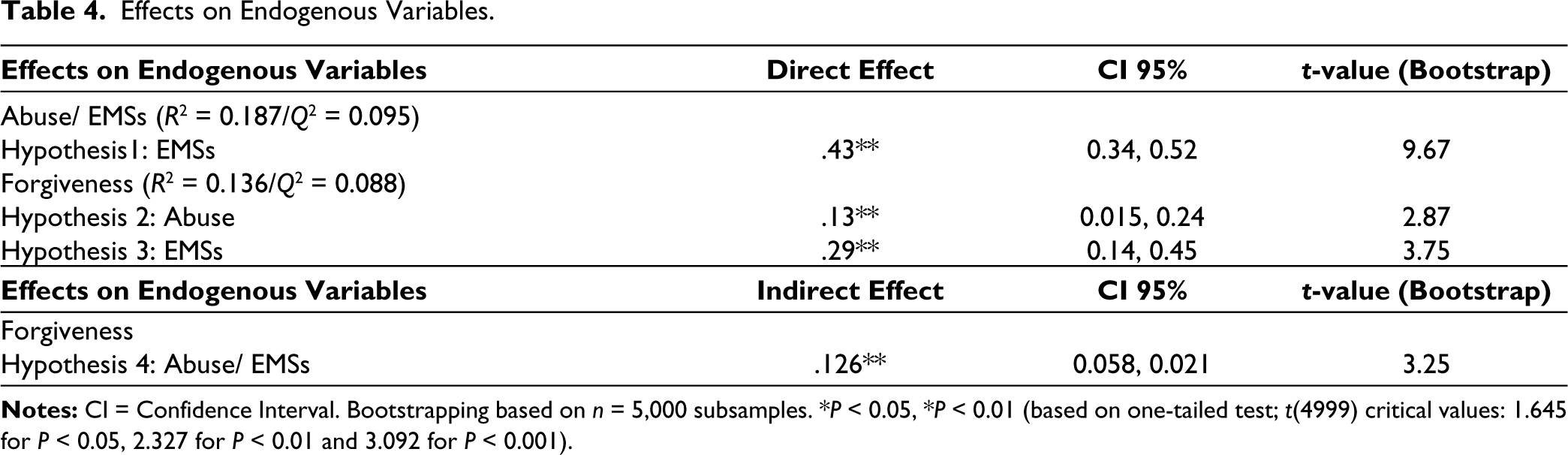
The endogenous constructs demonstrated moderate explanatory power, with R² values of 0.187 for EMSs and 0.136 for forgiveness. Predictive relevance was confirmed through cross-validated redundancy analysis (Q²), where all values exceeded zero, indicating adequate model predictive capability.
43
(Q2 for the EMSS factor was 0.095 and 0.088 for forgiveness, see Table 4). Standardized root mean square error of approximation (SRMSEA) = 0.08 suggested goodness of fit for the model. Although there is no definite consensus in the literature, an SRMR ≤ 0.09 is considered acceptable.
44
A high index of goodness of fit from 0.36 indicates the optimal fit model and is the primary model fit index in the PLS, equal to
To evaluate the precision and stability of parameter estimates, we employed bootstrapping (5000 subsamples) following Roldán and Sánchez-Franco’s (2012) methodology. 33 This generated standard errors and t-values using a one-tailed t-distribution (df = n − 1), enabling assessment of path coefficient significance and hypothesis testing (Table 4).
Childhood abuse experience had a direct path to EMSs (0.43, t = 9.67). EMSs had a direct path to forgiveness (0.29, t = 3.75), and child abuse experiences had an indirect path to forgiveness (0.13, t = 2.29).
Discussion
Using a sample of Iranian college students, this study evaluated direct and mediated pathways connecting childhood abuse, EMSs, and forgiveness—the first such investigation in this cultural context. Our analyses yielded multiple significant effects, as discussed below.
Initially, corroborating existing study results,23-29 childhood abuse experiences had a direct effect on EMSs. Thus, childhood abuse experiences, as prior painful events, can significantly influence the development of EMSs. The family environment serves as the primary arena where an individual’s life takes shape, with the most potent and enduring influences originating at home. Various types of EMSs can emerge within this familial context. For instance, the Disconnection and Rejection schema domains manifest in environments lacking emotional support or nurturing, marked by rejection, inconsistent care, and emotional or physical abandonment. Impaired Autonomy and Performance schemas are cultivated in families characterized by overprotection, excessive criticism, limited autonomy and independence, unrealistic expectations, and conditional love. The schema domain of Impaired Limits takes root in families with insufficient structure and boundaries, inconsistent discipline, permissiveness, a lack of clear rules, and a chaotic or unpredictable environment. Other-directedness emerges in families that place an overemphasis on neglecting personal needs to accommodate others, offering conditional acceptance based on conformity, and discouraging self-expression. Finally, Overvigilance and Inhibition schemas develop in families that overly emphasize rules and discipline, inhibit spontaneous behavior, practice fear-based parenting, and employ punishment for self-expression. 22
The analysis demonstrated significantly stronger correlations between childhood abuse and the first three schema domains compared to other EMS domains. This aligns with the theoretical distinction between core schemas (direct trauma responses) and compensatory schemas (coping adaptations). Core schemas constitute patterns that negatively impact an individual’s self-image during development, while compensatory schemas form as adaptive or avoidance patterns in response to negative and harmful beliefs present in core schemas. 45 Core schemas result from damage to the self-concept, particularly during childhood (found in domains 1 to 3), whereas compensatory schemas (found in domains 4 and 5) emerge to manage or prevent the activation of core schemas. Consequently, in addition to a confrontational style, there exists a form of confrontation at the schema level. Over time, compensatory schemas become more rigid and inconsistent, ultimately reinforcing primitive schemas. 46 Given that the first domain exhibited the highest correlation with all types of abuse, it can be elucidated through the lens of attachment theory. This domain is characterized by attachment dysfunction; every schema in this domain stems from disruptions in secure bonding and reliable interpersonal connections.
Second, consistent with previous studies’ results,31,32 EMSs directly affected forgiveness. In other words, an increase in EMSs can decrease forgiveness. EMSs affect individuals’ perception of the universe, self, and others. EMSs alter the relationship between individual and environment, make negative thoughts active, and lead to abnormal cognitive processes and attitudes. 36 Therefore, we can expect that through activating EMSs, non-forgiveness towards self and others will increase since the schemas lead to a change in individuals’ others and self-perception and in turn, change the interaction with self and others. 20 The inefficient identity appears when individuals behave in a way that the schemas are verified in routine interaction with others. Some schemas lead to a lack of trust toward self or others, and negative impressions, in turn, affect the ability to forgive self and others. Some schemas such as Defectiveness/Shame change the individuals’ attitudes toward self, and others, such as mistrust/abuse, change individuals’ attitudes toward others, which lead to a change in perspective about forgiveness. Thus, it is anticipated that activating EMSs increases the rate of revenge. 31 Furthermore, the results of correlations indicated that all schema domains were correlated with forgiveness of self and others except the correlation between other-directedness schema domains and other-forgiveness. This finding might be explained by the anger and stress that individuals with other-directedness schemas experience as a result of overly prioritizing the needs and desires of others, often neglecting their own, the difficulty in saying no to others, even when it comes at the expense of personal time, well-being, or goals, a tendency to avoid conflict at all costs, even if it means suppressing one’s own opinions or needs to maintain harmony in relationships, and finally the constant focus on meeting others’ expectations can lead to emotional exhaustion and a sense of emptiness.
Third, consistent with previous studies’ results, this study’s results indirectly linked childhood abuse to a lack of forgiveness.10-12 Abuse in childhood forms maladaptive schemas in abused persons and changes the individual’s impression toward self and others. 31 Child abuse can result in self-blame, low self-confidence, and self-esteem 47 guilt feeling, 48 lack of educational progress, 44 and weak social relationship, 45 which in turn leads to more cognitive shifts toward self and others. Childhood abuse can have profound and lasting effects on an individual’s ability to forgive oneself and others by creating trust and safety issues, negative self-perception, emotional pain, and trauma, impacting interpersonal relationships, difficulty regulating emotions, feeling guilt and shame, and internalizing abusive beliefs.
Complementing these results, our cross-sectional data revealed that cognitive mechanisms—particularly negative attributional styles and abuse-specific attributions—served as significant mediators between maltreatment severity and children’s symptom profiles (both externalizing and internalizing behaviors). 49 Young hypothesized that certain schema (e.g., defectiveness/shame, mistrust/abuse, and vulnerability to harm) are mainly related to early experiences of trauma, or victimization, including exposure to harm or abuse. Maladaptive cognitive structures are developed after childhood maltreatment and, in turn, change the person’s view toward self and others and consequently decrease the ability of the person to forgive self and others. 21
EMSs can act as intermediaries in the connection between child abuse and an individual’s ability to forgive oneself and others. Child abuse contributes to the formation of EMSs, enduring patterns of thoughts, beliefs, and feelings that shape how individuals perceive themselves, others, and the world. The childhood experience of abuse can detrimentally affect one’s self-image, giving rise to EMSs related to inadequacy, unlovability, and mistrust. When confronted with situations triggering memories or emotions tied to the abuse, these maladaptive schemas become active. The activated EMSs significantly impact the person’s capacity for forgiveness. For example, a schema associated with Disconnection and Rejection may make it difficult for the individual to believe they deserve forgiveness, both from themselves and others. Maladaptive schemas influence how individuals engage with others; issues of mistrust, for instance, may impede forgiveness as the person grapples with trust issues or views forgiveness as a vulnerability. The interaction between child abuse, maladaptive schemas, and forgiveness creates a cyclical pattern. The challenge of forgiving oneself and others reinforces the negative beliefs ingrained in the schemas, perpetuating the emotional aftermath of the abuse.
Limitations, Implications, and Future Research
While this study provides evidence that EMSs mediate the relationship between childhood abuse and forgiveness among Iranian college students (ages 17-25), its findings may not generalize to other populations, including clinical samples, different age groups, or individuals with lower education levels. Clinically, the results underscore the importance of assessing clients’ abuse histories, activated EMSs, and forgiveness capacities while highlighting the need for preventive interventions, particularly parental education programs targeting emotional abuse, which was the most prevalent form in our sample. Schema-based couple therapy may also help improve forgiveness by addressing trauma-rooted EMSs. Future research should explore these associations in larger, more diverse samples (including clinical populations) and employ qualitative methods to better understand survivors’ lived experiences, thereby informing more effective interventions.
Footnotes
Acknowledgements
We would like to thank all the participants of the study for their valuable time and help.
Declaration of Conflicting Interests
The authors declared no potential conflicts of interest concerning the research, authorship, and/or publication of this article.
Funding
The authors received no financial support for the research, authorship, and/or publication of this article.
Statement of Informed Consent and Ethical Approval
The study protocol was approved by the Ethics Committee of Islamic Azad University (#13820701962007; September 2, 2019). Written informed consent was obtained from all participants in accordance with the Declaration of Helsinki.