




Abstract
Background:
Training in augmentative and alternative communication (AAC) is essential, especially for speech-language pathologists (SLPs) as they are involved in the assessment and management of users of AAC. The aim of this study was to evaluate the effectiveness of the visual support implementation program by sensitizing and creating awareness among SLPs who work with children with autism spectrum disorders.
Methods:
Quasi experimental study was carried out in two phases. Phase 1 involved developing resources for visual support implementation training programs such as module and questionnaires to assess the knowledge, skills, and validation of the developed materials, involving five SLPs and five occupational therapists. Phase 2 consisted of testing the effectiveness of a visual support implementation training program, such as pre-knowledge and skill assessment, and conducting workshops and post-knowledge and skill assessment comprising sixty student SLPs. Inferential statistics, Cronbach’s alpha test, and Wilcoxon signed-rank test were used to check the reliability measure.
Results:
Overall reliability between SLPs and occupational therapists using Cronbach’s alpha score measured was greater than 0.70 indication excellent reliability. A significant difference was found between pre- and post-training scores at P < .05 level.
Conclusion:
Visual support training modules can be used as teaching material for SLPs in academic and clinical setup. Guidelines can be adapted for developing and implementing of visual support strategies during speech and language intervention program based on the module.
Keywords
Introduction
Communication is important when an individual wants to share information, get their needs and desires fulfilled, build social relationships, get an understanding of their surroundings, take control over their circumstances, and become aware of something. Individuals with autism spectrum disorder (ASD) might have difficulty dealing with the social and communicative demands in a normal school environment because of their restricted and repetitive behavioral patterns. 1 Cognitive and behavioral differences could influence how these children approach and accomplish tasks that require high degrees of executive function, such as keeping on goal, shifting between activities, and independently following activities with several step-by-step instructions. 2
Visual support is a method of communicating with the child that uses illustrations rather than words. Visual support consists of real items that are used to visually enhance an individual’s understanding of the physical and social environment. It can increase a person’s level of independence thereby increasing comprehension, lowering anxiety, facilitating communication and involvement in activities, reducing problematic behaviors, and increasing participation. 3 Visual support tool helps children communicate the order of planned activities or events by using objects, images, icons, words, or a mix of tangible supports to allow for the independent performance of a daily life skill. 4 Either it can be used to teach a new skill by breaking down a single task into smaller parts or it can consist of several discrete activities that are part of a routine. Both of these applications have the potential to be useful. Most children with ASD are visual learners, which means they learn best by looking and observing. 5 For instance, it has been suggested that providing autistic children with visual schedules that depict transitions between tasks could help lessen behaviors that are associated with autism. 6 It has been demonstrated that the utilization of visual supports, such as visual schedules and work systems, is effective in assisting students in special education and specific settings to remain focused on tasks; however, there is a lack of research to support the utilization of these strategies by teachers.
A literature review on the academic and clinical skills, scope, and evidence-based practices (EBPs) that speech-language pathologists (SLPs) use showed that they mainly use skills that they learned in graduate school and through continuing education. SLPs showed a positive attitude toward gaining knowledge and skills related to components of EBPs such as research evidence, clinical proficiency, and client preference through research practices. 7 Also, evidence on the usage of visual support during speech and language intervention exposed studies that focused on the identification of the occurrence of specific behaviors, formulation of goals, working, towards targeted skills, and tracking of achievement of targeted skills. Hence, SLPs who want to use visual support interventions with their children should know their baseline skills, choose appropriate tasks, and gather the necessary resources. However, limited education and clinical preparation of SLPs related to the implementation of visual supports have been documented. Lack of exposure to such training may result in ineffective intervention for children with communication disorders. Therefore, SLPs must possess the necessary knowledge and skills. Thus, this study focused on imparting knowledge and skills related to visual support for student SLPs during speech and language intervention for children with communication disorders, thereby improving the service delivery and outcome of the evidence-based treatment program.
Aim
This study aimed to assess the efficacy of the visual support implementation program by sensitizing and creating awareness among SLPs who work with children having difficulty in communication.
Objectives
To develop a visual support implementation education program for SLPs.
To assess the knowledge and clinical skills of visual support among SLPs.
To assess the efficacy of the visual support implementation education program among student SLPs.
Method
The Institutional Ethics Committee of SRM Medical College Hospital and Research Centre, Kattankulathur granted appropriate ethical clearance for this study.
Participants
Five SLPs and five occupational therapists (OTs) with a minimum of five years of professional experience dealing with children with ASD were considered for phase 1 content validation for the designed module and the questionnaires. In phase 2, the study involved sixty student SLPs to evaluate the efficacy of the visual support training program using the developed module and the questionnaires.
Inclusion Criteria
Student SLPs working with children having communication disorders.
Exposed to child language disorders theoretically and clinically
Exclusion Criteria
Undergraduate first- and second-year SLPs.
The research was carried out in two phases.
Phase 1: Development of resources for the Visual Support Training Program.
Phase 2: Delivery of a Visual Support Implementation Training Program among student SLPs.
Phase 1: Development of Resources for the Visual Support Implementation Training Program
It was carried out in two steps.
Step 1: Development of a module and questionnaire to assess the knowledge and skills of the SLPs.
A knowledge-based questionnaire was prepared to assess the understanding of the concepts related to augmentative and alternative communication (AAC) and visual supports for children with communication disorders among student SLPs. It contained 20 items focusing on knowledge skills related to visual support types, considerations for using them, the framework for visual language intervention, components of visual support, assessment protocol, and documentation. Also, a skill-based questionnaire evaluating the competency of student SLPs related to visual support was developed. It consisted of 14 questions focusing on professional training, awareness, confidence level, visual support components, problem behaviors, communication, learning, professionalism, assessment, identification of components, and planning intervention. The students were asked to rate both the knowledge and skill-based questionnaire related to visual support using four-point Likert rating scales such as (a) strongly agree, (b) agree, and (c) not sure (d) disagree. Thus, the scores for both the knowledge and skills of the SLPs were obtained for pre-training and post-training conditions.
The preparation of resource materials for the module comprised a booklet, a PowerPoint presentation, and videos about visual support implementation that were used during speech and language intervention for children with communication disorders. The content of the module was extracted from various multidisciplinary databases comprising published material from human and behavioral sciences such as PubMed, Google doc, Scopus, Web of Science, and books. The various steps involved in the development of the module began with an overview of the guide, basic knowledge about communication, visual support, and the types of visual support, reviewing the activities and items, construction of the activities and material, conducting a task analysis and rearrangement of tasks based on increasing complexity level, considerations for using visual support, providing skills and knowledge about when, who, and why visual support is used, and how to implement those in various settings. The domains in the module were selected through extensive conceptual and practical analysis, as well as discussions with experts in the field using a structured and unstructured approach where both open-ended and close-ended questions and statements were provided. It was done to assure a controlled, unvarying reply that is devoid of bias.
Step 2: Validation of the module and questionnaire to assess knowledge and skills
The rating was determined based on the level of support for each domain that was relevant to the implementation of visual support associated with all different kinds of challenges that are faced by children who have ASD. Then, for the validation process, the developed questionnaires were distributed among five SLPs and OTs who had a minimum of five years of professional experience in managing and working with children diagnosed with ASD (Appendix 2 provides the validation form for the content validation of the questionnaire to assess clinical skills and knowledge for SLPs about visual support (Sections 1 and 2) and the validation form for questionnaire and module assessment). Using the validation form, the experts provided their feedback. The final version of the resource materials incorporated content based on the feedback received from SLPs and OTs. As a consequence of this, a comprehensive resource material and questionnaire for evaluating the efficacy of training programs for both the knowledge and skills of student SLPs were formulated.
Information in the module that was identified with module variables, factual information, clinical case discussions, iconic and clear images, module size, assessment protocol, and documentation-related questions was used to frame a checklist, which was later used for content validation by experts in the field. The SLPs’ and OTs’ ratings served as the basis for selecting and organizing the essential content. The content of the visual support module is described as follows:
Chapter 1: Introduction
Chapter 2: Communication
Chapter 3: Visual support
Chapter 4: Types of visual support
Chapter 5: Assessment and outcome documentation
Chapter 6: Special guidelines for using visual support for specific high and low-structure activities.
Chapter 7: Useful Internet sites and other resources
Phase 2: Delivery of the Training Program on the Visual Support Implementation Training Program Among Student SLPs
It consisted of the following:
knowledge assessment skill assessment
Phase 2, the training program, involved a total of 60 students from the third year of the undergraduate program, internships, and postgraduate programs. All of the student SLPs had very limited exposure, prior training, and experience in the use of visual support and its incorporation into therapy for children who have communication disorders. The training session took place in the classroom of the Department of Audiology and Speech-Language Pathology at SRM University. The training program was conducted over three hours, and there were breaks between the different stages of the program. The principal investigator-led the training program with the assistance of a SLP. Before the start of the training program, both the pre-training knowledge and skill questionnaires were provided through Google Docs. The students were asked to provide appropriate responses concerning their knowledge and skills using a four-point Likert rating scale. The responses were collected and analyzed to obtain baseline knowledge and skills about visual support among student SLPs. The student SLPs were later provided with a presentation and workshop training activity that focused on visual support planning, setting up, and analysis of case presentations and discussions using the developed visual support module. Before session 2, a break duration of 10 to 15 minutes was provided. During the case presentation and video demonstration, the participants were asked to complete the activity based on visual support planning, setup, and execution. This session was made interactive to encourage student SLPs to discuss with the trainer and explain the visual support implementation strategies. After the training session (knowledge and skill-based questions), the questionnaire that was used for baseline assessment was redistributed for student SLPs to obtain the post-training scores. Later, the booklet samples, post-training questionnaires, and visual support kit provided during the workshop were collected and analyzed for the knowledge and skills the SLPs gained following the training program.
Statistical Analysis
The SPSS software, version 23, was utilized for the statistical analysis process. For the ratings that were obtained from SLPs and OTs, descriptive statistics, including mean and standard deviations, were calculated. Overall reliability analysis of SLPs and OTs was done using the Cronbach’s alpha test. The relationship between the ratings of the validators for each question was determined through the use of the Wilcoxon signed-rank test. Wilcoxon signed-rank test for pre- and post-knowledge and skill analysis.
Results
The purpose of this study was to develop a module on visual support and questionnaires to evaluate the knowledge and skills of student SLPs regarding the utilization of visual support in children with communication disorders. Following the training, the ratings and responses obtained were tabulated and analyzed as provided below.
The mean and standard deviation for SLPs (n = 5) for 20 questions (knowledge questions) and 14 questions (skill questions) showed a rating between very highly valid and not valid at all. Similarly, the mean and standard deviations for OTs (n = 5) for 20 questions (knowledge questions) and 14 questions (skill questions) showed a rating between very highly valid and not valid at all. The overall mean and standard deviations for both SLPs and OTs (n = 10) for 34 questions ranged from highly valid to not valid. The values are given in Table 1.
Knowledge Questions: Descriptive Statistics of the Mean and Standard Deviations of SLPs and OTs.
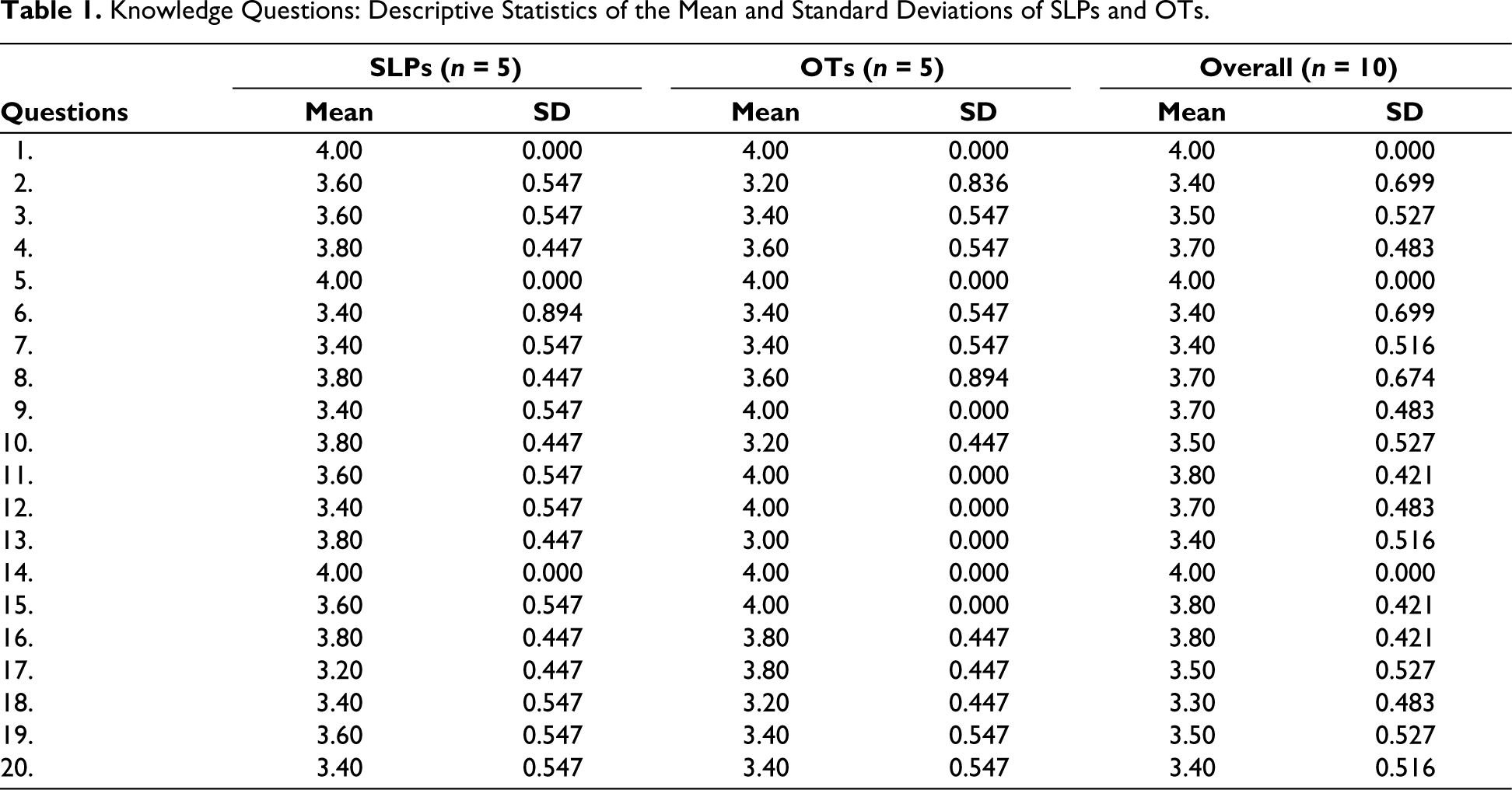
Based on the information presented in Table 1, it is clear that all five SLPs and OTs have strongly validated the concept of a questionnaire that can provide unbiased data for the investigation, allowing 0%-5% (very highly valid) to 21%-25% (not valid at all) error that offers accurate measures, eliminating biases, and practical uses. It was identified that questions related to the importance of visual cues and visual support usage during communication difficulties were rated as highly valid for the content. The questions focusing on component of modules for example visual schedules and support, physical prompting, social communication and assessment of various skills were rated with a score of 3 indicating good content validity. However, none of the questions were rated as irrelevant in the questionnaire related to the module.
Table 2 shows that all five SLPs and five OTs strongly supported the idea of a skill-based questionnaire. This would provide unbiased data for the study, with error rates ranging from 0%-5% (very highly valid) to 21%-25% (not valid at all), providing accurate measurements, removing biases, and useful information. All ten validators (SLPs and OTs) strongly agreed with the concept of the skill questionnaire, rating it as valid and highly valid for most of the validation questions. It can be understood that the skill-based questionnaire provided contained information related to various types of visual support, age range to use visual support, practical experiences, training programs in making use of visual support, perceiving the use of visual support, how to implement, skill training, intervention types, measuring awareness, the efficacy of visual support utilizing in clinical settings, describing confidence level, employing visual support in programs in various settings, and the influence of visual support in individuals, which were rated as valid. The item addressing confidence level in using visual support was rated as highly valid. On the other hand, the questionnaire that was related to the module was rated as comprising highly relevant questions.
Skill Questions: Descriptive Statistics of the Mean and Standard Deviations of SLPs and OTs.
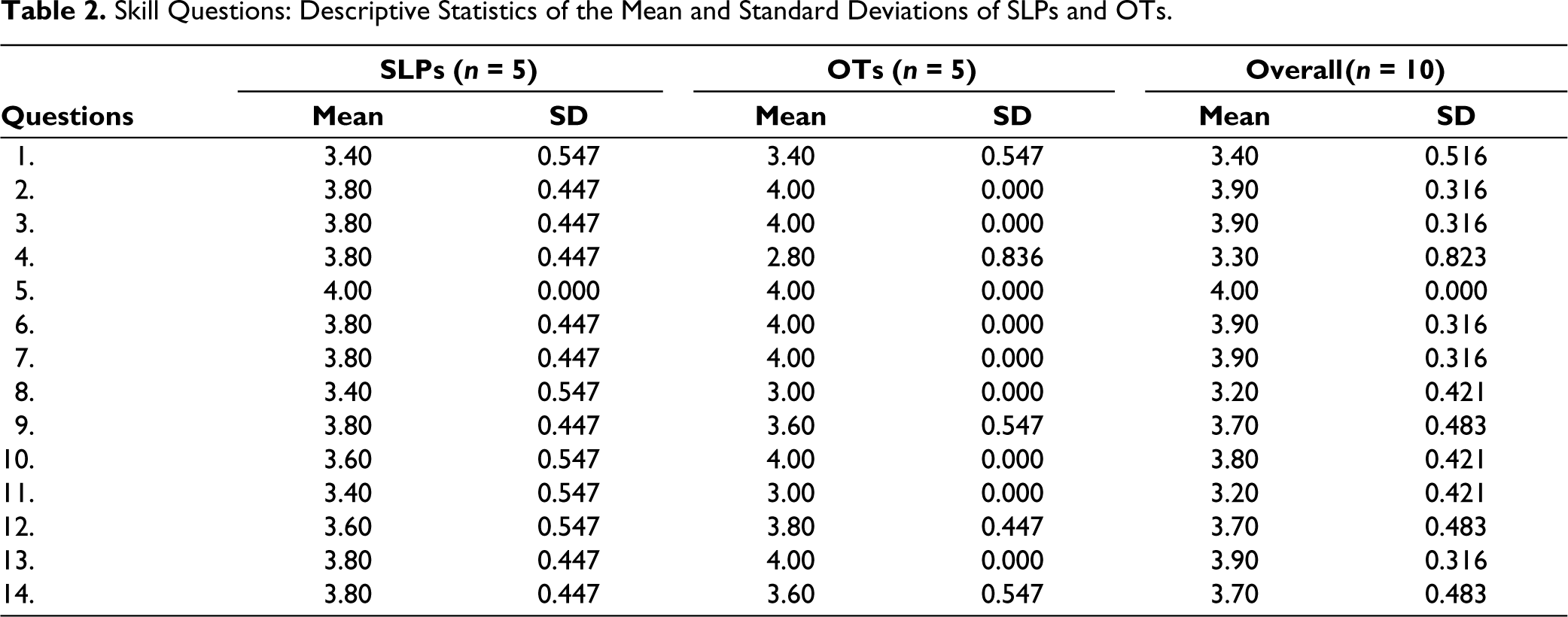
Overall reliability results given by both SLPs and OTs for all the questions (a total of 20 questions) under knowledge and skill (a total of 34 questions) were higher than 0.765, indicating the reliability measure to be acceptable (based on Cronbach’s alpha test). The overall I-CVI (content validity of individual items I-CVI) score measured was 9.375, revealing an excellent score (I-CVI score of 0.78 or higher indicates excellent content validity). The overall S-CVI (content validity of the overall scale) score obtained was 0.9. It also revealed an excellent score (an S-CVI score of 0.8 or higher indicated excellent content validity).
All five SLPs have strongly validated the concept of a module that can provide unbiased data for the investigation, allowing 0%-5% (very highly valid) to 21%-25% (not valid at all) error that offers information and clinical case discussions and serves the purpose as resource materials. All validators agreed that the concept of the module was highly valid. Questions regarding information and variables about the module, clinical case discussions, accessibility, simplicity, usability, ambiguity, clarity, iconicity, size of the module, instructions to plan and implement, assessment protocol, documentation, and response track forms were rated as excellent. However, none of the questions were rated as not valid for the module. The module reliability results given by both SLPs and OTs for each of the questions (a total of 10 questions) were 0.923 (according to Cronbach’s alpha test), indicating that the reliability is excellent (based on the Cronbach’s alpha test). The relationship between the ratings of the validators was determined through the use of the Wilcoxon signed-rank test, which showed a statistically significant difference. A statistically significant difference was obtained at Z Asymp. Sig. (2-tailed) at P < .05 for both knowledge-based questions and skill-based questions among student SLPs in both pre- and post-training assessments using the developed module related to visual support training for children with ASDs.
Discussion
The current investigation is a preliminary study that provides a pathway for training professionals in the field of visual support to improve their clinical skills. This study also throws attention toward the need for training the SLPs’ clinical skills to carry out evidence-based interventions. 7 In general, there is a lack of expert speech and hearing professionals practicing in India. Most individuals with disabilities are unsuccessful in accessing quality healthcare services due to a lack of professionals, an unsuitable organization, or the insufficient skills of the healthcare providers. It is also identified that healthcare professionals such as SLPs, OTs, and special educators working with complex communication needs meet demands in clinical and educational practice.
Experimental studies measuring knowledge and skills following training and linking them to the ability for entry-level AAC service provision will initiate the efficiency of instructional materials and approaches. 8 A study conducted among entry-level OTs revealed that problem-based learning showed improvement in knowledge and clinical skills, problem-solving, and teamwork skills among professionals. 9 A web-based professional development (PD) program titled Autism Competencies for Endorsement (ACE) was found to be effective in helping teachers build their knowledge, competencies, and skills to equip teachers to address the needs of children with ASD. 10 This study, which also demonstrated improvement in clinical skills among the student SLPs following the training program, has documented similar outcomes. This study also disclosed that students were more confident in implementing the strategies and types of visual support during therapy for children with communication disorders following the training program.
Online training on educators’ knowledge and usage of the system of least prompts (SLP) to enhance the communication of autistic individuals who utilize AAC was found to be beneficial in boosting educators’ awareness and ability to plan for a system of least prompts. 11 This study is in agreement with the above research, where many aspects of individual components did not show significant differences both in the knowledge and clinical skills sections of the training program. However, the overall study population accepted the acquisition of valuable skills and was more confident in using visual support as a result of the training.
Another study aimed to report on the results of the latest study about academic and clinical learning in AAC and to compare the results with those of a similar study to see if there have been any changes in speech-language pathology programs in the United States in the new certification standards of the American Speech-Language-Hearing Association through the survey. The result also showed that more academic and clinical training is needed in this area. 12 The above-mentioned research is in harmony, emphasizing the importance of training program areas related to AAC and visual supports in their curriculum.
Evidence also shows that the training can yield statistically significant outcomes and also shows improvement in clinical competency in SLPs’ knowledge. 11 However, in this study, though statistically significant differences were identified, the implementation of the gained knowledge and practical skills was not sufficient in terms of clinical decision-making. Also, the most efficient methods of instruction should include procedural and conceptual understanding. Both procedural and conceptual knowledge can be “deep” or “shallow” and complement each other. Conceptual understanding helps to avoid two sources of learning interference. Based on the evidence, teachers are misinformed about both conceptual and procedural knowledge types, which is problematic. However, this study was structured, including both procedural and conceptual methods of training for the student SLPs, which showed a notable difference in the pre-and post-training programs.
Summary and Conclusion
This study investigated the efficacy of a visual support implementation training program for student SLPs to improve their knowledge and clinical skills related to visual support. Participation in the training program showed signs of improvement in their theoretical and practical understanding of visual support among student SLPs. Every single student has learned new information and acquired new skills regarding visual support, its various types, usage to promote language skills, how it can be created and implemented in a variety of settings, and factors to consider during evaluations. A good number of student SLPs have also realized and comprehended the significance of utilizing visual support, particularly for children who have developmental disorders. The fact that there was much interaction between the researchers and the students during the training program implies that a level of knowledge was acquired after the program. This study also aids the existing literature by extending the efficacy of training programs and areas of study to be included when educating SLPs. A larger sample size could have provided the efficacy of the training program within and across undergraduate and postgraduate students, highlighting the amount and intensity of the training program required based on the educational level of the students. Also, the generalization of the acquired knowledge and skills was not analyzed in detail concerning clinical decision-making during the assessment and treatment process using visual support, which could be carried out in future research work. This study did not involve participants from multiple centers (different colleges and set up) to identify the efficacy of the training program, as the method and content of academic and clinical exposure may influence the knowledge and competency of the SLP students. Future studies can be planned to focus on training programs for parents regarding the use of visual support at home, and also research can be conducted to check for the efficacy of the application of the knowledge acquired in the training program. Research considering various instructional methods about types of visual support (e.g., the individual using visual support and its outcomes, the efficiency of communication partner training the children with communication disorders) can be conducted. EBP for clinical decision-making using visual support for various children’s communication orders could be focused in future directions.
Supplemental Material
Supplemental material for this article available online.
Footnotes
Acknowledgements
We would like to thank Dean Medical, HOD of Audiology & Speech Language Pathology, SRM MCH & RC, for the support. We are also grateful to all the validators and participants in the study.
Clinical Implications
The developed module on visual supports can be used as teaching material for SLPs in academic and clinical settings. It is necessary not only for students but also for all professionals to acquire the knowledge and clinical skills required to employ them in a manner that is both effective and efficient in clinical practice.
The module also provides guidelines for developing and implementing visual support strategies during speech and language intervention programs.
Declaration of Conflicting Interests
The authors declared no potential conflicts of interest with respect to the research, authorship, and/or publication of this article.
Statement of Ethical Approval and Informed Consent
The study protocol was approved by the Institutional Ethics Committee Ref No.15/ M.E.D/2021. The study was accorded Ethical Committee Approval vide the Institutional Ethics Committee under Ethical Clearance Number 3212/IEC/2022 of SRM Medical College Hospital and Research Centre, Kattankulathur dated January 28th, 2022. The study was carried out in accordance with the principles enunciated in the Declaration of Helsinki. This study did not involve any patients; hence, it does not have patient consent. However, a statement of verbal consent was obtained from each student participant during the training program.
Funding
The authors received no financial support for the research, authorship, and/or publication of this article.
References
Supplementary Material
Please find the following supplemental material available below.
For Open Access articles published under a Creative Commons License, all supplemental material carries the same license as the article it is associated with.
For non-Open Access articles published, all supplemental material carries a non-exclusive license, and permission requests for re-use of supplemental material or any part of supplemental material shall be sent directly to the copyright owner as specified in the copyright notice associated with the article.
