




Abstract
Aim:
Substance use can begin in adolescence and can lead to school drop-out, involvement in criminal activities, and development of mental health disorders. Good awareness is an important protective factor for keeping adolescents away from substance abuse. This study was planned to describe the knowledge, attitude and prevalence of substance use in school-going adolescents from a regional area of Punjab.
Methods:
An online survey was conducted recruiting 6927 students of 9th to 12th class. They were administered the English and Punjabi translated version of the “Knowledge and Attitude Questionnaire to Substance Abuse” and asked for ever use of substances using WHO-ASSIST. The association of sociodemographic variables with knowledge, attitude, and prevalence was analyzed.
Results:
Most of the school students had poor knowledge and attitudes regarding substance use. They had limited awareness of the harms and treatment of substance abuse. Social stigma for substance abuse was evident in the majority of students. About 3.3% of students reported ever use of substances. The commonest reported substances were alcohol, tobacco, and cannabis. The knowledge and attitudes were poor in students of urban areas, private schools, students of classes 9th and 10th, and those of middle socioeconomic status. Ever use was higher in males, students from rural areas, and classes 11th and 12th.
Conclusions:
There is inadequate knowledge and attitude for substance abuse among school-going adolescents in this regional area of Punjab. Students reported a low prevalence of ever use in the online survey.
Introduction
Initiation of substance use in adolescence is often accompanied by many serious consequences such as deterioration of health, poor mental well-being, educational decline, financial problems, and risk of becoming a problematic drug user.1,2 The awareness, beliefs, and attitudes of adolescents toward substance abuse may play an important role in prevention and early intervention.3,4
According to community-based surveys from India, adolescents commonly use tobacco, alcohol, cannabis, opioids, and inhalants.5,6 In the National Survey on Extent and Pattern of Substance Use in India, 2019 (NSEPSU) the prevalence of substance use in children aged 10-17 years has been reported as 1.3% for alcohol, 1.8% for opioids, 1.17% for volatile solvents, and 0.9% for cannabis. 6 Some school-based studies from different regions of India have reported varying prevalence of substance abuse in adolescents ranging from 11 to 47%.7-14 The degrees of awareness regarding substance abuse also vary with different regions in school-going children.10,12,15-22
It is important to know the prevalence and understanding of substance abuse in school-going students because adequate knowledge acts as a protective factor for preventing substance abuse. No prior study from Punjab explored these aspects, so this study was planned with the following aims and objectives:
To describe the knowledge, attitudes, and prevalence of substance use in school-going adolescents of a regional area of Punjab. To examine the association between substance use, and awareness with socio-demographic variables.
Materials and Methods
This study was conducted by a tertiary care center in Punjab, North India. An anonymous Google Survey Form was created for data collection from students of classes 9th to 12th. After getting permission, the district education officers (DEOs) of two nearby districts (Patiala and Ludhiana) were contacted and requested to share this Google Survey Form link with the WhatsApp groups of the school principals of their districts. The link thus got circulated to the principals of all the higher secondary and senior secondary schools of these two districts. School principals who agreed to participate in turn shared the link amongst the existing WhatsApp groups of parents of their school students from classes 9 to 12. To increase the number of study participants, the school principals of many schools were contacted telephonically and visited personally by the study investigators. Data collection was done in October 2022 and students from 128 schools could be recruited in this time.
Instruments
The following variables were assessed through Google Survey Forms:
Sociodemographic data—Age, gender, type of school (private/government), place of residence (urban/rural), class (9th,10th, 11th/12th), family income. “Knowledge and Attitude to Substance Abuse” questionnaire—The English and Punjabi translated version of the “Knowledge and Attitude to Substance Abuse” questionnaire used in the NSEPSU was used in this study.
6
It has 11 Likert-rated types of questions with scores on each question ranging from 1 to 3. Higher scores indicate poorer awareness and attitudes toward substance abuse.
23
For assessing the awareness of students regarding the harms of needle sharing, one question was framed by investigators of this study and administered. Alcohol, Smoking, and Substance Involvement Screening Test (ASSIST) V2. 0—The World Health Organization (WHO) ASSIST screens for abuse of over ten different types of substances.
24
The English and Punjabi translated version of this tool used in the NSEPSU was used in this study.
23
In this study, ASSIST was used to categorize “ever use” of substances only.
Ethics and Confidentiality
Approval from the institutional ethics committee was taken before conducting the study. Written permissions were obtained from the Director Public Instruction-Schools (Punjab) and the DEOs for data collection from the students. The Google Survey Form was anonymous and included a confidentiality statement, informed consent for parents, assent for students and study information in both English and Punjabi languages. Data collection was done for only those who gave active online consent. Those who refused to give consent would exit the survey automatically. The Indian Council of Medical Research (ICMR) guidelines for conducting biomedical research were followed as applicable.
Statistics
The data was analyzed using SPSS trial version 22 and Microsoft Excel. Statistical significance was taken as P <.05. Descriptive statistics were done for all the data. Kolmogorov–Smirnov test was used to check the normality of the data and it was found that the data was not normally distributed. Data was reported in terms of mode and percentages. Chi-squared test, Mann–Whitney U test, and Kruskal–Wallis test, Spearman’s correlation coefficient calculation were used for non-normally distributed data.
Results
A total of 6992 students agreed to participate in the survey with their parents’ consent, while 411 students refused (94.4% response rate). Sixty-five entries were found to be duplicate or invalid. Thus, the remaining 6927 entries from students were included in the study analysis.
Knowledge and Attitudes of Students Regarding Substance Abuse
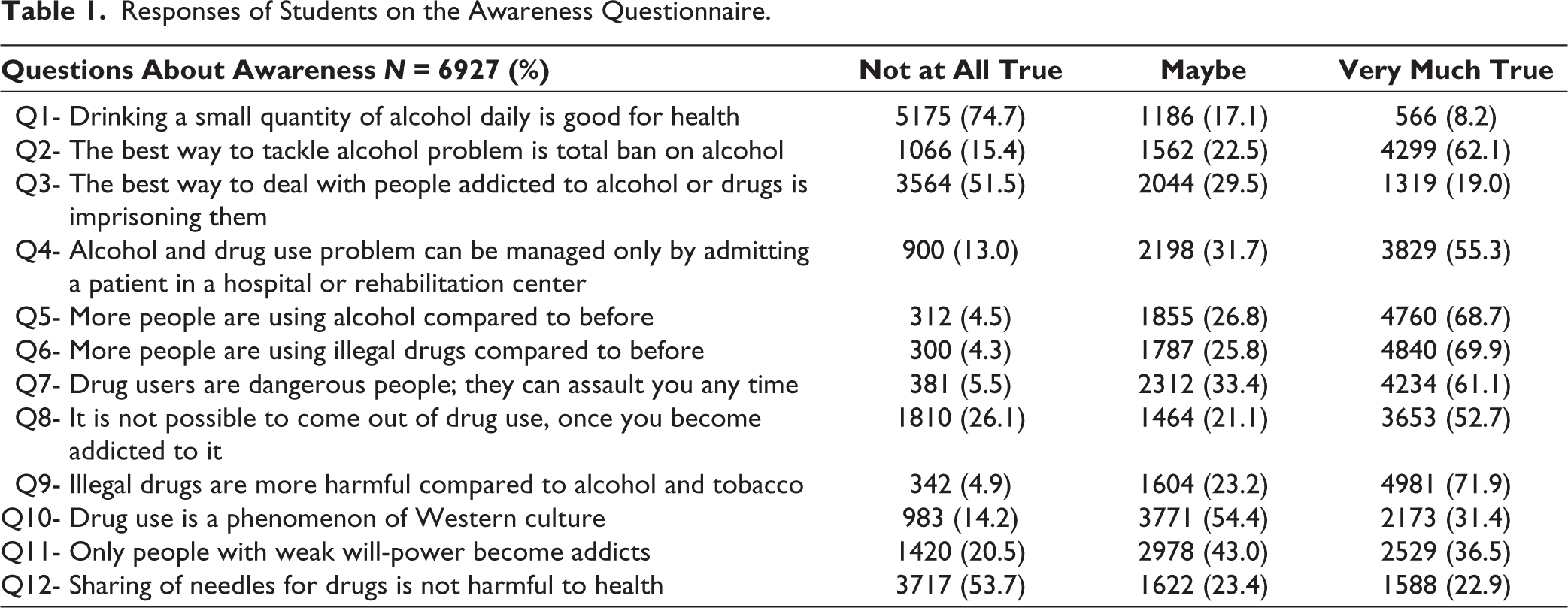
For Question One (Q1), the majority of students responded “not at all true” indicating good awareness and attitude. But for the other questions, the students responded “very true” or “maybe” indicating poor attitude and awareness. For Q3 and Q12, approximately 50% of students marked “not at all true” (Table 1).
Responses of Students on the Awareness Questionnaire.
Ever Use of Substances by Students
Two-hundred thirty (230; 3.3%) out of 6927 students marked “Yes” for “ever” use of substances. Among these 230 students, 111 students did not reveal anything about their type of substance use, while 38 students reported ever use of three or more categories of substances. Most commonly, students had ever use of alcohol (N = 65, 0.9%), tobacco (N = 52, 0.7%), and cannabis (N = 37, 0.5%). Students also had marked “ever use” for inhalants (N = 23, 0.3%), opioids (N = 16, 0.2%), sedatives (N = 27, 0.3%), cocaine (N = 31, 0.4%), amphetamines (N = 26, 0.3%), and hallucinogens (N = 16, 0.2%). Sixteen students had marked yes for intravenous use of substances and among them 12 students had accepted sharing of needles.
Association of Attitude and “Ever Use” of Substances with Sociodemographic Variables
The score of each item of the knowledge and attitude questionnaire was added to generate a total score for examining the association with sociodemographic variables. The mean score decreased significantly with age (Spearman’s correlation coefficient r-0.07, P <.001) indicating better awareness and attitude with an increase in age. The analysis also showed that awareness was significantly better in rural populations, those with higher/lower family income, government school students, and students of classes 11th and 12th (P <.001) (Table 2).
Regarding “ever use,” a significantly higher number of students were males, belonged to rural backgrounds, studied in the 12th class, and were from Patiala (Table 2).
Association of Ever Use and Attitudes with Sociodemographic Variables.
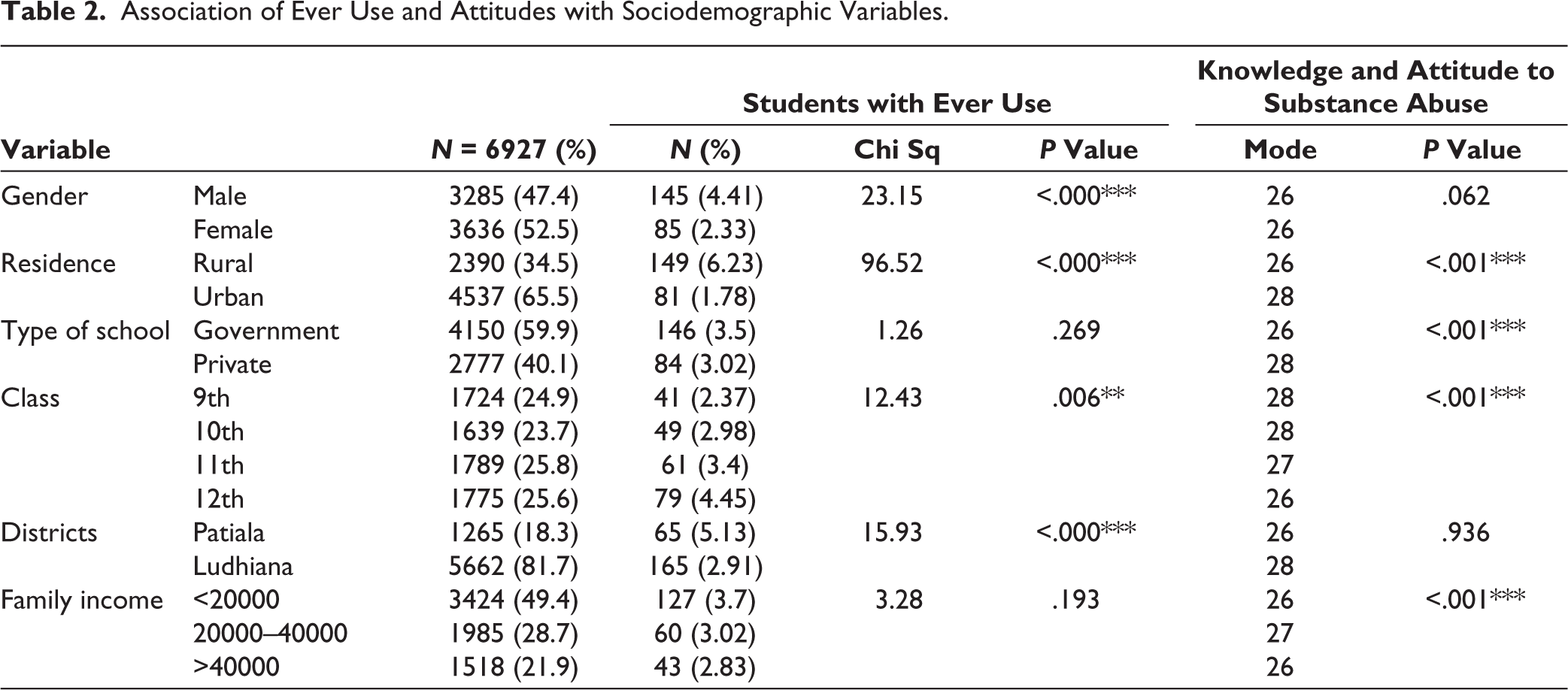
*P < .05, **P <.01, ***P <.001; Chi-squared test was done to compare the reported frequency of ever use; Comparison of knowledge and attitude toward substance abuse was done using Mann–Whitney U test and Kruskal–Wallis test.
Discussion
This study was undertaken to describe the knowledge, attitude, and prevalence of “ever use” of substances by school students of classes 9th to 12th through an online survey. According to the results, the majority of the students from this regional area of Punjab had unsatisfactory knowledge and attitudes regarding substance abuse. Overall, 3.3% of students reported ever use of different substances.
Most of the students in this study had inadequate knowledge in many domains. Some previous studies from India have also reported poor knowledge among school students,12,17,18 yet more of the previous research from different regions of India has reported good knowledge and attitude among students toward substance use.10,15,16,19-22 This could reflect variations in sample characteristics from studies of different regions. The poor knowledge of students in this region shows that they are very prone to start consuming substances.
For example, 72% of students responded that illegal drugs are more harmful than alcohol or tobacco. Similarly, a prior study from Aligarh reported that students do not consider tobacco and alcohol as abusive substances. 12 Students of our study may not refrain from trying alcohol and tobacco due to the belief of less harm associated with them.
Also, there was poor awareness among students about the treatment of substance abuse as 62.1% believed that the best way to tackle alcohol is by banning it, 55.3% believed that substance abuse can be managed only by admitting the patient, and 52.7% believed that it is impossible to come out of drug abuse once addicted. Some previous studies have also reported that students had limited knowledge about treatment modalities.17,18,20,21 Limited knowledge about treatment options shows that students once afflicted would not be able to seek help for early intervention.
A stigmatizing attitude was evident among students for people with substance abuse as 61.1% of students believed that people abusing drugs are dangerous, and the majority of the participants felt maybe only weak people get addicted to drugs. Close to half of the students marked Maybe or Yes for the question that for managing addiction people should be imprisoned. Similarly, a previous study from India had also reported social stigma among students for substance abuse. 21 This again shows that students tend to hide their problems from others.
About 68.7% of students believed that more people are using alcohol than before and 69.9% believed the same about illegal drugs. This shows that adolescents are overestimating the prevalence of substance abuse which is a risk factor for trying alcohol or other substances and there is a need to provide them with normative education about trends of substance abuse.3,4 About 54.4% of students believed that maybe drug abuse is a phenomenon of Western Culture. Students may want to identify themselves with Western culture and will easily get influenced by peers to try substances. Acculturation is a mediator for peer pressure and initiation of substance use. 25
Around 50% of students were not confident about the harms of needle sharing. A previous study from Chandigarh in 2013 reported that 90% of students know that injecting drugs may cause human immunodeficiency virus (HIV). 20 However, recently, it was found in National Health Survey-5 that three out of four Indians lack adequate knowledge of HIV. 26 This depicts a huge gap in the existing knowledge of students regarding most basic health-related information. Many are not aware of the risk of the development of HIV, hepatitis B, and hepatitis C with needle sharing.
Among all the questions on knowledge and attitude, there was a favorable response from students on only one question. In this survey, 74.7% of students did not believe that drinking small amounts of alcohol daily is good for health. A previous study also reported that only a minority of students feel that taking substances in small amounts is safe. 20 This may act as a protective factor preventing the initiation of alcohol.
Knowledge and attitude of students improved with an increase in age in this survey. Knowledge and attitude were better in those from rural areas, middle level of family income, government schools, and in those studying in classes 11th and 12th. It was similar in males and females. A previous study from Chandigarh (2013) reported that there was no difference in opinions regarding substance use among school-going boys and girls and whether they belonged to rural or urban areas. 21 This could be due to differences in sampling and regional variations. Results of our study show that more inputs regarding awareness are needed for students in urban areas, those with middle socioeconomic status, those studying in private schools, and students of 9th and 10th class.
The prevalence of ever use of different substances found in our study was close to that reported in the house-to-house survey of NSEPSU in children from aged 10-17 years. 6 However, this prevalence was much lesser than described in most previous studies. There are published claims that the prevalence of substance abuse in Punjab may be the highest in the country. 27 A prevalence of 56% has been found in a community-based study from the rural population of Jalandhar (Punjab) in youth aged 11–19 years. 28 The majority of the studies from school settings from different parts of India have also reported a higher prevalence of substance use.7-14 In our study, the student had to fill the Google forms in their home environment on their parents’ phones. Parents’ presence while filling out the forms might have compelled them to hide their substance use from them.
The commonest substances reported were alcohol, tobacco, and cannabis which are similar to that reported in other previous studies from this age group.7-14 In this study, 38 (16%) students reportedly used three or more substances. Another study from Delhi also reported that polysubstance use was present in 12% of students. 11 In our study, students with ever use were more commonly male concordant with prior studies.7-10,12-14 In this study, ever users were more frequently students of the 12th class, belonged to rural areas, and were from Patiala. A few previous studies have also found that substance use increases with age in school-going students.7,11 A survey from Himachal reported that substance use was less in students from villages compared to urban areas. 7 Some previous studies have also reported that substance use was more common in students of government schools than in private schools.7,9 These differences in results could be due to different environments and cultures in this area of Punjab.
Strengths and Limitations
Strengths of this study include recruitment of a large sample of students. There were comparable proportions of students from both private/government schools and urban/rural areas. We could get a high response rate (94.4%). A large sample could be recruited in a short period due to online survey-based methodology. The online survey was planned because the majority of the school-going students of Punjab had access to smartphones in 2022. During the coronavirus disease 2019 (COVID-19) pandemic, many parents had to buy smartphones for their children to continue online education. 29 The Government of Punjab state also distributed smartphones to students who were not able to afford one. 30 Yet the study had certain limitations due to the online survey method. The prevalence of substance use found in our study was lesser than most previous studies. The lower prevalence found in our study could be due to the design of our study as we combined the prevalence-related questions and the awareness-related questions in a single online survey. Anonymity is ensured in online surveys which can bring out authentic responses to simple questions, but responses to complex queries may not be precise. We could not obtain authentic responses about substance use may be due to the complexity of the questionnaires. The results might have differed if we had used a simple survey to assess prevalence alone. Also, the students might not have revealed their substance use due to fear of disclosure to their family members at home. The prevalence of substance use in our study may not be the true prevalence of substance use in school-going population. Secondly, the students marked “yes” to ever use of random substances like cocaine, hallucinogens, and amphetamines in large numbers. The high prevalence of abuse of these substances seems implausible as it is neither seen in clinical practice nor reported previously in any survey from India. We also reported just ever use and not the current use of substances. It was done so that students would not get confused between the two while responding. We did not report the level of dependence or harmful use according to ASSIST. Although we had attempted to identify students with problematic drug use by using ASSIST, most of the students had marked responses that were haphazard and did not depict the level of dependence. Hence, it was decided to omit that data from the description in this article. The students had difficulty comprehending the items of the ASSIST questionnaire assessing dependence. Another limitation included the lesser recruitment of students from Patiala district compared to Ludhiana district. We visited many schools, but we could not collect more data from Patiala due to a shortage of time and non-cooperation by many school authorities in Patiala. Lastly, written informed consent could not be taken from parents. Only their online consent could be taken.
Conclusion
This study highlighted many gaps in the understanding of students regarding substance use. There is insufficient knowledge of school-going students depicting a strong tendency for initiating and continuing substance use. A low magnitude of ever use of substances was reported by the adolescent students in this online survey. There is a lack of knowledge about the harms of alcohol and tobacco. They tend to overestimate prevalence. There is poor knowledge regarding available treatment modalities. There is also a stigma for substance abuse, which will prevent them from revealing and seeking help. They are susceptible to peer pressure due to their identification with Western culture. It is very urgent to impart knowledge to school-going adolescents to protect them from the perils of substance use.
Systematic reviews and meta-analyses from developed countries have reported that school-based preventive intervention focused on enhancing knowledge alone may not be effective. When other components, such as normative education, teaching assertiveness skills, drug refusal skills, life skills, or ways to tackle media influence, are combined with awareness generation programs, they produce positive results.31,32 A few studies from India have reported the role of school-based multicomponent intervention in the prevention of substance abuse. A program developed by the Ministry of Social Justice and Empowerment and the United Nations Office on Drugs and Crime, “I decide I will not take drugs” was a school-based, teacher-mediated awareness program that included components of life skills development. It was delivered to over 4 lakh students and the results demonstrated favorable attitudinal changes. 3 Another study from India was a multicomponent peer-led intervention with parental involvement for the prevention of tobacco abuse in over 14000 school children with fruitful outcomes. 33
Schools provide ideal settings where preventive programs can be implemented. To control substance abuse, increasing awareness is one major focus of national and state-level policies in India. The National Commission of Protection of Child Rights launched a school-based substance abuse prevention program, the “Prahari Club” program, in 2021. A club of 20–25 students is formed in schools that work to spread awareness about the harms of substance abuse. 34 Under Nasha Mukt Bharat Abhiyan, the Government of India prepared teacher training modules called “Navchetna” in 2022. Teachers from different parts of India are being trained to impart education on drug abuse prevention.35,36
With these recently launched approaches of the Government of India, the knowledge and attitudes of school children may improve with time. Research may be conducted to see the trends of rates of substance abuse and levels of awareness among school children. Future research may be undertaken to develop awareness programs for school children suited to Indian culture. The findings of this study may guide the areas in which the knowledge and attitude of school children need to be addressed in the forthcoming research.
Footnotes
Declaration of Conflicting Interests
The authors have no potential conflicts of interest concerning the research, authorship, and/or publication of this article.
Statement of Ethical Approval and Informed Consent
The study was accorded Ethical Committee Approval vide Institutional Ethics Committee No. Trg 9(310) 2022/24885 dated 28.7.2022. Online informed consent was taken from all the parents of students recruited in the study. The study was carried out by the principles as enunciated in the Declaration of Helsinki.
Funding
The authors received no financial support for the research, authorship, and/or publication of this article.