




Abstract
Background:
Traumatic parental loss during childhood and adolescence can have long-lasting effects on the developmental trajectory of youngsters. While there is some literature on the advantages of positive family communication fostering better adjustment in bereaved children and adolescents, patterns of family communication post parental loss have not received much attention. An understanding of these patterns can pave the way for more holistic interventions in this vulnerable group.
The aim of the study was to explore parental loss-related communication in families of children and adolescents who have lost a parent to a road traffic accident.
Method:
The study was carried out in a tertiary hospital setting in Bengaluru. The sample comprised of 24 children and 17 surviving parents. The study employed a qualitative research design. Semi-structured in-depth interviews were conducted with surviving parents/caregivers and the children/adolescents. The interviews were analysed by using inductive thematic analysis.
Results:
The themes generated from the semi-structured interviews highlighted patterns of communication in parentally bereaved families. Four major themes emerged from the semi-structured interviews – mode of getting to know about the death, disclosure regarding the death, discussion regarding the death and individual needs related to communication.
Conclusions:
Communication regarding parental loss as a result of road traffic accidents in the family context seems to be desirable and may enable healthy grieving in youngsters. Short-term interventions aimed at enhancing family communication patterns following traumatic parental loss need to be developed in the Indian context.
Introduction
The process of development encompasses physical, cognitive, social and emotional development. Child development is guided by both maturational and learning processes. Parents are a child’s first window, particularly to emotional and social development. Parental loss in childhood is therefore a significant event that a child must adjust to in multiple ways.
The earliest studies of bereavement in childhood were primarily anecdotal in nature and discussed “pathological mourning” following the death of a parent (in terms of depressed mood, phobic disorders, and school refusal).1-4 The earliest empirical studies in this area assessed childhood bereavement reactions through primarily interviews with surviving parents.5,6 Empirical studies on adjustment of children to parental death have come to the fore largely since the 1990s.7-13 Research in this area has been limited by small, homogeneous samples and a lack of control over confounding factors. However, the last decade has seen some studies with sound methodology that have been used to develop interventions such as the Family Bereavement Program which is strongly grounded in evidence-based research. 14
The Impact of Road Traffic Accidents
The National Institute of Mental Health and Neuro Sciences has compiled information from multiple national and international sources while preparing its report on road safety in India. The report states that on average, about 1400 accidents and 400 deaths occurred every day on Indian roads translating to 57 accidents and 17 lives being lost every hour. 15
The report highlights the increased impact of RTAs on low- and middle-income households due to limited affordability and accessibility to care. India is a young country where nearly one-third of the population is aged between 15 and 29 years, thus putting this segment of the population at high risk for death due to RTAs. The report also explains the implication of these findings with respect to the differential impact vis-a-vis gender roles and responsibilities. As most males involved in accidents are in the productive age group (18–60 years) and are the breadwinners of their families, their loss affects the family income in many ways. The loss of work and wages pushes families into a cycle of unemployment, poverty, and debt.
Limited research is available with respect to discussion regarding death with children in the family context. Research on family communication patterns post-death in a family has received some attention during the last two decades.
Published research related to family communication patterns post-parental death in accidents was not available. However, there is significant research that points toward the benefits of positive family communication post-parental loss for bereaved children and adolescents. Children in families who communicate openly about illness, death and express emotions have been found to have fewer mental health issues.16-19 Further, positive communication involving discussions around thoughts and emotions related to the loss, has been linked with comparatively lesser conduct and behavioral problems in parentally bereaved children and adolescents.20,21
In addition to the huge financial burden, the pain of affected families that have lost a loved one is beyond measure. Thus, the consequences range from losing a significant breadwinner to psychological and emotional effects on the bereaved. Bereaved children and adolescents undergo a major loss and adjustment to it may be influenced by various factors, of which family communication may be a significant one.
To the best of the researcher’s knowledge, there have been no Indian studies on family communication post-parental death. Studies carried out in the West may not reflect the reality in the Indian context because of social and cultural differences. Road traffic accidents are one of the leading causes of death in the young–middle adulthood age group and a significant number of the deceased in this age group would have children. It is therefore important to study how families communicate with respect to this. An understanding of the same in the Indian context can help researchers develop interventions to improve family communication and facilitate better adjustment to parental loss.
Material and Methods
Aim
To explore parental loss-related communication in families of children and adolescents who have lost a parent to a road traffic accident.
Research Design
The study employed a qualitative research design for collecting and analyzing data. Semi-structured in-depth interviews were conducted with surviving parents/caregivers and the children/adolescents.
Sample
Purposive sampling was utilized to identify children/ adolescents living in and around Bengaluru who had lost a parent in a road traffic accident in the last 2–5 years. The study was carried out on a sample of 24 children/adolescents and their surviving parents. The age group of the children ranged between 5 and 17 years. Most of the surviving parents were mothers, whose ages ranged between 24 and 32 years.
Tools
Semi-structured interview schedule—With surviving parent (prepared by the researcher) (Appendix 1)
The semi-structured interview schedule for the parent was prepared by the researcher for the study in order to gain an understanding of the surviving parent’s and child’s adjustment/coping with the loss. Areas covered under the semi-structured interview schedule were chosen based on a review of literature. Broad areas covered included socio-demographic details, family type, circumstances surrounding parental death, the surviving parent’s coping with the death, communication in the family regarding the death, support available, how the child is coping with the death, chief concerns about the child, etc. The questions employed in the interview were initially broader and more open-ended. Based on their responses, the surviving parents were encouraged to elaborate and provide further details.
Semi-structured interview schedule—With children and adolescents (prepared by the researcher) (Appendix 2)
This was prepared by the researcher for the purpose of the study based on a review of literature. The interview initially had questions pertaining to the personal details of the children which aimed at making the children comfortable. For example, name, class, school, friends, hobbies/games enjoyed. The interview then had broad questions pertaining to parental loss with a focus on circumstances of the loss, communication in the family regarding the loss, coping of the child and changes in their life.
Both the semi-structured interview schedules were reviewed by clinical psychologists with 20–30 years of experience in child and adolescent mental health.
Procedure
The study was carried out in a tertiary hospital setting in Bengaluru. Ethical approval was obtained from the Institutional Ethics Committee at the Hospital (NIMH/DO/ETHICS SUB-COMMITTEE 23rd Meeting 2015). During the pilot phase, a Kannada version of the interview was prepared with the sample characteristics in mind. Families were contacted telephonically for consent. The interviews were conducted with the participants orally and recorded in writing. Data collection was carried out initially in the hospital setting. Since several families found travel to the hospital inconvenient, families that were willing to participate but could not travel to the hospital due to illness, financial issues or work-related issues were seen at their homes. Most families belonged to lower socio-economic status (LSES) and were staying in rural areas around Bengaluru such as Gowribidannur, Kolar, Devanahalli, Avalahalli, Bilekenahalli. A few families belonged to middle socio-economic status (MSES) and were staying in different areas of urban Bengaluru. Written informed consent from surviving parents and assent from children and adolescents were obtained. Prior to starting the interviews, the surviving parents as well as the children/adolescents were informed about the sensitive nature of the questions that would be asked and a possibility that they may feel emotional. The participants were told that the interview could be stopped or discontinued at any time they wanted. Brief supportive counseling was carried out for the children, surviving parents or any other family member who was distressed or experiencing difficulties and they were provided with suitable suggestions regarding centers where they could seek help. Data collection was stopped once theme saturation was observed by the researchers.22-23 Since some children and adolescents belonged to the same family, similar themes emerged initially. Data collection was continued until similar themes appeared across different families.
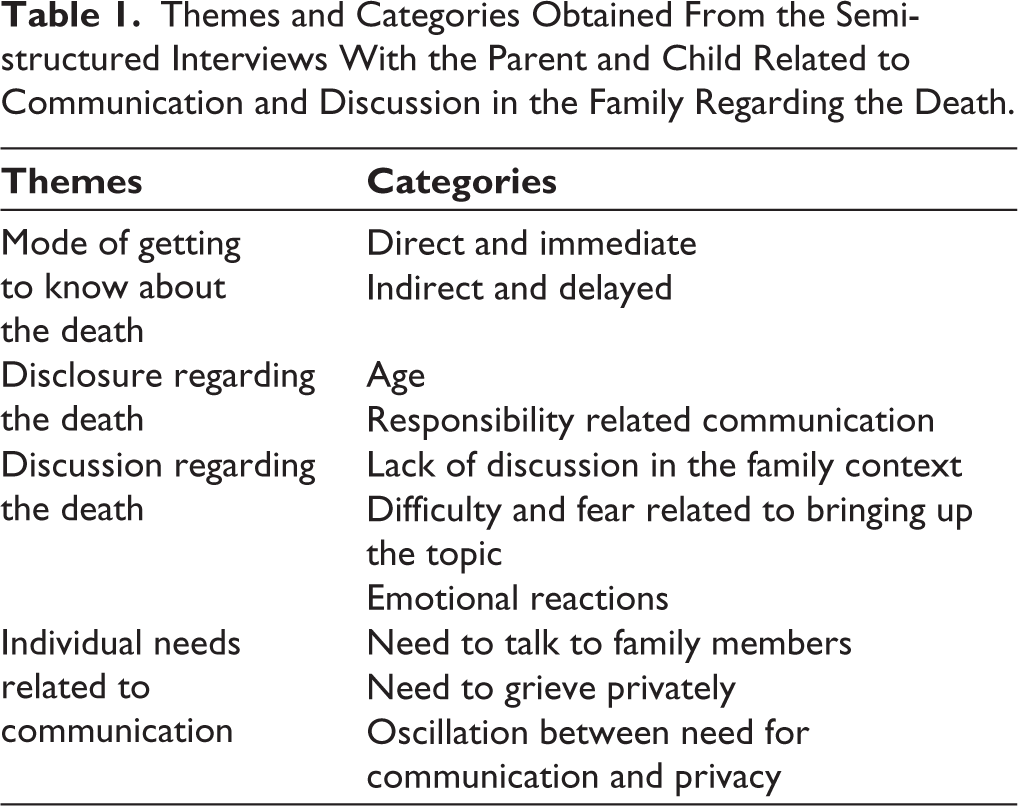
Themes and Categories Obtained From the Semi-structured Interviews With the Parent and Child Related to Communication and Discussion in the Family Regarding the Death.
Results and Discussion
Sample Characteristics
The sample comprised 24 children and 17 surviving parents. Ten children were taken from single-child families while 14 children were taken from families with two children. 88.23% of the deceased parents were fathers, while only 11.76% were mothers. The mean age of the deceased parent was about 35 years, and the age range varied between 27 and 45 years. The average time duration after parental loss was 9 months, with the time ranging between 3 months and 2 years. The age of the surviving parents ranged between 24 and 32 years. Most of the surviving parents had completed secondary education (58.82%). 82.35% were employed, while 17.65% were homemakers. Majority of them belonged to LSES (70.59%), while the rest belonged to MSES (29.41%). 50% of the children in the sample were in the age group of 5–12 years, and 50% of the children were aged between 13 and 17 years. There were slightly more boys (54%) than girls in the sample (46%). The majority of the children (45.83%) were studying in primary school, 25% were in secondary school, and a few of them had completed secondary schooling (16.67%). Most of the children in the sample were students (71%). 20.83% of the children in the sample were employed, and a small percentage of children were not studying or employed (8.3%).
The interviews with surviving parents and children were subjected to thematic analysis and screened thoroughly by following an inductive method 24 with the aim of exploring family communication following parental loss due to a road traffic accident.
The interviews were recorded verbatim by writing and then analyzed manually using inductive thematic analysis. Data were coded by the primary researcher by reading every line of the interview in search of themes. Inductive thematic saturation was employed based on the number of codes or themes identified.
Thematic analysis of semi-structured interviews with surviving parents and children was carried out to obtain an understanding of the pattern of communication and discussion in the family regarding the death. The themes and categories that emerged are enumerated in Table 1
I. Mode of getting to know about the death:
Direct and immediate: It was seen that some children got to know about the death immediately either because they were present with the parent when the death took place, or because they were the first to be informed. The mother of a 13-year-old boy who was with his father during the accident said
My son was riding pillion on the 2-wheeler with him, and my daughter and I were coming in bus. We reached there about half an hour after the accident happened. Phone had broken and my son had not informed us. When we reached there, the boy was just standing there crying and my husband was lying on the road. The father of a 5-year-old boy who was with his mother when she died in the accident reported
My son was there with her when it happened. Her death was instant. He just had a few scratches. He kept saying on the phone ‘Daddy, please do something. Save Mummy. She is not alright’. When I reached hospital, they told me she was dead and he was not walking. I was scared. But the moment he saw me he jumped from the bed and ran toward me saying Daddy, save Mummy. Indirect and delayed: Some children got to know about the death after it occurred, through a family member, or through other means. A 17-year-old girl who was not at home when her father died reported
I had gone to my native for my cousin’s engagement. That night, uncle and aunty said that my father was not well and we have to go home. They did not tell me anything else. When I reached home, my mother and brother were crying uncontrollably. That is when I realised that he had left us. A 16-year-old boy who was studying in a hostel and was not at home reported
His (father’s) friend did not tell me anything. He just said we have to go somewhere urgently. When we reached hospital, I asked uncle why we are here. He said father is not well and broke down. When we got out at Emergency, I started getting worried that it is a serious matter. Only when I saw father’s dead body, it struck me.
II. Disclosure regarding the death:
Age: With respect to disclosure regarding the death, the pattern was found to be different depending on the age of the child. In the case of younger children, communication tended to be more indirect. The mother of a 5-year-old boy who did not know that his father had met with an accident and was in the hospital said
I had to be with my husband in the hospital most days. I would come home for a day or 2 and go back. After some days, my son started asking where his father was. My mother initially told the boy that he had gone to their native place. When he started demanding to speak to his father, my brother spoke to him over the phone, pretending to be his father. A few days later, I took my son to hospital in the hope that my husband would respond to at least his voice. But when my son saw my husband lying in the bed with bandages and plaster, his reaction was of fear. He refused to recognize his father, ran out of the room, and refused to come back. After father’s death, my brother tried telling him but he would not even listen. It was only when they brought the body home that he realised that his father had died. The mother of a 5-year-old girl reported “When my daughter kept asking about where her father was, all of us told her that her father had gone to God and now she should pray to father also when she prays to God.” The mother of a 5-year-old boy said “I had my daughter a few months after my husband died. All my relatives told my son that his father has come back in the form of his sister.” Older children got to know about the death earlier (often even before the surviving parent), in greater detail and in a more direct manner. A 19-year-old girl who found her father injured on the road said
I was just coming back from the factory. When I reached the road near my house, many people were standing around. I saw my father’s bike fallen down. He had fallen on the side. I rushed and a few of us took him to hospital but he was dead by the time we reached. A 16-year-old boy who was told about his father’s critical condition by his uncle said “Uncle called me and said that father had got hurt in an accident. He asked me to come to hospital immediately and not inform my mother or sister. Father died by the time I reached the hospital.” Responsibility-related communication: In the case of older children, it was also seen that disclosure about parental death was often accompanied by a communication of the need to take up the responsibility of the family. This communication also seemed to differ based on the gender of the child. Boys seemed to receive communication related to financial and functional head of the family responsibilities while girls tended to receive communication related to caregiving responsibilities. A 15-year-old boy reported having been told by his uncle “You are the person who has to handle all responsibilities and run the house. There is no time for study and play now. Find a job and earn money.” A 17-year-old boy was told by his grandfather “Studies cannot be a priority any more. Find a job and focus on getting your sister married as soon as possible.” A 16-year-old girl reported having been told by an aunt “You have to replace your mother at home now. Look after your grandparents and father and sit at home.” A 19-year-old girl reported that her mother told her “You are the mother to your brother henceforth. I don’t know how long I will be around. You will have to bring him up.”
III. Discussion regarding the death:
It was seen that discussion regarding the deceased person varied between families.
Lack of discussion in the family context:
Some surviving parents and children reported never talking about it in front of each other. One mother said “We never talk about it. Maybe they talk to their friends. I do not know. I do not ask them. I am scared it will upset them.”
A boy said “It is almost like nothing has happened and father will come back any moment. None of us talk about it, but all of us know he has gone forever.”
Difficulty and fear related to bringing up the topic:
A father reported his fears in broaching the topic with his young 5-year-old son. He said
I never brought it up for months after she (mother) died. Elders in the family advised that it is important to talk about it to him about it. So, one day when we were playing, I casually asked him ‘Do you know what happened to Amma?’ He just replied saying of course, she has gone to God, no?
Another mother while talking about her 5-year-old daughter. “She asks me lots of things. How did Daddy die? Did he do something bad that God took him away so soon? I do not know what to say”
Emotional reactions:
A mother reported how all the family members become emotional remembering the deceased father at dinner time because dinner was a nightly family ritual when he was alive. She said “We all cry remembering him when we eat dinner together every day. All of us used to love this family time. He would be cracking jokes and all of us would be laughing. It used to be the best time of the day.” A 16-year-old boy who had recently started using his deceased father’s scooter said “My mother still breaks into tears every time I use Dad’s scooter. It has almost been a year. But she still cries.”
IV. Individual needs related to communication
Need to talk to family members: Some bereaved youngsters reported that they felt the need to talk to their siblings or parent about the loss. A 16-year-old girl reported “I feel like I want to talk about how I miss mother so much. No one else can understand this except my elder sister. But she is too busy now with her family life. I miss having someone close to share this with.” Yet another 11-year-old boy reported “Grandparents get upset when I ask about father. So, I never bring it up in front of them. I want to talk about it but I do not want to hurt them. Hence, I keep quiet.” Need to grieve privately Some of the participants reported that they preferred not to talk and chose to be alone when grief overwhelmed them. A 17-year-old boy reported “I feel sad sometimes when I remember father but I do not like discussing it with anyone. I feel better after I am alone for a while.” Yet another 13-year-old girl said “Yes. I miss my father a lot. But I do not like to talk about it. Most people do not understand.” Oscillation between need for communication and need for privacy There was also a tendency for some youngsters to feel the need to talk about their experience at times, and wanting to grieve privately at other times. A 17-year-old girl reported “When I miss my father at times, I like to share the good memories with my sister, and we remember his jokes and laugh. At other times, the pain becomes too much and I just want to be alone.” A 15-year-old boy said “Sometimes when I am sad, it helps to talk to my close friend about him (father who passed away). But sometimes, I get irritated when people keep asking about it and just want them to leave me alone.”
Discussion
The aim of the study was to explore parental loss-related communication in families of children and adolescents who have lost a parent to a road traffic accident. Four major themes in relation to patterns of communication emerged from the semi-structured interviews—mode of getting to know about the death, disclosure regarding the death, discussion regarding the death, and individual needs related to communication.
With respect to communication and discussion in the family regarding the death, some children got to know immediately, while others were told about it at a later point, usually by a relative. Older children got to know in a more direct manner and this communication was often accompanied by the need to take up family responsibilities. Younger children, in contrast, often got to know about death in a far more indirect manner. Surviving parents were unsure of how to bring up the topic of parental death with younger children. This finding is partly in line with some previous research in the area, which found that younger children were often not told the circumstances of the death. 25 A review of studies on parental death by suicide and its effect on children found that children often felt excluded and invalidated. They expressed a desire to be included in the bereavement rituals and sought to be reassured. 26 On the other hand, more recent qualitative research, albeit with a very small sample indicates that parents understand the importance of open communication with their children post-traumatic parental loss and do initiate conversations about the lost parent. 27
Discussion regarding the death in the family context was seen to evoke myriad emotions for both surviving parents and children, ranging from avoidance of talking about it, to fears related to bringing up discussion related to the loss, and sadness at times. The tendency to avoid communication with children regarding loss has been pointed out in a recent systematic review of qualitative work in the area. 28 Researchers examined the effect of family communication patterns on grief reactions following death in families, and found that increased perceptions of communication before a death in the immediate family contributed to feelings of personal growth and decreased detachment. 29 Some research has concluded that communication by adolescents with the mother about the deceased father was positively related to adaptive grief and self-esteem, may be advantageous for maintaining belief in a meaningful future and can help bereaved adolescents and the surviving parents to cope better with the situation.30,31 Researchers also opine that shared acknowledgment and a collective experience of the loss post-death in the family facilitates both short-term as well as enduring adjustment for family members. 32
It was also seen that communication related to the loss was a highly personal experience, with some children feeling the need to talk about the loss, others preferring to grieve privately, and several others vacillating between wanting to talk and wanting their space. Some available literature indicates that restricted “mourning behaviours” in terms of lack of adequate communication and the absence of shared grieving were potential predictors of depressive symptomatology in later life. 33 Other researchers on the other hand reported children feeling excessively pressured by their parents to be emotionally expressive. 34 Thus, a delicate balance may need to be maintained when sharing grief communication. 35
In sum, the results of this study are largely in line with previous work in the area, and it is likely that communication regarding the death in the family context is desirable and can enable healthy grieving. The study is limited by its small sample size and the lack of quantitative measures. Future studies may consider employing a mixed methods research design in order to analyze family communication in relation to traumatic parental loss, to arrive at more definitive conclusions. Nevertheless, the findings point toward a need for open communication in Indian families post-parental death, particularly in a road traffic accident, due to the traumatic nature of the loss. Keeping this in perspective, there is a need for Indian psychologists to come up with short-term interventions that can enhance family communication in the light of traumatic parental loss.
Footnotes
Declaration of Conflicting Interests
The authors declared no potential conflicts of interest with respect to the research, authorship and/or publication of this article.
Funding
The authors received no financial support for the research, authorship and/or publication of this article.
Statement of Informed Consent and Ethical Approval
The study was accorded Ethical Committee Approval vide Ethics Committee (NIMHANS) (NIMH/DO/ETHICS SUB-COMMITTEE 23rd Meeting 2015). Written informed consent as well as assent where appropriate was taken from all the participants. The study was carried out in accordance with the principles as enunciated in the Declaration of Helsinki.
Appendix 1
How are you doing? How are all the other family members? How have the children been doing? What were the circumstances of the accident? How did you get to know about it? How did the others in the family and the children get to know about it? How have you been dealing with this sudden loss? What is your support system like? Do you talk about the loss at times? Does it come up during conversations with others? How do you respond to questions from the children and others? Do others in the family bring up the deceased person at times? Has life changed for you in some ways after the loss? If yes, how? Is there anything else you would like to share?
Appendix 2
Rapport building through informal discussion—Name, Age, Class, Hobbies, Friends How did you get to know about the incident? How have you been dealing with this loss? Do you feel the need to talk to someone at times? If yes, who do you approach? Do you talk about the loss at times? Does it come up during conversations with others? How do you respond to questions from friends and others? Has life changed for you in some ways after the loss? If yes, how? Is there anything else you would like to share?