




Abstract
Background:
Autism is a developmental disorder that impairs the skills related to behavior, communication, interaction, and learning. This study was undertaken to understand the difficulties faced by caregivers in various aspects of life while taking care of children with autism and their unique life experiences.
Methods:
After obtaining ethical approval, the study was conducted in a tertiary care hospital in Bangalore, India. An informed consent and a subject information sheet were taken to obtain permission from the subjects. A baseline proforma was prepared for collecting the demographic data for both autistic children and the caregivers. An in-depth, face-to-face, semi-structured interview that consisted of around 10 questions was conducted for 30 minutes. The interview was recorded, later transcribed verbatim, and extracted into specific themes and subthemes.
Results:
The lived-in experiences throw light on many emotional, social, psychological, and physical distress the caregivers go through on a day-to-day basis. The daily hassles of every caregiver are unique and challenging. Five themes and corresponding subthemes were extracted as follows: emotional meltdown, change in family dynamics, spiritual transition, perceived social burden, and perception of a child’s future.
Conclusion:
The caregivers of children with autism faced various challenges such as physical and emotional turmoil, financial constraints, and the deprivation of a healthy social life almost every day. Interventional measures such as nurse-led clinics, counseling measure, and planning training sessions for nurses to deal with the various issues faced by the caregivers could be taken up to address the growing concerns of caregivers of children with autism.
Introduction
Autism spectrum disorder (ASD), being a developmental disorder, causes a burden to caregivers. Lived-in experiences are subjective events that require constant care for the patients. They revolve around financial constraints, disruption of the family routine, and changes in family roles and responsibilities. The caregivers have a lot of unaddressed emotional issues, worries, and feelings of guilt and shame while caring for the patients. 1 Exploring the lived-in experiences of the caregivers of patients provides an insight regarding the required needs and support of family members. It helps in the ventilation of the psychological distress they undergo in day-to-day life. Early diagnosis and availability of support services can help improve the self-efficacy of caregivers, thereby reducing the perceived caregiver burden. 2
Though caregiving is a normal parental duty, providing intensive care to a child with a long-term problem is burdensome and impacts both the physical and mental health of caregivers. 3 The pervasive and severe deficits often present in children with autism are associated with a range of difficulties for caregivers, including decreased parenting efficacy, increased parenting stress, and an increase in mental and physical health problems compared with parents of both typically developing children and children with other developmental disorders. In addition to significant financial strain and time pressures, high rates of divorce and lower overall family well-being highlight the burden that having a child with autism can place on families. These parent and family effects reciprocally and negatively impact the diagnosed child and can even serve to diminish the positive effects of intervention. 4
Children with ASD could often require additional primary care and long-term specialized medical care. It could additionally become traumatizing if the caregivers have a history of any forms of medical or mental illness or when they lack any kind of support among such crisis. The caregivers have different levels of experience as they care for children with ASD. The experience and perception of the disorder in day-to-day life vary from one caregiver to the other. Each of them has a unique experience in dealing with children with autism their daily life. 5
A qualitative phenomenological study was done among nine caregivers of autistic children. An in-depth interview guideline was used to collect the data. The results showed that mothers raising children with autism encountered numerous problems in their life. They felt physically exhausted due to the continuous supervision of their child. They underwent emotional problems such as denial, upset, and worry. In addition, all mothers faced social problems such as social blame, isolation, and ignorance from their relatives and society due to the atypical behavior of their child. An acute financial crisis was also reported by the parents. 6
A similar study was conducted in Goa, where a total of 12 parents of children with autism were included. The parents’ primary concerns revolved around various challenges, including culture-specific problems, their child’s inappropriate social behavior, and the difficulty in fully meeting their child’s basic needs. 7
A qualitative study was conducted in Chennai, a city in India, that aimed at exploring the expectations and attitudes of parents while raising their children with autism. The results mainly throw light on the challenges faced by parents in various domains, such as the academics of their child and unacceptable behavior in social and family setups. 8
Most interventions for autism are evaluated only in terms of child outcomes, ignoring parent and family factors that may have an influence on both the immediate and long-term effects of therapy. The present study methodology dives deep into the unique experiences survived by them that will help give a framework to health care professionals to deal with the various concerns of parents as well.
Materials and Methods
The study follows a qualitative research design. The subjects were selected using an inclusion criterion; that is, all the subjects must belong to the age range of 18-60 years of age with at least six months of caregiving. According to the exclusion criteria, the caregivers should not have any chronic physical or mental illnesses. (Caregivers refer to those who have been taking care of the autistic child for a period of six months and more).
The study was conducted in tertiary care centers in Bangalore. The population comprised caregivers of children with autism. A purposive sampling technique was used. Subjects were recruited based on inclusion and exclusion criteria. An interview guide was used for data collection. Data redundancy was reached in the 22nd sample. A semi-structured interview guide consisting of 10 questions was used to explore the lived-in experiences of caregivers of children with autism. It took around 30 minutes per participant. With prior consent, the interview was taped. To maintain confidentiality, each participant was given a code number. After recording, the entire audio was transcribed. The important domains were identified from each subject verbatim and grouped into subthemes to which individual relative themes were allotted.
The entire purpose of the study was explained in a language understood by the subjects using a subject information sheet. Informed consent was used to obtain permission from the subjects. A proforma to elicit baseline variables for caregivers and children with ASD was used. It consisted of age, gender, marital status, relationship with the patient, socioeconomic status, and educational status, whereas the proforma obtaining baseline variables for children with autism consisted of age, gender, education, birth order, and any other forms of therapy being received by the child.
Data analysis was done by decoding the taped audio, followed by identification of similar patterns of lived-in experiences, grouping them under relevant themes and sub-themes.
Results
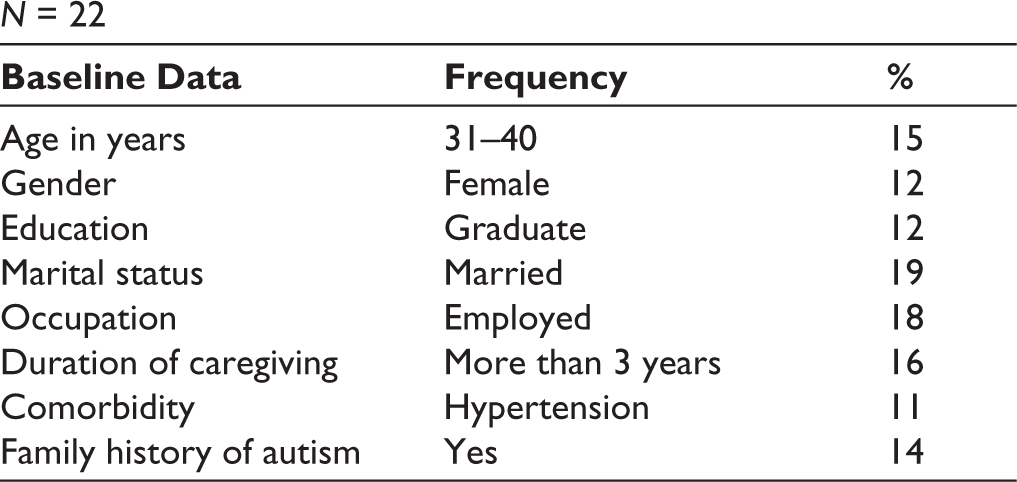
A total of 22 parents were interviewed. Fifteen of them belonged to the age range of 31–40 years, and 12 of them were mothers. Twelve of them were graduates, and around 19 were married. Eighteen of them were employed; however, four of them had given voluntary resignations. The baseline data is presented as follows:
N = 22
Discussion
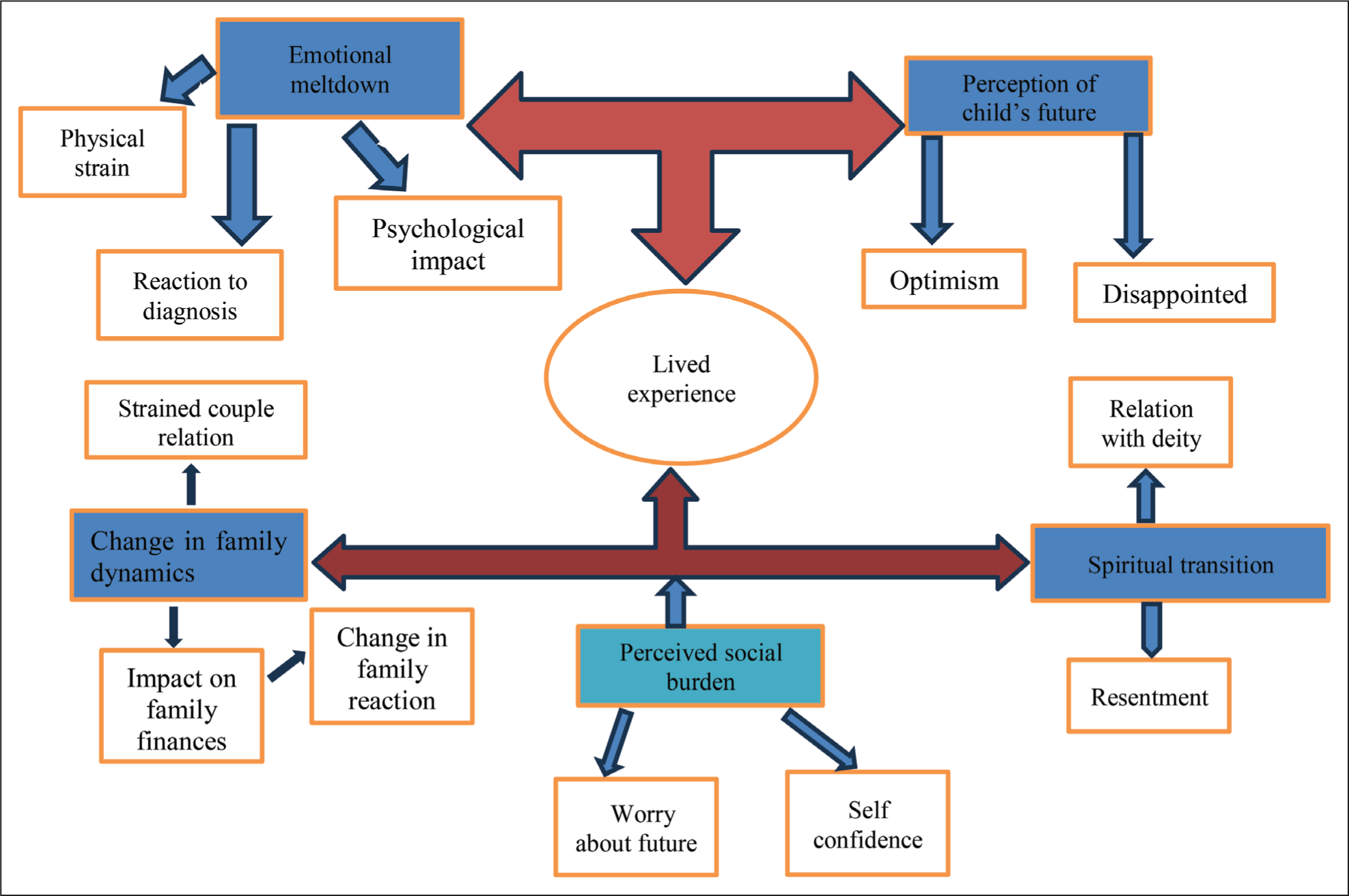
The inner circle in Figure 1 denotes the core holding the different physiological and psychological aspects of the caregivers. The circle branches out and opens up the vital themes. The warm colors like brown signifies the connectivity of the theme to its central core. The cool colors like blue and white represent the essence in identifying the vital elements that disturb the life of a caregiver from different aspects.
Schematic Representation of Lived Experiences of Caregivers of Autistic Children.
In the study, a majority of the participants reported despair, hopelessness, a lessening of their work productivity, and increased collisions in marital life. They reported going through a lot of psychological distress. They were unable to carry out many roles in the family, and it made them feel dissatisfied with themselves. Five themes were extracted, as presented in Table 1.
Lived Experiences in Caregivers Among Autistic Children.
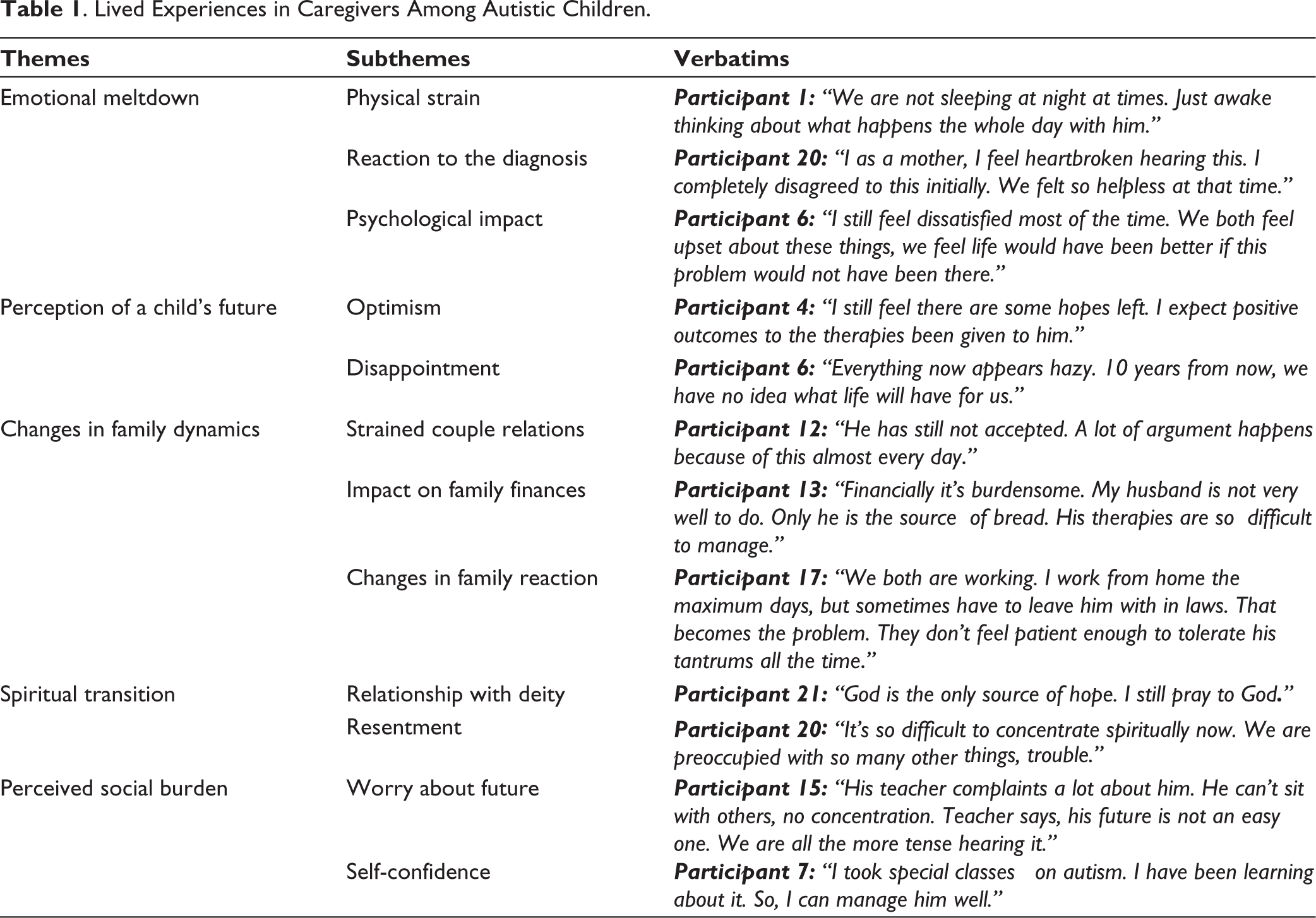
The first theme was emotional meltdown. The caregivers mainly expressed how they reacted to the diagnosis, the amount of physical strain, and the psychological impact. They expressed feelings of frustration, emptiness, instant denial, and lack of sleep. This could be suggestive of the fact that they were overburdened and had immense physical and emotional reactions. A similar study done in Chaiwan district, Nepal, showed that mothers of autistic children suffered physical and emotional burnout, with most of them complaining of sleeplessness, headaches, muscle aches, and emotional fatigue. 7
The second theme was the perception of a child’s future. The perception of a child’s future has been viewed differently by the caregivers. While a few caregivers were still hopeful about a child’s future, others were disappointed and directionless about it. Around seven of the caregivers expressed optimism and had hopes for the future, hoping for recovery. Such caregivers had some knowledge about autism, but few took special courses on raising children with autism. However, few of the caregivers expressed disappointment; they felt despair, had uncertainty, were constantly sensing uselessness in foreseeing the child’s future, and were deprived of proper guidance. A study done in Nepal among parents of autistic children revealed that the majority of them experienced sole disappointment regarding their children’s future. Few parents expressed that they faced substantial changes, which resulted in a cause of worry among the parents regarding their child’s future. 7
The third theme was changes in family dynamics. There was a wide aspect covering this theme. The caregivers expressed the severe impact on family finances. Most of them had strained couple relations and an increase in the frequency of anger outbursts and marital discord. Most of them had a change in family reactions after having realized the diagnosis of the child. Few mothers spoke about being blamed by their family for the child’s diagnosis. They found it embarrassing to ask for financial help from others. Around four mothers had to take voluntary resignations as they found it difficult to contribute to the needs of their children. The caregivers faced comparisons being made with other children. A relative study conducted in Nepal revealed that there were acute economic problems because of the child’s treatments and therapies that had resulted in financial strains and collisions among family members. 8
The fourth theme was perceived social burden. The caregivers felt the stigma of autism. Their social life was greatly disturbed. They faced socially embarrassing situations because of the child’s behavior, such as spilling food, crying, and head banging. Their participation in cultural events in society was impacted, and most of them had feelings of being isolated in society. In a similar study done in Goa among 12 parents, it was revealed that initially there was social cohesion. Over a period of time, there were social conflicts and stigmatization, gradually leading to isolation. Parents reportedly experienced a difficulty in adjustments and increased social challenges. 9
The fifth theme was spiritual transition. About six caregivers continued to have faith in God. They kept their hopes alive, praying for a secure life and confiding in God. However, the majority of them questioned their faith in spirituality, thus doubting a spiritual existence. A supportive study done among Iranian mothers showed three domains of spiritual journey. The main reflection was descent (where mothers expressed sorrowfulness and disconnection with God); some Iranian mothers still had a connection with the deity, whereas some subjects tried reflecting on this challenging journey of theirs. 10
Nurse-led clinics could be an important landmark in addressing the concerns of parents of children with ASD. There is a need to utilize nursing services and knowledge in areas where they are enriched with core competencies needed for patient care. A lot of emotional, social, and physical concerns could be worked upon with the help of nurse-led clinics. Such clinics could be an innovative approach where the nurses could exclusively focus on the caregiver’s needs and intervene appropriately.
The nursing practice has pointed out the need to take measures to attend to not only the children but also the parents undergoing several levels of burden. Training programs for senior nurses were conducted, so that they become the first point of approach for the parents who are dealing with various physical and emotional issues. The study will help to implement counseling services for caregivers of autistic children. Establishing and strengthening nurse-led clinics could be done by the administration. A follow-up study could contribute to creating an intervention module for the caregivers of autistic children, focusing on the various domains as highlighted in the study. The study highlights the need to set up awareness camps to eliminate social stigma around autism, involving nurses in sensitization and education programs on various factors leading to autism and the interventions possible for patients.
The phenomenological approach of the study was suitable to explore in depth the daily experiences of caregivers of autistic children. An in-depth interview with the caregivers helped reveal their unique experiences and perceptions.
The interview dealt with sensitive questions about the personal life domains of caregivers. Therefore, building an IPR and gathering in-depth information was a challenge.
Most of the caregivers were under a time constraint and hence found it difficult to give their attention and focus during the interview sessions.
The various themes identified in the study brought into focus many concerns and challenges that caregivers shoulder on a day-to-day basis. Many important parameters with regard to social life, financial and family life, and emotional aspects were depicted in the study. The findings of the study are certainly crucial and would encourage the development of an intervention module for future follow-up studies.
Footnotes
Acknowledgements
The authors would like to thank all the subjects and their families for their cooperation during the study.
Declaration of Conflicting Interests
The authors declared no potential conflicts of interest with respect to the research, authorship, and/or publication of this article.
Ethical Approval
An institutional ethics committee approval was obtained before the study was conducted (study number IEC/1/619/2021, reference number 270/271. St Johns College of Nursing Bengaluru, dated July 12, 2021.)
Funding
The authors received no financial support for the research, authorship, and/or publication of this article.
Informed Consent
The patients’verbal and written consent was taken before conducting the interview. The study was carried out in accordance with the principles as enunciated in the Declaration of Helenski.