




Abstract
A rich and long-standing history of creative arts as an instrument for healing, growth, and self-expression, especially amongst children and youth, has been well-documented across time and cultures. Arts-based therapies within the mental health community have also garnered increasing support for positively contributing to the well-being of various groups and individuals. Therefore, this article further examines the use of arts-based therapy in an eight-session therapeutic group with children. Five children in the age range of 9–12 years met weekly for a course of two months at a child and adolescent mental health service in Delhi-NCR, India. Over the course of these 8 sessions, the individual and collective journey of the group members witnessed many ebbs and flows, eventually leading to a positive shift in the inter-group dynamics. In addition, various therapeutic gains were observed and reported for the group members, showing an increased sense of collaboration, confidence, and community.
Introduction
The Arts in Healing
The idea that the creative arts can be used in the process of healing is not a new one. It has been richly embraced and practiced by different cultures over the years. Throughout recorded history, people have used music, chants, dances, rhythms, and stories as healing rituals. Our own culture is replete with stories of the use of artistic media in their diverse forms being at the center of the healing process—whether we look at the healing rituals of the shamans and mystics or the use of dance and music in psychological processes such as rites of initiation, grief, and celebration 1 . We ourselves have grown up being a part of community-based artistic rituals and practices such as story circles, musical gatherings, and festive celebrations.
Arts-based therapies make an attempt to combine this traditional and universal human affinity for the art forms, with the systematic and evidence-based methods of science, for the specific purposes of healing and therapeutic benefit. Various forms of arts-based therapy (ABT) currently exist in clinical practice. As a discipline, the ABTs have historically moved from the arts being used in an integrated way in healing to the formation of distinct therapeutic modalities based on specific art forms, such as music therapy, art therapy and dance therapy.
More recently, however, it is being acknowledged that the effectiveness of using the arts in an integrated way is far greater than when using any of them in isolation, and this has given rise to what is known as expressive arts therapy in the West and ABT 2 closer home. In these forms of therapy, which attempt to use the arts in an integrated way, there is a concurrence of art forms (drama, music and visual arts). This enables a practitioner to acquire a generic vocabulary of stories, songs, roles, rhythms, drawings and colors and use appropriate combinations to address specific client needs. A notable distinction between expressive arts therapy and ABT is that whereas most expressive art therapy pedagogy and curricula in the West tend to draw from psychodynamic and other philosophical frameworks, ABT tends to lean far more into the roots of arts and healing within the Indian context, and does so from a Buddhism philosophy framework.
Therapeutic Benefit
Research has shown that expressive arts assist in the healing process by altering one’s physiology. When people engage in expressive arts, it alerts the parasympathetic system in their brain. 3 Their breathing slows, their blood pressure lowers, and the body becomes more relaxed. This helps reduce the physiological hyperarousal, or fight-or-flight response, associated with stress.
Neurophysiologists have also shown that “art, meditation, and healing all come from the same source in the body; they are all associated with similar brainwave patterns and mind-body changes.” 3
With children particularly, the arts provide a natural and developmental “fit.” Not only this, bringing an “other” (modality) into the room often provides a safe, non-threatening way of expression and exploration, one that is not purely dependent on language. Children also often learn, explore, and grow best when they are able to experience something in all its dimensions, and the arts, with their inherent spectrum of textures, sounds, colors, and images, allow opportunities for this whole-body-and-mind sensory nurturance. As Chabukswar
4
points out, the arts allow us a novel opportunity to reach a person, where words may not be enough:
The artistic process also presents a complementary counterpoint to mere verbal engagement in therapy—that experience can transcend conceptual barriers to “reach” a person.
4
ABT as a Truly “Indian” Therapeutic Modality
ABT is the evidence-based use of art forms to accomplish individualized goals within a therapeutic relationship. It is practiced by a credentialed professional who has completed the year-long ABT Certificate Course.
The study and practice of ABT is based on the “view” of systems and practices in health, psyche, and the arts from an Indian perspective. 1
Traditionally, in India, all art forms, including drama, are strongly “integrated.” This integration at one level is the coming together of all arts in performance—dance, music, rhythms, puppetry, etc. At another level, this integration is also of the arts in everyday life, rather than for their performative value alone. It is these elements of integration and everyday wisdom that ABT attempts to bring to the process of healing.
The Documented Efficacy of ABT
Arts-based therapy has been used in both individual and group settings with a diversity of client populations. Its efficacy has been well documented across the age span, in both adults and children, as well as across a diversity of client populations, such as trauma survivors, children and adults with special needs or those with a mental illness, delinquents, addicts, and victims of domestic violence. In fact, various research studies have highlighted the positive implications of ABT on the emotional, social, and mental well-being of child participants.5,6 Children have also been noted to experience a sense of safety, upliftment, and hope through this creative medium of self-expression. 7
Philosophical Framework and Basic Principles
Apart from the use of arts, ABT is based on the subtle energy guide (SEG), which includes Indian psychology and ethics and studies of human development and cognitive neurosciences. Some of the core guiding principles of ABT, which were followed while conceptualizing, planning, and working with this particular group, are enumerated below, and discussed in some detail, along with their application, later in the chapter.
Using the arts in an integrated way
Gradation
Session design
Beginning before the beginning
Session boundaries
An ABT session belongs as much to the participants as it does to the facilitators
About Children First and the Use and Evolution of ABT Within the Service
All the sessions were conducted on the premises of a child and adolescent mental health service located in Delhi-NCR. This is a multidisciplinary service comprising psychiatrists, psychologists, occupational therapists, and administrative staff, all of whom come together to service the mental health needs of children and youth up to the age of 25 years and their families.
Although the therapists come from a diverse variety of training and qualifications, there is a clear emphasis on integrating the use of play and the arts within the work. The first therapist from the service got trained in ABT in 2013, and some others have subsequently received training in ABT, as well as in other allied modalities such as Neurodramatic Play→ 8 , and other expressive art therapies. Regardless of training, all therapists are encouraged to use arts, play, and storytelling in their work with children.
Method
A Snapshot of the Group
In order to identify and locate potential participants for “The Art Circle,” posters and e-mailers, outlining the broad goals and eligibility for the group, were sent out to parents already enrolled in the service. Following this, a brief conversation with some of these parents was had, to discuss their hopes for their child’s participation in the group, as well as to explain the methodology and goals.
The group finally included a total of five children, between the ages of 9 and 12 years, who met on a weekly basis for a course of two months at Children First. This included two boys and three girls, each of whom came with a diagnosis of attention deficit hyperactivity disorder (ADHD), autism spectrum disorder (ASD), and/or specific learning disorder (SLD). Our preliminary conversations with the children as well as their families told us that at school, home, and other settings, they were struggling with challenges in terms of distractibility, sustaining friendships, and interpreting social cues and had limited opportunities to experience a sense of community and belongingness with their peers.
The Structure and Design of the ABT Sessions
“The Art Circle” aimed to develop and build upon the group members’ skills of confidence, self-expression, creativity, and social skills, by offering them opportunities to interact individually and collectively, through the medium of the integrated arts—including painting, drawing, craft, stories, and games, among others. As facilitators, we also carried the intention of creating an environment that acknowledges and celebrates the group members’ unique strengths while also providing adequate scaffolding for some of their challenges.
A total of eight ABT sessions for 90 minutes each were held across February and March 2023 in one of the therapy rooms at Children First. The tables were aligned together at the center of the room, with chairs placed across both sides, allowing the group members to face each other. However, this physical arrangement was kept flexible depending upon the group’s individual needs and the activities planned for the day.
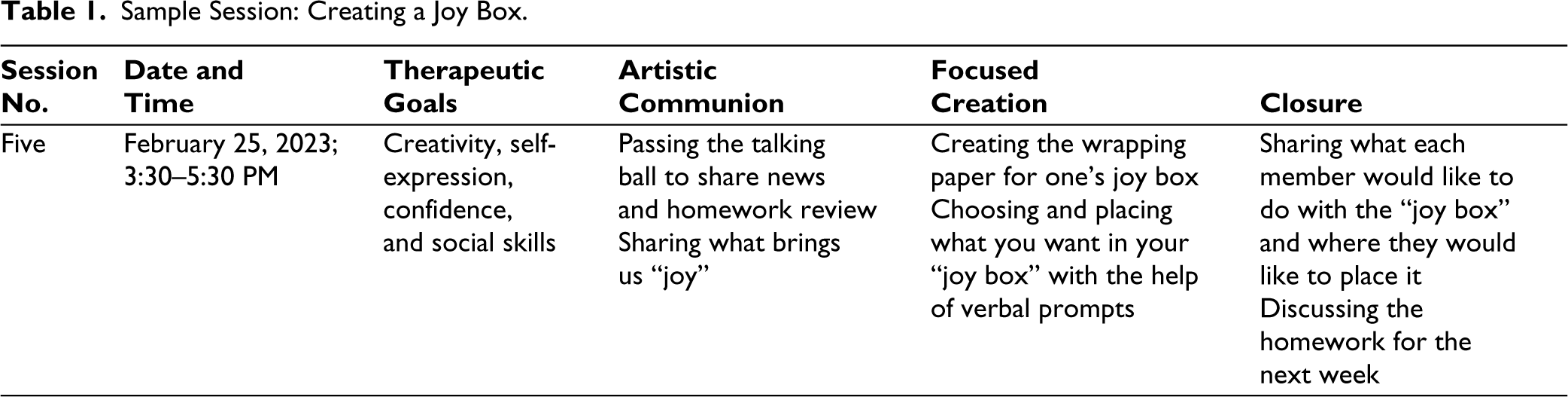
In alignment with the session design principles of the 3Cs, each group session was broadly planned keeping the three principles of communion, creation, and closure, 2 as also illustrated through a sample session in Table 1.
Subtle energy guide practice: This refers to the ABT practitioners’ daily SEG practice in terms of the preparation of mind, body, and psyche for the work of healing, through meditation, breath work, self-immersion in the arts, and setting clear goals and intentions for the session. 9
Session plan: This includes incorporating the feedback and observations from the last session, revising and setting clear therapeutic goals and activities in alignment with these goals, and preparation of space and materials.
Sample Session: Creating a Joy Box.
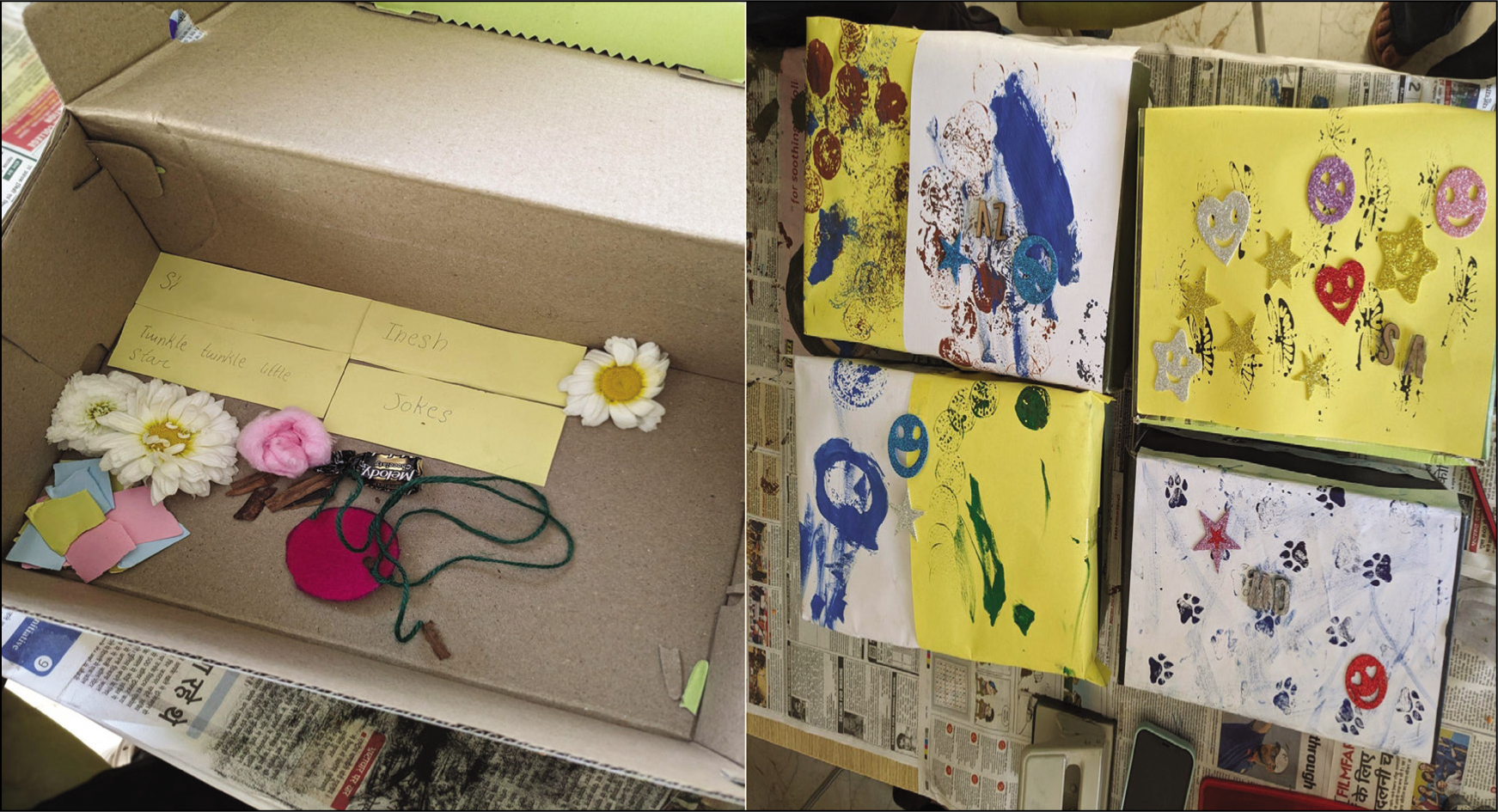
A Glimpse of the Joy Boxes.
Discussion
Starting Our Journey Together
As this group of five young children initially came together, their energy and enthusiasm lit up not only the therapy space but the entire building from the get-go. Every staff member at the service looked forward to Saturdays as “Art Circle” days, helped with preparation, greeted the kids as they came into the waiting area, and loved to have them share what they had made at the end of each session.
As facilitators, we could see how different each of the child was and were curious to see what they may co-create as a group together. In each session, we found ourselves both marveling at the ongoing chaos and frenzy as well as noticing the unique ways they were being and relating to each other. In the subsequent part of the discussion, we will attempt to detail this with process-based observations about the participants while also touching upon the intention and the structure of the intervention.
Z’s playfulness and endearing presence made it difficult for him to go unnoticed. At the same time, despite the best of intent, Z struggled to understand boundaries, figure out the social nuances of friendship, sustain attention, and take perspective. He would love to use himself as a canvas when engaging in art, and because of how immersive that sensory experience was for Z, he would try to smear paint all over others as well! For M, she was quite clearly the self-appointed leader of the group, with a strong sense of right and wrong; however, in doing so she would often come off as being too strict or demanding of the rest of the members. In addition, M would draw in her own meticulous manner and would struggle to complete the activity on time as she was quite focused upon the outcome. SA was the quiet, independent one who preferred to work alone and “do her own thing” in peace. SH wanted to please the facilitator, but also had a unique voice of her own, as we soon discovered. A wanted to approach the group, was curious, but close interaction also baffled and intimidated him.
Some of the core guiding principles of ABT, which were followed while conceptualizing, planning, and working with this particular group, are discussed here in some detail.
Using the Arts in an Integrated Way
Unlike the more recent Western expressive-art approaches that tend to segregate the arts into music, drama, visual art and the like, ABT draws upon our unique cultural history of the arts as integrated. As such, each session was designed in a way as to give both facilitators and participants a “generic vocabulary” of the arts—moving freely between the visual and the verbal, conversation and rhythm, paint and picture.
Gradation
Within each session, and from one session to the next, there was gentle and pre-planned grading of skills. So, for instance, we moved from statements to stories, strokes to pictures, “joy” as a food or a favorite song to “joy” as a physical box/space I can create and access for myself.
Session Design
The process of designing each session in accordance with the 3Cs has been outlined earlier in this chapter. This gentle structure allowed us scope for helping the kids move from the familiar to the unfamiliar, from ritual to risk, and also allowed a safety net of structure when spontaneity took over!
Beginning Before the Beginning
This took many forms with this group. It probably started with conceptualizing “the art circle” as an abstract concept, then moved to fueling it by holding a clear intention within SEG practice, seeking information and referrals from other team members, and getting to know the kids beforehand through reading of files and parent interviews. We also tried to “begin before the beginning” by putting in regular pre-session work in terms of reflecting on challenges, revisiting therapeutic goals, and planning for the journey ahead.
Session Boundaries
We discovered very quickly that each of the children had their own unique profiles that led to some challenges and sometimes rubbing each other the wrong way. For Z, his high need for touch and connection often translated into smothering others with paint too, and this was often not well received. M could come across as caustic and bossy, and A constantly wanted to go out into the balcony. By the third session we proposed a discussion on “group rules,” which elicited active participation from the group, including measures such as supporting people by encouraging them to take a “thinking break” when they were overcome by “big feelings.”
An ABT Session Belongs as Much to the Participants as It Does to the Facilitators
Hoping to lead with the principles of agency, choice, and respect, it was interesting to note how some of the participants gradually took up the role of the facilitators over time. For Z, we noticed that he would finish his activity very quickly and then wanted to do art all over the room and the people! However, we also noticed that he was fabulous at coming up with activity prompts for the rest of the group, and we started building in more and more opportunities for him to do so, which in turn motivated other group members to come up with the same. For A, honoring his sense of agency was sometimes as simple as respecting when he said, “I don’t want to share.” With M, opportunities to practice her leadership skills remained abundant; however, with gentle cues and scaffolding, we noticed how she was able to ask for help, share the art materials, and put across her messages more mindfully now. This in turn allowed her to shift her focus from the individual creation of an art piece to an endeavor that was more collective and collaborative in nature.
From Chaos to community and Finding Community in Chaos!
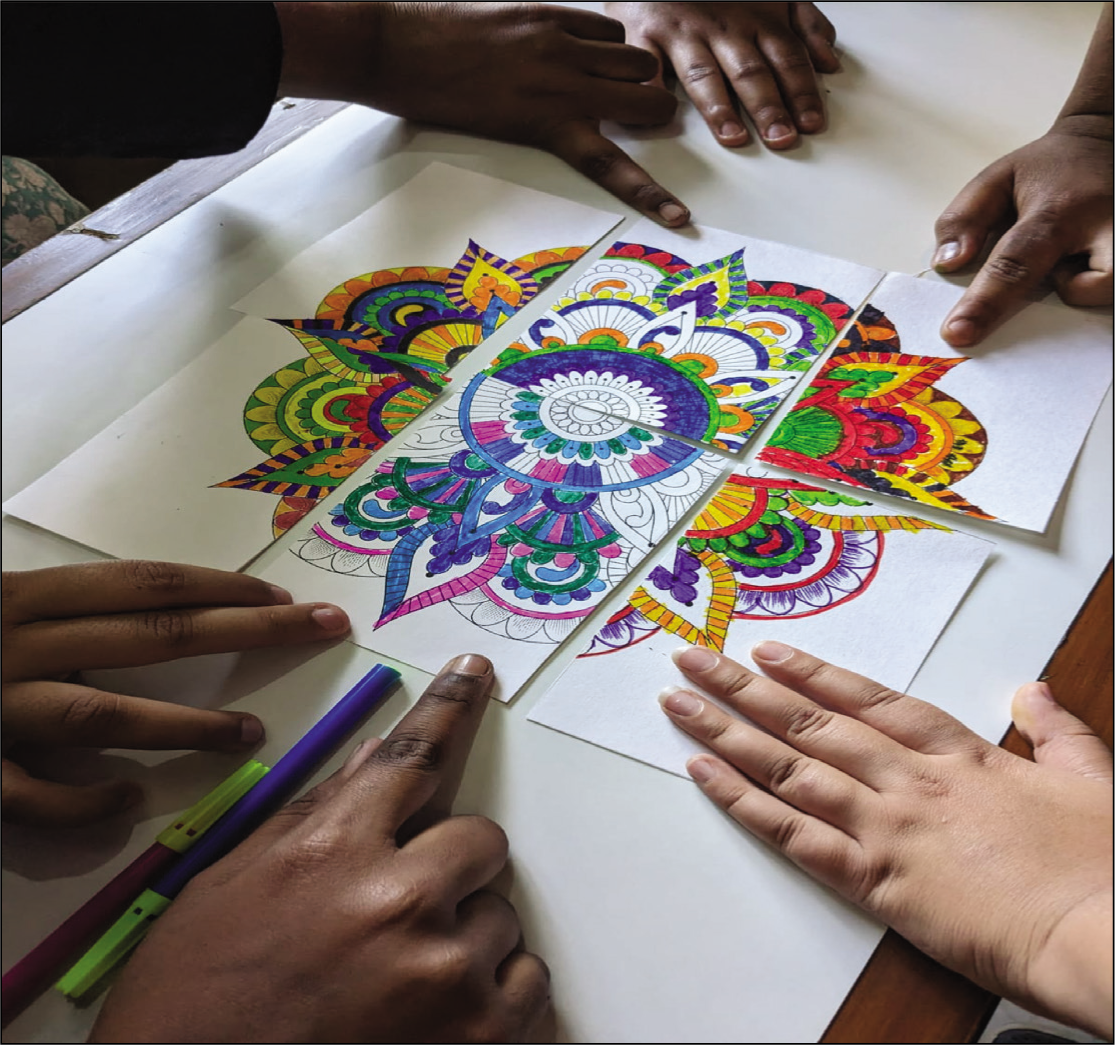
As we moved closer to the final phase of the art circle, it was a delight to notice the coming together of all the group members to prepare for the final “art show.” This involved creating a bunting, preparing badges, facilitating different activities for the parents, and so on, all done by the kids’ themselves. Here, in fact, one could see how Z and A moved from teasing, disliking, and playing with each other’s art to being friends, having fun, and respecting each other. The final art show was a resounding success, with a palpable sense of community and togetherness—the children proudly showed off their art pieces to their families and facilitated games, some parents chipped in to bring food, and there was also some spontaneous singing, in which everyone joined! The children received their certificates, and the session came to an end with children and their parents coloring pieces of a mandala, which came together to make a whole and was displayed on the wall. In so many ways, it felt and looked like a fitting symbol of the very “wholesome” journey we had traveled as a group (refer to Figure 2).
The Final Collective Mandala.
Concluding Reflections and Future Directions
This was the eighth ABT group that was facilitated at this child and adolescent mental health service over the years. And each time, we as therapists and facilitators have been left in awe of what the arts make possible. Many of these kids have been a part of other mental health interventions at our service, and outside, for years. And yet, the ability to access their unique individual strengths, the increased self-confidence made possible by just enough scaffolding and agency, and most important, the sense of community that is made possible through the integrated use of the arts, founded on a strong philosophical and evidence base, is, in our experience, unparalleled.
One of the future directions for examining the medium- to long-term efficacy of this intervention would be to follow the individual journey of these kids as they navigate the real world and other social settings to see how some of the observed effects carry. An arts-based group intervention, with its strong cultural relevance and minimal demand on spoken language, would lend itself not only to a clinical setup but also to classrooms, deaddiction, and rehabilitation centers along with other community settings. In fact, this modality can be used across the rural and urban divide for all age groups. All in all, in terms of both the depth and the breadth of impact, ABT is a highly promising and inclusive modality that we hope finds its way across diverse settings.
Footnotes
Declaration of Conflicting Interests
The authors declared no potential conflicts of interest with respect to the research, authorship, and/or publication of this article.
Funding
The authors received no financial support for the research, authorship, and/or publication of this article.