




Abstract
Background:
Previous studies have shown that children and adolescents living with single parents are prone to behavioral and psychological difficulties and experience a poor sense of well-being. Also, the period of adolescence is critical for the development of an individual in multiple aspects; it is important to focus on their well-being and associated factors for a better transition into adulthood.
Aim:
This study aims to find the mediating role of social competence and emotion regulation on the relationship between resilience and psychological well-being among single-parent adolescents.
Methods:
This was a cross-sectional study. The study sample was 385 adolescents residing in Kerala (179 boys and 206 girls, mean age = 15.03, SD = 1.45). A total of 185 participants (48.1%) were from families that lost either of their parents to death, and the other 200 participants (51.9%) were from divorced or separated families. Self-reported measures for resilience, social competence, emotion regulation, and psychological well-being were used for data collection. Data were analysed using IBM SPSS and AMOS version 24.
Results:
The results showed that resilience, the prosocial behavior dimension of social competence, and the cognitive reappraisal dimension of emotion regulation indicate significant positive associations with the psychological well-being of adolescents living in single-parent families. The expressive suppression dimension of emotion regulation and the antisocial behavior dimension of social competence have a substantial negative connection with the psychological well-being of adolescents raised by single parents. The findings suggest that resilience directly predicts psychological well-being; prosocial behavior and cognitive reappraisal partially mediate the association of resilience and psychological well-being.
Conclusion:
According to our findings in this study, developing social competence skills and adaptive emotion regulation strategies can improve the psychological well-being of adolescents living with single parents. The results have multiple clinical, educational, and community implications.
Keywords
Introduction
The concept of a single-parent family is not new to Indian society, though it has recently been discussed. In India, most cases are due to the demise of a parent, followed by divorce and separation. Moreover, most single-parent families are run by women. 1
As reported, children and adolescents raised by single parents are vulnerable to delinquent behavior, and low developmental achievements, and are more likely to develop psychiatric issues and substance abuse.2,3 Single parents’ psychological anguish has a detrimental effect on the competence, adaptability, and general well-being of their kids.4,5
Adolescence consists of physical, emotional, and psychological changes. The quality and nature of an individual’s adult life depends on how effectively he navigates the transition through adolescence. These transitions are critical because they indirectly shape and modify cognitions, emotions, and behavior, enabling them for their next life stage.6,7 This stage of life is significant and the involvement of parents and other family members could help to strengthen the values learned from family and peer interactions. A healthy and supportive family environment is essential for a child’s social development.8,9
This type of parenting can influence children’s thinking and learning processes. 10 Single-parent households can lead to a lack of parental attention, significantly impacting children. Furthermore, more delinquent behavior may result from a child’s experiences with transitions than from their family’s current or previous structure.11,12 The psychological health of adolescents raised by single parents deserves more attention.
The idea of psychological well-being (PWB) includes elevated levels of pleasant operations that can encompass various relationships with people and the surroundings, both interpersonally and interpersonally. 13 Numerous factors like parenting, social interaction, social support, resilience, and social competence (SC) can directly influence PWB. 14
According to Walsh (1996), adolescents who are resilient enough view divorce, separation, and living with just one parent as an emotive and empowering shift. Moreover, they can identify and use supportive systems and benefits. 15 Children and adolescents from single-parent households who are resilient are better able to cope with stressful situations and circumstances both during and after family dissolution. 16
This review’s insights led to the formulation of the subsequent hypothesis.
Social competence could significantly predict the mental health and well-being of an individual. 17 In general, SC is broadly described as the capacity to create and sustain effective peer interactions and beneficial social outcomes by managing one’s own and environmental resources. 18 Reduced social skills are reportedly common in children from disrupted families, whereas socially competent children experience higher PWB and academic achievement. 19
The following hypotheses were formulated based on these findings.
An individual’s capacity to identify, understand, and integrate emotional information while managing both intrapersonal and interpersonal objectives is emotion regulation (ER). Researchers are investigating how children’s ER abilities are impacted by their sociocultural background, especially family relationships and situations. 20 Adolescent mental health and the connection between mindfulness and psychological discomfort are impacted by ER. Adolescent social anxiety is correlated with non-acceptance of emotion, lack of clarity, and emotional awareness. 21 According to research findings, difficulties in coping with emotions are linked to symptoms of psychopathology. 22 Adolescents’ well-being is correlated to their preferred ER strategy. ER difficulties are associated with low levels of subjective well-being in adolescents. 23 Adolescents living in nuclear families tend to use expressive suppression rather than cognitive reappraisal. Moreover, ER mediates the relationship between parental attachment and empathy in adolescents. 24
In light of these research conclusions, the following hypotheses were formulated.
There is a visible lack of studies regarding adolescents living in single-parent households conducted in the Indian context, although studies have been conducted among single parents regarding their social, emotional, and psychological functioning and mental health.25–27 Therefore, through the present study we have made a sincere attempt to contribute in that direction by verifying the abovementioned formulated hypotheses.
Material and Methods
Research Design
Cross-sectional correlational research was the research method adopted in the present study. Standardized questionnaires were used for data collection.
Participants
This study included 463 single-parent adolescents aged 13–17 (225 boys and 238 girls) from Kerala. Due to missing data, 78 participants were excluded, resulting in a final sample of 385 adolescents (179 boys and 206 girls). Mothers ran 95% of single-parent households. A purposive sampling technique was adapted to select participants. Informed consent was obtained from participants and their parents. More than 95% of the participants were living with single mothers. About 48.1% of the participants were under single parenting due to the demise of one parent, and 51.9% were due to divorce or separation.
Measures
Four questionnaires, including a sociodemographic data sheet, were used in the study to collect self-report data. The tools used were psychometrically reliable and valid. Original questionnaires were in English, and a Malayalam-translated version of the tools was used for data collection.
Brief Resilience Scale 28
This measure includes six items to measure the resilience of the participant with Cronbach’s alpha 0.71.
Psychological Well-being Scale 29
The present study used an 18-item version of the 42-item scale with Cronbach’s alpha of 0.83. On a 7-point scale, respondents indicate how strongly they agree or disagree with each of the 18 statements.
Multisource Assessment of Children’s Social Competence Scale 30
This scale includes 15 items in total with four factors of social competence: cooperation abilities and empathy that measure the prosocial dimension, impulsivity, and disruptiveness measure the antisocial dimension with Cronbach’s alpha of 0.66.
Emotion Regulation Questionnaire 31
The Emotion Regulation Questionnaire is a 10-item scale that measures one’s capacity to manage emotions in two different ways: “cognitive reappraisal and expressive suppression” with Cronbach’s alpha 0.68.
Statistical Analysis
The primary data analysis used frequency, percentages, mean, and standard deviation. The product-moment coefficients were calculated to determine the magnitude and direction of the relationship between study variables. In addition, various other preparatory analyses, including reliability, were determined using SPSS version 24. We conducted a confirmatory factor analysis of the variables used in this study to develop a measurement model with an acceptable model fit. The maximum-likelihood method in the AMOS version 24 was used to test the measurement model. The model fit indices, also known as measures of goodness of fit, help us to scrutinize the observed model by comparing it with the theoretical model. Widely used fit measures are normed chi-square, Probability, root mean square error of approximation (RMSEA), comparative fit index (CFI), goodness of fit index (GFI), adjusted goodness of fit index (AGFI), and parsimony goodness of fit index (PGFI). Various researchers give acceptable levels of these different indices. Normed chi-square is considered good when it is less than 5 and best when it is less than 3. GFI, CFI, and AGFI are good fit indices that show how far the theoretical and observed models fit each other. These indices’ values can range from 0 to 1, indicating better model fitness when the values increase. However, if the value is greater than 0.9, it would be considered the best fit. RMSEA is an imperfect fit measure, and lower RMSEA is always considered a better model fit. Though an RMSEA value less than 0.08 is acceptable, and ˂0.05 is associated with a better model. Mediation analyses were carried out for further research.
Results
Descriptive Statistics and Demographic Characteristics
Following data collection, a frequency analysis was performed in SPSS to check for any potential trends. A total of 463 data were collected from the participants, due to incomplete and missing responses, 78 of them were excluded from the analysis. Further, 385 participants’ responses were analysed using IBM SPSS AMOS version 24.
The mean age of the participants was 15 years, and 46.5% of the sample were males and 53.5% were females. Most of the participants lived with single mothers. A total of 185 adolescents (48.1%) were from families where one parent was deceased, the remaining 200 (51.9%) were from separated or divorced families, and 44.9% of the participants lived in the presence of grandparents. About 70% of the sample is from rural, and only 30% are from urban settings.
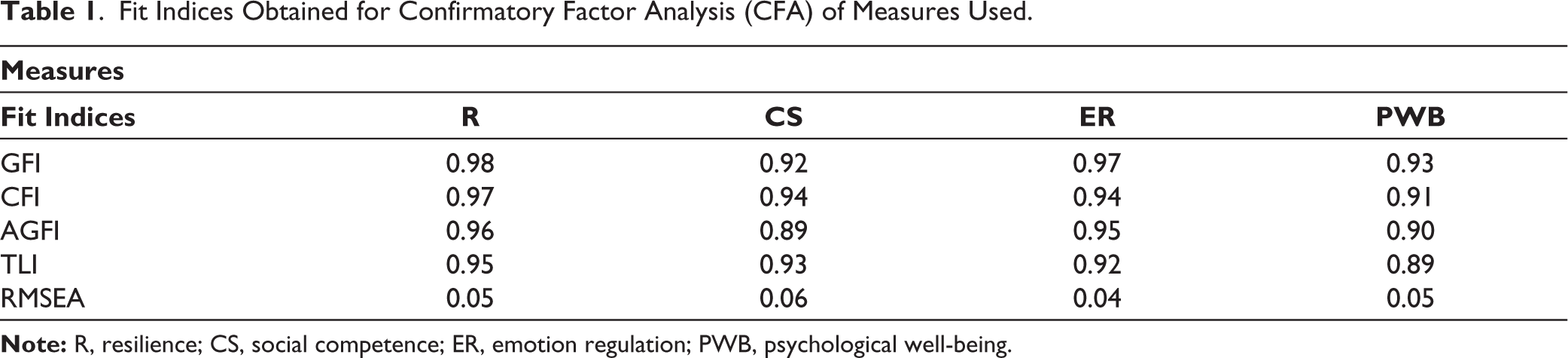
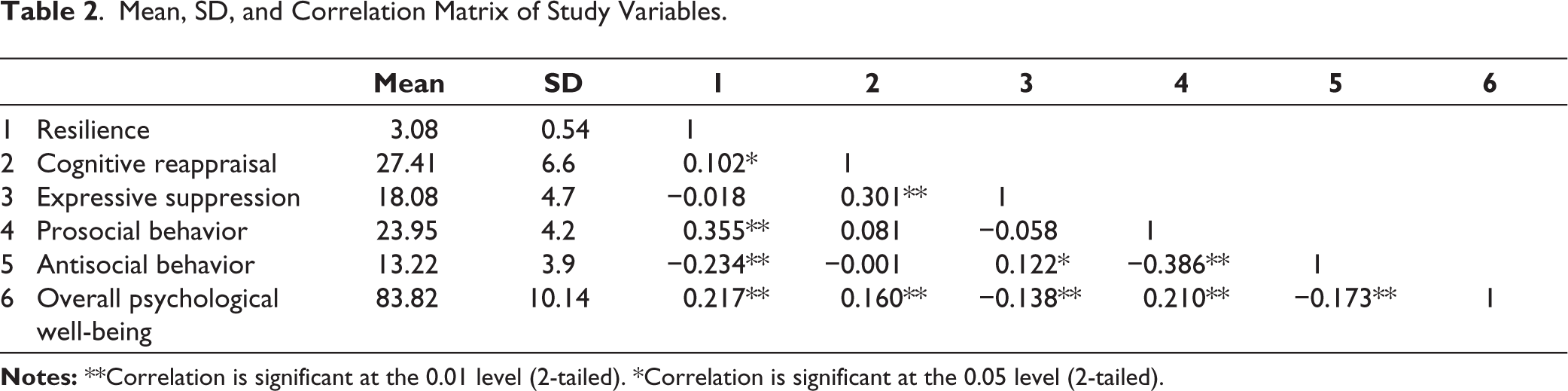
The descriptive statistics for the study variables depict that the average (mean) PWB reported by single-parent adolescents was 83.82 (SD = 10.14). The mean resilience, prosocial behavior, antisocial behavior, cognitive reappraisal, and expressive suppression are 3.08 (SD = 0.54), 24 (SD = 3.6), 13.2 (SD = 3.8), 27.41 (SD = 6.6), and 18.08 (SD = 4.7), respectively. Resilience shows a significant positive correlation coefficient with cognitive reappraisal (r = 0.11), prosocial behavior (r = 0.36), and psychological well-being (r = 0.22), whereas a negative coefficient for antisocial behavior (r = 0.23). Expressive suppression shows a negative relation with psychological well-being (r = −0.14) but positive relation with antisocial behavior (r = 0.12); moreover, antisocial behavior depicts negative correlation with psychological well-being (−r = 0.17) (see Table 2). The normalcy requirements were satisfied because the computed values for skewness and kurtosis fell between −1.96 and +1.96 (skewness: −1.33 to 1.243, kurtosis: −0.673 to 1.622). The data is considered standard when the skewness and kurtosis values are less than two. 32 The confirmatory factor analyses were carried out for all the tools used in the present study to operationalize the constructs using the AMOS software. Items loaded poorly and those cross-loaded items were removed, and required modification indices were applied to obtain the necessary model fit. Measurement model analysis of the measures used in the study is presented in Table 1.
Fit Indices Obtained for Confirmatory Factor Analysis (CFA) of Measures Used.
Mean, SD, and Correlation Matrix of Study Variables.
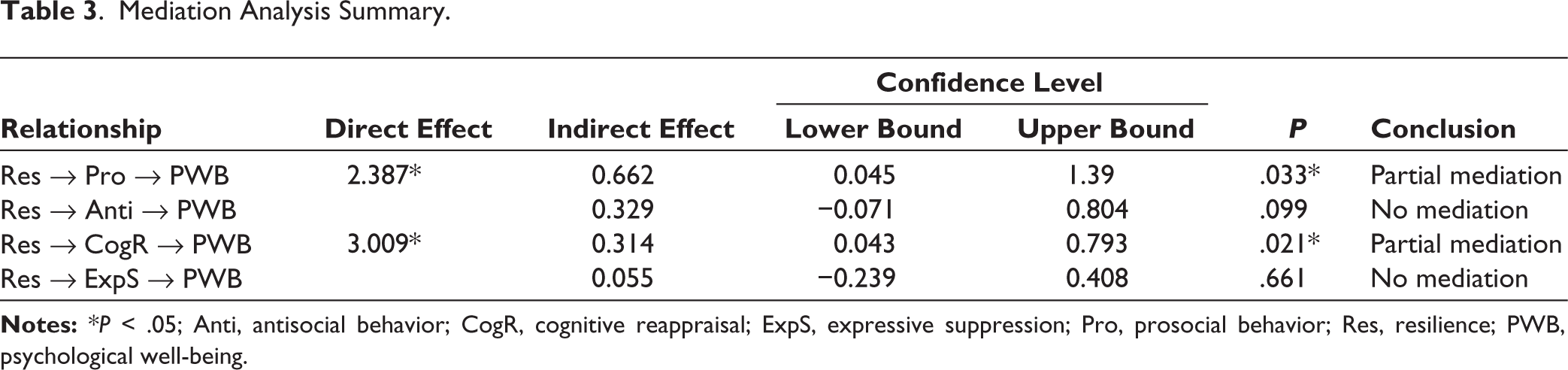
Mediation Analysis Summary.
The correlation results (Table 2) indicate that resilience is positively and significantly correlated to the overall PWB of adolescents living with single parents (r = 0.217, P < .01). The prosocial behavior dimension of SC (r = 0.355, P < .01) and the cognitive reappraisal dimension of ER (r = 0.102, P < .05) also show a significant positive association with resilience, where the antisocial behavior dimension of SC (r = −0.234, P < .01) shows a significant negative correlation. Furthermore, PWB shows a significant positive correlation with the prosocial behavior dimension of SC (r = 0.210, P < .01) and the cognitive reappraisal dimension of ER (r = 0.160, P < .01) and a significant negative correlation with the antisocial behavior dimension of SC (−0.173, P < .01) and expressive suppression dimension of ER (r = −0.138, P < .01).
The present study investigated the mediating role of prosocial and antisocial dimensions of SC in the relationship between resilience and PWB. The findings highlight a significant indirect effect of resilience on PWB in the presence of a prosocial dimension (b = 0.662, t = 1.952, P = .033). Analysing the role of the antisocial behavior dimension in mediating the relation between the contributing variable and PWB, the study found an insignificant effect (b = 0.329, t = 1.502, P = .099). Hence, prosocial behavior partially mediated the association between resilience and PWB, whereas the antisocial behavior dimension showed no mediation.
Furthermore, the study attempted to investigate the mediating role of cognitive reappraisal and expressive suppression dimensions of ER in the relationship between resilience and PWB. The findings highlighted a significant indirect effect of resilience on PWB through cognitive reappraisal (b = 0.314, t = 1.725, P = .021). Further, the mediating role of the expressive suppression dimension was found to be insignificant in mediating the linkage between resilience and PWB (b = 0.055, t = 0.343, P = .661). Hence, cognitive reappraisal partially mediated the relationship between resilience and PWB, whereas expressive suppression shows no mediation. Table 3 displays the summary of the mediation analysis.
Discussion
It is well documented that the absence of one parent affects the children’s psychological state, including the development of behavioral issues, poor self-concept, difficulties in social aspects, and relationships with the parents. Single-parent households and their interactions influence adolescents more than any other age group. Studies report that sudden changes in the familial environment, like divorce or separation, will negatively impact children and adolescents.
The study aimed to understand the relationship between resilience and single-parent adolescents’ PWB and determine whether social competence and emotion regulation impact the relationship between resilience and PWB. According to the correlation analysis results, resilience significantly improves PWB among single-parent adolescents, supporting H1. Resilience is one of the major contributing factors to well-being and mental health, especially in middle and late adolescence. Research suggests a positive association between resilience and PWB among children and adolescents and resilience is negatively correlated with the indicators that diminish mental health.33,34
Developing resilience can improve coping skills and mental health. Results show that intra- and interfamily support and open communication with family members and friends can promote resilience in single-parent families. Unlike Western culture, Indian families maintain frequent interactions with relatives and friends, which helps people share and reduce the negative impacts of their stressful experiences. Such interactions help them perceive more support from others and improve their well-being.
Results also indicate a significant positive correlation between PWB and prosocial behavior, supporting
Furthermore, a significant positive relationship was obtained between cognitive reappraisal and a significant negative correlation with expressive suppression. Hence, H5 and H6 are accepted. According to the literature, emotion regulation influences an adolescent’s mental health and has a significant impact on psychological distress and mindfulness. Cognitive reappraisal was closely associated with well-being outcomes and positive mental health indicators. 35 Moreover, cognitive reappraisal is a good way of emotional regulation and a protective factor for emotional well-being. Studies reported a positive correlation between cognitive reappraisal and positive affect, whereas expressive suppression was associated negatively with positive affect and mindfulness. Individuals who frequently use cognitive reappraisal experience better positive emotions and show superior interpersonal functioning and chronic use of suppression can lead to higher levels of depression and anxiety.
The results demonstrate that the prosocial behavior and cognitive reappraisal partially mediate the relationship between resilience and PWB of single-parent adolescents, partially supporting H4 and H7. According to research findings, resilience and prosocial behavior correlate positively, and resilient individuals appear to be more socially adaptable.36,37 In the past years, various studies reported a positive correlation between resilience and positive aspects of well-being and mental health; improving resilience among single-parent adolescents can enhance their well-being. Developing resilience can help an individual to be lenient of negative emotional states like stress, anxiety, and depression as they challenge one’s coping skills and mental health. 38
Family interactions and their contributions to different aspects of human behaviors and perceptions of life events are significant in cultures like India. Apart from other parts of the world where single parents are mostly on their own, in our society, children from single-parent families can interact with their grandparents and other extended family members, influencing their emotional and social development. This can be considered a positive aspect of collective cultures like ours; people are always in connection with one another, contributing to each other’s mental health. The basics of emotion management and social interactions are instilled in a person from the family in the early years of life. Positive emotion regulation strategies and social competence skills can directly contribute to the PWB of an individual. Furthermore, resilient individuals are capable of creating a positive outlook toward life and hence, they may have positive emotion regulation strategies and prosocial behaviors. This can be a reason for the indirect effects of cognitive reappraisal and prosocial behavior in the relationship between resilience and PWB.
Conclusions
In conclusion, this research complements earlier research on the PWB of adolescents raised by a single parent. Ultimately, this study found that among adolescents raised by a single parent, resilience, social competence, emotion control, and PWB were significantly correlated. The findings indicate that apart from the direct contribution of resilience to PWB, it predicts well-being through prosocial behavior and cognitive reappraisal.
Key Messages
This study shows that women run most single-parent households, and adolescents need immediate attention and supervision. Since resilience is a strong indicator of well-being, helping single-parent adolescents become more resilient can safeguard and improve their coping skills, sense of well- being, and happiness. The only data used in this study is the responses of the adolescents, which can be extended to their parents and teachers for future research. Other significant variables that predict PWB among single-parent adolescents can be studied and the present findings can be verified.
Parents and teachers can help their children enhance their resilience, cooperation skills, and empathy, which improves their prosocial behavior and helps in better social competence and well-being outcomes. The present study has further implications in educational settings. A better understanding of the factors contributing to adolescents’ mental health and well-being, especially in single-parent families, will help to maintain and modify those factors and improve wellness.
Footnotes
Declaration of Conflicting Interests
The authors declared no potential conflicts of interest with respect to the research, authorship and/or publication of this article.
Ethical Approval
The study was accorded Ethical Committee Approval of the Institute Ethics Committee (Human Studies), Pondicherry University, Approval No. HECPU/2021/30/15-11-2021 dated 23-11-2021.
Funding
The authors received no financial support for the research, authorship, and/or publication of this article.
Informed Consent
Every participant provided written, informed consent. The Declaration of Helsinki’s guiding principles were followed in conducting the study.