




Abstract
Previous research has found that religious/spiritual coping, which is generally understood as the use of cognitive and behavioral strategies based on an individual’s beliefs and values to deal with stress, benefits individuals’ well-being, and life satisfaction. The current study examined this link in a sample of Portuguese university students and explored the mediating role of emotion regulation (ER; in terms of strategies and overall abilities) on the relation between religious/spiritual coping and psychological well-being and life satisfaction. A total of 109 Portuguese university students (69.7% female; Mage = 32.05; SD = 13.16) were included in this cross-sectional study. Data were analyzed using PROCESS macro. Results indicated that both negative and positive religious/spiritual coping were linked to lower life satisfaction and diminished psychological well-being. These effects appear to be explained by an increase in difficulties related to ER but not by the use of specific ER strategies, such as expressive suppression or cognitive reappraisal. These findings suggest that religious/spiritual coping and ER could be significant factors in promoting the psychological functioning of university students, especially in terms of psychological well-being.
Introduction
University life can be challenging for students, bringing vulnerabilities to their well-being, such as emotional problems, anxiety, stress, depression, and even burnout (Maroco & Assunção, 2020; Pereira et al., 2020; Vale, 2021; Verger et al., 2009). Studies show that these problems have been increasing, especially during the COVID-19 pandemic (Barros, 2021; Maroco et al., 2020; Pereira et al., 2020; Rodríguez-Rey et al., 2020; Wang & Zhao, 2020). Several factors contribute to worse mental health, including a sedentary lifestyle, academic and social dissatisfaction, health issues, bullying, pre-existing mental disorders, and difficulty expressing emotions (Castro-Silva et al., 2021; Fleury et al., 2018; Oliveira et al., 2022).
In this study, we will explore the role of two interrelated variables: religious/spiritual coping and emotion regulation (ER), as variables capable of explaining individual differences in students’ psychological well-being and life satisfaction. Psychological well-being and life satisfaction are important dimensions to be assessed in university students since they are linked to important outcomes, such as academic satisfaction and performance, happiness, and mental health (e.g., Antaramian, 2017; Reppold et al., 2019; Zanon, 2017; Zanon et al., 2020). This study seeks to address an important gap in the literature, which predominantly concentrates on negative outcomes, as exemplified by the work of Dolcos et al. (2019). An exception to this trend is the research conducted by Vishkin et al. (2019), who explored the relationships between religiosity, ER, and well-being. However, it is noteworthy that their study employed samples drawn from religious communities not university students. This tendency has been contributing to ignoring factors that can promote positive outcomes in the university context. Both positive and negative outcomes are essential for gaining a comprehensive understanding of university students’ adaptation.
Religious/spiritual coping
The literature struggles to define spirituality and religiosity about coping, resulting in confusion when discussing spiritual/religious coping (Vitorino et al., 2018). However, religious/spiritual coping is generally understood as the use of cognitive and behavioral strategies based on individuals’ beliefs and values to deal with stress (Tix & Frazier, 1998). It is a coping strategy that focuses on both the problem and the emotion, with the potential to change negative evaluations to positive ones (Folkman & Moskowitz, 2007). It operates at the level of situational meaning by providing a search for meaning in the face of stressors (Park, 2007). This concept originated from Pargament’s (2001) theoretical work and was developed within the framework of Folkman and Lazarus (1986) transactional model of stress, which considers stress in terms of the interaction between the individual and the environment, and how the individual evaluates their ability to respond to the threat.
Pargament’s (2001) theory expands the transactional model of stress by defining religious/spiritual coping as seeking meaning in the sacred during stress. The positive or negative nature of this coping depends on how individuals interpret stressful events about God or the divine figure (Láng, 2013; Pargament, 2011). Pargament (1997) identified five fundamental functions of religious/spiritual coping: attributing meaning to events, feeling in control of challenges, finding comfort, connecting with peers, and supporting life transitions. These include behaviors, cognitions, and emotions that can change based on personal, situational, or sociocultural contexts, leading to either adaptive or maladaptive coping (Stein et al., 2013).
Religious/spiritual coping can be characterized as the cognitive, behavioral, and interpersonal approaches associated with religious or spiritual beliefs and practices that assist individuals in problem-solving and addressing the adverse impacts of difficult life circumstances (Pargament, 2001; Tomás & Rosa, 2021). These strategies can be either positive or negative. Positive religious/spiritual coping entails a constructive orientation toward problem-solving within a religious context (e.g., seeking spiritual support, a sense of spiritual connection with a higher power, or spiritual connection with others). On the contrary, negative religious/spiritual coping entails religious dissatisfaction and a lack of support from a religious community (e.g., perceptions of a punishing, interpretations of life events as divine retribution) (Pargament, 2000, 2011; Tomás & Rosa, 2021).
Higher levels of positive religious/spiritual coping appear to be associated with better overall psychological functioning, and lower levels of depression, distress, and psychopathology (Ano & Vasconcelles, 2005; Areba et al., 2018; Correia, 2017; Olson et al., 2012; Pargament et al., 2004). Negative religious/spiritual coping seems to promote difficulties in psychological adjustment and negative consequences for mental health (Ano & Vasconcelles, 2005; Francis et al., 2019; Nurasikin et al., 2013). Koenig (2010) pointed out that positive religious/spiritual coping seems to be a protector factor against mental illness, while negative religious/spiritual coping seems to be associated with a higher risk of developing psychopathology (Rahimi et al., 2021), being associated with a significant decrease in well-being, especially in the presence of stress (Láng, 2013; Pargament et al., 2011). Similarly, Trankle (2006) argues that high levels of religious/spiritual coping are correlated with high levels of psychological well-being, if those who report higher psychological well-being have a richer religious life. Furthermore, it has also been found that positive religious/spiritual coping appears to be an important predictor of greater life satisfaction (Abu-Raiya et al., 2018; Pargament et al., 2001; Szczesniak et al., 2020; Vance et al., 2011).
Religion has long played a significant role in how individuals cope with life’s challenges and navigate their emotional experiences. The relationship between religiosity and ER is a subject of growing interest among researchers. Recent studies have pointed to a link among them. For example, some authors have found that religious coping is positively linked to cognitive reappraisal and negatively linked to expressive suppression (Dolcos et al., 2021; Vishkin et al., 2016, 2019). Thus, we believe that ER may be a pivotal mediating mechanism that may elucidate the intricate link between religion/religiosity and psychological well-being among university students.
Emotion regulation
There are two perspectives on ER: the micro perspective, which focuses on specific strategies used to regulate emotions in specific situations or contexts, and the macro perspective, which focuses on the competencies and skills that underlie effective ER. The first perspective proposed by James Gross (1998a), emphasizes the importance of specific strategies, such as situation selection, modification, attentional deployment, cognitive change, and response modulation for effective ER. These strategies involve modifying one’s environment, attention, thoughts, or behaviors to manage emotional responses.
The second perspective, defended by Gratz and Roemer (2004), focuses on the underlying competencies and skills that are necessary for effective ER, such as emotional awareness, emotion acceptance, cognitive flexibility, distress tolerance, and interpersonal effectiveness. These competencies are thought to be important across various contexts and are associated with better mental health outcomes. Both perspectives are important for understanding ER and thus were used in this study.
The role of ER strategies
ER refers to how individuals can exert control over the emotions they feel, the timing of these emotions, and how they are expressed and experienced (Gross, 1998b). The Processual Model of ER proposed by Gross (1998b) distinguishes between two moments in which ER can take place: before or after the emotion generation. He called these antecedent and response-focused processes, respectively (Cabello et al., 2013). ER strategies change throughout the emotional response, starting with the evaluation and appraisal of the stimulus, which activates emotional strategies to compose the emotional response (Gross, 1998b; Yigit & Ragip, 2014). This model identifies five points in the emotional process where different ER strategies can be applied (Gross & John, 2003). From these, two main ER strategies have been studied: cognitive reappraisal which modifies the emotional impact of an event by altering the cognitive evaluation before the generation of an emotion, and expressive suppression which inhibits the behavioral expression of an emotion after it is generated (Cabello et al., 2013; Gross & John, 2003). Cognitive reappraisal is usually associated with better interpersonal functioning, higher psychological well-being, academic performance, and social competence, while expressive suppression is commonly linked to a decrease in positive affect, interpersonal satisfaction and social support, and psychological well-being and life satisfaction (Gross & John, 2003; Haines et al., 2016; Kao et al., 2017; McRae & Gross, 2020; St-Louis et al., 2021; Tang & Kao, 2017).
A study developed with university students found that a greater use of cognitive reappraisal was associated with higher levels of psychological well-being and a higher probability of displaying positive affect (Vally & Ahmed, 2020). In contrast, the use of expressive suppression significantly predicted the experience of high negative affect and lower levels of well-being. Similar results are highlighted by other authors, who emphasize that higher levels of ER are associated with greater positive affective emotional experiences and better evaluations of overall life aspects, leading to a greater sense of life satisfaction (Haga et al., 2009; Nelis et al., 2011; Santana & Gondim, 2016).
The role of ER difficulties
According to Gratz and Roemer (2004), ER refers to a multidimensional concept that implies the ability to understand, accept, and effectively use emotions, to be able to manage and modulate them, to control impulses, and direct behavior toward goals, and also the ability to tolerate negative emotional states when associated with activities that confer purpose to the individual’s life (Gratz et al., 2018; Gratz & Tull, 2010). In this sense, difficulties in ER result from one or more deficits in one or more facets, namely: at the level of emotional perception and understanding; the ability to accept experienced emotional states; the ability to manage impulses and maintain goal-oriented behavior despite being associated with negative emotional experiences; and the flexibility to use appropriate ER strategies in the context that allows emotions to be modulated and the individual to feel better (Gratz & Roemer, 2004; Hallion et al., 2018). Thus, according to the authors, it is not the intensity of the emotion or the individual’s reactivity to it that determines their degree of ER, but rather how they respond to the experienced emotion and, therefore, the trajectory they confer to it (Gratz et al., 2018).
In cases where ER difficulties emerge, there are interferences with the individual’s ability to act according to their values, goals, and needs, difficulties in expressing and accepting emotional states, as well as deficits in selecting goal-oriented behaviors with significant impairment in levels of well-being (Manju, 2017; Panayiotou et al., 2021; Shourie & Kaur, 2017; Weiss et al., 2019). Several authors emphasize that ER difficulties predict various forms of psychopathology, such as depression, lead to the maintenance of states of stress and psychological distress, and decrease quality of life (Castelli et al., 2018; Gross & Jazaieri, 2014; Karekla & Panayiotou, 2011; Michl et al., 2013; Panayiotou et al., 2015, 2021; Yiğit & Yiğit, 2019).
This study
In this study, we will examine how religious/spiritual coping (both positive and negative) is associated with psychological well-being and life satisfaction among university students and explore if ER (both in terms of ER strategies and ER abilities) contributes to explaining this association. Psychological well-being is here defined according to the model proposed by Ryff (1989) as being considered a complex concept that encompasses six different but interconnected dimensions: self-acceptance, positive relationships with others, autonomy, environmental mastery, purpose in life, and personal growth. According to the author, psychological well-being is linked to how individuals perceive their ability to achieve their potential, enjoy positive emotions, and effectively manage their personal and social lives. Life satisfaction is here defined as a person’s cognitive assessment of their life, comparing their current situation with their desired or expected life circumstances. It is a subjective and overall evaluation of one’s life, considering personal values and expectations as proposed by Diener et al. (1985).
Thus, and based on results from previous studies, we hypothesized that: (H1) positive religious/spiritual coping will be associated with more psychological well-being and life satisfaction (e.g., Abu-Raiya et al., 2018; Areba et al., 2018; Olson et al., 2012; Vance et al., 2011), while negative religious/spiritual coping will be associated with less psychological well-being and life satisfaction (Dobrakowski et al., 2021; Hebert et al., 2009; Holt et al., 2017); (H2) ER (both strategies of ER and difficulties in ER) will mediate the links between religious/spiritual coping and psychological well-being and life satisfaction as suggested by previous studies (Dolcos et al., 2021; Vishkin et al., 2016, 2019). Religious coping, through its association with specific religious practices, such as prayer or meditation, fostering more positive emotional states like compassion, and facilitating the enlistment of social support from a supportive community, can have a significant impact on ER, which in turn can contribute to positive outcomes for individuals’ psychological well-being and functioning. Also, as proposed by some authors religion seems to play a detailed role in shaping facets of ER by aligning emotional objectives closely with religious values, impacting intrinsic processes, such as self-regulation abilities, and influencing extrinsic processes that promote and facilitate ER (Vishkin et al., 2014).
Method
Participants
This study included 109 university students (69.7% female; Mage = 32.05; SD = 13.16). Most of the participants are single (69.7%) but are currently involved in a stable relationship (55%) and do not have children (63.3%). Most of the participants are undergraduate students (66.1%), attending the first and second years of the degree (33% and 33.9%, respectively), and studying psychology (36.7%), with a predominantly evening schedule (41.3%).
Of those who participated, the majority have already worked (28.4%) or are currently working (51.4%), with a majority workload of 40 hours per week (24.8%), followed by 20 hours per week (4.6%). Most participants (52.3%) identify themselves with a religious or spiritual affiliation, with Catholicism being the most prevalent (13.8%), followed by Islam (4.6%), and Christianity (2.8%).
Measures
Religious/spiritual coping
To examine positive and negative religious/spiritual coping, the Scale of Religious and Spiritual Coping was used (Pargament et al., 2001; Portuguese version: Tomás & Rosa, 2021). It consists of 19 items, each referring to a specific coping strategy. Later, these items are divided into positive religious/spiritual coping and negative religious/spiritual coping. The items have a multidimensional nature, reflecting different religious functions, such as the search for meaning or control, as well as different methods, including cognitive, behavioral, emotional, or relational strategies, through which individuals may seek to adapt to adversity (Pargament, 2011; Tomás & Rosa, 2021). Responses to the items are given on a 4-point Likert-type scale, ranging from 1 (never) to 4 (always). In its original version, the instrument showed good internal consistency, with Cronbach’s alpha values of at least .80 (Pargament et al., 2001). However, the Portuguese adaptation suggested the use of only 17 items, according to items’ discriminative power for each individual subscale. In the Portuguese version, similar results were found to the original version, as well as to other adaptations, with the items organized around two factors. In the present study, the values were .94 for positive religious/spiritual coping and .83 for negative religious/spiritual coping.
ER strategies
ER strategies were measured using the Emotion Regulation Questionnaire (Gross & John, 2003; Portuguese version: Machado Vaz, 2009). This questionnaire aims to assess the use of two specific strategies to regulate emotions: Cognitive Reappraisal and Expressive Suppression. The instrument consists of 10 items grouped into two scales that refer to the two aforementioned strategies. Responses to the items are given according to a 7-point Likert-type scale, ranging from 1 (strongly disagree) and 7 (strongly agree). However, it is important to note that both scales are independent, such that, the use of one strategy does not influence the use of the other. In terms of their psychometric properties, good internal consistency has been observed (α = .79 for cognitive reappraisal and α = .73 for expressive suppression) (Gross & John, 2003). In the present study, the Cronbach alpha was .83 for cognitive reappraisal and .80 for expressive suppression.
ER difficulties
ER difficulties were measured with the Difficulties in Emotion Regulation Scale (Gratz & Roemer, 2004; Portuguese version: Moreira et al., 2022). It is a self-report measure that aims to assess emotional dysregulation considering six domains: limited access to ER strategies, non-acceptance of emotional responses, lack of emotional awareness, difficulty in impulse control, difficulties in acting according to goals, and lack of emotional clarity. The scale consists of a total of 18 items, with responses organized around a 5-point Likert-type scale ranging from 1 (almost never) to 5 (almost always). The obtained Cronbach’s alpha values (between .78 and .91) showed good psychometric properties. In the present study, the value was .88 for the total score.
Psychological well-being
The psychological well-being was measured using the Psychological Well-being Scale (Ryff, 1989; Portuguese version: Novo et al., 2006). This scale aims to evaluate six dimensions of psychological well-being. The Portuguese version proposes a total of 18 items assessing six dimensions: autonomy, environmental mastery, personal growth, positive relations with others, purpose in life, and self-acceptance. The response to this scale is given according to a 6-point Likert-type scale that ranges from 1 (strongly agree) to (strongly disagree) (Novo et al., 2006). In the present study, the value was .86 for the total score.
Life satisfaction
Life satisfaction was measured using the Satisfaction with Life Scale (Diener et al., 1985; Portuguese version). This scale aims to assess how individuals judge their satisfaction with life, seeking answers to five items. The response to these items is organized around a 7-point Likert-type scale that ranges from 1 (strongly disagree) to 7 (strongly agree). In terms of its psychometric properties, the scale has a good level of internal consistency, with a Cronbach’s alpha value of .87. In this study, the value was .85 for the total score.
Procedure
This study was approved by the Ethics Committee of|| removed for blind review.|| The procedure for data collection involved the use of an online questionnaire created on the Google Forms platform. The study was then shared through various social networks. Participants were invited to voluntarily collaborate in the study. The protocol included a sociodemographic questionnaire and the self-report scales described above. All participants were informed about the voluntary nature of their participation and were required to provide informed consent before proceeding to the questionnaire. Confidentiality was assured. No incentives were provided to participants for their participation.
Data analysis
Data were analyzed using SPSS (Statistical Package for the Social Sciences). First, descriptive statistics were computed to summarize the sample characteristics and study variables. To examine the relationships between the study variables a correlation analysis was used. Finally, to test the proposed model the PROCESS macro (model 4) developed by Hayes (2017) was used. Four models were run separately since we had two independent variables and two dependent variables; thus model 1 included negative religious/spiritual coping, ER (three mediators), and life satisfaction; model 2 included negative religious/spiritual coping, ER (three mediators) and psychological well-being; model 3 included positive religious/spiritual coping, ER (three mediators), and life satisfaction; and model 4 included positive religious/spiritual coping, ER (three mediators), and psychological well-being.
The unstandardized direct, total, and indirect effects were reported. Indirect effects were considered significant if the confidence intervals (CIs) did not include 0. To account for multiple testing, we applied Bonferroni correction, and significance was assessed at the adjusted level of p < .01.
Results
Descriptive statistics
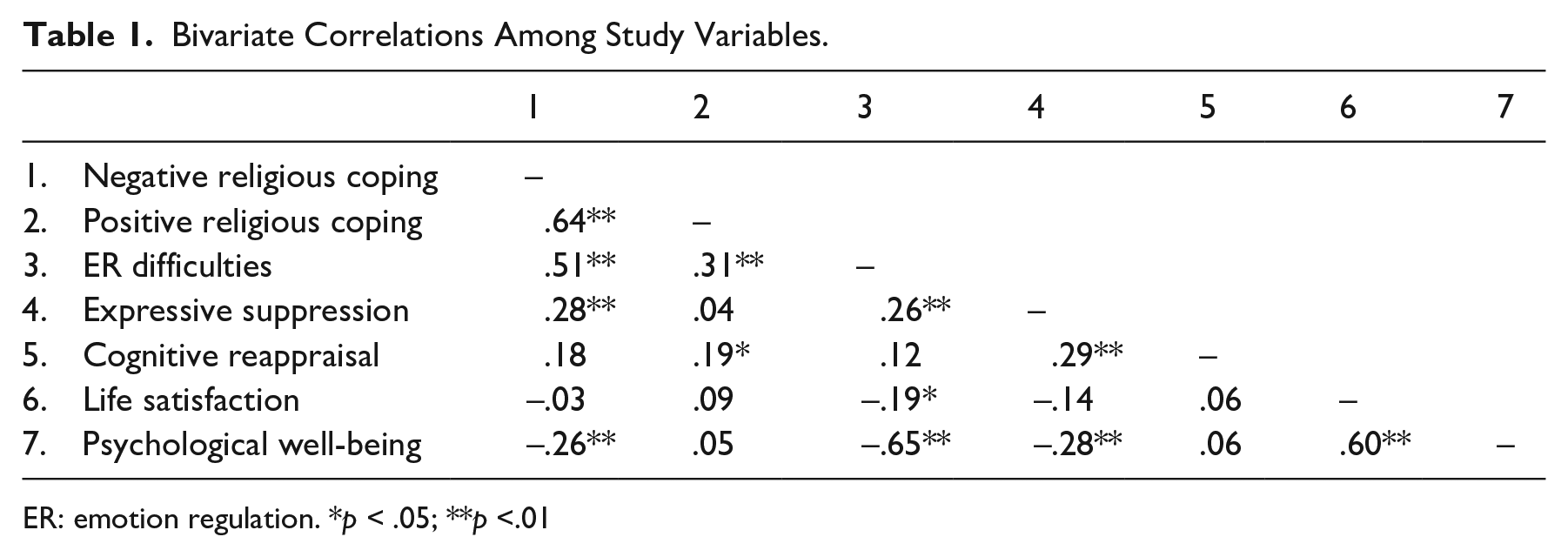
Correlations are presented in Table 1. Positive correlations were found between negative religious/spiritual coping and ER difficulties and expressive suppression, and a negative correlation was found between negative religious/spiritual coping and psychological well-being.
Bivariate Correlations Among Study Variables.
ER: emotion regulation. *p < .05; **p <.01
Positive religious/spiritual coping was positively associated with ER difficulties and cognitive reappraisal. ER difficulties were positively associated with expressive suppression and negatively associated with life satisfaction and psychological well-being.
Expressive suppression was positively associated with cognitive reappraisal and negatively associated with psychological well-being. Life satisfaction and psychological well-being were positively linked.
Mediational model
Four models were examined to the two independent variables (negative and positive religious/spiritual coping) and two dependent variables (life satisfaction and psychological well-being) (models are depicted in Figure 1 and tables are available at the Supplemental File).
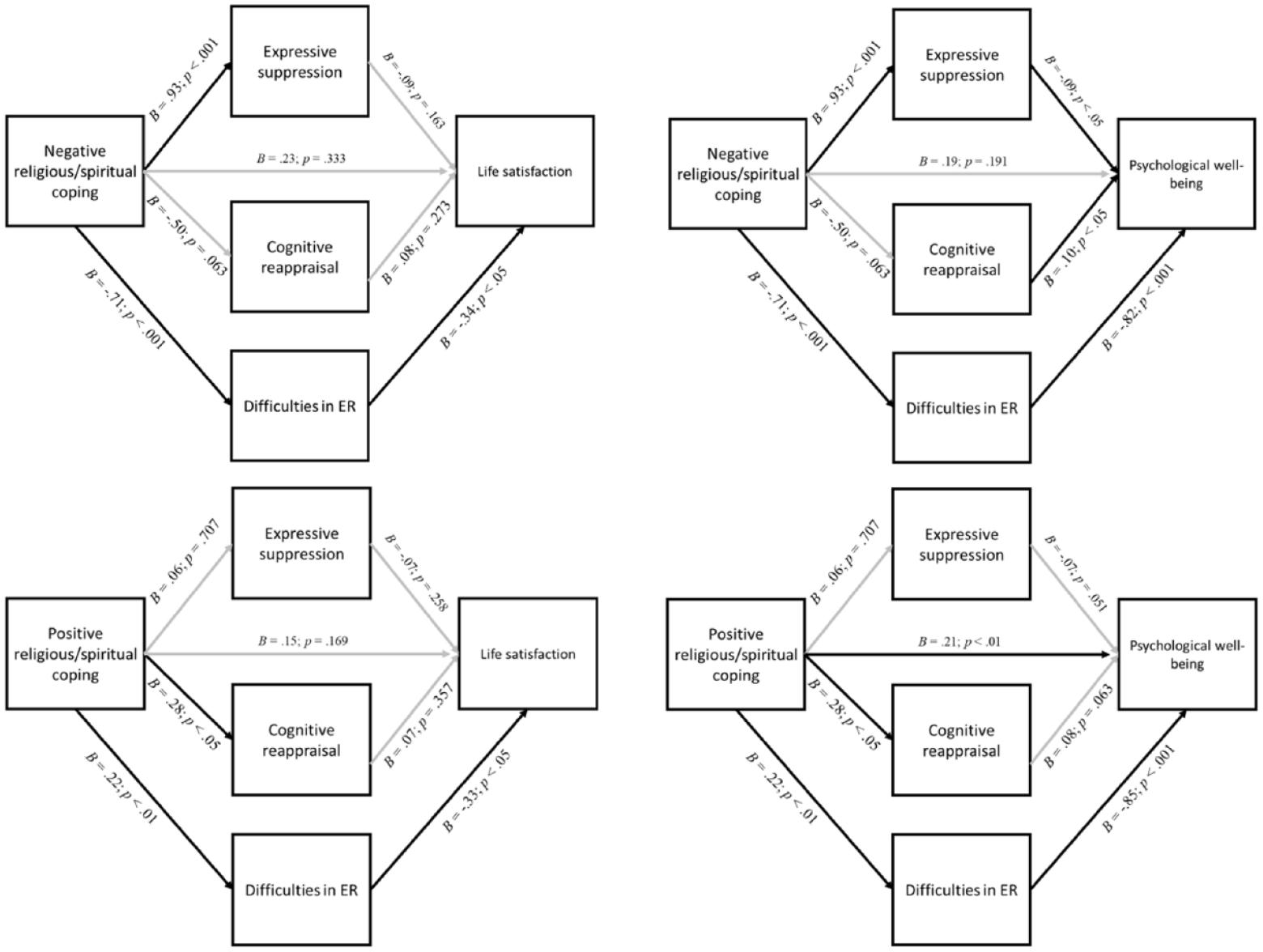
Mediational models.
Model 1 (negative religious coping, ER, and life satisfaction) accounted for 8% of the variance in the life satisfaction score, F (4,104) = 1.87, p = .122. The direct effect of negative religious coping in the life satisfaction score was not significant (B = .23; SE = .23, p = .333). The indirect effects of expressive suppression and cognitive reappraisal were not significant but the indirect effect of difficulties in ER was (–.24, 95% CI [–.51, –.02]). The total effect model was not significant (B = –.05; SE = .20, p = .787).
Model 2 (negative religious coping, ER, and psychological well-being) accounted for 26% of the variance in the psychological well-being score, F (4,104) = 23.08, p < .001. The direct effect of negative religious coping in the psychological well-being score was not significant (B = .19; SE = .14, p = .191). However, the indirect effect of difficulties in ER was significant (–.58, 95% CI [–.85, –.24]). The indirect effect of expressive suppression and cognitive reappraisal were not significant. The total effect model was significant (B = –.43; SE = .16, p < .01).
Model 3 (positive religious coping, ER, and life satisfaction) accounted for 8% of the variance in the life satisfaction score, F (4,104) = 2.13, p = .083. The direct effect of positive religious coping in life satisfaction score was not significant (B = .15; SE = .11, p = .169). The indirect effect of difficulties in ER was significant (–.07, 95% CI [–.15, –.00]). The indirect effects of cognitive reappraisal and expressive suppression, however, were not significant. The total effect model was not significant (B = .09; SE = .10, p = .370).
Finally, model 4 (positive religious coping, ER, and psychological well-being) accounted for 51% of the variance in the psychological well-being score, F (4,104) = 27.29, p < .001. The direct effect of positive religious coping in psychological well-being score was significant (B = .21; SE = .06, p < .01). Again, the indirect effect of difficulties in ER was significant (–.19, 95% CI [–.33, –.05]), but the indirect effects of cognitive reappraisal and expressive suppression were not significant. The total effect model was not significant (B = .04; SE = .08, p = .636).
Discussion
The aim of this study was to examine the links between religious/spiritual coping and life satisfaction and psychological well-being, and examine the potential mediating role of ER, in a sample of Portuguese university students. Overall, the findings suggested that both negative and positive religious/spiritual coping were associated with students’ adaptation (especially psychological well-being) via ER difficulties.
Specifically, we partially confirmed our first hypothesis (H1) about the links between positive and negative religious/spiritual coping and life satisfaction and psychological well-being. As expected, positive religious/spiritual coping was associated with more psychological well-being (Abu-Raiya et al., 2018; Areba et al., 2018; Vance et al., 2011). Several authors have suggested that belief in the support and protection of God and the ability to make requests/prayers for support in stress management and control are important predictors of individuals’ psychological well-being (Aten et al., 2019; Chen et al., 2021; Pargament, 1997; Pargament et al., 2001; Veit & de Castro, 2013). Counted et al. (2022) added that attributing the stressor to a divine plan or design, and therefore having meaning for the individual, allows for the preservation of the ability to imagine scenarios in which it is possible to successfully overcome the stressor. However, it is important to note that the association appears to be stronger in situations of acute or extreme stress, such as bereavement (Koenig, 2012). At the same time, this is a cross-sectional study, thus causal relationships cannot be inferred. As Koenig (2012) pointed out, it is not possible to know if it is the use of positive religious/spiritual coping strategies that improves psychological well-being, or if it is people who have higher levels of well-being who seek to cope with stressors using positive religious/spiritual coping strategies.
It is worth noting that negative religious/spiritual coping did not demonstrate significant associations with either life satisfaction or psychological well-being. This finding deviates from the patterns observed in prior research (e.g., Dobrakowski et al., 2021; Hebert et al., 2009; Holt et al., 2017), warranting further investigation and interpretation. Yet, in the correlational analyses, negative religious/spiritual coping was negatively linked to psychological well-being. While more research with larger samples are needed to better understand the impact of the negative religious/spiritual coping on the psychological well-being of individuals, prior research supports a negative link between them. Some authors suggest that individuals may resort to negative religious/spiritual coping strategies when confronted with stressors, particularly when they question whether they have been abandoned by God, with the stressor serving as perceived evidence of this abandonment. In line with this perspective, individuals may express and direct their anger and frustration toward God, thereby impacting their psychological well-being. Counted et al. (2022) suggested that negative religious/spiritual coping strategies may increase the impact of the stressor on the individual, leading to the emergence of spiritual tensions that affect the feeling of security in God and the sacred (Pargament & Ano, 2006). Therefore, the use of negative religious/spiritual coping strategies exacerbates the experience of disturbance and psychological suffering, prolonging the period of psychological recovery, which mainly impacts psychological well-being.
Regarding our second hypothesis (H2), it was partially confirmed. Overall difficulties in ER (but not expressive suppression neither cognitive reappraisal) were found to contribute to explaining the relationship between positive and negative religious/spiritual coping and life satisfaction and psychological well-being. However, before delving into these findings, it is important to acknowledge the links between religious/spiritual coping and ER.
As anticipated, negative religious/spiritual coping was associated with higher levels of expressive suppression and greater difficulties in overall ER (e.g., Dolcos et al., 2021; Vishkin et al., 2019). According to Vishkin et al. (2019), religion can significantly impact an individual’s ability to regulate their emotions, by affecting both intrinsic (such as self-regulation skills and emotional beliefs) and extrinsic processes that support and facilitate ER. Negative religious/spiritual coping strategies may lead to a negative reinterpretation of stressors, which can impede optimal functioning and result in deficits in ER (Fátima et al., 2022; Oles & Wozny, 2015).
Conversely, positive religious/spiritual coping was linked to an increase in cognitive reappraisal as found in previous studies (e.g., Fátima et al., 2022), and also to greater challenges in ER—a noteworthy result that warrants further exploration. One possible explanation for this finding is that while positive religious/spiritual coping may facilitate the development of a strong and positive connection with God, it may simultaneously introduce challenges in effectively managing emotions. Positive religious/spiritual coping can encompass aspects, such as fostering a close and positive relationship with a higher power, seeking comfort in religious beliefs, and drawing on spiritual practices for support. However, this heightened spiritual connection might lead to difficulties in effectively regulating emotions, including managing, understanding, and controlling them. Furthermore, it could affect an individual’s ability to direct their behavior toward specific goals (rather than religious’ goals) and their capacity to tolerate negative emotional states.
In addition, it is conceivable that positive religious/spiritual coping could result in greater challenges in ER when interacting with other cognitive factors. For instance, as highlighted by Dolcos et al. (2021), religious/spiritual coping mechanisms were linked to improved ER skills, but this association was contingent on individuals having confidence in their coping abilities and the capacity to attribute positive meanings to distressing experiences. In situations where individuals lack this confidence or struggle to find positive meaning, it is plausible that they may encounter difficulties in effectively regulating their emotions.
Regarding the proposed indirect effects, we found that positive and negative religious/spiritual coping was linked to poor life satisfaction and psychological well-being via difficulties in ER. It is noteworthy that the connection between religious/spiritual coping and psychological well-being appears to be more robust compared to its association with life satisfaction. This observation is underscored by the model’s ability to explain a significantly greater amount of variance in psychological well-being. While the direct effects between positive and negative religious/spiritual coping and life satisfaction and psychological well-being were not significant (exception the positive link between positive religious/spiritual coping and psychological well-being), the indirect effects via ER difficulties were significant. It seems that religious coping can contribute to poor psychological adjustment through different mechanisms, one of them ER difficulties. The difficulties and negative experiences resulting from the use of positive or negative religious/spiritual coping strategies, when combined with negative affect, maladaptive schema functioning, and inadequate and ineffective emotional experiences, may produce pronounced and impactful effects on psychological well-being. This can manifest as an exacerbation of the stressor event, an inability to generate alternative adaptive responses, and a state of tension and anger (cope anger) toward God and the Divine, which can hinder psychological recovery (Counted et al., 2022; Pargament & Ano, 2006).
Limitations and future research
Several limitations need to be taken into consideration when interpreting the findings of this study. First, in terms of sample composition, it is noteworthy that our participants predominantly consist of university students, with a majority being women and possessing educational backgrounds in psychology. Also, it is a very diverse sample, which includes individuals from various demographic profiles. This encompasses both young adults and adults, including those actively engaged in diverse professional roles, with participants representing both morning and evening schedules. All these factors contribute to the limitations of the study in terms of its generalizability. Second, the cross-sectional design used does not allow for causal inferences, and the data collection took place during a period of significant psychological and spiritual fluctuations resulting from the pandemic experience, which may have influenced the observed phenomena. To better understand the relationships between the use of religious/spiritual coping, ER strategies, ER difficulties, life satisfaction, and psychological well-being, a longitudinal approach is needed. Third, the use of self-report measures through an online platform may have introduced potential data contamination, ambiguities or misunderstandings in the questions, subjectivity in responses, and the influence of social desirability bias.
Fourth, the study did not comprehensively explore the impact of sociodemographic variables on the phenomena under study, which may have had explanatory effects on the results. Therefore, future research should employ qualitative strategies, such as interviews to explore and deepen our understanding of the study variables. Finally, other variables that may contribute to explaining the association between religious coping and life satisfaction and psychological well-being, such as resilience, social support, and self-esteem, were not considered in this study.
Clinical implications
From a clinical perspective, the collected data highlight the significance and importance of ER ability for the life satisfaction and psychological well-being of the university population, along with the adaptive nature of using religious/spiritual coping to cope with stressors, regardless of personal beliefs. Given the psycho-affective challenges that greatly impact experiences of satisfaction, well-being, and pleasure with life, it is crucial to develop programs and initiatives that cultivate a healthy relationship with one’s own emotions and emotional states. This includes acceptance, experience, and symbolization, as well as the ability to employ a multitude of strategies, including religious and spiritual resources, to empower individuals to face multiple stressors and produce adaptive responses to life contexts. Therefore, future initiatives in an academic setting should focus on exploring emotions and the relationship with the transcendent, the divine, and the spiritual as potential sources of ER and promoting life satisfaction and well-being, especially for those who score lower in these dimensions.
Supplemental Material
sj-docx-1-ptj-10.1177_00916471231223920 – Supplemental material for Religious/Spiritual Coping, Emotion Regulation, Psychological Well-Being, and Life Satisfaction among University Students
Supplemental material, sj-docx-1-ptj-10.1177_00916471231223920 for Religious/Spiritual Coping, Emotion Regulation, Psychological Well-Being, and Life Satisfaction among University Students by Lídia Graça and Tânia Brandão in Journal of Psychology and Theology
Footnotes
Author Contributions
All authors contributed to the study conception and design. Material preparation and data collection were performed by Lidia Graça; analysis was performed by Tânia Brandão. The first draft of the manuscript was written by Tânia Brandão. All authors commented on previous versions of the manuscript. All authors read and approved the final manuscript.
Data Availability Statement
Data presented in this study are available on request from the corresponding author. The data are not publicly available due to privacy and ethical restrictions.
Declaration of Conflicting Interests
The author(s) declared no potential conflicts of interest with respect to the research, authorship, and/or publication of this article.
Funding
The author(s) received no financial support for the research, authorship, and/or publication of this article.
Ethics Approval
The study was conducted according to the guidelines of the Declaration of Helsinki and was approved by the Ethics Committee of CIP—Universidade Autónoma de Lisboa.
Informed Consent
Informed consent was obtained from all subjects involved in the study.

Supplemental Material
Supplemental material for this article is available online.
Author Biography
References
Supplementary Material
Please find the following supplemental material available below.
For Open Access articles published under a Creative Commons License, all supplemental material carries the same license as the article it is associated with.
For non-Open Access articles published, all supplemental material carries a non-exclusive license, and permission requests for re-use of supplemental material or any part of supplemental material shall be sent directly to the copyright owner as specified in the copyright notice associated with the article.
