




Abstract
Childhood emotional abuse (CEA) is a highly prevalent but often overlooked area of child mental health research. One of the major hurdles in research in this area is the difficulty in defining emotional abuse (EA) across different cultures. This article aims to review the operational definitions and structured instruments used to assess CEA and to critically analyse the existing lacunae and challenges in this area. Original articles, systematic reviews, and meta-analyses with the objective of assessing emotional abuse in children and adolescent populations were chosen for the study. From the chosen articles, the data pertaining to the definition or structured instrument used to assess CEA was extracted and a narrative review was done. A total of 4 operational definitions and 9 structured instruments were included in the review of the 26 included articles. From this review, as per the author, some of the shortcomings of the available definitions and tools for assessing CEA include a paucity of instruments to assess EA in young children and special populations, the need for consensus on the terminologies used to denote EA, the need for longitudinal studies, the need for culturally appropriate standards for assessment, and also the need to understand the context of EA. A CEA assessment framework has been proposed that includes a longitudinal and qualitative assessment of the subjective experience of the child, which includes the context of EA, so as to plan individualized interventions.
Introduction
Emotional abuse (EA) is a highly prevalent form of abuse reported in children and adolescent populations across the world. 1 While the research on sexual and physical abuse in children has gained adequate attention from researchers and policymakers, childhood emotional abuse (CEA) remains overlooked. 2 It is well understood from the available literature that CEA poses a significant impact on the developing brain, which leads to long-term mental and physical health consequences,3, 4 and this emphasizes the need for research in this area.
Although EA often, or rather always, coexists with other forms of abuse, 5 there are certain features that are unique to it. EA is not described in terms of certain circumscribed events but is a longstanding pattern of maladaptive relationship between the child and the caregiver.5, 6 The wounds/scars of EA are not physically distinct to others; rather, they are a subjective perception. 7 As indistinct or ill-defined as it already is, with the added cultural connotations, 8 identifying and defining CEA in both clinical and legal contexts is a major challenge. 5 Again, unlike other forms of abuse, a global definition for EA cannot be accepted as different cultural practices across the world influence the way of parent–child interactions and thus the types and forms of EA as well. 8 This difficulty in defining EA is one of the major barriers for research in this area. 5
Across the years, researchers have tried to define CEA through operational definitions and structured instruments. One of the first documented efforts to define EA was the definition of “psychological maltreatment” (PM), which was put forward in the International Conference of Psychological Abuse of Children and Youth (1983). Later, Hart and Brassard (1987) proposed an operational definition for PM that included acts of commission such as verbal threats, terrorizing, and criticizing, as well as acts of omission such as ignoring and a lack of expression of affection. 9 This definition is certainly a landmark in CEA research, gives a broad perspective on CEA, and has paved the way for further definitions and tools for the assessment of CEA. With the advent of new instruments and definitions, the nomenclature has also been changing, with the terms “psychological maltreatment” and “emotional maltreatment” being used synonymously with EA.9, 10
These manifold definitions and varying terminologies highlight a general lack of consensus among the scientific community on the definition of CEA. Hence, there is a need to systematically evaluate the available definitions and tools for assessing CEA to understand how the definitions have scientifically evolved over the years. It is also important to critically analyse the existing lacunae and challenges in this area that are causing possible hindrance to research in this field.
In this article, the aim is to review and critically evaluate the operational definitions and structured instruments used to identify CEA in clinical research.
Methodology
Research articles with the following inclusion criteria were identified for the review:
Original research papers/systematic reviews/meta-analyses where the objective of the study has been to identify CEA Papers that have clearly stated in their methodology the operational definition or structured instruments used to identify CEA Studies done in children or adolescent populations Articles published in English in peer-reviewed journals
Research articles with the following exclusion criteria were identified for the review:
The articles that used non-validated scales to identify CEA Studies with legal definitions, as this review is on definitions of CEA in clinical research
A thorough and unbiased electronic search was done for articles meeting the above criteria in the following databases: MEDLINE through PubMed, ScienceDirect, and Google Scholar. The articles used the keywords “Emotional Abuse”/“Emotional Maltreatment”/“Psychological Abuse”/ “Psychological Maltreatment”/ “Child Abuse” AND “Children /Adolescents” /“Definitions” /“Tools” /“Structured Instruments”/“Scale”/“Scales.” The titles and abstracts of the articles that met the broad inclusion criteria were initially examined, from which articles eligible for the review were chosen and full texts were scrutinized to be included in the study.
Results
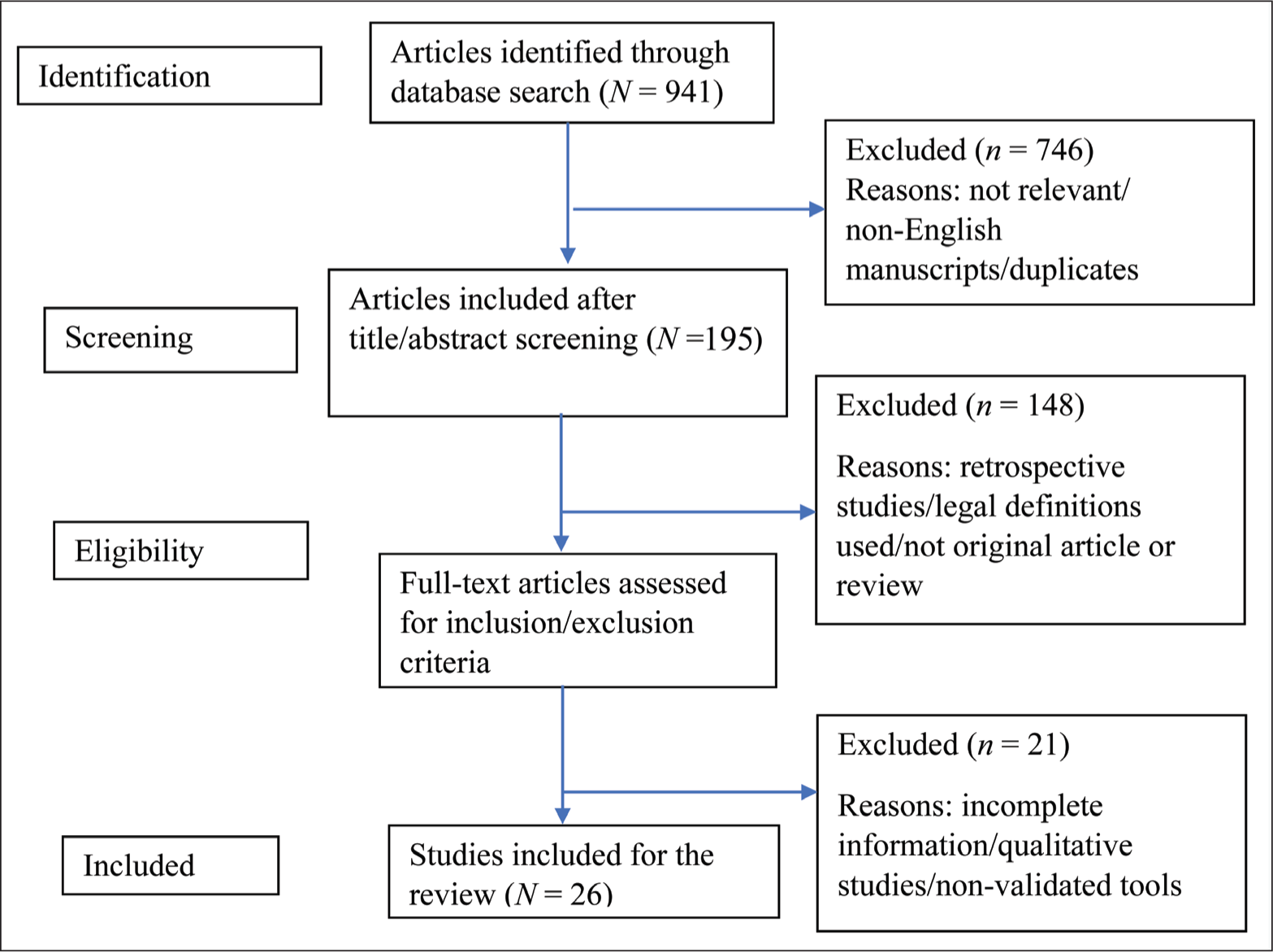
The PRISMA flowchart for the literature search is given in Figure 1.
PRISMA Flow Chart of Literature Search.
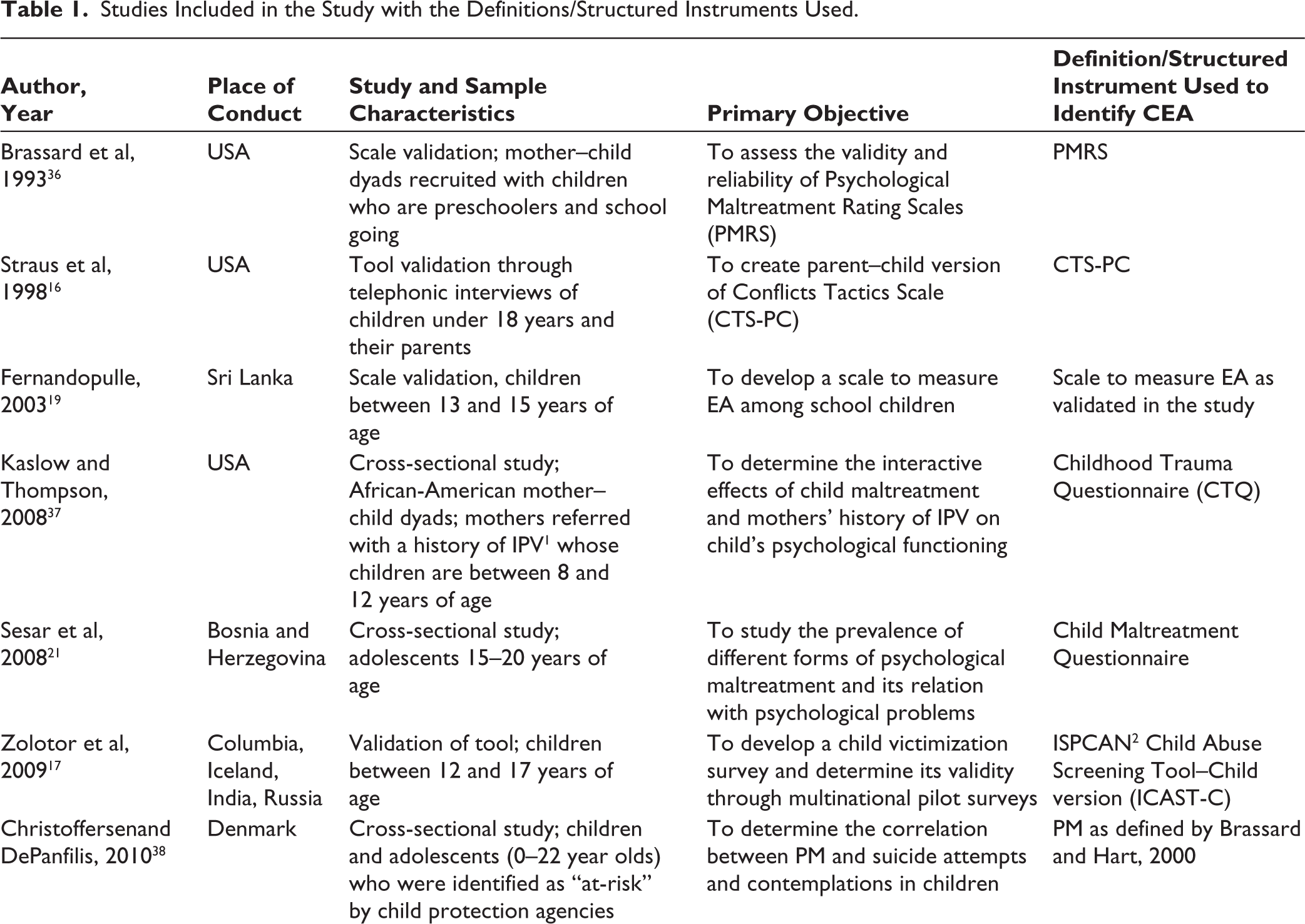
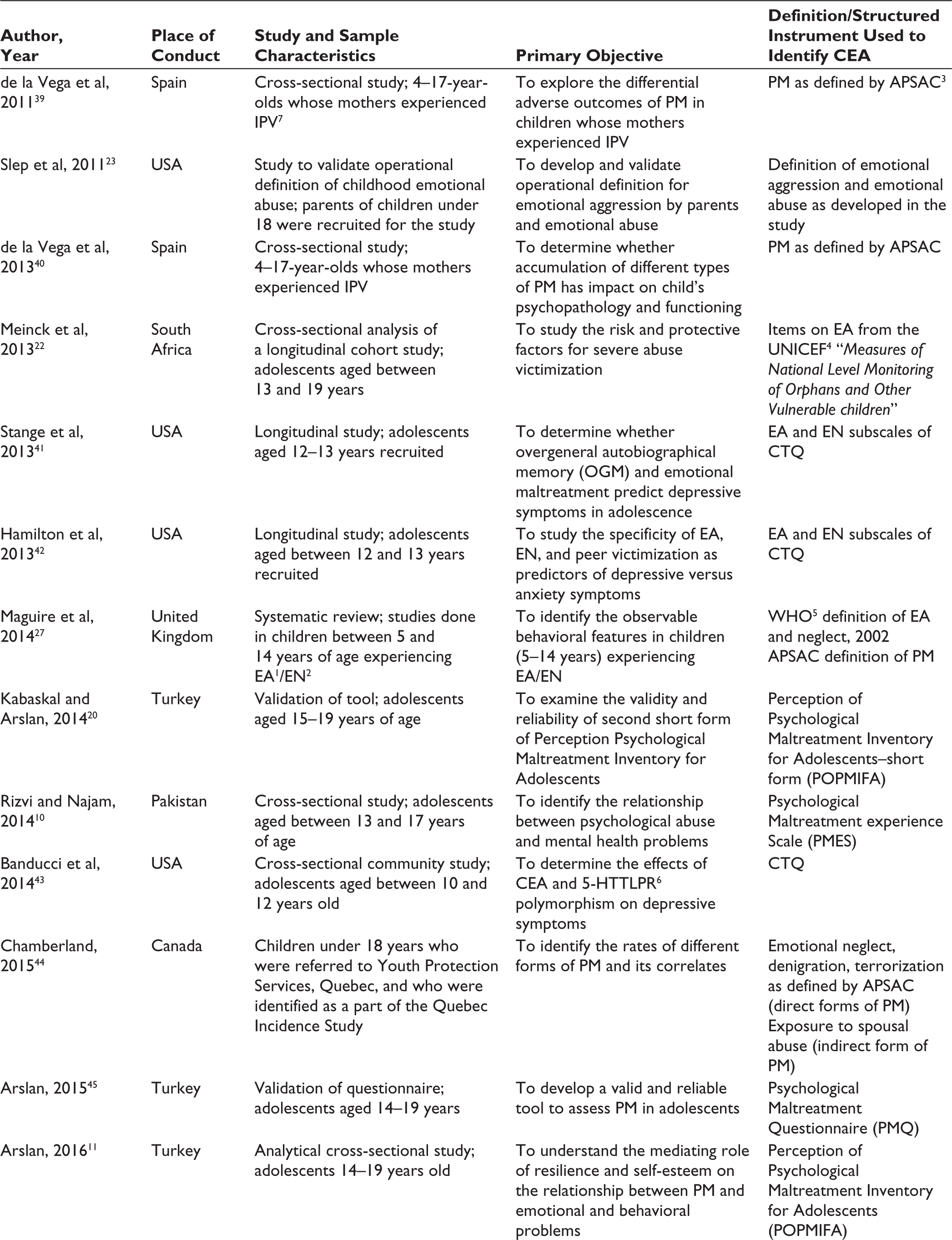
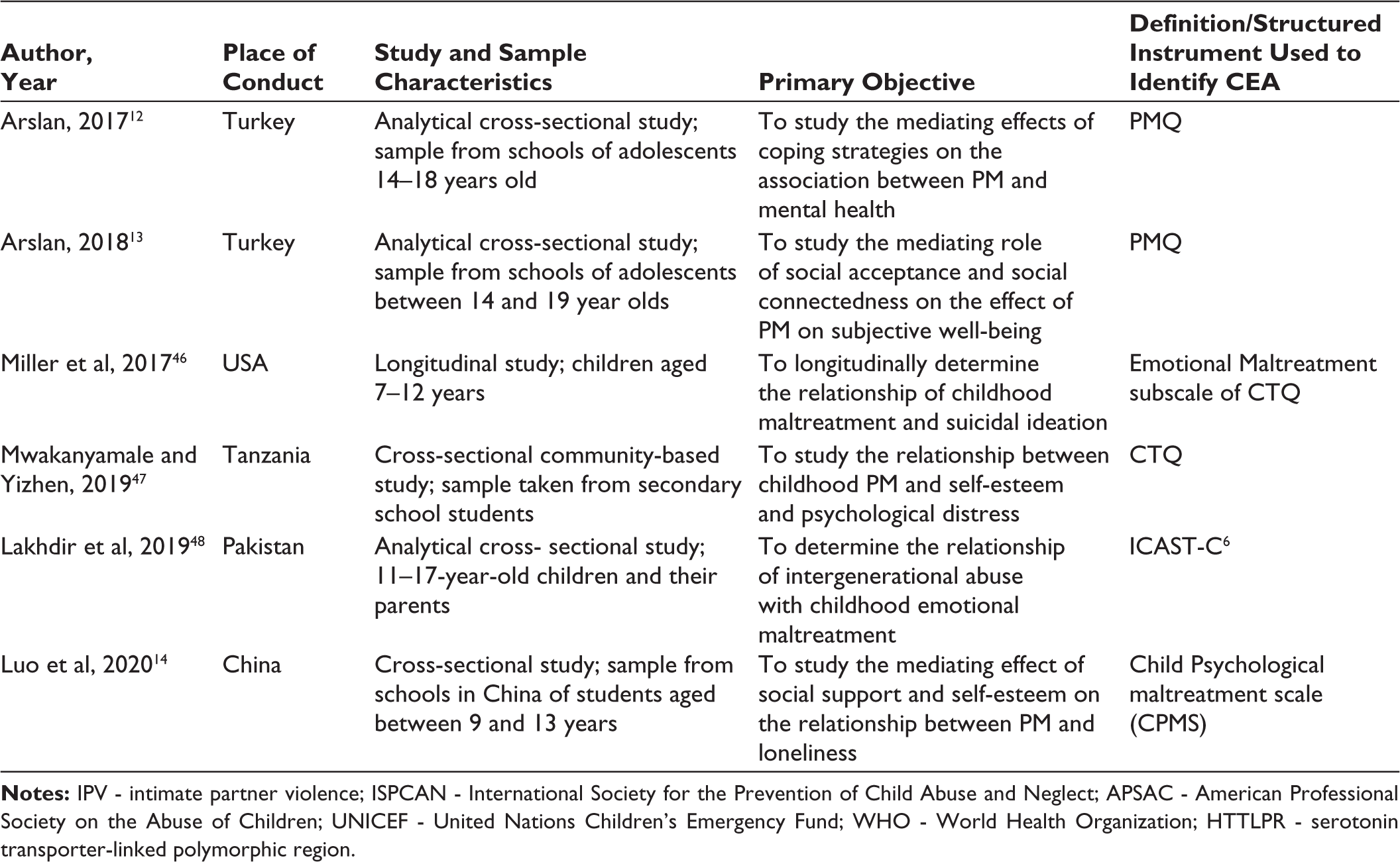
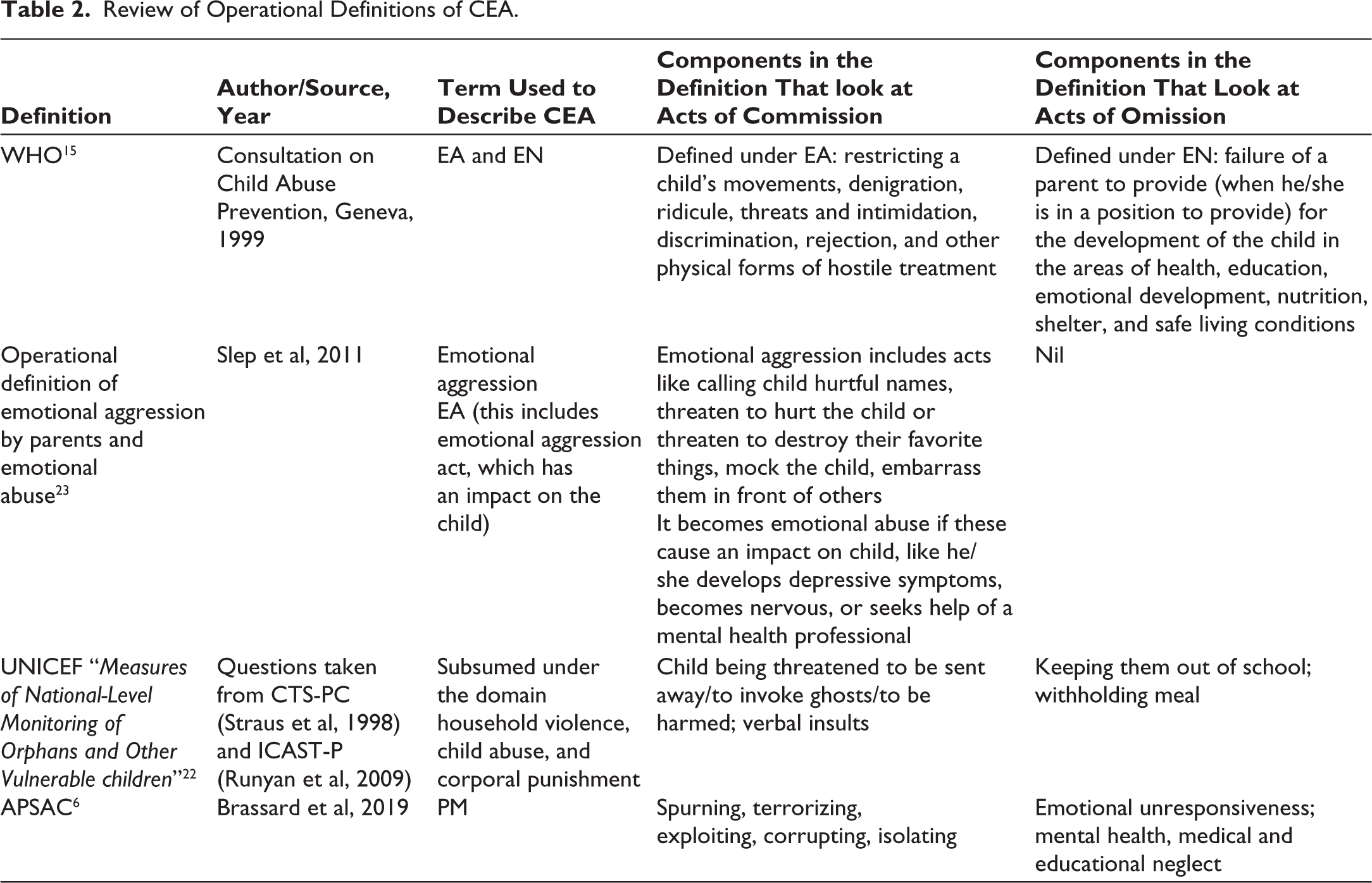
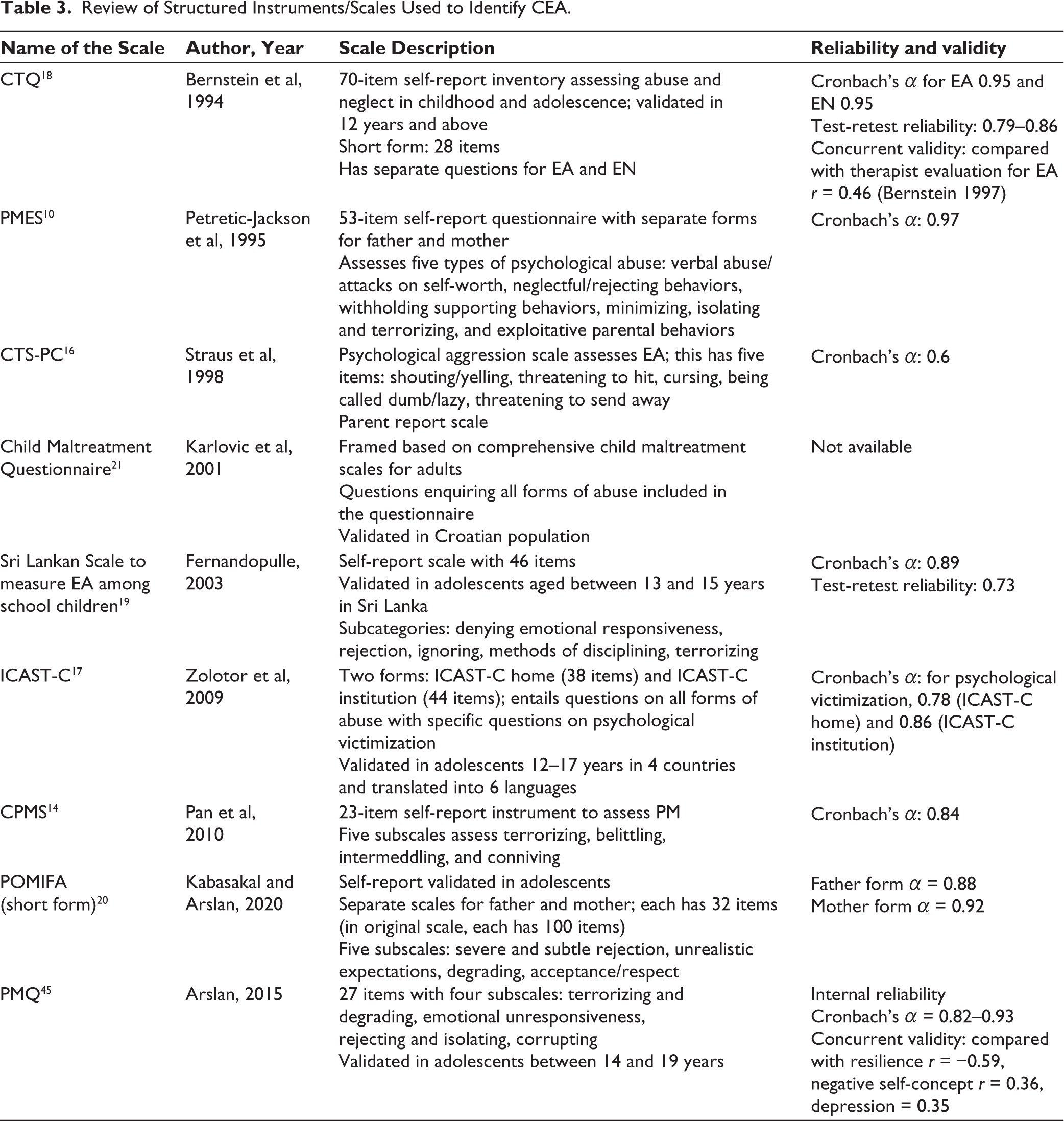
From the articles (n = 26) chosen for the review, data related to the operational definition or structured instrument used to identify CEA was carefully extracted and tabulated (Table 1). A total of 4 operational definitions and 9 structured instruments were included in the review, which were extracted from the 26 articles that met the inclusion and exclusion criteria. The details of the definitions and scales included in the study are mentioned in Tables 2 and 3, respectively.
Studies Included in the Study with the Definitions/Structured Instruments Used.
Review of Operational Definitions of CEA.
Review of Structured Instruments/Scales Used to Identify CEA.
Terms Used to Describe EA
Different definitions and scales have used different terminology for EA. The most commonly used term is “psychological maltreatment” (PM),6, 11–14 as in the original definition by Brassard and Hart, 9 which includes both acts of omission and commission. WHO defines EA and EN as separate constructs. 15 “Psychological aggression” is the term used to describe the pattern of EA between parent and child in CTS-PC. 16 In the more recent scale, ICAST-C, the term “child victimization” subsumes different forms of abuse, and the term “psychological victimization” is used to describe EA. 17
Domains of EA Assessed
There is considerable overlap regarding the domains of EA assessed by different definitions and scales. Some of the themes/domains that are common to most of the scales include terrorizing, verbal threats to harm or abandon, degrading, and isolating.6, 10, 11, 15 The impact of EA/EN on childhood development has life-long implications, and WHO’s definition explicitly states that not providing opportunity for developmental experiences can be considered EN. 15 The APSAC definition also acknowledges the deprivation of developmental experiences as a form of PM. 6
Assessment of EA in Different Age Groups
Six out of the nine structured instruments reviewed have been validated in the adolescent population.11, 17–21 There are no scales that specifically look into EA in a younger population. The operational definitions may be used across different age groups. The APSAC definition does state the need to use different strategies that are developmentally appropriate to assess PM across different age groups. APSAC also gives specific behavioral indicators for EA in different age groups, from infancy to adolescence. 6
Self- Versus Parent-reported Assessments
All the scales validated in the adolescent population are self-reported scales. CTS-PC, which can be used across different age groups, is a parent-reported scale. 16 The operational definitions reviewed are to be applied by the observer/researcher based on the information gathered from the interview with parents/children.6, 15, 22 But the definition of emotional aggression and emotional abuse developed by Slep et al. is a parent-reported assessment. 23
Validity and Reliability of the Scales
All the scales reviewed here have an internal consistency alpha of 0.82 12 –0.97 10 . The papers that validated the reviewed scales mention the challenge in defining the concurrent validity of the instruments because of the lack of a gold standard assessment tool for emotional abuse.17, 18 Thus, the authors have either compared the assessment from the scale with the independent assessment of psychiatrist 19 or therapist 18 or the scores from the scale with other related constructs such as depression, a negative view of self, and resilience. 12
Cross-sectional Versus Longitudinal Assessment
The scales and definitions reviewed here are based on cross-sectional interviews. But most of them have questions framed in a way that captures a pattern of interaction that has been present for a certain period of time.12, 17, 18 Some of the instruments also try to quantify this by documenting the frequency of each act that is included under EA.17, 23 The APSAC definition also mentions the need for a longitudinal assessment of patterns of maladaptive interaction between a child and a caregiver. 6
Cultural Factors in Assessments
Among the structured instruments reviewed, one of the scales included certain questions on EA that are culturally relevant. In this scale, they included certain terms in the local language (Singala), which are commonly used in the population to verbally degrade others. 19 The APSAC definition mentions the need to evaluate the acts and behaviors reported in light of the cultural practices of the population before drawing conclusions. 6 Most of the scales have been validated in a particular set of population, but ICAST-C is validated through pilot studies in four different countries and is translated into six languages. 17
Discussion
From the definitions and instruments reviewed in this article, we can see that there is a general lack of consensus related to the terms used to describe EA. While terms like “psychological maltreatment” include both EA and EN, 6 certain definitions and instruments conceptualize EA and EN as two separate constructs.15, 17, 18 While evidence from factor analysis studies supports that these should be treated as separate entities, 24 from a clinical and intervention perspective, should we treat EA and EN differently? There is evidence from research that both EA and EN in childhood increase the odds of developing depression, anxiety, substance use, and suicidal ideas, with the odds being slightly higher in EA than in EN. 3 The crux of both EA and EN is a negative parent–child interaction pattern. Most often, EA and EN coexist, and the interventions are mostly focused on rebuilding a healthy family environment and ensuring the protection of the child. 25 Thus, understanding EA and EN as dichotomous variables under the broader construct of PM is more meaningful from a clinical perspective.
Paucity of Instruments for Assessing CEA in Young Children
It is interesting to note that the instruments reviewed above are only a fraction of those available to assess CEA in the literature. This is because most of the tools for assessing CEA are validated in the adult population to assess it retrospectively. 26 Among the measures used in the child population, the majority are validated for adolescents.12, 17–20 This highlights the relative paucity of instruments to assess CEA in young children. It is important to identify EA in this population as it affects critical periods of development that have a lasting impact on physical and mental health. While assessing CEA in young children, it is important to keep in mind their developmental stage, especially their speech and emotional and cognitive skills, and frame questionnaires that are developmentally appropriate. 27 Sometimes we may also need to use experiential methods such as play and art to elicit the history of EA from them.
Assessing CEA in Special Populations
Children with special needs—those with intellectual disability, physical disability, sensory impairments, and chronic medical illness—are often victims of abuse, especially physical and emotional. 28 EA is often very contextual and related to their disability or illness and does not adequately get captured in the above-reviewed definitions or instruments. Again, as with young children, alternative methods of interviewing and assessments need to be employed here, as well as the need to plan individualized intervention plans.
Need for Longitudinal Assessments
The operational definitions emphasize that EA is the result of a long-standing conflictual relationship between the caregiver and the child; thus, there is a need to longitudinally assess the caregiver–child interaction pattern to elicit EA. 6 Most of the structured instruments use a Likert scale–based assessment to elicit the frequency of each behavior that is subsumed under EA. 17 But this is not a true objective measure of an enduring pattern of abuse. Thus, research on CEA should aim at longitudinal objective assessments of interaction patterns, which will more reliably pick up EA in children.
Cultural Challenges in CEA
The biggest critique of the available assessments is a lack of generalizability owing to the cultural variation in child-rearing practices around the world and its implications for what counts as emotional abuse in different parts of the world. If we look at the example of a lack of emotional expression of affection as a sign of emotional neglect, we need to keep in mind that in many cultures, it is normative not to express affection verbally or by physical gestures like hugging or kissing. But instead, affection is many a times expressed through materials like buying the child’s favorite food, toy, etc. 19
While keeping the child “grounded” is a common disciplining practice in some cultures, corporal punishment is common, accepted, and normalized in several other cultures. 29 Gender-based differential parenting in some cultures causes specific patterns of PM where girl children are verbally abused for not doing household chores, for not coming home early, for their dressing, as well as other forms of differential treatment where they are deprived of their material needs and opportunities. 30 In cultures where children are expected to financially contribute to the household from a very young age, it is not uncommon for them to be victims of economic exploitation/terrorizing, which is a documented form of EA.6, 15
Another context of child maltreatment that has cultural underpinnings is parental perceptions and responses to their child’s gender identity and sexual orientation. In certain cultures, children with same-sex orientation or those who are struggling with gender identity issues are at risk of being psychologically maltreated. 31
EA in the context of academics also varies across different cultures. While educational neglect is a well-documented form of childhood neglect, the opposite is common in some cultures. 32 The Asian style of parenting has been positively attributed to high academic achievement.33, 34 But prioritizing education over other normal childhood experiences often puts the children at risk for “academics-influenced” psychological maltreatment. Evidence from research shows that parents constantly remind children about their own sacrifice, make constant comparisons with their peers, and equate academic achievement to honor. 35 This leads to a parent–child interaction where emotional needs are delivered based on an academic achievement–based yardstick.
Most of the issues discussed above do qualify for emotional abuse or neglect as per the definitions provided above, but they often miss out on being documented because the act often becomes culturally normalized.
“Context” Versus “The Act”: What Matters More in Emotional Abuse?
As discussed above, the acts that constitute emotional abuse or neglect can be well captured by some of the operational definitions discussed above,6, 9, 15 but it is the context of the abuse that differs. One may argue that the aim of the definitions/tools is to pick up the act and not the context. But the context reflects the subjective meaning the child gives to the act, and this subjective experience of the child determines the impact of the act on the child. It is very important to pick up this dimension as it influences the intervention for EA.
Conclusion
The operational definitions of EA in the literature are comprehensive in picking up the acts that constitute EA. But there is a need to develop a methodology to assess EA in different age groups and special populations that is culturally appropriate. The need to longitudinally understand parent–child interactional dynamics and the context behind abuse cannot be ignored.
A framework with a qualitative analysis of different contexts of parent–child interactions, subjective experience of the child regarding the EA, and parental perception of the documented act of the EA while keeping in mind the developmental age of the child needs to be included in the clinical assessment of CEA. This will help in a holistic understanding of CEA to plan individualized intervention plans.
Footnotes
Declaration of Conflicting Interests
The author declared no potential conflicts of interest with respect to the research, authorship, and/or publication of this article.
Funding
The author received no financial support for the research, authorship and/or publication of this article.
Statement of Informed Consent and Ethical Approval
Not relevant as no participants were recruited for the study.