




Abstract
Background:
Child abuse and neglect is an issue of concern for public health professionals. The impact of abuse may lead to poor physical and mental health conditions. Family environment may impact coping and recovery among victims of abuse. The association between child abuse, mental health, happiness, and family environment is complex. The study examines the association and pathways between child abuse exposure, mental health and happiness, while exploring the potentially mediating effect of the family environment.
Methods:
Data were collected from 571 high school students from Kerala, India, by using various tools, including a semi-structured questionnaire, Depression and Anxiety Youth Scale, and happiness scale. A mediation analysis using structural equation modeling (SEM) was carried out to test the objectives of the study.
Results:
The analysis shows that mental health, happiness, and family environment are correlated with abuse experience. The mediation analysis further shows that the indirect effect of abuse on mental health via the family environment was significant (β = 0.013, 95% CI [0.002, 0.033]). The indirect effect of abuse on happiness via the family environment was significant (β = –0.019, 95% CI [–0.044, –0.003]). Furthermore, the total effect of abuse on mental health (β = 0.266, 95% CI [0.164, 0.354]) and abuse on happiness (β = –0.152, 95% CI [–0.259, –0.050]) was significant.
Conclusion:
The study reveals that abuse experiences impact happiness and mental health outcomes among students. The family environment mediates the relationship between child abuse and mental health, and between child abuse and happiness.
Introduction
Child abuse is a growing concern for public health professionals across the society. All forms of child abuse are common in all societies but combating them requires contextually driven efforts to safeguard our children. Child abuse prevention programs need to focus on families, in particular and relevant social and cultural influences, in general. 1 The Ministry of Women and Child Development (2007) conducted a nationwide study among children across 13 states in India. The report indicates that 23.2%, 26.51%, and 49.9% of the children had experienced various forms of abuse. 2 The NCPCR (National Commission for Protection of Child Rights) (2012) study, 3 which was conducted in seven states of India, reported that 99.9% of the children experienced abuse in one form or the other, 81.2% of them experienced rejection, and 75.0% of them were subjected to corporal punishment. The country has various laws and institutions that govern and ensure child safety. The traditionally rigid family systems and deep-rooted values complicate child abuse issues. 4 For instance, in India, corporal punishment is a common practice for sustaining control over children. 5
Child abuse affects the overall well-being of the children. The impact of abuse can be immediate or long-term, ranging from anxiety and depression to aggressive and self-injurious behavior. 6 There is evidence of a negative impact of abuse on the brain and behavior. It was identified that there were chemical and structural differences in the central nervous system activity when abused and non-abused children’s brains were examined.7–9 A longitudinal study on children reported that 80% of them were diagnosed with at least one psychiatric condition before they were 21 years old, which included anxiety and depression. 10 The impact of mental health on children is evident among children who witness violence or abuse. The unhappy and violent experiences of childhood can affect their mental well-being later in their life. 11
The family environment is the foundational aspect of an individual’s growth and development. Family experiences in childhood can have a lasting impact through adulthood. Family is the basic component of our social structure. The positive and negative experiences mold our mental and cognitive abilities. In Indian society, the survival, protection, health, and development of children rests with the family. 12 Though urbanization and industrialization have changed Indian society, the family still remains to be a strong influence in our lives. 12 The overall well-being of our children is largely dependent on the family environment. 13 The growth of a child is influenced by family dynamics. A healthier family keeps children healthy, both physically and mentally. 14 Mental health issues such as anxiety and depression can be buffered if the family environment is good and highly cohesive.15,16 The role of the family environment in the overall well-being of our children is an understudied area of research. Child abuse is a reality, and understanding and exploring all the possibilities to curb them is a task. It requires that the safety and well-being of our children be guarded by their families and they have to be equipped to deal with the negative impact of abuse. Hence, this study aims to describe the association and pathways between child abuse, mental health, and happiness, while exploring the potentially mediating effect of the family environment.
Method
The questionnaire is similar to the ISPCAN Child Abuse Screening Tool Children’s Version (ICAST-C) by Zolotor et al. 18 The tool aims to capture students’ experiences of abuse. Two sections of the Semi-Structured Questionnaire were used to understand the family environment and child abuse.
Out of 22 questions on this scale, 11 items measure depression while 11 items measure anxiety. A 4-point Likert scale is used for capturing the responses of the study subjects, ranging from not at all to almost all the time. The scores are obtained by summing the total responses for each trait: 11 questions for depression and 11 questions for anxiety. The lowest attainable raw score for depression and anxiety is 11 and the highest is 44. This scale has been used in previous studies and found to be suitable to measure depression and anxiety of the study subjects. 20 The reliability (Cronbach’s α values) is reported to be 0.84 for depression, 0.78 for anxiety and 0.89 for the total scale. 21
There are three items of this scale that intend to measure perceived happiness. A 7-point Likert scale is used for capturing the responses of the subjects, ranging from 1 (Least happy) to 7 (Extremely happy). The items include, “How happy do you feel about your family environment?”, “How happy do you feel about your school life?”, and “How happy do you feel in general?”. The scores range from 1 to 7 with higher scores indicating higher levels of happiness. A total happiness score was obtained by summing up the item scores. The scale has a good internal consistency with Cronbach’s α = .77.
Procedure
The Institutional Ethics Board (IRB) of Pondicherry University examined the proposal and granted ethical clearance. Out of 28 schools contacted by the researchers for data collection, 11 schools permitted the data collection. The school administrators were briefed about the study objectives. Flyers with details of the study were shared with potential participants and their parents inviting them to participate in the study. The students who had received parental consent to participate in the study were briefed on participant rights, including informed consent, confidentiality, withdrawal, and voluntary participation. Although data were collected from 660 students, after checking, 89 data sheets were rejected as they were found incomplete. All participants were given a child abuse awareness session. The school counselors of the respective schools participated in the sessions and informed the students about their availability and the students were also told that they could approach them if they had any concerns. Three schools did not have a school counselor, and hence, the researchers provided the contact of child line services and contacts of counselors at the nearest hospitals.
Data Analysis
Descriptive statistics and correlation among the variables were analyzed using SPSS (version 20). Mediation with structural equation modeling (SEM) was analyzed using AMOS (version 21). SEM with maximum likelihood estimation was used to test pathways between abuse, family environment, mental health, and happiness. The bootstrapping method in AMOS was used for the mediation analysis. 23 Model fit indices chi-square/degrees of freedom (CMIN/df), comparative fit index (CFI), the goodness of fit index (GFI), root mean square error of approximation (RMSEA), Tucker-Lewis index (TLI), and standardized root mean square residual (SRMR) were considered. The values of CFI and GFI >0.95 represent a good fit of the data. RMSEA <0.06 and SRMR <0.06 represent an acceptable fit of the data. The values of CMIN/df <5 indicate a reasonable fit of the data. 24
Results
Descriptive Analysis
The mean, standard deviation, and correlation among the variables are displayed in Table 1. All the correlation values were significant at 0.01 alpha level. Happiness was negatively correlated with abuse, family environment, anxiety, and depression.
Mean, Standard Deviation, and Correlation Among the Variables.

Mediation Analysis
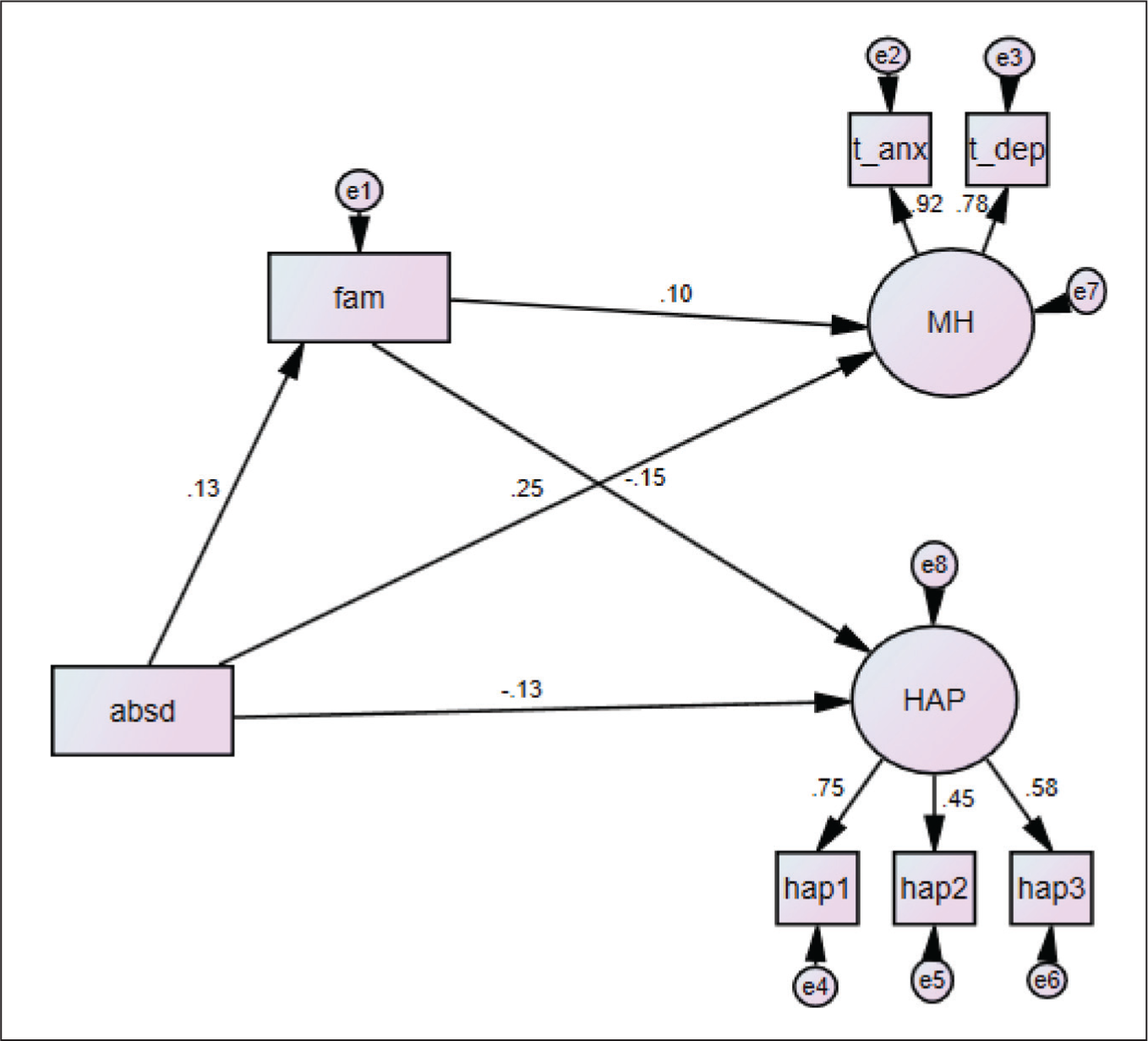
The model comprises the family environment as a mediator in the relationship between abuse and mental health outcomes and between abuse and happiness. The results indicated that the model showed a good fit to the data (χ2 (11) = 37.037, p < .001, χ2/df = 3.367, CFI = 0.962, GFI = 0.982, TLI = 0.928, RMSEA = 0.064, SRMR = 0.0590). Figure 1 displays the direct effect of the model, and Table 2 displays the total and indirect effects.
As seen in Figure 1, abuse was positively and significantly linked to family environment (β = 0.13, p < .01) and to mental health (β = 0.25, p < .01). Abuse was negatively and significantly linked to happiness (β = –0.13, p < .01). Family environment was positively and significantly linked to mental health (β = 0.10, p < .01). Additionally, the family environment was negatively and significantly linked to happiness (β = –0.15, p < .01). The model shows that all the direct paths are significant. The bootstrapping method was used to examine the mediation effects of the model. 23 To estimate the significance of indirect effects, 500 bootstrap samples and a 95% confidence interval were used.
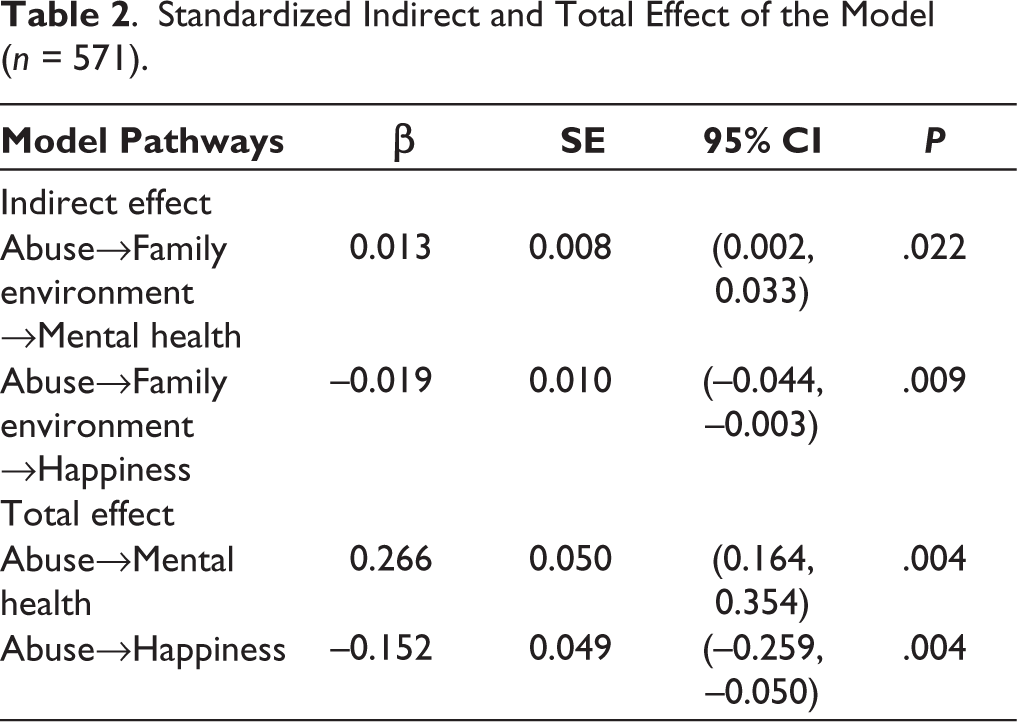
As displayed in Table 2, the indirect effect of abuse on mental health via family environment was significant (β = 0.013, 95% CI [0.002, 0.033]), whereas indirect effect of abuse on happiness via the family environment was significant (β = –0.019, 95% CI [–0.044, –0.003]). Furthermore, the total effect of abuse on mental health (β = 0.266, 95% CI [0.164, 0.354]) and abuse on happiness (β = –0.152, 95% CI [–0.259, –0.050]) was significant. The findings indicated that the relationship between abuse and mental health is mediated by the family environment. Also, the relationship between abuse and happiness is mediated by the family environment. In other words, the family environment acts as a mediator to the association between abuse and mental health, as well as abuse and happiness.
Standardized Indirect and Total Effect of the Model (n = 571).
Discussion
The mediation model with the family environment as a mediator between mental health and abuse and abuse and happiness is examined in this study. It is relevant to understand the role of the family environment in determining mental health and happiness among abused children. The association between the family environment and the variables mental health and happiness, which were analyzed for their association, indicates a significant relationship. Furthermore, a positive correlation is indicated among the variables, except for happiness. This implies that happiness and mental health of the participants are affected by their family environment. The strongest predictor for positive and adaptive adolescents is living in a comfortable home with healthy family relationships.25,26 Family environment is also a protective factor for growing adolescents. 27 However, conflicts within the family may also lead to negative feelings among them, 28 thus impacting their happiness. Thus, the family environment is a potential factor that can promote mental health or becomes a causal factor for mental health issues among abused children. The family environment has a positive impact on resilience. 29 A positive family environment reduces family conflict and mental health issues, 30 and promotes psychological health conditions. 31
The present findings indicate that there is a direct link between family environment, mental health, happiness, and abuse. As the aim was to understand the role of the family environment in determining the mental health and happiness of children who have experienced abuse, mediational analyses were applied. The estimation of mediation for indirect effects and total effects on the variables was checked. The findings indicate that the effect of abuse on mental health and abuse on happiness is mediated by the family environment. The mediating role of the family environment is substantiated by the results of this study. The WHO report (2004) on “Prevention of Mental Disorders: Effective Interventions and Policy Options” states that family can be a place of protection and/or risk for individuals. In both cases, it may be through biological, emotional, cognitive, behavioral, and interpersonal factors, which are all in the context of family. 32 In a series of studies examining the life satisfaction of children,33–35 Huebner identifies the relationship with family and friends as the two most important determinants of a child’s well-being.
In light of the above, it is crucial to comprehend the family-related experiences of the abused children. This study includes participants who had experienced abuse in one form or the other. Abused children need a positive environment and support to cope and overcome the impact of the negative experiences of abuse. Strong positive relationships promote trust and a sense of security. These will have a strong impact on their lives. The characteristics of caregivers and family environment are linked to child abuse and neglect. Though different factors are indicated to be of risk, parental behavior and psychological aspects within the family are said to lead to abuse, 36 which may affect mental health and happiness among children dealing with abuse. Dysfunctional family members and unstable family environments further complicate neglect issues among children. 37 Furthermore, domestic violence and intimate partner violence witnessed by children are found to be related to the risk of abuse.38,39 In such circumstances, children are not at risk only for physical abuse but other forms of abuse as well. 39 Moreover, children may feel victimized when they witness parents in conflict, which will have an impact on their mental health. There is limited research available that explores broken families harboring an environment of abuse that affects children in India. 40 Adolescence being a period of socio-emotional turbulence, home environment, and parental characteristics influence mental health. For instance, adolescents who live in positive home environments have less anxiety issues compared to others from dysfunctional families. 41 By examining the results of this study in light of the existing literature, it may be stated that family environment is a significant predictor for mental health and happiness among abused children. These findings have important implications for professionals in the field of psychotherapy, counseling, and policy-making for abused children, through family-based interventions.
Recommendations
This present study points out the need to consider the family environment as a priority in future abuse prevention programs for children. The findings of this research can be a base for further research and prevention program implementations in the Indian context. Many of the abusive parental practices and responses to abuse are said to be intergenerational transmission. This can be effectively addressed if the interventions focus on a public health approach, by involving family members as the gatekeepers of abuse. Many cultural and belief systems are rigid, which require a family-based approach to change and evolve over time. The findings here emphasize the need to devise primary and secondary prevention strategies for abuse involving the family components in the intervention programs. Identifying the key aspects of family that strengthen children socio-emotionally will have a far-reaching impact on their mental health and happiness.
Limitations
Self-report measures were adopted for data collection and therefore there is a possibility of the risk of social desirability. The variables of child abuse and family environment were measured using semi-structured tools. The role of other socio-demographic variables has not been considered in this study.
Conclusion
Adverse experiences impact happiness and mental health outcomes among students. The family environment mediates the relationship between child abuse and mental health, and between child abuse and happiness. Children experiencing abuse need family care, support, and involvement to cope with the abuse. A protective and positive family environment may buffer poor mental health and foster happiness among children.
Footnotes
Declaration of Conflicting Interests
The authors declared no potential conflicts of interest with respect to the research, authorship, and/or publication of this article.
Funding
The authors received no financial support for the research, authorship and/or publication of this article.
Statement of Informed Consent and Ethical Approval
The study proposal got ethical clearance from the IRB of Pondicherry University (No.PU/IEC/HS/2012-13/45 dated 28 February 2013). Written informed consent was obtained from all the students and their parents. The study strictly followed the principles as enunciated in the Declaration of Helsinki.