



Abstract
Background
Cynanchum radians (C. radians) is a small herb from the Asclepiadoid genera, found in both the Old and New Worlds. The plant has potential medicinal properties, but its effects on coagulation have yet to be fully explored.
Objectives
This study aims to evaluate the anti-thrombotic properties of C. radians acetone extracts by comparing their effects on coagulation markers with those of standard anticoagulants, such as heparin and aspirin.
Materials and Methods
Forty mice were divided into four groups: control, acetonic extracts C. radians treatment group, aspirin treatment group, and heparin treatment group. Blood samples were drawn from each mouse in the four groups using ethylenediaminetetraacetic acid, sodium citrate, and heparin tubes. Blood tests, including complete blood count, renal function and liver enzymes tests, activated partial thromboplastin time (aPTT), prothrombin time (PT), international normalized ratio (INR), fibrinogen, and D-dimer concentrations were evaluated for each mouse.
Results
There were no significant variations in the levels of chloride, potassium, sodium, blood urea nitrogen, creatinine, aspartate aminotransferase, and alanine aminotransferase across all groups. The C. radians acetone extracts caused a significant prolongation of PT, aPTT, and INR in mice compared to the heparin- and aspirin-treated groups (p < 0.05). However, no statistically significant differences were observed in D-dimer and fibrinogen levels among the groups.
Conclusion
The present investigation determines that the acetone extracts of C. radians have a more significant effect on prolonging aPTT, PT, and bleeding time in mice compared to heparin and aspirin. These findings suggest that C. radians extracts possess significant anti-thrombotic properties and may serve as potential precursors for developing thrombosis treatments. However, further research is needed to fully understand the underlying mechanisms, optimize dosing, and assess long-term safety and efficacy before clinical applications can be considered.
Keywords
Introduction
Thrombosis can develop in arteries or veins. Atherothrombosis begins with the rupture of atherosclerotic plaque in arteries. This disturbance causes platelets to clump together and triggers the activation of blood clotting, leading to the formation of thrombi that contain a high concentration of platelets. These thrombi obstruct the circulation within the affected arteries. This mechanism is the principal cause of myocardial infarction, ischemic stroke, and acute limb ischemia. Veins have a slower flow of blood compared to arteries, causing venous thrombi to have more fibrin and fewer platelets than arterial thrombi (Mackman, 2008). Venous thrombi lead to two different conditions: pulmonary embolism and deep vein thrombosis. When combined, these disorders are commonly referred to as venous thromboembolism (VTE). Arterial and venous blood clots combined account for about 25% of worldwide deaths, resulting in an estimated 18 million deaths annually (Raskob et al., 2014; Roth et al., 2015). Antiplatelet therapy is largely acknowledged as the primary method for preventing and treating atherothrombosis (Eikelboom et al., 2012; Fredenburgh et al., 2017). Anticoagulant therapy is the main method used to prevent and cure VTE as the fibrin is abundant and the presence of the platelets is limited in venous thrombi (Kearon et al., 2016). Bleeding is a main concern linked to antithrombotic medicine, especially when dual antiplatelet treatment (DAPT) is used. DAPT is the simultaneous administration of aspirin and a P2Y12 receptor antagonist. A receptor inhibitor, like clopidogrel, is preferred over using aspirin alone. Combining anticoagulants with single antiplatelet therapy or DAPT increases the likelihood of bleeding. The probability of experiencing major bleeding is around 1.8 times higher with DAPT compared to using aspirin alone (Bowry et al., 2008; Rothberg et al., 2005). Additionally, combining aspirin with a therapeutic dose of a vitamin K antagonist (VKA) such as warfarin results in a 2.5 times higher risk of serious bleeding. Ischemic episodes can lead to a large increase in hemorrhage and death, which is partly due to the cessation of antithrombotic medication (Eikelboom et al., 2006; Odén et al., 2006). Prescribing a normal dose of anticoagulant medicine is informed by experience with administering VKAs. For optimal effectiveness, dose changes for VKAs should be made to achieve an international normalized ratio (INR) value greater than 2 (Connolly, 2009; Patel et al., 2011). New studies are concentrating on natural products for preventing and treating arterial and venous thrombi caused by the negative effects of anticoagulant medication and aspirin. Cynanchum radians, sometimes known as radiating swallow-wort, is a perennial herbaceous plant with white flowers and a woody stem. It originates from South Africa and the Middle East areas, inhabiting grasslands and open woodlands (Khanum et al., 2016). This study aimed to evaluate the antithrombotic effects of C. radians in mice.
Materials and Methods
An analytical study was carried out in the laboratories of the Center of Health Research at the Deanship of Postgraduate Study and Scientific Research at Taif University.
Acetone Extraction of C. radians
Branches and leaves of the herb were dried at 50°C for 8 h in an oven supplemented with a vacuum. The dried branches and leaves were then ground into a fine powder using an electric blender. 15 g of the powder was immersed in 250 mL of acetone. The mixture was left to soak for 72 h at room temperature with continuous agitation. Afterward, the solution was filtered through Whatman filter paper to eliminate any solid impurities and then subjected to drying using a rotary evaporator. The resulting crude extracts were then securely stored in airtight containers at 4°C for further analysis.
Experiment Design
Forty Bagg albino mice, male, with an average age of 2 months and an average weight of 30 g ± 5, were kindly gifted by Dr. Abdullah Aldairi, Umm Al-Qura University, Saudi Arabia. The mice were housed in universal rodent cages with a bedding of woodchips. The cages were placed in a well-ventilated animal lab at Taif University and alternating 12-h light and dark cycles. The surrounding temperature was regularly monitored and maintained at 25°C. The mice were given regular mouse feed and access to plain drinking water throughout the study. Following a 2-week adjustment phase, the 40 mice were randomly grouped into four clusters, each group is made of 10 mice.
The initial cluster was assigned as the control group and did not receive any therapy.
The second cluster was labeled as the C. radians acetonic extract treatment group (C. radians acetone). In which, the mice were treated with the acetonic extracts of C. radians.
The third cluster received treatment with heparin (H-treated). In this group, the mice were given a single subcutaneous dosage of heparin at 40 U/kg of body weight. Blood samples were then obtained from the mice after 4 hours.
The fourth cluster was designated as the aspirin treatment group (A-treated). Oral aspirin was given to the mice in this cluster. A dose of 5 mg/kg of body weight was administered to the mice through intragastric gavage for 5 consecutive days. Following this treatment, blood samples were collected from each mouse in the group.
Collection of Blood Samples
Blood samples were drawn from all mice into ethylenediaminetetraacetic acid (EDTA), sodium citrate, and plain tubes via the retro-orbital venous plexus. After collecting the samples in sodium citrate and plain tubes, they were immediately centrifuged at 3,000 rpm for 20 min. The resulting sera were then frozen at –80°C for future analysis. The blood collected in EDTA tubes was immediately used to perform a complete blood count (CBC).
Estimating CBC
(UniCel® D×H 500) analyzer by Beckman Coulter, USA. was used to evaluate the CBC for all mice in this research.
Assessment of Coagulation Parameters
The serum derived from blood collected in a sodium citrate tube was employed to assess prothrombin time (PT), activated partial thromboplastin time (aPTT), the INR, fibrinogen, and D-dimer utilizing a Sysmex CS5100 automatic coagulation analyzer from Japan along with particular reagents. The bleeding time was evaluated personally.
Evaluation of Biochemical Parameters
The concentrations of carbon dioxide (CO2), chloride (Cl−), potassium (K+), sodium (Na+), blood urea nitrogen (BUN), anion gap, and glucose were quantified utilizing the Beckman Coulter AU480.
Statistical Analysis
The Statistical Package for the Social Sciences (SPSS) software version 16 by SPSS Inc. in Chicago, IL, USA, was used to conduct the statistical analyses. The data were presented as mean ± standard deviation (SD), and comparisons of total chemical parameters between various groups were conducted using one-way analysis of variance (ANOVA). The level of p < 0.05 was considered statistically significant.
Results
Serum Biochemistry
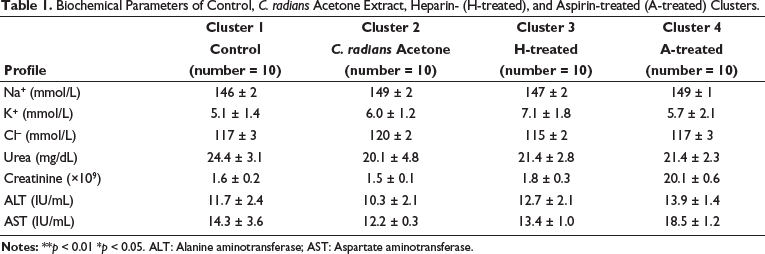
Table 1 displays the levels of electrolytes (Cl−, K+, and Na+), kidney function parameters (BUN and creatinine), and liver enzymes (alanine aminotransferase (ALT) and aspartate aminotransferase (AST)) in the four groups. There were no notable variations in any of the biochemical analyses across all of the groups. Nevertheless, the findings indicated that the kidney and liver function remained unaltered among mice that received various extracts of C. radians.
Biochemical Parameters of Control, C. radians Acetone Extract, Heparin- (H-treated), and Aspirin-treated (A-treated) Clusters.
CBC Results
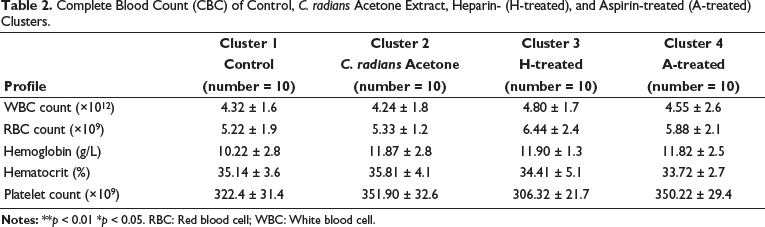
Table 2 displays the CBC results for the four groups. CBC levels showed no notable variations across all groups. The acetonic extracts of C. radians had no impact on the white blood cell (WBC) count, red blood cell (RBC) count, or the count of platelets. In addition, the mice that received various extracts of C. radians showed normal hemoglobin and hematocrit values.
Complete Blood Count (CBC) of Control, C. radians Acetone Extract, Heparin- (H-treated), and Aspirin-treated (A-treated) Clusters.
Coagulation Profiles
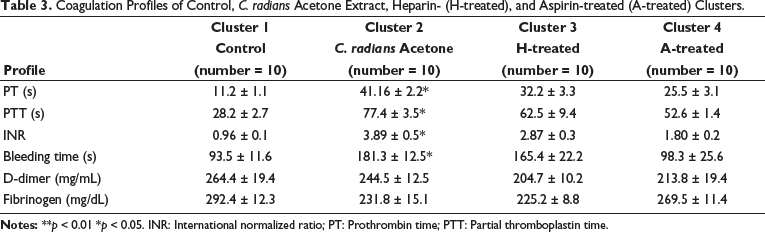
Table 3 presents the tests blood clotting profiles of the mice among the four clusters. The PT of the C. radians acetonic extract treatment cluster (41.16 ± 2.2) was significantly elevated in comparison to the heparin treatment (H-treated) and aspirin treatment (A-treated) clusters (32.2 ± 3.3 and 25.5 ± 3.1, respectively) (p < 0.05). The aPTT of the cluster administered the acetone extract of C. radians (77.4 ± 3.5) was significantly increased in comparison with that of the clusters treated with heparin (62.5 ± 9.4) and aspirin (52.6 ± 1.4) (p < 0.05). The INR of the C. radians acetone-treated group (3.89 ± 0.5) was considerably elevated compared to the heparin (2.87 ± 0.3) and aspirin (1.80 ± 0.2) treated groups (p < 0.05). The bleeding duration of the C. radians acetone extract-treated group (181.3 ± 12.5) exhibited a statistically significant difference compared to the heparin (165.4 ± 22.2) and aspirin treatment (98.3 ± 25.6) clusters (p < 0.05). No substantial differences were seen in D-dimer and fibrinogen levels among all groups.
Coagulation Profiles of Control, C. radians Acetone Extract, Heparin- (H-treated), and Aspirin-treated (A-treated) Clusters.
Discussion
C. radians is a rare genus of Asclepiadoid plants found in both the Old and New Worlds. The genus Cynanchum comprises over 200 plant species, with 17 identified as medicinal plants. In addition, a total of 24 well-known traditional medicines obtained from Cynanchum species were categorized (Han et al., 2018). Research on the chemical constituents and pharmacological properties of Cynanchum species has revealed a diverse range of bioactive compounds. These plants exhibit notable anti-cancer (Yang et al., 2021; Zhang et al., 2000), anti-fungal (Wang et al., 2023; Xin et al., 2019), anti-parasitic (Fu et al., 2014; Ji-Hong et al., 2017), anti-viral (Tao et al., 2011; Zai-Chang et al., 2005), and anti-inflammatory activities (Abdelhameed et al., 2021). In addition, several species have demonstrated neuroprotective effects (Weon et al., 2012).
However, despite the extensive research on various Cynanchum species, there are currently no studies specifically addressing the pharmacological properties of C. radians. C. radians is a little herb that has a wide geographic distribution throughout Saudi Arabia. In the past, the people of Saudi Arabia consumed the fruits of this shrub, which possessed a pleasant sweet flavor (Qari et al., 2021).
C. radians acetone extract did not cause any damage to the liver or kidneys, as confirmed by the normal results of hepatic function tests (ALT and AST) and renal function tests (urea and creatinine). No abnormalities were observed in the WBC, RBC, and platelet counts of mice treated with acetone extract of C. radians. In addition, these mice exhibited normal levels of hemoglobin and hematocrit. Aspirin is the primary antiplatelet agent in common use. Aspirin efficiently inhibits the enzyme cyclooxygenase-1, hence obstructing the initial phase of the synthesis pathway for prostaglandin and thromboxane A2. The process of platelet aggregation is inhibited. Aspirin reaches its greatest antiplatelet effect within minutes and is effective for the whole lifespan of platelets, which normally lasts for 5–7 days (Ebar et al., 2022; Ornelas et al., 2017). Heparin is widely used as an injectable anticoagulant in clinical settings. It is recommended for preventing VTE, acute coronary syndrome, mechanical heart valves, and atrial fibrillation, and for transitioning patients to and from long-acting oral anticoagulants in both primary and secondary prevention. Heparin interacts with antithrombin, altering its shape and accelerating its transition from a slow to a fast thrombin inhibitor. Furthermore, heparin inhibits the activity of activated coagulation factors IX to XII, as well as plasmin, while preventing the conversion of fibrinogen into fibrin (Boral et al., 2016; Hall & Mazer, 2011; Szczuko et al., 2021; Ziliotto et al., 2019). During vascular injury, fibrinogen is converted into thrombin, which triggers the onset of blood clotting. D-dimer, a breakdown product of fibrin, can be detected in the bloodstream following clot formation. PT is assessed by measuring the activity of the extrinsic pathway (factor VII) and the protein factors involved in the common pathway (fibrinogen, prothrombin, factors V and X). The present study observed an elevation in PT levels in mice that were administered C. radians acetone extract, which was more than that of mice treated with heparin and aspirin. aPTT is a specific test that directly measures the coagulation process. It assesses the activity of the intrinsic pathway, which includes factors XII, XI, IX, and VIII, as well as the common pathway factors discussed earlier. The aPTT in the cluster treated with acetone extract of the effects of C. radians were greater compared to the clusters treated with aspirin and heparin. Additionally, the INR of the groups receiving C. radians acetone extract was higher than those treated with aspirin and heparin. The bleeding time in the groups treated with C. radians acetone extract was significantly longer and greater than in the aspirin and heparin treatment clusters.
The specific mechanism by which C. radians exert anticoagulant effects remains unexplored. However, research on other Cynanchum species has revealed that their chemical composition includes C21 steroids, alkaloids, and flavonoid compounds. C21 steroids, alkaloids, and flavonoids have demonstrated promising antithrombotic effects through various mechanisms (Kang et al., 2012). C21 steroids influence the coagulation cascade, inhibit platelet aggregation, and reduce blood clot formation (Chang et al., 1998; Kang et al., 2012). Alkaloids exhibit antithrombotic activity by inhibiting platelet aggregation, reducing fibrin formation, and minimizing vascular inflammation, which indirectly lowers thrombosis risk (Li et al., 2002; Parvin et al., 2022). Flavonoids provide cardiovascular benefits by reducing platelet aggregation, oxidative stress, and improving endothelial function, while their antioxidant properties protect blood vessels from damage that may lead to clotting (Sharifi-Rad et al., 2022; Vazhappilly et al., 2019). Given these effects, it is plausible that these compounds contribute to the anticoagulant properties observed in C. radians, warranting further investigation into their specific role in this species.
Conclusion
This study revealed that the acetone extract of C. radians demonstrated a more significant impact on extending aPTT, PT, and bleeding time than both aspirin and heparin suggesting a potent anticoagulant effect. The study presents a novel insight into the anticoagulant potential of C. radians acetone extracts, demonstrating for the first time that these extracts significantly prolong PT, aPTT, and INR in mice, surpassing the effects of well-known anticoagulants heparin and aspirin. This finding suggests that C. radians could be a promising natural alternative for anticoagulation therapy, warranting further investigation into its mechanisms and potential clinical applications.
Limitations
This study has several limitations, including a small sample size of 40 mice, which may not provide sufficient statistical power to detect subtle differences in treatment responses. Although treatment with C. radians did not cause any immediate toxicity to the liver or kidneys in mice, the short duration of the treatment and observation period may not fully capture the long-term effects or safety profile of C. radians extracts. Further studies with extended treatment durations are necessary to better assess the potential for delayed toxicity and to ensure its long-term safety. Additionally, the murine model may not fully capture human physiological responses, and clinical studies are needed for verification. The investigation did not examine the mechanisms of action of C. radians on coagulation pathways, limiting insights into its antithrombotic properties. Lastly, the absence of comparative analysis with a wider variety of anticoagulants restricts the generalizability of the findings, highlighting the need for future studies to explore a broader range of treatments.
Footnotes
Abbreviations
ALT: Alanine aminotransferase; ANOVA: Analysis of variance; aPTT: Activated partial thromboplastin time; AST: Aspartate aminotransferase; BUN: Blood urea nitrogen; C. radians: Cynanchum radians; CBC: Complete blood count; Cl–: Chloride; CO2: Carbon dioxide; DAPT: Dual antiplatelet treatment; EDTA: Ethylenediaminetetraacetic acid; g/L: Grams per liter; INR: International normalized ratio; IU/mL: International units per milliliter; K+: Potassium; mg/dL: Milligrams per deciliter; mg/mL: Milligrams per milliliter; mmol/L: Millimoles per liter; Na+: Sodium; NF-κB: Nuclear factor kappa B; PT: Prothrombin time; RBC: Red blood cell; s: Seconds; SD: Standard deviation; SPSS: Statistical Package for the Social Sciences; VKA: Vitamin K antagonist; VTE: Venous thromboembolism; WBC: White blood cell.
Acknowledgments
The author extends their sincere appreciation to Dr. Abdullah Aldairi from Umm Al-Qura University, Saudi Arabia, for his invaluable contribution in providing the animal model used in this study. His support was instrumental to the successful completion of this research. The author also extends his appreciation to Taif University, Saudi Arabia for supporting this work through project number TU-DSPP-2024-204.
Declaration of Conflicting Interests
The author declared no potential conflicts of interest with respect to the research, authorship, and/or publication of this article.
Ethical Approval
The animal study protocol was approved by the National Committee for Bioethics at Taif University under protocol code HAO-02-T-105, and the Committee found that the proposal met all the necessary criteria.
Funding
The author disclosed receipt of the following financial support for the research, authorship, and/or publication of this article: This research was funded by Taif University, Saudi Arabia (Project No. TU-DSPP-2024-204).
