




Abstract
Background
Motherwort has a protective effect on the nervous system and can improve cerebral ischemia–reperfusion injury to a certain extent. However, the effect of motherwort on the biological behavior of the brain tissue of rats with ischemic stroke and its relationship with the phosphatidylinositol 3-kinase/protein kinase B (PI3K/AKT) signaling pathway is still unclear.
Objectives
Therefore, we will explore the effect of motherwort on the biological behavior of the brain tissue of rats with ischemic stroke and its relationship with the PI3K/AKT signaling pathway.
Materials and Methods
There were 17 model rats in each group, divided into a control group, a model group, and a motherwort (low, medium, and high) dose group. Detect cell proliferation, invasion, and so on, and observe the expression of proteins and genes such as nuclear factor kappa B (NF-κB), AKT, Pl3K, and β-actin.
Results
After successfully constructing a rat model of ischemic stroke, motherwort can improve neurological damage and cerebral infarction in ischemic stroke and is closely related to PI3K/AKT signaling; in addition, motherwort can upregulate PI3K/AKT signaling and improve neurological damage and cerebral infarct size in ischemic stroke rats to a certain extent, and play a role in protecting neurons.
Conclusion
The antioxidant and antineuronal apoptosis effects of motherwort can improve neurological damage and cerebral infarction area of ischemic stroke rats by upregulating the expression level of the PI3K/AKT signaling pathway, thereby inhibiting nerve cells. Apoptosis further protects neurons and plays a role in slowing down disease progression.
Introduction
The pathogenesis of neurological diseases represented by ischemic stroke involves multiple aspects of hemodynamic changes, inflammatory response, and oxidative stress (Feske, 2021). In relevant research reports, motherwort’s anti-inflammatory, antioxidant, and anticoagulant pharmacological mechanisms have certain effects on the treatment of nephritis, bronchitis, neurasthenia, and other diseases (Zong & Zhao, 2021). When ischemic stroke occurs, it can promote the protection of brain tissue by activating phosphatidylinositol 3-kinase/protein kinase B (PI3K/AKT) (Wang et al., 2022). Therefore, this study aimed to explore motherwort’s effect on the biological behavior of brain tissue in rats with ischemic stroke and its relationship with the PI3K/AKT signaling pathway (Hu et al., 2022).
Motherwort is mainly extracted from the leaves of motherwort. It can reduce the increase in blood pressure caused by epinephrine. And it can play a certain preventive role in cardiovascular diseases. Motherwort can not only enhance the anti-stress ability of cells by upregulating the expression of HSP, thereby exerting its protective effect, but it can also protect cells from damage by downregulating the level of reactive oxygen species (ROS) and reducing the degree of oxidative stress reaction (Leung et al., 2020). It is believed that upregulating the expression of nitric oxide synthase (NOS) can regulate vasomotion to a certain extent and play a certain role in improving cancer, cardiovascular disease, and coronary heart disease (Olszewski et al., 2022). On this basis, motherwort affects the intracellular calcium ion concentration by regulating the expression of HSP27, HSP70, HSP90, and other proteins, thereby affecting the excitability of cells (Shkembi & Huppertz, 2021); in addition, various reactive oxygen species such as O2–, H2O2, and ·OH. Under its regulation, it can exert its regulatory effect to a certain extent by affecting the intracellular redox state (Yang et al., 2019). At the same time, by inhibiting the production of anti-inflammatory factors, it can reduce a series of inflammatory reactions, and can also exert a certain inhibitory effect on IL-17 and IL-23 (Huang et al., 2022). In this process, it can not only inhibit ADP-induced platelet aggregation by regulating cAMP, cGMP, and other signaling molecules in platelets, but it can also inhibit thrombus formation by regulating the synthesis of PGI2 (Levine et al., 2022). In addition, the participation of Ca2+, 5-HT, and nitric oxide (NO) also plays a certain role in the process of motherwort inhibiting platelet aggregation and dissolving thrombus (Nouruzi et al., 2022).
The PI3KAKT pathway can not only regulate Bcl-2 and Bax, but also regulate the levels of Bad, Bid, and other proteins. In addition, it can also affect nuclear factor kappa B (NF-κB), IκBα, and other inflammatory response-related proteins to a certain extent, thus affecting the activity of stress indicators (Forman & Zhang, 2021). In addition, studies have found that the PI3K/AKT pathway can also upregulate Beclin 1 and LC3 to promote the autophagy process, thereby clearing damaged organelles, further reducing ischemic damage, and improving neurodegenerative diseases such as Parkinson’s disease and stroke (Tolosa et al., 2021). In this process, not only the participation of the PI3K and PTEN pathways regulates cell growth and proliferation, but PDK1, as an important component of the PI3K/AKT pathway, promotes phosphorylation and activation of Akt to a certain extent (Xu et al., 2020). In this process, the participation of mTOR and MAPK pathways also played a certain regulatory role (Deleyto-Seldas & Efeyan, 2021). In some research reports, Traditional Chinese Medicines such as Salvia miltiorrhiza, Ligusticum chuanxiong, and ginseng are believed to have the effect of regulating the PI3KAKT signaling pathway, inhibiting apoptosis and promoting the survival of nerve cells (Wang et al., 2022); the dry aerial parts of motherwort plants can diuresis and reduce swelling, and also have the effect of clearing heat and detoxifying. In related studies, motherwort activates the PI3KAKT signaling pathway, which can not only improve the survival rate of nerve cells but also reduce the damage caused by ischemic stroke to a certain extent, making the deficiency symptoms of hemorrhagic stroke (Feske, 2021). Therefore, this study observed changes in leonurine on histopathological changes, oxidative stress indicators, and cell apoptosis in the brain of rats, and explored its relationship with the PI3K/AKT signaling pathway (Jakubiak et al., 2021). Therefore, this study provides a certain basis for the mechanism of motherwort in ischemic stroke.
Materials and Methods
Instruments, Reagents, and Animals
Instruments and reagents: Motherwort base (purity: ≥98%; batch number: 24697-74-3; Shanghai Xianke Biotech; it is an extract of motherwort leaves, which has pharmacological effects such as antioxidant, antiaging and inhibiting the growth of cancer cells. It can also treat the cardiovascular system and has a certain protective effect); PI3K antibody (Shanghai Guduo Biotechnology); AKT antibody (Aimeiji Technology); secondary antibody (Thermo Fisher); superoxide dismutase (SOD) kit (Shanghai Fanzhou Biotechnology); oxidized low-density lipoproteins (ox-LDL) reagent kit (Shanghai Huabang Biotechnology); NO kit (Shanghai Keaibo Biotechnology); endothelial nitric oxide synthase (eNOS) kit (Beijing Xingyiyachuang Biotechnology); TTC solution (Shanghai Yuntai Information Technology); HE staining kit (Yisheng Biotechnology); real-time polymerase chain reaction (PCR) primers and kits (Guangzhou Ruibo Biotechnology); RNA extraction kit (Shanghai Haifang Biotechnology).
Animals: 85 SD rats, male (Beijing Vitong Lever) were raised in an environment with constant temperature, constant humidity, light and dark for 12 h, respectively.
Construction and Grouping of Ischemic Stroke Rat Model
According to the literature by Leung et al. (2020) and Levine et al. (2022), the rat model was constructed through the Longa suture method. Before the operation, the rats were fasted and kept hydrated, weighed, and then anesthetized. First, the carotid artery of the rat was isolated and ligated, and the distal end of the internal carotid artery was blocked using an arterial clamp. After the incision, a fishing line was inserted into the internal carotid artery until reaching the opening of the left middle cerebral artery, and then the tail end of the fishing line was cut off for disinfection. Finally, the rats were returned to the cage and given normal feeding with food and water, while maintaining their body temperature through an incandescent lamp. Unplug the wire and perform secondary perfusion. During this process, if the rat develops neurological deficit symptoms and survives for 24 h, the model is considered successful.
Grouping: Control group and model group: Rats were given 20 mL/kg physiological saline respectively; low-dose motherwort group: Given motherwort 4 mg/kg/d; medium-dose motherwort group: Given 4 mg/kg/d motherwort; motherwort alkali high-dose group: Motherwort alkaline was given 4 mg/kg/d, and there were 17 rats in each group.
Detection of Neurological Damage
The neurological damage of rats was scored with reference to the literature. Twelve rats from each group were taken out and tested through the tail lift reflex, balance test, walking test, sensory test, and reflex test at 24 h, 3, 7, and 14 days after administration. Missing and abnormal movements are scored, with a maximum score of 18 points, and 1 point if missing or unable to complete.
Oxidative Stress Detection
After the last dose, the rats were fasted and water-free for 12 h. After that, four rats from each group were taken out and killed by dislocation. The brain tissue of the rats was quickly removed. The left hemisphere of the brain tissue was cut sagittally, and the right side was discarded. The left brain was removed. Half of the hemisphere is flushed with saline to remove blood, and a filter is used to absorb any remaining saline on the tissue. Measure the weight of the left hemisphere to determine the volume of saline added. Put the saline and brain tissue into a beaker filled with ice cubes at a ratio of saline to brain tissue of 9:1, then use a glass homogenizer to make a brain tissue homogenate, centrifuge, and let it store at a certain temperature. Strictly follow the instructions of the kit, detect SOD activity by xanthine oxidation method, and detect ox-LDL, NO and eNOS contents in brain tissue by enzyme-linked immunosorbent assay.
TTC Staining
After the last administration, five rats were taken out from each group. After sacrifice, brain tissue was removed and fixed in formalin solution for 1 week. The brain tissue was removed from the formalin, and the moisture on the surface of the tissue was sucked dry, placed in a −20°C refrigerator for 30 min, and then sliced and dip-stained. After repeated operations, the rat cerebral infarction area was measured and analyzed through IPP images, where red represents normal brain tissue and white represents the brain infarct area.
PCR Detection of PI3K and AKT mRNA Expression
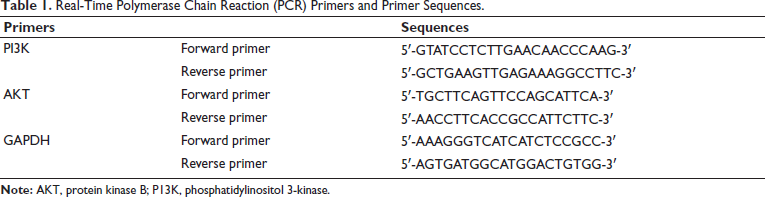
RNA was extracted and RT-qPCR was used to reverse-transcribe it into cDNA. GAPDH is an intrinsic control between ROCK/MLCK and miRNA, and the qRT-PCR results were analyzed. Relative levels were estimated using the 2−∇∇Ct method. Table 1 lists the primers and primer sequences.
Real-Time Polymerase Chain Reaction (PCR) Primers and Primer Sequences.
WB Detection of Protein Expression of PI3K and AKT
The protein concentration is detected by the BCA method. First, a protein loading buffer is added to a protein tissue sample containing an equal amount of protein and boiled, and then SDS-PAGE and membrane transfer are performed. Give primary antibodies PI3K (ab302958, 1:1,000), AKT (ab8805, 1:1,000), β-actin (ab8226, 1:1,000); rabbit secondary antibody (1:200) for incubation. β-actin was used as an internal reference. Protein bands were detected and analyzed through the chemiluminescence method and QuantityOne software.
Statistical Analysis
The data obtained in each of the above experiments were analyzed using SPSS21.0 and GraphPad Prism software. If there are no special requirements, p < 0.05 is used as the test standard.
Results
Motherwort has an Effect on Improving Neurological Damage and Cerebral Infarction in Ischemic Stroke
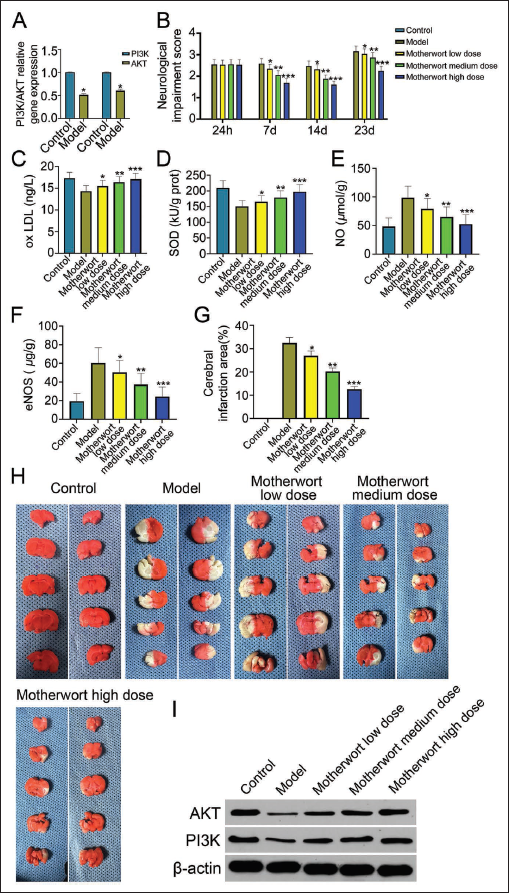
The survival time of rats in this study was more than 24 h, and the overall survival rate was 100%. In order to explore the effect of motherwort on ischemic stroke rats, we conducted animal in vitro experimental intervention experiments and found that PI3K and AKT expression in the model group was lower than control group (p < 0.05, Figure 1A), indicating that PI3K and AKT genes are abnormal in ischemic stroke rats. The results of subsequent comparisons showed that under the motherwort intervention condition, the neurological damage scores of rats showed a significant decreasing trend with prolongation of time (compared with the motherwort medium-dose group, p < 0.05, Figure 1B). At the same time, ox-LDL and SOD expression increased significantly, while the results for NO and eNOS index levels were opposite (compared with motherwort medium-dose group, p < 0.05, Figure 1C–F), indicating that motherwort can effectively improve oxidative stress in ischemic stroke. Further investigation found that as the concentration of leonurine increased, the cerebral infarction area of rats continued to decrease (compared with the leonurine medium-dose group, p < 0.05, Figure 1G and H), and protein level also increased significantly (Figure 1I).
PI3K/AKT Signaling is Involved in Neurological Damage in Ischemic Stroke
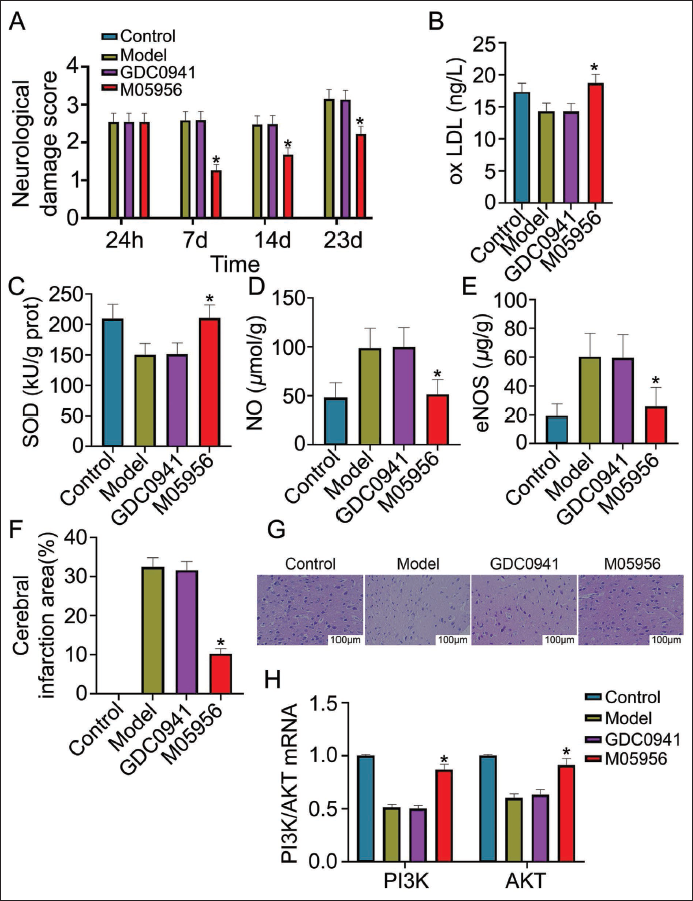
We found the neurological damage scores and oxidative stress showed no changes (Figure 2A–F), but neurological damage scores were reduced after intervention of M05856 (PI3K/AKT activator) (VSGDC094 group, p < 0.05, Figure 2A). Meanwhile, levels of ox-LDL and SODDE were increased (VSGDC094 group, p < 0.05, Figure 2B and C), while the levels of NO and eNOS were significantly reduced (VSGDC094 group, p < 0.05, Figure 2D and E), and the cerebral infarction area of rats was reduced (VSGDC094 group, p < 0.05). Further studies later found that the number of nerve cell apoptosis in the cortical area of the rat brain tissue was reduced, most notably in the M05856 group (Figure 2G). PI3K and AKT gene expression showed an upward trend (VSGDC094 group, p < 0.05, Figure 2H). The above experimental results reflect that upregulating PI3K and AKT can improve neurological damage and cerebral infarct size in ischemic stroke rats to a certain extent.
Motherwort improves Neurological Damage and Cerebral Infarction Area in Ischemic Stroke Rats
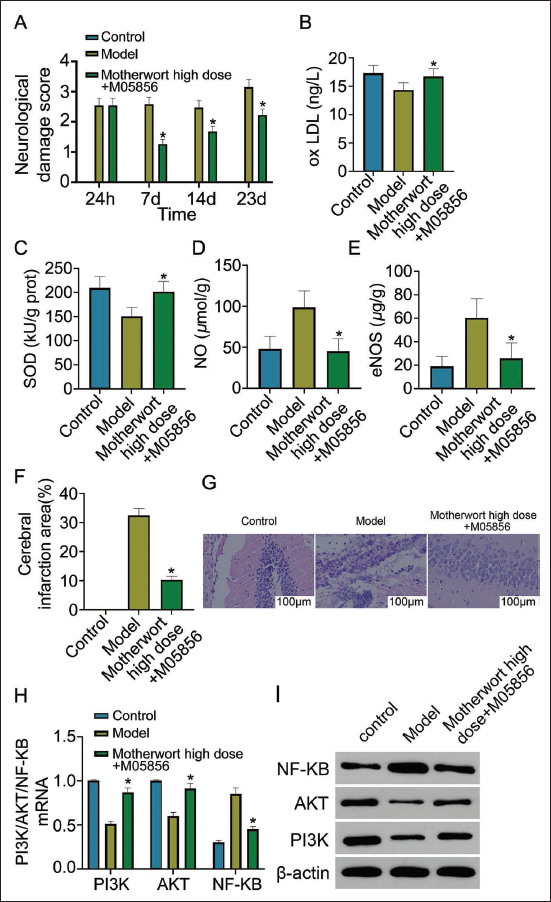
In order to verify the above experimental results, the rats in the control group, model group, and motherwort high dose + M05856 group were selected for experiments. It was found that the neurological damage score showed a reduced level (p < 0.05, Figure 3A), oxidative stress was higher (VS model group, p < 0.05, Figure 3B–E), and the area of cerebral infarction was reduced (Figure 3F), and the neuronal edema in the hippocampus area of the rat brain was decreased. There was less necrosis (Figure 3G). During this process, we found that high doses of motherwort and M05856 had a positive promoting effect on PI3K and AKT expression in ischemic stroke rats. We had an inhibitory effect on NF-κB, and the motherwort high-dose + M05856 group was the most prominent (VS model group, p < 0.05, Figure 3H and I). This further verifies that motherwort can improve neurological damage and cerebral infarction area in ischemic stroke rats by upregulating PI3K/AKT signaling and downregulating NF-κB, and has a good protective effect on neurons.
Discussion
Motherwort, as one of the traditional Chinese medicinal materials, is often used as a gynecological medicine (Huang et al., 2021; Zhao et al., 2021). As the most important alkaloid, motherwort has several biological activities. It can also dissolve thrombosis, improve microcirculation, reduce intracellular calcium overload, and treat the cardiovascular and central nervous systems. A potential drug for neurological diseases (Li et al., 2022; Qiao et al., 2023). Many documents show that motherwort has good therapeutic effects on myocardial infarction, myocardial fibrosis, cardiomyocyte hypertrophy, and other diseases in rats (Liu et al., 2023; Zhang et al., 2019). In the study of Guo, Wang, et al. (2019), it was reported that motherwort has a protective effect on cerebral ischemia. Later, it was found that combining motherwort with SL06 can improve nerve cell survival, inhibit nerve cell apoptosis, and activate superoxide dismutase, inhibit lactate dehydrogenase, reactive oxygen species, and malondialdehyde. In addition, it can also activate AKT and GSK3 and promote the expression of Bcl-2 to a certain extent. Previous studies have mostly focused on the preventive effect of motherwort on myocardial infarction. However, the current application mechanism of motherwort in the biological behavior of brain tissue in patients with myocardial ischemic stroke is not clear enough. Therefore, finding better treatment methods is of great significance for ischemic stroke treatment. In this study, motherwort was used to influence the biological behavior of the brain tissue of rats with ischemic stroke, and the pathological changes in the brain tissue and the disease development of the rats were observed, and further by observing genes such as PI3K and AKT, and motherwort regulates PI3K/AKT signaling to explore the biological behavior of brain tissue in rats with ischemic stroke, so as to achieve the purpose of slowing down the development of the disease in rats, and explore its mechanism of action to provide an important reference for related clinical research. In the previous study, the optimal dose of motherwort was obtained by detecting the serum indicators of ischemic stroke rats. Finally, it was concluded that the best effect was achieved with the intervention of motherwort 16 mg/kg, so this dose was used for further research.
We showed that the survival time of all rats was more than 24 h, and the overall survival rate was 100%. In order to explore the effect of motherwort on ischemic stroke rats, we conducted animal in vitro experimental intervention experiments and found that PI3K and AKT expression in the model group was lower than control group, indicating that PI3K and AKT genes are involved in ischemic stroke. Abnormalities appear in the body of rats with stroke. The results of subsequent comparisons showed that under motherwort intervention conditions, the neurological damage scores of rats showed a significant decreasing trend with prolongation of time. Meanwhile, the expression of ox-LDL and SOD increased significantly. In contrast, the results of NO and eNOS index levels were opposite, indicating that the motherwort base can effectively improve the level of oxidative stress in ischemic stroke. Further investigation found that as the concentration of leonurine increased, the cerebral infarction area of rats continued to decrease, and the protein expression level also increased significantly, suggesting that the treatment of ischemic stroke with leonurine has a certain concentration dependence. In the study of Quan et al. (2022), it was shown that motherwort has a concentration-dependent effect on the treatment of cerebral ischemic injury, and the brain infarct area, myeloperoxidase activity, nitrate/nitrite metabolite levels, and nerve fiber apoptosis after treatment. The mortality rates were significantly improved, further showing that motherwort can be used as a neuroprotective agent for ischemic stroke. This also confirms the research point of this article that motherwort slows the progression of ischemic stroke.
In order to further explore the mechanism of motherwort in improving neurological damage and cerebral infarction in rats with ischemic stroke based on the aforementioned experimental results, we used GDC094 (PI3K/AKT inhibitor) and found no change of oxidative stress indicators, but the neurological damage scores were reduced after intervention of M05856 (PI3K/AKT activator). At the same time, ox-LDL and SODDE levels were significantly increased, while NO and eNOS levels were reduced, and the cerebral infarction area was reduced to a certain extent; further research later found that the number of nerve cell apoptosis in the cortical area of the rat brain tissue was reduced, and the highest dose of leonurine + M05856 group was the most obvious. PI3K and AKT gene expression also showed an upward trend. The above experimental results reflect that upregulating PI3K and AKT can improve neurological damage and cerebral infarct size in ischemic stroke rats to a certain extent. In the study of Sun et al. (2021), a comprehensive description of the relationship between PI3K/AKT signaling and ischemic stroke showed that Chinese herbal medicine can slow down the damage of ischemic stroke through PI3K/AKT signaling. Later, in the study of Guo, Zhu, et al. (2019), it was confirmed that piperine protects neurons in patients with ischemic stroke by upregulating PI3K/AKT signaling. This is also the same view as this study. In addition, we found that the neurological damage scores of the rats were reduced, the oxidative stress level was obvious, and cerebral infarction area was reduced, and the neurons in the hippocampus area of the rat brain showed a certain degree of edema and less neuronal necrosis. During this process, we found that high doses of motherwort and M05856 had an effect on PI3K and AKT expression in ischemic stroke rats. It has a positive promoting effect and an inhibitory effect on NF-κB, and the high-dose motherwort + M05856 group is the most prominent. This further verifies that motherwort can improve neurological damage and cerebral infarction area in ischemic stroke rats by upregulating PI3K/AKT signaling and downregulating NF-κB, and has a protective effect on neurons. In the studies of Fang et al. (2022) and Zhuang et al. (2022), it was found that motherwort can reduce oxidative stress and exert a protective effect on neurological damage caused by the disease by regulating oxidation and NOS pathways, rebuilding brain niche, and restoring blood–brain barrier integrity. The research point of view is the same as this article.
Conclusion
In summary, motherwort has antioxidant and antineuronal apoptosis effects. By upregulating PI3K/AKT signaling, it can improve neurological damage and cerebral infarction area in ischemic stroke rats, inhibit nerve cell apoptosis, protect neurons, and thereby slow disease progression. However, this study still has shortcomings. For example, can motherwort affect the brain tissue of rats with ischemic stroke through other signaling pathways, and what is its improvement effect? The experimental plan needs to be optimized to explore, which will also provide new directions for subsequent in-depth research.
Footnotes
Abbreviations
eNOS: Endothelial nitric oxide synthase; NF-κB: Nuclear factor kappa B; NO: Nitric oxide; ox-LDL: Oxidized low-density lipoproteins; PI3K/Akt: Phosphatidylinositol 3-kinase/protein kinase B; PCR: Real-time polymerase chain reaction; SOD: Superoxide dismutase.
Declaration of Conflicting Interests
The authors declared no potential conflicts of interest with respect to the research, authorship, and/or publication of this article.
Ethical Approval and Informed Consent
This study was approved by the ethnic committee of Zunyi First People’s Hospital.
Funding
The authors disclosed receipt of the following financial support for the research, authorship, and/or publication of this article: This work was supported by Zunyi Science and Technology Plan Project Kehe HZ(2021) No. 240.
