




Abstract
Nature exhibits a unique beauty that is both recognized and integrated into human practices globally. Annona squamosa Linn., commonly known as “sweet sugar,” is a small medicinal shrub cultivated for its fruits. This species is widely distributed across Asia, Africa, North and South America, and Brazil. Traditionally, it has been used for its antidiabetic, antihypertensive, insecticidal, and antimicrobial properties. This article is based on the literature review collected from various sources such as Scopus, Sci-Hub, PubMed, Google Scholar, Science Direct, and SciFinder. The literature review reveals that A. squamosa possesses numerous promising pharmacological activities due to its rich array of active phytoconstituents. This review provides essential knowledge for future research, guiding investigators in exploring the plant’s pharmacological activities, isolating bioactive fractions, and implementing these findings in the management of various diseases.
Introduction
Annona squamosa, commonly known as sugar-apple or custard apple, is a tropical fruit-bearing plant belonging to the Annonaceae family. Indigenous to the Americas, A. squamosa is cultivated in various regions worldwide for its edible fruits and medicinal properties. The plant is characterized by its small, round, or heart-shaped fruits with a knobby, greenish-yellow exterior and creamy white flesh containing numerous black seeds (Gajalakshmi et al., 2012).
In addition to its culinary uses, A. squamosa has a long history of traditional medicinal use across different cultures. Various parts of the plant, including the leaves, stems, bark, and seeds, have been employed in traditional medicine for the management of diverse health conditions. Traditional remedies derived from A. squamosa are reputed for their efficacy in addressing ailments such as gastrointestinal disorders, respiratory infections, inflammatory conditions, and diabetes (Ma et al., 2017; Vyas et al., 2012).
Modern scientific research has validated many of the traditional uses of A. squamosa, uncovering its pharmacological properties and mechanisms of action. Extracts and bioactive compounds isolated from different parts of the plant have exhibited diverse pharmacological activities, including antioxidant, anti-inflammatory, antimicrobial, antidiabetic, anticancer, and antihypertensive effects. These pharmacological properties have attracted the attention of researchers and pharmaceutical companies, driving further exploration into the therapeutic potential of A. squamosa for the development of novel treatments (Bhattacharya &Chakraverty, 2016; Moussa et al., 2024).
Overall, A. squamosa holds immense promise as a valuable botanical resource with both culinary and medicinal significance. Its rich ethnobotanical history, coupled with emerging scientific evidence supporting its pharmacological properties, underscores the importance of continued research and conservation efforts to fully harness the potential of this remarkable plant species.
Geographical Distribution and Botanical Description
Annon is derived from the Latin word “anon,” meaning yearly produce, and it contains approximately 2,300 known species, whereas squamosa is a species and refers to the known appearance of the fruit. The plant is a drought-resistant tree or shrub and is widely distributed throughout tropical countries (Gajalakshmi et al., 2012).
A. squamosa Linn. is a medicinal plant/shrub that is small in size and widely grown for the cultivation of their fruits, which are also known as sweet sugar, and they are globally distributed in Asia, Africa, North and South America, and Brazil (Holm et al., 1979; PIER, 2015), and many more but these trees mainly belong from American region (Randall, 2012). These are small trees of 3–6 m in height having irregular spreading branches, elliptic oblong dark green leaves (10–15 cm long and 3–5 cm wide) having peculiar smell, pear-shaped yellowish green fleshy fruit (5–20 cm in diameter) covered with edible pulp from inner side, and a green thick round-shaped coating from the outer side and they are yearly producing sweet fruits also known as sweet sugar (Carangal et al., 1961; Coronel, 1983).
Methodology
A literature survey on A. squamosa L. utilized sources such as Scopus, Sci-Hub, PubMed, Google Scholar, ScienceDirect, and SciFinder with keywords such as “Annona squamosa,” “morphology,” “toxicology,” “pharmacology,” “phytoconstituents,” and “phytochemistry.” The gathered data were analyzed to compile a comprehensive review of the plant’s morphology, toxicology, pharmacology, phytoconstituents, and phytochemistry.
Morphological characteristics, including botanical features and reproductive biology, were detailed. Toxicological studies highlighted the plant’s safety profile and potential adverse effects. The review covered extensive pharmacological properties, such as anticancer, antimicrobial, anti-inflammatory, antidiabetic, antihypertensive, antioxidant, and antihelminthic effects. Phytoconstituents such as alkaloids, acetogenins, flavonoids, terpenoids, and phenolics were identified and characterized. Phytochemical analyses provided insights into the chemical composition and bioactive compounds of the plant.
Ethnobotanical Uses of A. squamosa Linn.
A. squamosa exemplifies the rich history of natural products in traditional medicine and modern pharmacology. Traditionally, various parts of the plant, including fruits, stems, bark, and leaves, have been used to treat numerous ailments such as gastrointestinal disorders and inflammatory conditions. This longstanding use underscores its medicinal value.
In recent years, A. squamosa’s bioactive constituents have attracted significant attention from researchers and the pharmaceutical industry, leading to the development of novel therapeutic agents. Studies have validated its traditional uses, revealing promising anti-inflammatory, antimicrobial, antidiabetic, and antihypertensive properties.
The integration of A. squamosa into pharmaceutical formulations represents a synergistic approach, combining traditional knowledge with modern science. This can lead to the development of safer and more effective treatments, benefiting patients worldwide (Jamkhande &Wattamwar, 2015; Saha, 2011; Vyas et al., 2012).
Research has elucidated the therapeutic mechanisms of A. squamosa leaves, highlighting the roles of bioactive compounds such as alkaloids, flavonoids, and phenolics. These compounds provide anti-inflammatory, antioxidant, and hypoglycemic effects. Clinical studies have validated the leaves’ effectiveness in treating hysteria, reducing swelling, and improving anal prolapse. Experimental studies with animal models have confirmed their antidiabetic properties. The pharmacological effects of A. squamosa leaves underscore their potential as sources of novel therapeutic agents. Continued research aims to further understand their molecular mechanisms and optimize therapeutic applications, enhancing treatments for various health conditions and benefiting global healthcare (Patel et al., 2008; Shirwaikar et al., 2004). The fruit part has been established for the treatment of anemia, burning sensation, and is used as a purgative and expectorant (Vyas et al., 2012), the seeds of the plant have been studied and can be used as an antitumor and for central analgesic activity, pesticides, and for anti-inflammatory and hypotensive activities (Chinghai et al., 2017), whereas the root part has been well established for the management of diabetes, treating dysentery, and can be used for spinal marrow disease and finally, the bark has been studied for management of cancer, has showed a significant response for the treatment of cancer, and is also used in diarrhea treatment (Gowdhami et al., 2014).
Pharmacological Investigation
Antidiabetic Activity
A. squamosa, known for its diverse phytochemicals, shows promise in managing various diseases, especially diabetes. Researchers have used animal models, primarily mice and rats induced with diabetes using streptozotocin (STZ), to study its effects. For about 30 days, these animals are given A. squamosa extracts orally. The studies show significant reductions in blood glucose and uric acid levels, highlighting its antihyperglycemic and hypouricemic properties. These findings validate its traditional use and suggest further research to understand its mechanisms and optimize dosages for diabetes management (Gupta et al., 2005).
Antimicrobial Activity
A. squamosa bark extract has shown promising antimicrobial activity against various bacterial pathogens. Methanolic extracts are particularly effective against Escherichia coli, Bacillus coagulans, Bacillus subtilis, Staphylococcus aureus, Vibrio alginolyticus, and Staphylococcus epidermidis. Comparative studies using different solvent extracts found the methanolic extract to be the most potent, especially against Pseudomonas aeruginosa. This effectiveness is attributed to the presence of flavonoids and volatile oils. These findings validate traditional uses and highlight the potential of A. squamosa as a source of new antimicrobial agents. Further research is needed to understand its mechanisms and optimize extraction methods (Patel &Kumar, 2008).
Antioxidant Activity
Ethanolic extract of the bark of A. squamosa showed significant antioxidant activity using in vitro antioxidant models.
The polar extracts obtained from the bark of A. squamosa showed a positive and better free radical scavengers’ activity, DPPH radical scavenging activity, hydroxyl radical scavenging activity, and superoxide radical scavenging activity when it was compared with the less polar whereas it was observed that leaf contains the highest number of flavonoids with them.
From the leaf part it was confirmed that it contains some flavones such as structured compounds based on spectral data obtained from IR and LC-MS (El-Chaghaby et al., 2014).
Antitumor Activity
A. squamosa defatted seed extract demonstrated significant antitumor potential through robust scientific investigations. Studies using the AK-5 tumor cell line revealed enhanced caspase-3 activity and changes in ROS and GSH levels, indicating effective induction of apoptosis. Further research on AD-5 tumor cells and human hepatoma cells confirmed its therapeutic potential against various cancers. These findings highlighted A. squamosa’s promise as an antitumor agent, warranting further research to understand its molecular mechanisms and optimize extraction techniques for cancer treatment (Ranjan &Sahai, 2009).
Antigenotoxic Agent
The bark of A. squamosa was rigorously studied for its antigenotoxic potential, focusing on its ethanolic extract. Experiments assessed chromosomal aberrations and micronucleated polychromatic erythrocytes (MnPCEs) in hamster bone marrow cells. Oral administration of the extract significantly reduced these genotoxicity markers, suggesting protective effects against genotoxic insults. These findings highlight the extract’s potential as a preventive or therapeutic agent for mitigating genotoxicity-induced health risks. Further research is needed to explore its molecular mechanisms and optimize dosage regimens for effective genotoxicity management (Fernandes et al., 2008).
Antihypertensive Activity
The methanolic extract from A. squamosa seeds has shown potent effects in managing hypertension. Studies using a rat model demonstrated the extract’s ability to counteract aortic vasoconstriction, a key factor in hypertension. The phytoconstituent cyclosquamosin, isolated from the seeds, was found to inhibit voltage-dependent calcium channels, reducing vascular smooth muscle contraction and promoting vasodilation. These findings highlight cyclosquamosin’s potential as a novel antihypertensive agent, suggesting that A. squamosa seeds could offer alternative treatments with fewer side effects than conventional drugs. Further research is needed to explore its pharmacokinetics, safety, and clinical efficacy (Ma et al., 2017).
Antiulcer Activity
Active phytoconstituents in A. squamosa, particularly isocorydine and methylarmepavine, show potential for managing ulceritis. These compounds reduce pepsin and gastric acid levels and inhibit key enzymes and pumps involved in acid secretion. Studies revealed their ability to mitigate gastric ulcer formation by inhibiting hydrogen, potassium, and ATPase pumps, thus lowering hydrochloric acid secretion. They also modulate pepsin activity, preserving the gastric mucosal barrier and preventing tissue damage. These multifaceted actions make isocorydine and methylarmepavine promising therapeutic agents for ulceritis. Further research is needed to understand their mechanisms and optimize their use in treating gastrointestinal disorders (Win et al., 2017).
Anti-inflammatory Activity
The anti-inflammatory activity of A. squamosa was evaluated using a rat model with carrageenan-induced edema. This method induces acute inflammation by injecting carrageenan into the rat’s hind paw. The study compared the plant extract’s efficacy with standard anti-inflammatory agents, histamine, and serotonin. The plant extract significantly reduced paw edema, showing anti-inflammatory effects comparable to the standard drugs. These findings suggest that A. squamosa has potent anti-inflammatory properties and could be a natural alternative to conventional drugs. Further research is needed to understand its mechanisms and optimize its therapeutic use for inflammatory conditions (Hemalatha et al., 2009).
Antiobesity Activity
A. squamosa shows antiobesity potential due to bioactive constituents such as quercetin, thiamine, epigallocatechin-3-gallate (EGCG), sitosterol, and stigmasterol. Quercetin inhibits adipogenesis and modulates lipid metabolism. Thiamine influences energy and lipid metabolism. EGCG enhances fat burning and inhibits adipocyte differentiation. Sitosterol and stigmasterol modulate cholesterol absorption and have anti-inflammatory effects. These findings support A. squamosa as a natural antiobesity agent, warranting further research to optimize its use for obesity and metabolic disorder management (Pratap Singh &Pattnaik, 2023).
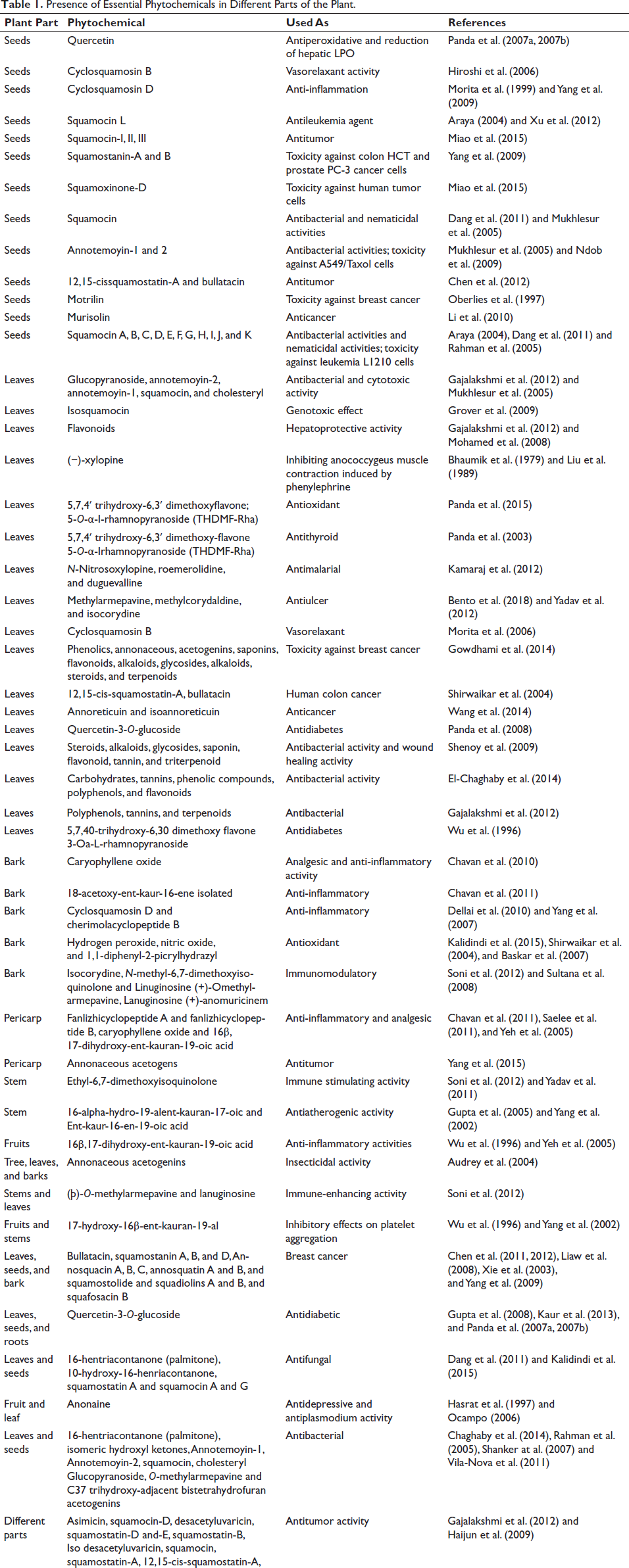
However, a concise overview of various phytoconstituents and their corresponding pharmacological activities are provided in Table 1.
Presence of Essential Phytochemicals in Different Parts of the Plant.
Phytochemistry of the Plant
A. squamosa, known as sugar apple or custard apple, is a rich source of diverse phytoconstituents with significant therapeutic potential. This plant contains a variety of bioactive compounds, including alkaloids such as annonaine, squamocin, reticuline, annomuricin A, and annonamine, which exhibit cytotoxic, antimicrobial, and antiparasitic properties. Acetogenins such as squamostatin, squamocin, annonacin, and bullatacin are noted for their potent cytotoxic effects on cancer cells through mitochondrial complex I inhibition. Flavonoids include quercetin, kaempferol, rutin, and luteolin provide antioxidant and anti-inflammatory benefits. Additionally, terpenoids and phenolics such as β-sitosterol, lupeol, stigmasterol, ursolic acid, gallic acid, chlorogenic acid, ellagic acid, and caffeic acid contribute to the plant’s wide range of pharmacological activities. The combined effects of these phytoconstituents underscore A. squamosa’s potential in drug discovery, nutraceutical development, and integrative medicine, warranting further research to fully harness its therapeutic applications.
Toxicology and Cytotoxicity
After reviewing different journals and articles, it was found that different authors have given different LD50 values and toxicity studies of the selected plant, such as LD50 value for the methanolic extract was found to be 5000 mg/kg of body weight (Onwusonye et al., 2014), whereas safety profile from methanolic extract of the plant was determined and was said that it should not be more than 2000 mg/kg of body weight (Madhu et al., 2012; Sharma &Goray, 2009), same as LD50. Value from seeds and leaves extract of the selected plant A. squamosa was found to be 510 mg/kg and 500 mg/kg body weight, respectively (El Banna et al., 2016). LD50 from the plant extract was determined to be more than 200 mg/kg body weight in some studies (Kumar et al., 2015; Mishra et al., 2015), and in one study it was reported that LD50 value was more than 1500 mg/kg body weight for ethanolic fraction (Masimba et al., 2016).
Conservation Needs of A. squamosa: Safeguarding Against Threats and Preserving Genetic Diversity
Conserving A. squamosa is crucial to mitigate threats and maintain genetic diversity. The species face challenges from habitat degradation, overexploitation, climate change, and emerging diseases. Habitat loss from agriculture, urbanization, and deforestation disrupts ecological processes, requiring habitat preservation and restoration. Overharvesting for fruits and plant parts leads to population declines, necessitating sustainable harvesting and regulated trade. Climate change alters precipitation and temperature, exacerbating threats and hindering adaptation, calling for climate-resilient strategies. Emerging diseases and pests pose significant risks, highlighting the need for monitoring and management programs. Preserving genetic diversity through seed banking and captive propagation is essential for resilience and adaptation. Comprehensive conservation strategies addressing these threats are vital to safeguard A. squamosa for future generations (Bonneau et al., 2017; Ma et al., 2017).
Conclusion
A. squamosa is a valuable medicinal plant because of its wide range of medicinal use and pharmacological activity, and has a long history of use in traditional medicine for the treatment and management of different diseases. The present article was designed to show the overall activity and availability of the plant such as its traditional use, phytochemistry, pharmacological activity, toxicity, and botanical aspects. Different articles were viewed and arranged in this article, showing the use of different parts of the plant in the management and treatment of different diseases. This article will help researchers find the different phytochemicals present in different parts of the plant and based on it any further study can be explored such as this plant has not been studied so for the management of obesity but has strong evidence for the management of obesity based on the essential phytoconstituents present in them. The selected plants have very promising pharmacological approaches for the management of different diseases and have already been proven to be antitumor, anticancer, antidiabetes, antimalaria, antithyroidal, antifungal, antibacterial, antixenotoxic, antioxidant, antihypertensive, antiulcer, and many more, which have been well elaborated in this article. Therefore, based on the literature review, in the future, A. squamosa can be studied, and clinical evaluation of the plant is very important to ensure its safety for its therapeutic and pharmacological use.
Footnotes
Abbreviations
µL: Microliter; A. squamosa: Annona squamosa; MnPCEs: Micronucleated polychromatic erythrocytes; IC50: Half-maximal inhibitory concentration; KD50: Knockdown dose; LD50: Lethal dose 50; w/v: Weight/volume.
Acknowledgments
The authors are thankful to BIT Mesra, Ranchi for providing the access of various journals and search platform.
Declaration of Conflicting Interests
The authors declared no potential conflicts of interest with respect to the research, authorship, and/or publication of this article.
Ethics Approval and Informed Consent
No ethics approval or consent to participate is required for this study.
Funding
The authors received no financial support for the research, authorship, and/or publication of this article.
