



Abstract
Background
Atopic dermatitis (AD) is a common but complex chronic inflammatory skin condition characterised by intense pruritus, severely impacting patients’ quality of life. At present, there is no specific drug for AD. Herba Siegesbeckiae (HS) had a therapeutic effect on AD, but its mechanism has not been completely elucidated.
Purpose
We aimed to understand the mechanism of HS in the treatment of AD in this study.
Materials and Methods
To investigate the mechanism of HS for AD, including active components, key targets and pathway analyses, systemic pharmacology was used. Molecular docking was conducted to validate the interactions between the key components and their targets. Afterwards, an AD-like animal model was established, skin pathology was observed and immunohistochemical staining was used to confirm the key targets.
Results
Six vital active components (daucosterol,
Conclusion
HS might exert its anti-AD effects by up-regulating PPARG and down-regulating TNF-α, VEGFA, TLR4, STAT3, TLR2, STAT1, MMP9, IL-6 and TRPV1. This study laid a foundation for understanding HS’s bioactive components and mechanism against AD.
Introduction
An inflammatory dermatosis characterised by recurrent skin lesions and persistent itching, atopic dermatitis (AD) is chronic, relapsing and characterised by repeated skin rashes (Weidinger & Novak, 2016). AD is prevalent in 15%–30% of children and 2%–10% of adults worldwide (Hashizume & Takigawa, 2006; Serrano et al., 2019), and has become an intractable public health problem worldwide (Edwards et al., 2018) Although the exact aetiology AD is still under investigation, studies have shown that genetic predisposition, environmental exposures, skin barrier defects, bacterial infections, environmental infections and immune responses play an important role in its development (Ong & Leung, 2016). In recent years, greater progress has been made in the treatment of AD, corticosteroids, calcineurin inhibitors and ultraviolet phototherapy have all achieved certain results in clinical practice (Frazier & Bhardwaj, 2020), but the current treatments can only temporarily alleviate the condition, and long-term use of medication will bring greater side effects (Wang et al., 2021). For this reason, drugs with optimised efficacy and low side effects are urgently needed for AD treatment.
Herba Siegesbeckiae (HS) has the efficacy of dispelling wind and removing obstruction in the meridians, clearing heat and detoxifying in traditional Chinese medicine. A modern pharmacology study showed it had anti-inflammatory properties (Su et al., 2014), anti-rheumatic (Zhang et al., 2019), anti-tumour (Gao et al., 2018), anti-thrombosis (Chou et al., 2006) and anti-oxidation (Ha & Boo, 2021) effects and so on. Previous studies have found that HS has an anti-AD effect, but the authentic anti-AD active substance and its mechanism have not been thoroughly studied. In order to establish a scientific basis for clinical applications of HS to treat AD, system pharmacology will be applied to elucidate the pharmacodynamic substances of HS and their anti-AD mechanisms.
Materials and Methods
Chemicals and Reagents
The herb Siegesbeckiae was purchased from Taizhou Central Hospital (Zhejiang, China); TNF-α, VEGFA, STAT3, TLR2, PPARG, STAT1, MMP9 and IL-6 antibodies were purchased from Proteintech (Wuhan, China); we purchased the TRPV1 antibody from Abcam (Shanghai, China) and the TLR4 antibody from Affinity Biosciences.
Network Pharmacology Analysis
Collection and Screening of the Active Components of HS
Chemical components of HS were analysed using the TCMSP (Traditional Chinese Medicine System,
Access to Targets of HS in the Treatment of AD
The structures of active components were imported into SwissTargetPrediction (
Network Construction
HS, active components, targets and AD are represented by nodes in the network diagram created with Cytoscape_v3.9.1,while edges represent the relationships between them and HS, active components, corresponding potential targets and AD.
Analysis of Gene Ontology (GO) Enrichment and Pathway Enrichment
The Clue GO (Bindea et al., 2009) analysis was conducted to examine the biological processes, molecular functions and cellular components related to the potential targets of HS for AD. The pathways enrichment of the above potential targets was further analysed using Wiki Pathways in Clue GO.
Key Targets Determined
The above potential targets were imported into the STRING database to obtain the protein-protein interactions, using the cytoHubba plug-in, the degree-centred indicator was calculated to determine the key targets (degree > 20) of HS for AD after importing the protein-protein interaction network into Cytoscape_v3.9.1.
Validation of Molecular Docking
The binding affinities and modes of interaction were analysed by AutoDockTools-1.5.7 between the vital active components daucosterol (F2), 19-acetoxy-15-hydroperoxy-12-oxo-13,14E-dehydro-10,11,14,15-tetrahydr-ogeranylnerol (C2),
Animal Experiments Validation
The mice were purchased from Zhejiang Weitong Lihua Experimental Animal Technology Co, Ltd in Zhejiang, China (SYXK (Zhe) 2021-0013). Animal experiments at Taizhou University were approved (ethics ID number TZXY-2023-20131058).
Four groups of BALB/c mice were randomly assigned, each consisting of eight mice––a control group, a model group and two HS groups (1.5 and 3 g/kg). We subjected mice to the animal experiment one day after removing hair from their abdomens and dorsal skin (Liu et al., 2023), and sensitizing their abdominal skin with 200 µL of 1% dinitrofluorobenzene (DNFB) for one week (every other day). In the treatment group, 200 µL of 0.5% DNFB was administered once a day during days 14, 17, 19, 22, 24, 27 and 29, whereas the control group was given an equal amount of substrate solution containing DNFB. As a control group, 1.5 g/kg of HS was administered for 16 days, while 3.0 g/kg of HS was administered for 16 days, whereas saline was administered to the model and control groups at the same dosage.
We collected several dorsal skin samples and immersed them in 4% paraformaldehyde following anaesthesia and sacrifice of mice.
Skin Lesions on the Back are Evaluated
The severity of dorsal cutaneous dermatitis was assessed by scoring the AD (SCORAD) index. According to the main clinical signs of AD––erythema/haemorrhage, oedema, epidermolysis bullosa/erosion and desquamation/dryness, clinical severity was rated as 1 (absent), 2 (mild), 3 (moderate) and 4 (severe).
Haematoxylin and Eosin (H&E) Staining
H&E staining was used for pathological analysis, and which were evaluated by an optical microscope at magnifications of 40× and 100×.
Immunohistochemical Staining
The tissues were sectioned with a paraffin slicer. The following steps were performed sequentially: deparaffinisation, restoration of tissue, antigen repair, sealing, primary and secondary antibody incubation, DAB chromatography, retaining, differentiation, transparency and neutral gel sealing. Finally, they were analysed with a BX53 orthogonal fluorescence microscope (OLYMPUS Corporation).
Results
HS Active Components are Screened
In Table 1S, 85 components of HS were collected from literature and the TCMSP database, including 60 diterpenoids, six sesquiterpenoids, five flavonoids and 14 others.
Screening the Potential anti-AD Targets for HS
To focus on the targets with active components, 940 potential targets for the 85 active components were acquired from SwissTargetPrediction. Then, 77 potential targets of active components from HS for AD were obtained by matching with OMIM, CTD and NCBI databases (Table 2S).
Construction of ‘HS-active Components-targets-AD’ Network
To clarify the anti-AD effects of active components from HS at the system level, the ‘HS-active components-targets-AD’ network was constructed by Cytoscape_v3.9.1 (Figure 1). As for the active components, daucosterol (F2, degree = 32) showed the greatest interactions, followed by 19-acetoxy-15-hydroperoxy-12-oxo-13,14E-dehydro-10,11,14,15-tetrahydr-ogeranylnerol (C2, degree = 27),
‘HS-component-target-AD’ Network.

GO Enrichment and Pathway Enrichment Analysis of Anti-AD Targets of HS
GO enrichment and pathway enrichment in system pharmacology can simplify functional analysis by grouping a large number of genes and enhancing their explanatory power. Figure 2 illustrates, as a result of GO enrichment, mitogen-activated protein (MAP) kinase activity has been significantly altered, neuroinflammatory response, regulation of leukocyte migration, regulation of smooth muscle cell proliferation and so on were highly enriched with the anti-AD targets of HS.
GO Enrichment Analysis of HS.

Identification and Validation of Key Targets
A protein interactions network with 77 nodes and 613 edges was constructed based on the anti-AD targets of HS. And the key targets of TNF-α, VEGFA, TLR4, STAT3, TLR2, STAT1, MMP9, IL-6, TRPV1 and PPARG were obtained by using the centrality of degree method with the scores as 50, 41, 35, 31, 27, 26, 22, 22, 21 and 20, respectively (Figure 3a). As shown in Figure 3b, toll-like receptor, PI3K-Akt and HIF-1 signalling pathways enriched for key targets.
Protein and Protein Interactions Network and Pathway Analysis. (a) Protein and Protein Interactions Network Based on the Anti-AD Targets of HS. In a Network, the More Central a Target is, the More Important it is. Nodes in the Graph are Coloured and Sized According to Their Degree Value, with Darker Colours and Larger Nodes Indicating Higher Centrality and More Critical Targets. (b) In Order to Eliminate Interference from Enriched Disease Pathways, only Non–disease-related Pathways were Examined.

Molecular docking was carried out to validate the above result and determine the affinity of the vital active components (F2, C2, F10, A25, A26 and A28) with the 10 key targets. The binding energies of the active components with the key targets were all less than −5.0 kcal/mol (Table 3S), indicating good interactions. (Liu et al., 2023). Figure 4 showed the example of daucosterol (F2) bound to TNF-α, VEGFA, TLR4, STAT3, TLR2, STAT1, MMP9, IL-6, TRPV1, PPARG and hydrogen bonds through strong electrostatic interactions, Accordingly, the binding energies were −7.2, −8.3, −7.1, −8.2, −9.1, −8.1, −8.5, −6.6, −8.2 and −8.6 kcal/mol, respectively. These indicated highly stable binding.
Molecular Docking of F2 to Key Targets. (a) The Binding Mode of F2 to TNF-α. (b) The Binding Mode of F2 to VEGFA. (c) The Binding Mode of F2 to TLR4. (d) The Binding mode of F2 to STAT3. (e) The Binding Mode of F2 to TLR2. (f) The Binding Mode of F2 to STAT1. (g) The Binding Mode of F2 to MMP9. (h) The Binding Mode of F2 to IL-6. (i) The Binding mode of F2 to TRPV1. (j) The Binding Mode of F2 to PPARG.

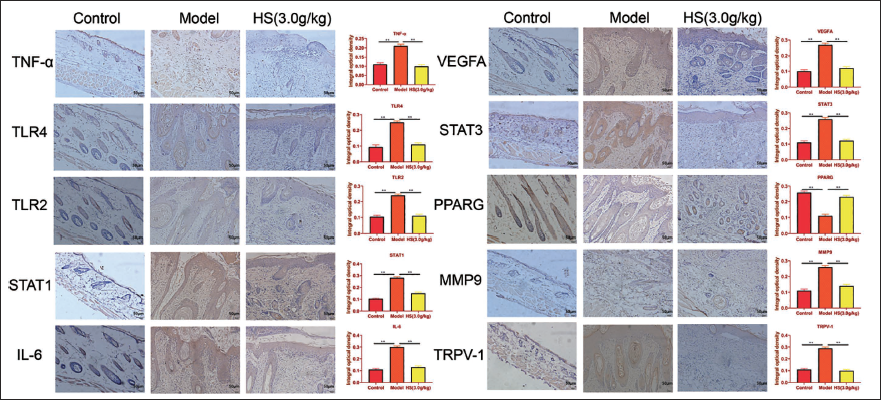
To improve the reliability of the results, animal experiments were taken to evaluate the therapeutic effect of HS for AD and the key targets. Thus, the skin lesion scores were evaluated. The scores were significantly increased in the model group than control group (p < 0.01); HS at 1.5 and 3.0 g/kg significantly reduced AD mice’s scores (p < 0.01). The effect of 3.0 g/kg HS was better (p > 0.05) (Figure 5a). In the model group, epidermal thickening, hyperkeratosis, thickening of the acanthocyte layer and inflammatory cells infiltrating the dermis were observed compared to the control group. Similar pathological changes were observed in the HS (1.5 g/kg) group than model group, while 3.0 g/kg HS could significantly reduce epidermal thickening and inflammatory cell infiltration to ameliorate DNFB-induced skin lesions (Figure 5b), suggesting that 3.0 g/kg HS is a better dosage of HS for AD. Consequently, 3.0 g/kg HS was used to confirm the key targets by immunohistochemical staining. As shown in Figure 6, the protein expressions of TNF-α, VEGFA, TLR4, STAT3, TLR2, STAT1, MMP9, IL-6 and TRPV1 were up-regulated (p < 0.01) while PPARG was down-regulated (p < 0.01) in model group than control group, and those of which could be reversed by 3.0 g/kg HS. According to the results, the above targets are important players in the mechanism of HS for AD.
The Skin Lesion Scores and Pathological Analysis of AD. (a) The Skin Lesion Scores. Erythema, Edema/Papules, Epidermal Stripping/Scratching and Scaling (Drying) are the Symptoms of Dorsal Skin Lesions in Mice. **p < 0.01. (b) Skin Lesions were Detected Through H&E Staining at Magnifications of ×40 and ×100.

Immunohistochemical Staining Analysis of the Key Targets. SEMs of Protein Integral Optical Densities from Each Group were Presented as Means. Positively Expressed Proteins Showed Brown-Yellow Granules. **p < 0.01.
Discussion
Currently, hormones and immunosuppressants are commonly used in clinical practice for the treatment of AD, but due to the severe side effects, alternative treatments are often carried out with traditional Chinese medicines, of which HS is one of them (Kwack et al., 2022). The results of our study demonstrated that 3.0 mg/kg HS improves skin lesions and pathological conditions associated with skin injuries, suggesting that HS may be useful in treating AD. System pharmacology was used to analyse the pharmacodynamic substance basis and mechanism of HS in AD treatment. System pharmacology analysis results were highly accurate and reliable based on molecular docking and immunohistochemical staining validation.
In this study, six vital active components were obtained from the constructed ‘HS-active components-targets-AD’ network. For the vital active components, daucosterol (F2, degree = 32) is a phytosterol glycoside of HS, which has been reported to be responsible for therapeutic effects, such as anti-inflammatory, anti-oxidative and immunoregulatory activity (Lee et al., 2015; Zhang et al, 2023), moreover, daucosterol could down-regulate the MAPK pathway to provide neuroprotection and reduced oxidative stress (Chung et al., 2016), which might reduce symptoms such as itch and inflammation in AD; d-mannitol (F10, degree = 27) as an anti-free radical intervention could inhibit the secretion of histamine (Masini et al., 1990), which is highly expressed in AD; and the pharmacological effects of the remaining four had not been reported, further studies on the anti-AD effects of these components are worthwhile in the future.
Subsequently, a biological process GO enrichment of 77 potential targets revealed significant enrichment for regulation of MAP kinase activity, neuroinflammatory response, leukocyte migration and smooth muscle cell proliferation. As a result of AD, IL-5 synthesis by human Th cells is dependent on MAP kinase activity, which promotes an intense inflammatory state in AD (Mori et al., 1999). In patients with AD, neuroinflammatory response related to AD mental disorders closely (Yuan et al., 2022). Regulation of leukocyte migration was closely related to adhesion molecules on endothelial cells, and which reflected the extent of systemic inflammation, such as AD (Yamashita et al., 1997). Regulation of smooth muscle cell proliferation was important for the prevention and treatment of proliferative lesions, such as AD lesions (Wu et al., 2016). A key role played by HS in anti-AD is regulating the immune system and inhibiting inflammation.
The key targets from 77 potential targets including TNF-α, VEGFA, TLR4, STAT3, TLR2, STAT1, MMP9, IL-6, TRPV1 and PPARG were selected, toll-like receptor, PI3K-Akt and HIF-1 signalling pathways were significantly involved. It was noteworthy that AD is associated with the immune system and inflammation (Wu et al., 2023), and the three pathways are closely related to immunity and inflammation (Che et al., 2022; Kusama et al., 2022; Zheng et al., 2022). A molecular docking study also revealed high affinity between the active components and the key targets, toll-like receptor, PI3K-Akt and HIF-1 signalling pathways are key pathways involved in the anti-AD mechanism.
Targets with a high centre degree in the protein-protein interaction network might be crucial drivers of HS in AD treatment. TNF-α, an inflammatory cytokine, was produced during acute inflammation and highly expressed in AD (Lee et al., 2020). VEGFA was a key regulator of vascular growth, while vascular changes associated with the inflammatory process in AD patients (Genovese et al., 2012). TLRs signalling pathways were highly correlated with immunity and inflammation (Chang et al., 2021). In AD lesion skin, TLR2 expression was shifted to the lower layers and TLR4 expression to the upper layers, and it had been suggested that changes in TLR expression may be associated with skin barrier disorders and microbial invasion and that both would be balanced between adequate immune response and overstimulation (Panzer et al., 2014). Inhibition of STAT3 activation could alleviate the visible skin symptoms of AD (Xiong et al., 2021), while STAT1 could be phosphorylated and translocated to the nucleus, activating inflammatory factors that trigger AD-like inflammatory skin diseases (Choi et al., 2021). Inflammation-related diseases are closely associated with MMP-9, and up-regulated MMP-9 has been detected in tissues from AD patients and animal models (Takai & Jin, 2022). IL-6, as a pro-inflammatory and anti-inflammatory cytokine (Nakahara et al., 2003), whose receptor gene variant, 358Ala, had recently been found to be associated with a persistent form of AD (Ilves & Harvima, 2015). There is evidence that stimulation of TRPV1 triggers the release of neurogenic inflammatory mediators and neuropeptides, leading ultimately to itch and various skin diseases, such as AD (Tang et al., 2022). PPARG plays a vital role in acute epidermal barrier impairment with implications for diseases, such as AD (Blunder et al., 2021). Using immunohistochemistry as external validation, we confirmed that these proteins are the key targets of HS for AD. According to our findings, HS mainly targets toll-like receptor, PI3K-Akt and HIF-1 signalling pathways to treat AD, while IL-6, STAT1, TLR4, TLR2, STAT3 and VEGFA play important roles in immunity and inflammation; future studies on HS treatment for AD should, therefore, focus on these targets.
Conclusion
HS has a better therapeutic effect on AD when administered at 3.0 mg/kg, according to our study. In this study, we identified vital active components that are highly correlated with potential targets, as well as key targets that are highly correlated with disease processes, providing a better understanding of how HS targets AD. Our study explored the mechanism of HS in AD treatment. There are still certain limitations in our research that should be acknowledged. The field of system pharmacology primarily relies on the utilisation of extensive existing vast data, which encompasses the majority of active compounds and their corresponding targets in the HS but not all of them. There are currently unidentified molecules in HS, as well as undiscovered targets of AD, which will require future investigation to confirm. In addition to providing insight into the mechanism of HS for anti-AD, this study provides the foundation for further research and development of HS as a clinical treatment for AD.
Abbreviations
AD: Atopic dermatitis; DNFB: 2:4-dinitrofluorobenzene; DAB: 3: 3′-diaminobenzidine; HIF-1 Signalling pathway: Hypoxia-inducible factor signalling pathway; IL-6: Interleukin-6; MMP9: Matrix metalloproteinase-9; PI3K-Akt signalling pathway: Phosphoinositol 3-kinase/ serine threonine protein kinase signalling pathway; TNF-α: Tumour necrosis factor-α; TLR4: Toll-like receptor 4; TLR2: Toll-like receptor 2; TRPV1: Transient receptor potential vanilloid-1; VEGFA: Vascular endothelial growth factor; STAT3: Signal transducers and activators of transduction-3; STAT1: Signal transducers and activators of transduction-1.
Footnotes
Acknowledgements
The authors would like to thank their parents and the deputy director of the pharmacy department of Taizhou Central Hospital for their support, guidance and valuable information.
Declaration of Conflicting Interests
The authors declared no potential conflicts of interest with respect to the research, authorship and/or publication of this article.
Ethical Approval
Taizhou University’s animal ethics committee approved all animal experiments (ID number: TZXY-2023-20231058).
Funding
The study was supported by the Zhejiang Province Health Innovation Talents, the National Natural Science Foundation of China (82204572), Zhejiang Province Traditional Chinese Medicine Science and technology project (2024030145) and Taizhou Science and Technology plan project (21ywb36).
Supplemental Material

References
Supplementary Material
Please find the following supplemental material available below.
For Open Access articles published under a Creative Commons License, all supplemental material carries the same license as the article it is associated with.
For non-Open Access articles published, all supplemental material carries a non-exclusive license, and permission requests for re-use of supplemental material or any part of supplemental material shall be sent directly to the copyright owner as specified in the copyright notice associated with the article.
