




Abstract
Background
Phytopathogenic fungi remain the main infectious agents in plants, causing severe damage to the environment and human health. Thus, to reduce the usage of synthetically derived fungicides and perform agricultural crop production, the search for new control strategies including plant extracts constitutes an eco-friendly and safe alternative.
Objectives
This study aimed to quantify the phytochemical constituents of the three plant (Mentha pulegium L., Mentha spicata L., and Mentha longifolia L.) extracts and to screen their phytochemical composition including total phenolic (TPC), flavonoids (TFC) and condensed tannins contents (TCTC), and to evaluate their antioxidant activities. The efficacy of all mint extracts will be investigated against phytopathogenic fungal species.
Materials and Methods
The three plant extracts were screened to assess their total phenolic, flavonoids, and condensed tannin contents using spectrophotometric assays. The antioxidant activities include 1,1-diphenyl-2-picrylhydrazyl (DPPH), ferric ion reducing antioxidant power (FRAP), and β-carotene assays. The antifungal activities were investigated on phytopathogenic species including Botrytis cinerea, Fusarium culmorum, Fusarium oxysporum, Aspergillus niger, Aspergillus flavus, and Trichoderma sp.
Results
Quantitative analyses of phytochemical constituents of Mentha genus extracts revealed that both ethyl acetate (EtAc) and chloroformic (Chl) extracts are a rich source of phenols, flavonoids, and condensed tannins. Ethyl acetate extract of M. longifolia (EtAc L) displayed the highest content of phenols (69.9 ± 1.35 mg GAE/g DW) and flavonoids (53.26 ± 2.11 mg CE/g DW), while M. pulegium ethyl acetate extract (EtAc P) has the highest condensed tannins content (2.13 ± 0.4 mg CE/g DW). Moreover, the tested extracts exhibited potent antioxidant activities at low concentrations for EtAc L, followed by M. spicata (EtAc S), and EtAc P (IC50 = 35.76 ± 1.32 µg/mL for scavenging DPPH free radicals; EC50 527.96 ± 5.45 µg/mL for FRAP, and IC50 = 106.3 ± 3.75 µg/mL for β-carotene bleaching test). Finally, all tested extracts were able to inhibit the growth of several phytopathogenic micro-organisms on both agar and broth media.
Conclusion
The Mentha extracts derived from the three mint species (i.e., L, P, and S) could be used for their antifungal activities to provide sustainable crop pest management.
Introduction
The agricultural sector in the Hail region is one of the distinct sectors that demonstrate the efforts made to achieve comprehensive and balanced development in line with the Kingdom’s 2030 vision. Despite that, plant fungal pathogens are responsible for most of the diseases occurring in agriculture (Elahi et al., 2019; Sellar et al., 2020). To overcome this, synthetic fungicides are the most common way to prevent a fungal infection, but they will face major limitations with several significant concerns inducing excessive yield or quality loss and are rendered unfit for human consumption (Da et al., 2016; Elshafie et al., 2017; Usta, 2013). Due to their overuse and misuse in agriculture, synthetic pesticides remain very restricted and discouraged, causing the development of pesticide-resistant pests as well as chronic human ailments due to either consumption or exposure (Damalas & Koutroubas, 2019; Kumari et al., 2014). Therefore, the need to search for alternative control strategies that are affordable and environmentally safe, such as medicinal plants, especially plant extracts as control agents to prevent damage from pests and pathogens is of great interest, and researchers have been focused on understanding their effectiveness and potential to be another alternative solution (Enis et al., 2019; Muhammad et al., 2019). Traditional medicine provides an important healthcare service and can be used as an alternate therapy. Medicinal plants and their bioactive compounds have been used in traditional medicine for the treatment of various diseases (Felhi et al., 2017; Hajlaoui et al., 2019). Their application has been explored in the control of phytopathogenic organisms (Chandel & Kumar, 2017; Karabuyuk et al., 2018). The importance of plant-based pesticides is linked to their efficacy, biodegradability, safety, and availability of source materials (Neeraji et al., 2017). Plant extracts and their phytochemical are gaining popularity as they do not represent a health risk or pollute the environment (Alminderej et al., 2021).
Mentha (family Lamiaceae), also known as the “Mint” of the Lamiaceae family, encompasses several aromatic species, which are distributed worldwide (Lawerence, 2006). The Mentha genus was subdivided into five sections including Audibertia, Eriodontes, Mentha, Preslia, and Pulegium (Tucher, 2007). It consists of 20 worldwide-spread species, with the most important being L, P, S, Mentha piperita, Mentha gracilis, Mentha rotundifolia, and Mentha suaveolens (Amalich et al., 2016; Gonzalez-Tejero et al., 2008). Mentha species are well known for their distinct aroma and commercial value, commonly used in traditional food flavoring or as medicine for the treatment of cold, fever, and digestive and cardiovascular disorders as well as against flatulence, nausea, ulcerative colitis, anorexia, bronchitis, and liver diseases (Abdelli et al., 2016; Hajlaoui et al., 2010; Kumar & Patra, 2012; Kumar et al., 2011; Mahboubi, 2017; Moricia et al., 2016; Murad et al., 2016; Shaikh et al., 2014). It was a source of a number of biological activities such as anti-oxidant, anti-microbial, anti-tumor, anti-cancer, anti-viral, anti-allergic, anti-inflammatory, anti-hypertensive, and urease inhibitory (Abdelli et al., 2016; Mahboubi, 2017). The traditional pharmacological attributes of Mentha herbs value owing to its aromatic species and can be linked to the occurrence of bioactive phytochemicals such as phenolic compounds, tannins, terpenes, terpenoids, quinones, coumarins, flavonoids, alkaloids, sterols, and saponins (El-Gharbaoui et al., 2017; Malika et al., 2019).
This study aimed to curb the usage of synthetically derived fungicides by determining the anti-fungal activities of L, P, and S aerial part extracts against Botrytis cinerea, Fusarium culmorum, Fusarium oxysporum, Aspergillus niger, Aspergillus flavus, and Trichoderma sp. The obtained results will be correlated with the phytochemistry of each extract.
Materials and Methods
Plant Materials and Culture Conditions
Young seedlings (15 days) of three mint species M. longifolia(L), M. pulegium (P), and M. spicata (S) were cultivated in the ground under greenhouse for five months until stage flowering.
Preparation of the Extracts
Aerial part extracts were prepared following the same protocol as done by Kais et al. (2022).
Determination of Total Phenolic, Flavonoid Contents, and Condensed Tannins
The total phenolic content of the two species of mint was determined using the same previous protocol with slight modification (Aouadi et al., 2021; Hajlaoui et al., 2022).
Antioxidant Activities
The 1,1-diphenyl-2-picrylhydrazyl (DPPH) radical-scavenging activity, ferric ion reducing antioxidant power (FRAP), and β-carotene bleaching test were estimated (Bakari et al., 2017; Bakari et al., 2018; Patro et al., 2005).
Anti-fungal Activity
Micro-organisms
The used micro-organisms included the following six fungal strains: Botrytis cinerea, F. culmorum, F. oxysporum, Aspergillus. niger, A. flavus, and Trichoderma sp. These fungal strains are provided by the Laboratory of Phytopathology of the INRAT of Tunis under the direction of Prof. Mohammed Rabeh Hajlaoui.
Disc-diffusion Assay and Inhibition Test of the Growth Fungus on Liquid Medium
Antifungal activity testing was performed by using the same protocol described by Hajlaoui et al., (2009) with light modifications.
Statistical Analysis
All the experiments were conducted in triplicate, and the average values were calculated using the SPSS 26.0 statistics package for Windows. The mean differences were calculated using Duncan’s multiple-range tests for means with a 95% confidence limit (p ≤ 0.05).
Results and Discussion
Quantitative Analyses of Phytochemical Constituents of Mentha Genus Extracts
The results of the quantitative phytochemical screening of EtAc L EtAc S, and EtAc P are summarized in Table 1. Accordingly, the tested extracts showed a considerable quantity of phenolic compounds with the highest content of TPC, mainly TFC in the EtAc then in chloroform for the three plants (Table 1).
TPC (mg GAE/g DW), TFC (mg CE/g DW), and TCTC (mg CE/g DW) in Different Extracts in the Aerial Part Extract of Three Mint Species.
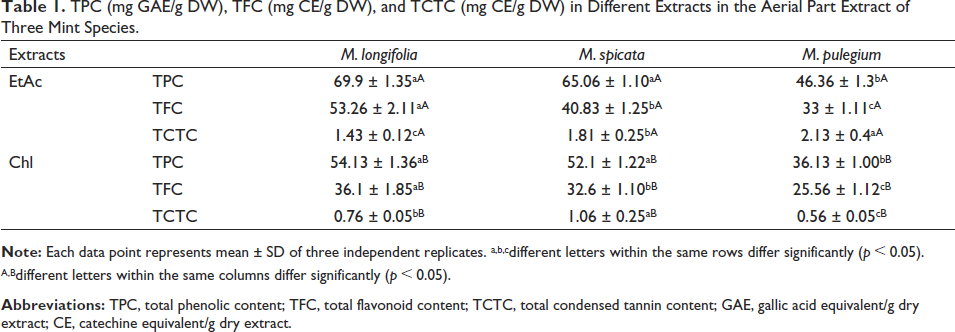
Overall, our results showed high and not significantly different (p > 0.05) total polyphenolic content found in M. longifolia (69.9±1.35 mg GAE/g DW) and M. spicata(65.06±1.10 mg GAE/g DW), while M. pulegium extract displayed significantly (p < 0.05) lower TPC (46.36±1.3 mg GAE/g DW). Similarly, significantly different TFC (p < 0.05) was observed in three plants with the strongest level was observed in M. longifolia (53.26±2.11 mg CE/g DW), followed by M. spicata (40.83±1.25 mg CE/g DW) and M. pulegium (33 ±1.11 mg CE/g DW), respectively. Lower significantly (p < 0.05) different TCTC was obtained for the three Mentha species. In fact, M. pulegium extract exhibited the highest level. In chloroformic extracts, also strong and not significantly different (p > 0.05) TPC are shown in M. longifolia (54.13±1.36 mg GAE/g DW) and M. spicata extracts (52.1±1.22 mg GAE/g DW), however the lowest level (36.13±1.00mg GAE/g DW) was recorded for M. pulegium extract, which was significantly (p < 0.05) different.
Likewise, the Mentha species had significantly (p < 0.05) different TFC and TCTC with the highest levels were recorded specifically to M. longifolia (36.1±1.85 mg CE/g DW), and M. spicata extracts (1.06±0.25 mg CE/g DW), respectively. Previous studies have reported that Mentha genus members are a rich source of phenolic compounds (mainly caffeic acid and its derivatives, chlorogenic acid, and rosmarinic acid), flavonoids, terpenoids, steroids, ceramides, and tannins with different pharmacological activities (Soleimani et al., 2022; Parham et al., 2020; Kumar et al. 2010; Eftekhari et al., 2021). In fact, it has been reported that methanolic extract from M. longifolia collected from Saudi Arabia have a very high phenol (157.99 ± 12.3 mg GAE/g DW) and flavonoid content and (16.96 ± 1.48 mg RTE/g DW) (Osman, 2013). Similarly, the methanolic extract from M. spicata, M. longifolia, and M. pulegium are a rich source of polyphenols, flavonoids, and tannins. The highest polyphenols were recorded in the methanolic extract from M. longifolia (89.16±0.96 mg GAE/g DW), followed by M. pulegium (62.06±2.31 mg GAE/g DW), and M. spicata (39.8±1.21 mg GAE/g DW). Similarly, the highest yield of flavonoids was recorded in the methanolic extract from M. longifolia (63.93±1.68 mg GAE/g DW), followed by M. pulegium (51.66±2.12 mg GAE/g DW), and M. spicata (32.83±1.25 mg GAE/g DW) (Hajlaoui et al., 2015).
Moreover, it has been demonstrated that Mentha genus is a source of diverse bioactive molecules with important biological activities (Hajlaoui et al., 2009; Mikaili et al., 2013; Hajlaoui et al., 2015; Pereira et al., 2016; Parham et al., 2020; Eftekhari et al., 2021). In fact, Hajlaoui and colleagues reported the chemical composition of the methanolic extract of the same studies Mentha species by using RP-HPLC technique. These authors reported the identification of chlorogenic acid (6.88%), trans-cinnamic acid (10.32%), myricetin (10.93%), and morin (20.87%) in M. spicata. While, myricetin (8.36%), chlorogenic acid (14.9%), and trans-2-dihydroxycinnamic acid (59.73%) were the main compounds identified in M. pulegium . In addition, trans-2-dihydroxycinnamic acid (4.48%), apigenin (8.23%), ferulic acid (12.37%), and chlorogenic acid (23.31%) were dominant in the methanolic extract from M. longifolia (Hajlaoui et al., 2015). It has been also demonstrated that Mentha species contain other compounds like trace elements, triacylglycerol, fatty acids, sugar, saponins, alkaloids, anthraquinones, and quinines (Padmini et al., 2010; Kaizil et al., 2010; Perez et al., 2014).
It has been well documented that the obtained compounds are the main compounds identified in M. pulegium (Goudjil et al., 2015; Fancello et al., 2017; Marwa et al., 2017). Other phenolic compounds are reported in M. spicata including rosmarinic acid, salvianolic acid, hydroxybenzoic acid, caffeoylquinic acid, hydroxycinnamic acid, flavanones, and flavones (Derwich et al., 2009; Riahi et al. 2013; Singh et al., 2015; Bahadori et al., 2018). Prasterone acetate and sclareol were also reported in M. longifolia (Shelepova et al., 2014).
Antioxidant Activity Evaluation
The antioxidant power of the investigated extracts for the three species plants was assessed through three assays including DPPH, FRAP, and β-carotenes. The results shown in Table 2 revealed that EtAc exhibited better antioxidant potency then chloroform extract in three assays. Indeed, in EtAc, M. longilfolia (IC50 = 35.76±1.32 mg/mL), and M. spicata (IC50 = 38.16±1.25 mg/mL) exhibited high and not significantly different (p > 0.05) DPPH scavenging ability when compared to the standard, BHT (IC50 = 11.56±0.35 mg/mL). Poor FRAP activity was found for the three studied species; however moderate antioxidant activity was obtained with b-carotenes test for the three plants met the following order: M. longilfolia = M. spicata > M. pulegium.
In contrast, chloroformic extract from M. longilfolia and M. spicta exhibited moderate and not significant DPPH scavenging capacity in comparison to the standard both, however, in FRAP and b-carotenes assays, the three species recorded a significantly (p < 0.05) weaker activity. This result correlates well with our evaluation of the polyphenolic compounds and flavonoids of the two extracts studied, because high level of phenolics compounds were found in the extract whose constituents possessed high potentials for DPPH radicals scavenging activity.
DPPH Test (IC50; µg/mL), Reducing Power (EC50; µg/mL) and β-Carotene (IC50; µg/mL) of Mentha spp. Aerial Part Extracts, and Authentic Standards (BHT, BHA, and Ascorbic Acid) (µg/mL).
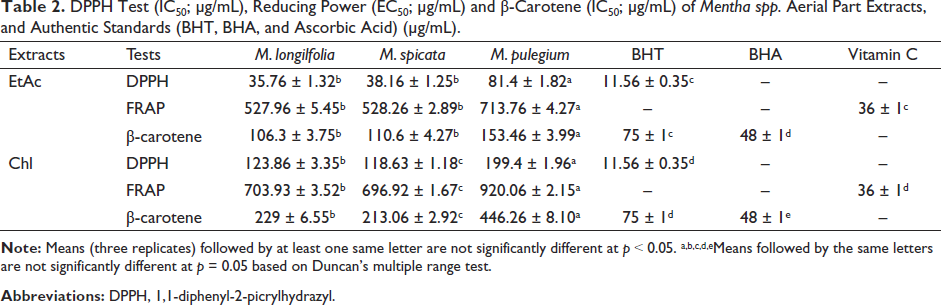
Previous reports have discussed the antioxidant activities of Mentha species, and mainly their essential oil obtained by hydrodistillation (Hajlaoui et al., 2015; Bahadori et al., 2018; El Hassani, 2020; Tafrihi et al., 2021). It has been reported the antioxidant activity of M. piperita organic (Petroleum ether, Chl, EtAc, ethanol) and aqueous extracts. In fact, the antioxidant capacity (%) ranged from 69.8±5.2 (%) for the aqueous extract to 91.2±5.6 (%) for the Chl. Similarly, the highest DPPH free radical scavenging activity (%) was about 91.8±5.8 (%) for the Chl extract followed by the EtAc extract (84.9±4.2%), and the ethanolic extract (84.9±4.2%) (Singh et al., 2015).
Similar results have been reported previously showing the high antioxidant activities of M. longifolia, M. pulegium, and M. spicata (methanolic extract) by using DPPH test, O2.- scavenging assay, iron chelating/reducing assays, and b-carotene system. The lowest IC50 concentration (DPPH and b-carotene) was recorded for M. longifolia methanolic extract (68.96±3.9 µg /mL and 23.06±2.8 µg /mL, respectively) (Hajlaoui et al., 2015). It has been demonstrated that Phenolic acids (caffeic acids and rosmarinic), flavones (luteolin derivatives), ascorbic acid, and flavanones (eriocitrin derivatives) are known to show promising antioxidant capacities, whereas vitamin antioxidants such as carotenoids exhibit weak radical scavenging traits (Eftekhari et al., 2021).
Anti-fungal Activity Evaluation
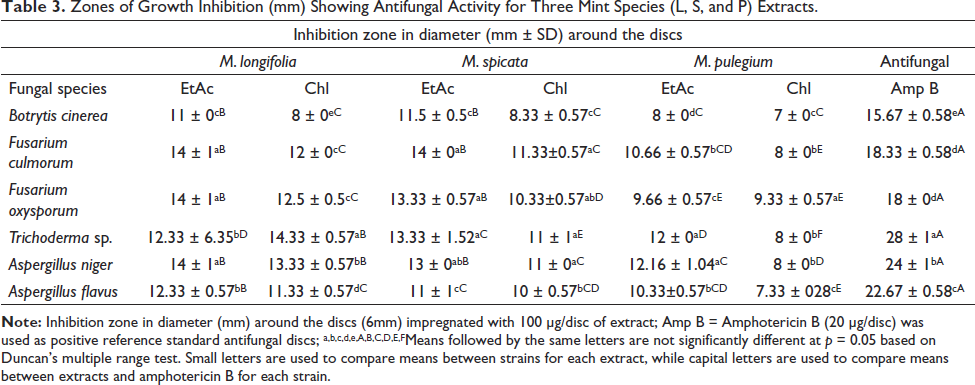
Plant pathogens such as fungi are responsible for various plant diseases resulting in severe damage to plants with considerable loss of crop yields in agricultural industries. The screening of the antifungal potential of plant extracts toward some phytopathogenic fungi has been studied. As shown in Table 3, both ethyl and chloroform extracts significantly (p < 0.05) inhibit the growth of all tested fungi in a different manner with potent to moderate activity, and globally, EtAc extract exhibited better antifungal inhibitory effect than chloroform extract in the three plant species (Table 4).
Zones of Growth Inhibition (mm) Showing Antifungal Activity for Three Mint Species (L, S, and P) Extracts.
Percentage of Inhibition (%I) of the Growth of Fungus Species Cultivated on Liquid Medium with Various Concentrations of Three Mint Extracts (100 µg/mL YNB broth), Compared to Positive Standard Drug (Amphotericin B, 10 µg/mL YNB broth).
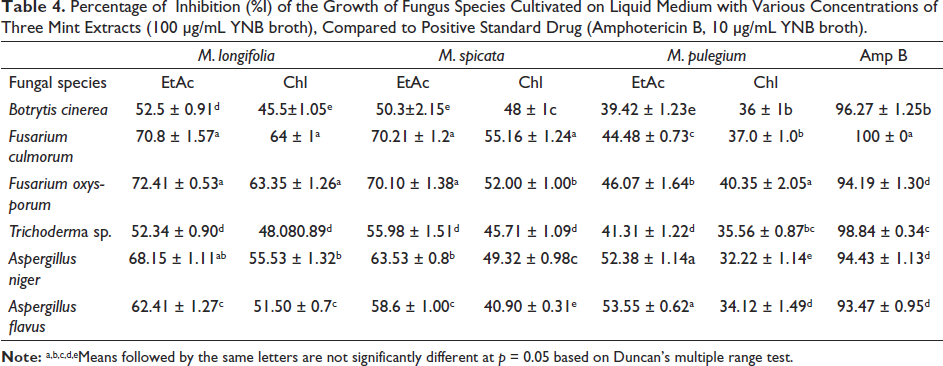
EtAc L had good antifungal activity against the three most sensitive test organisms B. cinerea (IZ = 11±0 mm, %I = 52.5±0.9), F. culmorum (IZ = 14±1 mm, %I = 70.8±1.57) and F. oxysporum (IZ= 14±1 mm, %I = 72.41±0.53). EtAc S displayed also good activity towards the same strains, B. cinerea (IZ = 11.5±0.5 mm, %I =50.3±2.15), F. culmorum (IZ = 14±0 mm, %I = 70.21±1.2) and F. oxysporum (IZ= 13.33±0.57 mm, %I = 70.10±1.38). besides all chloroform extracts revealed significantly weaker (p < 0.05) antifungal inhibitory effect over all strains for the three investigated plants.
Previous reports have discussed the antimicrobial activities of Mentha essential oil and extracts (Sokovic et al., 2009, Hussain et al., 2010a; Hussain et al., 2010b; Džamić et al., 2010; Hajlaoui et al., 2015). In fact, Sokovic and colleagues reported that essential oils from M. piperita (Menthol-chemotype) and M. spicata (Carvone-chemotype) exhibited antifungal against the mostly cited strains. In another studies, Hussain and colleagues (Hussain et al., 2010a; Hussain et al., 2010b) reported the antifungal activities of M. piperita, M. arvensis, M. spicata, and M. longifolia essential oils and their main compounds (Menthol, menthone, piperitenone oxide, and carvone) against A. niger, A. flavus, Alternaria solani, F. solani, Rhizopus solani, Alternaria alternata, Botryodiplodia theobromae, Mucor mucedo, and Rhizopusspp. with high growth inhibition zones, and low minimum inhibitory concentrations (especially for M. arvensis mint species).
Few studies have reported the antifungal activities of mint extracts. In fact, Džamić et al., (2010) reported the antifungal activities of M. longifolia methanolic extract tested against P. ochrochloron, Cladosporium fulvum, and Cladosporium cladosporioides were observed to be the most sensitive to M. longifolia extract (Džamić et al., 2010). It has been demonstrated that crude extracts from M. piperita collected from Sultanate of Oman by using different solvents including hexane, EtAc, Chl, and butanol were active against Staphylococcus aureus, Escherichia coli and Xanthomonas campestris bacteria at low concentrations ranging from 0.335 mg/mL to 2.5 mg/mL.
Conclusion
In this study, the phytochemical composition of the ethyacetate and chloroformic extrcats from three Mentha species including M. longifolia, M. spicata, and M. pulegium was assessed. Overall results showed that both EtAc and Chl exhibited an important antioxidant and antifungal potential due to their richness in phenolics, flavonoids, and condensed tannins. Further analyses are necessary in order to study the chemical composition of the tested extract and to elucidate the possible mechanism of action of the identified molecules.
Footnotes
Abbreviations
CE/g DW: Catechine equivalent/g dry; Chl: Chloroformic extract; DPPH: 1,1-diphenyl-2-picrylhydrazyl; EtAc L: M. longifolia ethyl acetate extract; EtAc P: M. pulegium ethyl acetate extract; EtAc S: M. spicata ethyl acetate extract ; pEtAc: Ethyl acetate extract; FRAP: Ferric ion reducing antioxidant power; GAE/g DW: Gallic acid equivalent/g dry extract; IC50: Inhibition concentration of 50%; TCTC: Total condensed tannin content; TFC: Total flavonoid content; TPC: Total phenolic content; SD: Standard deviation; ANOVA: Analysis of variance; SPSS: Statistical Package for the Social Sciences.
Acknowledgments
The authors would like to express gratitude to the Sheikh Ali Al-Jumaiah Scientific Research Chair for Sustainable Development in Agricultural Communities at the University of Ha’il, Saudi Arabia, for their generous funding support through project number SCR-22 088.
Declaration of Conflicting Interests
The authors declared no potential conflicts of interest with respect to the research, authorship, and/or publication of this article.
Funding
This research has been funded by Sheikh Ali Al-Jumaiah Scientific Research Chair for Sustainable Development in Agricultural Communities at the University of Ha’il-Saudi Arabia through project number SCR-22 088.
Statement of Informed Consent and Ethical Approval
Necessary ethical clearances and informed consent were received and obtained, respectively, before initiating the study from all participants.
