




Abstract
The present study pursues a two-fold objective: to evaluate the performance of rural producers’ cooperatives in Isfahan Province, Iran, and to develop a general model for this purpose. To develop a model for the comprehensive assessment of rural producers’ cooperatives in Isfahan, the survey method is employed in the present descriptive-analytical study and use is made of an especially-designed questionnaire as well as the structural equation modelling. Efforts are also made to include in a most comprehensive and systematic manner all the parameters involved in rural producers’ cooperatives. The statistical population comprises all the membership and decision-making bodies (including the General Assembly, Board of Directors and Inspectors) of the cooperatives in Isfahan. The sample size as determined by Cochran’s formula comprises 375 people. Sampling is accomplished using a two-stage stratified and cluster sampling with simple random sampling included. Results indicate that 63.36% of the cooperatives investigated record a satisfactory performance and that, from among the independent variables, the Chief Executive Officer (CEO) behaviour records the highest direct impact on the performance of the cooperatives. Finally, the model fit indices reveal the capability of the proposed model in performing a comprehensive assessment of rural producers’ cooperatives.
Introduction
The majority of rural communities and farmers the world over live in Africa, Latin America and Asia. Despite the rapid urbanisation in these areas, their populations are still on the rise (Mercoiret and Mfou’ou 2006). According to an Food and Agriculture Organization (FAO) release, ‘This is not surprising as 75% of the poor in developing countries live in rural areas and derive significant parts of their livelihoods from agriculture or activities dependent on it’ (Food and Agriculture Organization of the United Nations 2009, 28). While some of these farmers have been able to exploit market opportunities towards good ends, most small farm owners and peasants suffer a myriad of difficulties. Small farm owners are the great losers in their transactions with product buyers, suppliers, or service providers generally due to their disadvantaged positions as individuals lacking organized support (Benson 2014; Gillani et al. 2022; Mizik 2022; Swaminathan 2013).
The predominant farm operating system in Iran is the family farm production, which is the legacy of the Land Reform Act of 1962. A main feature of this system is the wide dispersion and small size of farmlands which obviously render infeasible investments in such large-scale projects as pressurised irrigation systems or deep well excavations. So, rural producer’s cooperatives were set up to increase agricultural production of small-scale farmlands (Hadizadeh Bazaz et al. 2015; Zamani et al. 2019).
Isfahan Province located in central Iran between 30° 43˝ and 34° 27˝ north latitudes and between 49° 36˝ and 55° 31˝ east longitudes covers an area of 107,019 km2 (Management and Planning Organization of Isfahan Province, 2015). Isfahan Province has the eighth rank among the 31 provinces of Iran that have the highest number of cooperatives. Based on the most recent information and data released by the Rural Cooperatives Organization of Isfahan Province, a total of 55 such cooperatives exist across the province, out of which 43 are presently operational and the rest are either non-operational or semi-operational (Rural Cooperative Organization of Isfahan Province, 2016).
The rural communities in Iran typically have to cope with many challenges and difficulties. On the one hand, the small size and dispersion of farms have not only led to low farm productivity due to the high cost and unaffordability of farm machinery but also made the transition from traditional farm practices to modern agricultural techniques extremely difficult. On the other hand, water scarcity has led to a serious crisis across the state. The best solution to these problems is to organize rural communities in rural producers’ cooperatives. Cooperatives serve as tools to achieve socio-economic development by rural producers (Ahado et al. 2022; Biswas 2015; Chiurciu et al. 2022).
Generally speaking, three types of cooperatives are active in rural areas: rural producers, agricultural and rural community cooperatives. They are powerful social and economic tools with great potential that can fuel agricultural, rural, and thereby, national development (Mirdamadi et al. 2014). Cooperatives are owned, controlled and managed by the members who come together voluntarily (Dave 2021; Mourya and Mehta 2021). Cooperatives can play a crucial role to increase profitability in agriculture (Bharti 2020). They play vital roles not only in attracting support for farmers to change and improve their products in compliance with standards but also in reducing costs of data collection on related activities (Higuchi et al. 2011; Lawangen 2022; Sarkar et al. 2022; Xu et al. 2022).
The Land Reform Act of 1963 scattered farmlands in space and reduced them in size, which made farming on such land uneconomical. In response to this, the Cooperative Act was adopted in 1970 which led to the establishment of rural producers’ cooperatives in order to improve the current production system, provide solutions to farmers’ problems and secure support for the rural communities (Hadizadeh Bazaz et al. 2015). Indeed, rural producers’ cooperatives are a kind of agricultural production system and, in their legal form, they are a non-governmental economic institution of agricultural production (Rural Cooperative Organization of Isfahan Province, 2017). In rural producers’ cooperatives, by consolidating lands, the boundaries of each cooperative member’s land should be preserved as a part of a large piece of land. Therefore, in obtaining membership in Rural Production Cooperatives, small farmers enjoy the facilities of forming a company, such as quick and timely access to the necessary agricultural tools and equipment at the lowest cost (Ghazimoghadam et al. 2019). It is the objective of the present study to evaluate the performance of rural producers’ cooperatives in Isfahan Province. For this evaluation, we explore all the factors affecting the success of cooperatives and develop a model that can explain the role of these factors in improving the performance of cooperatives. The results can be used by cooperative managers to better lead and improve the performance of their cooperatives. Moreover, the results can improve the current literature of cooperatives which has been given a lot of attention.
The literature on rural producers’ cooperatives has a long history. Cesarini (1979) conducted a study in South Italy to find out that rural producers’ cooperatives had led to improved land utilisation, exhaustive and rational uses of natural resources, enhanced product quality as a result of preplanned cropping patterns, strengthened cooperation and solidarity, better water application over larger agricultural units and facilitated marketing. Royce (2004) reported on the successful performance of cooperatives that increased production, enhanced member income levels and strengthened cooperation and public participatory decision-making. Sadighi (2005) claimed that cooperatives were able to increase production efficiency, reduce operation and cultivation costs, decrease farm labour costs, enhance crop diversity and improve resource utilisation efficiency. Yazdani (2012) concluded that cooperatives had been relatively successful in most rural areas as evidenced by their high ranks in terms of quantity (number of cooperatives) and quality (infrastructural services provided). Donovan et al. (2017) reported that cooperatives had been able to provide a wide variety of services to their members; for instance, they had been able to supply their products to international markets and to strike deals with international buyers. Sisay et al. (2017) reported on cooperatives that provided vital services by supplying seeds. They produced seeds and supplied them to the market through a variety of channels such as direct supply to farmers, contractual agreements and direct sales in markets. Suh (2015) found that cooperatives were able to serve as sustainable substitute systems for industrial agricultural farms or act as a survival strategy for small rice paddy farm owners.
Despite the above success stories, some cooperatives have been failures. Zarafshani et al. (2010) reported that members expressed their discontent with the managers of their failing cooperatives. On the other hand, a number of factors have proved to have negative impacts on the performance of cooperatives. MacLean and MacKinnon (2000) found the lack of commitment among cooperative board members to discharge their responsibilities among the factors leading to the failure of such cooperatives to achieve their goals. Zarifian and Bahadori (2014) found the lack of a sound model for the evaluation of cooperative managers as the most important weakness leading to their failure. Hosseini et al. (2014) found the lack of powerful leadership and management skills to be the greatest weakness in failing cooperatives. This finding is confirmed by Mhembwe and Dube (2017 who detected lack of financial support as well as poor management skills responsible for the failure of cooperatives.
A number of factors have positively contributed to the success rate of cooperatives. Godo (2022) Found that the members’ commitment and the cooperative management had a more important role in the success of cooperatives. Pham (2022) found that management competency had a positive correlation with the performance of cooperatives. Osmar and Wander (2021) found that one of the important factors in the success of cooperatives is the professionalisation of cooperative management. Godo et al. (2022) found that the members’ commitment and cooperative management had a greater impact on the success of cooperatives than other factors.
Biswas (2015) identified members’ mutual trust, commitment, beliefs and attitudes towards their cooperative and the management style adopted to be important factors affecting a cooperative’s success. Gupta (2014) discovered that cooperatives offer structures that not only secure their own benefits but also guarantee the individuals’ interests. Mirdamadi et al. (2014) noted that capital is such an important component in the economy of cooperatives that 40.2% of the variance of the dependent variables may be explained by this parameter. Mojo et al. (2017) claimed that cooperatives could achieve higher levels of success if they were able to offer more incentives to their members.
Despite the numerous studies conducted so far on cooperatives, few have been devoted to their management and organisational behaviour (Biswas 2015). In their study, (Höhler and Kühl 2014) explored the reasons underlying the differences in the status and success of cooperatives in different sectors and in different countries. MacLean and MacKinnon (2000) maintained that identification of the roots of the problems cooperatives face will help lifting the obstacles against their successful performance. Bond (2009) recommended that boards of directors seeking the higher success of their cooperatives might gain more benefits from the investigation of non-governmental factors. Ritossa and Bulgacov (2009) suggested that the role of cooperative organisation, the external factors that impact the performance of the Brazilian cooperatives, and the lack of research in this area in Brazil, will hopefully encourage future academic investigation. Bijman and Iliopoulos (2014) suggested that Future research on the conditions and characteristics of agricultural cooperatives to perform well could focus on member commitment. van Oorschot et al. (2013) suggested that the investigation and examination of cooperatives in different countries might be beneficial because the findings of each research are contributions to the knowledge of the field as a whole and that the results obtained from the study of cooperatives in different countries might help to develop better theories and plans of cooperatives. Šumylė and Ribašauskienė (2017) suggested that further efforts should be addressed towards identifying the causes and barriers for more successful performance among cooperatives. Amene (2017) suggested that future research may make an in-depth study by considering other regions to clearly factors influencing agricultural cooperatives’ performance. Marcis et al. (2019, 1111) expressed that ‘There are few studies that explain what a performance evaluation is, and there are no authors who have stood out in the research on this theme’.
The authors specifically maintain that the study of rural producers’ cooperatives in Iran, as part of a whole, can provide beneficial information. Unfortunately, however, there are not many published reports on the performance of rural producers’ cooperatives investigating all their aspects. This gap in investigations instigated the present study to explore rural producers’ cooperatives and their performance in order to derive a general model of the factors affecting their performance. The findings are expected to help rural planners gain a deeper insight and understanding of how best they could plan for the development and growth of rural producers’ cooperatives to improve the livelihood of rural communities.
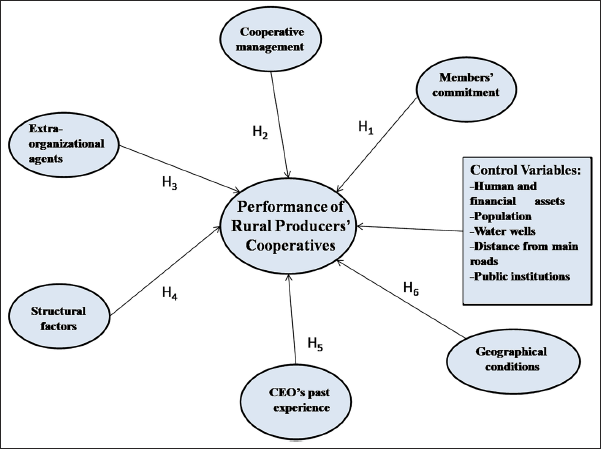
A Memorandum of Association is a document that indicates what activities the company can undertake (Balakrishnan et al. 2018). Based on the objectives defined in Rural Production Cooperatives’ memorandum of association, these cooperatives are mandated to serve their members in the following six areas: improved production systems and productivity of production elements, optimised resource allocation and utilisation, enhanced farm product quality and quantity, environmental protection, improved livelihood and economic empowerment of members, facilitated service activities (Rural Cooperative Organization of Isfahan Province, 2016). Moreover, the fifth principle of the cooperatives’ statute, as a universal one among all cooperatives (Carrasco 2007; Seguí-Mas and Bollas-Araya 2012), mandates them to engage actively in the education, awareness raising and training of their members. Thus, the training and extension services were also added as the seventh dimension to the above six to construct a heptagonal system of activities to delineate and determine cooperative performance as the dependent variable in this study. Also, all the independent variables are constructed by the researchers. In this regard, the objectives of the research are investigating the effects of the members’ commitment, the optimal discharge of management duties by managers, the extra-organisational agents (Rural Cooperative Organization and the Government), structural factors, the Chief Executive Officer (CEO) past experience and the differences in geography on the performance of rural producers’ cooperatives. So, six hypotheses are proposed:
The first hypothesis of the present study states that there must exist a significantly positive effect of the members’ commitment on the performance of rural producers’ cooperatives (H1).
The second hypothesis of the present study states that there is a significant and positive effect of the optimal discharge of management duties by managers on the successful performance of a cooperative (H2).
The third hypothesis of this study states that there is a significant effect of the extra-organisational agents (Rural Cooperative Organization and the Government) on the performance of the rural producers’ cooperatives in the Isfahan Province (H3).
The fourth hypothesis of our study states that there is a significant effect of structural factors on cooperatives’ performance (H4).
The fifth hypothesis states that there is a significant effect of the CEO’s past experience on the performance of the rural producers’ cooperative (H5).
The sixth hypothesis states that there is a significant effect of differences in geography on the performance of cooperatives across the province (H6) (refer to Figure 1).
A Conceptual Model Based on the Assumptions of the Study.
Methodology
Initially, the size of the sample was examined to determine whether it could be extended to a statistical population. Since the variables were hypothetical constructs, the factor analysis method was employed in the second stage of the study to construct the required variables. This was followed by conducting a factor analysis to determine the structure of the measures and to ensure the validity and reliability of the variables. The research hypotheses were analysed by constructing a structural equation model comprising one layer of independent variables and one layer containing the performance of cooperatives as the dependent variable. Finally, path analysis yielded the intermediate variables in the structural equation model.
Sampling
According to the latest statistical release by the Rural Cooperatives Organization of Isfahan Province, there are a total number of 55 rural producers’ cooperatives in Isfahan Province, out of which 43 are operational while the remaining are inactive at the moment. The active cooperatives have 17,157 members and cover 92,241 ha of farmland (Rural Cooperative Organization of Isfahan Province, 2016). The 17,175 members (including the General Assembly, Board of Managers and Inspectors) comprise the statistical population of the present study. The research sample size was obtained to be 375 using Cochran’s formula with an accuracy of 5% and a confidence level of 95%. Sampling was accomplished using the two-stage stratified and random cluster sampling. Briefly, the towns in the province were taken in the first stage as the first stratum and, in the second stage; samples were randomly taken from among the clusters that comprised the cooperatives. The sampling was based on two principles. First, samples must be collected from all towns (strata) that hosted cooperatives such that no town would be excluded from the sampling. Second, using the simple random method, the number of clusters in each town should be set equal to half the number of cooperatives. According to Table 1, the number of cooperatives would be 22.
Status of Rural Producers’ Cooperatives in Isfahan Province and the Cooperatives Sampled in Each Town.
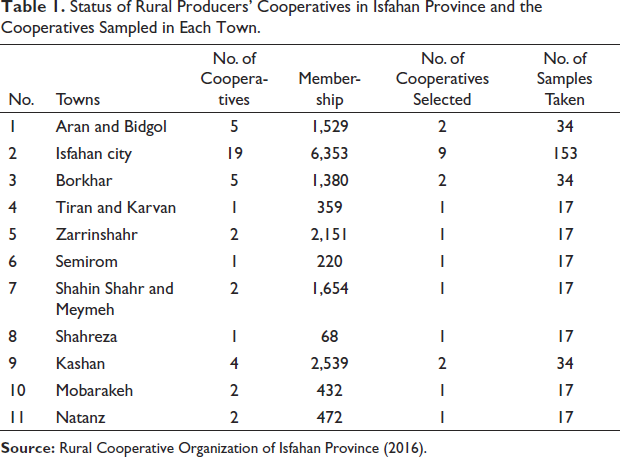
Based on the sample size of 375 and the total number of cooperatives set equal to 22, the required number of samples from each cooperative was obtained to be 17. Since the statistical population included seven people in the management (five members on the board of managers, one CEO and one inspector), 10 samples were also selected from the cooperatives’ membership. This ensured the complete variance of the statistical population covering all the towns and all the ranks in the cooperative structure.
Measurement
Based on a literature review and the memorandum of association of rural producers’ cooperatives, the research dependent variable (namely, the performance of cooperatives) and the main variables of the research hypotheses (including members’ commitment, cooperative management, extra-organisational factors, structural factors, CEO’s past experience and Geographical conditions) as well as the control variables (including human and financial resources, population size, number of water wells, distance from main roads and public institutions) were extracted.
Prior to the extraction of variables, a number of tests including the Kaiser–Meyer–Olkin (KMO) statistical test and Bartlett test were performed to ensure the appropriateness of the data for factor analysis (Williams et al. 2010). Also, Cronbach’s alpha coefficient was used to determine the reliability of the measurement tools used (Santos 1999).
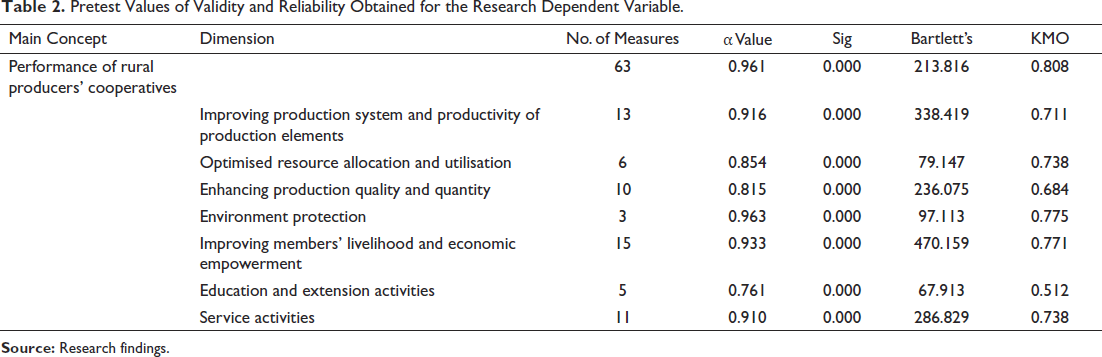
The questions used in the questionnaire prepared were presented to experts for approval before the validity and reliability of the questionnaires were confirmed by a pretest in which the questionnaire was presented to our samples of 30 subjects. Tables 2 and 3 report statistical results in pretest stage. As already mentioned above, the dependent variable of the research was the performance of rural producers’ cooperatives in Isfahan Province that consisted of seven dimensions. Each dimension was constructed using relevant measures, the validity and reliability of each of which are individually reported in Table 2. These seven dimensions were then used to construct the performance of cooperatives as the dependent variable. In this study, validity was measured using the KMO statistical test and reliability was determined using Cronbach’s alpha coefficient. Based on the data obtained, a Cronbach’s alpha coefficient value of above 70% for each dimension indicates its validity. Also, the Bartlett test results were found highly significant as evidenced by their KMO values of above 50%. Thus, the correlations among the data indicate their suitability for factor analysis.
Pretest Values of Validity and Reliability Obtained for the Research Dependent Variable.
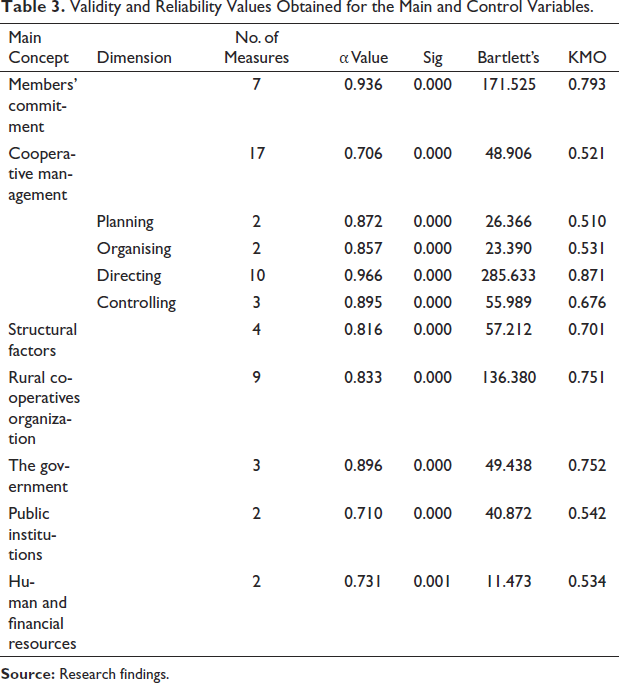
It is clear from Table 3 that Cronbach’s alpha coefficients for the different concepts recorded values above 70% and Bartlett’s values proved highly significant while the KMO values were above 50%.
Validity and Reliability Values Obtained for the Main and Control Variables.
After it was ensured that the research constructs were valid and reliable, the questionnaire was presented to 374 of cooperative members (including ordinary members, board members, CEOs and inspectors) in 11 towns across Isfahan Province.
Factor Analysis of Research Variables
Factor analysis employs different mathematical methods to detect the relations among the variables in a set (Yong and Pearce 2013). Principal Component Analysis was used to construct the research variables.
Predictive validity is defined as the ability to predict the value of a parameter in the future based on another parameter measured now. A high correlation between the two parameters indicates the high predictive validity of the latter (Drost 2011). The positive performance of cooperatives has positive effects on their positive financial performance (Chesnick 2000). In order to investigate the predictive validity of the hypothetically constructed performance index of producers’ cooperatives, a profitability index was constructed using the three measures of assets, shareholder rights and net profits. The results of regression analysis revealed that the hypothetically constructed index in question had a significant effect at the 0.05 confidence level on profitability (p = .002, t = 3.18, B = 0.163). Thus, it may be expected that rural producers’ cooperatives will achieve higher profitability rates if their performance is improved.
All the research measures recorded factor loadings of above 0.4, which is acceptable (Lee et al. 2004). Moreover, all these measures recorded composite validity values above 0.7. discriminate validity was also determined for the measures using the method described in (Fornell and Larcker 1981). It is established that in the determination of discriminate validity, the measures must have recorded average variance extracted (AVE) values of above 0.5; this was observed with all the measures in this study. The factor loading, CR and AVE values of the research constructs are reported in Supplementary (A).
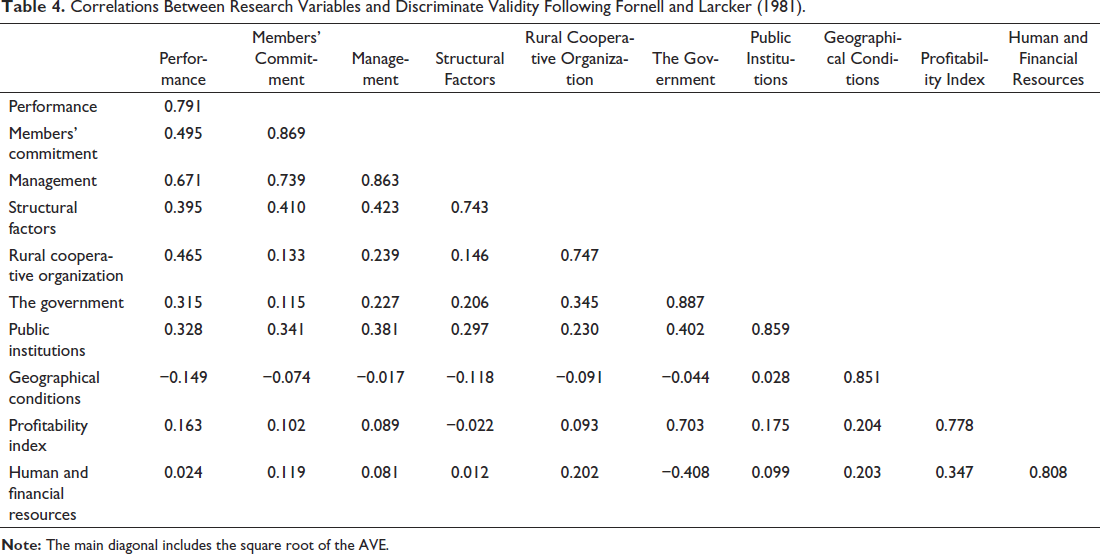
The research variables were computed using factor loadings before their correlations were determined. Based on the Fornell and Larcker (1981) method, the factors in Table 4 represent the correlations among the research variables. Clearly, a discriminate validity is confirmed because all the elements below or on the left-hand side of the main diagonal are smaller than those on the main diagonal (i.e., the square root of the AVE). These results are reported in Table 4.
Correlations Between Research Variables and Discriminate Validity Following Fornell and Larcker (1981).
Results and Discussion
Characteristics of Respondents
The questionnaire was administered to respondents with an average age of 50 years (minimum and maximum 25 and 90, respectively) including 97.6% males and 2.4% females. The respondents also held an average farming experience of 28 years with an average of 11 years serving as members of their cooperatives. With respect to education, 6.4% of the respondents were illiterate or poorly educated, 17.4% had finished primary school, 53.7% had attended guidance school or held high school graduation diploma, 19% held undergrad education, and 3.5% held graduate degrees.
Characteristics of Rural Producers’ Cooperatives in Isfahan Province
Cooperatives in Isfahan Province have recorded an average history of 20 years, while the youngest is 3 years old and the oldest is 52 years old. They serve an average number of four villages. Their average initial capital amounts to 203,333,011 Iranian Rial (IRR) and their average working capital reached 858,489,634 IRR. This is while their average farmland area is 2,386 ha and their reclaimed farmland area amounts to an average of 731 ha. Finally, their average number of irrigation wells at the time of their foundation was 74 which has presently increased to 146.
Assessment of Rural Producers’ Cooperatives in Isfahan Province
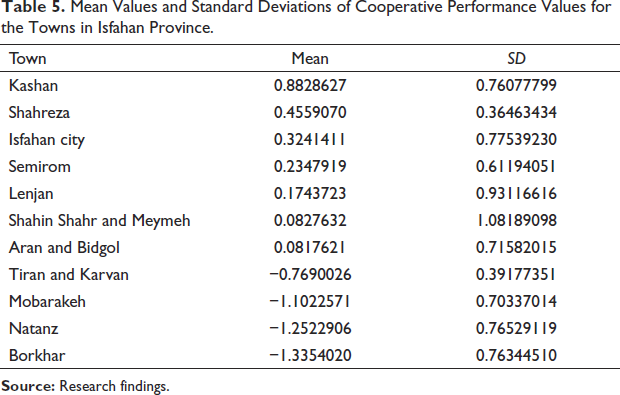
The cooperatives in Isfahan Province were evaluated with respect to their performance using the one-way analysis of variance (ANOVA) based on the difference in average performance values obtained from factor analysis of the towns in the province. Results indicated significant differences between the cooperatives in the different towns (F = 29.081, p = .000). It may be claimed that these cooperatives recorded an overall good performance as evidenced by the 63.6% which had above average performance values. However, 36.4% of the cooperatives recorded a poor performance below the average value. Table 5 reports the performance mean values and standard deviations obtained for rural producers’ cooperatives. Clearly, Kashan with a mean value of 0.8828627 recorded the highest and Borkhar with a mean value of −1.3354020 recorded the lowest performance among the towns in the province.
Mean Values and Standard Deviations of Cooperative Performance Values for the Towns in Isfahan Province.
Examination of Performance Differences Among the Constituent Elements of Rural Producers’ Cooperatives in Isfahan Province
The one-way ANOVA was used to explore performance differences among cooperative constituent elements (members, board of managers and inspectors). Results indicated no significant differences in the performance of these elements (F = 0.260, p = .955). This means that the managers did not commit bias errors in their assessment of cooperative performance.
Modelling Results
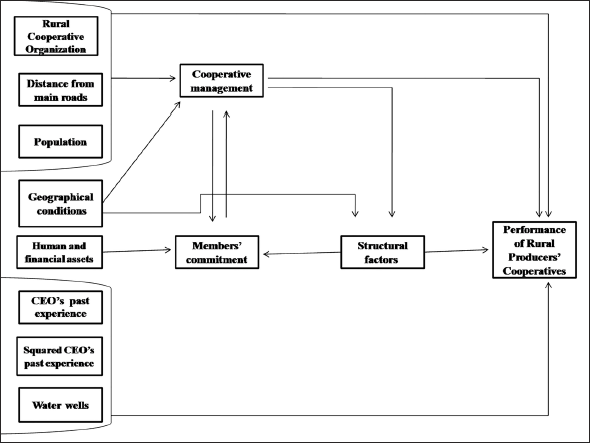
The STATA14 software was used to investigate the variables hypothetically constructed by factor analysis in the structural equation model presented in Figure 1. The goodness of fit indices of the model included root mean square error of approximation (RMSEA) = 0, comparative fit index (CFI) = 1 and Tucker Lewis Index (TLI) = 1.002, which represent an overfitting that can be removed by defining the relationships among the variables (Hayes et al. 2008). The goodness of fit indices are acceptable only for an RMSEA value less than 0.08, a CFI value above 0.9 and a TLI value above 0.9 (Awang 2012; Forza and Filippini 1998; Greenspoon and Saklofske 1998; Hair et al. 2010). For this reason, the method of model indices modification was employed in STATA14 to eliminate insignificant variables that resulted in overfitting. This yielded intermediate variables. In this regard, the variables ‘Government’ and ‘public institutions’ were eliminated as they had no significant effects (p>.05). Instead, the variables ‘management’, ‘legal structure’ and ‘members’ commitment’ were defined as intermediate variables. Figure 2 presents the modified model after the analysis of variables.
Rural Producers’ Cooperatives Comprehensive Assessment Model.
The results of structural equation modelling yielded the paths presented in the relevant table in Supplementary (B).
The committed attitude of members was found to have no direct impact on the performance of rural producers’ cooperatives. Its indirect effect can, however, be investigated using the intermediate variable of ‘management’ (B = 0.1526, Z = 3.01, p = .003) or those of ‘management’ and ‘satisfaction with structural factors’ (B = 0.0122, Z = 2.11, p = .035). Thus, our first research hypothesis is confirmed by the indirect effect of members’ commitment realised through the above intermediate variables.
From among the independent variables, ‘management’ was found to have the greatest direct impact on cooperative performance (B = 0.4498, Z = 12.78, p = .000). In addition, this same variable had indirect impacts on ‘cooperative performance’ via the intermediate variable of ‘satisfaction with structural factors’ (B = 0.0360, Z = 2.61, p = .009), also via ‘members’ commitment’ and ‘management’ (B = 0.0732, Z = 5.49, p = .000); ‘members’ commitment’ ‘management’ and ‘satisfaction with structural factors’ (B = 0.0058, Z = 2.47, p = .014); and ‘satisfaction with structural factors’, ‘members’ commitment’ and ‘management’ (B = 0.0066, Z = 2.04, p = .041). These findings confirmed the second research hypothesis stating that a significant and positive relationship holds between the improved performance of duties by the management board and the cooperative performance.
As already mentioned, ‘government’ in the initial model had no significant effect on ‘performance’; hence, its elimination from the model. This can be interpreted as the lack of effects by the government on cooperative performance. In contrast, the Rural Cooperatives Organization had a significant and positive effect on cooperative performance (p = .2716, Z = 8.35, p = .000). Moreover, the Rural Production Cooperatives Organization as a variable had indirect effects on ‘cooperative performance’ via such other intermediate variables as ‘management’ (B = 0.0678, Z = 3.70, p = .000) as well as ‘management’ and ‘satisfaction with structural factors’ (B = 0.0008, Z = 2.12, p = .034). Our third research hypothesis stated that significant and positive relationships exist between ‘government’ and ‘Rural Production Cooperatives Organization’, on the one hand, and ‘cooperative performance’, on the other. Thus, one part of this hypothesis (i.e. the significant and positive relationship between ‘government’ and ‘cooperative performance’) was refuted while the significant and positive relationship between ‘Rural Production Cooperatives Organization’ and ‘cooperative performance’ was confirmed.
The variable ‘satisfaction with structural factors’ had a direct positive effect on ‘cooperative performance’ (B = 0.0939, Z = 2.79, p = .005). This is while none of the indirect paths of this variable had significant effects on ‘cooperative performance’ (p>.05). Thus, ‘satisfaction with structural factors’ had no indirect effects. Thus, the fourth hypothesis stating that a significant relationship exists between ‘satisfaction with structural factors’ and ‘cooperative performance’ is confirmed.
CEO’s past experience was shown to have a direct and positive effect on the cooperative’s performance (B = 0.1373, Z = 3.46, p = .001) such that increasing years of the CEO’s past experience led to improved performance of the cooperative. However, the squared value of the CEO’s past experience had a direct but negative effect (B = −0.0176, Z = −6.14, p = .000), indicating that the rising trend would not continue ad infinitum but that, beyond a certain number of years of experience, the impact is reversed and the cooperative’s performance declines (Miller and Shamsie 2001). These observations confirm the fifth hypothesis stating that the CEO’s past experience and the cooperative’s performance are significantly correlated. In order to determine the optimum point at which previous management experience would have its maximum positive effect, the first derivative of equation 0.137x−0.0176x2 was set equal to zero to yield X = 3.89, or almost four years. This represents the optimal maximum value for the effect of management experience. It may, thus, be claimed that the maximum term of office for a cooperative’s CEO is four years beyond which they may have to step down.
The Geographical conditions as a variable had no direct and positive effect on cooperative performance (p>.05). It, however, had indirect effects on cooperative performance via the intermediate variable of ‘management’ (B = 0.0615, Z = 2.65, p = .008) and those of ‘members’ commitment’ and ‘management’ (B = 0.0100, Z = 2.43, p = .015). This confirms our sixth hypothesis stating the indirect relationship between Geographical conditions and cooperative performance.
The results of structural equation modelling with respect to the research hypotheses may be summarised as follows:
Public institutions were eliminated from the initial model as its impacts were insignificant. Human and financial resources had no direct impact on cooperative performance (p >.05). Population and Distance from main roads revealed a direct and indirect effect on cooperative performance (p <.05). Water wells had only a direct impact on the performance (p <.05) (refer to Supplementary B for details).
Conclusion
The results of the present study revealed that around 63.6% of the cooperatives studied recorded performance levels above the mean, which is clearly satisfactory. Our findings confirm those reported in Cesarini 1979; Donovan et al. 2017; Hadizadeh Bazaz et al. 2015; Royce 2004; Sadighi 2005; Sisay et al. 2017; Suh 2015; Yazdani 2012). In contrast, these findings are not in agreement with those of Hosseini et al. 2014; MacLean and MacKinnon 2000; Mhembwe and Dube 2017; Zarifian and Bahadori 2014).
Based on our findings, the independent variable of ‘management’ recorded the highest direct and positive effect (B = 0.4498) on the dependent variable (i.e. the performance of rural producers’ cooperatives). It may, thus, be claimed that management is the principal factor affecting the performance of such cooperatives. This is consonant with the reports by Biswas 2015; Godo 2022; Godo et al. 2022; Hosseini et al. 2014; Osmar and Wander 2021; MacLean and MacKinnon 2000; Mhembwe and Dube 2017 Pham 2022; Zarifian and Bahadori 2014). The presence or absence of similar factors determines whether a given type of cooperative will succeed or fail (Attwood and Baviskar 1987). It follows that the successful performance of a cooperative will not be a far-fetched objective to achieve if the managers are able to discharge satisfactorily their responsibilities of planning, organising, directing and controlling their enterprise. This is while such satisfactory performance of managers should encourage members’ commitment to the cooperative’s goals and objectives. The latter will, in turn, have feedback to the managers who will be further motivated to perform better and to enhance the performance of the cooperative (B = 0.0732). The modified model presented in the current study indicated the existence of a cycle that was obtained for the first time and we named it ‘the cooperative commitment cycle’ in which ‘management’ has an indirect and positive effect on cooperative performance through the following path: management↓satisfaction with structural factors↓members’ commitment↓management↓cooperative performance. According to this cycle, the better the performance of the cooperative management, the more satisfied will be the members with the structural factors, and the more they are satisfied, the more committed will be the members to the goals of the cooperative. This will ultimately affect the performance of the cooperative through the feedback to the management team.
Footnotes
Acknowledgement
The authors would like to extend their gratitude to the Rural Cooperatives Organization of Isfahan Province for sharing the data required. The rural producers’ cooperatives operating in Isfahan Province and their members also deserve our special thanks for their cooperation and the time they shared to respond to the questionnaires.
Declaration of Conflicting Interests
The authors declared no potential conflicts of interest with respect to the research, authorship and/or publication of this article.
Funding
The authors received no financial support for the research, authorship and/or publication of this article.
Supplementary Material

References
Supplementary Material
Please find the following supplemental material available below.
For Open Access articles published under a Creative Commons License, all supplemental material carries the same license as the article it is associated with.
For non-Open Access articles published, all supplemental material carries a non-exclusive license, and permission requests for re-use of supplemental material or any part of supplemental material shall be sent directly to the copyright owner as specified in the copyright notice associated with the article.
