



Abstract
Background
Digital political campaigning in India has expanded rapidly, increasing the likelihood that young voters encounter election-related content routinely across social platforms and messaging groups. The Neurocognitive and mental health correlates of such exposure remain insufficiently characterised, particularly in regional election contexts.
Purpose
To examine associations between digital political campaigns exposure and election-period psychological distress, and to evaluate whether this distress is associated with bias-relevant thinking dispositions (cognitive reflection, need for cognition and actively open-minded thinking) among young voters in Jharkhand.
Methods
A cross-sectional, questionnaire-based survey was conducted with 300 voters aged 18–35 years residing in Jharkhand. Digital political campaign exposure (study-developed multi-dimensional scale), psychological distress (Kessler-10), cognitive reflection (3-item CRT), need for cognition (NCS-18) and actively open-minded thinking (AOT short form) were assessed. Pearson correlations, multiple regression models and bootstrapped mediation analyses were performed with demographic and political interest covariates.
Results
Digital campaign exposure was not associated with psychological distress (r = 0.01; β = 0.02, p = .814). Psychological distress showed a small negative association with cognitive reflection (r = −0.13) and significantly predicted lower CRT scores in regression models (B = −0.03, SE = 0.01, p = .015, where, B: the unstandardized regression coefficient (often called the slope) and SE: the standard error of B), whereas associations with the need for cognition and actively open-minded thinking were non-significant (p > .50). The hypothesised indirect pathway from exposure to thinking dispositions via distress was not supported; bootstrapped confidence intervals for indirect effects included zero for all outcomes.
Conclusion
In this sample, routine digital campaign exposure volume did not predict election-period distress, but higher distress was associated with lower reflective reasoning. Future election-period research should operationalise exposure with greater sensitivity to stress-relevant and problematic engagement features and adopt designs capable of clarifying temporal ordering.
Keywords
Introduction
India’s digital ecosystem has expanded rapidly, with social platforms becoming a primary channel for communication, entertainment and information for large segments of the population. 1 For many young adults, social media functions not only as a social space but also as an ambient ‘news layer’, where civic narratives and political cues are encountered incidentally during routine platform use. 2 During election cycles, such ambient exposure can become intensive and difficult to avoid when political messaging is packaged as engaging short-form content and circulated repeatedly through feeds, pages and groups. Importantly, exposure is socially patterned; national survey evidence in India indicates unequal exposure to political information through social media across socio-demographic strata. 3 Digital political campaigning is now a central feature of Indian elections, where parties use social media as an infrastructure for mobilisation, persuasion and narrative reinforcement. 4 Election communication increasingly blends ‘open’ platforms (public feeds) with ‘closed’ platforms (messaging groups), which can amplify reach while reducing transparency and research visibility. 5 Institutional guidance issued during recent national elections has also emphasised responsible platform use and the need to address misinformation and synthetic content in the electoral communication environment. 6 However, digital campaign exposure is not a unitary construct: it may include passive feed encounters, repeated messaging in groups, direct contact from campaign networks, participation in partisan communities and exposure to emotionally negative or hostile content. In India’s messaging ecosystem, misinformation can be resilient and may interact with motivated reasoning, meaning that increased exposure does not necessarily translate into more accurate beliefs or improved evaluation. 7 Accordingly, the present study treats exposure as multi-dimensional (frequency, saturation, negativity, engagement) and operationalises it via a study-developed scale aligned to the election period.
Political events and election cycles can function as psychological stressors for young people. Qualitative evidence indicates sustained emotional responses among youth during and after national election periods, 8 and survey research shows that election stress can be associated with depression and anxiety symptoms. 9 In parallel, the social media and mental health literature indicates that stronger associations with distress typically occur for problematic or dysregulated use rather than general exposure; meta-analytic and systematic review evidence links problematic Facebook use and broader problematic social media use to psychological distress and related symptoms among adolescents and young adults.10–12 Indian evidence similarly suggests an association between intensive, addiction-like social media engagement and psychological distress among young adults. 13
Political judgements are shaped not only by message content but also by individual differences in thinking style. The cognitive reflection test (CRT) captures the tendency to override intuitive (but incorrect) responses and engage in reflective reasoning and predicts performance on heuristics-and-biases tasks.14, 15 Need for cognition (NFC) reflects enjoyment of effortful thinking and is associated with deeper, more systematic processing of persuasive messages, while lower NFC is associated with greater heuristic reliance.16–18 Actively open-minded thinking (AOT) reflects the willingness to consider counter-evidence and revise beliefs; lower AOT is associated with confirmation-consistent evaluation styles and resistance to belief updating. 19
Integrating these strands, the present study specifies a mediation framework in which digital political campaign exposure (X) may increase psychological distress during the election period (M), which may in turn relate to bias-relevant thinking outcomes (Y: CRT performance, NFC, AOT). A direct path from exposure (X) to outcomes (Y) is also tested, with demographic and political interest covariates included. The hypotheses are that digital campaign exposure is positively associated with psychological distress (H1), psychological distress is associated with more bias-prone thinking (lower CRT, lower NFC, lower AOT) (H2), and psychological distress mediates the association between digital exposure and bias-relevant thinking dispositions after adjustment for covariates (H3–H4).
Materials and Methods
A cross-sectional, questionnaire-based survey design was employed to examine associations among digital political campaign exposure, psychological distress and bias-relevant thinking dispositions during the Jharkhand election period. The sample comprised 300 young voters aged 18–35 years residing in Jharkhand. Inclusion criteria were: (a) residence in Jharkhand, (b) eligibility to vote in the recent election and (c) use of at least one digital platform for political or news content. Demographic variables recorded included age group, gender, education, area of residence, income bracket and political interest. Data were collected via an online questionnaire circulated through social media and student networks shortly after the campaign period. Participation was voluntary, and confidentiality safeguards were communicated via an information sheet; informed consent was obtained prior to survey initiation.
Measures
The instruments used in this study are summarised below.
Digital political campaign exposure scale (study-developed; 2025 election period). Assessed four dimensions: (a) frequency of exposure, (b) perceived intensity/saturation, (c) negativity/hostility and (d) engagement (e.g., liking/commenting/forwarding; participation in political groups). Items were rated on a 5-point Likert scale and summed to yield a total score; higher scores indicate greater exposure.
Kessler Psychological Distress Scale (K10).20, 21 A 10-item measure of non-specific psychological distress (anxiety and depressive symptoms) over the previous four weeks, adapted to the election context (‘during the election campaign period…’). Items were rated from 1 to 5, yielding a total score of 10–50; higher scores indicate greater distress. Severity interpretation bands followed published guidance.
Cognitive reflection test (CRT). 14 The three classic items (bat-and-ball; widgets; lily-pads) were used. Each item was scored 0/1 and summed to a 0–3 total; higher scores indicate more reflective correct responding.
Need for cognition scale (NCS-18).16–18 An 18-item scale assessing enjoyment of effortful thinking. Items were rated on a 5-point agreement scale with reverse scoring where appropriate and summed; higher scores indicate greater need for cognition.
Actively open-minded thinking (AOT) short form. 19 A short scale assessing willingness to consider counter-evidence and revise beliefs. Items were rated on a 5-point agreement scale with reverse scoring where required; higher scores indicate greater open-mindedness.
Statistical Analysis
Data were screened for missingness and implausible response patterns prior to inferential testing. Descriptive statistics and internal consistency reliability (Cronbach’s α) were computed for multi-item measures. Pearson correlations assessed bivariate associations. Multiple regression models tested H1 and H2 under covariate adjustment. Mediation was examined by estimating indirect effects with bootstrapped confidence intervals, controlling for demographics and political interest. Analyses were conducted in the Statistical Package for Social Sciences (SPSS version 22).
Results
Descriptive statistics for the primary variables are presented in Table 1. Overall, the sample reported moderate digital campaign exposure (mean 34.27, SD 3.34) and mild-to-moderate psychological distress (K10 mean 20.43, SD 3.91), with mid-range need for cognition (mean 56.81, SD 5.20) and actively open-minded thinking (mean 44.09, SD 4.28). Mean CRT performance was 1.06 (SD 0.85) on a 0–3 scale. Internal consistency reliability for multi-item measures was acceptable to good: Digital exposure (α = 0.85), K10 (α = 0.88), NCS-18 (α = 0.80) and AOT-13 (α = 0.78).
Descriptive Statistics for Study Variables (N = 300).
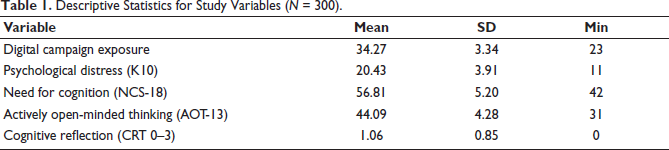
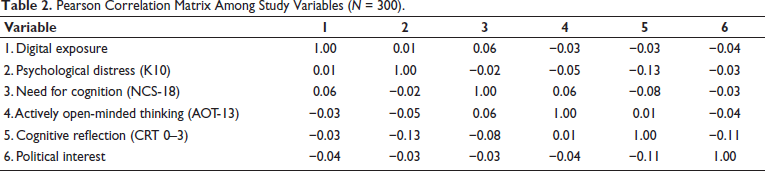
Table 2 summarises bivariate correlations. Digital campaign exposure demonstrated a near-zero association with psychological distress (r = 0.01). Psychological distress showed a modest negative correlation with CRT performance (r = −0.13), while associations between distress and need for cognition (r = −0.02) and actively open-minded thinking (r = −0.05) were negligible. Political interest demonstrated negligible correlations with the principal study variables (absolute r values ≤0.11).
Pearson Correlation Matrix Among Study Variables (N = 300).
Multiple regression models were estimated to test the hypothesised directional associations under covariate adjustment (key coefficients in Table 3). For H1 (digital exposure ↓ psychological distress), the model explained minimal variance (R² = 0.01) and digital exposure was not a significant predictor of distress (B = 0.02, SE = 0.07, p = .814). For H2 (psychological distress ↓ thinking dispositions), distress significantly predicted lower CRT performance (B = −0.03, SE = 0.01, p = .015) but did not significantly predict need for cognition (p = .753) or actively open-minded thinking (p = .537). Mediation models testing indirect effects (digital exposure ↓ distress ↓ CRT/NFC/AOT) were not supported; bootstrapped confidence intervals for indirect effects included zero for each outcome.
Multiple Regression Summary for Hypothesis Tests (Key Predictors Shown).

Discussion
In this sample of young voters from Jharkhand, digital political campaign exposure did not show a meaningful association with election-period psychological distress, whereas distress exhibited a small inverse relationship with cognitive reflection. The null exposure–distress association is consistent with broader evidence indicating that mental health correlates are typically more robust for problematic or dysregulated social media use than for routine exposure metrics.10–12 Meta-analytic and systematic review findings report positive associations between problematic Facebook use or problematic social media use and psychological distress and related symptoms. Indian evidence similarly links intensive, addiction-like social media engagement patterns with psychological distress among young adults. 13 In the Indian election context, campaign communication frequently occurs via semi-closed messaging ecologies and repeated forwards. 5 In such settings, misinformation and motivated reasoning can be resilient, and high exposure may not map onto a uniform psychological pathway without accounting for content valence, perceived threat, interpersonal conflict, or compulsive engagement dynamics. 7
The observed distress–CRT association is directionally compatible with neurocognitive accounts linking stress to reduced efficiency in prefrontal systems that support cognitive control and reflective processing. 22 Experimental and translational evidence indicates that stress-related neuromodulatory changes can impair prefrontal cortex function, and meta-analytic evidence suggests that acute stress can impair core executive functions such as working memory and cognitive flexibility—processes plausibly involved in overriding intuitive responses. 23 Election periods have also been described as psychologically salient stressors for youth populations, with empirical work linking election stress to adverse mental health outcomes.8, 9 Notably, distress was not meaningfully associated with need for cognition or actively open-minded thinking in this dataset, which may indicate that election-period distress is more strongly expressed in state-sensitive performance outcomes (reflective accuracy) than in comparatively trait-like dispositions.
Consistent with these patterns, the hypothesised mediation pathway (digital exposure ↓ distress ↓ bias-relevant thinking outcomes) was not supported, largely because the exposure–distress association was negligible. Future work should operationalise digital political exposure with greater sensitivity to stress-relevant mechanisms (e.g., hostile interactions, perceived threat, doom scrolling intensity, misinformation salience, compulsive checking) rather than relying primarily on frequency-based indices and should preferentially use designs capable of clarifying temporal ordering when testing indirect pathways.
Conclusion
Among young voters in Jharkhand (18–35 years), digital political campaign exposure did not predict election-period psychological distress in the present dataset, but higher psychological distress was associated with lower cognitive reflection. These findings suggest that routine exposure volume may be an insufficient proxy for distress-relevant election experiences and that distress may have measurable correlates in reflective reasoning. More granular exposure metrics and prospective designs are warranted to clarify neurocognitive and mental health pathways during election cycles.
Footnotes
Authors’ Contribution
Ankita collected the data and wrote the initial draft of the manuscript. Kashif Hasan contributed to the study methodology and supported writing, editing, and proofreading of the manuscript. Areena Mirza assisted in questionnaire development, data refinement, and data analysis, and also supported polishing of the manuscript. Sajid reviewed the final questionnaire and provided industry-oriented inputs to ensure relevance and clarity.
Declaration of Conflicting Interest
The authors declared no potential conflicts of interest with respect to the research, authorship and/or publication of this article.
Funding
The authors received no financial support for the research, authorship and/or publication of this article.
Informed Consent
Written informed consent was taken from professionals to participate in this study. Participants were briefed about their voluntary participation and the confidentiality of their responses. No incentive was provided for their participation.
Statement of Ethics
This study was performed in line with the principles of ICMR and the World Medical Association Declaration of Helsinki.
