




Abstract
Background
Fear of missing out (FOMO) is a recent psychological phenomenon and has been constantly linked with aggression, disturbed sleeping habits and deficits in self-regulatory skills. It is important to understand the mechanism through which FOMO influences sleepiness, self-regulation and aggression.
Purpose
The objective of the study was to investigate the relationship between FOMO and aggression in young adults and examine the mediating roles of fatigue, daytime sleepiness and self-regulation in the relationship between FOMO and aggression.
Method
A cross-sectional correlational research design was employed to collect data from 455 young adults aged 18–24 years (M = 20.71; SD = 1.61). Data were collected through standardised self-report measures. The obtained data were analysed using the Statistical Package for the Social Sciences v23, and sequential mediation analysis using AMOS v22.
Results
Findings indicated significant relationships between FOMO and the outcome variables like aggression, daytime sleepiness and self-regulation. However, no significant relationship was found between FOMO and fatigue; therefore, fatigue was not considered for further analysis. Sequential mediation analysis revealed that elevated levels of FOMO predicted lower daytime sleepiness (β = –0.26, p < .001), which in turn predicted low self-regulation (β = –0.39, p < .001) and consequently led to elevated levels of aggression (β = –0.26, p < .001). The indirect route (FOMO → sleepiness → self-regulation → aggression) was statistically significant with excellent model fit (χ2(2) = 3.86, RMSEA = 0.02, CFI = 0.99, SRMR = 0.01).
Conclusion
The study indicates a full sequential mediation: greater FOMO levels reduce daytime sleepiness, possibly due to heightened arousal, which in turn leads to poor self-regulatory skills and increased aggression. It can be concluded that psychological interventions to improve self-regulation can help manage aggression in people with high levels of FOMO.
Introduction
Social media platforms and other networking websites have become popular communication media for people from different regional and global demographics.1, 2 Initially, individuals used the computer desktop or laptop to access these social media websites, but with the rise of smartphones, that is not the case anymore. Social media has become a necessity, allowing us to form new social and professional connections over platforms like Facebook, LinkedIn, Instagram, X, etc. The feature of frequent notifications from these applications makes it hard to miss updates related to others’ life events. 1 Social media has certainly helped us to expand and maintain our social relationships, but at the same time, it harms one’s mental well-being. 3 Excessive social media usage is connected to anxiety, depression, loneliness, isolation, and digital addiction.4–7 Fear of Missing Out (FOMO) is also associated with increased social media usage.8, 9 Popular media refers to FOMO as an apprehensive state of mind where users feel anxious about being left behind while others are having fulfilling experiences offline, or on social media and virtual platforms. 10 This, in turn, allows individuals to keep track of their friends’ and relatives’ lives via social media. 11 If they are not able to do so, then they feel alienated and unappreciated, which is the foundation of FOMO. 12 According to self-determination theory (SDT), FOMO is a response to unmet psychological needs. 11 Undoubtedly, social media connections are crucial in this digital era, and enhance a sense of belonging, but at the same time, they can harm self-perception and mental well-being. 13 It is clearly understood that FOMO brings challenges in managing one’s self-regulation, affecting an individual’s striving for social belonging.
FOMO and Self-regulation
Recent research has shown that elevated levels of FOMO are associated with quick shifts of attention toward digital media and the tendency to maintain attention towards it. This state of constant alertness leads to anxiety about missing experiences, making individuals stay active on social media even more. 14 There is an increase in FOMO, especially when users see their known persons post live updates on social media. 15 Consequently, the frequency of using social media increases to keep track of the lives of other people, leading to fatigue and mood swings. 16 If the usage is restricted, it further increases irritability and anxiety, disturbing one’s daily routine. 17 As a result, this ongoing cycle weakens self-control, 18 which leads to compulsive usage of social media, leading to poor eating behaviour 19 and sleep quality.
FOMO and Sleep
FOMO-related distress can lead to several psychosomatic changes like increased blood pressure, elevated cortisol levels and disturbance in sleep patterns.20–22 Excessive use of smartphones, especially at night, disrupts the natural circadian rhythm, which further leads to fatigue, and individuals experience daytime sleepiness, hindering their daytime routine. 23 Furthermore, the daytime sleepiness further affects key cognitive functioning like alertness, decision making and planning, which are required for a structured daily functioning. Especially in adolescents, it has been found that FOMO has a positive correlation with late-night social media use and total nighttime sleep duration. 24 A study conducted in Jaipur, India, also found that FOMO is positively correlated with poor sleep and reduced functioning. 25 This may, in turn, further impact physical and mental fatigue.
FOMO and Fatigue
The increasing dependency on social and electronic media has led to fatigue, burnout, along mental and physical exhaustion. 17 A recent study established that FOMO, along with information overload from excessive social media usage, leads to fatigue, stress and sleep deprivation, leading to impaired daily functioning.26, 27 The compensatory internet use theory describes compulsive digital behaviour as a mechanism to avoid social exclusion, and this behaviour, with time, causes fatigue via constant hyper-vigilance and low recovery time because of disturbed sleep. 28 There are plenty of neurological studies that point out that FOMO activates the reward system of the brain, causing alertness in the short term, but in the long run, it leads to dysregulated sleep and distress. 29 Not only is FOMO related to fatigue, but also to aggression, as shown by recent literature. 30
FOMO and Aggression
It is well understood by now that FOMO has been shown to negatively influence sleep quality, fatigue, and this may lead one to display more verbal and physical aggression.30–32 As FOMO is also associated with social comparison, along with a fear of exclusion, it further increases the possibilities of displaying aggressive behaviour. 14 Such a chronic feeling may further lead to even online hostility affecting digital social relationships. 33 Such kind of aggression often reflects attempts to get back control or defend against isolation. The experience of FOMO is now widely acknowledged for having an interdependent interaction with physical states and behavioural outcomes, leading to enhanced arousal, changed sleep patterns, and cognitive overload. 11 Several studies have explored psychological phenomena associated with FOMO, but limited studies investigate internal processes like sleep and external behaviour like the display of aggression. Self-regulation as a protective factor has also not been widely studied. 11 The present study explores the relationship between FOMO and aggression, hypothesising that fatigue, sleepiness, and self-regulation will act as mediators in the relationship. Fatigue, daytime sleepiness and self-regulation not only function as outcomes of FOMO but can also become mechanisms that may explain the pathways to aggressive outcomes. With this background, the present study proposes a model evaluating the pathways between FOMO and the outcome variables, and further explores the association between FOMO and aggression through mediating variables of fatigue, sleepiness and self-regulation. This pathway proposes that FOMO can set off a chain reaction wherein it can first impact fatigue and daytime sleepiness, which further undermines the self-regulation, subsequently predicting increased aggression. Thus, studying these mediating factors using a single model, it attempts to explain both direct and indirect effects of FOMO on total aggression, recognising that the effect may not be linear but an interplay of various psychological factors. Thus, this model aims to understand the contribution of each of these psychological factors in the relationship between FOMO and aggressive outcomes.
The present study hypothesises that FOMO will share a significant positive relationship with fatigue (H1), aggression (H2) and daytime sleepiness (H3); and a significant negative relationship with self-regulation (H4). Additionally, it was also hypothesised that fatigue, sleepiness, and self-regulation would mediate the relationship between FOMO and aggression (H5).
Methods
Design
Following a quantitative approach, the study used a cross-sectional research design to explore the associations between the variables and to examine the mediating roles of fatigue, sleepiness, and self-regulation between FOMO and aggression.
Participants
The sample comprised 455 young adults. Data for the study were collected using a convenience sampling method by the first author through an online call for participation on accounts of social media platforms for maximum outreach. The call contained a link for an online form. G*Power 3.1, a popularly applied tool for power analysis, 34 was used to estimate the required sample size. The suggested minimum sample size was 254 to achieve the desired power of 95% with an expected medium effect size set at 0.05. The present study has a sample of 455 participants, surpassing the minimum threshold to guarantee sufficient statistical power. As per the inclusion criteria of the study, participants with the ability to read and write in the English language, possessing a smartphone or laptop with internet access, and with a minimum of one active social media account were included in the study. Individuals diagnosed with any psychological disorders or those under psychiatric medication were excluded from taking part in the study through a self-reported screening question in the survey.
Measures
FOMO Scale
This scale is designed by Przybylski et al. (2013), assesses an individual’s intensity of anxiety or FOMO on social events or opportunities where friends/family are involved. Responses are measured on a 5-point Likert scale. The total FOMO score is calculated by summing all 10 item scores (range: 10–50), with higher scores indicating greater FOMO levels. Reliability of the scale has been reported to range between 0.87 and 0.90. 11
Short Self-regulation Questionnaire (SSRQ)
This self-report measure consists of 31 items that assess an individual’s self-regulatory skills, using a 5-point Likert scale with certain specific items being reverse-scored; high total scores indicate enhanced self-regulation.35, 36 The psychometric properties of the scale demonstrate robust internal consistency (Cronbach’s alpha = 0.82–0.87) and satisfactory test-retest reliability (r = 0.80). Overall, this scale has strong construct and convergent validity through significant relationships with related domains like self-efficacy and impulsivity.35, 37
Chalder Fatigue Scale
The Chalder Fatigue Scale is used to assess the symptoms of physical and mental fatigue across different populations. Developed by Chalder et al. (1993), the scale consists of 11 items measured on a 4-point Likert scale with elevated scores signifying increased fatigue severity.38, 39 The scale demonstrates strong internal consistency (Cronbach’s α = 0.80–0.87) and test-retest reliability (r = 0.80), with the results of factor analyses supporting a two-factor model that distinguishes between physical and mental fatigue. 39
The Epworth Sleepiness Scale (ESS)
This tool is a self-administered measure that assesses overall daytime sleepiness by rating the chances of falling asleep in day-to-day life situations. The total range of scores can vary between 0 and 24, and scores above 10 suggest increased sleepiness. It has good internal consistency and reliability with a Cronbach’s alpha of 0.73–0.90, with a test-retest reliability between 0.81 and 0.93.40–42
The Buss-Perry Aggression Questionnaire (BPAQ)
This instrument is a 5-point Likert scale with a 29-items. It is a self-report questionnaire that intends to assess four factors of aggression, namely, physical and verbal aggression, anger, and hostility. Statistically, BPAQ has shown strong reliability, with an internal consistency of 0.89, and is often widely used in research as well as clinical practice. 43
Procedure
Prior to collecting data, ethical clearance was taken from the Institutional Review Board, following which the tools were administered online using Google Forms (Google LLC, Mountain View, California, United States). The Google Form link was circulated among the potential participants. The first page of the form had brief information about the objective and purpose of the study. The respondents were assured of the confidential nature of their responses and had the autonomy to reach out to the researcher at any step during the data collection process. After obtaining informed consent from the participants, the form having all the measures included in the study was provided to them. The researchers debriefed the respondents and expressed gratitude for their participation at the end of the data collection.
Data Analysis
The obtained data were analysed using SPSS v26 and AMOS v22. Descriptive statistics were calculated to examine the demographic characteristics of the participants. Pearson’s product-moment correlations were computed to explore the associations between FOMO and the selected correlates, namely, fatigue, sleepiness, self-regulation, and aggression. Based on the significant correlations, structural equation modelling (SEM), bootstrapped for 5,000 iterations and used to measure the direct and indirect paths from FOMO to its correlates. A serial mediation model was run to understand the mediating roles of sleepiness and self-regulation in the relationship between FOMO and aggression. Model fit was evaluated using relevant fit indices such as RMSEA, CFI, TLI, SRMR, and χ²/df benchmarks consistent with SEM best practices. 44
Results
The obtained data included 96 men and 348 women, while 11 individuals did not reveal their sex. The average age of the sample was 20 years (M = 20.71; SD = 1.61), and they were between the ages of 18–24 years. Approximately 288 participants were active across more than three social media platforms, while 127 participants had at least two social media accounts. About 388 participants reported spending one hour a day on social media platforms, while the rest spent more than one. Harman’s single-factor test was used to verify the potential common method variance. This method involves loading all items into a single exploratory factor to determine whether one factor accounts for the variance. 45 Results showed that a single factor accounted for 18.32% of the total variance, way lower than the critical threshold of 50%, suggesting that common method bias is not a factor in the current study.
Table 1 presents the results of descriptive statistics and Pearson’s correlations. Pearson’s product-moment correlations between the study variables were estimated to explore the relationships between FOMO, fatigue, sleepiness, self-regulation and aggression. Table 1 presents the mean, Standard deviations and Pearson’s correlation findings. It can be observed that FOMO shares a significant negative relationship with self-regulation (r = −0.39, p < .01), fatigue (r = −0.18, p < .01), and daytime sleepiness (r = −0.26, p < .01) and a positive relationship with aggression (r = 0.28, p < .01). This evidence indicates that a greater FOMO is associated with lower levels of daytime sleepiness, fatigue, and self-regulation.
Means, Standard Deviations, and Intercorrelations Between Fear of Missing Out, Self-regulation, Fatigue, Aggression, and Sleepiness (N = 455).
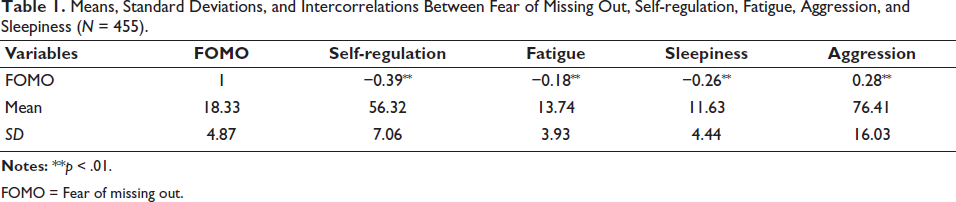
FOMO = Fear of missing out.
However, FOMO has a direct relationship with aggression. Significant correlations indicate the possibility of progressing with regression analysis as the assumptions of regression analysis are met.
Fit Indices of the Serial Mediation Model Between FOMO and Aggression.

Figure 1 shows the mediation model and the path coefficients between FOMO and aggression. The path analysis results showed that the direct paths from FOMO to self-regulation (β = −0.31, p < .01) were significant, supporting hypotheses H4. However, the direct relationship between FOMO and fatigue (β = −0.18, p < .01) and FOMO and daytime sleepiness (β = −0.26, p < .01) was negative and significant, which does not support hypothesis H1 and H3. Though the initial correlation analysis suggests a direct positive correlation between FOMO and aggression, in the context of path analysis, controlling for mediators showed different results. The direct effect from FOMO to aggression showed an insignificant relation (β = 0.02, p > .01), thereby negating H2. FOMO was found to be directly influencing fatigue, daytime sleepiness, and self-regulation, but not aggression. The indirect relationship between FOMO and aggression through sequential paths with sleepiness and self-regulation was therefore found to be significant.
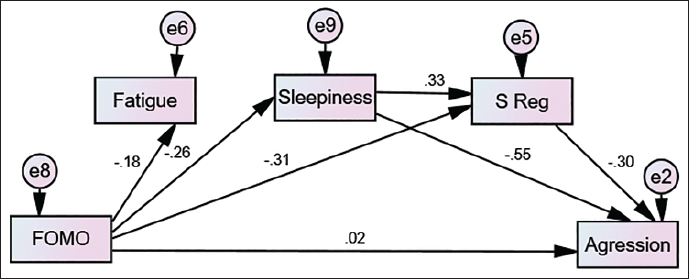
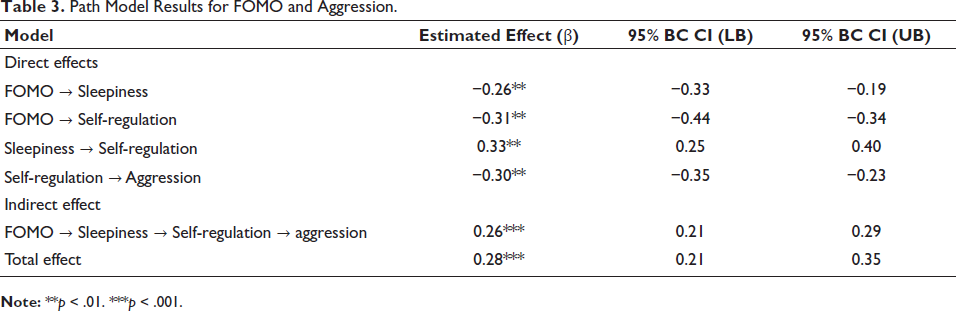
Table 3 shows the results of the serial mediation model tested with direct, indirect, and total effects between FOMO and aggression at 95% confidence intervals. The bootstrapped indirect effect of FOMO on aggression (β = 0.26, p < .001) is significant. The total effect of FOMO on aggression was significant through daytime sleepiness and self-regulation as mediators (β = 0.28, p < .001; 95% CI [0.21, 0.35]), partially supporting H5. Fatigue was not associated with other variables. Higher FOMO was associated with less sleepiness, which in turn predicted poorer self-regulation, ultimately leading to higher levels of aggression. The direct effect of FOMO on aggression was non-significant after accounting for the mediators, suggesting full mediation.
Path Model Results for FOMO and Aggression.
Discussion
Sequential mediation analysis revealed that self-regulation and daytime sleepiness emerged as significant mediators; however, fatigue did not. Results indicated that individuals with elevated levels of FOMO showed reduced levels of self-regulation. In individuals with elevated FOMO, the desire to stay connected with others is significant, and the compulsive use of social media creates a sense of belonging and acceptance. But the desire to stay updated with others’ life events distracts the individuals from their own set goals and priorities, leading to an uncontrollable pattern of checking their social media accounts. Such behaviour stands in contrast to the deliberate and task-oriented nature of self-regulation. This pervasive and persistent pattern of giving in to the desire to check their smartphones reduces self-control and discipline. Studies conducted in the past also support these findings.46, 47
Next, the findings surprisingly even revealed that FOMO negatively predicts daytime sleepiness. Individuals with high FOMO often stay online for extended periods due to constant anxiety, which hinders their ability to relax. Due to this constant hyper-vigilance, the body does not easily relax and stays in an alert state even when in a sleep-deprived state. Despite the fact that FOMO leads to sleep disruption and fragmentation, individuals may exhibit lower daytime sleepiness or under-report it due to heightened mental alertness, affective engagement, or offsetting behaviours that sustain a state of alertness even with insufficient sleep. Such behaviour impacts individuals’ health negatively. The findings gather support from a study conducted on 2,700 university students, where it was found that individuals may have high FOMO but no daytime sleepiness. 48 Another study pointed out that individuals experiencing FOMO and sleep reactivity did not show signs of daytime sleepiness. 49
Even though previous literature points towards a positive association between FOMO and fatigue, the results of this study indicate the opposite. Past literature shows similar findings as well. 50 A possible explanation may be that emotional support and a sense of contentment, which individuals derive from compulsively checking their social media and interacting with people online, may act as a buffer against perceived fatigue. On the other hand, FOMO has been shown to stimulate the Dopaminergic pathways around the ventral tegmental area and nucleus accumbens. This activation increases a sense of temporary alertness, masking fatigue. But with time, it further disturbs sleep quality, increases stress, and leads to fatigue in the long run. 29 Even though FOMO and aggression were significantly correlated, the mediation analysis showed no significant direct relationship.
According to SDT, FOMO arises from the unmet needs for autonomy and relatedness, which leads individuals to spend more time on social media to feel a sense of inclusivity, and can be understood as compensatory behaviour. This constant connectivity with digital media comes with psycho-physiological consequences; primarily, sleep disturbances and reduced sleep, which are associated with poor impulse control, making individuals prone to aggressive behaviour. These findings add to prior literature linking FOMO with disagreeable behavioural outcomes. A study found FOMO associated with relational aggression on Facebook, where individuals displayed manipulative strategies to prevent feelings of inadequacy, resulting in online aggression. 51 Another study also suggested that aggressive behaviour among college students is associated with higher FOMO. 52 Together, both these findings suggest that FOMO contributes to displaying aggression via dysregulation of self-regulatory skills.
The findings of this particular study highlight mixed outcomes for FOMO’s influence on self-regulation, daytime sleepiness, and fatigue. The overall results indicated a complex pathway through which FOMO influences all the variables. One major factor that needs to be considered here is that there is a possibility of Type 1 error because of the large sample size.
Thus, future studies need to be conducted in a longitudinal design to understand FOMO’s effects on psychological and physiological health. The tools which were used to collect data in this study were self-report measures, which is a limitation of the study as it increases the likelihood of socially desirable responses. The results indicate that self-regulation has a strong association with FOMO. Strengthening self-regulation can be a focus for FOMO intervention. Working towards strengthening one’s ability for impulse control, regulating attention, and emotions can be associated with lower levels of FOMO. Awareness camps in universities may help in educating the youth about the ill effects of increased social media usage.
Conclusion
In this dynamic and ever-evolving digital landscape, which has taken over the day-to-day running of our lives, the phenomenon of FOMO has emerged as an upcoming area of research that requires nuanced study. This study explores the influence of FOMO on correlations, namely, fatigue, sleepiness, self-regulation, and aggression. Results revealed FOMO to be a significant predictor of self-regulation, fatigue, and sleepiness, along with an indirect association with aggression. These findings have important implications for designing suitable interventions and spearheading public health campaigns to make effective changes in the controlled usage of social media content.
Footnotes
Authors’ Contribution
The first author was involved in data collection, data analysis, manuscript preparation and manuscript formatting. The second author conceptualised the study and was involved in data analysis and manuscript preparation. The third author was responsible for data analysis, manuscript preparation and editing. The fourth author was responsible for manuscript preparation.
Statement of Ethics
Ethical approval was provided by the Research Ethics Committee at Christ University, Delhi-NCR, India (RCEC/00315/06/22).
Data Availability Statement
Research data are available on request.
Declaration of Conflict of Interests
The authors declared no potential conflicts of interest with respect to the research, authorship and/or publication of this article.
Funding
The authors received no financial support for the research, authorship and/or publication of this article.
Patient Consent
Informed consent was obtained from all participants, ensuring their understanding of the study’s purpose, and procedures, and the right to withdraw at any time.
