




Abstract
We organize the literature on triggers and functions of nostalgia by advancing a regulatory model in which the emotion serves as a homeostatic corrective (i.e., a process that establishes and maintains a relatively stable psychological equilibrium) that countervails the negative effects of psychological perturbations and adverse environmental conditions. We illustrate complementary approaches to testing this model as it applies to transient, or state-level, nostalgia and show how the model can be generalized to different levels of analysis, including chronic, or trait-level, nostalgia and collective nostalgia. We then formulate a proposal for future research inspired by recent developments in causal mediation analysis and conclude with a discussion of the model’s potential boundary conditions.
I am parched with thirst and dying: quickly, give me the cool water flowing from the Lake of Memory.
The word “nostalgia” was coined by the Swiss physician Johannes Hofer (1688/1934) to denote homesickness. For centuries, nostalgia and homesickness were used interchangeably. As recently as 1943, McCann conducted what, in his words, was the first “controlled investigation” of nostalgia by comparing “one hundred college students who were or who recently had been homesick . . . with 100 college students who never had been homesick” (p. 97). In little more than a decade, nostalgia had become a subject of psychological theorizing in its own right (Martin, 1954). Yet nearly half a century would pass before the emotion finally became the target of systematic research around the turn of the 20th century.
In this article, we organize findings pertaining to the triggers and functions of nostalgia within the framework of a regulatory model. The model’s first tenet is that discomforting, adverse states trigger nostalgia. Its second tenet is that nostalgia countervails these negative states and thereby maintains homeostasis. We illustrate the regulatory model with representative studies on transient, or state-level, nostalgia. We then consider its utility for understanding chronic, or trait-level, nostalgia and collective nostalgia. We begin by addressing how laypersons view the emotion.
What Is Nostalgia?
In an investigation of lay conceptions of nostalgia in the United Kingdom and United States (Hepper et al., 2012), participants were instructed to identify which features they considered most characteristic (or prototypical) of the emotion. Participants viewed nostalgia as a predominantly positive, social, and past-oriented emotion that involves bringing to mind a fond and meaningful memory, typically of one’s childhood or a close relationship. One often sees the remembered event through rose-colored glasses, misses it, and may even long to return to the past. One feels sentimental—mostly happy, but with a tinge of sadness. This prototypical view of nostalgia cuts across cultural boundaries (Hepper et al., 2014).
Nostalgia has also been mapped by comparing it with other emotions. Multidimensional scaling analyses comparing 11 emotions revealed that nostalgia is characterized by high pleasantness and low arousal. It was rated as most similar to pride, self-compassion, and gratitude, and most distinct from shame, guilt, and embarrassment (van Tilburg, Wildschut, & Sedikides, 2018). In another study, we (van Tilburg et al., 2019) examined the appraisal profiles of experiences associated with 31 emotions and found that nostalgia is the only one elicited by experiences that are appraised as unique, temporally or psychologically distant, and predominantly pleasant but irretrievable.
The Regulatory Model of Nostalgia
Figure 1 depicts the regulatory model of nostalgia in its generic form. According to this model, an adverse event will have a negative influence on one’s current state (Path c), but will also increase nostalgia (Path a). Nostalgia, in turn, will have a positive influence on one’s current state (Path b). In this configuration, nostalgia functions as a balancing feedback mechanism that maintains homeostasis. The model shares its core principle that threats activate protective countermeasures with such diverse theoretical perspectives as attachment theory (Shaver & Mikulincer, 2008), self-affirmation theory (Steele, 1988), the mnemic neglect model (Sedikides et al., 2016), and terror management theory (Pyszczynski et al., 2004).
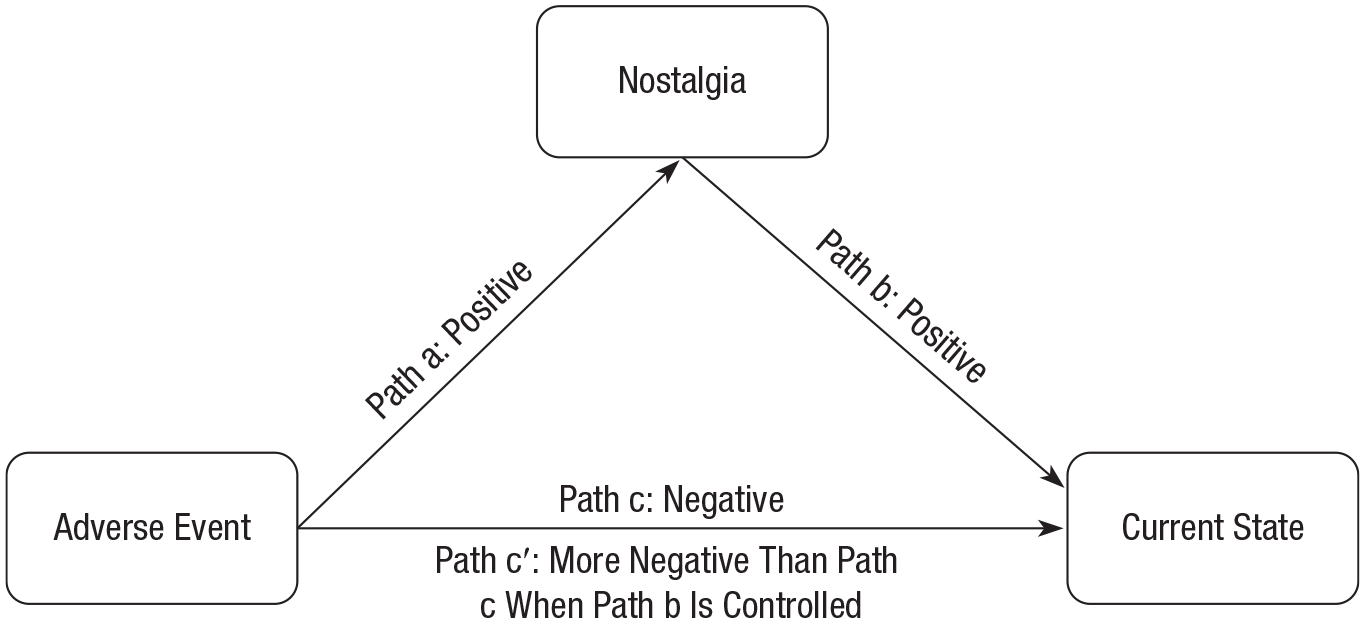
The regulatory model of nostalgia in generic form. According to this model, an adverse event has a direct negative effect on one’s current state (Path c) but also has an indirect positive effect via nostalgia (Paths a and b). When analyses control for the indirect effect, the negative influence of an adverse event is increased (Path c′).
In statistical terms, the pattern of relations depicted in Figure 1 amounts to inconsistent mediation (MacKinnon et al., 2000). This occurs when the direct effect of a predictor (here, an adverse event) is directionally opposite to its indirect effect via a mediator (nostalgia). When the countervailing influence of the mediator is removed, the opposing direct effect of the predictor is enhanced (Path c′ in Fig. 1). Spencer and colleagues (2005) described three research designs for testing mediation (see Fig. 2 for the application of these designs to the model in Fig. 1). First, in the experimental-causal-chain design (Fig. 2a), researchers first experimentally test the causal effect of the independent variable on the mediator (Path a). Then, in a subsequent experiment, they test the causal effect of the mediator on the outcome (Path b). Given that both the independent variable and the mediator are (sequentially) manipulated, this design enables strong causal inferences regarding the chain of events. Second, in the measurement-of-mediation design (Fig. 2b), relations among the independent variable, mediator, and outcome are examined in the context of a single study. The independent variable is either measured or manipulated, and the mediator and outcome are both measured. When the independent variable is manipulated, this design allows strong causal inferences regarding Paths a and c. Yet, because the mediator is always measured instead of manipulated, this design does not allow causal inferences regarding Path b, which is a major limitation. Third, in the moderation-of-process design (Fig. 2c), the mediator is neither manipulated nor measured. Instead, researchers introduce a moderator variable that is assumed to obstruct the mediational process through which the independent variable influences the outcome. If the relation between the independent variable and outcome (Path c) is weaker when the obstruction is in place than when it is not, this provides the basis for inferring the hypothesized mediational process. We now illustrate how these three designs have been used to test the regulatory model of nostalgia.
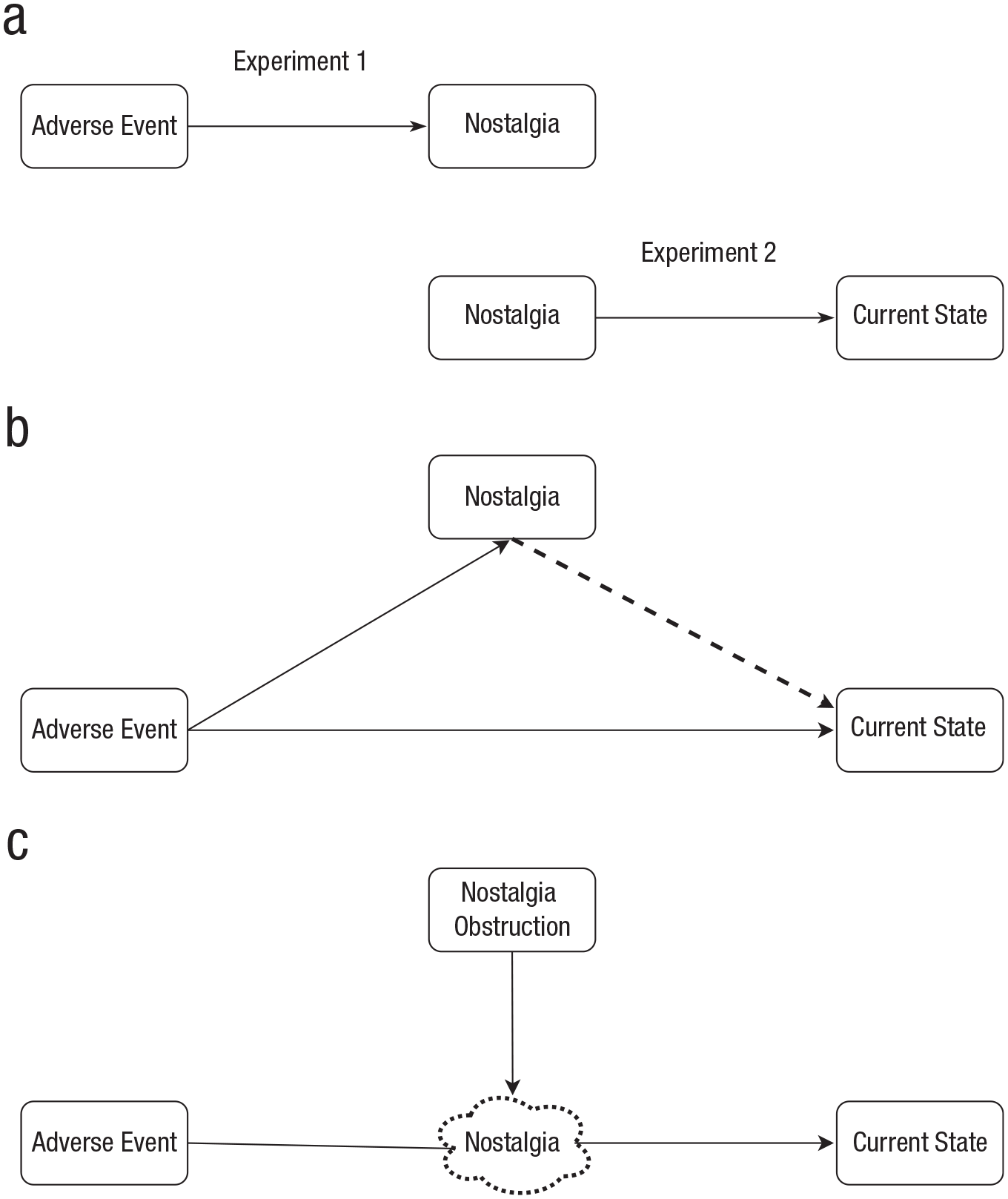
Three designs for testing the regulatory model. In the experimental-causal-chain design (a), separate experiments are conducted to test the causal effect of an adverse event on nostalgia and the causal effect of nostalgia on participants’ current state. In the measurement-of-mediation design (b), relations among an adverse event, nostalgia, and participants’ current state are examined in a single study. If the presence of an adverse event is manipulated, causal influences on nostalgia and current state can be inferred (solid arrows), but causal influences of nostalgia on current state cannot be inferred (dashed arrow) because nostalgia is not manipulated. In the moderation-of-process design (c), the introduction of a variable that obstructs nostalgia makes it possible to infer whether or not nostalgia mediates the effect of an adverse event on participants’ current state.
Experimental Causal Chain
Self-discontinuity, a sense of disjointedness between one’s past and present selves, is a discomforting state (Sedikides, Hong, & Wildschut, 2022). With two of our colleagues, we implemented the experimental-causal-chain design to examine if self-discontinuity instigates nostalgia and whether, in turn, nostalgia increases self-continuity (i.e., a sense of connection between one’s past and present selves; Sedikides, Wildschut, Routledge, & Arndt, 2015). To test the first link in this chain (Path a), we randomly assigned undergraduate students to one of three experimental conditions (Study 2). In the negative-self-discontinuity condition, participants were told that, according to extensive research, the university years are a time a transformation during which students experience negative changes. Participants in the positive-self-discontinuity condition learned that the university years are a time of positive transformation. In the self-continuity condition, participants were instructed that the university years are a time of stability. Participants then rated how nostalgic they felt “at this moment” for various objects from their past (e.g., “vacations I went on”; Batcho, 1995). We hypothesized and found that, compared with self-continuity, negative self-discontinuity (but not positive self-discontinuity) significantly increased nostalgia.
Next, we (Sedikides, Wildschut, Routledge, & Arndt, 2015, Study 3) tested the effect of nostalgia on self-continuity (Path b). We manipulated nostalgia with the event reflection task (ERT; Sedikides, Wildschut, Routledge, Arndt, et al., 2015), in which participants are randomly assigned to recall either a personally experienced nostalgic event (nostalgia condition) or an ordinary (e.g., everyday, regular) event (control condition). Participants in the nostalgia condition scored significantly higher on a four-item measure of self-continuity (e.g., “I feel connected with my past”), compared with participants in the control condition. Jointly, the two experiments underpin strong causal inferences regarding the proposed chain of events: Self-discontinuity instigates nostalgia, which, in turn, increases self-continuity.
Extending the scope of the regulatory model, we (Zhou et al., 2012) examined nostalgia’s role in counterbalancing adverse physiological states, specifically, thermoregulatory discomfort (i.e., feeling cold). Such a role would be consistent with poignant testimonies of Holocaust survivors that the recollection of satisfying meals was a common response to starvation. Goldenberg (2003) likened this to a form of nostalgia that served to revive moments of comfort, that is, to simulate a pleasant physiological state as if it were occurring (i.e., “as-if body loop”; Damasio & Damasio, 2006). To manipulate thermoregulatory discomfort, we randomly assigned participants to a cold, neutral, or warm room (Study 2). After completing a 5-min filler task, participants rated how nostalgic they felt for various objects from their past (Batcho, 1995). Participants in the cold room were significantly more nostalgic than those in the neutral and warm rooms, who did not differ significantly from each other. In a subsequent experiment (Study 4), we first manipulated nostalgia with the ERT and then instructed participants, who were seated in a cold room, to estimate the ambient temperature. Those in the nostalgia condition perceived the room to be warmer (i.e., more comfortable) than did participants in the control condition. Thermoregulatory discomfort triggers nostalgia (Path a). In turn, nostalgia augments thermoregulatory comfort (Path b).
Measurement of Mediation
The measurement-of-mediation design allows researchers to examine mediation statistically by testing the product of the effects of Paths a and b. The effect of Path a is extracted from the regression of the mediator (i.e., nostalgia in Fig. 1) on the independent variable (i.e., adverse event), and the effect of Path b is extracted from the regression of the dependent variable (i.e., current state) on the mediator, controlling for the independent variable. This ab product is equivalent to the change in Path c after controlling for the mediator (MacKinnon et al., 2000). Because the regulatory model proposes that the (positive) indirect effect of adverse events via nostalgia is directionally opposite to the (negative) direct effect of adverse events, controlling for the mediator should strengthen Path c (i.e., Path c′ will be more negative than Path c).
In another study (Stephan et al., 2014, Study 2), we implemented this design to test if avoidance motivation (i.e., a discomforting concern with preventing, escaping, or rectifying negative situations) instigates nostalgia and whether nostalgia, in turn, predicts increased approach motivation (i.e., motivation to promote, maintain, and sustain positive situations). In the avoidance-motivation condition, participants considered their life unfolding in the future and listed five events that they wanted to avoid. In the control condition, participants listed five ordinary, likely future events. Then, participants rated how nostalgic they felt for various objects from their past (Batcho, 1995). Finally, they responded to a measure of approach motivation (e.g., “I go out of my way to get things I want”; Carver & White, 1994). Participants in the avoidance-motivation condition, compared with those in the control condition, expressed greater nostalgia (Path a). In turn, greater nostalgia predicted stronger approach motivation (Path b), controlling for the avoidance manipulation. When we controlled for the mediator, the negative effect of avoidance motivation on approach motivation was strengthened (i.e., Path c′ was more negative than Path c). Avoidance motivation caused nostalgia, but whether nostalgia caused approach motivation is less certain because their association (Path b) was purely correlational. To protect this Achilles heel, we followed up with an ERT experiment that demonstrated a positive causal effect of nostalgia on approach motivation (Study 3). This hybridization of the experimental-causal-chain and measurement-of-mediation designs has the advantage of generating two methodologically distinct tests of Path b.
The limitations of the measurement-of-mediation design are widely publicized (Fiedler et al., 2018). This is one reason why few researchers have relied on it exclusively to test the regulatory model of nostalgia (but see Bialobrzeska et al., 2019, for a longitudinal test). Another reason is that it is relatively easy to manipulate transient, or state-level, nostalgia and test its causal effects. In addition to the ERT, manipulations include those based on songs and lyrics (Sedikides, Leunissen, & Wildschut, 2022), images (Yang et al., 2021), and prototypical features of nostalgia (Hepper et al., 2012). Nonetheless, the measurement-of-mediation design is informative because it puts the mediational hypothesis at risk.
Moderation of Process
In the moderation-of-process design, researchers introduce a moderator variable that is assumed to impede the mediational process. This was the approach we took to test nostalgia’s countervailing influence on distress evoked by adverse weather (van Tilburg, Sedikides, & Wildschut, 2018, Study 3). We simulated adverse weather by randomly assigning some participants to listen to a recording of heavy wind; other participants listened to a recording of light breeze (control). We then introduced a moderator variable designed to obstruct the postulated mediational process—nostalgia. To be precise, some participants were assigned to a cognitive-load condition, in which they performed a task that involved counting backward, which hampered their ability to bring to mind nostalgic experiences; other participants did not have to perform this task. Results revealed a significant Weather × Cognitive Load interaction effect on weather-induced distress (e.g., “Listening to this recording makes me feel distressed”). As hypothesized, listening to heavy wind (compared with listening to a light breeze) caused significantly more distress when cognitive load was induced than when it was not. According to the logic of the moderation-of-process approach, this interaction effect provides the basis for inferring the entire mediational chain from adverse weather to reduced distress via increased nostalgia, even though the individual links were not observed directly. When researchers are not content to merely infer the operation of a mediator that was neither measured nor manipulated, they may gather additional evidence to bolster their claims. So, implementing a measurement-of-mediation design, we (Study 4) demonstrated that the adverse-weather condition (compared with the light-breeze control condition) increased nostalgia, which, in turn, was positively associated with social connectedness, meaning in life, self-continuity, self-esteem, positive affect, and optimism.
More recently, Maher et al. (2021, Study 3) implemented the moderation-of-process design to examine nostalgia’s capacity to maintain one’s sense of meaning in life when faced with disillusionment. Disillusionment (compared with a control condition) caused a larger reduction in meaningfulness when nostalgia was hampered by cognitive load than when it was not. Rather than rely solely on this Disillusionment × Cognitive Load interaction effect to infer the postulated mediational sequence, these researchers, too, used a measurement-of-mediation design to gather corroborating evidence (Study 2). Disillusionment (compared with a control condition) increased nostalgia. In turn, nostalgia was positively associated with higher meaning in life.
Generalizations of the Regulatory Model
Personality traits can be conceptualized as density distributions of states. That is, individuals’ average tendencies to experience specific, discrete states, such as nostalgia, provide highly stable descriptions of their personality (Fleeson, 2001). Accordingly, the regulatory model may capture nostalgia’s role in palliating chronic adversity at the trait level. In another set of studies (Zhou et al., 2022, Studies 1–3), we examined the relations among trait-level loneliness (a type of chronic adversity), nostalgia, and well-being during the COVID-19 pandemic in three cultures (China, United Kingdom, United States). Given that personality traits are difficult to manipulate, we relied on a measurement-of-mediation design. Loneliness during the pandemic was associated negatively with well-being, but positively with nostalgia. Nostalgia was associated positively with well-being, countervailing the adversity of loneliness.
Although we have focused on personal nostalgia, research on collective (often, national) nostalgia is blossoming (Sedikides & Wildschut, 2019; Smeekes et al., 2021). Collective nostalgia is contingent on thinking of oneself in terms of a particular group membership and pertains to the people, history, experiences, and objects associated with this in-group (Wildschut et al., 2014). A recent cross-cultural study supports the model’s utility at this level of analysis (Smeekes et al., 2018). Using a measurement-of-mediation design, the researchers found that collective angst (e.g., “I am concerned that the future vitality of [country] is in jeopardy”) was negatively associated with in-group continuity (e.g., “[Country’s] people have maintained their values across time”), but positively associated with national nostalgia (e.g., “I experience nostalgic feelings when I hear [country’s] music from the past”). National nostalgia was positively associated with in-group continuity, counteracting collective angst.
Causal Mediation and the Counterfactual Framework
We see potential for new causal mediation methods based on the counterfactual framework (MacKinnon et al., 2020; Valente et al., 2020). These methods allow researchers to model the interaction effect of the independent variable and the mediator on the outcome, and so to differentiate which component of the total effect is due to mediation and which is due to interaction. We envision that these developments will accelerate a synthesis between the regulatory model, which emphasizes (inconsistent) mediation, and a complementary moderation perspective according to which the beneficial effects of nostalgia are more pronounced in the presence than in the absence of adverse events (Wildschut & Sedikides, 2022).
As an illustration, we turn to a study we conducted with our colleagues (van Dijke et al., 2019, Study 1). We found that employees who experienced adversity at work in the form of chronically low levels of interactional justice (i.e., poor interpersonal treatment by organizational authorities) reported less intrinsic motivation (i.e., less curious and exploratory engagement in activities that they felt were inherently interesting and enjoyable) during the work day than did employees who experienced chronically high levels of interactional justice. However, low interactional justice was also associated with a higher level of nostalgia during the work day, which, in turn, was positively associated with intrinsic motivation. These findings, then, were amenable to a test of the regulatory model with the measurement-of-mediation approach. Had we adopted this strategy, however, we might have overlooked that the association between nostalgia and intrinsic motivation was significantly stronger when interactional justice was low (i.e., adversity was present) than when it was high (i.e., adversity was absent). As it was, we hypothesized precisely this Interactional Justice × Nostalgia interaction effect and, accordingly, focused on moderation rather than mediation. Yet, by doing so, we passed over the theoretically (and practically) meaningful negative association between interactional justice and daily nostalgia. Causal mediation analysis can end this trade-off between focusing on mediation or moderation.
Alternative Perspectives
In Dante’s (1320/1982) Divine Comedy, Francesca, who is punished in Hell for adultery, remembers her lover and brother-in-law Paolo, remarking: “There is no greater sorrow than thinking back upon a happy time in misery” (Inferno, Canto V, 5.121–5.123). Over the years, various scholars have echoed Francesca’s negative characterization of nostalgia. We briefly present a characteristic selection of these alternative views.
Newman et al. (2020) argued that nostalgia “seems predominantly negative when [it] is experienced in the course of everyday life” (p. 325). Yet their own findings contradicted this conclusion. When instructed to rate the positivity (1 = not at all positive, 7 = very positive) and negativity (1 = not at all negative, 7 = very negative) of a nostalgic episode they had experienced in the course of everyday life, participants evaluated it as far more positive (M = 5.02) than negative (M = 2.47; Newman et al., Study 5, Table 6, p. 341).
Other researchers have focused on identifying potential boundary conditions for nostalgia’s beneficial effects, asking under what circumstances and for whom nostalgia could be negative. Beiser and Wickrama (2004), studying Southeast Asian refugees in Canada, and Iyer and Jetten (2011), studying first-year undergraduates making the transition to university in the United Kingdom, were in general agreement with each other. They proposed that nostalgia for “a past that has been left behind” (Iyer & Jetten, p. 96) can create a painful contrast between one’s present condition and a “never-to-be-regained past” (Beiser & Wickrama, p. 909). We found only qualified support for this assertion in an ERT experiment among Syrian refugees who were resettled in Saudi Arabia (Wildschut et al., 2019). For refugees who scored low on a measure of dispositional resilience, nostalgia (compared with the control condition) increased self-continuity and meaning in life but reduced optimism and inspiration (there was no significant effect on self-esteem or social connectedness). For high-resilience refugees, nostalgia (compared with the control condition) increased four of the six aforementioned psychological functions (there was no significant effect on optimism or inspiration). Even civil-war refugees, who had been forcibly separated from their past life, derived psychological benefits from nostalgia, although those who were low in resilience also incurred some costs—a finding in need of replication. In this light, it is noteworthy that Dante wrote Divine Comedy in exile from his beloved Florence, never to return there again.
Conclusion
Over the past two decades, nostalgia has stepped from the shadows into the spotlight of psychological science, and it is now recognized as being a common, predominantly positive, and universally shared emotion. In this review, we have advanced a regulatory model for organizing the empirical evidence pertaining to nostalgia’s triggers and functions, and we have illustrated three research designs for testing its hypothesized homeostatic role in countervailing the negative impact of adverse events. We hope that recent advances in causal mediation analysis based on the counterfactual framework will pave the way for refining current understanding of the interplay between adversity and nostalgia, and how it shapes psychological functioning. Nostalgia’s future is calling.
Recommended Reading
Leunissen, J., Wildschut, T., Sedikides, C., & Routledge, C. (2021). The hedonic character of nostalgia: An integrative data analysis. Emotion Review, 13(2), 139–156. https://doi.org/10.1177/1754073920950455. A report combining results from 41 experiments testing the effect of nostalgia on positive, negative, and ambivalent affect.
Sedikides, C., & Wildschut, T. (2019). (See References). An overview of research on the social-connectedness function of nostalgia and the downstream consequences of nostalgia-induced sociality.
Sedikides, C., Wildschut, T., Routledge, C., Arndt, J., Hepper, E. G., & Zhou, X. (2015). (See References). A general introduction to nostalgia as a subject of psychological inquiry.
Wildschut, T., & Sedikides, C. (2022). (See References). A report on the benefits of nostalgia in vulnerable populations, including sojourners and immigrants, civil-war refugees, people suffering bereavement, people facing a limited time horizon, and people living with dementia.
Wildschut, T., & Sedikides, C. (in press). Nostalgia and protection of psychological well-being during the COVID-19 pandemic. In M. Miller (Ed.), The social science of the COVID-19 pandemic. Cambridge University Press. An application of the regulatory model illustrating how nostalgia may protect psychological well-being during the COVID-19 pandemic.
