




Abstract
Background
The evolution of the marketing environment has been influenced primarily by two factors: the increasing relevance of digital technologies and the ever-increasing importance of social media.
Purpose
This investigation seeks to identify the neuroscientific mechanisms that contribute to how social media marketing (SMM) can influence purchase intention, specifically through the mechanism of consumer engagement (i.e., emotional attention and cognitive appraisal). This research also investigates the extent to which different types of engagement may have a greater or lesser effect, and whether the effects differ amongst different subgroups of users.
Methods
This research is survey-based, collecting data from 485 respondents who actively use social media in India, utilising standardised questionnaires. Statistical analyses were employed to analyse the quantitative data collected in this study using descriptive statistics, correlation analysis, and mediation testing with the PROCESS macro. A set of hypotheses was proposed to investigate the direct and indirect relationships among the variables examined.
Results
The results indicate a statistically significant positive relationship between SMM and purchase intention. Additionally, it was demonstrated that consumer engagement serves as a significant mediator for this relationship. It is posited that when consumers view persuasive content online, the corresponding neural pathways are related to the processing of rewards, motivation, and memory activation. These activated neural pathways increase the level of consumer engagement and ultimately influence the development of purchase intentions.
Conclusion
The findings of this study provide an integration of existing knowledge and theory regarding digital marketing, consumer psychology, and neuroscience.
Keywords
Introduction
India is one of the fastest-growing digital markets in the world, with more than 600 million internet users. With the speedy rise of social media in the country, the marketing landscape has changed dramatically. In India, social media platforms have become key players in the digital marketing mix, providing companies with a wealth of opportunities to interact with customers, file their brands and impact their buying choices. With the rapid expansion of smartphone usage and internet penetration, India has become one of the largest social media markets in the world. Therefore, marketers increasingly prefer these platforms to reach the targeted audiences based on location, interests and their behavioural patterns.
Out of the many platforms available, certain social media platforms have emerged as key players in the Indian digital marketing space. Just to name a few, these would include Facebook, Instagram, YouTube, Twitter (now X), LinkedIn and WhatsApp. Each platform delivers a host of different features and avatars, which makes them attractive for various marketing purposes which including brand awareness, lead generation, customer engagement and direct sales. For example, while Instagram is the favourite for visual storytelling and influencer marketing, B2B communication and professional branding are better done on the LinkedIn platform. Since YouTube’s primary focus is on video, it is used widely for tutorials, product demonstrations and influencer reviews.
There has been a massive change in the marketing landscape over the last few years, primarily caused by the growing importance of digital technologies and social media. While still proving effective, old media such as print, radio, and television are being replaced by a growing variety of interactive, real-time digital marketing techniques. Social media marketing (SMM) rates as one of the most successful marketing techniques that companies can resort to in order to be successful at connecting with their consumers. With the widespread availability of smartphones and internet access, consumers are spending a wealth of time online using ‘platforms like Facebook, Instagram, Twitter, LinkedIn and YouTube’.
SMM differs from traditional advertising because it is a two-way communication. Companies are no longer just pushing a message; they are opening up a dialogue, inviting input and building communities. This interaction is at the heart of understanding how consumers today make their purchasing decisions. The concept of consumer involvement has become a vital concept for evaluating the success of SMM. User involvement includes such things as the creation of content, comments, sharing, favourites, and viewing. Such behaviours suggest a consumer’s level of concern with the brand and purchase probability that goes beyond curiosity. The purchase probability is an important outcome that marketers wish to influence with marketing efforts. It is the likelihood of a consumer to buy a product, service, or cause. The normally accepted reading is that if consumers are more involved with social media, their purchase intention is enhanced. A clear correlation exists, however, between marketing input and purchase intention from users. Oftentimes, involvement acts as a mediating factor and becomes an important link between marketing communications and the action of consumers. If a user is highly involved with many of a company’s related posts, he or she may feel greater trust and emotional involvement with the brand, thus rendering a higher purchase probability. Sometimes, too, the involvement itself may vary in nature and involve different degrees of strength. Different forms of involvement or engagement may generate varying degrees of effectiveness. A ‘like’ may be indicative of casual approval of interest, sharing suggests greater interest and attention, while commenting indicates greater involvement and thought. Thus, it is important to know which forms of involvement predict purchase intention. In addition, this relationship may be different among different socio-demographic groups. Response to advertising and involvement with content related to social media will depend upon the age, degree of masculinity or femininity, income and educational level of the participants in this experiment.
Social media is continuously evolving through changing algorithms, new or enhanced features, and user interface redesigns. This rapid evolution influences how users engage with content. This, in turn, may have an effect on the type of consumer engagement that occurs and ultimately the effectiveness of marketing campaigns. To gain a full understanding of both the direct linkage between SMM and purchase intention, the mediating effects of interaction, and how demographic and platform-specific factors may be affected by such dynamic environmental factors, there is a need to analyse these factors together. This study intends to fill the gap identified above.
To address the identified gap, we aim to explore the extent to which SMM influences consumer behaviour through interaction. Although social media has been widely adopted, very little is known about how SMM actually impacts consumers’ decisions to purchase. The primary mechanism for developing consumer trust and influencing purchase intentions is consumer engagement, and it encompasses liking/sharing/commenting on posts and/or directly interacting with others. This research will assess the role of engagement as a mediator of the relationship between SMM and consumer behaviour.
This study adds to the growing body of literature in the area of neuromarketing by providing a comprehensive model that integrates aspects of digital marketing, consumer psychology, and neuroscience. The findings from this study offer insight into the design of more effective, ethically grounded marketing strategies that reflect and support consumers’ cognitive and emotional processes while encouraging ethical digital engagement practices.
Review of Literature
The primary determinant of marketing success is ‘purchase intention’. The present empirical study focused on the ways in which SMM affects purchase intention. The link between SMM and purchase intent is mediated by consumer engagement. By shedding light on the factors influencing customers’ decision-making processes, this section deals with the previous studies which are related to the social media marketing (SMM) affects purchase intention. Nguyen et al. 1 investigated the connection between SMM, consumers’ intent to buy, and their level of involvement in Vietnam. Based on the 300 individuals. To test their hypothesis, the authors used regression analysis. The results show that customer participation and purchase intent are highly correlated with SMM. Their research indicates that the relationship between customer participation and purchase intent is mediated in part by SMM. Munawar et al. 2 examined SMM, consumer interaction, and intent to purchase from ‘the perspective of Indonesian mobile phone users’. Social network marketing significantly influences customers’ inclination to purchase, according to the data processing results. In terms of consumer engagement, SMM is supreme. Customers’ degree of participation has a significant impact on their likelihood of making a purchase. Consumer involvement moderates the relationship between the intention to purchase and social network marketing. Hassim et al. 3 investigated how ‘perceived Social Media Marketing Activities (SMMAs)’ affect consumers’ intentions to make purchases. The findings showed that SMM Activities had no influence on purchase intention. Laksamana 4 demonstrated that SMM has a significant influence on both purchase intention and brand loyalty in the Indonesian market. Savitri et al. 5 investigated the relationships among ‘purchase intention and SMM, brand image’. PLS SEM SmartPLS software is employed as a data processing instrument in the quantitative approach employed in the research in Indonesia. She concluded that although there was a negligible correlation between SMM and brand image, there was a robust connection ‘between purchase intention and social media marketing’ when brand image was employed as a mediator. Subasinghe et al. 6 investigated the ways in which SMM influences consumers’ inclinations to purchase natural personal care products. Additionally, the researcher was able to confirm that SMM has a more pronounced impact on purchase intention than perceived trust, and that ‘perceived trust and social media marketing’ have a substantial positive correlation. Noreen and Han 7 examined how SMM affects the purchase intentions of customers in South Korea and Pakistan. The influence of electronic word of mouth on purchase intention is also greater than that of social network marketing.
Al-Abed et al. 8 identified ‘elements of social media marketing’, that affect customer purchase intent in Jordan. Results indicated that the relationship between SMM and client purchase intent is influenced by levels of customer engagement. Sianturi et al. 9 analysed the degree to which SMM influence client purchase intent in Medan, Indonesia. Findings suggested that SMM will be positively related to client purchase intent if the SMM (a) contains relevant information; (b) provides relevant benefits; or (c) is comparable to competing products. These results provide recommendations for marketing practitioners. Yen et al. 10 also researched the effects of social media marketing on clients’ online purchase intent in Malaysia. Perceived usefulness, informativeness, price awareness, and word of mouth regarding SMM all positively influence client online purchase intent. Alfeel and Ansari 11 explored the effect of SMM on clients’ purchase intentions in Saudi Arabia. Results showed that 92.4% of clients intended to purchase based on SMM. Therefore, client purchase intentions are positively affected by SMM. Businesses cannot avoid SMM; however, it does require thoughtful planning and implementation to increase revenue and profit. Yeo et al. 12 researched the effects of social media advertising on client purchase intent to complete online transactions in Malaysia. Research results suggest that the interaction between ‘social media advertising characteristics such as interactions, information, vividness of trust, and brand image’, affects the likelihood that clients will complete an online transaction. Shien et al. 13 researched the effects of SMM on young Malaysian clients’ purchase intentions while controlling for the level of engagement. Young clients’ purchase intentions are positively and significantly associated with SMM. This study has demonstrated the mediating effect of the engagement strategy on the relationship between SMM and the purchasing intent of young consumers as well as the mediating effect of the engagement strategy on the relationship between SMM and the purchasing intent of young consumers. Hussain and Chimhundu 14 used ‘correlation and regression analyses’ to assess the extent to which SMM impacts Australian retail consumers’ purchasing intentions. Based upon the results of the study and through the use of ‘exploratory factor analysis’, the researchers have concluded that social media does positively affect customers’ purchasing intent, and that ‘brand equity serves to moderate the relationships between the independent and dependent variable’. Jiang and Yin 15 examined how SMM affects ‘consumers’ intentions to make an online purchase’ using ‘the TAM and TPB theories’. The researchers discovered that both ‘attitudes, subjective norms, perceived utility, perceived ease of use, and appropriate SMM materials’ impacted ‘consumers’ intentions to make online purchases’ favourably and significantly. Parıltı and Ghafourzay 16 investigated the relationship between SMM and consumer motivation/purchasing intention within the context of Afghanistan’s telecommunications industry. The researchers established significant positive correlations between SMM, consumer motivation/purchasing intention. Raees et al. 17 assessed the effect of social media advertising on the purchasing intent of customers in Pakistan. The data was analysed using a combination of factor analysis and regression analysis in PLS with SEM. Businesses can enhance the awareness of their brand, build trust and impact ‘consumer purchasing decisions’ through influencer marketing, social media advertising and customer-generated content.
Methods
The methodology utilised in this study represents a quantitative and systematic research approach. As such, the methodology is reflective of the rapid and continued changes in digital platforms and their increasing influence on consumer behaviour. Quantifiable and standardised responses were gathered by the researcher using a questionnaire as the primary tool for collecting data. The constructs measured by the questionnaire, and assessed on a 5-point Likert scale, include the degree of consumer involvement, SMM strategies, and indicators of purchase intention.
The data was processed and interpreted using Statistical Packages of Social Sciences (SPSS), a widely recognised statistical software package. This allowed for the accurate evaluation of ‘regressions, correlations, and the mediating function’ of marketing participation in customer behaviour. Every step, from designing the research tool to analysing the data, was taken with care to ensure methodological rigour and academic integrity.
Objectives of the Study
The following are the goals of the study:
Investigate and analyse the direct influence of SMM efforts on consumer purchase intention. Systematically examine and establish the extent to which ‘consumer engagement on social media platforms’ mediates the relationship between marketing activities and purchase intention.
Hypotheses of the Study
Sample Size
The structured questionnaire gathered 485 valid answers in total. This sample size was considered adequate to perform meaningful statistical analysis, including mediation testing, correlation analysis, and subgroup analysis.
Reliability of the Instrument
The term ‘reliability’ describes the measurement’s stability and consistency throughout time and among various elements. Internal consistency dependability was evaluated in this study using Cronbach’s Alpha, a statistical metric for scale reliability that is often employed.
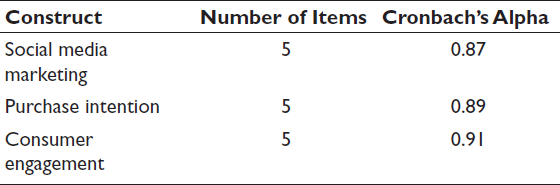
A high degree of internal consistency was shown by all values above the permissible cutoff of 0.70. In particular, the overall Cronbach’s Alpha for the complete instrument was more than 0.8, which confirms that the items were well correlated and suitable for further analysis. This enables the data to be interpreted with confidence and ensures the credibility of findings derived from hypothesis testing and mediation analysis in the subsequent chapters.
Result
The hypothesis testing for H1 was conducted to examine the correlation between SMM and consumer purchase intention. The null H01 proposed that there is no significant relationship between these two variables, whereas the alternative Ha1 stated that a significant relationship exists between SMM and consumer purchase intention.
Hypothesis 1
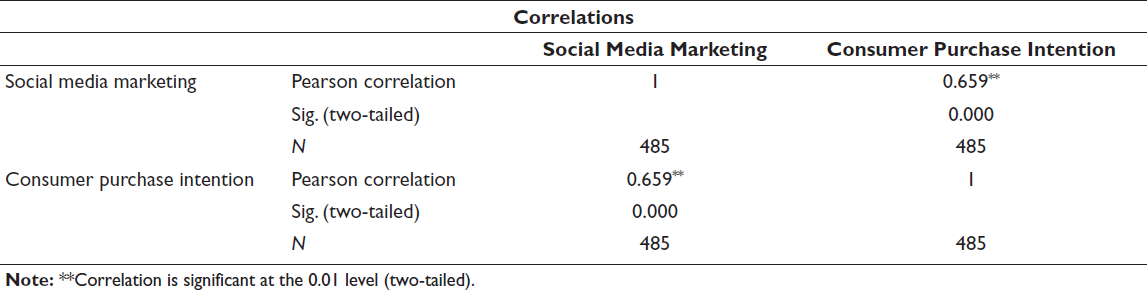
To test this, a Pearson correlation analysis was performed using a sample size of 485 respondents. The results revealed a Pearson correlation coefficient of 0.659 between SMM and consumer purchase intention. This value indicates a strong positive correlation, suggesting that as SMM efforts increase or become more effective, consumer purchase intention also increases correspondingly. The statistical significance of this relationship was tested using a two-tailed significance test, and the p value was found to be .000, which is less than the .01 significance level. This indicates that the observed correlation is statistically significant, and the likelihood that this relationship occurred by chance is extremely low. Since the correlation is both strong (r = .659) and statistically significant (p < .01), the null H01 is rejected, and the alternative Ha1 is accepted. This implies that the evidence is adequate to infer that there is a substantial and beneficial correlation between consumer purchase intention and SMM.
Hypothesis 2
Mediation Analysis Summary (Process Macro).
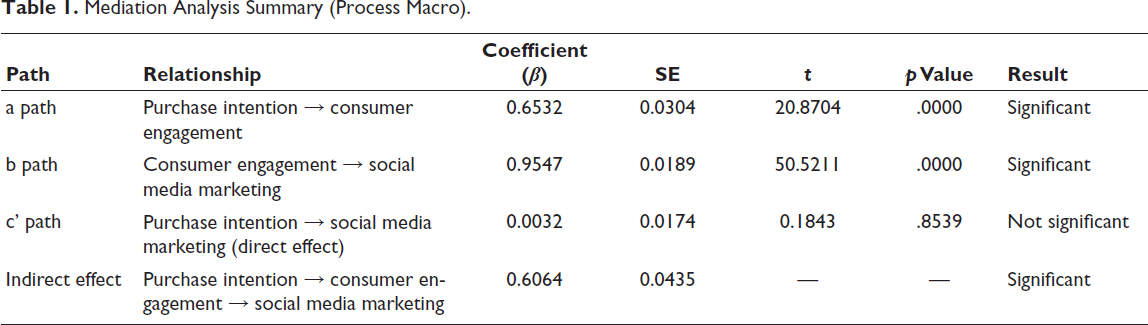
To test this, the PROCESS macro by Andrew F. Hayes was employed using data from 485 respondents. In this model:
X (Independent Variable): Purchase Intention
M (Mediator): Consumer Engagement
Y (Dependent Variable): Social Media Marketing
Step 1: Testing Path A (X ↓ M)
The first part of the mediation analysis evaluated whether purchase intention significantly predicts consumer engagement. The results show a strong, statistically significant effect, with a coefficient of 0.6352 and a p value of .000. The R-squared value is 0.4742, indicating that approximately 47.42% of the variance in consumer engagement is explained by purchase intention alone. This supports the first segment of the mediation process.
Step 2: Testing Path B (M ↓ Y) and Direct Effect (X ↓Y)
Consumer Engagement and Purchase Intention in the Second Section are used in this section to predict SMM. In this study, we find that consumer engagement had an extremely high positive and statistically significant effect on SMM, with a coefficient of 0.9547 (p = .0000), but the direct effect of purchase intention on SMM was found to have a low positive effect that was statistically insignificant, with a coefficient of 0.0032 (p = .8539). These results suggest that once consumer engagement is entered into the model, the direct path becomes virtually negligible.
Step 3: Indirect Effect and Bootstrapping Results
Mediation analysis has two key aspects. The first aspect is testing for the indirect effect using bootstrapping (using 5000 samples). The indirect effect of purchase intention on SMM via consumer engagement was 0.6064, with a bootstrap standard error of 0.0435. The 95% bootstrap confidence interval was [0.3208, 0.6911]—that is, it did not contain zero; thus, the indirect effect was statistically significant.
The second aspect of mediation analysis is testing whether or not the direct effect exists. As can be seen in the coefficient of 0.0032, along with the confidence interval of [0.0210, 0.0975], the direct effect was almost negligible and clearly was statistically nonsignificant. Together, these two aspects support that the impact of purchase intention on SMM was fully mediated through consumer engagement.
Thus, there is substantial empirical evidence of a mediating effect of consumer engagement in the relationship between purchase intention and SMM. Furthermore, the indirect path was statistically significant; the direct path became statistically negligible once the mediator was included. Thus, the mediation was further supported by the confidence intervals of the bootstrap analyses, which contained no zero values. Accordingly, the null H02 was rejected, and the alternative hypothesis was accepted. Therefore, consumer engagement played a highly important and statistically significant mediating function linking SMM attempts to consumers’ purchase intentions.
Conclusion
To develop a greater understanding of how SMM can influence customers’ purchase intent, this research was conducted. This research focused specifically on determining whether customer involvement serves as an intermediary between the marketing efforts and the ultimate desire to purchase from consumers. A number of important conclusions were developed throughout this research using systematic reviews, careful data analysis, and logically based reasoning to clarify the relationships among the various variables under investigation.
The first conclusion drawn from this research was that SMM directly impacts consumer purchase intention. Based upon the responses provided, it was clear that marketing content that individuals view through social media influences their purchasing behaviour. Although the specific mechanisms behind these influences vary, the general trend indicates a significant relationship between exposure to marketing information and the willingness to consider making a purchase. The type of marketing content viewed (e.g., video, image, advertising post, endorsement) seemed to capture the consumer’s attention, generate interest, and enhance the consumer’s likelihood of transitioning into a more purchase-ready mindset.
A direct and indirect relationship between purchase intent and SMM was also demonstrated, with the mediation role of consumer involvement being the basis for demonstrating the indirect relationship. The results of the research illustrated that engagement activities played a key role in determining the overall effect of marketing on consumers’ decision-making processes. As well, in most instances, marketing content that received higher levels of engagement was more likely to result in a positive shift in consumer intent toward purchasing products. Therefore, engagement acted as a conduit through which marketing influenced consumer behaviour.
An examination of the mediation role of consumer engagement from a neurocognitive perspective revealed that not all types of engagement elicit similar neural activity.
Engagement at an active level (i.e., commenting, posting, or generating content) requires greater effort than engagement at a passive level (i.e., liking a post), which is therefore less emotionally stimulating, cognitively demanding and less mentally taxing. Thus, the brain responds differently to each type of engagement. Active engagement stimulates those parts of the brain related to anticipating rewards, evaluating emotions, and understanding people—thus creating a strong motivation to purchase the brand/product being promoted.
Passive engagement does little to challenge the mind or to create a sense of emotional attachment; rather, it elicits only superficial attentional activity. Therefore, the different patterns of brain activation suggest that active engagement results in a more profound mental link between the consumer and the promotional material, enhancing the potential for long-term memory storage, affective attachment and subsequent purchase behaviour.
Therefore, the concept of ‘consumer engagement’ represents a multi-faceted neuropsychological phenomenon that includes a range of attentional, emotional and cognitive investments. Ultimately, this study implies that marketing stimuli that increase the intensity of both emotional and cognitive engagement will result in increased neural reward responses that will, in turn, lead to an increased probability of future purchasing behaviour.
Across the course of this research, engagement was shown to be an important variable. While engagement was considered an individual’s response to the content of a marketing message, it became clear that engagement was a critical factor in determining how the message was perceived, processed and translated into action. Furthermore, engagement was found to include cognitive, behavioural and emotional components, including the degree to which a consumer engages with the content, develops a relationship with the brand and makes a conscious choice to interact.
Collectively, the factors described above provide a pathway from the marketing stimulus to decision-making on the part of the consumer.
This research demonstrated that consumer behaviour in online settings is influenced by many variables, including personal preferences, social norms, familiarity with digital technologies, and changes in technology itself. Some consumers have a predisposition to engage because they believe in the brand, are attracted to the product, or use the platform(s).
Footnotes
Acknowlegement
I express my sincere gratitude to Chhatrapati Shahu Ji Maharaj University, Kanpur, for providing the necessary infrastructure and support to successfully complete this research work.
Authors’ Contributions
Mansi Bajpai: Conceptualisation of the study, development of research design, Data collection, questionnaire administration, preparation of the initial manuscript draft, and formatting and validation of findings.
Prof. Sudhanshu Pandiya: Research guidance, refinement of the theoretical framework, and critical academic review of the manuscript.
Pallavi Mishra: Critical academic review of the manuscript.
Pravin Kumar Agrawal: Support in methodology selection.
Mohit Kumar: Support in methodology selection.
Statement of Ethics
Ethical permission is not required for this research work.
Declaration of Conflicting Interests
The authors declared no potential conflicts of interest with respect to the research, authorship and/or publication of this article.
Funding
The authors received no financial support for the research, authorship and/or publication of this article.
Patient Consent
Patient consent was not required as the study did not involve patients or any clinical intervention.
