




Abstract
Background
Consumer behavior research and neurology are combined in the emerging discipline of neuromarketing. Neuromarketing is considered to be one of emerging field to study how consumer’s brain reacts to advertisement and other brand’s message by observing brainwave, eye, and skin response. The current study examined the emerging field of constructs of neuromarketing like social, attention, technology, and emotions to examine Indian consumer’s buying behavior.
Purpose
To study the validity and reliability of constructs of neuromarketing that examines consumer’s buying behavior among Indian consumers.
Methods
A sample of 191 people of different age groups was considered in the study. A random sampling technique was used for data collection. The self-designed questionnaire used for the measurement of neuromarketing constructs and consumers’ buying behavior. The current study applied SPSS and AMOS software to validate the measurement model of neuromarketing.
Results
The Kaiser-Meyer-Olkin (KMO) and Bartlett’s Test’s value is 0.784 and this value confirmed that the sample is adequate for factor analysis. Apart from that, the five constructs of neuromarketing – Attention (A), Social (SC), Technological (T), Emotion (E), and Consumer Buying Behavior (BB) had shown the value of Cronbach’s alpha to be more than 0.7. Confirmatory Factor Analysis (CFA) had shown value of average variance explained of each constructs 0.5 and composite reliability more than 0.7 which indicates excellent construct validity of constructs for model formation of neuromarketing. The study also validates measurement research model of neuromarketing on the basis of model fit index (chi-square/df = 3.397, RMSEA = 0.10, GFI = 0.92, and CFI = 0.87).
Conclusion
The present study had shown good validity and reliability of constructs of neuromarketing and also proved that marketers can apply these constructs to examine behavior pattern of consumers.
Introduction
According to a Deloitte report titled “India matters: Winning in growing markets,” India is anticipated to become the world’s largest middle-class consumer market with an aggregated consumer spend of close to US$13 trillion by 2030. Psychologists at Harvard University first used the word “neuromarketing (NM)” in 1990, and it is now recognized as one of the most important concepts in the modern world. In 2002, they 1 coined the phrase NM, a fusion of two significant disciplines: neuroscience and marketing. According to them, 2 it is still in its infancy and merges two interdisciplinary sciences, such as psychology and neuroscience, with marketing. The “meme,” a unit of knowledge based on the brain, is the cornerstone of NM. Systems neuroscience focuses on how different and complex brain systems confront. 3
These tools help influence people’s 2.6-s decision-making time. Systems neuroscience, which analyses how various brain areas or complex brain systems interact, is the main focus of NM. 3 A key distinction is made between consumer neuroscience, which is academic research on the intersection of neuroscience and consumer psychology, and NM, which refers to the use of neurophysiological equipment for commercial reasons. 4 .
According to Morin, 5 the concept is derived from the words “neuro” and “marketing,” which suggests the blending of two important academic disciplines (neuroscience and marketing). The concept neuroscience had emerged to assist marketers in understanding how advertising and marketing tactics affect the human brain physiologically. 6 It is one of the more recent sectors of the advertising industry since it is a developing interdisciplinary field that applies marketing knowledge from the perspectives of psychology and neuroscience. 2 The advertising industry has recognized NM as a new field of study and an area of multidisciplinary study that merges neuroscience and psychology with marketing. 2 NM is still in its infancy as marketers are only now beginning to reveal the brain circuitry involved in selecting, choosing, and purchasing a product.
Read Montague, a professor of neuroscience at Baylor College of Medicine, conducted the first academic study on NM in 2003, and it was later published in the journal Neuron. While their brains were being scanned using a functional magnetic resonance imaging (fMRI) scanner, a group of participants in the study were invited to drink either Pepsi or Coca-Cola. However, the study’s findings were intriguing. Some of the techniques such as eye tracking, facial analysis, behavioral experiments, biometrics (body signal measures) that measure perspiration, respiration, heart rate, and facial muscle movement electromyography (EMG), and neuromeric (brain signal measures) that measure electrical activity electroencephalography (EEG), and blood flow (functional) are used in NM to measure consumer’s behavior.
In the past 10 years, numerous ground-breaking studies have been carried out by neuroscientists, psychiatrists, engineers, and market researchers with the goal of comprehending customer motives, preferences, and decisions. However, the majority of these studies and methods are based on wealthy nations. Apart from that, the unconscious mind was exposed to a wider variety of concealed knowledge thanks to NM, which helped consumers make informed decisions about what to buy. According to Sebastian, 7 traditional research can evaluate consumers’ emotional and cognitive experiences based on their conscious language expressions because it is connected to their real-world experiences. That brings us to the real problem with traditional methods, which is that they completely rely on consumers’ consciousness for their insights into goods, services, or advertisements while ignoring the unconsciousness, which is crucial for decision-making. This has resulted in a huge discrepancy between the real market and what businesses believe the market to be. 8 In light of this, NM is a fascinating and ground-breaking area for marketing study.
Numerous indications of commercial effectiveness can be examined using NM, such as attention, novelty, emotional involvement, memory retention, and purchase intention. One of the main areas of research on consumer behavior for the future is the application of neuroscientific techniques to the study of consumers’ emotional and cognitive responses, and this field is seen as a great asset for businesses looking to improve customer. 9 Therefore, the current study has considered constructs of NM that consists of both cognitive and emotions such as Social (SC), Attention (A), Technology (T), Emotions (E), and Buying Behavior (BB). Indian consumers make their purchase decisions based on their own feelings and emotions. The emotional excitement level causes the emotional involvement level to rise. Indian consumer’s emotional engagement level increases when an experience is thought to be more intense. This is merely one reliable indicator of how Indian consumers react to specific marketing stimuli, and it can also predict when they will make a purchase. When they decide to purchase a particular product, the level of marketing stimuli encoding can have an impact. Brainwave measurements can be used to identify this mechanism, which has undergone extensive research. The pattern of the brainwaves can reveal how well a stimulus was remembered. More research is required to better understand how attention and emotion influence the creation and consumption of news especially in consumer’s buying behavior. 10 Consumer’s behavior depends on emotion, without which they are unable to weigh their options. 11 When consumers are making decisions at the point of purchase, emotion is thought of as unconscious emotional responses such as approaching, avoiding, and valence. 12 Feelings are regarded as the outcome of conscious emotional status, which results from people’s evaluations of an event (such as their level of pleasure or unhappiness). Therefore, scholars can use feelings and emotions to influence a consumer’s behavior. Positive feelings, such as those that are pleasant, can encourage a consumer to approach, whereas negative feelings, such as those that are unpleasant, can cause a consumer to withdraw or avoid. 13 Feelings and emotions are important factors in consumer’s buying behavior. Another important construct is attention, which also plays an important role in consumers buying behaviors. Attention is the simultaneous attraction of a consumer’s mind to one purpose among several reasons. The concentration, which entails removing some ambiguity to interact with others successfully, is seen to be the essence of it. According to Du Plessis, 14 attentions can occasionally function subconsciously. When consumers pay attention to something, they concentrate on one feature while disregarding others nearby. Attention also acts as a filter, causing customers to pay more attention to some notable aspects of the products than other aspects. Thus, emotions and attentions are important constructs in consumer’s buying and behavior.
Apart from these techniques, technology such as eye tracking, heart rate, skin conductance, breathing, brain activity using functional magnetic resonance imaging, and brain waves using electroencephalography are the techniques that are being used marketers to examine consumer’s buying behavior. NM affects Indian consumer’s purchasing decisions by utilizing social psychology and they are more likely to buy products influenced by friends, relatives, and colleagues.
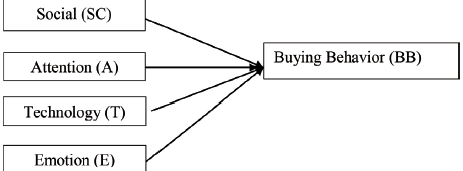
With the aim of understanding consumer reasons, preferences, and decisions throughout the past 10 years, various groundbreaking studies have been conducted by neuroscientists, psychiatrists, engineers, and market researchers. The majority of these studies and methodologies, however, are based on developed nations. In addition, NM opened the unconscious mind to a greater range of hidden knowledge, assisting consumers in making well-informed purchasing decisions and NM is considered to be an innovative and exciting field of marketing. 8 However, very less study had been conducted on validation of key dimensions of NM and consumer’s buying behavior in Indian context. Therefore, the objective of the current study is to validate key dimensions of NM that affect customers’ purchasing decisions. The current study conceptualizes a model that emphasizes the interaction between the elements of NM for marketers in order to investigate the significance of these constructs for marketers to understand consumer’s buying behavior. Thus, on the basis of above discussion, consumer’s buying behavior depends on emotion, attention, technology, and social. The objective of the current study is to validate key dimensions of NM that affect customers’ purchasing decisions. The study conceptualizes a model that emphasizes the interaction between the elements of NM for marketers in order to investigate the significance of these constructs for marketers, as shown in Figure 1.
Conceptual Framework of Neuromarketing Model Methods.
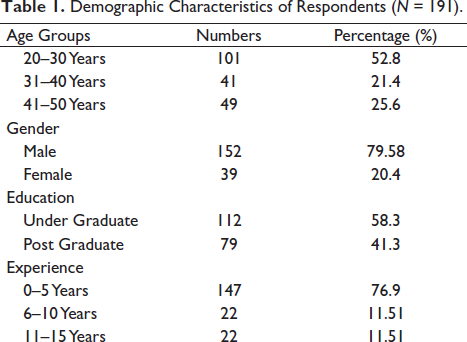
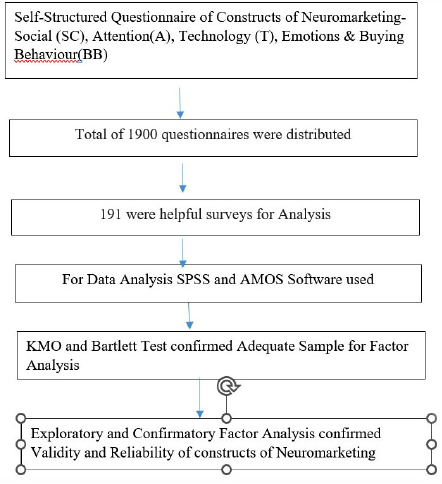
In the 16 months of study, five constructs of NM were assessed using the self-designed 5-Point Likert Scale where 1 is “strongly disagree and 5 is “strongly agree.” A total of 1,900 questionnaires were distributed to respondents and 191 were helpful surveys for examining the validity and reliability of constructs. The current study had considered 191 samples sizes as sufficient for factor analysis. A statistical test called the Kaiser–Meyer–Olkin (KMO) test evaluates the suitability of data for factor analysis. The KMO value should be more than 0.7, which represents that the sample size is adequate for factor analysis. The current study found the value of KMO as 0.787, which is shown in Table 2, and this represents that the sample is adequate for factor analysis. Demographic characteristics of respondents are shown in Table 1 and research process of the study is shown in Figure 2.
Demographic Characteristics of Respondents (N = 191).
KMO and Bartlett Test.

Methods
Sample Size
The KMO test is used to determine whether a sample size is enough. With the use of the SPSS program, the current investigation discovered a KMO value of 0.784, which denotes the suitability of the sample for factor analysis. As indicated in Table 2, the current investigation discovered a KMO value of 0.799, which is favorable for factor analysis.
Measurement of Variables
The current study applied self-designed scale. This scale consists of 14 items of four constructs of NM, such as Attention (A), Social (SC), Emotion (E), and Technology (T). Apart from that, four items of Buying Behavior (BB) had applied for the study. Responses were recorded on the 5-point Likert scale: 1 = totally disagree and 5 = totally agree.
Statistical Tools
The current study used SPSS version 21.0 AMOS 24 for the data sets’ reliability and construct validity. These tools have been used to conduct exploratory factor analysis (EFA) and confirmatory factor analysis (CFA) for data analysis.
Results
Reliability Test of Neuromarketing Constructs
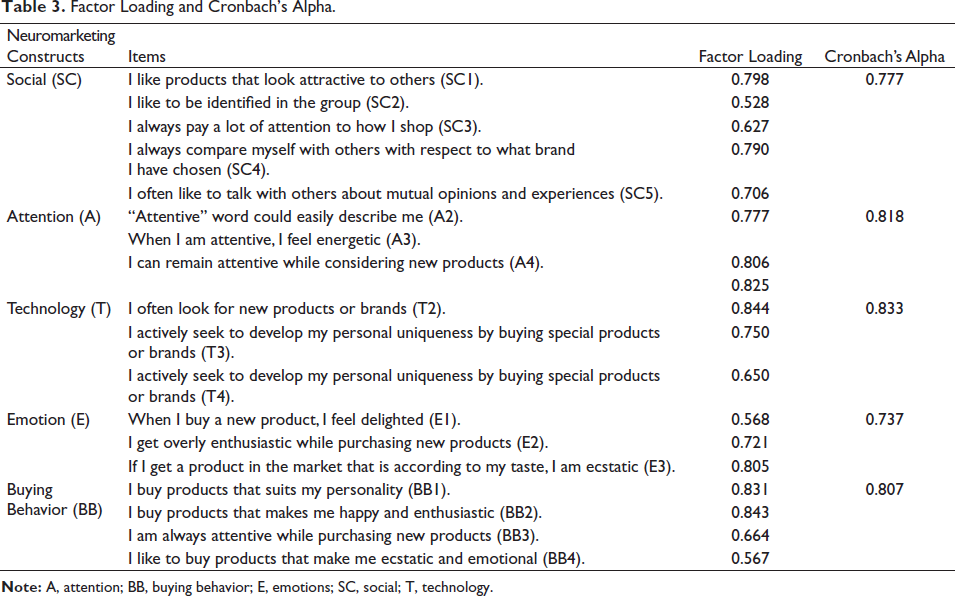
With the use of SPSS, Cronbach’s alpha was determined in order to determine the validity of constructs of NM. The reliability of data sets is determined by Cronbach’s alpha, which has a value range of 0–1. As a general rule, 0.6−0.7 is considered adequate, and 0.8 or more is considered to be extremely good. As demonstrated in Table 3, the results of Cronbach’s alpha for each construct are greater than 0.7, indicating excellent internal consistency.
Factor Loading and Cronbach’s Alpha.
Factor Analysis
Exploratory Factor Analysis
Without imposing a predefined assumption on the results, EFA has been used to study the number of latent variables or constructs underlying a group of items in CFA. The underlying factor structure will be discovered by the use of EFA. Yet, CFA will be a superior strategy to data analysis when there will be enough theoretical and empirical framework to specify the model or a small group of models. The validity construct of the items was examined in the current study using CFA.
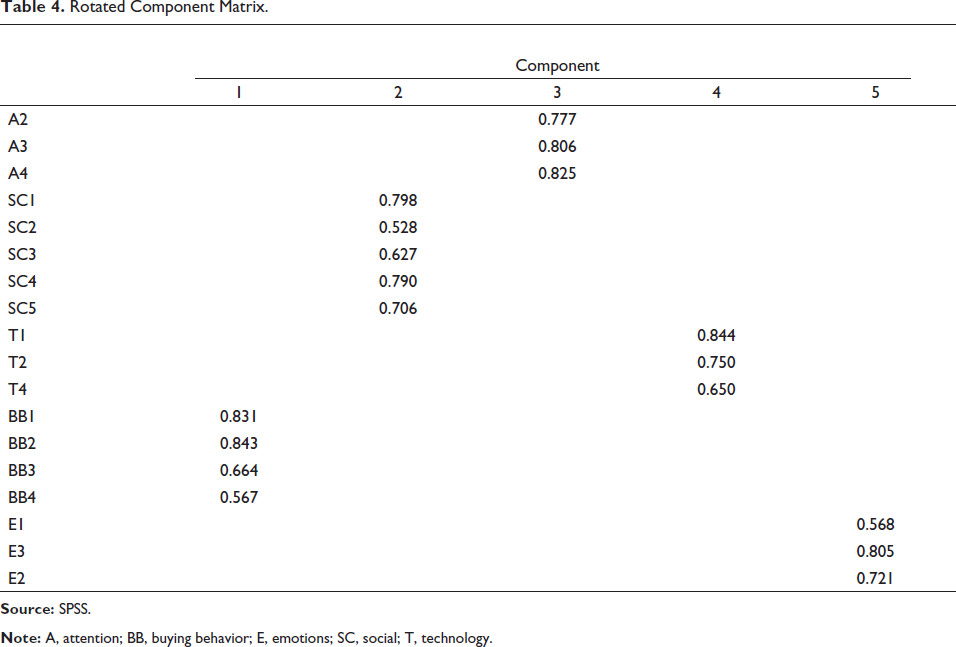
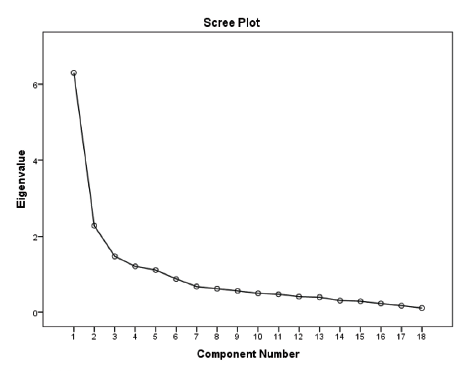
The constructs of NM items in the current investigation, which employed EFA, had a KMO value of 0.784, as shown in Table 2, indicating that they could be easily turned into factors and that the sample size met the requirements for the study. Values should be greater than or equal to 0.70. Therefore, if the KMO value is less than 0.50, the components are not significant. The number of components in EFA is determined using the scree plot, as seen in Figure 2. It displays the number of factors on the X-axis and the eigenvalues on the Y-axis. Similar in shape, the scree plot begins high on the left, drops swiftly, and then flattens out. Components’ pattern of each construct is shown in Table 4, which are more than 0.5.
Rotated Component Matrix.
Confirmatory Factor Analysis
Convergent Validity of Constructs or Dimension of Neuromarketing
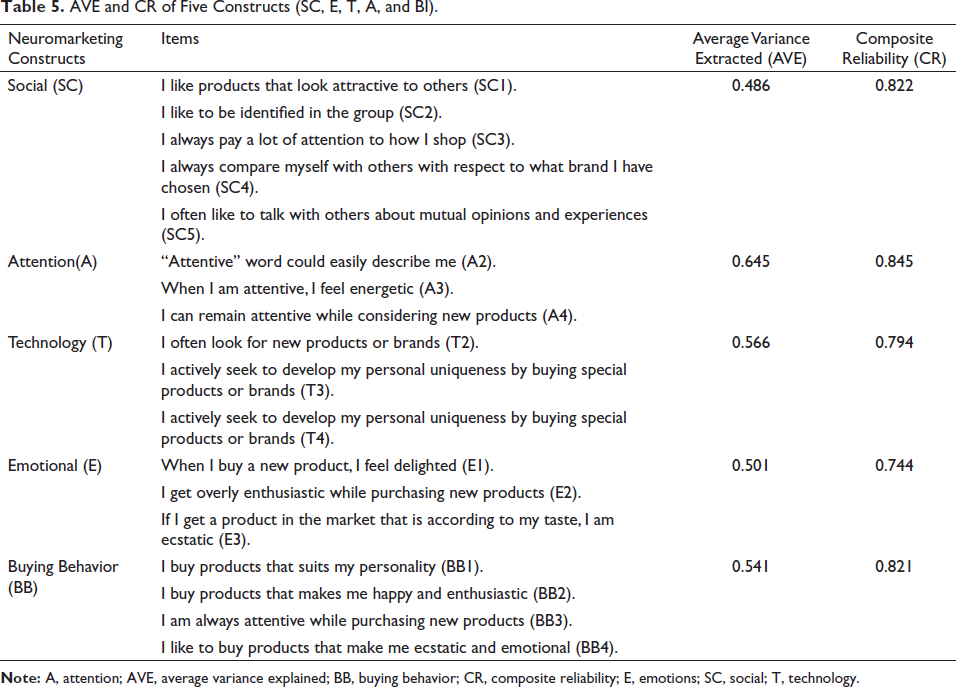
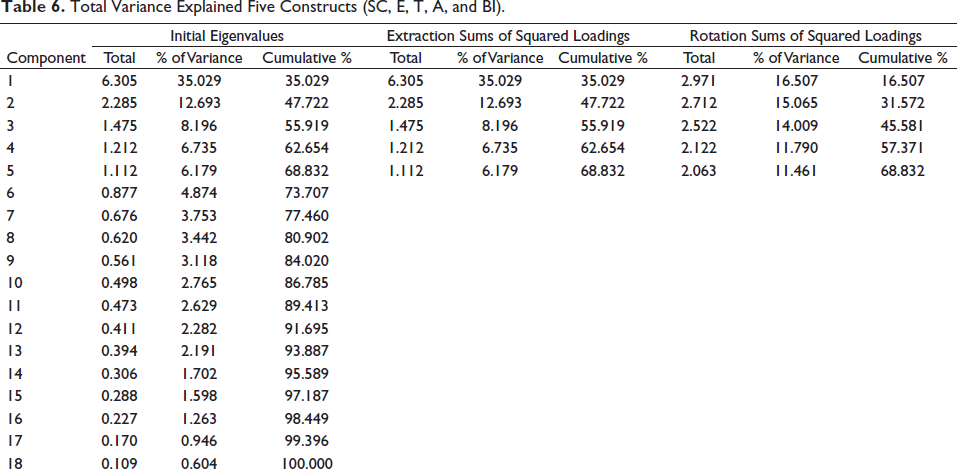
The Average Variance Explained (AVE) in CFA can be utilized to evaluate the convergent validity of the scales. The internal consistency reliability, or Cronbach’s alpha, is a measure of the consistency of the scale’s items. The current study found that each construct of NM has values of AVE and Composite Reliability (CR) were greater than 0.5 and 0.7 and this shows good reliability and validity of constructs,15, 16 as shown in Table 5. The number of components in EFA is determined using the scree plot, as seen in Figure 3. It displays the number of factors on the X-axis and the eigenvalues on the Y-axis. Similar in shape, the scree plot begins high on the left, drops swiftly, and then flattens out. As scree plot shows that total numbers of components of current study are five – social, emotion, technology attention, and consumer buying behavior. Total cumulative variance explained by each construct is 68.3%, as shown in Table 6.
AVE and CR of Five Constructs (SC, E, T, A, and BI).
Total Variance Explained Five Constructs (SC, E, T, A, and BI).
Measurement Model
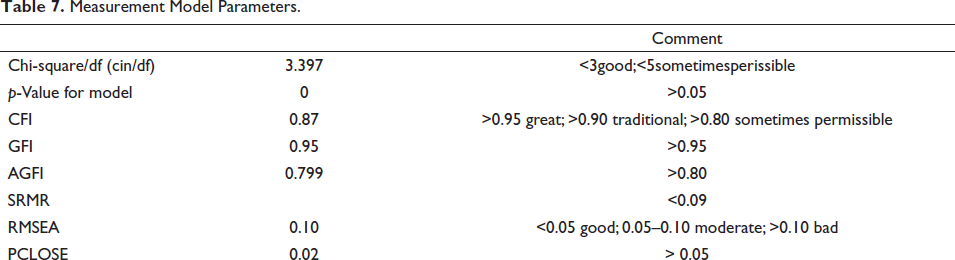
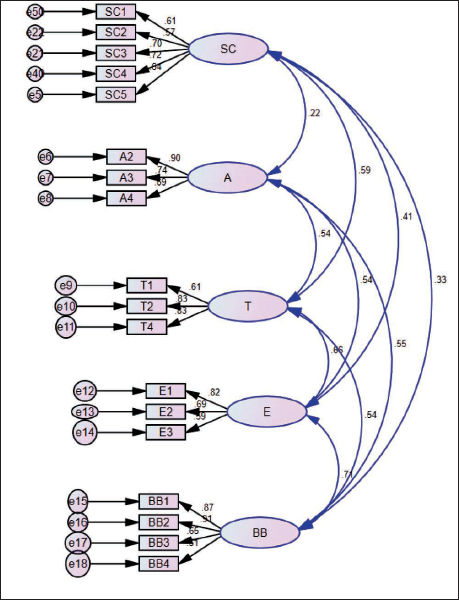
In structural equation modeling, measurement model measures latent variables, while in the current study, latent variables of NM are Social (SC), Attention (A), Technology (T), Emotions (E), and Buying Behavior (BB), which had shown a good model fit (chi-square/df = 3.397, RMSEA = 0.10, GFI = 0.92, and CFI = 0.87). which is moderately good according to 0.92 should be considered good, root mean square error of approximation (RMSEA) value of 0.10, considered moderately good, according to with values below 0.06 being indicative of a good fit model), standardized root mean square as shown in Table 7 and Figure 4. Apart from that, the total variance explained by all five latent variables of NM is 68.8%, as shown in Table 7.
Measurement Model Parameters.
Discussion
Neuromarketing makes use of customer behavior and neuroscientific research to boost marketing efficiency and, ultimately, sales. In order to understand how people physically react to marketing messages, NM research plays an important role to track brain activity. Based on empirical analysis of constructs of NM, it can be understood that Social (SC), Attention (A), Technology (T), and Emotion (E) are important constructs in the NM to determine consumer buying behavior. This research provides empirical insight into the validity and reliability of constructs of NM that are associated with buying behavior of consumers, which were missing in the Indian context. The research has a number of important findings. First, it examines that all four constructs of NM are important for consumer buying behavior. The findings of current study is consistent with the previous findings that examined that affective cognitive constricts are important for consumer’s buying behavior.7, 8, 11–14, 17 The Cronbach’s alpha of five constructs including Buying Behavior (BB), Social (SC), Attention (A), Technology (T), and Emotion (E) are more than 0.7, which shows excellent internal consistency. AVE and CR of all five constructs have fulfilled their validity as well. Apart from that, the model fit of the measurement model of NM met its criteria, which signifies that marketers can apply the model to study consumer’s buying behavior in the Indian market. Since the past few years, consumer’s buying behavior has become ardent issue for marketers, and the findings of the current study might help marketers to study behavior patterns of consumers to boost sales in the market.
Conclusion
The Indian market is gradually gearing up despite facing great challenge in managing buying behavior of consumers in order to boost sales. Marketers continuously facing challenges because of the unpredictable behavior of consumers and fluctuation in markets; under such circumstances, managing sales is very difficult. In conclusion, the present study confirmed new insights that NM can play an important role in studying the behavior of consumers. The current study examined validity and reliability of constructs of NM such as Social (SC), Attention(A), Technology (T), and Emotion (E) to predict consumer’s buying behavior. These types of studies greatly contribute to NM research. It initiates to apply these constructs practically in the Indian market to study behavior of the consumers. Moreover, it acts as a guide to marketers to study the behavior pattern of consumers in the Indian context.
Footnotes
Acknowledgements
The authors acknowledge the assistance received from Dr Anju Shukla and Dr Mili Dutta regarding research on the validity and reliability of constructs of NM.
Authors’ Contribution
ST did the planning and supervision of the work, statistical evaluation of data, and writing the manuscript, and MD had done proofreading. AS was involved in manuscript editing and overall supervision.
Statement of Ethics
Not Applicable
Declaration of Conflict of Interest
The authors declared no potential conflicts of interest with respect to the research, authorship, and/or publication of this article
Funding
The authors received no financial support for the research, authorship, and/or publication of this article
