




Abstract
Background
Sexting, the explicit sharing of digital content, is found commonly among young adults in this era. It appears to originate from a process of identity exploration and need for external validation or attention. Social media is used as a tool to validate this need, with easy access to smartphones and impulsivity contributing to its rise.
Purpose
Nomophobia, the fear of being separated from one’s mobile, has become a significant concern among young adults in today’s digital era. This study aimed to examine the psychological and emotional implications of nomophobia, focusing on its relationship with risky decision-making and sexting behaviour.
Methods
A sample of 206 young adults aged 18–25 is utilised. Data is collected using self-report questionnaires: the nomophobia questionnaire (NMP-Q), the sexting behaviour scale (SBS) and the domain-specific risk-taking scale (DOSPERT).
Results
Linear regression was conducted to evaluate the predictive relationships between risky decision-making, sexting behaviour and nomophobia. Baron and Kenny’s mediational analysis examined the role of sexting behaviour as a mediator. Results: This study found that males reported higher levels of risky decision-making (M = 4.03, <0.001) and marginally higher levels of sexting behaviour (M = 1.94, p = .051) compared to females. Regression analysis revealed that risky decision-making significantly predicted nomophobia (β = 0.454, p < .001), while sexting behaviour also emerged as a significant predictor of nomophobia (β = 0.502, p < .001). Baron and Kenny’s analysis showed that sexting behaviour partially mediated the relationship between risky decision-making and nomophobia. Risky decision-making significantly predicted nomophobia (β = 0.454), and the indirect effect through sexting behaviour was also significant (β = 0.111).
Conclusion
The findings highlight the significant role of risky decision-making and sexting behaviour in predicting nomophobia, with notable gender differences observed in these variables. This study emphasises the need for targeted strategies to address the psychological impact of excessive dependence on mobile devices among young adults.
This study contributes to the Sustainable Development Goals (SDG-3) Good Health and Well-being as it explores reasons for risky decision-making behaviour and sexting behaviour among young adults.
Introduction
Nomophobia (no mobile phone phobia) refers to anxiety and fear developed due to disconnected from mobile devices. 1 People tend to experience psychological distress when they are unable to reach or access their mobile phone. However, the term ‘phobia’ is closely associated with an anxiety disorder, and various factors include a lack of self-confidence and personality, reduced communication with family members due to spending most of their time on smartphones and social platforms and being busy with friends.
Additionally, severe mental health conditions, such as anxiety disorder, excessive attraction to social media and panic disorder, can exacerbate the symptoms of nomophobia.2–3 It is challenging to determine the causes of nomophobia, as it may result from spending excessive time with smartphones or the emergence of pre-existing anxiety disorders.1, 4
Risky decision-making refers to the selection between multiple choices when considering possible risks and rewards, and this process is significantly affected by various factors, including past knowledge and emotions.3, 5 Risk-related decisions continuously happen when outcomes include potential benefits and losses, severely affecting health or well-being.4, 6 This kind of decision-making is associated with health-risk activities in real life, which include unsafe sex and drug use. 7 Moreover, risky behaviours like sexting are directly linked to adverse outcomes and can lead young adults to rely more on their smartphones.8–9
Dir and Cyders (2015) have proven that sexting functions as an intermediate element connecting risky decision-making processes with nomophobia. 10 The Baron and Kenny (1986) mediation model identified how sexting behaviour helps explain the association between risky decision-making abilities and nomophobia development. 11 People who make high-risk decision-making frequently participate in sexting activities and seem more anxious about being separated from their cell phones. The Baron and Kenny (1986) mediation model identified specific relationships between these behaviours in modern technology use. 11
The rise of excessive Internet usage among people has led to the emergence of new inappropriate behaviour addictions, including nomophobia. 4 Consenting to engage in sexting, regardless of the reason, has been identified as a strong indicator of risky sexual behaviour.1, 4 Research experts have identified smartphone-triggered psychological disorders and syndromes such as ‘short message service texting addiction’, compulsive selfie-taking behaviour, sexting and phubbing activity, among others. 12
The Theory of Planned Behaviour is a crucial framework for researchers studying social variables that influence risky decision-making among young adults regarding actions like sexting. 13 Gender disparities play a significant role in online behaviour. Studies have shown that males tend to engage in higher risk behaviours such as sharing social media profile information, arranging unknown online encounters and committing Internet-based bullying.4, 14–15 Rodríguez-García et al. (2020) reported that females primarily use the Internet for message exchange through various applications and digital platforms like blogging and social networks. 1 Research indicates that males prefer uploading videos, while females prefer uploading photographs on social networking sites due to distinct gender patterns and risky behaviours. 16 Recent reports have highlighted gender differences in mobile device anxiety behaviours, with males showing higher engagement in risk-related behaviours. 4
While existing literature has separately explored the prevalence of nomophobia and sexting among young adults, there is limited research on how specific cognitive processes such as risky decision-making interact with digital behaviours like sexting to influence nomophobia. Moreover, most studies have not thoroughly investigated the mediating role of sexting behaviours in the psychological pathway between decision-making tendencies and digital dependency, particularly within the Indian context or sociocultural settings. Additionally, gender differences in these patterns are not well understood, which hinders the development of targeted interventions.
This study aims to address these gaps by examining how sexting behaviour mediates the relationship between risky decision-making and nomophobia among young adults, while also considering gender-based variations.
Materials and Methods
Hypotheses
H1: Individuals with higher levels of risky decision-making are likely to experience heightened levels of nomophobia.
H2: Increased involvement in sexting behaviour is significantly associated with increased levels of nomophobia.
H3: Sexting behaviour mediates the relationship between risky decision-making tendencies and nomophobia.
Study Design
The study utilised a quantitative, cross-sectional, correlational research design to explore the relationship between nomophobia symptoms, risky decision-making tendencies and sexting behaviour among young adults. Also, the study explored whether sexting behaviour served as a mediating variable between nomophobia and risk decision-making. Furthermore, gender-based comparisons were conducted to assess similarities and differences in these psychological and behavioural patterns.
Participants
The research study gathered data from 206 participants aged 18–25 using a purposive sampling method. The eligibility criteria to participate in this study is to own a smartphone and have no history of psychiatric conditions. The participants were individuals from diverse occupational backgrounds.
Informed consent was obtained from the participants, and they were assured of anonymity and confidentiality throughout the research process. The participants were briefed on the sensitive nature of the study. They were given detailed explanations about the purpose of the study and addressed any emotional discomfort they might be experiencing. They were also offered resources for psychological support if needed.
Participants were asked to complete three standardised self-report questionnaires and explicitly informed that participation was voluntary, and they retained the right to withdraw at any point without facing any negative consequences.
Data Collection
Three self-report surveys were the main research tools utilised to obtain primary study data. The nomophobia questionnaire (NMP-Q) designed by Yildirim and Correia (2015), demonstrated excellent internal consistency with a Cronbach’s alpha of 0.945 for the total scale. 17 Its subscales also showed high reliability, with alpha values ranging from 0.898 to 0.939. It consists of 20 items that evaluate four nomophobia dimensions: inability to communicate (6 items), lost connectedness (5 items), access to information (4 items) and convenience (5 items). Participants used a seven-point Likert scale ranging from 1 (strongly disagree) to 7 (strongly agree).
Sexting behaviour scale (SBS) developed by Jeanfreau et al. (2019) showed good internal consistency with a Cronbach’s alpha of 0.87. 18 Its construct validity was established through factor analysis, and its criterion validity was demonstrated by significant correlations with sexual risk-taking and impulsivity. Participants answered a total of 11 questions by selecting their responses from a five-point Likert scale from never (1) to frequently (5).
The Domain-Specific Risk-Taking Scale (DOSPERT) revised by Blais and Weber (2006) was used to assess the risk-taking attitudes across five domains. 19 The subscales employed in this study evaluated risk-taking attitudes through five domains: social, health/safety, financial, ethical and recreational domains. These constructs showed Cronbach’s alpha values of approximately 0.79, 0.82 and 0.74 respectively. The DOSPERT scale is further supported by strong construct and predictive validity, having been widely validated across diverse populations. The research exclusively employed the social, health/safety and ethical subscales from the DOSPERT. This scale includes 30 statements, and respondents use a seven-point Likert scale ranging from extremely unlikely (1) to extremely likely (7) to rate their responses.
Data Analysis
Descriptive statistics summarised participants’ demographics and calculated the mean scores for nomophobia, risky decision-making and sexting behaviour. Linear regression analyses were performed to explore the relationships between risky decision-making, nomophobia and sexting behaviour. Mediational analysis, based on Baron and Kenny’s method, assessed whether sexting behaviour mediated the relationship between risky decision-making and nomophobia. Independent t-tests were used to evaluate gender differences in these variables. The Shapiro–Wilk tests were conducted to assess the normality of variables.
Results
Gender Differences in Nomophobia, Risky Decision-making and Sexting Behaviour
Table 1 indicates that there are gender differences in nomophobia, risky decision-making and sexing behaviour among young adults. Males are reported to have slightly higher level of nomophobia scored (M = 4.55) than females (M = 4.43) and show there is no statistical significance (t (199) = 0.713, p = .238) and it is inferred that both the groups showed similar levels of phone related fears. However, males scored higher in risky decision-making (M = 4.03) than females (M = 3.39), meaning there is a statistically significant difference (t (199) = 4.134, p < .001). This shows that males are much more likely to be involved in taking risky and impulsive decisions.
Comparative Analysis of Gender Differences in Nomophobia, Risky Decision-making and Sexting Behaviour.
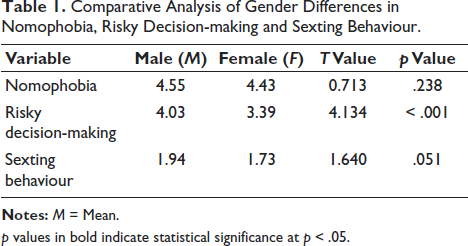
p values in bold indicate statistical significance at p < .05.
With reference to sexting behaviour, males scored higher (M = 1.94) than females (M = 1.73), with a marginal significance (t (199) = 1.640, p = .051). This indicates that males might have slightly potential to show more engagement in sexting; however, it does not show significant statistical difference in a conventional level.
In this study, the significant differences involved in risky decision-making along with the marginal significance with respect to sexting behaviour highlight the need for gender-specific strategies while addressing mobile phone usage among young adults.
Risky Decision-making as a Predictor of Nomophobia
The regression analysis revealed a significant predictive relationship between risky decision-making and nomophobia (Table 2). Risky decision-making was a positive predictor of nomophobia, with a β of 0.454 and a SE of 0.063. The predictor demonstrated a highly significant result (t (200) = 7.232, p = .001; Table 2). The model’s intercept was 2.816, with an SE of 0.245, a significant t-value of 11.481 and a p value of .001. The adjusted R2 value of 0.2033 indicated that the model explained approximately 20.33% of the variance in nomophobia, and the overall model was statistically significant (F-statistic = 52.3, p < .001; Table 2). These findings suggest that higher levels of risky decision-making are strongly associated with increased levels of nomophobia.
Regression Analysis of the Predictive Relationship Between Risk Decision-making and Nomophobia, Including Model Fit Statistics.

Sexting Behaviour as a Predictor of Nomophobia
The regression analysis indicated a significant predictive influence of sexting behaviour on nomophobia (Table 3). Sexting behaviour emerged as a positive predictor, with a β of 0.502 and a SE of 0.083, and the predictor exhibited a highly significant (t (200) = 6.074, p = .001; Table 3). The intercept of the model was 3.582, with a SE of 0.170 and a statistically significant (t (200) = 21.070, p = .001) reflecting the baseline level of nomophobia when sexting behaviour was absent. The adjusted R2 value was 0.1515, indicating that sexting behaviour accounted for approximately 15.15% of the variance in nomophobia. The model’s overall fit was statistically significant (F-statistic = 36.9, p = 6.172e-09; Table 3). These findings suggest that higher levels of sexting behaviour are strongly associated with increased levels of nomophobia.
Regression Analysis of the Predictive Influence of Sexting Behaviour on Nomophobia, Including Model Fit Statistics.

The Mediating Role of Sexting Behaviour in the Relationship Between Risky Decision-making and Nomophobia
Baron and Kenny’s mediational analysis demonstrated that sexting behaviour acts as a mediator in the relationship between risky decision-making and nomophobia (Table 4). The total effect of risky decision-making on nomophobia was significant (p = .001), with a β of 0.454 and a SE of 0.063 (Table 4). The analysis revealed that risky decision-making significantly predicted sexting behaviour, with a β of 0.374, an SE of 0.048, and a p value of .001. When sexting behaviour was included as a mediator in the model, the direct effect of risky decision-making on nomophobia was reduced to a β of 0.343, with an SE of 0.070 and a p value of .001 (Table 4). The indirect effect, represented by the pathway from risky decision-making to nomophobia through sexting behaviour, had a β of 0.111 (Table 4). This indicates partial mediation, suggesting that sexting behaviour accounts for part of the relationship between risky decision-making and nomophobia, while the direct effect remains significant. Results indicate that sexting acts as a partial explanation for the relationship between risky decision-making and nomophobic symptomatology.
Baron and Kenny’s Mediational Analysis of Sexting Behaviour as a Mediator in the Relationship Between Risk Decision-making and Nomophobia.

Discussion
Nomophobia and Its Psychological Impact
Young adults are increasingly developing nomophobia, which is characterised by the inability of individuals to tolerate abstinence from using mobile phones. The current research investigated how choice behaviours paired with sexting activities lead to nomophobia by examining their psychological effects on young adults. The Radical Change Theory provides a framework for understanding how the current youth navigate their decision-making processes in the context of the current digital age and offers theoretical solutions to combat risky sexual messaging and unsafe decisions. 20 Within this framework, sexting and risky decisions are seen as a manifestation of the cultural and cognitive shift amongst our youth population. Our study proves that risky forms of sexting create two distinct effects; they strain social relationships while simultaneously generating negative mental health outcomes, thereby reinforcing the strong influence of nomophobia.
Gender-based Behavioural Differences in Nomophobia, Risky Decision-making and Sexting Behaviour
The findings from our current study reveals gender-based variations between nomophobia, risky decision-making and sexually explicit communication habits among young adults. Both female and male participants demonstrated comparable levels of anxiety stemming from abstinence from mobile phone usage, according to non-significant statistical comparisons between their mean scores. However, previous research shows males are more likely to engage in risky decision-making than females. 21 In terms of sexting behaviour, the comparison between males and females revealed that their participation rates matched, without revealing any statistical significance. Avcı (2022) established that women displayed stronger nomophobia symptoms than men. 22 In summation, the results reveal that gender discrepancies are more strongly observed in risky decision-making than in the behaviours related to nomophobia or sending explicit sexual content via electronic communications.
Risky Decision-making as a Predictor of Nomophobia
The results of the study establish the role of risky decision-making serves as a vital predicting variable for the development of as people who take more risks displayed higher nomophobia levels (β = 0.454). A strong association exists between impulsive behaviour and risky choices, which indicates that individuals who lead impulsive lives tend to experience anxiety when their mobile devices are not accessible. Such risky behaviours generate psychological consequences that can develop into nomophobia, which characteristically displays excessive mobile phone dependence. Findings from this research confirm what previous studies have identified with respect to the psychological implications of the relationship between risky decision-making and the influence of technology. Dir and Cyders (2015) discovered that individuals who exhibit risky behaviour patterns tend to develop negative emotional reactions as an outcome of their technological dependence. 10 Similarly, Márquez-Hernández et al. (2020) found that dangerous conduct patterns are key contributing factors associated with developing dependence on technology, confirming how our behavioural tendencies affect the emotions of mobile phone users. 23 The findings indicate that preventing problematic decision-making behaviours could serve as an effective solution against nomophobia. Understanding the behavioural mechanisms underlying mobile phone dependence informs future efforts to prevent mental health risks triggered by prolonged phone use while simultaneously promoting healthier technology habits.
Sexting Behaviour as a Predictor of Nomophobia
The results of the study demonstrated that sexting behaviour had a significant impact on nomophobia (β = 0.502) which accounts for 15.15% of variation in nomophobia levels. Findings suggest that individuals who engage in sexting are at higher risk of developing nomophobia, thereby supporting previous research on the correlation between digital risks and technology-related anxiety.2, 24 Sexting facilitated by mobile phones is a manifestation of psychological consequences stemming from excessive smartphone usage and concerns about separation from phone. The anonymity provided by digital platforms exacerbates mobile phone dependence due to their privacy features.2, 24 The results underscore the importance of incorporating interventions to reduce risky online behaviour in treatment of nomophobia.
Sexting Behaviour as a Mediator Between Risky Decision-making and Nomophobia
Sexting behaviour mediates the relationship between risky decision-making and nomophobia in our study. The total effect of risky decision-making on nomophobia was significant (β = 0.454), with sexting behaviour playing a key mediating role (β = 0.374). When considering sexting behaviour, the direct effect of risky decision-making on nomophobia decreased to β = 0.343, with an indirect effect of 0.111, indicating partial mediation. Consistent with this, Morales Rojas et al. (2022) reported that 64.7% of 300 participants engaged in sexting, and 96.3% exhibited medium to high mobile phone dependency, showing a positive correlation between risky decision-making, sexting and mobile phone dependency (r = 0.166, p < .050). 3 These findings suggest that interventions targeting risky decision-making and sexting may help alleviate nomophobia.
Theoretical Insights and the Role of Sexting Behaviour
The research findings provide valuable insights into the Theory of Planned Behaviour. 13 From this standpoint, examining the relationship between sexting behaviour and risky decision-making enhances our understanding of nomophobia, as individuals engaging in these activities often experience negative psychological outcomes. 13 By exploring the link between risky decision-making and sexting behaviour, we can elucidate the development of nomophobia symptoms with sexting playing a crucial role in connecting these two variables. The data suggests that individuals involved in sexting are not only directly susceptible to nomophobia but also exhibit tendencies that heighten anxiety related to phone separation.
Limitations, Future Research and Practical Implications
This study has partial limitations that must be considered. Primarily, the use of purposive sampling restricted to limited participants of young adults from Chennai, Tamil Nadu, which lessens the generalisability of the findings to other populations or regions. Second, the study relied on self-report measures, which might have influenced the social desirability or recall bias affecting the accuracy of the data. Future research shall consider using diverse samples, incorporating longitudinal or experimental study design. This might give deeper insight into psychological factors influencing the usage of smartphone related behaviours.
Despite these limitations, the study promotes valuable insights for practical implications. It pinnacles the need for educational programs that promote healthy digital habits among young adults. From the results it is suggested that sexting behaviour may marginally mediate the relationship between risky decisions and nomophobia, providing a foundation for future interventions. Mental health professionals and policy makers can use these insights to develop interventions tailored to gender and personality. Addressing these issues in advance may reduce emotional distress and strengthen well-being among youth.
Conclusion
This study highlights the complex underpinnings between risky decision-making, sexting behaviour and nomophobia among young adults. The findings offer more meaningful directions for future research and practical intervention. Understanding the psychological interplays that drive digital dependency, we can better support young individuals in developing safer, much mindful technology use.
Footnotes
Acknowledgements
We as research team would like to show gratitude to all the participants who consented to participated in this study.
Authors’ Contribution
Divya Nayana R, Sai Madhumitha A, and Lakshmi R performed the initial conception, all data collection and the first manuscript preparation.
Darshini M performed the statistical analysis and methodology development procedure.
Durga RP brought the manuscript to completion, along with administrative oversight and conceptual research direction of the project monitoring.
Consent to Participate
Participants provided written informed consent to participate in this study.
Consent for Publication
Not applicable.
Data Availability
Data is available with the corresponding author. Data is not shared publically as it involves young adult population.
Declaration of Conflicting Interests
The authors declared no potential conflicts of interest with respect to the research, authorship and/or publication of this article.
Funding
The authors received no financial support for the research, authorship and/or publication of this article.
Statement of Ethics
The participants were provided with the informed consent prior to the study. Voluntary participation and rights to withdraw without receiving any negative consequences were highlighted.
