




Abstract
Background
Stress is a major concern among research scholars as it has a detrimental effect on mental health, productivity and overall well-being. Several stressors, including academic pressure, financial issues, lack of resources and guide–student relationships, significantly contribute to the increased risk of lower physical and mental well-being in the long term. It is important to understand how stressors contribute to increased stress levels.
Summary
This study aimed to investigate the causes and consequences of stress, coping strategies in research scholars and policy implications of stress management. A literature search was performed using Google Scholar and PUBMED. This study included original research and review articles that were published in English. This study highlights academic pressure, lack of resources, guide–student relationships, future uncertainty, financial issues and work–life imbalance as major stressors for research scholars. Chronic stress decreases physical, mental, academic and professional outcomes.
Key Message
We propose adapting the ‘AAA strategy (approach, assessment and administration)’ by universities and institutes for stress management in research scholars. Policy changes in academic research are needed to improve research scholars’ overall productivity and quality of life.
Introduction
The World Health Organization (WHO) defines stress as a natural human reaction to difficult situations or life events that can affect the mental and physical state of an individual. 1 Stress among research scholars is a major concern that has recently gained much attention owing to its significant effects on mental health, overall productivity and well-being. Research scholars are individuals pursuing advanced academic education, usually at the postgraduate (master’s), doctoral or post-doctoral level, who are engaged in conducting original research in a particular field. Scholars pursuing higher education, particularly doctoral students, often experience unique pressures that contribute to elevated levels of mental issues such as anxiety and depression. 2
Higher education (post-graduation onwards) puts a fair amount of pressure on students as they strive to adjust to the new environment and demands of academic curricula that aim to change their emphasis from guided learning to research and innovation. 3 The primary goals of research scholars are to conduct research, write and publish, teach and mentor, collaborate, secure funding and contribute to academic knowledge. Earlier universities were regarded as low-stress-causing regions; however, growing academic research suggests an alarming rise. 4
Several known factors primarily contribute to the increased stress levels. Studies have identified a lack of supportive networks, difficulties in conducting research, funding and career possibilities and intrapersonal regulation as principal sources of stress. 5 A study of 306 PhD scholars reported that they had high level of stress, which was related to their work, family, personality and affective stress. 6 The current competitive world pushes students towards personal, social or academic stress, which affects their physical health and mental health. 7 Similarly, a study of 163 scholars from Indian universities revealed high-to-moderate levels of perceived stress. 8 Besides academic issues, other factors, such as institutional policies, imbalance between work and life, job demands and career growth, make research scholars susceptible to stress. 9 A study of 1,224 college students found academic stress to be a major stressor among them. 10 Another study of 320 university students revealed that academic workload was the major stressor (48.4%). 11 However, continuous exposure to these stressors can have serious consequences on their physical and mental health, which may further impact their productivity and quality of life (QoL). Depending on the exposure to stressors, they may be acute or chronic. In research, acute stress is usually adaptive and does not affect health. However, if it becomes chronic over the long term, it can severely damage health. 12
Although coping strategies to tackle stress have been studied at the higher education level, 7 stress still has a widespread and damaging effect on how research scholars perceive and implement training at the personal level. Stress is a significant burden on society and the country. However, the impact of stress on research scholars has not yet been comprehensively explored. The limited number of randomised controlled trials (RCTs) is the major limitation of this field. Research scholars are the building blocks of any country as they guide and generate evidence for the development and implementation of adequate interventions. They play an important role in the generation of new knowledge. Therefore, it is pertinent to study or analyse the factors affecting research productivity and formulate policies that substantially reduce the burden of stress, thereby aiding scholars in innovative research and discoveries. 13
Causes of Stress
Every individual experiences stress at some point in time irrespective of their profession. Sources of stress vary depending on the profession, but are more prominent in academia. A comparative study conducted in a UK academy in 1998 and 2004 reported that, in the academic setup, participants were more stressed than other professions. 14 A study of 81 doctoral students reported that these scholars experienced difficulties in obtaining social support, academic community and lack of access to their supervisors. 15 Research indicates much higher levels of attrition (30%–50%) among postgraduate research scholars than among undergraduate students. 16 Unlike other professionals, teachers and research workers at universities and colleges have been found to report work-associated stress. 17
Nowadays, higher education has become a competitive business industry because of continuous educational reforms, increased student enrolment, increased workload, control over research productivity and teaching quality and a shift towards commercialisation by management. 18 This exerts a substantial amount of mental pressure on academics, especially research scholars to maintain performance and productivity.19, 20 A Chinese PhD study reported various contributing factors, including degree related, job prospects, relationship with guide, family, roommates and financial issues. 21 In a national survey of 387 psychology graduates, four factors were mainly responsible for stress: academic pressure (68.1%), financial issues (63.9%), anxiety (60.7%) and work–life imbalance (58.7%). 22
Academic Pressure
Academic pressure is a major source of stress for researchers. Most outline issues about academic pressure include the need for high productivity, publication pressure in high-impact journals or more and more publications, PhD/research work timeline/overload, a competitive environment and high expectations from guides/peers/mentors. 23 These pressures often make people feel incompetent, create self-doubt and lead to chronic stress. Academic isolation also contributes to psychological well-being, as research scholars, particularly PhDs, require collaborative and interactive approaches in the scholarly community. Many scholars have experienced isolated or problematic relationships between themselves and their communities.24, 25 A study from India of 500 postgraduate students reported that academic curriculum and instructional aspects were responsible for stress in 86% of the participants. 26 Another study of 50 research scholars reported that work overload was a major stress-causing factor. 23 Apart from their research, they also have to work extra to earn money. Combined together, 44.1 hours/week were spent by the PhD scholars as overall working hours. 27
Lack of Resources
Limited resources to pursue research have also been reported. 28 Financial support is required to pursue high-quality research, particularly in biological research. 28 The allocation of grants by universities or government funding agencies is important for conducting good research. 29 This requires the purchase of chemicals and equipment, travel, conference attendance, workshops and training.
Financial Instability
Financial instability has been considered a key cause of stress in research scholars, as most rely on financial support (in the form of scholarship/stipend/grants) or engage in part-time work to support their higher studies and pay daily living expenses. 30 In some cases, they also have to support their families, which creates a financial burden owing to limited earnings. 31 A UK study reported increased financial stress in students following the coronavirus disease 2019 (COVID-19) pandemic. 32
Guide–Student Relationship
Guiding students can also contribute to stress. The mental health of research scholars has been demonstrated to be significantly influenced by the quality of supervision and degree of assistance offered by the supervisor/guide. In this context, a supportive guide can significantly alleviate stress, whereas a lack of support or guidance can exacerbate it. 33 The relationship between the mentor and guide should be comfortable. This is reflected in the results of a German study, in which 98.5% of PhD students responded to a supportive supervisor as a potential way to improve their mental health, 28.6% felt degraded and 19.1% felt mistreated. 27 A study by Mansson and Myers on the relationship between doctoral students and advisors (advisees-advisors) indicated six behaviours, including appreciation, courtesy, humour, tasks, protection and goals important for a successful advises–advisor relationship. 34
Future Uncertainty
Job placements in 63% of the participants contributed to stress in postgraduate students. 26 A study carried out on 589 PhD scholars from Germany found that more than 80% of the participants worried about getting a permanent job. 27 A cross-sectional study (n = 14,916) in Germany suggested that university students were highly worried about their future. 35
Work–Life Imbalance
The nature of work often creates an imbalance between their personal and professional life. The long working hours, deadlines to complete research work and fulfilment of expectations of guides significantly hampered their lives. Maintaining a balance between work and life has always been a challenge for attaining QoL. It is well documented that individuals whose work and personal lives are imbalanced are more likely to experience physical and psychological issues. They have reduced physical and mental well-being. 36
Coping Strategies
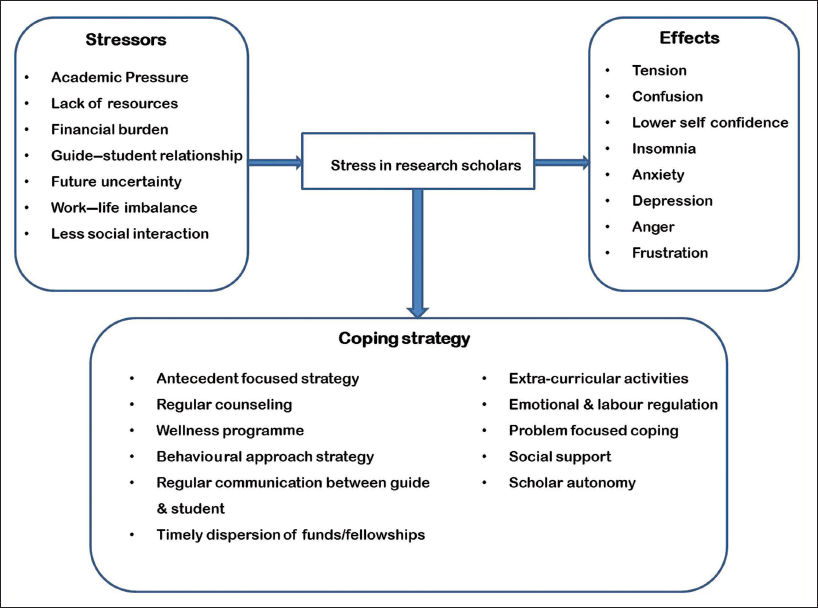
Our findings suggest that stress is prevalent among research scholars, particularly among those pursuing PhDs. Therefore, there is an urgent need to develop policies that actively support researchers in finishing their work without affecting their physical and psychological well-being 37 (Figure 1).
Stress in Research Scholars: Stressors, Effects and Coping Strategy.
Antecedent-focused Strategies
This strategy is used in an academic setup to regulate emotional behaviours. This set of strategies includes situation selection and modification, attention and cognition improvement. 18 Antecedent-focused strategies emphasise preventative methods of emotion regulation.
Regular Counselling
Counselling is important for improving the psychological well-being of research scholars.38, 39 Scholars experience a significant amount of stress due to interpersonal relationships. Frequent counselling at the university level is effective in reducing personal and professional stress. 21 Various studies have suggested counselling as an effective means of addressing workplace stress.40, 41
Wellness Programmes
Engaging in physical activities provides stress relief. Universities should include wellness programmes as an active means of countering stress among scholars. Studies have confirmed that wellness programmes focusing on self-realisation, mindfulness-based techniques, exercise and sports activities provide relaxation and rejuvenation to work throughout the day with reduced stress.22, 42–44
Behavioural Approach Strategies
Given the substantial level of stress associated with research, elucidating the behavioural approach strategies by scholars, as well as their perceived effectiveness are crucial steps towards assisting them to tackle stress in a constructive way. 22 Behavioural strategies focusing on teaching and practice research planning, time management, lifestyle modifications (diet, exercise etc.) and problem-solving are effective in reducing the burden of stress. 45
Regular Communication Between the Guide and Student
Communication is one of the most effective means of establishing good relationships. Regular and open communication is characteristic of a good relationship, which was depicted by the interview with a guide and the student, enabling the student to address challenging situations. 46 In this regard, training a guide or supervisor to establish a healthy relationship can be achieved. This will help manage the intense relationship between students and the guide.
Timely Dispersion of Funds or Fellowships
It has been noted that financial restrictions cause a significant amount of stress to the research scholars. 47 There should be a strict policy regarding the timely dispersion of fellowships or funds. A separate fund to support the research activity will not only enhance research productivity but also contribute to the quality of the research. This will help them obtain relief from financial distress. 48
Emotional Regulation and Labour
Emotional regulation and emotional labour are two constructs that focus on modifying feelings and expressions. Emotion regulation refers to a variety of strategies people use to control the emotions they feel and how they express themselves. 49 Emotional labour is described as a subtype of emotional regulation that occurs in a specific work environment where certain emotions are prescribed by ‘display rules’ that may or may not be publicly displayed.18, 50
Self-management of Stress
In addition to what the government and institutions do, the self-management of stress is important, especially when scholars are surrounded by daily stressors. There are ways in which stress can be managed. This includes involving in activities that make one feel good, such as exercising or playing, listening to music, healthy eating, relaxing and spending time with family or friends. 7 In addition, a supportive social network may help manage stress. They can connect with their loved ones and share their problems with them. Reaching out to family/friends or visiting places of worship and practicing regular meditation or engaging in social programmes 51 may help them self-manage stress.
Consequences
The chronic stress that results from a combination of the above-mentioned factors may have major and lasting effects that impact not only their physical and mental health but also their educational performance and QoL.
Physical Health
Prolonged stress can severely deteriorate the physical health of a research scholar. 52 Stress is linked to various lifestyle ailments in research scholars, including cardiovascular disorders, diabetes, obesity, hypertension, gastrointestinal problems and poor immune systems. 53 Scholars are vulnerable to these lifestyle problems, owing to their persistent deadlines and academic pressure. They are more likely to engage in physical inactivity and irregular dietary habits, which significantly affect their health outcomes.54, 55 A study conducted by Keech et al. on university students reported that their stress mindset had a direct influence on their physical health. 56
Mental Health
Chronic stress negatively affects research scholars’ mental health conditions, such as anxiety, depression and burnout and is continuously increasing among early career researchers. 57 The literature suggests that PhD research scholars have a greater impact on mental health than the general population. A 2017 research revealed that 32% of PhD scholars were at high risk of developing psychiatric issues. 9 A pilot study of 69 biomedical doctoral scholars reported high levels of anxiety (31.9%), depression (moderate-to-severe symptoms; 10.1%) and burnout. 52 Sleep disturbances are common among scholars and students 58 Sleep disturbances are common among scholars and students. 59 A similar study on PhD students from Poland reported anxiety and insomnia as the most common problems, followed by social dysfunction and somatic symptoms. 60 Due to the increased prevalence of psychological distress among research scholars, the completion timing of their degree is also affected. 15
Academic and Professional
In academic setting, long-term exposure to stress can significantly impact a research scholar’s ability to think critically, focus on work, creative or innovative nature and problem-solving attitude for conducting successful research. This negatively impacts their productivity and timely completion of work, which eventually take longer to complete their research projects. The pressure of publication in high-impact journals and presenting data at meetings or conferences also contributes to decreased research quality, as they have to meet institute norms or supervisor expectations for high-standard publications. Additionally, chronic stress affects their personal and professional relationships with their family, friends, colleagues or supervisors, which further make them feel isolated and narrows their support system.
How Is This Stress Response Mediated?
All living beings have a complex equilibrium mechanism called homeostasis. This is constantly affected by internal or external stimulus, that is stressors. 61 These stimuli ultimately lead to stress. The stress system of the body mediates the stress response, which is partly located in the central nervous system (CNS) and peripheral organs. 62 The effectors of this system are intricately linked, including norepinephrine and hypothalamic corticotropin-releasing hormones. 63 These effectors target the reward and fear systems, cognitive system, sleep-wake centre, cardiorespiratory, immune, gastrointestinal tract (GIT) tract and the metabolic system. 62 Adequate basal activity and responsiveness of this system are crucial in order to have a healthy well-being. Any issues in the stress system may result in various acute and chronic problems. Physical, social, psychological and environmental factors contribute to the development of acute and chronic stress disorders. The stress system of scholars is affected by the nature of the study or work, creating a homeostasis imbalance. Chronic stress increases catecholamine levels and suppressor T cells, which in turn suppress the immune system. This increased the risk of infection. 64
Policy Implications
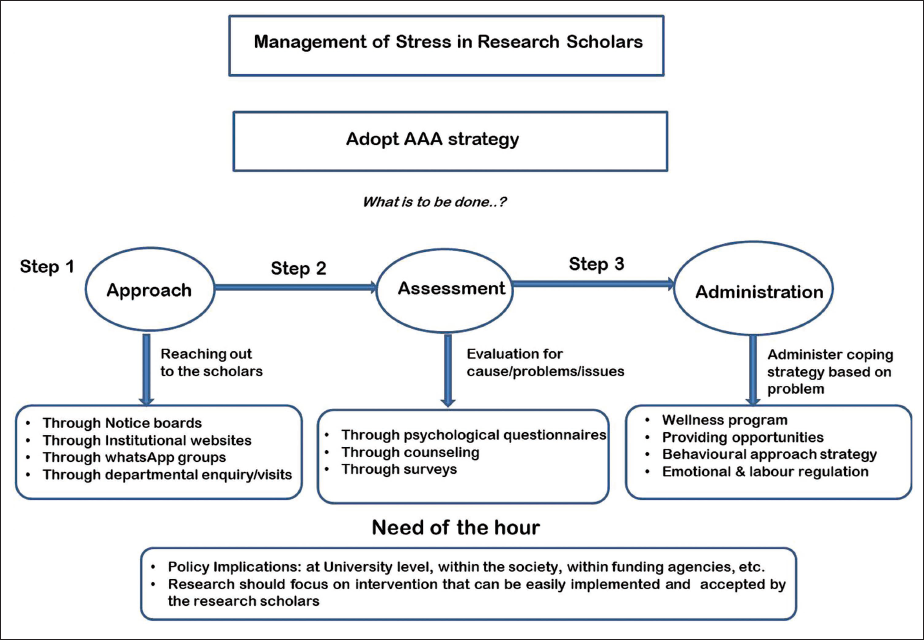
Policy-driven towards the higher education sector is more driven towards hard outcomes, such as publications, patents and impact factors, 9 whereas the effects of soft outcomes, such as stress, have been largely ignored. 9 Stress is currently a major research topic. Changes in lifestyle patterns and continuous pressure from academics and other factors impose a significant burden on scholars. A serious institutional policy mainly based on the guidelines of good laboratory practice (GLP)65–67 in this regard, the need of the hour is the need of the hour, which has long been neglected. The focus of research scholars continues to narrow, especially in developing countries, where the government is already battling several other challenges. An ‘AAA’ approach strategy can be followed to deal with such conditions (Figure 2). Our AAA strategy includes ‘approach (approaching), assessment and administration’. First, scholars can be approached through various means, such as university/notice boards, WhatsApp groups or departmental visits, focusing on identifying the problem and providing solutions to it. This should be done regularly (once in the academic year) to help students understand their problems. Second, psychologists and counsellors should counsel scholars to understand the actual causes or sources of stress. To achieve this, a university or small-scale survey can be conducted, and those facing problems/challenges should be identified. Third, based on the assessment, interventions should be administered or resolutions should be provided to scholars. Regular and timely adoption of this strategy at the university or institutional level may help society and the government address this major stress challenge.
A Structural Framework to Adopt ‘AAA Strategy’ to Identify and Provide Solutions to the Research Scholars Facing Stress.
In recent years, many governments have started shifting their focus to the psychological health of their students and scholars. 9 Not only the government but also the institute is responsible for making and implementing strict policies that focus on improving the overall well-being of research scholars. A policy may include (a) creating awareness, focusing on recognising and solving problems at the right time. (b) Creating scholarships and grant funding opportunities. The number of scholarships and adequate funding for conducting this research could be gradually increased. This may create an extra burden on the government and deal with public–private partnerships (PPP). (c) At a time, only a minimal number of PhDs can be assigned to each supervisor, so that a quality research time between the scholar and supervisor can be spent. (d) Providing employment opportunities for research scholars. Future uncertainty is a major concern for PhD researchers. After obtaining a degree, career guidance and employment opportunities should be provided. (e) Universities should continuously monitor and map stressors in their organisation. (f) Regular amendment in the research curriculum every five years. (g) Promote health and balance work life by sending them on vacations and conducting regular sports activities. Our study found that universities may benefit from adopting these small changes in their research policies. The lack of sufficient scientific research may limit government agencies in developing solutions to scholarly problems.
Conclusion
Research scholars are involved in conducting advanced and original studies, especially at postgraduate and doctoral levels. The primary objective of these scholars is to contribute new knowledge or insights to their respective fields. However, it has been observed that exposure to a variety of stressors, including academic pressure, financial issues and work life, severely compromises their mental and physical health. Addressing these stressors is a major challenge that requires a comprehensive approach from governments and institutes. This could be achieved by implementing a research policy that focuses on boosting research funding and scholarship numbers, improving guide–student relationships and promoting programmes that help students learn problem-solving behaviours, thereby managing mental stress. The proposed AAA strategy focuses on reaching out to scholars, identifying their problems and providing them with appropriate resolution. We also found that there are a limited number of RCTs, and future research should include more such studies, which may help policymakers develop solutions to the problems of scholars.
Footnotes
Abbreviations
AAA, Approach, assessment, administration; CNS, Central nervous system; GIT, Gastrointestinal tract; PPP, Public–private partnerships; QoL, Quality of life; WHO, World Health Organization
Authors’ Contribution
SK was involved co-conceptualisation, writing, editing and illustration. GS and AK helped in writing and editing. SKG helped in conceptualisation, supervision and editing.
Declaration of Conflict of Interests
The authors declared no potential conflicts of interest with respect to the research, authorship and/or publication of this article.
Funding
The authors received no financial support for the research, authorship and/or publication of this article.
