




Abstract
Background
In today’s world, developing resilience is crucial for managing stress, preserving mental and emotional health, managing work–life balance, fostering self-growth and good relationships and promoting physical health. Nourishing the mind–body connection, using methods for stress reduction and self-care and incorporating a Mind Body Module can contribute to resilience-building initiatives as well as help in wellness promotion.
Purpose
This study aims to design, develop and validate a resilience-building module that incorporates mind–body practices.
Method
The existing literature on traditional yoga texts and published scientific studies in the area of mind–body practices was used to build the Mind Body Module. Through this approach, a total of 26 practices were identified based on the strength of evidence. Each of these practices was scored by subject matter experts, and the content validity ratio (CVR) was calculated using Lawshe’s formula for validation.
Result
The practices/techniques that scored ≥50% along with those suggested by the experts were grouped, and an eight-week module for resilience building and wellness promotion was developed.
Conclusion
The Mind Body Module crafted to foster resilience has brought together the knowledge from the Indian system and the well-being practices from the West in a cogent manner. The module’s viability and effectiveness will be evaluated appropriately.
Keywords
Introduction
One of the main causes of people’s desire or propensity to multitask is lack of time and an increase in the pace of everyday situations. 1 Trying to accomplish multiple tasks at once might feel overwhelming and stressful. 2 Although stress has the potential to cause many acute physiological reactions, the actual stress response is linked to a number of other circumstances. One of the crucial elements is the type of stressor involved. HPA axis responses are typically seen following prolonged, intense exercise, but not after a brief, moderate-intensity or low-intensity exercise. Physiological stressors are linked to an increase in SNS and a decrease in PNS. 3 Therefore, the best strategy for improving a person’s well-being may be to enhance their ability to handle stress.
A key component to approach this is by strengthening resilience. 4 In order to promote health, Antonovsky’s salutogenesis theory places emphasis on resilience. 5 Resilience refers to the phenomenon in which a person does not experience or experiences only temporary mental health issues, despite being exposed to psychological or physical stresses of any duration. 6 In Colen’s blog, 7 Dean Becker, the president and CEO of Adaptiv Learning Systems, writes: ‘a person’s level of resilience will determine who succeeds and who fails more than education, experience, (and) training’.
Studies8–10 show a correlation between resilience and good physical and mental health and training can improve an individual’s resilience, which may improve clinically significant outcomes. In terms of brain activity, resilience is correlated with higher prefrontal cortex activation and decreased limbic system activation, particularly in the amygdala. Resilience training offers a feasible and potentially beneficial method for boosting a person’s well-being. 11
There are three kinds of resilience: primary, secondary and tertiary. Primary resilience is associated with maintaining homeostasis, health and well-being, which guarantee the welfare and guard against diseases brought on by stress. Secondary resilience gives us the ability to deal with adversity, recover from a disease and re-establish health and psychosomatic equilibrium. Tertiary resilience is the capacity to live joyfully, creatively and effectively despite the existence of one or more chronic conditions. 12
According to the National Health Interview Survey conducted between 2007 and 2012, meditation and yoga are among the top 10 alternative therapies used by both adults and children. With the aim of using the mind to directly change physical function and health, these therapies emphasise on the relationship between the mind and body. 13 The MORE mind–body training has been specially designed by researchers for better personal and professional use of mind–body approaches to enhance the wellness of healthcare professionals by reducing stress and improving mindfulness. 14 This study has created a similar but modified version of MORE that incorporates mindfulness-based stress reduction techniques to help people become more resilient.
Methods
The purpose of this study is to develop and validate a customised Mind Body Module to build resilience. This article adopts the 23-item checklist and guidelines developed by Katla et al. 15 for module development and validation.
Stages of Module Development
Literature Search
A brief evidence-based practice used for stress management was done for stress management and relaxation using various search engines such as PubMed, Google Scholar, Cochrane Library, Research gate, etc.
Data Compilation
Various practices that were used for stress management and relaxation were compiled and grouped into two key areas, yogasana and pranayama (Group A), and other mind–body practices including relaxation techniques, mindfulness practice and art therapy (art, music and dance) (Group B).
Circulation of Compiled Practices to Experts
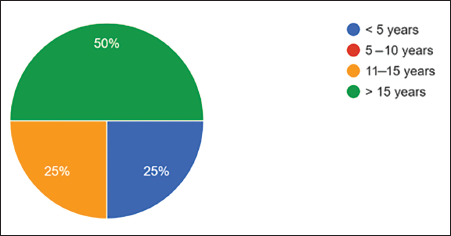
The various practices that were compiled were created as an online form with the aid of Google Forms for ease of circulation to eight different field experts whose designations were professor in medicine, assistant professor in psychology, medical officer, demonstrator, lecturer, professor and associate dean (PG studies), founder & CEO at Emerging Fit and executive coach. The form also included sections regarding the details of the experts. Years of experience of field experts involved in framing the module are given in Figure 1.
Years of Experience of Field Experts Involved in Framing the Module.
The experts were requested to rate the usefulness of the practice in improving resilience on a 3-point scale (1. Essential; 2. Essential but can be avoided; 3. Non-essential). In addition, they were requested to suggest any other techniques that can be included in the module.
Validation of Protocol
CVR
16
for each practice was calculated using Lawshe’s law for the validation, and those practices which were marked ≥50% were included in the final module. The CVR is calculated using the following formula:
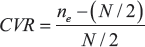
where
CVR is the content validity ratio
nₑ is the number of panel members indicating an item ‘essential’
N is the number of panel members
CVR values range between −1 (which is perfect disagreement) and +1 (which is perfect agreement). CVR values above 0 indicate that over half of the experts have agreed that a practice/technique is essential.
Selecting and Regrouping the Techniques into Weekly Practice Modules
After discussing with field experts, incorporating the comments and obtaining the CVR for each practice, the final eight-week module was developed for stress management and resilience building.
Results
Analysis of the Report
The practices and techniques that were circulated among the experts for their comments are given in Table 1.
Responses of Experts on Each Practice.
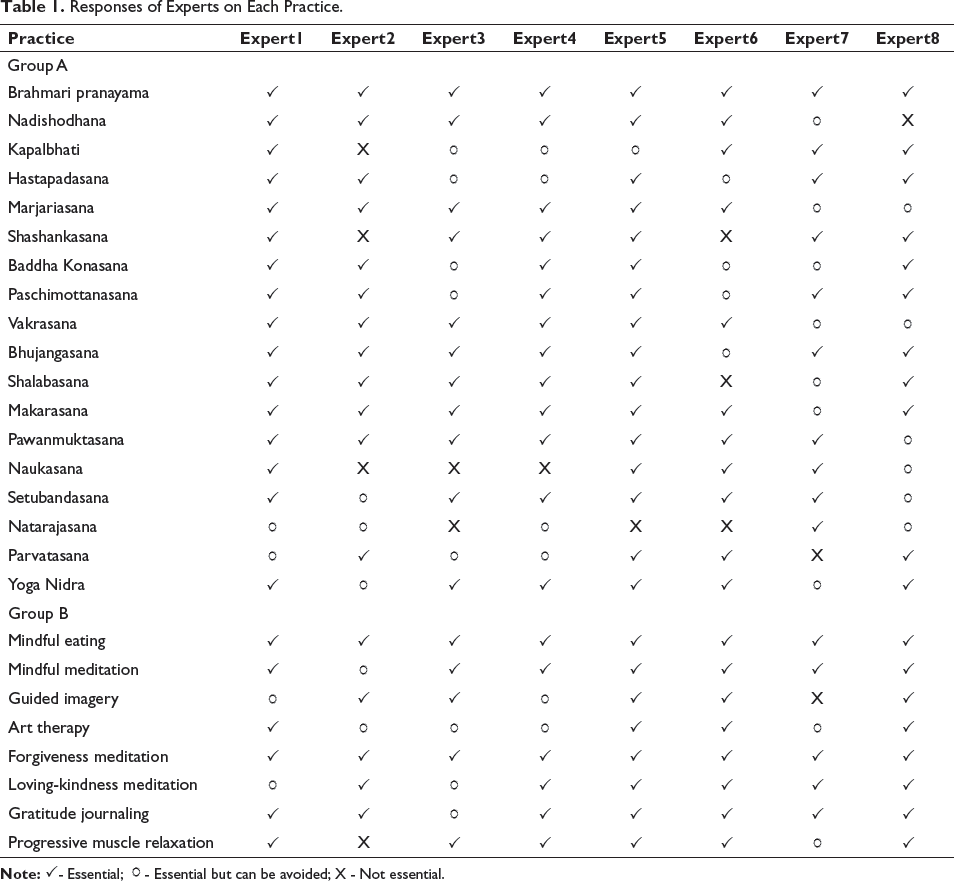
Experts also suggested to include other techniques such as Bhastrika pranayam, Ujjayi pranayama, Anulom vilom and deep breathing.
Validation of Each Practice
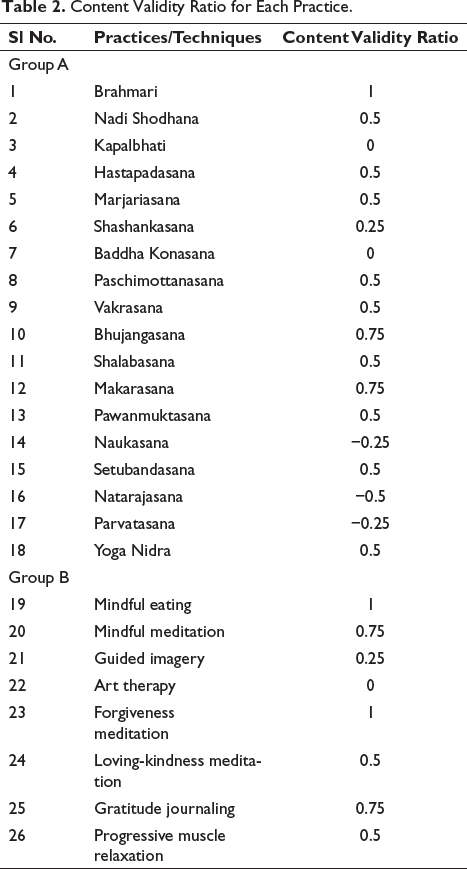
The list of practices and their CVR scores are given in Table 2.
Content Validity Ratio for Each Practice.
Module for Resilience building and Stress Management
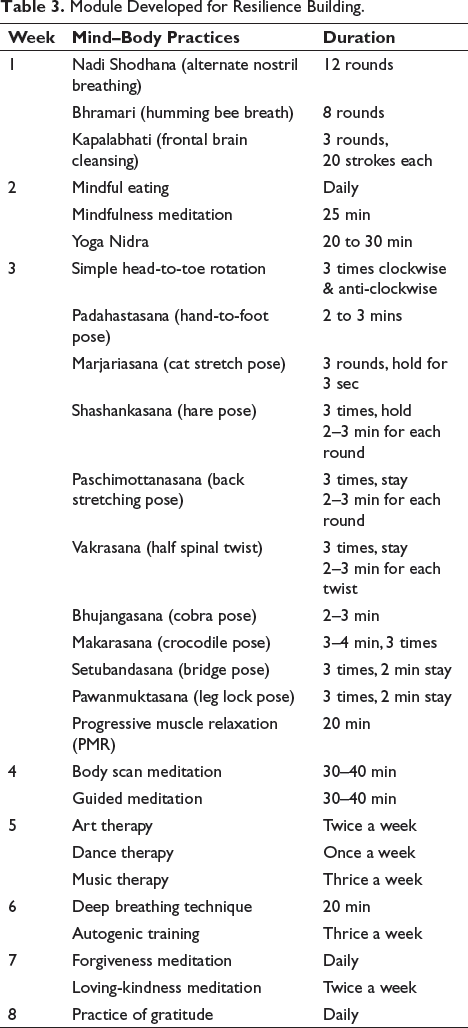
The final eight-week module for resilience building and stress management developed after validating each practice along with the duration of practice is given in Table 3.
Module Developed for Resilience Building.
Discussion
This study has developed a protocol for stress management and resilience building using yoga asanas, pranayama and certain mind–body techniques. These were framed using an extensive scientific literature search to target resilience building in stressful situations with the discussion among field experts. This is curated keeping in mind the effectiveness and ease of practice for all frontline healthcare workers of the COVID-19 pandemic situation as well as for others. The practices included in the study are easy to practice and can be customised as per individual preferences as well. The experts suggested a protocol duration of eight weeks, and personal supervision should be done since stressors for each individual are different.
The practices included in this module allow one to be nonjudgemental and become aware of the present moment and its accompanying mental processes such as body sensations, perceptions, thoughts and emotions. A systematic review by Helmreich 17 has mentioned that, by doing so, practitioners are said to adjust to stress more effectively because they learn to accept whatever arises at the moment. Because increased sensitivity to positive facets of life may result from increased awareness of the ‘here and now’, mindfulness-based resilience therapies may support practitioners in developing a more optimistic outlook on the future or in having more frequent positive emotions. In addition, mindfulness instruction could improve participants’ cognitive flexibility by educating them to accept adverse circumstances and emotions.
To our knowledge, this is the first time a specific mind—body module, integrating pranayama, asana, meditation as well as concepts from positive psychology, has been developed with components to enhance resilience in an individual. The efficacy of this module needs to be tested in comparison with a control group as well as other existing therapies to build resilience.
Conclusion
Knowing health and sickness, the course of therapy and recovery, as well as comorbidities and multimorbidity is greatly aided by understanding resilience, which is a complex collection of diverse protective and salutogenic elements and processes. When one focuses on biological, psychological, social and spiritual variables and processes at every stage of life, one can regulate the relationship between stress, trauma and sickness, on the one hand, and a beneficial, desirable outcome, on the other.
There is a lot more research that demonstrates how the body and mind may interact. Taking care of one’s mental health can occasionally aid in the prevention of some medical conditions and even speed up the recovery time. The immune system is impacted by the way one’s emotions affect one’s blood circulation, heart rate, metabolism and other functions. By paying attention to one’s emotional and mental states, one can support one’s own long-term health.
This study has developed a mind–body module which was designed based on available literature and was validated with the help of field experts to build resilience in an individual; this will be of great help in handling any given situation.
Footnotes
Abbreviations
HPA axis: Hypothalamic–pituitary–adrenal axis; SNS: Sympathetic nervous system; PNS: Parasympathetic nervous system; CEO: Chief executive officer; MORE: Mindful opportunity to reflect on experience; PG: Postgraduation; CVR: Content validity ratio; IEC: Institutional Ethics Committee; DST: Department of Science and Technology; SATYAM: Science and Technology of Yoga and Meditation.
Authors’ Contribution
Damal Chandrasekar Mathangi has been the main person behind the concept. Sudhagar Singh has contributed by giving important inputs while framing the concept. Arthi Balakrishnan helped in compiling the instructions for practices and making it available electronically for the ease of distribution. Haritha Dhanasekar has contributed by writing the manuscript
Declaration of Conflicting Interests
The authors declared no potential conflicts of interest with respect to the research, authorship and/or publication of this article.
Funding
The authors disclosed receipt of the following financial support for the research, authorship, and/or publication of this article: This project was financially supported by the Department of Science and Technology (DST) under the SATYAM category. DST Reference No: DST/SATYAM/COVID-19/2020/136, reference project number: 28262). The funding agency did not have any role in developing this module or writing the manuscript.
ICMJE Statement
The ICMJE disclosure form is submitted along with this article.
Statement of Ethics
Ethical clearance for the study was obtained from the institutional ethics committee of Sri Ramachandra Institute for Higher Education and Research (Ref no: IEC-NI/21/ APR/78/74).
