




Abstract
Background
Adversity quotient (AQ) is an individual’s ability to persist during the phase of constant alteration within one’s context, privation and response is measured by assessing AQ. It is a measure of resilience including four components which are ‘control’, ‘ownership’, ‘reach’ and ‘endurance’. Healthcare professionals face regularly changing adversities and new challenges, yet perform with optimal functioning. This also sometimes results in anxiety, depression, burnout and poor professional quality of life (ProQOL).
Summary
The current systematic review’s aim is to explore the existing literature on AQ and the ProQOL of doctors, counsellors, psychologists, nurses, nursing students, psychiatric social workers and other healthcare professionals. Electronic databases of PubMed, NIH and Scopus were searched and authors conducted a systematic review of 23 published, unpublished studies and dissertations on the impact of workplace adversities on AQ and ProQOL of healthcare professionals, medical students and other helping professionals, up to 2024.
Key Message
Showed a significant relationship between AQ, ProQOL, anxiety, depression and burnout among healthcare professionals and other helping professions. It was also observed that healthcare professionals with high AQ were able to experience a better ProQOL and improved well-being at the workplace.
Keywords
Introduction
‘Mental health is a state of well-being in which the individuals realises his or her own abilities, can cope up with the normal stressors of life, can work productively and fruitfully and is able to make contribution to his or her community’. This definition helps to simplify the broader definition of mental health, and includes the relevance of normal stressors of life, though the subjectivity to experience the intensity of stressors may vary from person to person. In certain professions, stressors may be experienced more frequently in comparison to other professions. One such profession is the medical field, in which as per the core competency, medical professionals continue to serve in their respective fields. Irrespective of the stress they face in dealing with critical conditions, specifically such as doctors working in emergency wards, trauma centres and oncology departments, they cope up with the situation. Sometimes it may result in situations like burnout. The work environment, the role of gender, length, type of practice and overall psychological strength play a crucial part in maintaining their psychological well-being and professional quality of life (ProQOL) and help them stand against the adversities as a part of their medical profession. Recently in 2021, a study concluded that out of 203 medical professionals, 79.8% were having moderate levels of stress, in which female doctors had meaningfully higher levels of stress. The causes of stress levels were found to be emergency duties and the working environment.1, 2 Healthcare professionals are susceptible to high levels of occupational stress because of hectic work hours, less time to be involved with friends and family, increased demand, moral and spiritual dilemmas associated with ethical practices, uncertain treatment outcomes and direct exposure to witnessing serious situations of patients who are at the verge of dying. 3
The component of adversity quotient (AQ) could be a key element in understanding how the majority of medical professionals serving in critical situations manage to cope up with their stressors and maintain their ProQOL, instead of having moderate levels of stress arising due to their work life. The notion of AQ was proposed by Stoltz (1997), which is defined by him in the following ways. 4
AQ is a measure of resilience.
AQ predicts how an individual endures hardships with one’s existing abilities.
AQ assesses who can surpass their own expectations associated with their performance and who will not be able to do it.
AQ gives an idea about who easily gives up and who continues to fight.
AQ predicts who can overcome their current struggles and who will have a poor impact of it in their lives.
AQ is a comparatively new concept which helps in developing and understanding an insight about all areas of success. Its application is almost in each area of life, for instance, interpersonal relationships and intrapersonal relationships, across cultures, societies and communities. On the basis of extensive research, Stoltz (2000) demarcated AQ as a degree of an individual’s ability to bounce back and capacity to endure in the face of ongoing change, stress and difficulty, or alternatively. 4 AQ is merely a measurement of one’s response to adversity. 5 An extended explanation of AQ given by Stoltz (2000), based on his provided theories, he considers AQ as the measure of one’s resilience and ability to persevere in the face of constant change, stress and difficulty or AQ is simply a measure of how you respond to adversity’.4, 5 To put simply, AQ measures the capability of a person while dealing with challenging situations of life. 6 For a better understanding of the same, Stoltz proposed the following four domains of AQ, which is abbreviated as CORE (Control, Ownership, Reach and Endurance). Control is a person’s ability to be in charge of his or her life and regulate the associated negative outcomes effectively. Ownership means owning the accountability of one’s behaviour or actions and working towards the betterment of the present context. One’s ability to resist the effect of adversities on other areas of life is termed as Reach. Whereas Endurance means the strength to bear the consequences of emotional turmoil or pain and yet be hopeful about the forthcoming positive side beyond all difficulties.
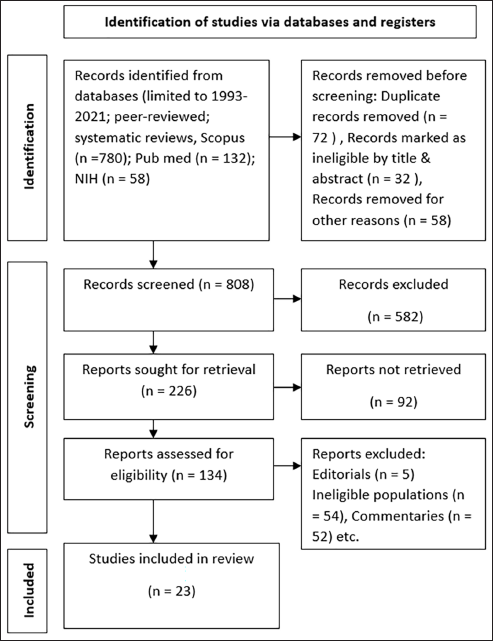
In professional life, CORE plays a major role in deciding how one is going to respond in a given situation. When people directly connect with the life of others, they can have both positive and negative effects of it which predicts whether one is going to experience compassion satisfaction or compassion fatigue. Like medical professionals, counsellors and nurses spend a lot of time in exchanging gestures with their patients and helping them during the phases of illness and recovery. There are many professionals who take accountability and responsibility for their own emotional crisis arising due to such situations and which have an undesirable consequence on their ProQOL, which refers to a range of positive and negative feelings that a person experiences while performing a job role, especially as a helping professional. 7 and includes secondary traumatic stress, burnout and compassion satisfaction. The concept of a ‘helping relationship’ has gained popularity, with terms like therapy, counselling, coaching, mentoring and guidance often used interchangeably, which focuses on one-to-one helping relationships, examining their aim, purpose and nature. 8 The basic idea is that when people directly connect with the life of others, they also happen to feel a similar vast range of emotions of their clients at the workplace regularly. This also predicts whether one is going to experience compassion satisfaction or compassion fatigue based on their response to adversities or even daily workplace hazards and stressors. In the current study, a systematic review has been done following the PRISMA model (Figure 1), to understand the existing literature available about AQ among medical students, medical practitioners, nurses, counsellors and psychologists.
Methods
To summarise the search process, the PRISMA flow chart and PRISMA Criteria were used. This systematic review focuses on papers that have been published or unpublished studies and dissertations, which address the association amid emotional intelligence, AQ and ProQOL among medical professionals, medical students and other helping professionals.
The study design and language were inclusion criteria for this systematic review. AQ, ProQOL were included in the study design. In study design, the research papers selected should include AQ or ProQOL, or any sub-variable of these two. Full text available only in English that have been published or unpublished were included.
In this systematic review, there are three exclusion criteria. The first was the researcher that does not address the association between AQ and ProQOL. Second, there are research studies which do not focus on medical professionals’, medical students and other helping professionals. The third category which does not define or discuss the variable or sub-variables of AQ and ProQOL with reference to medical professionals, medical students or other helping professionals.
Three databases were used to conduct a systematic review. The data was derived from NIH, PubMed and Scopus databases. The studies published up to 2024 were included. The scope of the literature search was restricted to English language publications in which the sample was either medical professionals, medical students, health professionals or other helping professionals. The terms ‘health care professionals’, ‘Helping professionals’, ‘health care professionals’, ‘adversity quotient’ and ‘professional quality of life’ were used for the search.
Every accepted full-text publication was examined for sample size, year of publication and results regarding the correlation between ProQOL, or the AQ, and helping professionals, specifically medical professionals. Every chosen research study was selected for the purpose of data synthesis. The selection of studies was carried out in accordance with the systematic review flow chart (Figure 1). The reviewers carefully extracted the data and eliminated duplicates. Based on the author’s information, the year of publication, the sample size, the tools used and all of the significant results that were published, the data was abstracted and incorporated.
Data Extraction
Every accepted submission for review underwent a methodical and meticulous analysis process. Data was examined in the articles completely, examining the sample, tools and conclusions.
Synthesis of Data
The information offered in the text and tables was combined into a systematic narrative synthesis that outlined and clarified the traits and conclusions of the research that were included. The association between the ProQOL, AQ, and various supplementary findings from the included studies was examined by the authors. An overview of the current PRISMA model was done.
Research Documentation
As the basis for manuscript evaluation, the authors used inclusion and exclusion criteria. The search results’ titles and abstracts were compared to the inclusion criteria. Furthermore, all titles that appear will have full-text reports reviewed, which determines if they satisfy the inclusion requirements.
Up until 2024, published research and unpublished dissertations were searched through the electronic databases of PubMed, Scopus and NIH. Twenty-three papers were chosen using a three-phase screening procedure. These comprised review-based studies and quantitative studies that reported on the effects of workplace adversities on the AQ and ProQOL of professionals and students. Together with a methodological evaluation, the authors provide a narrative systematic review of these 23 papers (Table 1).
Overview of 23 Studies with Author, Year, Sample, Sample Size, Tools Administered and Major Findings of Each Study.
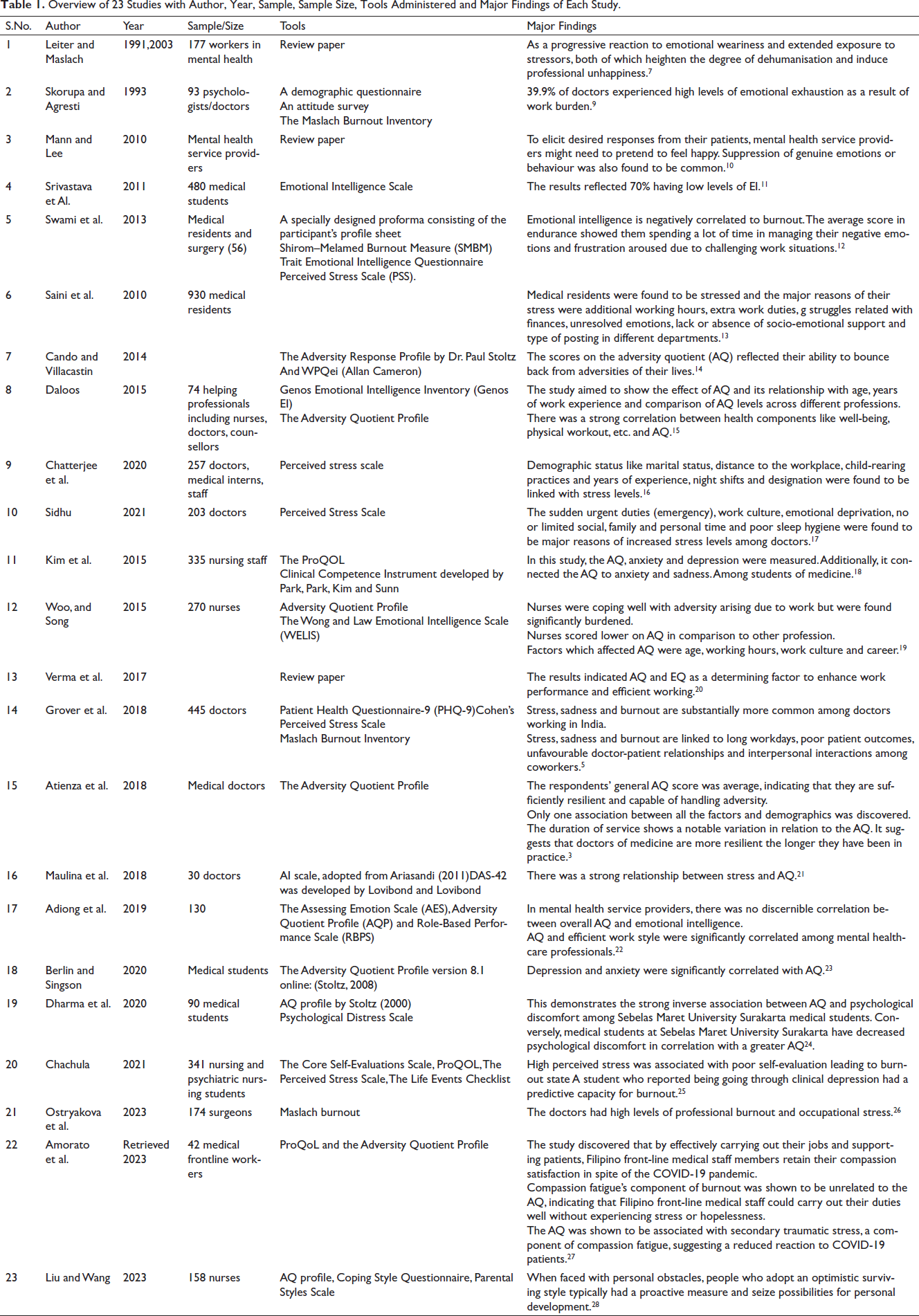
These studies include response and mental health challenges during adversities at the workplace of seven professions in the above literature including nurses, helping professionals like doctors, nurses, counsellors, medical residents, medical students, psychiatric nursing students, psychologists, psychiatric social workers and mental health service providers.
Based on the above literature, it can be summarised that the nursing professionals were able to cope up with the adversity at the workplace but they scored lower on AQ in comparison to other professions and the major factors included exhaustive working hours work culture and career choice. Studies also revealed below-average AQ among helping or medical professionals which could be a result of frustration caused by adversity experiences of apathy, low self-efficacy excessive job demands emotional exhaustion stress burnout and lack of work-life balance. AQ levels have found to increase as work experience increases, gender, working hours, culture, management positions and emotional intelligence play a significant role in deciding the response to adversities resulting in respective high or low AQ scores. 11
The studies also reflect a negative correlation between AQ stress anxiety depression professional dissatisfaction among medical students medical professionals and management professionals. The literature also suggests that a high level of AQ is associated with health behaviours like having a fitness regime, positive well-being and high work efficiency, high emotional intelligence and general response to adversities is better than other populations. The report of burnout emotional exhaustion and other negative emotions is also found to be lower among people who are high on AQ. The report less stress depression and burnout are able to manage their negative emotions irrespective of adversities at the workplace their overall mental health and patient care are better and professional dissatisfaction is less.
The above researches give an idea about the current status of healthcare professionals facing conditions like burnout, compassion fatigue, depression, emotional exhaustion, low self-efficacy and anxiety. This may not only impact the well-being of treating doctors but also affect their ProQOL. The decreased interpersonal interaction with colleagues and limited patient-doctor interactions are also found to be present among medical practitioners as a result of the excessive workload and the nature of work they do, such as breaking bad news, experiencing frequent negative emotions of patients, uncertainty of treatment outcome and many more. Instead of these adverse circumstances the healthcare professionals and general health physicians continue to serve their professional obligations. This gives rise to the need to explore the areas responsible for the intrinsic motivation and resilience among healthcare professionals.
The medical profession requires unique struggles in everyday professional life, which requires abrupt adjustment to extremely critical situations like mental health, oncology, emergency wards and physicians wherein there is a lot of workload and long working hours. These adjustments and work pressure required in their daily life may or may not cause both happy and sad or disappointing experiences, but what matters is that the next day person is able to stand against all adverse circumstances to fulfil their professional obligations. The above studies show that there has been a significant amount of professional burnout among medical professionals and there have been even gender differences to it. The years of experience and amount spent in practice have found to be a major contributing factor as a response of facing adversities of life successfully by continuing the other areas of their life least affected by it. There have been a lot of studies done on nurses who work in critical care units and medical students who have the pressure of both studying and interning. There also have been studies on how practice makes the mental health of medical professionals go in a negative direction, even leading to the development of psychopathology. But most of medical professionals survive the adversities of life and continue to serve towards the betterment of society. This gives rise to an inquisition of exploring the underlying strength which affects how their level of ProQOL is going to determine and whether the effect of gender, type and length of practice has any influence on it. EQ and AQ have a particular impact on career success for organisational professionals who wish to increase organisational productivity and for individuals who want to succeed in their careers.1, 6 Shen states that the capability to cope up with the difficulties of life is also gathered with overall life experiences. This eventually leads to a high level of AQ, as an outcome of work experience gathered over the years. The studies evidently state that there has been a negative correlation between AQ and stress aroused due to occupation, anxiety depression and AQ had a negative low correlation.4, 9
Conclusion
Based on the above literature, it could be summarised that the level of AQ is a key element in deciding the ProQOL, leading to the prevention of professional dissatisfaction, burnout, secondary traumatic stress and a high level of compassion satisfaction. Higher levels of AQ are a mandatory component among healthcare professionals like, nurses, counsellors and psychiatric social workers because their nature of the job often leads to emotional exhaustion as an output of continuous and consistent exchange of a wide range of emotional responses with their respective patients and their family members or primary caregivers. All of these professions have varying degrees of adversities on a daily basis, which makes the idea of how the day is going to be almost unpredictable and coping mechanisms uncertain as something which has worked before on a few patients, may not work for others. This constantly changing environment requires quick adaptation to existing challenges and defines the AQ of an individual. Observing the relevance of AQ and ProQOL among medical professionals, nurses, psychiatric social workers and psychologists, it could be considered as an additional pre-requisite or life skill necessary to be equipped with for these professions for their enhanced well-being, professional satisfaction and better work-life balance.
Limitations
The review’s conclusions might be impacted by a limitation. Evaluation procedures almost always provide studies with varying designs, methodological quality, intervention details, educational backgrounds and respondent types. The required level of similarity across research projects may not always be objectively determined.
Future Directions
More researches are required to be conducted in the field of healthcare professions, observing the level of burnout, compassion fatigue and other mental health issues discussed in this article. Apart from quantitative researcher in the field which measures just the scores to define the level of AQ, ProQOL or any other tool, a qualitative analysis can also be done to know the elaborative reasons and coping mechanisms of medical professionals like surgeons and other helping professionals to get a deeper understanding of various psychological processes which they undergo everyday conscientiously.
Footnotes
Acknowledgements
The authors would like to express their appreciation to the responsible authorities. The authors also acknowledge the personnel and other colleagues who helped to make the research work environment favourable to continuing.
Authors’ Contribution
The conceptual framework and design of the study were shaped by both authors. SS and BR conceptualised the research work and conducted the data sorting. SS authored the initial draft of the article, and the second author provided feedback on earlier iterations of the work. The completed work was read and approved by both the authors.
Statement of Ethics
Not applicable.
Declaration of Conflicting Interest
The authors declared no potential conflicts of interest with respect to the research, authorship and/or publication of this article.
Funding
The authors received no financial support for the research, authorship, and/or publication of this article.
Informed Consent
Not applicable.
ICMJE Statement
The manuscript complies with ICMJE guidelines.
