



Abstract
Background
Indian females have been objectified since time immemorial. The ancient Indian texts and architecture have numerous instances of sexual objectification of females. In the present time, self-objectification in girls is evident from the increasing popularity of apps like Photoshop, the rise in the makeup industry, plastic and cosmetic surgeries, and so on. This is especially relevant for females across the globe and leads to huge negative effects on women’s identities.
Purpose
The aim of the present study is to assess and compare the levels of body surveillance (self-objectification), body shaming, and control beliefs in adolescent girls from co-educational schools and all-girls schools.
Methods
Four hundred adolescent girls from Convent schools in different cities in Uttar Pradesh were included in the study using purposive (homogeneous) sampling based on the inclusion criteria. The Objectified Body Consciousness Scale (OBCS) was used to assess body surveillance (self-objectification), body shaming, and control beliefs.
Results
The results of the study revealed that the level of body surveillance (self-objectification) was significantly high among Indian adolescent girls. It was found that all-girls schools had a higher level of body surveillance (self-objectification), body shaming, and control beliefs as compared to adolescent girls from co-educational schools.
Conclusion
It can be concluded that the phenomenon of self-objectification has numerous implications for the physical and mental well-being of girls, particularly during their formative years. Healthy behaviors and positive thoughts are the best ways to respect and honor one’s body. The research suggests the need for meditation, awareness workshops, and school-level counseling for adolescent girls, especially in all-girls schools.
Keywords
Introduction
Objectification is viewing yourself as an object rather than as a human. A common topic of discussion in sex and gender is self-objectification, which results from objectification. Women are more likely to be affected than men. The psychological process of self-objectification is defined by Calogero as the internalized enmity toward one’s own body that causes women to constantly criticize themselves. 1 Self-objectification is closely related to sexual objectification. Sexual objectification is a phenomenon in which society views a human being as an object for sexual gratification. Advertisements show a woman’s body but not her face. Women’s bodies are dehumanized by these messages, transforming them into objects of pleasure, which leads to self-objectification. With time, women internalize the message that they are not human beings at all but objects of pleasure, play, and beauty.
Sexual objectification and self-objectification can be viewed as a cycle process; sexual objectification perpetuates self-objectification, and self-objectification leads to sexual objectification by others. Billboards, music videos, and magazine covers depict women who seem ideal in this cycle. It perpetuates a cycle of self-objectification. It occurs when people believe they should look and behave like the women depicted in the media to conform to these ideals. It is also affected by social interactions, as people communicate subconsciously with each other.
Sexual Objectification of Women
Sexual objectification involves treating women as objects or using their appearance as objects for men’s pleasure. 2 Women are objectified by whistles, looking at their bodies, making sexual comments, and being goaded by others. The media emphasizes women’s bodies and body parts, and women are portrayed as objects of male lust. Sex is sold in movies, but not in messages. Films portray women as objects that fulfill men’s sexual needs and desires rather than as individuals. It hasn’t been surprising that the male-centric world views women’s worth as determined by their physical appearance and sexual performance, hence the sexual objectification of women’s bodies. The scopophilic tendency of the public may be satisfied by the filmmakers by using sexual objectification and dismemberment in their movies. In the case of sexually objectified women, they often experience a form of persecution, either by being removed from their jobs or by being subjected to lewd behavior or brutality.
By objectifying women, we assert that women’s sentiments and experiences aren’t important, but their bodies are. Objectification of women is used to prove that they are desirable to certain men. According to the study, sexual objectification has the unfeeling effect of driving women toward self-objectification, leading them to generalize themselves and demand to be evaluated based on their appearance. 2 This objectification causes women to become fixated on dietary issues and numerous medical conditions. The sexual objectification theory of Fredrickson and Roberts, however, asserts that sexual objectification leads to sexual badgering, rape, and other violent acts, such as assault, which are the most horrendous consequences of sexual objectification. 2
Theory of Objectification and Self-objectification in Adolescent Girls
As per the social constructionist record of women’s activist analyses, in Western social orders, the female body is socially developed as an item to be respected and evaluated. The objectification hypothesis states that women are frequently checked out as items by society, with a sexual spotlight being put on their bodies instead of on their capacities. The omnipresence of these objectification encounters mingles women to disguise an onlooker’s point of view on their bodies. As a result of self-objectification, women think about themselves and evaluate themselves based on their appearance. 3
Literature has to a great extent exhibited the harmful mental result of self-objectification. The exploratory examination has shown that elevated self-objectification advances general disgrace, appearance anxiety, the drive for slimness, blocks task performance, and expands negative moods.4–7 Reliably, correlational research has tracked down that self-objectification is associated with appearance uneasiness, body disgrace, depression, uplifting perspectives toward restorative medical procedures, sexual dysfunction, and different types of eating disorders.8–11 Most correlational research has been cross-sectional, yet some longitudinal information is accessible too and reports comparable results. 12
The very first study to consider self-objectification in composition showed that female assumptions about how males look at them enhanced body shame and social body anxiety. 13 Sexual objectification has been examined depending on the possibility that adolescents and women form their self-perspective by comparing themselves with others. These perceptions can happen in the media or through very close personal arrangements. 2 A woman’s extraordinary real attributes are summed up through a mix of expected and genuine presentation. 14 Adolescents and women foster an ordinary, real appearance for themselves, thinking about perspective on others, and understanding that others are probably going to see it in addition. The sexual objectification and self-objectification of women are recognized to influence social sex occupations and aberrations between the genders. 15 In Ariel Levy’s view, Western women who misuse their sexuality through, say, wearing short clothes and taking part in profane conduct, do so in order to externalize themselves as women. It is accepted by two or three women as a kind of support, but Levy claims it has led to a more tangible increase in women’s confidence, which he refers to as “classlessness culture”. 16
Levy discusses this marvel in the book Female Chauvinist Pigs: Women and the Rise of Raunch Culture. The author argues that American mass culture has framed the game so perversely that young women now strive to be the hottest and sexiest girl they know rather than the most accomplished. 17 According to the study, women who participate in a wet T-shirt challenge or are satisfied with unequivocal sex redirection are viewed as extremists.
Jordan Peterson has asked concerning the good reason ladies need to wear make-up or high heels in the workplace that a twofold standard exists for wrong direct and females who self-objectified themselves in the public arena. 18 According to research with Chinese subjects, materialistic women are more likely to externalize themselves and show more body-aware behavior. 19
In an article named “Maxims or Myths of Beauty?” A Meta-Logical and Theoretical Review, the researcher guaranteed that (1) raters agree concerning who is and isn’t appealing, both inside and across societies; (2) charming adolescents and adults are judged more positively than unattractive children and adults, even by those who know them; (3) attractive youngsters and adults are treated with more emphatic language than ugly ones; and (4) attractive children and adults show more positive behaviors and qualities than unattractive children and adults. 20
According to research, adolescent girls are more concerned about their outer beauty than their inner potential. Adolescence is when one begins forming a sense of identity. The concern is raised here. The adolescent appearance was taught through school intervention, according to the researchers. 21
At the onset of puberty, girls become the focus of male attention and sexual interest (known as the male gaze). 2 This may lead to girls becoming concerned with the opinions of others, especially men and boys, regarding their bodies. Self-objectification is a form of self-representation. A person who values their appearance over their body’s function is considered high in self-objectification. The concept of objectified body consciousness 3 was also proposed concurrently. Three components of objectified body consciousness were identified in the conceptualization: habitual body surveillance; body shame, in which one feels one’s body does not meet cultural beauty standards; and control beliefs, in which one believes that with enough effort, the way one looks can be controlled. Adult and college women experience objectifying experiences in large numbers.22, 23 A study found that young Australian women are exposed to objectifying events on average about once every 2 days (typically an objectifying gaze) and 1.35 times a day (typically in the media). 24 A woman is more likely to self-objectify if she is exposed to and witnesses objectifying events. Women are also frequently sexually objectified in the media, and exposure to this media can result in self-objectification. 25 In addition to depression, disordered eating, and sexual dysfunction, women’s self-objectification can also lead to psychological and physical health problems. In North America, feminism 26 and media literacy 27 have been found to be important factors, and participating in embodying activities, including yoga, 28 can protect women from self-objectification.
A study found that girls who put more emphasis on their physical appearance and believe they can control their lives cannot improve academically. 29
Physiological Impact of Objectification
Women’s bodies are routinely objectified and surveyed even more once in a while due to the physical, hormonal, and genetic characteristics of the female body. 30 Adolescents’ self-objectification will generally be driven by two essential drivers: the obscuring of standard greatness rules handed down through the media and any sexual speculations that they might encounter during their daily lives. 31 Women often turn to self-surveillance/self-objectification as a way to cope with the constant need for sexual objectification in society. Consequently, this can cause women and adolescents to experience various critical issues, including disgracing their bodies, apprehension, negative views toward the female menstrual cycle, irritated perception, diminished appreciation of generous states within, distress, sexual dysfunction, and disordered eating. 1
Psychological Impact of Objectification
Young minds may be greatly impacted by being observed and treated as items. This is particularly true when these observations are exciting and sexual in nature. If they feel devalued, they may act in harmful ways, including substance abuse and self-harm.
In the present times, the youth are consistently bombarded with ideal images of beauty standards on a daily basis, and these messages reflect social norms. The effects of this exposure are subtle and logically inconspicuous. Issues related to self-esteem and dietary problems result from a craving to achieve them by and large unreachable level of perfect beauty. When people are shaped to acknowledge that they should look a particular way, they go beyond ordinary or natural techniques and become discontent if they fail. This can incite an enormous gathering of challenges concerning self-affirmation and certainty. According to a study, “the experience of being female in a sociocultural setting that expressly epitomizes the female body” develops in females’ unique mental difficulties. Experts allude to self-externalization; as adolescent girls, these women suffer from appearance anxiety, body shame, and trouble eating. 32
Causes of Female Objectification
Impact of Social Media
People’s daily lives are deeply affected by social media, a bridge connecting individuals and society. Newspapers, magazines, and other media can deliver ideologies. Society as a whole should be aware of it. A message to self-objectify is sent by social media when it asks women to physically improve their appearance. There is also a greater emphasis on cosmetics and face beauty products in Asian women’s fashion magazines than on clothing. Magazines are increasingly focusing on makeup articles or adding huge amounts of makeup advertisements. Magazines usually cover topics related to the Beauty Myth, such as diets, beauty products, or sugary cosmetics. There is always an emphasis on women’s appearance in articles about celebrity women. The writer of a Chinese news agency, for example, emphasized Angela Dorothea Merkel’s makeup and clothing in an article about her rather than discussing what she has accomplished as a great politician. The article focused more on Angela Dorothea Merkel’s deeds. 33 Female readers might be misled into believing the appearance of a person is more important than their other character traits by articles that focus only on appearances. There is also a connection between beauty articles and pleasing a man’s ego. Female readers are brainwashed by magazines, which say that they must use their bodies and sexuality to exert their power in the world. Women are becoming more and more treated as beauty objects as a result of the false belief that they need to attract men to cater to their needs. The research found that women used magazines as professional journals for the home because they provided recipes, patterns, and tips, as well as informed them about important topics like film reviews and new beauty products.
Peer Pressure
Women’s self-objectification is influenced by group thinking. A study found that despite appearances no longer being used for personal expression, they have become an indicator of group membership and social status. 34 It is common for students in school or friends to evaluate a person’s value based on their appearance. A school or company might host a beauty contest to find who has the most beautiful face or body; there might be an online competition to find the top 10 most beautiful girls. As far as the judges’ superficial definition of beauty goes, they included only features such as big eyes, long legs, and pointed chins. In a society that valued attractive appearance as a standard of friendship, some people, especially women, were unable to make friends unless they changed their appearance. It has become normal for people to pursue physical beauty and change their appearance for this reason. Increasingly, women are willing to make physical changes to themselves in order to make new friends, such as buying beauty products, eating healthy, having plastic surgery, and so on.
Relationships
Based on a study, men reported high levels of objectification toward their partners, whereas women reported high levels of self-objectification toward themselves. As a result of their hypotheses, romantic relationships based on appearance and physical attraction are more likely to end in people objectifying their partners. 35 An experiment was conducted on the subject of personal and partner objectification with the hypothesis that (1) partner objectification would negatively impact relationships and sexual satisfaction, (2) media consumption that is objectifying will affect self and partner objectification, and (3) men will be more likely to objectify their partners than women. In support of their hypotheses, the data showed that men expressed more partner objectification than women. A significant correlation was found between partner objectification and lower levels of satisfaction with their relationships and sexual lives for men and between media consumption and partner objectification. 35 The result is that men who view the media as objectifying are more likely to compare their partner to the media, while women tend to compare themselves to the media.
A Diversity of Definitions of Beauty
There is a longing for beauty in everyone’s nature. According to a study, “pursuing beauty is seeking pleasure.” Because it is human to admire beautiful appearances, “pursuing beauty is seeking pleasure”. 36 Each individual defines beauty differently, including the appearance of beauty. There are various definitions of beauty, making it difficult to determine what is considered beautiful. It may, therefore, be aberrant to define beauty uniformly. It is the diversity of beauty itself that makes people call it “beauty”. In some Asian cultures, for example, women have been pushed to pursue physical beauty by dressing up for their beholders.
Consequences of Self-Objectification
Understanding self-objectification is important, not only for its theoretical and sociocultural interest but also for the myriad of adverse consequences it has. A study mentioned that self-objectification can be associated with depression. 37 They claim that anxiety and powerlessness are experienced by women because they don’t know when or where they will be objectified. This may explain the relationship between self-objectification and depression. Women may experience depressive symptoms as a result of these feelings. Researchers found that both body-based shame and eating disorders can result from self-objectification. 2 In addition to diet, exercise, fashion, beauty products, surgery, and eating disorders, women are continually trying to change their bodies and appearances, which may result in a perpetual and hardly adaptive body-based shame resulting from a fusion of negative self-evaluation with social exposure. Based on the findings of the research, body shame is caused by uncertainty about when and how one’s body will be evaluated and how it will be viewed. 2
In the early stages of life, women are likely to experience a negative social environment, including receiving negative remarks about their appearance. 2 According to a study, eating disorders lack the power to directly control the objectification of bodies, reflecting girls’ and women’s lack of control. Among feminist arguments for this is that women’s concerns about weight control and dieting are a reflection of their normative discontent with their bodies and that eating disorders are viewed by women as a way of protesting patriarchal systems. 2 It is possible for a woman to stop enjoying her life once she starts to self-objectify and compare her body to others, which can lead to ceasing to enjoy things such as socializing, dating, attending school, or working. According to the study, this is called opting out, 38 and it concluded that 67% of women between the ages of 15 and 64 withdraw from life-engaging, life-sustaining activities due to their sense of inferiority.
Various life tasks, including forming meaningful interpersonal relationships and succeeding academically, can be impeded when the girls are not able to meet the standards of beauty. 39 Self-objectification interferes with academic performance when the subjects wear swimsuits and sweaters. 40 Adolescent girls wearing swimsuits were more likely to restrain eating and perform poorly on math tests than those wearing sweaters. 2 A woman’s body is the subject of another’s attention when she engages in sexual activity, which is why self-objectification can also cause sexual dysfunction. Due to thoughts about their bodies, women may experience less sexual pleasure when engaging in sexual relations. 41 A study estimates that one-third of college females feel self-conscious about their body image during sexual interaction. 42 Self-harm can also result from female self-objectification. As a result of this disorder, people cut themselves, burn themselves, bite themselves, bang their heads, scratch excessively, pull their hair, interfere with wound care, break bones, ingest or insert toxic objects, or perform unnecessary surgeries. 38 These extreme behaviors can be caused by self-objectification induced low self-esteem.
Objectives of the Study
The research has three objectives:
To study the level of body surveillance (self-objectification) among Indian adolescent girls. To explore the level of body shaming and control beliefs among Indian adolescent girls. To compare the levels of body surveillance (self-objectification) among adolescent girls from co-educational schools and all-girls schools.
Hypotheses
H1: There would be a high level of body surveillance (self-objectification) among Indian adolescent girls.
HO: There would be no difference in the levels of body surveillance (self-objectification) among adolescent girls from co-educational schools and adolescent girls from all-girls schools.
Methods
Four hundred adolescent girls from convent schools in different cities in Uttar Pradesh were chosen using purposive (homogeneous) sampling based on the inclusion and exclusion criteria. Informed consent was obtained from the participants. The participants were advised to honestly address each question. They were assured of the confidentiality of the information they provided. Demographic data such as name, age, socioeconomic status, school type, and so on were also included.
Inclusion Criteria
Adolescent girls studying in English medium schools aged 14–18 years.
Girls who gave their consent to take part in the study.
Girls who did not have any serious physical or mental impairments.
Exclusion Criteria
Adolescent girls studying in Hindi Medium Schools.
Adolescent girls not willing to participate in the study.
Adolescent girls who are less or more than 14–18 years of age.
Adolescent girls affected with any physical or mental illness.
Measures
The Objectified Body Consciousness Scale (OBCS), which Nita Mary McKinley and Janet Shibley Hyde developed and approved in 1996, consists of three subscales and is a self-reported measure of bodily mindfulness. 3 Each of the 24 items on the OBCS is scored on a seven-point Likert scale, with one being “unequivocally disagree” and seven being “solidly agree.”
The subscales are as follows:
Body Surveillance: The body surveillance subscale of the OBCS was used to measure body surveillance, or viewing the body from the outside (McKinley & Hyde, 1996). An eight-item subscale ranging in strength from strongly disagree (1) to strongly agree (7) is used to rate this subscale.
Body Shaming: OBCS (McKinley & Hyde, 1996) has an eight-item subscale for measuring feelings of shame related to nonconforming bodies (p. 180). There are seven possible responses to each question. Each response is rated from strongly disagree (1) to strongly agree (7), with higher scores indicating greater levels of body shame and feeling like a bad person if you don’t fit in with cultural expectations.
Control Belief: According to McKinley & Hyde (1996), the Control Beliefs subscale of the OBCS quantifies how much people believe they can control their weight and appearance. Using a seven-point scale, items range from strongly disagree (0) to strongly agree (7); the higher the rating, the more strongly one believes the body can be controlled.
Results
In order to code, arrange, and analyze the gathered data, Statistical analyses were performed using SPSS in accordance with the study’s objectives and hypothesis. The mean, SD, and t-test were used to get meaningful results.
The mean scores of 400 adolescent girls were found to be 27.56, with an SD of 9.73. In comparison with adolescent girls with low objectification, more girls fall into the higher objectification category based on the median split of scores obtained.
The mean for body shaming is 24.15, and 9.26 is the SD among 400 adolescent girls. This indicates that fewer adolescent girls from the sample feel ashamed about their appearance, as they do not fall into the higher-level category of body shaming.
A higher percentage of girls in the sample fall into the low-control belief category. This implies that 49.75% of girls in the sample believe that they cannot control their outer appearance, as compared to 46.5% who believe that they have full control over their appearance.
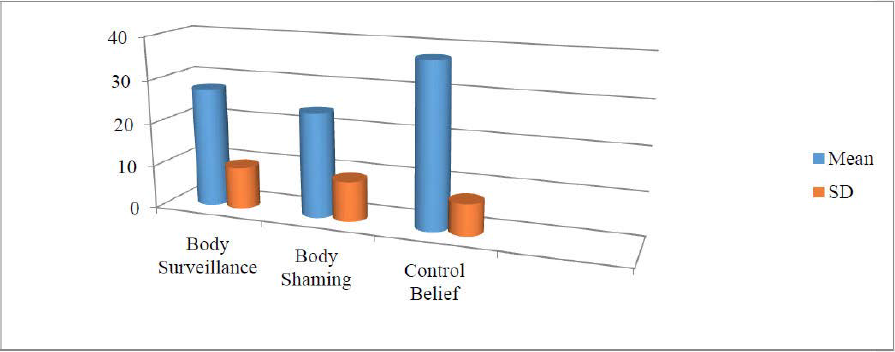
Figure 1 shows that the mean of control belief is 37.58 and the SD is 7.22; the mean of body shaming is 24.15 and the SD is 9.26; for the body surveillance, the mean score is 27.56 and the standard deviation for the same is 9.73. Body surveillance, which seems to be higher than body shaming, indicates that adolescent women are more concerned about their physical appearance and less ashamed of their bodies, in addition to believing they can control their looks and appearances.
Shows the Levels of Body Surveillance, Body Shaming, and Control Belief Among 400 Indian Adolescent Girls.
Based on Table 1, adolescent girls in co-educational schools scored a mean of 25.96 with an SD of 9.86 in body surveillance (self-objectification), whereas adolescent girls in all-girls schools scored 29.16 with an SD of 9.42. On body shaming, participants from co-educational schools scored a mean of 23.96 with an SD of 8.55; adolescent girls from all-girls schools obtained a total of 24.34 mean scores and 9.94 SD scores. As shown in the Table 1, girls from co-educational schools scored 37.12 on the control belief scale with an SD of 7.41, whereas adolescent girls from all-girls schools scored 38.05 on the control belief scale with an SD of 7.01.
Shows the Mean Scores and SD of Three Sub-Scales of the Objectified Body Consciousness scale (Body Surveillance, Body Shaming, and Control Belief) Among Indian Adolescent Girls from Co-Educational Schools and All-Girls Schools.
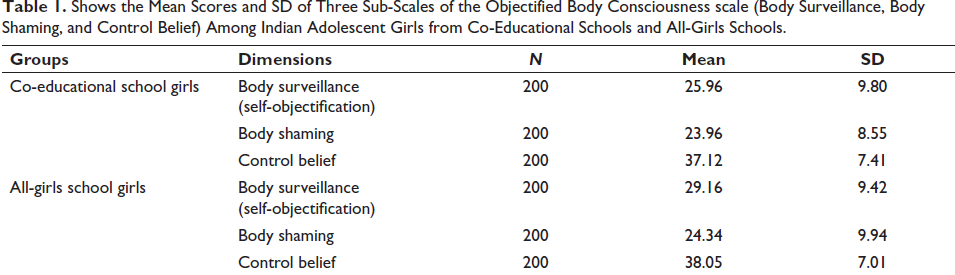
Compared to adolescent girls from co-educational schools, girls from all-girls schools have a high level of body surveillance (self-objectification), body shaming, and control beliefs.
Body surveillance results (t = 3.35*) indicate a significant difference between the mean scores of adolescent girls from co-educational schools and all-girl schools (Table 2). This means girls from all-girls schools scored a high level of objectification, with a significant difference at a significant level of 0.05 and a p-value of .001.
Shows the Mean Difference of Body Surveillance (Self-Objectification) among Indian Adolescent Girls from Co-Educational Schools and All-Girls Schools.

Discussion
The purpose of this research is to examine self-objectification levels among Indian adolescent girls. Objectified body consciousness scores were found to be exceptionally high among the adolescent girls who participated in the study. As Table 3 shows, the majority of adolescent girls are highly self-objectified, with a mean score of 27.56 and an SD of 9.73, indicating that adolescents are highly concerned about their appearance. It was hypothesized that there would be a high level of body surveillance (self-objectification) among Indian adolescent girls based on the review of literature from the West, as this is the age of globalization. Stereotypical views of gender roles and characteristics are likely to reinforce body surveillance among females. Adolescents who hold sexist views may view physical attractiveness as relevant. Beauty plays a key role in both men’s and women’s decisions, 20 but traditionally women do so more.
Shows the Mean Scores, SD, and Median Split Results of Body Surveillance (Self-Objectification) of 400 Adolescent Girls.

A mean score of body shame of 24.15 with an SD of 9.26 was scored by Indian adolescent girls in the sample (Table 4). These scores suggest that Indian adolescent girls did not appear to feel ashamed of their physical appearance because they do not fall into a higher level category of bodily shame. Young girls are prone to constantly striving to improve themselves, but this craze for improvement can adversely affect their mental health, particularly when it comes to their physical appearance. Body shaming and fat jokes are often perpetrated against overweight characters in the media, leading to self-doubt and body image issues. Children who are subjected to body shaming suffer serious emotional trauma as a result of being humiliated about their body shape or size. A person can be ashamed by a parent, sibling, friend, enemy, or classmate regarding their bodies. People can suffer from low self-esteem, anger, self-harm, and mental health disorders such as body dysmorphic disorder, among others, when they negatively comment on the size or shape of their bodies.
Shows the Mean Scores, SD, and Median Split Results of Body Shaming of 400 Adolescent Girls.

According to Table 5, the mean score for control belief was 37.58 points, while the SD was 7.22 points. This indicates that girls with higher body surveillance scores believe strongly that they can control how they look on the outside.
Shows the Mean Scores, SD, and Median Split Results of Control Belief of 400 Adolescent Girls.

This study focused on the level to which Indian adolescent girls self-objectified themselves and whether younger girls from co-educational schools or girls from all-girls schools were more self-objectifying. According to Table 1 and 2, based on the mean estimation of the OBCS score of 29.16, adolescent girls in all-girls schools self-objectify themselves more than girls in co-educational schools. However, adolescent girls in co-educational schools scored 25.96 with an SD of 9.80. Using t-statistics (t = 3.35*), at *0.05 significance level, there is a significant difference between both means, indicating that adolescent girls in all-girls schools place a greater emphasis on their outer appearance than adolescent girls in all-gender schools. It is a fact that adolescent girls from co-educational schools are living more balanced lives and controlling their bodies and appearances better than adolescent girls from all-girls schools. As a result, girls from all-girls schools focus on their external beauty as a means of achieving personal success, while girls from co-educational schools in this study focus on other developmental goals.
Gender stereotyping is lesser in co-educational schools as compared to all-girls schools, in which the girls are often advised to “walk like ladies, talk like ladies,” and so on. This can have an impact on the self-perception of females, who want to appear more feminine to conform to the teachings from their school since early childhood. Co-educational institutions promote gender equality, and girls are more interested in competing with boys in academics, sports, and other co-curricular activities.
The present paper focuses on the level of self-objectification among adolescent girls and the difference between self-objectification among girls studying in co-educational and all-girls schools. Creating a strong self-cognition system, which includes enhancing the self-esteem and self-confidence of Indian adolescent girls, is the best way to deal with this grave problem. When an individual has self-awareness, they have their own definition of beauty and a sense of right and wrong. In order to prevent a female from changing appearances for the sake of catering to others, society should monitor the unrealistic demands on these females by the media and their families and peers. This will help people realize that objectification is not an acceptable social phenomenon. It is up to the individual to define what beauty means to them, which is not determined by external factors but rather by intrinsic virtues. Further, social modeling suggests that people are more likely to follow the path of others when they watch them succeed. An interviewer may say that a woman passed because of her well-prepared portfolio rather than her beautiful makeup or outfits, thus sending the message that the person’s learning is much more important. By focusing on enhancing their knowledge instead of changing their physical appearance, people will be more likely to develop themselves. People who have an in-depth and mature understanding of how objectification negatively affects them can not only influence the people around them to become better people but also help society improve. Once people are aware of the causes and consequences of objectification, they will realize the importance of confidence and self-belief. Adolescent girls should focus more on their abilities and understand the importance of learning rather than changing their appearances. Girls should be encouraged to join book clubs and hobby classes in schools in order to gain knowledge and develop their faculties. Developing a strong self-cognition system and learning a wide range of topics will let young girls feel a sense of independence within themselves, creating a beneficial cycle of self-cognition and knowledge acquisition. These adolescent girls enriching themselves with knowledge will prove to be a great step in women’s empowerment and a boon to society.
Conclusion
It is important for girls to recognize the context in which self-objectification takes place, manage triggers, criticize the thin ideal, and encourage respect for their bodies. The benefits of self-objectification are often short-lived and superficial, which is why it is important to put self-objectification into context. It is important to identify which circumstances or environmental contexts trigger self-objectification in order to prevent the problem from affecting the well-being of adolescent girls. The best way to respect and honor one’s body is to practice healthy behaviors and turn negative thoughts into positive ones. A young girl who believes she is in complete control over her appearance and who places an emphasis on her physical appearance is less likely to focus on academics or any other curriculum activities. The research focuses on the need for school-level counseling and meditation, especially in all-girls schools, to teach girls how to focus on their internal capacity rather than their external appearance.
Footnotes
Acknowledgements
The authors are ineffably indebted to the participants from convent schools in Uttar Pradesh and the school administration for allowing the researcher to conduct the study. The author also extends her gratitude to her family for their encouragement, support, and lots of motivation throughout the research. The authors also acknowledge the support of their friends and colleagues for providing a conducive environment to carry forward the research work.
Authors’ Contribution
All authors contributed to the study’s conception/design and all authors read and approved the final manuscript.
Statement of Ethics
The approval was granted by Ethics Committee of Amity University Uttar Pradesh, Lucknow.
Declaration of Conflicting Interests
The authors declare no conflicts of interest with respect to the research, authorship, and/or publication of this article.
Funding
The author received no financial support for the research, authorship and/or publication of this article.
Informed Consent
Written informed consent was obtained from the participants to participate in the study.
ICMJE Statement
The manuscript complies with ICMJE guidelines.
