




Abstract
Background:
The worldwide spread of COVID-19 infection and its preventive measures has resulted in global disruption of overall functioning of the individuals. In the post-COVID period, several stressors associated with the pandemic have exacerbated adjustment problems in students and impacted their mental health.
Purpose:
The study aims to assess the Academic Stress and Emotional Adjustment of male and female secondary school students in Uttar Pradesh, post-COVID-19 pandemic lockdown.
Methods:
A sample of 500 students from various schools in Uttar Pradesh pursuing high school were included in the study. A purposive sampling technique was employed for data collection based on inclusion and exclusion criteria. The Scale for Assessing Academic Stress and the Adolescents Emotional Adjustment Inventory were used to assess the academic stress and emotional adjustment of secondary school students post-COVID-19 pandemic lockdown.
Results:
The results of the study revealed that there was a significant difference in academic stress and emotional adjustment between male and female secondary school students. A significant positive relationship between academic stress and emotional adjustment was found, which indicates a high level of academic stress perpetuates emotional maladjustment. Furthermore, it was found that the level of academic stress and emotional adjustment were higher among females as compared to males.
Conclusion:
It can be concluded that the extended impact of COVID-19 has led to a surfeited level of distress propounding that females are more predisposed to academic stress and tend to have poor emotional adjustment than their male counterparts.
Introduction
The year 2020 has brought unprecedented challenges in the world due to the COVID-19 pandemic. Several preventive measures were taken by the government to limit the spread of the coronavirus among the citizens, which successfully curbed the spread of the virus but negatively impacted the psychological well-being and mental health of individuals. 1 The education sector is one of the major sectors that has been facing unexpected challenges in maintaining the teaching-learning process. Owing to the global pandemic and lockdown restrictions, schools and colleges quickly shifted their teaching methodology and converted into the online mode to provide equitable access for all students and to support the educational needs of teachers, students/scholars. 2 Studies reported that the long-term closure of schools and home confinement due to the outbreak of the disease has negatively impacted the mental health of adolescents. 3 The conditions surrounding the COVID-19 pandemic have heightened tension and worry in individuals, especially secondary school students.4–6
Although, for a very long time, it was believed that students were least affected by stress as their only task was to study, and it was never thought of as onerous. Subsequently, with increasing parental expectations, students felt the burden to perform, failing which they became stressed and further predisposed to a plethora of psychosocial problems, viz. academic stress, adjustment problems, anxiety, depression, and behavioral problems to the extreme steps including suicide. 7 According to data from the National Crime Records Bureau, a student commits suicide once every hour and reported that 1.8% of students who failed their exams ended their lives, and the suicide rate increased by 80% in a single year. 8 These concerning numbers have been linked primarily to academic stress. 7 A study reported that stress results from the interaction between environmental stressors, students’ appraisal of such stressors and their responses. 9
Academic stress has nowadays become a serious reason for concern, acting as an indicator of the degradation of mental health. 10 When students feel excessive or negative stress, they incur psychological and physical repercussions. 11 Severe stress causes physical complications, and it is not uncommon for students to experience symptoms such as disturbed appetite, bodily aches, fatigue, and gastrointestinal difficulties. 12 Studies have shown that poor study habits, problems with studying, changes in teaching methods, problems in the environment, and low socioeconomic conditions can lead to academic stress.13, 14
During the final years of school, an increased academic stress is conspicuous among all the students, but the associated factors that increase academic stress over time are less explored. 15 Prior studies concluded that there are no significant differences between gender and academic stress level.16–18 In contrast, a study done by Karaman et al. 19 concluded that females tend to experience high academic stress as compared to males20–22 and the predictive factors that are associated with academic stress are life satisfaction and locus of control. 19 Poor academic performance and impaired physical and mental health are linked with increased stress levels among students. 11
When students perceive excessive distress, they face difficulty in maintaining emotional equilibrium. Individuals are said to be emotionally stable when they can express their emotions in varied circumstances and in an appropriate way. A person who is emotionally stable may be well adjusted, whereas emotionally unstable conditions might lead to maladjustment. 23 Both internal and external factors contribute to adjustment issues in individuals. 24 Duncan (1949) defined adjustment as the state of a person’s harmonious relationship with their environment. 25 It also refers to the ongoing process through which a person modifies his own behavior, attempts to alter his surroundings, or modifies both in order to establish a satisfactory relationship with his environment. 27
Emotional adjustment is necessary for the development of a healthy personality. Emotional adjustment is the culmination of personality development, and it paves the way for physical, intellectual, mental, and aesthetic alterations. Maintaining emotional balance in the face of internal and external stressors is the process of emotional adjustment. 26 Internal stressors are related to emotional aspects, whereas external stressors include social and educational aspects. 27 When a person is in harmony with their surroundings, they are able to develop certain behaviors to deal with issues or to cope with stress. 26 A significant difference in emotional adjustment pertaining to gender was found in the study done by Richard and Sumathi. 28 Another research reported that adolescents’ emotional adjustment abilities were found to be low.27, 29 Sivakumar 30 and Joseph 31 concluded that male and female higher secondary school students have a similar level of emotional adjustment. Literature showed that although men are generally better at handling their emotions, women were also shown to be more capable of adjusting emotionally.
To determine how the COVID-19 pandemic lockdown has influenced the mental health and well-being of secondary school students, the present study aimed at assessing the academic stress and emotional adjustment of male and female secondary school students in Uttar Pradesh.
Objectives
To assess the level of Academic Stress of Secondary School Students
To assess the Emotional Adjustment of Secondary School Students
To compare the level of Academic Stress and Emotional Adjustment among Secondary School Students based on gender.
To assess the relationship between Academic Stress and Emotional Adjustment.
Hypotheses
H1: Secondary school students will score high on academic stress
H2: Secondary school students will score low on emotional adjustment
H3: Male and female secondary school students will differ significantly on academic stress
H4: Male and female secondary school students will differ significantly on emotional adjustment
H5: There will be a significant relationship between academic stress and emotional adjustment.
Methods
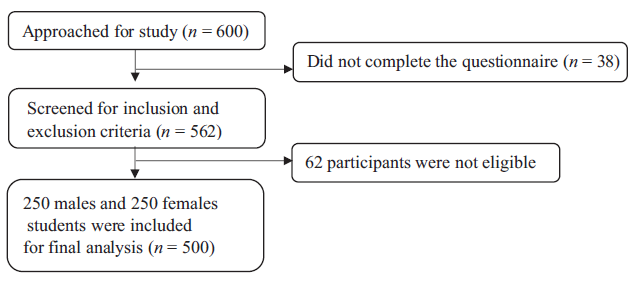
To gather the data, the questionnaire was administered on 600 Secondary School Students from various schools in Uttar Pradesh. The sample comprised 250 males and 250 females based on inclusion and exclusion criteria (Figure 1). The performa of the study consists of three parts: informed consent, basic demographic data, and psychological assessments. Informed consent was taken from the participants. The sociodemographic sheet included age, gender, city, class, family type, father’s education and profession, mother’s education and profession, and annual income. To assess the academic stress and emotional adjustment of secondary school students, the Scale for Assessing Academic Stress (SAAS) and Adolescent’s Emotional Adjustment Inventory (AEAI) were used. The data were collected using a purposive sampling technique based on defined inclusion and exclusion criteria.
Flow Chart of Data Collection Process.
Inclusion Criteria
Students who were in Xth standard Students who were studying in English Medium Private Coeducation school Students from the middle, upper-middle, and upper socioeconomic classes
Exclusion Criteria
Students who were studying at any standard other than Xth standard. Students enrolled in government and separate (only boys and girls) education schools Students from low and lower-middle socioeconomic backgrounds
Measures
It was used to gather the sociodemographic information related to age, gender, standard (class), school, educational board, religious faith, socioeconomic background, father’s education and profession, mother’s education and profession, family type, and career goal.
It was developed by Dr. Uday K. Sinha, Dr. Vibha Sharma, and Dr. Mahendra K. in 2001. It is a self-report measure that assesses all possible indicators of academic stress among students. It comprises 30 items, which measure five independent factors, that is, cognitive factor, affective factor, physical factor, social/interpersonal factor, and motivational factor related to academic stress. The total academic stress score is obtained by adding up all the scores obtained on the items. Higher scores obtained on this scale indicate a higher level of academic stress. The test–retest reliability was found to be 0.88 and the split-half reliability was 0.75. The scale’s internal consistency ranges between 0.30 and 0.81.
It has been developed by Dr. R. V. Patil. It measures the emotional adjustment of adolescents. Responses are recorded in yes and no. A score of two is given to each yes responses and a score of one is given in case of no responses. Higher scores obtained on this scale indicate emotional maladjustment. The split-half reliability was 0.82 and test-retest reliability was 0.87. The validity of the AEAI was 0.77.
Results
The statistical analysis was done using the Statistical Package for Social Sciences (SPSS) version 20 software. A t-test and Pearson correlation were used to get meaningful results. To evaluate the variation in the aforementioned categories, the dataset’s mean, SD, and t-values were computed.
The frequency and percentage of male and female respondents are mentioned in Table 1. In total, 250 males (50%) and 250 females (50%) were included in the present study.
Showing the Frequency and Percentage of Gender.

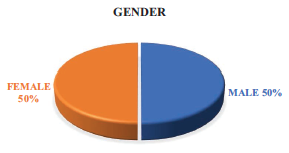
Table 2 shows the level of academic stress in secondary school students. It was found that 22.4% of the students reported a high level, 53.4% of students reported a moderate level and 24.2% of students reported a low level of academic stress.
Showing the Level of Academic Stress in Secondary School Students.

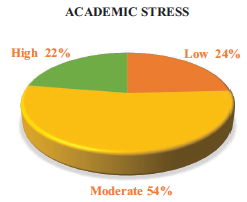
Table 3 shows the level of emotional adjustment in secondary school students. It was found that 19.2% of the students reported a high level, 59.6% of students reported a moderate level and 21.2% of students reported a low level of emotional adjustment.
Showing the Level of Emotional Adjustment in Secondary School Students.

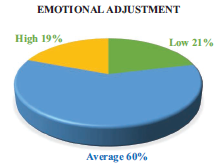
Table 4 depicts the comparison of factors of Academic Stress (i.e., cognitive factor, affective factor, physical factor, social and interpersonal factor, and motivational factor) and Emotional Adjustment of Male and Female Secondary School Students. Findings revealed that there is a significant difference in the Academic Stress (p =.000, p <.00) of male and female secondary School Students and Emotional Adjustment (p =.000, p <.00) of male and female secondary school students. There is a significant difference in cognitive factor (p =.001, p <.00), affective factor (p =.000, p <.00), physical factor (p =.000, p <.00), social and interpersonal factor (p =.000, p <.00), and motivational factor (p =.020, p <.05) of Academic Stress between male and female secondary school students.
Shows the Comparison of Variable of Secondary School Students Based on Gender.
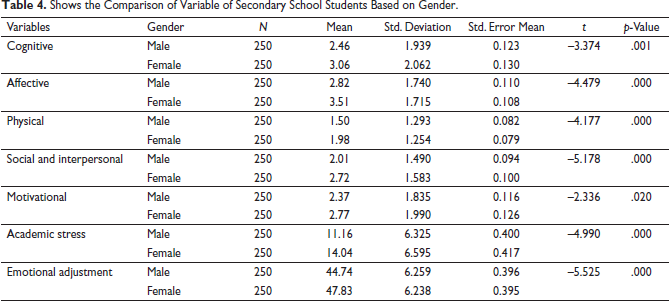
Table 5 shows the relationship between factors of Academic Stress and Emotional Adjustment. Results revealed that there is a significant positive relationship between emotional adjustment and factors of Academic Stress (i.e., cognitive factor (r = 0.637, p >.00), affective factor (r = 0.561, p >.00), physical factor (r = 0.547, p >.00), social and interpersonal factor (r = 0.602, p >.00), and motivational factor (r = 0.560, p >.00).
Shows the Relationship between Factors of Academic Stress and Emotional Adjustment.
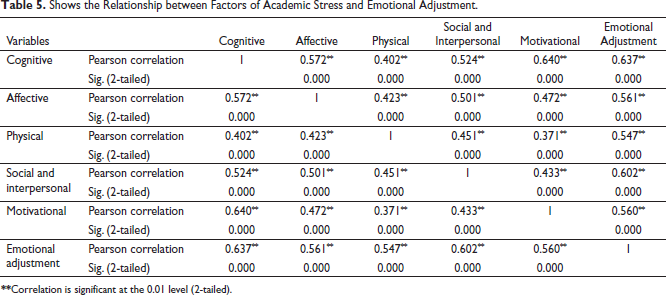
Table 6 shows the relationship between academic stress and emotional adjustment. Results revealed that there is a significant positive relationship between Academic Stress and Emotional Adjustment (r = 0.757, p >.00). The high emotional adjustment score obtained on this scale indicates maladjustment and vice versa.
Showing the Correlation between Academic Stress and Emotional Adjustment.

Discussion
This study attempts to provide a glimpse of academic stress and emotional adjustment in boys and girls at the secondary school level. This study was conducted post-COVID-19 pandemic lockdown and the pandemic may be assumed to affect the results as it may act as a confounding variable. The study was conducted to examine the level of Academic Stress and Emotional Adjustment in male and female Secondary School Students of Uttar Pradesh post coronavirus pandemic lockdown. Being in the transitional stage of development, secondary school students are highly susceptible to develop sensitivity toward psychological issues in response to instances like peer pressure, and unrealistic expectations from parental figures, school personnel, society, etc.
Extant literature has reported the deleterious impact of disease outbreaks on adolescents’ mental health and well-being.32–35 The present study revealed that the majority (53.4%) of secondary school students experience a moderate level of academic stress and the majority (59.6%) of the students have an average level of emotional adjustment. It was also found that females scored higher in Academic Stress and Emotional Adjustment as compared to their male counterparts. The positive correlation between factors of academic stress and emotional adjustment indicates that students who scored higher on academic stress and its factors would have poor emotional adjustment.
The continued progression and the aftermath of COVID-19 have added stress in addition to the widely known antecedents and negative effects of school-related stress for high school students. Consistent with the existing literature on the academic stress of secondary school students, the outcome of the present study revealed that 22.4% of secondary school students scored high on academic stress and 53.4% of secondary school students experience a moderate level of academic stress while 22.4% of the students reported a low level of academic stress. Therefore, the first hypothesis of the study, which stated that secondary school students would score high on academic stress, is accepted. A study done in Gorakhpur by Neeta and Singh 36 found that most of the students had a moderate level of academic stress and concluded that academics is the main source of stress among secondary school students.
A higher level of academic stress in students is associated with expectations from self, expectations from the parents and school authorities.37–39 In schools, academic stress in students is exacerbated by factors like grade competition with classmates, excessive number of tests, time limitations, educator’s pressure, increased amount of homework, and number of subjects. 40 Personal factors that contribute to academic stress are parental expectations, fear of failure, comparison with others, lack of sleep and interest. 40
Adolescents who experience high levels of stress exhibit symptoms such as emotional issues, including aggressive behavior, shyness, social anxiety, and a lack of interest in activities that might otherwise be pleasurable. 41 In the present study, it was revealed that 59.6% of secondary school students have average emotional adjustment; 19.2% have high emotional adjustment and 21.2% of students have lower emotional adjustment. Hence, the second hypothesis, which states that secondary school students will score low on emotional adjustment was rejected. Studies have shown that students’ emotional, physical, and mental health are compromised when they are constantly exposed to stressful situations. 42 A study concluded that the amount of stress experienced by students had an effect on their overall academic performance and mental health. 43
In reference to gender, the findings of the present study revealed that the females at the secondary school level scored higher on factors of academic stress as compared to males. Academic stress has been extensively studied and has shown a wide range of outcomes in relevance to gender. Some studies have reported that female students are more likely to experience a higher level of stress than their male counterparts;44–49 other studies on the contrary reported that the stress level of males was higher as compared to females. 50 Hence, the third hypothesis, which states that male and female secondary school students would differ significantly in academic stress, was accepted.
In reference to factors of academic stress, females in the present study scored higher on cognitive, affective, physical, motivational, social, and interpersonal factors of academic stress. A previous study conducted in this area found that males scored higher in affective, behavioral, physical, and social factors whereas females scored higher in the cognitive factor of academic stress. 44 Some literature also elucidated no significant difference between females and males in academic stress.50–51
Decades of research have shown that the physical presence in the school environment is important for the better mental health of adolescents. 52 As a result of the fast spread of COVID-19, many schools throughout the world were forced to shut their doors in March 2020. Students across grade levels had a tough time adjusting to this rapid transition from offline mode to online learning. 53 They faced difficulties in adjusting physically and emotionally during the transition.
In accordance with previous research on emotional adjustment,54–55 the present study revealed that females have poor emotional adjustment as compared to males. Hence, the fourth hypothesis, which states that male and female secondary school students would differ significantly in emotional adjustment, was accepted. Previous studies have also provided insight into gender differences in the emotional adjustment of adolescents. It was depicted in the studies that females tend to experience more adjustment problems as compared to males.56–59 Studies attempted to explore the adjustment capacities of secondary school students and concluded that there are significant disparities in the adjustment of secondary school students based on gender. 60 In contrast to the findings of the current study, a few studies also concluded that females have a better level of adjustment in all areas than their male counterparts.61–63
Findings also revealed a significant positive relationship between factors of academic stress (cognitive, affective, physical, social, interpersonal, and motivational factors) and emotional adjustment. A significant positive relationship was also found between academic stress and emotional maladjustment, which indicates that a higher level of academic stress will result in a higher degree of emotional maladjustment. Therefore, the fifth hypothesis, which states that there would be a significant relationship between academic stress and emotional adjustment, was accepted.
Conclusion
The present study highlights that elevation in academic stress of secondary school students is a major concern for students, academicians, and other stakeholders as it is linked to their emotional adjustment owing to their exposure to the COVID-19 pandemic. The ongoing pandemic has increased the stress related to academics, which demonstrated the negative impact on emotional adjustment, academic performance, and overall mental health of adolescents. Based on the findings of this research, it can be concluded that there is a significant difference between female and male secondary school students in terms of academic stress and emotional adjustment. As compared to male students, female students are found to be less emotionally adjusted and tend to experience more academic stress. Psychosocial factors, viz. family background, parenting, gender bias in upbringing, role ambiguity, gender-based discrimination etc., have been significant predisposing and perpetuating factors leading to coping issues, adjustment problems, and other major mental health conditions in adolescents and adulthood. In each factor of academic stress, females scored higher than males which indicates that females have a higher level of stress in each factor of academic stress. A significant positive relationship between academic stress and emotional adjustment was found, which indicates a high level of academic stress perpetuates emotional maladjustment.
Limitations
Data were collected from one state of India, however, in order to generalize the findings and include them in policy documents, a larger sample size from different states of India can be taken. This study was conducted at the beginning and mid of the academic session, therefore it might be possible that academic stress levels and emotional adjustment differ when assessed during the end of the academic session and before the end-term examinations. Another limitation that can be taken into account is the COVID-19 induced health-related stress, which has significantly contributed to academic stress and emotional adjustment among students.
Future Implications
Emotional adjustment is necessary for academic achievement and psychological equilibrium in students. Higher emotional maladjustment and higher academic stress in female students can be targeted by future research. Subsequently, school authorities and parents should make an effort to lessen academic stress especially in the female population, thereby reducing students’ emotional adjustment concerns. Students who have coping difficulties relevant to commitments and social expectations may witness aggravated stress and anxiety in their lives. Teachers, parents, and school counselors should collaboratively guide students on how to develop good study habits, thereby enhancing their academic success. The intervention sessions may catalyze in fostering their coping strategies and better adjustment. It is necessary to provide students with relevant information on the perceived academic, social, and cultural problems they face while attending school to aid in their overall adjustment. Parents should provide a healthier environment to develop good study habits among adolescents. Workshop pertaining to stress management, time management, and setting smart goals should be conducted for students. Intervention at the parental level in form of counseling and workshops is strongly recommended.
Footnotes
Acknowledgements
The authors extend their gratitude to the participants from various schools in Uttar Pradesh and the school administration for allowing the researcher to conduct this study. The authors also acknowledge the support of staff and colleagues who provided a conducive environment to carry on with this research work.
Authors’ Contribution
All authors contributed to the study’s conception and design. Research conceptualization, data collection, analysis, and duplication checks were performed by GS, SS, VS, and SZHZ. The first manuscript draft was prepared by GS, and all authors reviewed the results and approved the final version of the manuscript.
Statement of Ethics
This study was performed in line with the principles of ICMR and World Medical Association Declaration of Helsinki. The approval was granted by Ethics Committee of Amity University Uttar Pradesh Lucknow Campus.
Declaration of Conflicting Interests
The authors declared no potential conflicts of interest with respect to the research, authorship, and/or publication of this article.
Funding
The authors received no financial support for the research, authorship, and/or publication of this article.
Informed Consent
Written informed consent was taken from students to participate in the study. Participants were informed of the confidentiality of their responses and of the voluntary nature of the study. No incentive was provided for their participation.
