



Abstract
Background:
Meditation is a conscious mental discipline, that has been implicated in the relaxation response. The mechanism behind such a relaxing effect is psychoneuroimmunology (PNI), based on the interaction between mind, physical health, and self-healing; that conceptualizes that stress and an individual’s emotional state led to predisposition to diseases. Research to date suggests that meditation may play an active role in remodeling the imbalance between mind and body by modulating the psychoneuroimmunological effects of stress. However, to date, the multi-dimensional psychoneuroimmune aspects of meditation together have not been completely explicated. An evidence-based mechanism has been framed for the first time in India to explain the psychoneuroimmunology of regular and long-term meditation practice.
Summary:
Present evidence-based mechanism confirms prefrontal cortex (PFC) acts as a ‘Functional Connectome’ where psycho-neuro-immune aspects of meditation function simultaneously to exert positive benefits in the regulation of cognitive and emotional behavior. Also, this mechanism will help us to understand how human augmentation with lifestyle modification fosters brain plasticity to overcome various neuropsychiatric illnesses.
Key Message:
Meditation is a scientific tool against neuro-psychiatric illnesses.
Keypoints
Present evidence-based mechanism has been framed for the first time in India to understand how human augmentation with yoga-based lifestyle modification fosters brain plasticity to overcome various neuropsychiatric illnesses.
The present mechanism confirms that the prefrontal cortex (PFC) acts as a “Functional Connectome” which regulates psychoneuroimmune aspects of meditation simultaneously to exert the positive benefits on health.
Integration of mind-body-associated nonpharmacological interventions with modern medicine should be enhanced for better health outcomes, especially during the COVID-19 pandemic.
Introduction
The perception of a healthy lifestyle is evergreen and everyone’s dream. There are a few who achieve this healthy lifestyle in their lifespan. According to World Health Organization (WHO), “health” is defined as a state of complete physical, mental, and social well-being and not merely the absence of disease or infirmity. 1 But in today’s era, life is full of hassles, deadlines, frustrations, and demands, and all these situations lead to stress. Eustress is a physiological, psychological, and physical reaction to positive or negative situations in life whereas distress needs to be controlled to achieve a healthy lifestyle.
Meditation is a well-known Yogic tool to reduce stress and anxiety. 2 The mechanism behind the relaxing response might include the psychoneuroimmunological effects of yoga-meditation. Psychoneuroimmunology (PNI) is based on the interaction between the mind, physical health, and self-healing 3 that conceptualizes that the negative emotional state of an individual lead to susceptibility to diseases. 4 Such an effect is possibly mediated by the nervous system by modulating the behavior and the immune system. Studies to date suggest that meditation might play a dynamic role in remodeling the imbalance between mind and body by modulating the psychoneuroimmunological effects of stress.5–25
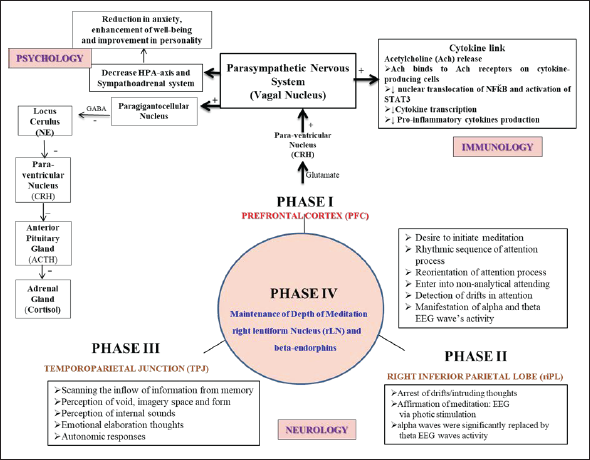
Here, the authors would like to emphasize that in our previous published study, 26 the novel methodology 26 was acquired to scan the human brain during meditation using neuroimaging technique. Therefore, the findings of the author’s psychoneuroimmunological research findings7–10, 26–30 have been used in framing the present mechanism (Figure 1). Based on previous research studies, a few hypothetical mechanisms of meditation had been proposed, but still not completely explicated.28, 31–36 Therefore, the present multidimensional mechanism has been framed for the first time in the Indian scenario to explain the psychoneuroimmunological aspects of meditation. The present mechanism confirms that the prefrontal cortex (PFC) acts as a “Functional Connectome” which regulates psychoneuroimmune aspects of meditation simultaneously to exert positive benefits on health. Also, provides an appropriate nonpharmacological treatment that may ameliorate cognitive and emotional related brain morphological abnormalities in people with neuropsychiatric illness. Before proceeding with an integrated physiological mechanism, the authors would like to give a brief about the psychoneuroimmunological effects of meditation.
Schematic Framework of Psychoneuroimmunological Mechanism of Long-Term Preksha Meditation. The Present Framework is Based on Scientific Evidence to Show Prefrontal Cortex (PFC) Acts as a “Functional Connectome” Where all the Components of Preksha Meditation that Including Attention Control, Emotional Regulation, and Altered Self-Awareness Function Simultaneously to Exert the Positive Benefits in the Maintenance of Neuropsychiatric Illnesses.
Psychoneuroimmunological Effects of Meditation
In the present scenario, mental stress leads to various stress-related neuropsychiatric disorders like depression and anxiety37–40 that affects our immune system. Although antidepressants and anxiolytics are available to overcome neuropsychiatric disorders, they also produce long-term side effects. But the evidence from the existing studies37, 41–47 on nonpharmacological interventions such as yoga and meditation reported as such no side effects and has shown better efficiency in combating various neuropsychiatric disorders. The previous studies5–10 have shown the efficacy of alternative and complementary therapies on various neuropsychiatric disorders and found a significant decrease in the symptoms of anxiety and depression by activating the anti-inflammatory physiological mechanism that significantly improved the quality of life of patients. Studies 48 have also been conducted to show a significant increase in the levels of the alpha and theta electroencephalography (EEG) waves activity in the frontal region of the brain as well as result in extensive changes in the frequency of gamma wave 49 by balancing the effect on the functional activity of participants in the left and right hemisphere.13, 26, 50, 51
Previous neuroimaging studies52, 53 have shown the different brain areas activated including the PFC, amygdala, superior temporal lobe, and hippocampus-strongly support focused attention but no literature has engrossed on the “maintenance of the advance state of meditation.” In a recent neuroimaging study, 26 meditating human brain was scanned with scientific affirmation with activated brain areas including the right mid Frontal gyrus (rGFm), right Broca’s (rBroca) area of right inferior frontal gyrus (rGFi), right inferior Parietal Lobe (riPL), right Superior Lateral Temporal Lobe (rsLT), right parieto-temporal cortex/junction (PTC/PTJ), arcuate nucleus (β-endorphins), right caudate nucleus (rCN), right lentiform nucleus (rLN). These activated brain areas were used in designing the neural model 28 to show the PFC plays an important role in nonanalytical functions 54 of an advanced state of meditation by initiating more synchronizing activity among different right-hemispheric neural correlates. Further, the question arises of how neural signatures 26 of PFC, play an essential role to exert the psychoneuroimmunological effects of meditation to foster brain plasticity to overcome various neuropsychiatric illnesses. On this basis, the authors have designed an integrated framework to understand the brain plasticity of regular meditation practice.
Integrated Psychoneuroimmunological Framework of Long-Term Meditation Practice
Meditation is an important tool of PNI that balances the mental and emotional aspects of the spiritual spectrum. 55 On this concept, studies from our laboratory5–10 served as the evidence base, which highlights the health promotion, disease prevention, and therapeutic role of yoga-meditation in healthy and diseased individuals. Using this evidence-based concept, we propose that PFC acts as a “Functional Connectome” that may aid in improving the health by modulating the psychoneuroimmunological effects of long-term meditation practice; further improve the inflammatory status by reducing inflammatory makers including TNF-α, NFKB, and IL-6 and by upregulating the anti-inflammatory genes expression, decelerating the rate of cellular aging and improving cellular endurance thus promoting positive quality of life and increases lifespan.44, 56–61
In today’s era, many meditation techniques are being practiced but the authors have focused specifically on “preksha meditation” (PM) because of the enhancing properties of attention skills and how these attention skills exert their psychoneuroimmunological effects on understanding the specific physiological pathways that warrant specific treatment interventions. Based on the previous literatures,9, 28, 30, 35, 36 the present evidence-based mechanism of long-term meditation practice is designed to highlight how three components of induction of meditation include efferent attenuation, afferent attenuation, and targeted nonanalytical thinking help in regulating the psychoneuroimmunological effects of depth of meditation.27, 28, 31, 62 These three components represent three Meditative Phases operating in a cyclic pattern within the different brain structures involved in the active preksha meditation process. The PFC plays a vital role in initiating the meditative processes by helping to detect and avoid wandering thoughts (Phase I, Figure 1). This Phase I has a role in a decision-making phase and is revealed by the appearance of both alpha and theta EEG wave’s activity was significantly and consistently higher for experienced meditators, probably reflecting relaxation, awareness, conscious state, and affective processing.13, 63–69 Phase II helps to arrest intruding thoughts; for this, the meditator is encouraged to enhance the capability to focus attention on a focussed target. To detect thought wandering various neurophysiological techniques have been involved that including EEG with photic stimulation,26, 27, 62 button press system, 55 and many more.70, 71 Scientifically, EEG recording with photic stimulation was found to be an appropriate marker to detect the drift-in attention,26, 27, 31, 62 especially in studying the human brain during neuroimaging with a novel methodology. 26 Further, in Phase II i.e., sensory attenuation, alpha EEG waves were significantly substituted by theta EEG waves, proportionately with the depth of the meditation.26, 27, 31, 62 At last, Phase III plays an important role which involves the temporal lobe plays an important role in emotional elaboration and conception of peculiar memory patterns often reported by meditators. The Phase III state is equivalent to samadhi where alpha EEG waves were consistently higher and there was a “shut down” inappropriate network for the maintenance of internalized focused attention.13, 31, 35, 62, 69, 72 and this same was affirmed in the author’s previous study 27 by giving photic stimulation. Hence, all three Meditative Phases may operate in a cyclic pattern and this pattern goes on repeatedly till the meditation process continue. Further, to maintain the cyclic pattern (Phase IV) between all the phases of meditation, it is very important to perceive the inner positive feelings-like experiences that help in the regulation of emotions and the attention process. Further, PFC simultaneously gives excitatory inputs to the arcuate nucleus of the hypothalamus to release β-endorphin, along with subcortical structures including right caudate nucleus (rCN) concerned with emotional and focused attention regulation and right lentiform nucleus (rLN) of basal ganglia, involved in the reward-like experience. Previous studies have also shown an increased level of β-endorphin during various relaxation techniques including meditation and exercise.10, 54, 73, 74
Then involves psychoimmunological aspects of meditation. Here, the authors would like to emphasize that in meditation how precisely activated brain regions of the PFC (rBroca, rGFm) along with the right inferior parietal lobe, and right temporoparietal regions regulates the psychoimmune status. Previous research has shown that stimulation of PFC leads to the stimulation of the hypothalamic-ventromedial nucleus via glutamate excitatory neurotransmitter with subsequent stimulation of the peripheral parasympathetic system,75, 76 which relates to the subjective sensation of relaxation. Further, activation of the parasympathetic system leads to the activation of the paragigantocelluar nucleus of the medulla which ceases to innervate the locus cerulus (LC) of the pons resulting in a decrease in the level of NE.77, 78 This decrease in levels of NE from Locus cerulus during meditation would likely decrease the production of a corticotropin-releasing hormone (CRH) by the PVN which would ultimately decrease cortisol levels.79, 80 Numerous studies have been conducted to show the decrease in plasma cortisol levels during meditation processes.6, 10, 81, 82
Cytokines are implicated in the pathophysiology of various diseases, and a reduction in inflammatory cytokines may play an important role in the prevention of causation and/or progression of such inflammatory diseases. It has been suggested that these changes were because of the activation of the parasympathetic nervous system during meditation.83, 84 It has been shown that stimulation of the vagus nerve leads to the inhibition of inflammatory cytokines such as TNF-α, IL-1, IL-6, and IL-86, 10, 85 through the cholinergic anti-inflammatory pathway which is a neurological mechanism that helps to control cytokines with accuracy and restraint. 86 On the other hand, practicing regular and long-term preksha meditation for five or more than five years, improvement in the levels of anxiety, well-being, and overall personality6, 9, 87 have been observed that might imitate meditators have a relatively stable personality, and there are minimal fluctuations in various psychological aspects over time. 6 Overall, the present mechanism has thrown the light on the power of positive thinking that strengthens the brain neural circuits for experienced meditators, further increasing the ability to fight infection against any diseases. This might reflect not only a better quality of life but also a positive outlook, and improved self-rated health. Hence, from the multidimensional mechanisms, it has been concluded that the PFC acts as a “Functional Connectome,” where psychoneuroimmunological responses interact with each other for the regulation of cognitive and emotional behavior.
Clinical Application
The present evidence-based framework could be a secret tool against stress, which scientifically will help us to understand how a particular pathway fosters brain plasticity to overcome various neuropsychiatric illnesses through a nonpharmacological intervention.
Summary
A simple form of the mental-relaxation technique helps in the regulation of Psychoneuroimmune status by the “Functional Connectome” including the precise activated brain regions of PFC. Further, will provide the scientific platform for clinical research, specifically targeting areas of development in the treatment of various stress-mediated psychoneuroimmunological disorders.
Footnotes
Acknowledgment
The authors were greatly thankful to the Department of Biotechnology (DBT, BT/PR10269/GBD/27/82/2007), New Delhi, for granting the financial support for completing the research study which helps the author’s in designing the evidence-based mechanism.
Authors’ Contribution
DM: Implemented the idea for this review, literature search, and drafted initial manuscript; RKY: contributed to review the concept and helped in revising the manuscript.
Statement of Ethics
The study was conducted in accordance with the Declaration of Helsinki, and the protocol of the study was approved by the Institute’s Ethics Committee, All India Institute of Medical Sciences, New Delhi. The study was registered at Clinical Trial Registry India (CTRI), CTRI/2009/091/000727.
Declaration of Conflicting Interests
The authors declared no potential conflicts of interest with respect to the research, authorship, and/or publication of this article.
Funding
The authors disclosed receipt of the following financial support for the research, authorship, and/or publication of this article: Department of Biotechnology (DBT, BT/PR10269/GBD/27/82/2007), New Delhi.
