



Abstract
In Indian cities, the dynamic interplay between motorized and nonmotorized transport (NMT) has significant implications for urban development. Reliance on motorized transport often results in challenges like vehicular congestion, while increasing the use of NMT offers various advantages for urban mobility. The current study assesses the state of active travel to school (ATS) in Dehradun city, the capital of Uttarakhand state in India. To understand the factors influencing the use of ATS, a statistical study was conducted in four local schools, both public and private, in the city. Results from the survey were used to draw conclusions about the factors that affect the choice of ATS. The study showed that income was a major determinant of NMT use, as less socioeconomically well-off children studying in public schools are more likely to use NMT. Moreover, the study showed that male students are more willing to shift to NMT use than female students, as safety concerns are a major issue that affects the choice of ATS among females. Thus, the present study provides first-hand data from a holistic study on ATS in a nonmetropolitan city in India and suggests that cultural issues (psychological), like more safety concerns for females and status in society, along with education vis-à-vis income of parents and gender of students (socioeconomic), are the primary determinants rather than those of built environment for choice of ATS.
Introduction
Standard transportation modes are classified as motorized (also called passive) and nonmotorized (also called active) travel. In cities, transportation is mainly attributed to the need to travel for recreation or from home to workplaces and schools. While motorized transport is currently overwhelmingly being used for transportation in cities, there is a recognition that nonmotorized transport (NMT) has many benefits over motorized transport. Such benefits include, but are not limited to, less pollution, less traffic congestion, and more health benefits. Thus, there is a need to promote NMT in cities. In the current study, we try to find out the level of ATS, also called active travel to school (ATS), in Dehradun city of India, and the factors that affect the choice of using NMT among school-going children and their parents.
The choice of travel options to school by parents and children depends on their attitudes towards different travel modes. Therefore, the attitude toward different modes of choice can be explained through decisions based on parents’ and students’ current use and preferences for modes. Several studies have shown that parents’ attitude and their perception regarding urban land use patterns, transportation and education policies, safety from traffic and surroundings, and socioeconomic conditions (Kingsly et al., 2020; Reimers et al., 2013) are significant factors in deciding the mode of travel of their children to school (Helbich, 2017; Huertas-Delgado et al., 2017). In the context of developing countries like India, factors affecting the choice of ATS become more complicated because of other reasons too, like poor public transport, strict zoning regulations, lack of neighborhood school concept, and revenue-driven transport policy resulting in more extended trips. It is because of these reasons that recent studies suggest that the use of motorized transport for school trips, like private cars and motorbikes, has increased (Oluyomi et al., 2014).
The impact of increasing use of motorized transport is visible in greater traffic congestion and increasing air pollution because of vehicular emissions (Dirks et al., 2016), as motorized transport is a major source of greenhouse gas emissions in the world. To offset the impact of motorized transport, many solutions like efficient public transport, encouraging walking and cycling, efficient infrastructure, carpooling, and so on, have been applied in cities worldwide (Das et al., 2021; Lukenge & Siu, 2021). Of these, ATS is most promising as it not only decreases congestion and pollution in the city but also promotes a healthy lifestyle and positive mindset (Kim & Lee, 2021) of students. However, it is found that despite having multiple advantages over motorized transport, ATS is decreasing in many countries (Fusco et al., 2012) especially USA (Kim & Lee, 2020), United Kingdom (Kelly & Fu, 2014), China (Fan et al., 2018), Spain (Huertas-Delgado et al., 2017) and India (Kingsly et al., 2020).
To understand this, we can classify the reasons for decreasing use of ATS into (a) reasons related to the built environment, (b) factors associated with society, like crime rates and the social status of the family, and (c) threats associated with traffic conditions and road safety. Of these, the first reason has been tested in the USA and found to be an insufficient reason for the decreasing trend (Oluyomi et al., 2014). At the same time, even developing countries like Iran have a share of motorized transport to school as high as 60% (Aliyas et al., 2022). The second and third factors related to crime and traffic have been widely studied and found to be significant, along with the country-specific social considerations contributing to the increasing pattern of use of private vehicles for school trips.
However, as previously mentioned, it is the perception of children (Ramanathan et al., 2012) and the attitude of parents to walking and cycling (Sirard & Slater, 2008) that have proved to be the most important factors in determining the use of ATS. This understanding has led to a paradigm shift in research related to sustainable travel choices, like ATS, which focuses on the decision-making of people (Yang & Markowitz, 2012). The attitude toward NMT is mainly dependent on climatic conditions, urban patterns, traffic volume, personal safety, crime rates, distance from school, and unavailability of walkways (Esmaeli et al., 2024; Huertas-Delgado et al., 2017; Oluyomi et al., 2014).
Even though the use of NMT is a much-studied subject in developed countries, there is significantly less literature on it in the Indian context. Work on ATS in India has been done in metropolitan cities like Chennai (Kingsly et al., 2020), Prayagraj (Meena et al., 2022), and Rajkot (Mahadevia & Advani, 2016). Surprisingly, little emphasis was given to nonmetropolitan cities, which are higher in number in India and have the maximum school-going population in the world. Another issue is that the literature on NMT in India, while acknowledging its potential benefits for urban mobility, is often limited in scope and depth. One of the key shortcomings is the narrow focus on infrastructural inadequacies, such as the lack of dedicated lanes and pedestrian facilities. While these issues are important, the literature does not sufficiently explore the broader social, cultural, and behavioral factors that affect the adoption of NMT. For instance, safety concerns, particularly for women and children, and the stigma associated with walking or cycling in lower-income groups are underexplored topics (Bisht & Tiwari, 2023).
Moreover, the current literature often fails to address the impact of urban form and land-use planning on NMT adoption. Studies that link the built environment to transport choices are sparse, and most existing research is limited to major metropolitan cities, neglecting smaller towns and peri-urban areas where NMT could play a crucial role (Anand & Tiwari, 2006). This limits the generalizability of the findings across diverse Indian contexts.
In summary, while the literature on NMT in India highlights important infrastructural and policy challenges, it overlooks critical social, behavioral, and integration aspects. Addressing these gaps is essential for developing comprehensive strategies to promote NMT across varied urban settings.
Thus, the use of ATS in India is influenced by a number of social, cultural, and economic factors. For example, the safety of school-going girls is a major factor in the Indian context and influences the decision of parents (Adlakha & Parra, 2020). Similarly, social status associated with cars in Indian cities is also a factor contributing to less use of ATS (Tiwari, 2022). Historically, Indian cities were not well planned for active travel, and the infrastructure supporting active travel was not readily available. The new focus on smart cities in India has changed this attitude, with new pedestrian zones being created as part of smart city planning.
As discussed above, there are some major issues that constitute the knowledge gap on the use of ATS in India. The current study is a unique attempt to bridge this knowledge gap by doing a comprehensive and holistic study to identify the determinants of use and preference of ATS in Dehradun city, the school capital of the country, as many famous schools attracting students not only from different parts of India but also from around the world are located here.
Materials and Methods
Study Area
For the present study, Dehradun City was selected to collect the data. Dehradun became the capital of the Himalayan state of Uttarakhand in India in 2000, resulting in a massive increase in population due to migration. The population of Dehradun city increased from 426,000 in 2001 to 574,840 in 2011 (Census of India, 2011), and a projected population of 784,000 at present (
Operationalization of Conceptual Framework
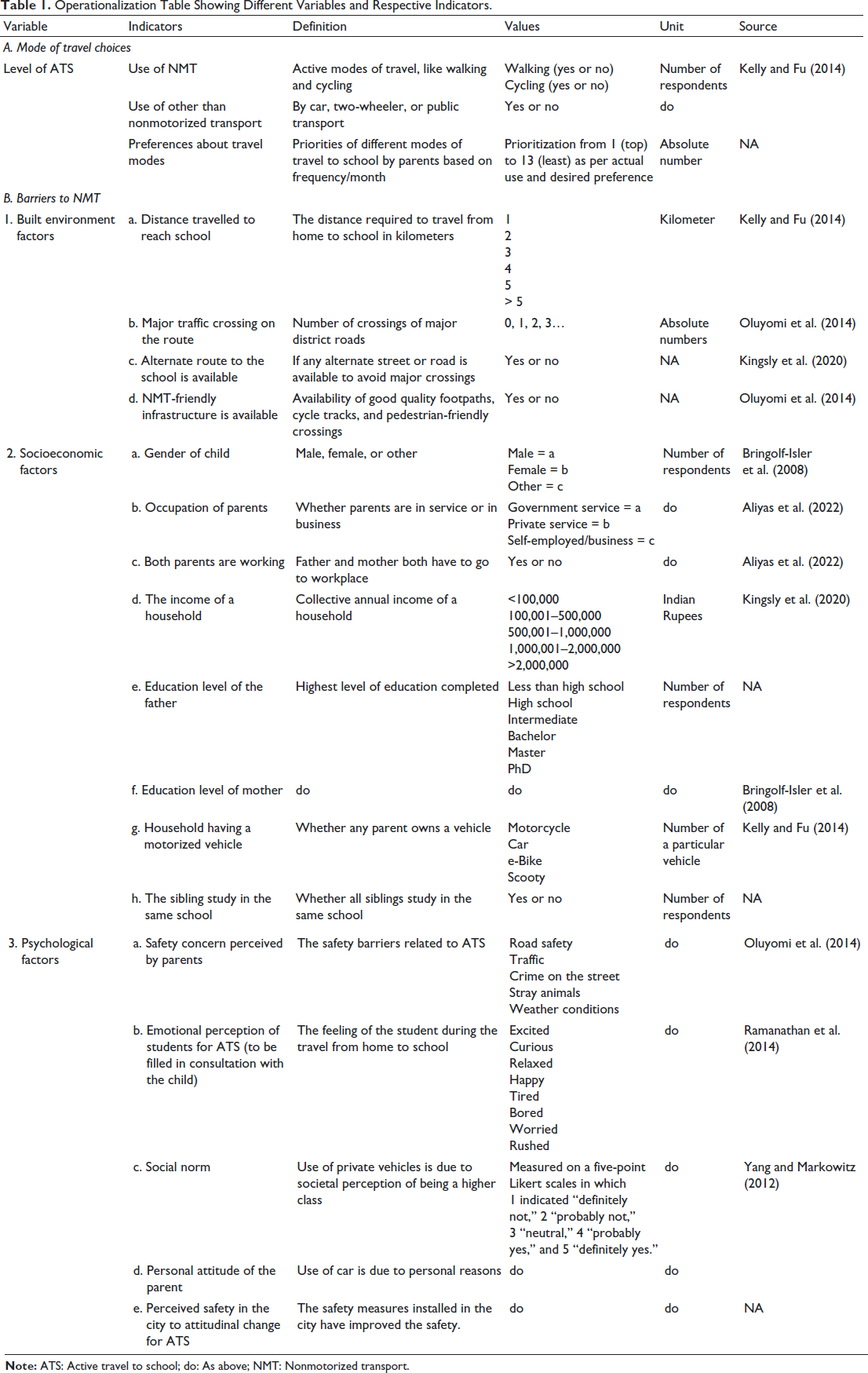
The conceptual framework was operationalized through different indicators of all three independent variables: built environment, socioeconomic, and psychological factors. The definition of each indicator, its value, and its unit of measurement were decided and compiled (Table 1).
Operationalization Table Showing Different Variables and Respective Indicators.
Data Collection
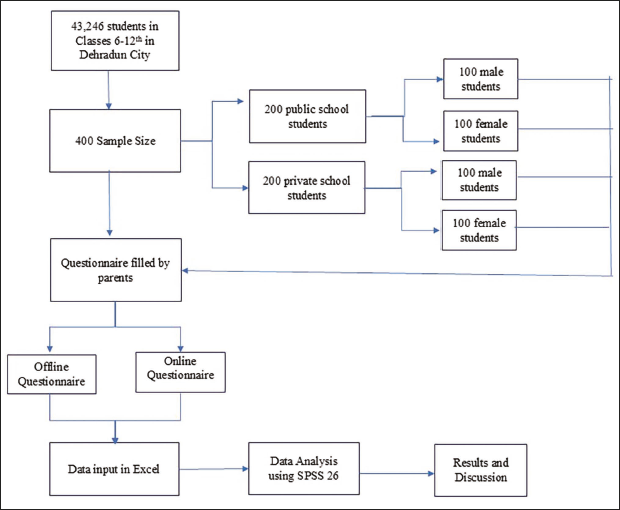
The participants included in this research were parents of students enrolled in classes 6–12 in Dehradun city. A sample size of 381 was deemed adequate, considering a confidence level of 95% and a margin of error of 5% for a population of 43,246 (Hulley, 2007); however, a sample size of 400 respondents was finalized. A total of four schools, two public (Government Girls Inter College, Rajpur Road (hereafter GGIC), and Government Inter College, Kurbuda (hereafter GIC)) and private schools (St Joseph Academy, Rajpur Road (hereafter SJA) and Sri Guru Ram Rai Inter College (hereafter SGRR)) were considered as data collection points with 100 samples each, having 50% female students. All four schools were selected because students from all across Dehradun city come to study in these schools based on their educational merit and the financial status of their parents. The students were asked to approach either of the parents to be respondents of this research because, in the Indian cultural milieu, the parents’ decision is more critical for the travel choice of children.
The primary method of sample collection was a survey through a questionnaire. A questionnaire with 33 questions based on a literature survey was designed. The questionnaire was made in both English and Hindi. Further, an online link was generated through “Google Forms.” The questionnaire was distributed in both hard copy and as an online link to students in school. All forms were codified and linked with students to ensure tracking of the questionnaire. A detailed flowchart on the methodology used for data collection and data analysis is given in Figure 1.
Schematic Representation of the Methodology Used in the Study.
Data Analysis
The primary data analysis was done through quantitative methods using survey data in Statistical Package for the Social Sciences (SPSS) software version 26. In order to assess the level of ATS, it was essential to examine all modal choices taken for travel to school. Along with the current composition of travel choices, desired preference was also assessed to evaluate the ATS preferences of other modal users. For analysis purposes, the score (most preferred mode was assigned maximum marks followed by addition of marks assigned by all respondents constitute score of a particular travel option) was calculated separately for all options provided in the questionnaire, and a collective score of ATS (addition of score of walking and cycling for each respondent). The correlation and linear regression coefficients through the ordinary least squares (OLS) methods were calculated to establish a relationship between the variables. The OLS method was selected due to its simplicity, efficiency, and ease of interpretation. Alternative methods like Ridge, Lasso, and so on, could have been used, but as OLS remains optimal in scenarios where assumptions are met, and regularization or additional complexity is unnecessary, it was preferred. A multiple linear regression test was performed after checking multicollinearity and omitted variable biases.
Reliability and Validity
The reliability and validity of data are the most critical aspects of social science research. Clear conceptualization, selection of variables, their measurement, and unit based on an exhaustive literature review added to the reliability of the study. Multiple indicators of all three factors further eliminated the chance of biases. The data collection instruments, and questionnaire, were tested before execution to ensure relevance in the local context. The questionnaire demonstrates validity by aligning closely with established research on travel behaviors, socioeconomic factors, and safety concerns affecting school commuting choices. It was tested for content validity through expert review and pilot testing with a small sample to ensure relevance and clarity of items. Additionally, test-retest reliability was established by administering the questionnaire twice to a subset of respondents, confirming stable results over time. These instruments were made available in English and Hindi (local language), as well as offline and online modes, to include all possible respondents and eliminate the chances of a specific sample population. The sample size was more than the threshold level, increasing the data’s external validity. The survey findings were triangulated using secondary data from the Departments of School Education, Transport, and Police to ensure internal validity.
Results and Analysis
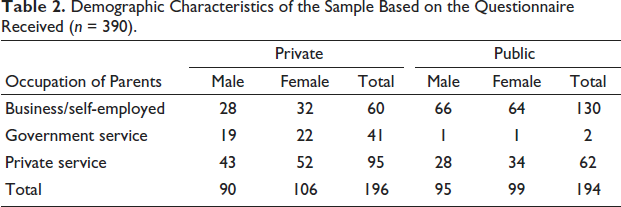
Of 400 survey forms sent to the parents of two public and two private schools (data collection points), 390 forms (97.5%) were returned. The job profile of respondents was also analyzed to assess income source, which is related to the affordability of private schools. There was a difference in the job profile of respondents from both public and private schools (Table 2). Among the public schools, the maximum number of respondents (67%) were self-employed or doing business. As per interpersonal communication with the students, it was found that most of the respondents are daily wagers. In contrast to this, the maximum number of respondents from private schools were doing private service (48.5%), followed by business or self-employment (30.6%), and government jobs (20.9%). Thus, the respondents of both public and private schools belonged to different socioeconomic backgrounds. Families with a salaried income (government and private jobs) prefer private schools, and self-employed, low-income families are forced to go to public schools in the Indian context.
Demographic Characteristics of the Sample Based on the Questionnaire Received (n = 390).
Travel Mode Choices for School Trips and Preference for ATS
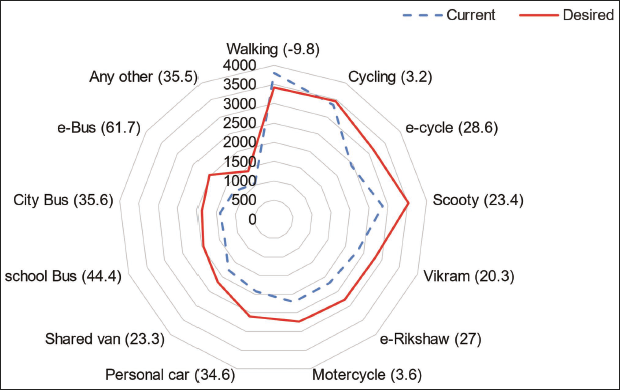
All possible present travel modes for commuting to school by respondents’ children were recorded. Upon analyzing the frequency, the majority of respondents (44.7%) indicated walking as their top preference, followed by scooty (11%) and cycling (9.4%). Respondents were requested to assign corresponding rankings to these options to capture their preferred choices for each mode of transportation. In terms of preferred choices for transportation modes, a significant number of respondents favored walking as their first choice, although the percentage (18.7%) was considerably lower than the actual usage (44.7%). In terms of actual usage, the ATS choice accounted for 25.6% of total trips; however, this was slightly higher than the desired preference of 20.3%.
All 13 respondents’ preferences about every travel mode were converted to a score to get a definitive conclusion. According to the scores assigned to each mode (refer to Figure 2), the inclination toward walking slightly decreased by –9.8%, while cycling showed a marginal increase of 3.2% as a preference compared to current usage. Notably, the e-bus, introduced in Dehradun as a pilot project for public transport, exhibited a remarkable 61.7% surge in preference as a future mode of travel to school compared to its current usage.
Collective Score of Different Travel Modes as Per Actual Use and Desired Preference. Values in Parentheses Depict Percentage Change.
Factors Explaining the Level of ATS
The respondents were asked to prioritize the key factors influencing ATS, as identified in the literature review. They were instructed to assign a rank of 1 to the most crucial factor and 18 to the least important, similar to the approach used for ranking travel mode choices. Since not all the factors might be considered critical by the respondents, they only ranked factors based on their observation and experience. In terms of actual usage, 41.6% of participants identified the distance between home and school as the most crucial factor influencing ATS. Following closely were footpaths and cycle tracks, chosen as the top priority by 21.8% and 12.3% of respondents, respectively. This data corroborates that Dehradun city has only 38% of roads with footpaths either on one side or on both (UKMRC, 2019). However, the footpath is not continuous and of bad quality.
The psychological factors were given lesser preference over the built environment factors when all factors were clubbed together. The lower priority may be due to the evident presence or absence of built environment factors rather than psychological factors, which are more perceived. Among the psychological factors, high traffic volume (fourth preference), crime on the street (fifth preference), and presence of stray animals (sixth preference) were prominently selected by the respondents.
Respondents’ answers shifted when they were posed with the same question, this time focusing on the factors critical to their preferred choice for ATS. This time, the significance of distance as a critical factor was somewhat diminished, with only 23.5% of respondents identifying it as their foremost priority. Interestingly, the quality of cycle tracks (20.6%) and the presence of footpaths (19.5%) become the second and third most essential factors for ATS. A comparable trend was noted in psychological factors influencing the desired preference for ATS, mirroring the observed pattern in actual usage. Road safety and traffic volumes were deemed crucial for sustaining ATS, and they featured more prominently than in the context of actual use.
Similar to the process for travel mode choices, critical factors influencing both the current level of ATS and the preferred choice were assigned scores. According to these scores, the presence of footpaths and cycle tracks emerged as the most crucial factors, surpassing the importance of distance. Notably, when comparing the pivotal factors for current use and desired preference, psychological factors took precedence over built environment factors. Factors such as company during travel (35.2%), high traffic volume (32.4%), and street crime (29.9%) exhibited significant percentage increases, closely following the impact of the presence (39.4%) and quality of cycle tracks (41.0%). In summary, respondents, after assigning scores, regarded psychological factors as more influential on the level of ATS compared to the ranking based on the number of respondents choosing a particular factor.
Since the present article is focused on factors explaining the level of ATS, the relationship between three independent variables, namely, built environment, socioeconomic, and psychological factors, with the level of NMT, is discussed separately.
Built Environment Factors and Level of ATS
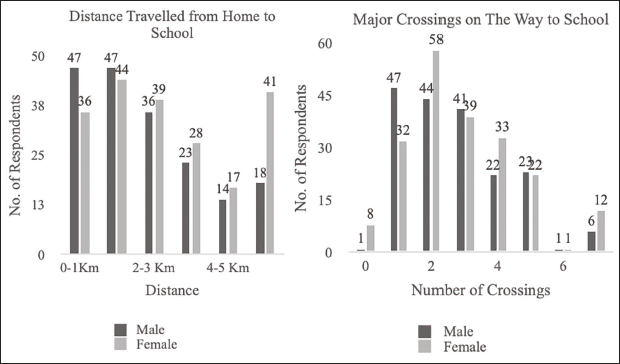
According to the literature review, gender plays a significant role in determining the level of ATS among parents. Thus the impact of built environment factors explained in relation to gender. Figure 3 reveals that 70.3% of male students, compared to 56.6% of female students, travel up to 3 km from home to school daily. Although the distance covered by female students is distributed across various cohorts, a higher percentage of females (20%) travel more than 5 km, as opposed to 9.7% of male students. Additionally, the median distance covered by female students (median 2.5 ± SD 1.75 km) exceeds that of male students (median 1.5 ± SD 1.59 km).
A notable finding is that 25.4% of male students cross one major crossing during their commute to school, while 28.3% of female students cross two major crossings. Surprisingly, although many students travel >5 km in one direction daily, the number of students crossing over six major crossings per side is minimal. This discrepancy may be attributed to a lack of vigilance when using modes of transportation other than NMT. The data on the number of crossings and the distance traveled by students from home to school mutually support each other.
To address the issue of major crossings, respondents were queried about the availability of alternate routes. In total, 41.6% of respondents reported the existence of alternate routes for their children’s school commute. However, the availability of alternate routes for female children was lower than that for male children using ATS. Furthermore, respondents who reported having alternate routes were asked about the reasons for not using them. The most commonly reported reason (37%) for not opting for an alternate route to avoid major crossings was a feeling of insecurity. Thus, while the distance between home and school emerged as a critical factor, female students traveled longer distances, and the preference for routes with major crossings stemmed from a sense of insecurity in alternate routes.
Gender-wise Distance Travelled by Children (Left) and Major Crossing Points from Home to School (Right).
Socioeconomic Factors and Choice of ATS
Differences in the level of ATS were observed between public and private schools, referred to as school status in this study. Various socioeconomic parameters were analyzed based on school status, providing insight into family status determined by income and education within Indian society. Public school students accounted for 76.7% of total ATS, while private school students contributed 23.3%. Additionally, gender-specific data indicated that travel mode choices were influenced by the respondents’ children’s gender, with female students (42.2%) utilizing ATS less than their male counterparts (57.8%). The reduced ATS usage by female students could be attributed to longer travel distances and parental safety concerns related to local social phenomena.
Parental safety concerns, particularly for female students, not only influence the choice of travel mode but also highlight the significance of companions during the journey to school in promoting ATS. Thus, the presence of companions during the journey to school was identified as a significant determinant of promoting ATS in the literature review. The majority of students traveled alone (33.8%), followed by those accompanied by parents (26.9%), friends (23.8%), and siblings (15.9%). Notably, parents accompanied 31.2% of female students, while many male students commuted with friends (26.5%) after traveling alone. This underscored parental safety concerns regarding female students, impacting their lower ATS usage compared to male students.
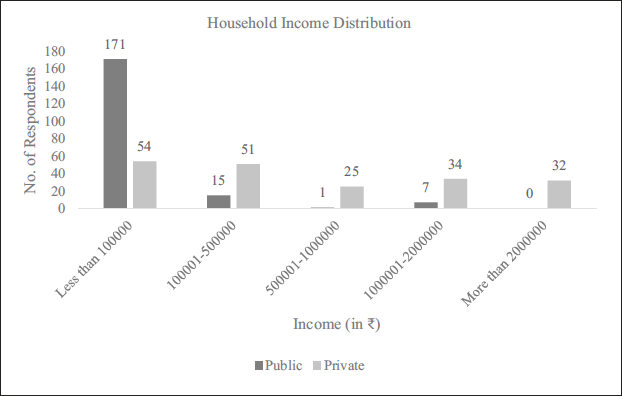
Similarly, in the Indian context, household income emerged as a crucial criterion for school selection. Low-income families opted for public schools due to free education. Among students from public schools, 57.7% had both parents working, exceeding the percentage for private schools (42.3%). However, the median income of respondents from public schools was lower (₹50,000) than that of private schools (₹300,000). This disparity may be attributed to both parents of public school-going children engaging in low-income employment, contributing less to household income despite their dual employment. The majority of respondents sending their children to public schools had a household income below ₹100,000 (88.1%), while those sending children to private schools exhibited a more diverse distribution across income categories, with the highest percentage falling below ₹100,000 (27.6%), followed by ₹100,001–₹500,000 (26%) (Figure 4).
The link between household income and school selection also extends to parental education levels, with lower-income families opting for public schools, where parents typically have lower educational qualifications, further influencing reliance on NMT for school commuting. In the present study, the education level of both parents was asked. Respondents attending public schools, characterized by lower income and a higher reliance on ATS for school commuting, exhibited lower education levels for both parents (below high school). Conversely, respondents from private schools, with higher income and a lower reliance on ATS, had parents with higher education levels, typically holding a bachelor’s or master’s degree. 65.9% of respondents had a motorized vehicle like a car (27.2%), a scooty (23.9%), or a motorcycle (13.4%), and the rest had electric bikes; however, 60.3% of respondents from public schools had no vehicles. This again corroborated income levels and the unaffordability of having any vehicles; thus, their children were using NMT.
Household Income of Respondents as Per Their School Status.
Psychological Factors and Decision of NMT
Psychological factors primarily revolved around perceptions of transportation modes and safety considerations. These aspects were examined with a focus on the gender of children, given that parental safety concerns vary and are particularly crucial for female students within Indian culture. Respondents were asked to consult their children regarding their feelings during the journey from home to school (refer to Table 3).
The Emotional Feelings of Children When Travelling from Home to School.
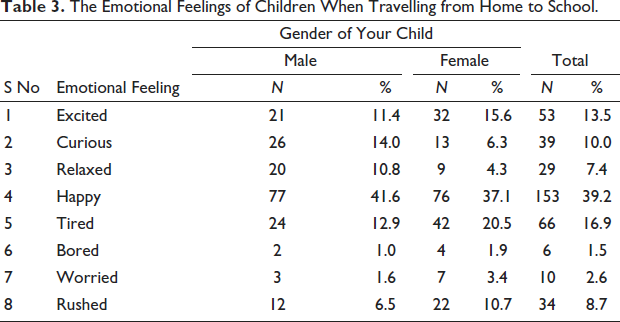
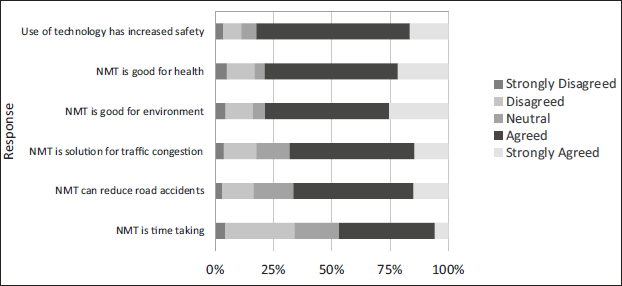
As indicated in Table 3, female students exhibited more negative emotions compared to their male counterparts, who tended to express more positive emotions. Consequently, female students displayed a reluctance to use NMT. Respondents were also queried about the benefits and limitations of NMT. While these questions garnered agreement from many respondents regardless of their chosen mode of travel, these factors do not provide a conclusive basis for determining travel choices. Instead, they reflect widely accepted norms within society (see Figure 5).
Response of Respondents on the Nonmotorized Transport (NMT)-related Statements.
Inferential Statistics About ATS and Its Relation With Different Factors
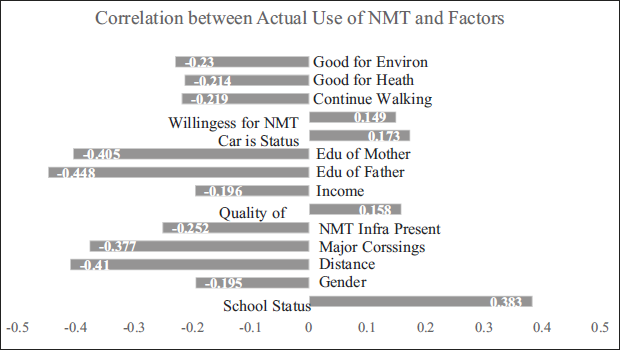
Analysis of variance (ANOVA) was performed between different factors affecting travel choices and the level of ATS by the respondents. The present level of ATS was found to be significantly related to different variables mentioned in Figure 6. An increase in the distance between home and school, and highly educated parents, reduces the NMT choices of parents. Actual ATS was positively correlated with school status (R = 0.38), quality of NMT infrastructure (R = 0.15), car as a status symbol for respondents (R = 0.17), and willingness to continue ATS (R = 0.15). Collectively factors mentioned above predict in 27.7% (adjusted R2 = 0.277) change in the present level of ATS in multiple regression (p < .01). However, maximum positive change was contributed by school status (β = 0.26) and adverse change by the distance between home and school (β = –0.22), keeping other factors constant at a 1% significance level.
Correlation Analysis Showing the Relationship Between the Actual Level of Nonmotorized Transport (NMT) and Other Factors at a 1% Significance Level.
Discussion
Different barriers affecting choices towards ATS, as per actual use, were assessed and compared with those of desired preference for ATS. Respondents identified the distance between home and school as the most crucial barrier for NMT, followed by the number of major road crossings on the way. Similar findings were reported by Kelly and Fu (2014) in Ireland, Hatamzadeh et al. (2017) in Iran, Kingsly et al. (2020) in India, and Helbich et al. (2016) in the Netherlands. Those with a longer distance between home and school, but less income of household, were forced to walk or cycle, but higher household income with a shorter distance between home and school was using MT. Thus, the distance between home and school was a significant factor for the level of ATS, it does not play an influential role in deciding the mode of travel. Further, based on the literature review and findings of the study, it is evident that there is no specific threshold of distance to restrict ATS.
The level of ATS was also found to be inversely related to the highest education of parents, meaning thereby, the income of households as reported by Bringolf-Isler et al. (2008). Respondents with a secure income source, like government or private sector jobs, preferred private schools, which are considered better than public schools (Meena et al., 2022). These respondents had a lesser preference for ATS in private schools, as Timperio et al. (2006) observed. ATS was the primary travel mode in public schools, which primarily cater to lower-income students with less educated parents. It has been found that the income of households (Pabayo et al., 2011; Tudor-Locke et al., 2001) and the education of parents (Reimers et al., 2013; Shi et al., 2006) are critical determinants for the decision of travel choices. Interestingly, both parents of students using ATS were working but had a low income, suggesting that they were involved in daily wage works, resulting in the unaffordability of motorized transport. This finding is in contrast to the reports of Aliyas et al. (2022), in which the walking and working of both parents were inversely reported.
Preference for MT was also found to be gender-specific (McDonald, 2012). Many respondents with girl children have lower levels of ATS because of safety concerns, a cultural phenomenon in India (Meena et al., 2022). Since girl students traveled more distance than boys, it is evident that parents are more concerned about a safe environment in schools. Thus, the distance between home and school is a secondary consideration. Like in this study, Kingsly et al. (2020) also found that girls travel a greater distance than boys in Chennai, India. The perceived reputation of the school is also responsible for longer trips to school through MT in India (Meena et al., 2022).
Another critical factor is the company during the travel from home to school, on which the emotional perception of commuters depends (Ramanathan et al., 2014). Male students generally travelled with their friends, while female students were accompanied by their parents, showing their safety concerns, which is specific to Indian culture. Emotional perception of students revealed that 70.2% of students had positive emotions like excited, curious, relaxed, and happy. In contrast, the rest had negative emotions such as tired, bored, worried, and rushed, which suggested that many students are satisfied with their current mode of travel. However, their parents wished to switch from NMT, especially those who were walking, to cycling or other MT because children, particularly females, felt tired during walking, the second dominant feeling among NMT-using children. This finding contradicts the report of Aliyas et al. (2022), who suggested more positive emotions in children who walk in Iran.
Safety concerns related to traffic and personal safety from crime and stray animals were identified as significant psychological barriers in NMT, as also identified by Rezaei et al. (2022). Respondents with alternate routes to school reported that they do not use them because of safety concerns and the quality of footpaths and roads. This result is supported by the findings of Huertas-Delgado et al. (2017) in Spain, Race et al. (2017) in Canada, and Romero (2015) in Australia.
Children walking to school at present did not show their desired preference for walking to school. Female students preferred walking, and male students liked cycling in the present study. Respondents walking at present were unwilling to continue it in the future, indicating that they use it due to unaffordability to use other motorized transport, but they are willing to use a cycle. There is likely to be a drop in ATS in Dehradun, as observed in different cities worldwide (Fusco et al., 2012; Kelly & Fu, 2014; Kim & Lee, 2020). Moreover, parenting style and perception of parents regarding safety while walking to school are also important factors in determining active travel choice (Rezaei et al., 2022).
Key Findings
The study makes several important contributions to understanding the factors influencing ATS: Identification of key barriers: It highlights the critical role of distance between home and school, road crossings, and safety concerns as major barriers to ATS, especially for NMT modes like walking and cycling. Socioeconomic influence: The study reveals that household income and parental education are significant determinants of travel choices, with lower-income families relying more on NMT, while higher-income families prefer motorized transport. Gender-specific insights: It uncovers that gender plays a role in ATS choices, with safety concerns particularly affecting female students, reflecting cultural dynamics in India. Emotional perceptions of travel: The study examines emotional responses to commuting, finding that most students have positive feelings about their travel mode, though fatigue is a concern among walkers, particularly girls. Relevance to policy: These findings offer a foundation for policies targeting infrastructure improvements, gender-sensitive safety measures, and socioeconomic support to promote equitable ATS participation.
Policy Recommendations
To promote ATS and address barriers identified in the study, a multifaceted policy approach is recommended. Infrastructure improvements should prioritize the reduction of major road crossings and ensure safe, well-maintained footpaths and cycling lanes, especially in areas with longer home-to-school distances. Traffic safety measures, such as pedestrian crossings and speed regulations, must be strengthened to alleviate parents’ concerns about their children’s safety, particularly for female students. Public awareness campaigns should be conducted to highlight the benefits of ATS, with a focus on addressing safety concerns. Collaborative efforts between schools, local governments, and law enforcement agencies can introduce initiatives such as supervised walking or cycling groups, which may alleviate parental anxiety, especially regarding the safety of female students. These programs can foster a sense of community and social cohesion among students while offering emotional support during commutes.
The findings of this study suggest that socioeconomic factors, including household income and parental education, play a major role in ATS choices. Students from higher-income families, who tend to attend private schools, show a lesser preference for ATS due to their access to motorized transport. To mitigate this, private schools should be incentivized to promote ATS by offering secure bike storage facilities and encouraging carpooling or cycling clubs. Additionally, urban zoning policies should aim to reduce the need for long-distance travel by ensuring more affordable and quality public schooling options closer to residential areas, particularly for low-income families who currently send their children to public schools far from home.
Gender-specific concerns must also be addressed. Many parents of female students, worried about safety, prefer to avoid NMT. Policymakers should introduce gender-sensitive measures, including well-lit routes, surveillance systems, and an increased police presence in areas where girls are most likely to walk or cycle. Schools can play a role by providing workshops that raise awareness about the importance of ATS, coupled with safety training for female students, encouraging a cultural shift toward more gender-inclusive mobility.
In addition to physical and gender-specific barriers, emotional factors should not be overlooked. The study reveals that 70.2% of students express positive emotions towards their current mode of travel, suggesting that any shift in policy should maintain or enhance this positive experience. Programs designed to foster a joyful travel environment, such as music, social activities, or rewards for ATS participation, can sustain and increase ATS engagement.
Limitations
The study has several limitations. It is based on a cross-sectional analysis focused solely on Dehradun, limiting its applicability to cities with similar characteristics. The study’s findings may not fully capture the diversity of travel behaviors in other regions with different socioeconomic, cultural, or geographic conditions. Additionally, the research only considers specific variables identified from a literature review, potentially overlooking other relevant factors influencing ATS choices. Finally, the study primarily addresses one type of commuter—students—and is based on the survey of parents whose children go to two private and two public schools of Dehradun, leaving out insights from other commuters as well as teachers and policymakers who may offer broader perspectives on active travel. Moreover, the study was so designed to understand the perceptions of parents and not the impact that their parenting style has on the choice of ATS, as has been done by some studies like Janssen (2015).
Conclusion
The study thus provides valuable insights into the factors affecting ATS, with a particular focus on the barriers that influence choices towards NMT, such as walking and cycling. One of the most critical findings is that the distance between home and school, while a significant determinant for the level of ATS, does not necessarily influence the choice of transport mode. This suggests that students, particularly those from lower-income households, may be compelled to use NMT regardless of distance due to financial constraints. In contrast, families with higher incomes tend to use motorized transport (MT) even for shorter distances, underscoring the socioeconomic disparities in ATS choices. This is further reinforced by the observation that ATS levels are inversely related to parental education, meaning that lower-income families with less educated parents are more likely to rely on NMT, especially in public schools, while students from higher-income families attending private schools show a preference for motorized modes.
A particularly significant aspect of the study is its exploration of gender-specific influences on ATS. Safety concerns, particularly for girl students, emerge as a major barrier to NMT, reflecting broader cultural dynamics in India. Parents are more cautious about allowing their daughters to walk or cycle to school due to perceived threats such as traffic accidents, crime, or harassment. Interestingly, the study also reveals that female students often travel longer distances than their male counterparts, adding to parents’ safety concerns. This finding suggests that, for many families, safety outweighs distance as a consideration when deciding the mode of travel, particularly for girls. The study’s comparison of emotional perceptions between male and female students further underscores these gendered differences. While male students generally travel with friends and report more positive emotional experiences during their commute, female students are often accompanied by their parents, reflecting deeper concerns about their safety.
To conclude, it is imperative to promote ATS through multiple interventions to avoid the extinction of experience among the children and to let them know about the surroundings and cultural heritage of the city, in addition to their health and a clean environment. Results revealed that parents did not prefer ATS based on its benefit, but out of financial compulsion. One possible reason for this is that current transport and infrastructure planning is calibrated for motorized transport (Winters et al., 2010). Therefore, the education of parents and children regarding the benefits of active travel is required to promote a healthy lifestyle. An NMT-based child-friendly city is always in the making through societal transformation, technological innovations, and user feedback, resulting in AT-centric urban planning.
Footnotes
Acknowledgment
The support from the Government of India and the Government of Uttarakhand is gratefully acknowledged.
Declaration of Conflicting Interest
The authors declare no potential conflicts of interest with respect to the research, authorship, and/or publication of this article.
Ethical Approval and Informed Consent
The authors confirm that a quantitative survey regarding the use of ATS was conducted, and the data of survey participants were collected for this study. The authors also confirm that the study was performed in accordance with the ethical standards as laid down in the 1964 Declaration of Helsinki and its later amendments.
Funding
The authors disclosed receipt of the following financial support for the research, authorship, and/or publication of this article: The author, AKS, is thankful to the Joint Japan/World Bank Graduate Scholarship Program (JJ/WBGSP) for providing financial assistance to study at the Institute of Housing and Urban Development Studies of Erasmus University Rotterdam.
