




Abstract
The strand of environmentalism that focuses on biodiversity as produced by the ecosystem places natural agency beyond human control. In Melanesia, where plants, animals, and men cannot radically be distinguished from one another, this standpoint seems too radical. Agronomic studies have shown that Melanesian gardens possess a profusion of biodiversity superior to the so-called natural one. This article therefore attempts to show that Melanesian commonality between people and plants and the correlative association of plants with humans are at the root of this profusion. In sum, rather than placing nature outside the reach of humans, the Melanesian case suggests that biodiversity is best served by human ritual actions during which vegetal materialize the social relations which link the different people.
Seen from a comparative anthropological perspective, environmentalism and its numerous studies, claims, and propositions concerning the alarming ecological state of our planet constitute a complex cosmological view that shares crucial dimensions with many major prophecies. Like the prophecies, these anticipate an apocalypse resulting from a terrible fault, pollution, perpetrated by the human race, designate culprits- capitalism, the industries, the cars, the power plants, and, in fact, each one of us– suggest that it can provide a road to salvation, assuming that many prohibitions are respected. Like the prophecies, these also regularly proclaim that it is already too late and that our doom is inevitable.
Like several other worldviews, environmentalism claims to speak for the whole planet, including humans, animals, and plants, but unlike them, it has little to say about gods, supernatural beings, and ancestors, perhaps because it is mainly concerned with the future, leaving the past unquestioned. Environmentalism is also a very eclectic movement, composed of many branches, orientations, and theories that often contradict one another. So much so that in France, the Greens have never managed to become a unified political force, although every French person is an environmentalist at heart.
Classical anthropology generally considers worldviews or cosmological constructs to be relative and, to a large degree, incomparable with each other. However, ecology does not entirely conform to this description, since it is reputed to be built on hard facts that are scientifically proven and therefore universally valid. Some anthropologists nonetheless disagree with that view and consider that science is merely Western “local knowledge,” whose universal claim is a leftover of colonialism (Latour, 2006; Turnbull, 1993).
I personally trust scientific methods and, unlike former president Trump, believe that global warming, as defined by science, is simultaneously a cosmological view, a local knowledge, and a fact endowed with a high degree of probability. But this does not mean that science is always the best road to preserving nature. Sometimes other cosmologies offer what appear to me to be more efficient solutions.
To show this, this article first focuses on the notion of biodiversity, which is quite slippery in spite of its apparent straightforwardness. As I gradually discovered, biodiversity bears no precise quantitative evaluation and can only be defined as the product of the global biosphere when humans refrain from interfering with it. It is therefore placed beyond any human control, and by definition, society can never have a positive grip on it.
This assumption, however, contradicts several agronomic studies that were conducted in the Pacific. These show that in Melanesia, subsistence gardens host an unusually high number of cultivars. Using ethnography, I then attempt to understand why and how Melanesian social practices increase biodiversity instead of reducing it as elsewhere. My conclusion is that in Melanesia, enhanced biodiversity is produced in conjunction with exchange rituals that place relations hierarchically above individuals. In sum, associating valued ritual practices with vegetables multiplies biodiversity.
To conclude my article, I invented a small fable on how the Melanesian propensity toward relationality could inspire today’s world at large, if not change it.
Is Biodiversity an Objective Choice?
As mentioned in the introduction, today, environmentalism is—throughout the world—a very rich and lively social movement. In what follows, I start to investigate the massively used notion of biodiversity. My findings concerning this concept are therefore probably trivial for many of you.
In 1992, the United Nations Conference on Environment and Development held in Rio de Janeiro ended with the signing of the convention on Biological Diversity, which begins as follows:
The Contracting Parties, Conscious of the intrinsic value of biological diversity and of the ecological, genetic, social, economic, scientific, educational, cultural, recreational, and aesthetic values of biological diversity and its components. Conscious also of the importance of biological diversity for evolution and for maintaining life sustaining systems of the biosphere, Affirming that the conservation of biological diversity is a common concern of humankind.
My interest in this declaration arises principally from the fact that it features a complete reversal from previous ways of thinking and acting upon what we used to call nature. Ever since human beings started growing food plants some 10,000 years ago, they have constantly reduced or multiplied biodiversity through selection and crossbreeding. However, the UN declaration goes against this human intervention by establishing biodiversity as a good per se, independent of any human context or goal.
In spite of this, just like yesterday, farmers all over the world today select certain cultivars over others for various idiosyncratic reasons. In modern Europe, selection is principally geared toward increasing production, a goal also prominent in other realms of these very social configurations. However, in other cultures, and even in Europe, when food is produced for self-consumption, other motivations may prevail, such as the food variety’s quality (taste), its capacity to survive attacks (pests, sicknesses), its ability to withstand unusual climatic variations, and the habits of the farmers—their moral beliefs, religion, regional influences, and so forth. For example, for ritual reasons, the Indonesian Toraja breed meticulously selected buffaloes whose skin is spotted black and white.
What is common in all these cases is that someone decides which species are better than others according to a scale of values that varies from place to place, from one epoch to another, from family to family, and sometimes from person to person. Agricultural selection is thus a normative practice that obeys varied values, which are often also preeminent beyond agriculture in other domains of the concerned social configurations.
In Euro-America, until World War II, selection was not considered a threat to human life or to nature. Farmers used it with no second thoughts to achieve an easier life and to obtain what they conceived of as better products. From the end of the nineteenth century onwards, however, selection has intensified drastically with the appearance of so-called applied scientific procedures. According to historians, agriculture was then gradually encompassed into the liberal economy, which offered no choice but to favor productivity over any other criteria. And it worked, since in Europe, between 1945 and today, food crop production has multiplied by 4.5, a much larger increase than that which occurred between the invention of agriculture and the 1940s. See, for example, the graphic representation in Figure 1, which is very telling:
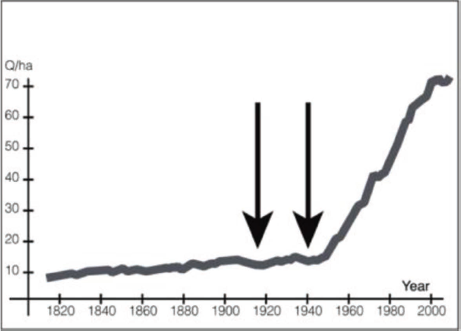
In capitalist systems, this amazing increase in yield was driven, it was argued, by the desire of individuals for wealth. But it occurred as well in the communist states, where it was kindled by the professed goal of improving the conditions of the people. In both contexts, the single value of “massive production” was in principle pursued by all farmers.
Therefore, what has changed in Europe since the 1940s is not that agriculture has become selective while previously it was not, but that selection is now made with only one goal in mind, rendering all other values such as taste, health, and biodiversity redundant. This is, as Dumont (1977) argued, characteristic of individualistic social configurations that are unable to order hierarchically different values. In the present case, reduction to a single value had dramatic consequences for biodiversity.
However, environmentalism is, we hope, on the verge of changing this. As stated by the UN’s declaration, a new “intrinsic value,” “biological diversity,” is to be pursued by all humankind. Its scope encompasses the diversification and selection due to biological evolution but not the creation by humans of new species, like genetically modified organisms (GMOs). Therefore, biodiversity is to be only maintained and controlled by the “life-sustaining systems of the biosphere” that human beings must refrain from disturbing. Biodiversity is thus a self-regulating system that resembles, in many ways, Adam Smith’s vision of the economy. In both schemes, an invisible hand guarantees the balance of the system for as long as no human activity interferes with it. 1 Biodiversity is thus placed, like the economy, beyond the evaluative sphere of social systems.
This very radical understanding of biodiversity poses new problems. Since biodiversity stands beyond any moral evaluation, science must develop an objective measurement for it to decide, for example, whether to protect a particularly richer tract of land rather than a poor one or to prohibit industrial practices that threaten the natural balance.
To create such an objective gauge, one must first determine the scale on which biodiversity is to be measured. This point was dramatically illustrated by Erwin’s (1980) pioneering study of a single tree in Panama, in which he discovered a number of fauna species that outnumbered the total variety of animals identified in the United States.
However, this problem of scale is easily manageable, as it only requires that all research adopt a common scale of measurement. What is more problematic, however, is devising a scale to measure the diversity of species within a natural context. To grasp this, we have to consider a definition of biodiversity; for example, the first one, given by Wilson (1988), state:
Biological Diversity, or biodiversity, is the variety and variability of all living organisms. This includes the genetic variability within species and their populations, the variability of species and their life forms, the diversity of associated species complexes and their interactions, and the ecological processes they influence or play a role in.
Unlike stars in the sky, the elements that compose biodiversity, as defined by Wilson, are heterogeneous and therefore cannot simply be added to one another. To measure them, the ecologists must use complex mathematical models borrowed from other disciplines like economics or communication theories. These models have two common characteristics. First, they ensure that each individual organism that is taken into account is different from all others, and second, they attribute an equivalent weight within the global index to all unique living organisms. This is to say that an elephant and a cockroach are different but of equivalent value. As a result, the measurements that these algorithms produce, objective as they are, never match the common perception that we all have of what biodiversity is and of what must be preserved at the expense of what else. The ecologists call this discrepancy the “Noah’s Ark paradox.”
For example, a patch of forest populated by thousands of ants presenting distinct genetic characteristics is, according to these models, richer in natural diversity than an equivalent patch of forest populated by hundreds of animals of what we think of as diverse species. Thus evaluated, the disappearance of white elephants counts for nothing when weighed against the diversity of ants.
So, the question arises whether we should use these abstract “objective” models that do not match the public notion of biodiversity or balance them with factors that produce more “humanly acceptable,” if necessarily biased, results. For example, taking into consideration the impact of wildlife on the ecological milieu, one could decide to diminish the value of species that have only a small population (like the white elephants) in relation to others that are numerous (for example, the bonobos, which number, it is said, 30,000). This option is certainly more holistic than the former, but it further penalizes smaller populations, and if followed, white elephants are gone.
An alternative solution would favor an ecological niche populated by a few widely separated species over one populated by a high number of closely related ones, like insects. This would protect white elephants, but produces nothing more than our common idea of biodiversity, a worldview derived from the Bible, that favors mainly big vertebrates to the detriment of roaches. 2 This incapacity to produce an acceptable measurement scale is disastrous, because how could an idea like biodiversity gain universal acceptance, if not at least based on scientific forms of truth equally valid for all?
In reaction to this relativity, or perhaps because of this relativity, Bolivia proposed in 2013 an alternative definition of biodiversity, centered around what it called Mother Earth.
The concept of Mother Earth is completely different from nature. Mother Earth is a living system or living being. This would imply saying that nature is considered as a living being with specific “rights,” paralleling, “human rights.” In conclusion, Mother Earth is “our mother and therefore is not an object to be exploited by human beings.” (Borie & Hulme, 2015, p. 492)
From a different perspective, this definition comes to a similar conclusion as the UN’s: that the Earth should not be exploited by human beings. But is that the best solution to protect biodiversity? In what follows, I attempt to show, on the contrary, that Melanesian social configurations are remarkably effective at exploiting the Earth while producing biodiversity.
A Different Form of Relationship to Whatever Is Around
If anything is common to all non-urbanized Papua New Guineans, in spite of their very diverse cultures, it is that they primarily see themselves as gardeners. When a Papua New Guinean is asked to tell what characterizes her or his nation, rather than insisting on a language, a custom, a territory, or a religion, she or he answers systematically: “Being X is growing such or such vegetable 3 in one’s garden.” And for them, this is not only an idea, since food production occupies most of their time and their vegetable harvest makes them particularly proud. This is why one chooses a spouse, not mainly because she or he is good looking or intelligent, but because she or he is good at gardening.
This is also why Papua New Guinea became famous in anthropological literature when Malinowski (1935) meticulously described in his Coral Gardens and Their Magic how the Trobrianders daily addressed their yam with spells and discourses to convince them to grow. Apparently, it worked, as it was not uncommon for Trobriand farmers to exhibit yams that were well over 10 feet long. I refer here to this classical piece of work to introduce the idea widely accepted today among Melanesia specialists that cultivated plants are, in certain respects, not very different from women and men.
This becomes even clearer when one considers that Melanesian gardens are very similar to villages. To develop this point, I have to go into detailed ethnography and therefore turn to the Orokaiva of Papua New Guinea, among whom I work. As they see it, in ancient times, Orokaiva’s ancestors had neither villages nor gardens. They lived in scattered caves, around which they foraged for food and fought for their lives with everyone they met (Vevehupa, 2013). Villages and gardens were simultaneously invented when two apical ancestors made friends with each other and decided to settle together, thus initiating present-day civilized life. 4 Ever since, villages and gardens together have represented the most valued form of living.
However, their acquisition is not irrevocable. If the present-day Orokaiva do not do what must be done, they may return to their ancestors’ pitiful condition. Civilization can only be preserved if women and men combat the equatorial forest (araga) that invades, covers, and digests everything at an almost visible pace. This is why, every morning at around six, the women descend to the ground from their houses raised on posts with a bush knife in their hand. Before doing anything else, they scrupulously uproot every small bit of vegetation that has grown during the night. Then they move on to the garden, which also needs to be weeded daily.
At any rate, wild plants growing uncontrollably in the village or garden are associated with doom. For example, when someone dies, her or his corpse is generally buried under her or his house, which is thereafter abandoned. Soon, grass grows under and around the building, and the forest rapidly regains the area that the house previously occupied in the village. This invasion has not only a horizontal dimension but a vertical one as well, as the house’s posts are made of a particular kind of wood that has the capacity to take root everywhere it is installed. Consequently, after the owner’s death, the house’s posts start growing vigorously, raising what is left of the house toward the sky. A village in which too many houses are left to rot is considered a victim of death magic. So, the remaining residents get frightened and move away to other villages rapidly. Finally, when everyone is either dead or gone, the wild bush regains its rights over the entire ground.
An identical dynamic punctuates the gardens’ activities. As soon as an Orokaiva arrives in her or his garden, she or he begins to uproot or cut all the wild plants that have grown between the crops since her or his last visit. Of course, in France, we weed gardens as well, or perhaps we spread chemicals like Roundup. However, we do this not out of fear of the wild, but because we believe that this is what it takes to multiply production. The Orokaiva think differently. For them, human beings and plants are not totally dissimilar. A garden is, therefore, a village where civilized plants live. This is why crops and humans are united in their struggle against a common enemy, the wild bush.
Slash-and-burn gardens are conquered, like villages, over the jungle by clearing everything that grows on the ground and then burning the leftovers. Later, when ripe crops are harvested for consumption, their shoots and buds are replanted on a piece of land that extends the main garden. In the same way, grown-up boys often settle on a plot that extends their parents’ village. Finally, like in a village, when there is nothing left to eat in an old garden, the owners abandon it to set up a new one somewhere else, away from the desolate site.
Garden crops are parsimoniously consumed as everyday food, along with what is obtained by foraging, hunting, and fishing. However, the main purpose of gardening is always to organize a gift-giving ceremony. Among the Orokaiva, as elsewhere in Melanesia, on such occasions, a wife and husband offer their guests large quantities of pork and garden-grown vegetables, especially taro or yam (tubers), which are piled on a platform perched on particularly high stilts. Among the Orokaiva, like in many other Melanesian societies, these stilts are made from trees that are planted upside down into the ground. The taro tubers are piled on the floor of the platform and covered with thick foliage, so they remain in complete darkness. On the day of the ceremony, when all the guests are assembled at the foot of the platform, the big man’s helpers remove the foliage to uncover the taro. It is then said that the audience is amazed by the sight.
Because the stilts of the platform are planted upside down and the taro is hidden in the dark, the platform represents an inverted garden whose floor is the ground. Therefore, on the feast day, the donor renders visible the taro, which usually hides underground. 5 This means that, for the sake of the ceremony, a garden has been transported to the center of the village, uniting the two civilized spaces that resist the powerful expansion of the wild bush.
Strathern (2010) argued that in Melanesia, the relationship between the people and the land cannot be described in terms of ownership. What is at stake here, she argues, is not the ground itself, but the crops that women and men plant on it. Through their actions, they acquire a sort of “intellectual property” over them. Their crops are produced by their people, just as their people are produced by their crops. In line with this view, the Orokaiva taro piled up on the feast platforms constitutes the epitome of an alliance of those who are civilized against the bush.
Aliki Nono’oohimae, one of the founders of the Solomon Islands’ independence movement Maasina Rule, expressed this same continuity in a different and deeply mysterious form when, in 1985, he dictated to Daniel de Coppet (1985) what was intended to become a land tenure code.
The Land owns people, but people own land:
because your Tree
6
is there! because your Afterbirth is there! because your Funeral Site is there! because your Apical Ancestor is there! That is why you own land; that is why you rule over land!
From the Orokaiva point of view, what Aliki probably meant here is that all important human actions consist of piercing the surface of the ground—to construct a village, to plant a garden or a tree, to bury a placenta or a dead person—because all these human practices defend civilized life as against the digestive capacity of the bush.
Relations and Natural Diversity
Considering the importance of their garden, one would expect the Melanesian to exercise drastic crop selection in order to boost their yield. However, they do nothing of that sort. On the contrary, what unanimously struck and puzzled the agronomists who observed Melanesian agricultural practices is that each family garden contains an extremely large number of varieties of the most important local crop. For example, for taro, agronomists have counted more than 80 varieties present in each garden (see Caillon, 2005a, 2005b, 2012; Kreike et al., 2004). Taro gardening in Melanesia is probably over 8,000 years old, and the specialists wondered why the Melanesian farmers preserved so many distinct varieties instead of selecting the most productive of them, as was done everywhere else in the world since the appearance of agriculture. As an anthropologist, I think I can attempt to answer this question by replacing agriculture practices within the social configurations to which they belong. But to do this, one must go back into detailed ethnography.
Among the Orokaiva, where taro is the main crop, families do not have the same relationship with all the varieties that grow in their garden. 7 Rather, each family is closely connected to a specific taro cultivar, which they say they own and are the best at growing. Therefore, each woman or man, following her or his ancestors’ practices, always seeds in her or his gardens a large amount of this variety. One could perhaps consider this strong identification between people and plants as an unsophisticated form of totemism (Lévi-Strauss, 1969).During gift ceremonies, the taro piles that are offered are always topped off with a bunch of the giver’s particular taro variety. This bunch functions as a sort of signature that identifies each pile’s giver in the eyes of onlookers. But this is not all. The taro piles presented during the ceremonies contain not only food but also vegetal life. Taro tubers are eaten, but the leaves can be replanted to grow new taro. Therefore, someone who ceremonially receives taro can replant in her or his garden the leaves of the species associated with the donor’s family. Orokaiva always do this, as they feel that it prolongs the relationship between the giver and the taker. Consequently, in every family garden, one finds, together with a large proportion of the gardener’s own cultivar, a number of other varieties that were given to her or him on ceremonial occasions. The presence of numerous varieties in every Melanesian garden thus appears to be the outcome of ritual exchanges. One obtains taro seeds of a new variety every time one acts as a receiver in a ceremony where the giver is someone whom one was not in contact with previously. If one replants these seeds in one’s own garden, one will recall the giver’s identity and the occasion when the taro was given and also that one must at one time or another reciprocate by giving back a gift. Hence, the number of taro species found in Orokaiva gardens depends on the involvement of the gardeners in gift ceremonies that put them in contact with rather distant families. People who have numerous varieties planted in their gardens also have numerous relationships with others, especially with people who live far away. When looking at their garden, Melanesian farmers are thus less interested in the size of the harvest that they expect to obtain than in measuring the extent of their relations with others. In sum, they assess their prestige by the number of taro varieties that grow in their garden. Their interest has thus little to do with what we call biodiversity. On the contrary, the crop varieties attest that, due to the ritual work of the people who planted the garden, women, men, animals, and plants have, for the time being, managed to remain civilized.
It is important to note that in this context, taro is not simply a sign that represents a relationship. Rather, the relationship depends on it to remain active. This becomes visible when a flood washes away a particular variety of taro from a family’s garden. 8 The farmer is then devastated and invests tremendous effort in finding similar shoots. This is so, not because she or he lacks taro to eat, but because if one cannot find seeds of the same kind to replant, the relationship she or he had with those who gave her or him this cultivar is jeopardized. Without the taro, memory does not stick, and soon there will be no reason to revive a relationship for which no variety of taro is planted in the garden.
In the wake of environmentalism, a number of agronomic studies have recently been conducted on taro (Caillon, 2005a, 2005b). Among others, a research team has replanted in an agronomic station all the varieties they found in the gardens of a Vanuatu couple. Their goal was to see whether what the owners considered different varieties were biologically distinct species. The results of this study are interesting for us as well.
Many varieties of taro are visually so similar to one another that it is impossible, even for specialists, to distinguish them. However, older Vanuatu informants were able to differentiate a very large number of species, including some whose names they had forgotten. After biological analysis, these pretended varieties also appeared to be genetically distinct cultivars. Furthermore, the agronomists traced the origin of most of them not to a single region, but to different places all over Vanuatu and to other surrounding islands as well. These results show that in Vanuatu, as among the Orokaiva, cultivars circulated over large distances, establishing and recalling relationships between people living far away from each other.
For the agronomists, the fact that all these cultivars are genetically distinct demonstrates that the original exchange in the context of which they were given took place long ago. In the meantime, the cultivars were then able to genetically separate from the species they were taken from. This also means that the Ni Vanuatu were able to preserve these species continuously in their garden all this time (Quero-Garcıa et al., 2006).
A second experiment surprised me even more. After they had planted the taro in their agronomic station, the agronomists invited the farmers from whom they had received the crops to come and see their own plants in this new setting. However, since the species of taro were now distributed on the land according to a different logic, the farmers were unable to distinguish the varieties that they had easily differentiated previously. This shows, I think, that beyond the visible characteristics of these varieties, Melanesian gardeners perceive or perhaps recall the invisible human origin of all species of taro according to their placement in the garden. Melanesian gardens are not, therefore, simple plots where vegetables grow, but are organized to display a totality of relationships. Among the Orokaiva, the farmer’s own cultivar is hierarchically most prominent and valued and dominates the other varieties, which are nonetheless indispensable. A Melanesian garden is therefore a landscape of a holistic nature in which each variety obtains its identity from the presence and arrangement of all varieties, just as a village is characterized by the relations among its inhabitants.
One could consider that this case illustrates the structuralist rule by which, as in totemism, natural differences are used to index social distinctions. However, in my view, it is more than this. The numerous taro species known in Melanesia do not result from natural biodiversity, as defined earlier. On the contrary, the practice of vegetable exchange permitted the Melanesian people to diversify taro into numerous species, which have been preserved over generations. In short, in Melanesia, exchange practices produce and maintain biodiversity, just as the 30,000 species of orchids result from the coevolution of these plants and of the insects that pollinate them.
This is not new, since we know that, over centuries, farmers have created thousands of plants by selection or hybridization. What may be specific to Melanesia is that the intensity of social relations with others, especially with people who live far away, is directly productive of biodiversity. Maybe this should lead us to reconsider today’s very trendy notion of eating locally produced food.
Conclusion
Bananas were originally turned into cultivated plants in Papua New Guinea some 6,800 years ago (Hunt & Rathnasiri, 2018). What puzzled the archeologists who worked on this question was that they also found cultivated banana fragments dating back to 5,200 years in Uganda. Understandably, they wondered how these plants got there from Papua New Guinea. However, recently, new data shed new light on the matter. Scientists have discovered domesticated banana fragments dating back to 6,000 years in Sri Lanka, thus offering a link to their presence in Uganda.
Given these elements, it is possible to imagine that those who invented this new delicious fruit in New Guinea, proud of their discovery, decided to transport it to other people. The endeavor must have been difficult since bananas only reached Sri Lanka 800 years later. It is true that those who transported the bananas had to cross the ocean on canoes. They had to carry shoots in pots, since bananas do not reproduce from seeds. My guess is that this banana export features an antique instance of today’s Melanesian vegetable gifts in the hope of creating relations with faraway people.
Returning to environmentalism, after writing this article, I am still unsure of what I can do for the planet. However, I think that I have learned something about relationships. If vegetable species could be considered in Euro-America to preserve a relationship with the people who created them, as they do in Melanesia, the world in which we live could improve and biodiversity could be better protected. This would simply mean that each time we eat a tomato, a banana, or a sweet potato, we think of the people who created these species in America, Africa, or Oceania. And this is indeed what Melanesian people do. Every time they eat corn, potato, or apple, they think of those distant exchange partners who invented these vegetables and to whom they would be eager to send a return gift of taro.
Footnotes
Declaration of Conflicting Interests
The author declared no potential conflicts of interest with respect to the research, authorship, and/or publication of this article.
Funding
The author received no financial support for the research, authorship, and/or publication of this article.
