



Abstract
In this article, the author intends to reappraise the Naga perceptions of cosmology and spirituality which are rooted in the spheres of ecology, folklore, stone culture, “gennas” (rituals and taboos), and ancestor veneration. Included within the realm of ecology are village territory, land, forest, and agricultural fields. The Naga spirituality is perceptible in persistent survival of revered human relationships with the nature and the supreme creator, enduring roles of shaman-priests and clan/village elders as also commitment toward village customs and gennas, including agricultural rituals plus reverence for elders.
In this article, the author intends to reappraise the Naga perceptions of cosmology and spirituality which are rooted in the spheres of ecology, folklore, stone culture, “gennas,” and ancestor veneration. Among the Nagas, the spiritual beliefs become comprehensible in terms of numerous genna-based social and ritual observances, reverence for sky and earth divinities, ancestor veneration, and respect for clan-village gates, monoliths of ancestors and memories of origin myths. The Naga spirituality may be broadly envisaged as a persistent survival of revered human relationships with the nature and the supreme creator, enduring roles of shaman-priests and clan/village elders as also commitment toward village customs and gennas. “Naga” is an umbrella term for several indigenous “tribes” of Northeast India and Upper Myanmar. The word Naga originated as an exonym, but has since been internalized. In this article, the author is focusing on the Nagas of Nagaland and Manipur. 1
Spirituality, Cosmology, and Ecology
Scholars of religion have identified symbolic and ethical dimensions within particular religions in their relations with the natural world (Tucker & Grim, 1993). Many indigenous spiritual and philosophical traditions express ethics and respect for nonhuman life, and particularly for the Earth itself (Taylor, 2005). Scholars use the term spirituality to refer to indigenous ontologies, “ways of being” and epistemologies, “ways of knowing” (Grieves, 2009). Indigenous or tribal cosmologies are rooted in creation stories related to the cosmos and humankind and are linked with earth and sky, directions, and seasons. Indigenous peoples’ traditional knowledge of natural resources and ecosystems are often associated with folk narratives. Ritual practices and oral narratives are part of indigenous cosmology (Grim, 2005). Tribespeople attribute enormous importance to ancestral lands, ancestral legends and memory. Environmental ethics in tribal societies are visualized in people’s “closeness” with nature and intricate relationships between people’s physical, spiritual, and human worlds (Altman, 2004). The tribespeople need to interact with the environment to obtain food, water, fuel, medicines, and many supplementary things. History of humankind shows that humans are woven into the ecological interconnectedness of the earth surface. Ecology is indeed not separate from cosmology, which is functioning at the scale of terrestrial coexistence, integrating the same dynamics of differentiation, self-organization, and communion (Mickey, 2018). Berry (1999, p. 84) puts this point succinctly: “ecology is functional cosmology.”
Naga Worldview, Cosmovision, and Spirituality
Among various Naga tribes, the worldview, cosmology, and myths of origin are critically tied with the Naga perception cosmovision. In traditional Naga perception cosmovision is articulated through the spiritual world and physical environment in which the Nagas conduct their lives. The cosmovision is the holistic worldview of the Nagas. It interprets the relationship between humans, their environs, and the universe—the cosmos.
The Naga tribes visualize a cosmological order and a creator god, which is the ultimate being conceived as the originator of the universe. Various Naga tribes identify divinities and “spirit-beings” of the earth, sun, sky, light, fire, wind, water, streams, mountain, and numerous inanimate objects. The Naga tribes venerate the nature particularly by revering the deities of dwelling, of wealth, of forest, of river, of rock, and mountain (Martemjen & Lanusashi, 2014). In the Naga worldview, the earth is a “living earth” (Martemjen & Lanusashi, 2014). Hence, the cultural life of the Nagas is influenced by its relationship with its natural environment.
The Naga spiritual worldviews and the cosmovision encode ethical practices, taboos, and the knowledge systems, which are historically linked with farming practices and agrarian rituals. One notices among the Nagas an innate commitment to cosmological principles. The spiritual beliefs among the Nagas also tend to surround around customary jural-ethical practices, such as “oath-taking” practices, which are used as last resort (Das, 1993, p. 88). The moral, jural, and divine implications of Naga “oath-taking” are discussed below.
Searching for Naga religion in terms of a specific set of organized beliefs and practices will be a futile exercise. In fact, visualizing religiosity in Naga society from the prism of the world religion will lead to the misleading inferences. Likewise, imposing various notions and concepts such as the god, deity, spirit, heaven, and hell in cultural spheres of Naga tribes will be incongruous. In this article, therefore, the author intends to situate Naga cosmology and spirituality in the larger ecological, folkloric, and cultural spheres. Geertz says that there is no difference between religion and culture or religion and worldly sphere, because in his definition the religion is a cultural system (Geertz, 1973, p. 90).
There prevails a pervasive stimulus in Naga mind which juxtaposes the humans, the plants, animals, and the earth and sky as a part of a cosmological continuum. Naga cosmologies are related to earth and sky, and the seasons. Guided by the cosmological relationships, Nagas have sustained creation stories and cultural memory of ancestors, which are tied with the earth, sky, and the “stones.” Hence, one may characterize the Naga spirituality as an amalgam of diverse ecological, cultural, ethical, and celestial notions, which are sustained through adherence to multiple rituals and regulations collectively called “genna.”
Many Naga tribes have a clear concept of the creator, known by different names, alongside the Mother Earth. The Maos consider the sky as the father and the earth as the mother. The Semas call the supreme divinity as Alhou, the Lothas call it Potso, the Angamis call it Ukepenuopfu, the Aos call it Lijaba, Rengmas refer to it as Sunggigu or Anyiza, and the Phoms call it Vangyoung Ongpa (Martemjen & Lanusashi, 2014). The Lotha deities are divided into three categories such as the supreme god, the deities, and the spirits. Situated in the upper strata of the cosmos is the supreme god. Occupying the lower strata of the cosmos, alongside humankind and the flora and fauna surrounding it, are lesser deities (supernatural beings/spirits). The Lotha ultimate god is an object of worship, the creator, the sustainer, and the controller of the universe. The Lotha use the term potsow to describe the supreme god (Ezung, 2014, p. 44). The Naga cosmovision, cosmological beliefs, practices, tales, and songs revolve around nature. However, the rich cultural heritage of the Nagas has been subjected to transformation as a result of the modern education, change in religion, and westernization of culture (Martemjen & Lanusashi, 2014), even though Naga scholars in recent years have shown intellectual fondness for the pristine Naga cosmology, spirituality, and festivals.
Human–Animal Symbiosis and the Origin Myths
The Naga people believe that human beings, divinities, animals, aquatic creatures, and plants had symbiotically existed since time immemorial. The Rengma Nagas regard the tiger as brother. On the other hand, the Konyaks treat the tiger as a family member. The author had met fully tattooed Khiamngan Naga “warriors” in Noklak in 1980s, who were designated as the “tiger men.” The Khiamngans have tattoo traditions associated with tigers and the chest tattooed with V-shape is equated with the “tiger chest.” Likewise, among the Changs, the author had met elderly chiefs who had tigers as their companions (Das, 1994).
Stone Culture, Monoliths, and Cultural Memory
The widespread distribution of monoliths throughout Naga territories, represents a rich heritage of stone culture. In fact, folktales are replete with accounts of stone derivation of the Naga tribes. Hence, historically one may designate the Nagas as the stone people. Great penchant is accorded to large stones and there is a belief that these stones are alive.
About 100 years ago, Hutton reported that in many Angami villages the Ketseshe genna is performed and thereby the son who inherits the ancestral house erects stones in memory of the parents (Hutton, 1921a; 1921b, p. 407). The author during numerous visits to Angami, Chakhesang, and Mao areas has witnessed series of monoliths which have preserved the memory of the dead. In Viswema, the author had observed in the 1980s the popular tradition of dragging the stone ceremonially (Das, 1993, p. 144). Stone pulling in Viswema is associated with feast of merit or “status elevating” gennas. The wife plays an important part in the genna. Completion of this genna leads to the pulling of stones, and thereafter the host acquires special status and privileges and right to erect stone (Das, 1993, pp. 144–145). Megalithic building practices have survived amongst the Nagas of Manipur (Devi, 2011). Dolmens are present among the Poumai, Maram, Mao and the Liangmai Nagas of Manipur (Devi, 2015, pp. 641–665). Erecting of monoliths was observed among the Lhotas and Rengmas as also the Semas (Hutton, 1921a, p. 407). 2
Culturally remembering their ancestors, the Sema Nagas and a section of the Aos believe that a pair of stones, male and female, had produced their ancestors. A section of the Angamis believes that their ancestors emerged from the depths of the earth. The Konyaks believe that they first came out from beneath a rock (Longphang Phinyu) situated in a wide-open-stone-cave (Das & Imchen, 1994). The Aos believe that their forefathers were born out of six stones which are still existent in a village called Chungliyimti (Ao, 2014, pp. 54–70). Temsula Ao has commemorated this legend in this manner:
Lungterok The six stones Where the progenitors and forbears Of the stone-people Were born Out of the womb Of the earth.… Stone-people Savage and sage Who sprang out of Lungterok Was the birth adult when the stone broke? Or are the Stone-people yet to come of age? —Ao (2009, pp. 1–3)
In the writings of colonial ethnographers, we find many illustrations of stones. Thus, we notice that many Naga tribes such as Angami Lhotas, Semas, Changs, Aos regard stone celts as thunderbolts. The possession of a celt is regarded by the Angamis as a sure means to prosperity and well-being. The Lothas regard them with some awe, and oaths are taken on them (Hutton, 1921, p. 406). Many Angami clans, keep a genna stone called Kepuchi, usually near one of the village gates (Hutton, 1921, pp. 404–406). In Lhota morungs, too, round stones, not very large, are kept and seem to be regarded as the habitation of a spirit (Hutton, 1921, p. 406). Oaths are taken on them.
In Lotha Naga villages, there are “genna” stones (longzi) standing in front the house of the owner. Every Lotha village has a sacred head-tree called Menkitong. The village luck-stones (Oha-long) are preserved at the foot of this head tree. Every year the luck stones are counted. It is believed that if the numbers increase from the previous year’s count, it is a good omen for the village well-being and if it has decreased it is a bad omen (Ezung, 2014).
In Ao-Naga areas, there are forest and bamboo groves, streams, peaks, and caves considered to be the abodes of the deities, and hence are sacred and felling down of trees, collecting forest produces, or farming are prohibited in these areas (Zingkhai, 2015). In Waromung Ao village, Jangjanglung, a majestic rock retains its sacred character. Even today none would spit near the stone or thrust the spears on the ground (Zingkhai, 2015).
In Manipur, there is a village called Makhel. It is believed that it is birthplace of many Naga tribes. Before departing, each tribe erected stones to memorialize their common ancestry. These stones are still in existence today (Kamei, 2022).
Referring to the southern Angamis, Hutton wrote that the memorial stones among the Memi and “Dzunokehena” Angami are erected among the rice terraces (Hutton 1921a, p. 48). What was “Dzunokehena” segment in the past is Zounuo-Keyhonuo today (Das, 1993). In most Zounuo-Keyhonuo villages including Viswema indeed such stones are profusely visible in village outskirts and within clan-territories, called thenu. The Konyak monoliths are smaller and less impressive. They attach a ceremonial importance to the use of stone, and while the Angami build elaborate stone forts or sitting places on the graves of the founders of their clans, the Konyaks make stone seats for their chiefs (Angs) (Hutton, 1921a, p. 28).
Centrality of Land and Forest Ecosystem in Naga Cosmovision
Cosmovision is the cosmic worldview of a people. According to indigenous cosmovision, nature and Mother Earth is a sacred living being, which depends on all other living beings, including stones, water, air, earth, and all the creatures that inhabit earth. All beings have the right to life, respect. The Indigenous women spoke about the responsibility of humans to care for the source of life, the need to live in balance and harmony with nature. (
For the Nagas, the land and forests exist not merely for material and economic purposes, but also for spiritual purposes. Rudiments of traditional reverence for the land are noticeable among Naga tribes. Thus, among the Ao-Nagas, the forests, paddy fields, bamboo groves, streams, peaks, and caves are considered to be the abodes of the deities (Zingkhai, 2015).
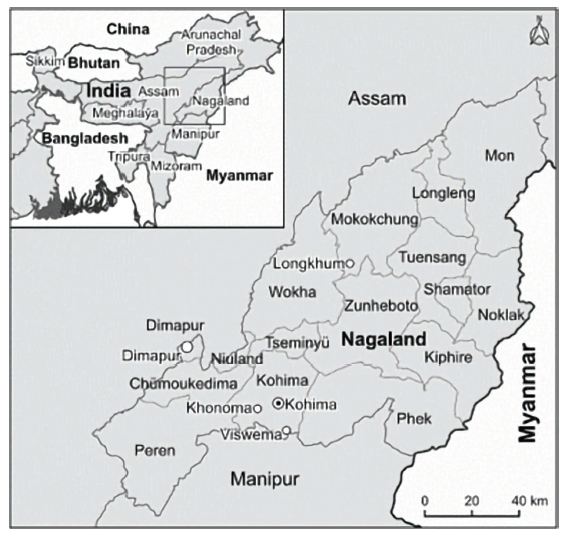
Nagaland is entirely a hilly region. Here, the mountains merge with the Patkai Range along the Myanmar border (Figure 1). Secluded within their “territories” different Naga tribes had historically maintained a high degree of isolation while they lived in their “village republics” with little contact with outside (Das, 1993, pp. 30–31). The Naga tribes possess high ethical concerns about the forests, trees, and animals. Hence, cutting trees without specific purpose, cruelty to animals, mismanagement of seeds, and fruits are regarded as unethical. Among the Phom Nagas, a saying states: “Don’t cut the stem of this plant; it will feed you during famine” (Martemjen & Lanusashi, 2012). The Nagas believe that forests are the abode of divinities and spirits. Before a tree is cut down, the Aos usually place a stone on the stump of the tree so that the spirit of the tree might not blame the men for the high handedness but simply put the blame on the stone (Bendangangshi & Aier, 1997/1990, p. 15). Large trees are visible in the outskirts of the village often close to monoliths erected in memory of the ancestors. Such trees are not harmed as they are village guardians as also part of cultural memory.
The Naga mode of communication with divine powers has been through natural agents like birds, plants, animals, and signs and dreams. Birds, fowls, and insects are part of agrarian sphere among Naga tribes. Among the Chakhesang tribe, the birds and insects provide some guidance in farming activities. A common belief in Ao villages noted by the author is that appearance of Zipangrep, a seasonal bird, indicates the time for seed sowing. According to village elders, arrival of the Kukurhe’s (hawk-cuckoo) in March implies the time for sowing of seeds (Tshipfo-Tshikhru) in the jhum fields. A common belief in Ao villages noted by the author is associated with crows of cock. When the first round of cock crows it is rising time from the bed; second round is alert for getting up and third round indicates time for cooking and getting ready and reaching the field before 8 o’clock in the morning.
In the past, numerous rituals were performed by the priest-shamans to appease the divinity so that bumper crops are obtained. In the past, the life essence of the dead was conceived of as directly associated with the fruitfulness of the crops, and it is perhaps in keeping with this association that graves of the dead were used as places of rain-making ceremonial for the benefit of the crop to come (Hutton 1921a, p. 237; 1923, p. 157; Mills, 1926, p. 129). It is believed that when a village suffers an epidemic of disease or a succession of poor harvests, heads are sought to replenish the obvious deficiency of fertility (Hutton, 1928). Hence, one purpose of headhunting was agrarian assurance. The Nagas believed that this practice was essential for maintaining the fertility of the crops and the well-being of the community. 3
Genna Tradition and its Historical Continuity
Roughly about 100 years ago, J. H. Hutton wrote that “acts of worship” have been spoken of as “gennas” in Naga Hills (1921, p. 189). The Naga people’s bond with the nature, land/forest, and fauna-animal world is characteristically reflected in various rituals, festivals, and prohibitions which are all included within the axiom “genna.” Among the Naga tribes, the gennas are taboos, rituals, and moral codes tied with a set of rules that a person or group of people follow in order to live a virtuous life. One who violates prohibitions is disrupter of social, religious, and ritual practices and moral code. Gennas, having both secular/social and spiritual implications, link the individuals to both their ancestors and living relatives (Das, 1993, pp. 41–42).
Genna is derived from the local word kenna meaning prohibition which I learnt in Viswema village (southern Angami). The Nagas regard observance of gennas as supreme safeguard of basic needs of survival and foundation of relationship between human being, land, cattle, rains, and bodily well-being (Das, 1993, p. 132). In Viswema, I discovered the multipronged subtexts of “genna” such as mena-kenu and kru-nanu. Viswema villagers associate the term kru-nanu with spiritual belief and “religion,” though a clear definition of “religion” could not be obtained. When enquired from the “genna-buras” (shaman-priests) of Pavoma clan, they agreed that the village spirituality is an uncharacteristic phenomenon which included gennas such as agricultural rituals and annual festivals but it also includes the mena and kenu. While mena is a forbidden, non-working day, kenu is prohibition of any kind to be observed by individual and family (Das, 1993, p. 125). Some gennas are collective, related to the agricultural cycle, while others are individual and are associated with life-cycle events, including “status elevating” feasts, stone-pulling ritual, and erection of monoliths.
When it comes to agriculture, strict observation of genna such as abstaining from making love before clearing jungle and sowing seeds in the field is observed (Das, 1993, pp. 41–42). Principal gennas associated with agricultural operations are discussed below. During genna prohibitions, no one is allowed to work or to go to fields. Genna is observed during various stages of agrarian operations, such as when the paddy fields are attacked by the pests, during the birth of new baby in the family, the rise of new moon, sowing of seeds, harvesting of crops, and unnatural death of a person. Also, certain prohibitions exist which prohibit the killing of animals at certain stages of life. For instance, hunting, killing, and keeping traps are forbidden and taboo during the breeding season (Martemjen & Lanusashi, 2014). Killing of pregnant animals and birds and during gestation remains a taboo, for by doing so it would bring misfortune to the hunter and his family. Fishing and the use of certain poisonous roots and leaves that kill fishes in the rivers or springs during the spawning season are restricted (Wati, 1995, p. 25).
Among the Nagas, most of the gennas are connected with the rice cultivation. The Tangkhuls observe six gennas annually. The first genna of the year is observed in the first three days of the “Luira phanit” (seed sowing festival) (Shimray, 1985, p. 143). The last genna is held after the completion of the harvest (Hodson, 1911, p. 168). The Maos have four gennas connected with crops, the Marams observe six gennas for crops, and the Koirengs have four agricultural gennas.
The Nagas believe that the customs and customary laws embody the worldviews of the people. In Viswema village numerous families of Pavoma clan still adhere to traditional faith. In fact, Pavoma clan provides the shaman and religious-specialists who are hereditary associated with specific lineages, elsewhere described by the author (Das, 1993, pp. 143–145). Even today most Viswema families are bound by old ethical principles and rituals tied with the land. There are many agrarian or land-centered genna-rituals which all families observe (Das, 1993, p. 40).
In Viswema village (Zounuo-Keyhonuo Naga), there were three agrarian ritual specialists, such as Tsakro, Liedepfu, and Rase. The first two are still present in Viswema. Tsakro is actually the “First Sower,” and until Tsakro has inaugurated the sowing of crop, it is taboo for anyone to sow even today. Similarly, Liedepfu, the lady ritual specialist, is the first Reaper. Rase is Rainmaker (Figure 2) and he performs three days rituals before onslaught of rainy season (Das, 1993, pp. 148–149). The ritual specialists pronounce the dates for sowing and reaping even today. Despite widespread Christianity, most villagers adhere to traditional ritual sanctions and maintain the sanctity of important sites such as clan/village gates, ancestral grave-yards, and monoliths (Das, 1993, pp. 148–149).
Rase, the Rainmaker in Viswema.
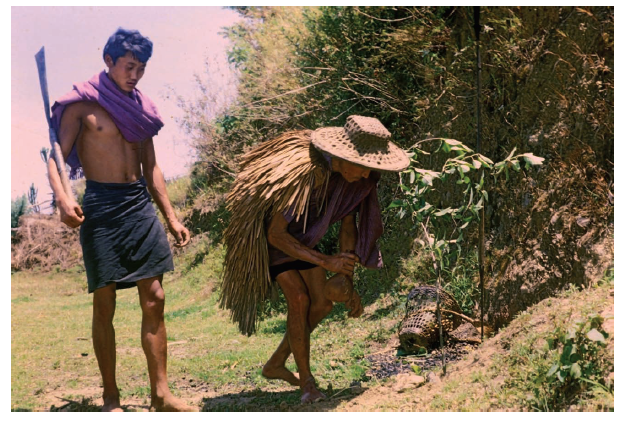
A ritual specialist called rase, or rainmaker, makes an offering of rice beer to various divinities as the wet season approaches in the southern Angami village of Viswema. He wears a cloak made from the leaves of Borassus or coconut palms. When the rain comes, the rase turns to other rituals by drawing gourds of water from the village spring. In this Naga village such rituals were still observed in 1977, when the author took this photo during the first visit to this village. Shamanic rainmaking ceremonies are practiced all around the world. A person with a tendency to rainmaking would be trained to develop skills and endure a deep relationship with nature and weather. Shamans in Viswema endorsed the deep connection between Earth and cosmos and they were able to communicate with the cosmic force.
Nagaland is aptly called the land of festivals. Among the Angami Nagas, the Sekrenyi is main festival celebrated in the month of February. Two matching festivals called Sükrunyi and Tsukhenye are celebrated by the Chakesangs, after the harvest and with the onset of the sowing season. Metemniu festival is celebrated by the Yimchungru Nagas after the harvest of millet. During this festival, they also offer prayers to the departed ones. Moatsu festival is celebrated by Ao tribe in order to seek blessing from the deity for well-being. Aoleang festival among the Konyak Nagas is celebrated toward the end of sowing season.
For the agricultural people like the Lothas whose subsistence depends on the success of the Jhum cultivation, regular performance of agricultural gennas, such as rituals, sacrifices, and prayers with the help of Pvüti, the village priest, becomes pertinent. The agricultural festival starts from the beginning of the jhum season until it finally culminates with the harvest genna called the Tokhu Emong festival (Ezung, 2014, p. 49). Ronsü is agricultural deity of prosperity. The Lothas believe that Ronsü appears in the form of insects like bees, frogs, and dragonfly and his abode being the fields and granaries. In his presence, humans should not behave or speak disrespectfully lest he will be hurt (Murry, 1976, p. 4). The genna of Ronsü Etsa (summoning prosperity) takes place when the rice is about to sprout (Ezung, 2014, p. 49). Among the Lothas, the ritual Epo Etha (giving what is due) is performed in remembrance of the ancestors, by offering them their due share (of agricultural products) and seeking blessing to ward off evils and deaths (Ezung, 2014, p. 38).
Among the Zeliangrong Nagas, genna is commonly known as Nuhmei, meaning “not to do” or “not to act” against the divine message and custom of the society (Imphal Free Press, 1994, p. 22). During the observance of Kairao Kalumei, the gathering offers prayer to Tingkao Ragwang for safe passage of the dead to the land of death (Kamei, 2012). Seeing the dreadful signs, the family or lineage may consult the diviner-shaman locally known as Mangtatmei to learn the exact cause of the omens. Mangtatmei may conduct the appropriate ritual to appease the ancestors (Kamei, 2013).
Genna Conception in South East Asia
Writing in 1928, Katz observed that the numerous “tribes” belonging to Tibeto-Burman and the Mon-Khmer stocks spread in vast peninsula of South-Eastern Asia, including Burma as also Northeast (then called Assam) exhibit, in varying form and under diverse names, a social–religious complex, ordinarily called “Genna” (Katz, 1928). These tribes had advanced the notions of Penna and Kenna, and erected great stones, dolmen, and menhir in honor of their dead (1928). They gradually evolved an annual cycle of agricultural ceremonies, diverse sorts of sepulchral monuments in wood, phallic posts, and phallicism (Katz, 1928). Katz (1928) has counted about 200 situations/rites under the Genna and Kenna-Penna, as proclaimed by the shaman-priests. Within the genna complex, both “religious” and “social gennas” are recognized. Many gennas indeed had non-spiritual nuance which included social gennas of hosting of communal feasts for elevating status, erection of memorial-stones, as also “gate-pulling” events which have largely survived in Naga areas of Myanmar and India, though their intensity has minimized.
Naga Specialists: Shamans, Shaman/Healers, and Priests
There are numerous religious specialists among the Nagas. Broadly, they may be classified as shamans, shaman/healers, and priests. In the old ethnographies of Hutton and Mills, we find descriptions of both priests and shamans, by various names. Generally, a Naga priest is a religious leader authorized to perform the various rituals following the sequence of gennas, such as life-cycle gennas and agricultural gennas. He also oftentimes acts as a mediatory agent between humans and divinity. A standard definition of shaman is that “A shaman is a part-time religious specialist who receives his or her power directly from the ‘spirit world’ and acquires ability to do things through personal communication with the supernatural.” Both men and women are able to become shamans (Stein & Stein, 2017, pp. 128–129). This definition perfectly matches with the competency of the Naga shaman.
In order to discuss the procedures and practices of the priest and shaman in Naga society, we may compare the roles performed by specialists in Lotha Naga tribe. Pvüti is the village priest of the Lothas (Ezung, 2014), while the Lotha Shaman is called Ratsen (Mills, 1922, p. 164). Pvüti is the custodian of the village calendar and announces the time of major agricultural operations. The Lotha Shaman—Ratsen—is a mediator between the supernatural phenomenon and humans (Mills, 1922, p. 164). He experiences dreams and ecstasies. The Lotha Ratsen is not hereditary and any man or woman is liable to develop the symptoms associated with shamanism. A person with such symptoms goes into a fit or into deep trance or delirium, especially during full moon. The Lothas believe that it was during those fits that the soul of the Ratsen goes to the next world to communicate with the “spirits.” When a person shows these symptoms for the first time, an experienced Ratsen is called in to diagnose the case. If he finds it to be genuine, he strangles a cock, from the head of which he is believed to extract a small pebble like substance called ratsenha. This ratsenha is kept by the new Ratsen in his possession (Mills, 1922, p. 164). The function of the shaman Ratsen is to dream and to foretell the future. But his main function is to cure illnesses caused by the evil spirits. By falling into a trance and separating the spirit from the corporeal body, the shaman is believed to cure the sick. The Lothas attribute all sickness to the malice of the tsungrham, the evil spirit. The Ratsen not only diagnoses but also prescribes herbal medicines, which are supposed to have been revealed to him in dreams or while in a trance. For wounds, the shoots of a type of bush called nungnung is crushed and applied. For weakness, a bat’s flesh is prescribed, for diarrhea, roasted goat’s hoof and gall of cow or pig, and for intestinal diseases gall of a python is prescribed (Ezung, 2014, p. 131). The Lothas believe that the soul of the Ratsen could turn into leopard or tiger which they call sonyuo (Ezung, 2014, p. 131).
Revival of “Agricultural Gennas” in Nagaland
Most Naga tribes, despite departure from indigenous faith and spirituality, continue to observe most agricultural festivals, including adhering to basic operational schedules announced by shaman-priests in Naga villages. They follow most of the gennas and sometimes fuse the rite as per Church directive. It is observed that some Nagas have revived their gennas. Such revival is observed among the Sumi Nagas, who have revived two agricultural festivals Tuluni and Ahuna since 1966. Tuluni is celebrated before the harvest season and Ahuna is celebrated after the harvest season. They have declared 8 July as restricted holiday to celebrate Tuluni festival in the month of July. The Sumis believe that the paddy and other crops in the fields will not grow well if such festivals are not celebrated. Tuluni festival is celebrated for one week, the fourth day being the most important wherein prayers and offerings to the deity who helps grow and protects the crops for the effectiveness takes place. Ahuna is a traditional post-harvest festival celebrated in November (Ahuna qhi) after all the harvested crops and paddy are brought and kept inside the granary. The new rice is pounded and tested by cooking the rice in bamboo. While taking out the first rice from the barn, they utter a saying “Chumpa shompamo no chupuh shopuh peniu” meaning “Let there be no early exhaustion of foodstuff and let there be abundance of this food” (Aye, 2002, pp. 12–13).
Moral/Spiritual Vision and Oath Taking
In Naga social-jural sphere, the celestial authority is valued even today because sky and earth as also water are invoked during prayers and oath-taking occasions (Das, 2012; Khongreiwo 2011; Khongreiwo 2014a, p. 298, 2014b, p.71). The author wrote elsewhere that the Naga society survives to a great extent through the “dogma” of kinship norms based customary laws and dependence on supernatural sanctions invoked during “oath-taking” events (Das, 1993, 2012). During 1980s, the author observed that oath-taking method was frequently employed to settle complicated disputes, even in Customary Law Court in Kohima.
In Viswema village of southern Angami area, oaths are taken by both contenders one by one claiming lives of family members. Normally, the decree goes in favor of the person self-confidently taking an oath on larger number of lives of his kinsmen. Depending on the severity of a wrangle, the elders decide the stuffing of an oath. The oath appeals to supernatural power. It is an act of calling upon supernatural beings to bear witness to the truth of what one says. Legitimacy of oath taking is still in vogue. Even in the district level customary law courts, the oath administration is often resorted to in complicated cases. Indeed, any oath, whereby lives of others as well as the life of the swearer is put at stake is usually accepted by either party. (Das, 1993, p. 157).
Dream, Omen, Totem, and Supernatural Specialists
Among the Naga tribes, different genres of dreams, totems, and omen are acknowledged. The dreaming plays a significant role in the lives of tribespeople and their spirituality. Dreaming is critically linked with legends. They help understand how the world was created and its history. The Angamis consider dreams as a deciding factor in the wake of venturing into new activities. Dream also helps in arranging a marriage. Some examples of various interpretations of dream among the Angamis are: if one dreams about cow, it rains; if one dreams about fire, it will be a sunny weather, if one catches fish in a dream, he gets money. If a tooth is fallen in a dream, death may occur in the family. However, interpretation of dreams may differ from person to person (Zetsuvi, 2014).
The Nagas give great importance to dreams as sources of divine knowledge, especially knowledge about the future. A century ago, J. H. Hutton remarked that “the Angamis have almost a science of dreaming.” Heneise (2017) has critically interpreted the dreaming among the Angamis. He has also discussed Hutton’s observations. The Nagas never take up any important task without good omen. The Nagas believe that some deliberate calamity will inevitably follow if any of their taboo, custom, and genna are violated. (Mataisang, 2019).
The Lotha Nagas attach great importance to dreams. In them the Lothas believe that the souls of the dead visit them. A professional dreamer (hahang) used to be in high demand. Woman dreamers are also reported among the Lothas. The night before hunting is most unlucky to dream of a successful hunt, for it means that the dreamer’s spirit has been out hunting and driven all the game away. Mills says that the interpretation of dreams by opposites is frequent among the Nagas (Mills, 1922, p. 171). When going to a place supposed to be haunted by evil spirits, a Lhota wears a sprig in the lobe of his ear and rubs some in his hair. A small onion (sandhra) or a cowrie carried on the person is also considered to be effective (Mills, 1922, pp. 168–169). The commonest charm against evil spirits is a kind of wild mint called rarakham (Ocimum basilicum) (Mills, 1922, pp. 168–169).
Witchcraft, in the evil sense of the word, was not common among the Lhotas, though the practice used to exist of making a straw image of an enemy in another village, and after addressing it by name spearing it (Mills, 1922, p. 169).
Omen is an important aspect of Angami belief system, which the author has witnessed. The simplest method of observing omen is by tossing two leaves on the ground. If one leaf is right side up and the other upside down, it is a sign of good luck. Another type of consulting an omen is by strangling a fowl during ceremonies such as Sekrenyi. In this case, if the right leg crosses over the left, then it is said to be a good omen.
While making a journey, if a civet, a squirrel, or a snake runs across one’s path, then it is seen as a sign of an unsuccessful mission. The Angamis also consult the chirping of certain tiny bird called Tseuno. While going out of house, if the chirping is heard from the leftward direction, it heralds good news. The reason for taking the left-hand side as a good omen is that one usually carries the pezhii (shield) on the left hand (Zetsuvi, 2014).
The totem is the connection between the people of today and their ancestral beings. Members of tribe inherit the spiritual emblem or totem, which is usually an animal, plant or natural object. Hutton wrote that clearly the totemism has either never fully developed into a system among the Naga tribes, or has become so far submerged that it only appears as a barely recognizable survival (Hutton, 1965, p. 22). Among the Khuigai Naga tribe every clan has a totem, which is a reminder of a clan’s ancestry. Totemism in the village has witnessed a revival recently. In 2017, the Khuigai Kamei clan of Lamdan Village, Manipur erected a memorial stone. On the stone, the image of the totem, a wild pigeon is engraved, celebrating their common ancestry. (Kamei, 2022).
Death and Rebirth, Land of the Dead, and Ancestor Veneration
The Naga tribes have numerous concepts about the deity, soul, death, and hereafter (Chuhwanglim et al., 2016). Most Nagas believe that all the dead people’s souls go to the land of the dead (Kathe Lozho). The passage to that land is beset with danger, and the path is guarded by malicious spirit-beings. The Changs locate the land of the dead below the earth, but most Nagas locate it in the sky, as the old ethnographic records also suggest (Mills, 1922, p. 159; Hodson, 1911, p. 160; Hutton, 1921b, p. 211).
Rebirth of soul in a different form is a common Naga belief. The Chang people believe that the souls of those that can sing become cicadas (Hutton, 1965, p. 21). The Angamis believe that the dead go to the sky where indeed, the high goddess, Kepenopfu, is located, and others transmigrate into a bird, butterfly, or moth (Hutton, 1921a, p. 184, 185). The Sema seem to distinguish between the deserving and non-deserving dead and the form of the soul as an insect, commonly a moth or butterfly. The disposal of the dead, however, varies greatly from tribe to tribe. The Angami in the past buried, often in stone-lined graves (Hutton, 1921a, p. 226). The Lhotas likewise, sometimes excavating a vault out of sandstone, and sometimes using a canoe-like coffin (Mills, 1922, p. 157). The Aos dispose of their dead on platforms; the Chang practice both platform disposal and burial; the Konyak dispose of theirs on platforms, but separate the head, which is put into a pot, or into a stone cist (Hutton, 1927, 1929). Some of the more easterly Konyak tribes set up a human effigy in wood and let the soul descend into the effigy (Hutton, 1928), and wooden effigies of the dead were set up by many of the Angami over the grave. In some Angami villages, a wooden statue used to be erected on the grave of a dead man apparently as a lodging for his disembodied soul (Hutton, 1965, p. 31).
Ancestor reverence is not the same as the “ancestor-worship.” Among the Naga tribes, the ancestors are regularly remembered and venerated even though “ancestor worship” is not a universal facet of Naga spirituality. The ancestral veneration is one of the attributes within the spiritual realm of the Nagas. Since survival of humans and their continuity is reliant upon the support given by the ancestors (being the divinities), the Naga longing for the ancestral-soul force remains crucial for well-being. In many Naga tribes, ancestors are believed to mediate on behalf of the living. Ancestors seem to understand human needs since they epitomize the divine being. Naga tribes believe that their ancestors actually need to be provided with some offerings of food and other necessities. Memories of ancestors are immortalized through intermittent expressions and preservation of monoliths associated with the ancestors.
The Naga tribes believe in the immortality of the soul (Shimray, 1985, pp. 223–224). The immortality of the soul and the transmigration are acknowledged by most Naga tribes. The Naga forefathers believed that the soul does not vanish after death, but continues to live in a different realm, through the transmigration of souls. Mills has described the Ao belief of passing after death into the next world. The souls reappear as a hawk or butterfly or cricket and linger near the body for some time (Mills, 1926, p. 226). The dead go toward a stream by crossing the path of ancestors, the stream is called Lungritsü (Longchar, 2002, p. 271). The Lothas believe in the reincarnation of the soul, in some lower forms of life. No member of a household in which a death has occurred may take the life of any creature, whether animal, bird, or insect, till “genna” are accomplished and the soul has finally left for the land of the dead. It may be that the creature killed is the dead man in another form (Mills, 1926, p. 119). Among the Nagas, the line of cleavage is primarily by sex, both in heaven and on earth. This belief regulates mortuary ritual too. Thus, only men are eligible for entering the intermediate heaven from which return to earth is possible (Hodson, 1910, p. 77).
The Tangkhul Nagas believe that the mangla (soul) of the dead sometimes returns to its place of origin. This cosmological perception continues to encapsulate the concept of life after death for the Tangkhul Nagas—even after extensive religious transformation among them (Yaoreipam, 2018). Only after thisham festival (soul departure festival), the deceased becomes an ancestor and moves to live with the other ancestors in the “land of the dead” called Kazeiram. The Tangkhul Naga scholars have evoked their cultural practices through Petkhok (long bed) of the Morung dormitory, the Lencheng, a specific house, the Tarung-Y-shaped totem post and the Onra—megaliths—which have not been lost but continue to exist as remnants from the pasts (Yaoreipam, 2018). In Pettigrew’s writings (1910) and other books (Vashum, 2013) details of the Tangkhul belief system and practices around the soul, spirit beings, and the cosmos are discussed. Hodson wrote that the Mangla-tha or general village genna, held after the close of the cultivating season, is part of ancestor worship, wherein final rest is provided to souls of all the dead that have died within the year (Hodson, 1911, p. 157). It is in November or December that the mangla-tha-genna, on behalf of the dead, is performed. Indeed, the erection of memorial stones has a close connection with rudiments of ancestor worship (Hodson, 1910, p. 77).
The Zounuo-Keyhonuo people regard their two ancestors as creators of their “tribe” (Das, 1993). They are distributed in 10 principal and several offshoot villages. They conceive their “tribe” as a giant patriclan descended from “Zounuo” and “Keyhonuo,” the twin apical ancestors. They perform annual clan-gate dragging from forest in ritualistic manner remembering the ancestors. This aspect of custom has not vanished despite extensive religious transformation (Das, 1993, p. 120). Among the Zounuo-Keyhonuo the death of father entails that children immortalize him after his death by “integrating him with his ancestors” through offering prayers, by establishing wooden emblems and stone monoliths (Das, 1993, p. 40). A major divergence amongst the Zounuo-Keyhonuo and other “Angamis” is that among the former the daughters inherit paternal and maternal land property. 4
The Lotha Nagas properly bury the dead with proper funerary rites so that the departed soul peacefully goes to the abode of the dead. Cowrie beads are also tied on the wrist of the dead so that he may trade it for refreshment while on way to the land of the dead. The Lothas believe that the souls go to the world where the ancestors live (Ezung, 2014). One scholar wrote that the souls (spirit-beings) of the forefathers are worshipped in times of trouble and sickness (Zanao, 2004, p. 22). Ezung wrote however that the Lothas practice no ancestor worship (Ezung, 2014). Libations and the giving of meat and soko (rice beer) to ancestors during various Lotha ceremonies are tokens of respect and sign of continuity of family pedigree (Ezung, 2014). Mention of witchcraft is made by Mills in his ethnography of the Lhotas. Some say that the spirits of those who die “apotia,” or at the hands of enemies or by witchcraft, are earthbound and cannot go to the world of the dead (Mills, 1922, pp. 168–169). In general, the ancestors are aware of what goes on in this world and at times punish the living with sickness. They appear in dreams. It is occasionally necessary to appease the dead. A pig is killed and a share given to a dreamer (hahang), who offers it to the dead man in his dreams. (Mills, 1922, pp. 168–169).
The Zeliangrong Nagas believe that the ancestors often come back to their people through some human or other medium. The ancestors, according to Budha Kamei, are honored as the “living dead”; hence, utmost respect is paid to the grave of ancestors and their monoliths (2013). In Zeliangrong society, the souls become Kairao. Thus, the term Kairao Kalumei is used to describe ancestor reverence. The rites and rituals are carried out by a priest called Mhu who administers offerings to the ancestors (sacrificial food, drink, vegetable, and egg on a fixed day). According to Budha Kamei, the main objective of “ancestor worship” is to confirm the continuation of the life-line, to avert illness, to obtain good crops and to mediate with gods, since the ancestors become associated with gods in the sky. They also venerate the ancestors during the life cycle gennas, namely, birth, puberty, marriage, and death. Among the Zeliangrong the mortuary rites are meant to ensure safe passage of the dead to the next world. A coin is put in the mouth of the dead which is intended to pay to the ferry for crossing the Kanungdui, the mythical river which divides between life and death (Kamei, 2013).
Appeal to Revive Traditional Culture and Reconsideration of Christianity
Some Naga scholars have tried to highlight the worth of the pre-Christian Naga belief systems. They have also noted the ill-effects of Christianity. One scholar surmised that, nature including land, plants, and animals are central to the “lifeworld” of the Tangkhul Nagas. The earth and its natural inhabitants are considered part of the sacred world in Tangkhul cosmology (Varah, 2013, pp. 249–252). The Tangkhul Nagas regard the “nature” including the land as sacred which symbolizes spiritual values (Varah, 2013). Varah (2013) has translated the Tangkhul native term Otsem as nature, which precisely defines the cosmology of the people. Otsem indeed engulfs the lands of the clans and village and unites the ancestors with them as one family (Varah, 2013). For Tangkhul Nagas, land is a sacred quality which symbolizes identity, culture, traditions, and spiritual values. Varah concludes that the Tangkhul Nagas need to rediscover the knowledge of earlier generations, and revive the traditional Tangkhul culture. (Varah, 2013).
The arrival of the Christian missionary in the Tangkhul Naga Hills had changed the interaction between human and nature, according to Varah (2013). He says Christianity needs to play a vital role in order to liberate the Tangkhuls who are being dehumanized and uprooted. In this respect, he refers to 1967 paper of Lynn White wherein he had suggested that present environmental problems have emerged from the Christian worldview of “domination” over non-human species. In fact, Lynn White’s (1967) article is considered a watershed movement in the development of environmental ethics (Jenkins, 2009). White’s hugely influential thesis has been cited thousands of times in a variety of disciplines, including but not limited to religious studies, environmental ethics, history, ecological science, philosophy, psychology, and anthropology. White’s article had raised important points about the historical responsibility of Christianity. 5
Conclusion
In this article, the author has reappraised the Naga perceptions of cosmology, cosmovision, and spirituality which are rooted in the spheres of ecology, folklore, stone culture, “gennas” (rituals and taboos), and ancestor veneration. As elucidated above, the Naga spirituality is perceptible in persistent survival of revered human relationships with the nature and the supreme creator, enduring roles of shaman-priests and clan/village elders as also Naga commitment toward village customs and gennas, including agricultural rituals. The cherished link of the Naga people with the forest and natural resources, which provide food and sustenance, is the basis of the Naga social and cultural cosmovision. The rich cultural and spiritual heritage of the Nagas has been subjected to transformation as a result of change in religion and westernization of culture; nevertheless, Naga scholars in recent years have shown intellectual fondness for the pristine Naga cosmology, spirituality, and festivals.
Footnotes
Acknowledgments
The author is thankful to the Anthropological Survey of India for providing a visiting fellowship (2009–2013) to the author and sponsoring the fieldworks to study the indigenous knowledge and belief systems in Nagaland and Arunachal Pradesh. The author is also grateful to Dr. Lidia Guzy for inviting him to contribute this article in this journal.
Declaration of Conflicting Interests
The author declared no potential conflicts of interest with respect to the research, authorship and/or publication of this article.
Funding
The author received no financial support for the research, authorship and/or publication of this article.
