




Abstract
Achievement of the Sustainable Development Goals relies heavily on the sustainability of supply chains in developing countries where the relevant literature is still in its infancy and needs to be expanded. Drawing on this concern, this study strives to examine the sustainability practices embraced and implemented to unveil the sustainability integration efforts and the barriers that hinder the integration efforts within the supply chain in a developing country through an exploratory case study on Dogˇus¸ Group operating in Türkiye. The results reveal that the group companies are dedicated to sustainability and are taking significant initiatives towards achieving it. Nevertheless, a more inclusive effort is required, particularly in the areas of social sustainability and the integration of sustainability into supply chains. The barriers, such as financial and technological constraints, unstable economic conditions, lack of education of small and medium-sized firms for sustainability, and lack of standards and regulations in terms of environmental and social sustainability, are found to hinder the sustainability integration efforts.
Keywords
Introduction
Social, environmental, and economic challenges—such as the inability to fulfil basic needs in certain regions, rapid degradation of natural resources, climate change, poverty, and gender inequality—serve as primary motivations for sustainability research. Central to these studies is the urgent need for an intellectual and behavioural transformation in business practices, as global economic growth cannot be achieved by depleting scarce resources and exacerbating climate crises (Jackson & Victor, 2015). Key factors driving this transformation include the anthropogenic climate crisis, irreversible biodiversity loss, energy crises, and increasing income inequality and poverty. Achieving a more sustainable world necessitates collective action from all layers of society, with businesses playing a pivotal role. Consequently, businesses are restructuring their processes to align with sustainability requirements. The adoption of the Sustainable Development Goals (SDGs) by 193 nations in 2015 further cements sustainability as a global agenda and offers a roadmap to a more sustainable future. Experts argue that economic growth grounded in conventional supply chain management (SCM) is unsustainable due to its ecological impact (Paulraj et al., 2017). Accordingly, businesses must extend their focus beyond internal operations to engage with their supply chain partners, addressing stakeholder concerns regarding organizational sustainability (Banik et al., 2022).
Integrating sustainability into SCM is essential for maintaining competitiveness in dynamic ecological and social contexts, requiring the simultaneous assessment of economic, social and environmental factors (Brandenburg & Rebs, 2015; Song et al., 2022). Although multinational corporations bear the burden of generating sustainable supply chains, they must also enhance the sustainability performance of their suppliers (Ahmed & Shafiq, 2022). However, there is a notable lack of systematic integration of environmental and social components in addressing supply chain sustainability (De Brito & Van der Laan, 2010).
Industries in developing countries struggle to incorporate sustainability initiatives due to limited competence and understanding (Banik et al., 2022; Kubler et al., 2016). Developing nations face less market and legal pressure to adopt sustainable supply chain methods, although this pressure is gradually increasing (Alzubi & Akkerman, 2022). As these countries become significant stakeholders in global supply chains, their transition to sustainability is critical for achieving the SDGs. Therefore, careful examination of practices and obstacles in developing countries is essential. In summary, despite growing scholarly and managerial interest in sustainability integration in supply chains within these regions, the literature remains in its early stages and requires further development (Alzubi & Akkerman, 2022; Jia et al., 2018; Khan et al., 2021).
Building on the foregoing and resting on the idea that sustainable supply chain management (SSCM) constitutes an encouraging field of enquiry in the scope of emerging markets, the main purpose of this study is to investigate how companies integrate sustainability into their supply chains in an emerging country. Based on this objective, it is aimed to fill three critical research gaps in the pertinent literature: (a) to advance the extant knowledge of sustainability of the supply chains by unveiling the SSCM practices, (b) to unfold the efforts put into the integration of sustainability into the supply chain and (c) to determine the challenges for the integration in the context of an emerging market, which has been relatively neglected by prior research.
On the other hand, the majority of business-to-business (B2B) sustainability research focuses on managing supplier relationships (Casidy & Yan, 2022; Naudé & Sutton-Brady, 2019) and performance impacts of SSCM practices (Hollos et al. 2012; Kumar et al. 2012; Zhu et al. 2012) rather than taking into account how the sustainability efforts of the focal company in its supply chain are assessed by their supply chain members. The prevalence of sustainability marketing has risen due to the blooming focus on sustainability and has become a crucial marketing strategy for companies. Considering that companies are increasingly scrutinized for their sustainable practices, sustainability positioning is vital for enterprises operating in highly competitive markets (Casidy & Yan, 2022). According to prior research, a company’s sustainability positioning is determined by how successfully it incorporates sustainability into its operations (Lee & Lam, 2012). Yet, Kapitan et al. (2019) have operationalized an assessment tool to evaluate the firm’s sustainability level so that the sustainability practices of companies can be differentiated as ‘highly sustainable’ or ‘weakly sustainable’. Thus, the current study also endeavours to examine how the suppliers perceive the sustainability practices and the integration efforts of the focal company. In other words, the company’s reputation for sustainability among its major suppliers will be investigated. Considering that most of the relevant research on sustainable SCM relies on governance systems that extend sustainability practices to the supply chain’s members (Gimenez & Tachizawa, 2012), and the call for much more investigation into sustainability within B2B marketing (Sharma, 2020), the current study brings a diverse perspective to SSCM studies by incorporating the sustainability image of the focal company in question. Thus, the sustainability practices and the efforts of integration of sustainability into the supply chain perceived by the suppliers will be assessed. Hence, it is expected that the buyer–seller interaction in the supply chain within the context of sustainability will be better comprehended, and the sustainability integration efforts can be carried out in a more efficient and effective manner.
The layout of the article is as follows. In the first section, the literature review on SSCM is provided. After revealing the research design and data-collection process, a brief overview of the Doğuş Group as the subject of the case study is provided in the research methodology section. The findings encapsulate the sustainability practices, sustainability integration efforts, barriers to integration and the sustainability image of the Doğuş Group Companies. The results of the research are argued extensively in the discussion part, which is followed by the conclusion section.
Literature Review
Sustainable Supply Chain Management
In order to attain global economic development, industrialization has accelerated, resulting in environmental issues, including climate crises, rising greenhouse gas emissions, air and water pollution, rising waste volumes, deforestation and chemical contamination. Global environmental degradation is mostly the result of industrial operations (Rausch-Phan & Siegfried, 2022). Sustainable supply chain management also refers to the variety of management techniques, including impact on the environment as a critical consideration for all phases of a product’s value chain and an interdisciplinary perspective that encompasses the full product life cycle (Laurin & Fantazy, 2017). Most of the studies in the extant literature pinpoint that the research on SSCM neglects the other components of sustainability (Chan et al., 2012; Islam et al., 2017; Panpatil & Kant, 2022; Shang et al., 2010; Srivastava, 2007; Zhu & Sarkis, 2004; Zsidisin & Hendrick, 1998). Nevertheless, SSCM has three pillars—economic, social and environmental—built on the triple bottom line (3BL) concept, which refers to 3Ps: people, planet and profit (Elkington & Rowlands, 1999). Thus, SSCM seeks to respond to environmental concerns along with social and economic problems within the supply chains (Khaghani Zadeh et al., 2021; Sarkis et al., 2011). Sustainable supply chain management is defined as the important, unambiguous unification and achievement of an institution’s economic, social and environmental goals via the systematic identification of strategic business operations inside the firm to increase the commercial efficiency of the overall supply chain (Carter & Rogers, 2008). As indicated by Sánchez-Flores et al. (2020), the preservation of the potential balance between social responsibility, environmental protection and economic viability across the supply chain is the main idea behind SSCM.
Managing supply chains is challenging due to differences in the economy, laws, regulations and standards. Emerging economies, which typically serve as manufacturers or suppliers of raw materials, encounter challenges that impair performance. Environmental instability and institutional voids are two issues that inhibit supply chains in emerging economies from learning, innovating and changing at an appropriate rate on their sustainability trajectory (Silvestre, 2015). The review conducted by Sánchez-Flores et al. (2020) pinpoints that SSCM research for emerging economies lags behind global SSCM research. They claim that interest in SSCM in emerging economies has occurred years after SSCM research began. However, it should be noted that enhancing the sustainability of supply chains in emerging nations has enormous global implications, and to some extent, the sustainability of the supply chains paves the way for the societal transformation into a more sustainable lifestyle.
Sustainable Supply Chain Integration
The definition of ‘integration’ is the combined control of several successive or similar economic, particularly industrial, activities that were historically carried out individually (Webster, 1966). 1 When a supply chain is integrated, it means that all of the chain members are closely connected to one another. Information and communication technologies are used to maintain this relationship. Even though pertinent literature divides supply chain integration (SCI) into three categories (internal, external and supplier), they occasionally concentrate on just one or all three. While Basnet (2013) and Pagell (2004) focused on internal integration, Huo (2012), Cousins and Menguc (2006) and Das et al. (2006) concentrated on supplier integration; Droge et al. (2004) focused on both external and internal integration; and Homburg and Stock (2004) concentrated on customer integration.
Sustainable supply chain integration (SSCI) and SCI are distinct terms and differ conceptually (Syed et al., 2019). While SSCI refers to cooperation among supply chain partners for mutually sustainable practices, SCI entails the coordination of a company’s information and resources between all supply chain stakeholders (Afum et al., 2020). External and internal SSCI are the two important subcategories of SSCI. Internal SSCI refers to advancing organizational capacities through the removal of obstacles and inspiring staff to take on environmental education projects. The term ‘external SSCI’ describes the cooperation between the company’s clients and vendors to address environmental problems (Junaid et al., 2022; Syed et al., 2019). Companies’ chances of innovation rise when they cooperate and combine their resources with supply chain partners. Green innovation is a word used by sustainable businesses to describe methods that are focused on sustainability. It can also refer to eco-innovation, environmental innovation or environmentally friendly innovation (Afum et al., 2020).
Since the supply chain has a complex structure and contains many parties and stakeholders both internally and externally, integrating sustainable action for each stakeholder is also complicated. The merger of 3BL increases the reputation among customers, suppliers, employees and stakeholders, which promotes economic growth (Capaldi, 2005). The ultimate goal of SSCI is to provide a steady flow of information, products and investments that will boost company growth (Wolf, 2011). Carter and Dresner (2001) advise organizations to be proactive in regard to sustainable practices. If the ‘3BL’ is successfully implemented, there may be financial rewards from raising community standards and protecting the environment for future generations.
According to Morali and Searcy (2013), some significant obstacles to SSCI implementation include the inability to comprehend the intricate relationship between sustainability pillars and its impact on the bottom line of the economy: financial obligations, assessment, clarity of knowledge and information, aligning SSCM efforts with corporate strategy and organizational culture. Other challenges include growing designation complexity, insufficient associate knowledge sharing and manager incompetence (Seuring & Müller, 2008). Before implementing sustainability practices, Walker and Brammer (2009) argue that it would be useful to examine some of the company’s general conditions: investigate the sustainable strategy, laws and policies, among other things; organizational fit, including receptivity to change; identify and contract with vendors who use eco-friendly techniques and procedures; and verify their capacity to execute sustainability, taking into account cost, quality and culture. Recently, Khan et al. (2021) have also mentioned the above barriers and added some other barriers to sustainability: poor performance measurement systems, lack of IT systems standards, absence of team/employees’ interest, and lack of resources and knowledge.
Despite substantial progress in understanding SSCM and SSCI, several significant gaps remain within the literature that this study aims to address. First, numerous studies point out that existing SSCM research has often overlooked the interplay between economic, social and environmental components, potentially leading to an incomplete understanding of sustainable practices (Zhu & Sarkis, 2004; Zsidisin & Hendrick, 1998). Although previous research highlights the lag in SSCM studies relevant to emerging economies, there is a critical need for deeper investigation into the specific challenges these regions face that impair sustainable practices, including institutional voids and resource limitations (Sánchez-Flores et al., 2020). This gap suggests that further insights are essential to understand how global sustainability initiatives can be effectively localized within these specific contexts. Besides, the literature has noted a deficiency in the systematic incorporation of environmental and social components into the overall sustainability assessment within SCM (De Brito & Van der Laan, 2010). Investigating strategies for better integration could yield practical frameworks for sustainable practices. And finally, various factors that hinder the adoption of SSCI practices, such as financial constraints, lack of understanding and inadequate performance measurement systems, have been identified (Morali & Searcy, 2013; Seuring & Müller, 2008). More robust empirical studies are needed to explore these barriers in detail and develop actionable strategies for overcoming them. By addressing these gaps, this study seeks to contribute to the existing body of knowledge in SSCM, enhancing our understanding of how to facilitate the integration of sustainability practices effectively across diverse contexts.
Data Description
The overall objective of the current research is to examine and grasp an understanding of the current situation of the SSCM practices, explore the integration efforts of sustainability into the supply chain and understand the challenges of the integration in the context of an emerging market. To realize the research objectives, we conducted an exploratory case study of Doğuş Group operating in Türkiye in response to recent demands for greater qualitative research on SSCM within a developing country context, which has been relatively neglected in the relevant literature. Doğuş Automotive, Doğuş Construction and Doğuş Hospitality & Retail—which are part of the Doğuş Group—are analysed to identify the SSCM practices, integration efforts and the challenges encountered in the integration of sustainability in the supply chain.
Company Background
Doğuş Group involves several companies in various industries—including automotive, construction, media, hospitality and retail, real estate, technology and energy—and has other investments. There are almost 300 enterprises with over 21,000 employees in the group. The author’s goal is to convey the company’s experiences in an academic atmosphere in order to serve as a road map for other firms seeking sustainability in their supply chains within the specified industries. Doğuş Group published the latest sustainability report in 2015. In this report, Doğuş Group expressed its sustainability approaches as follows:
Sustainability is not only an investment in environmental and social projects; it deals with a holistic, contemporary approach that covers all issues from social conditions at our suppliers and dealers to conscious consumption, from risk and reputation management to innovation culture, including employee, customer, and investor experience. (Doğuş Group Corporate Sustainability Report, 2015)
Before moving on to the findings, it will be valuable to provide information about the supply chain structure of each company. Doğuş Automotive makes interim sales, and they work B2B with two dimensions. One of them is car logistics; vehicles are received from production facilities. It is brought to the port by train and from the port to the country. It is then forwarded to the dealers. The other dimension is the spare parts that are imported and stored in common storage areas. Doğuş Construction works on a project basis. There is no in-house production. They either purchase materials (raw materials), services or both. Doğuş Hospitality & Retail encompasses 4 sectors, 59 brands, 149 restaurants, 15 hotels and 51 retail stores. Central productions cater to existing restaurants and, from time to time, serve hotels. In central productions, ready-to-eat products are produced, cooked or sent as semi-finished products. There is also a central distribution centre (warehouse).
Materials and Methods
Research Design and Data Collection
The requirement for a greater grasp of the context—SSCM—approaches applied by the concerned businesses are exploratory and descriptive in nature, address a present and unique phenomenon and have theoretical development potential. Since relatively few firms in Türkiye publish a sustainability report, the purposive sampling technique is applied and the Borsa Istanbul Sustainability Index 2 is used as a reference source for sampling. In order to raise awareness, knowledge and practice regarding sustainability in Türkiye, and particularly for companies trading in Borsa Istanbul markets, Borsa Istanbul launched the BIST Sustainability Index, where constituents are shares of companies with high performance on corporate sustainability. The BIST Sustainability Index 2020 list of companies involves 61 companies. 3 These 61 companies are contacted either through e-mail or telephone. Most of the companies did not respond to our invitation for the research. Some companies had schedule conflicts; thus, only three of the listed companies agreed to participate in the research. Among the three companies, Doğuş Automotive is selected. In order not to rely too heavily on SSCM practices of one industry and to observe the differences in terms of the objectives of the current research between firms that are listed in the BIST Sustainability Index and the firms that are not listed in the index, Doğuş Group, which is the parent company of Doğuş Automotive, is determined as the case subject. The rationale behind the selection of the Doğuş Construction and Doğuş Hospitality & Retail companies, which are not listed in the BIST Sustainability Index, is that they are the companies that accepted our invitation to conduct the case study. The external validity indicates whether the findings of the research can be generalizable, which is an issue to be addressed in the early stages of the research design (Ellram, 1996; Yin, 2018). It should be considered that making analytic generalizations is difficult since it should be recognized that the generalization is not statistical (or numerical) but an argumentative claim (Yin, 2018). According to Eisenhardt (1989), a cross-case study encompassing 4–10 case studies may serve as a solid foundation for analytical generalization. Researchers may perform different case studies within one organization rather than conducting and evaluating multiple case studies of distinct organizations, and researchers should present a clear justification for the case study selection (Gibbert et al., 2008; Yin, 1994). Hence, the current research adopted a nested approach, which is multiple case studies within one organization.
In order to ensure the reliability of the research, a protocol involving the interview guide and the procedures to follow is formed. Besides, a database is created encompassing all available documents, interview transcripts, company reports and so on. Hence, the transparency and replicability of the research were assured. Internal validity is primarily an issue in explanatory case studies, which attempt to explain how and why incident x led to event y (Yin, 2018). The current research is exploratory and descriptive in nature; thus, internal validity is irrelevant in our case (Beverland & Lindgreen, 2010; Ellram, 1996; Gibbert et al., 2008; Yin, 1994). To ensure construct validity, which is referred to as the degree to which research explores what it asserts to investigate (Denzin & Lincoln, 1994), two strategies were employed. The first strategy was to send the draft findings to the key informants for re-review and approval (Ellram, 1996). As a second strategy, multiple data sources implemented in various studies (Baškarada, 2014; Neri et al., 2021) were used in the current research. Primary data were collected via semi-structured interviews and questionnaires, and secondary data were collected from company reports, company websites and media news. Ten online semi-structured interviews were conducted as indicated in Table 1. The sessions were tape-recorded upon the consent of the participants. The online meetings ranged in length from 45 to 86 minutes.
Semi-structured Interviews.
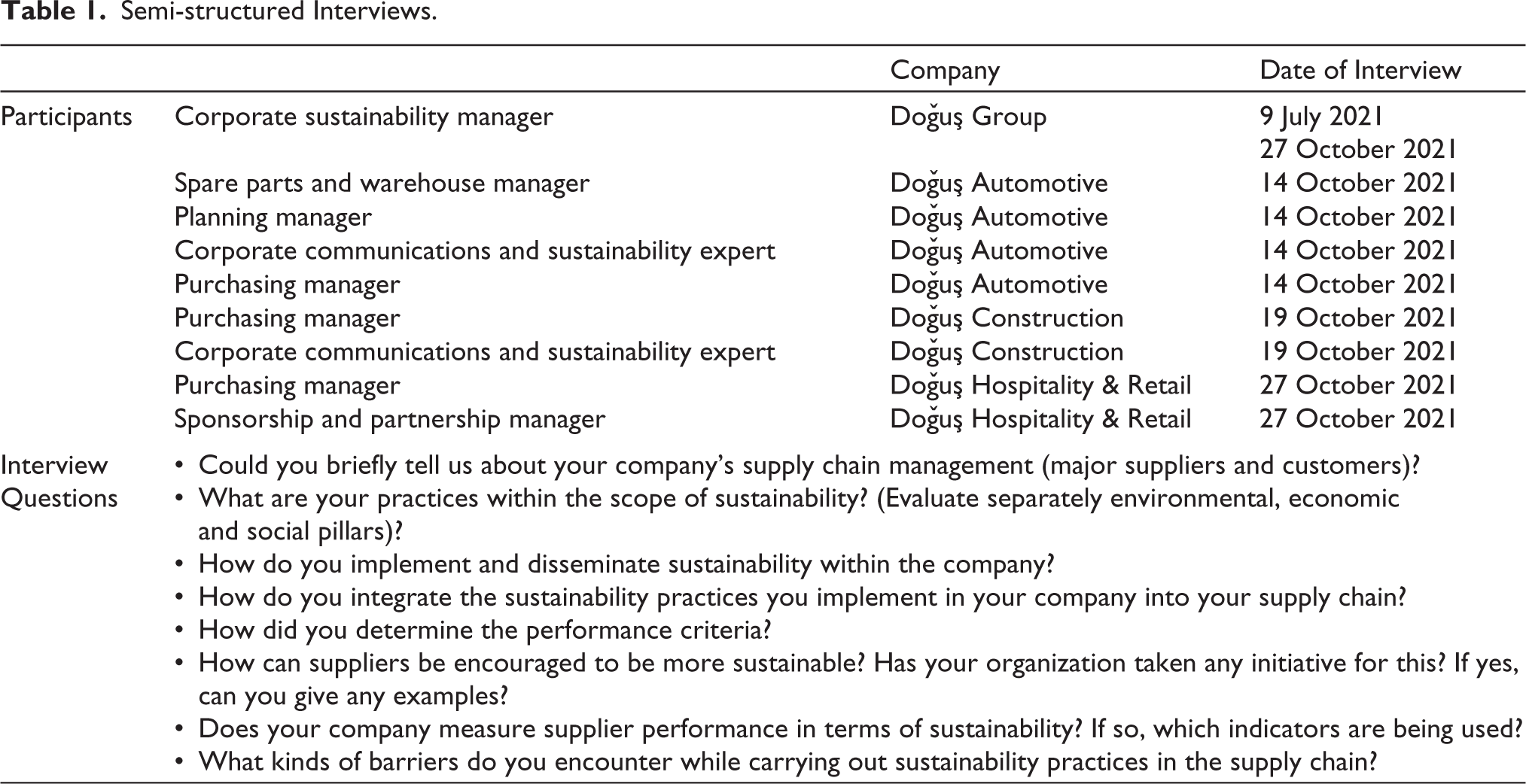
The recordings of the interviews were later transcribed verbatim into a Word document for further analysis. Each author independently reviewed the verbatim to enhance the validity. Doğuş Automotive Corporate Sustainability Report 2020, Doğuş Group Corporate Sustainability Report 2015 and Doğuş Global Compact Report 2020, websites, and media news (years 2015–2021) of the parent group and the companies under analysis were investigated, and the relevant data were compiled in the Word document.
In order to identify the sustainability image of the companies from the suppliers’ perspective, a questionnaire was developed and applied to the key suppliers of each company. The sustainability image scale of Kapitan et al. (2019), encompassing five dimensions—sustainable credibility, environmental impact, stakeholder consideration, resource efficiency and holistic philosophy—was adopted. All measurement scales were anchored with a 5-point Likert scale (ranging from 1 [completely disagree] to 5 [completely agree]). The questions in the survey were translated into Turkish. A pilot test with 10 academicians was conducted to ensure the understandability of the questions. The contact information of the key suppliers of the three companies was requested from the Doğuş Group’s sustainability manager.
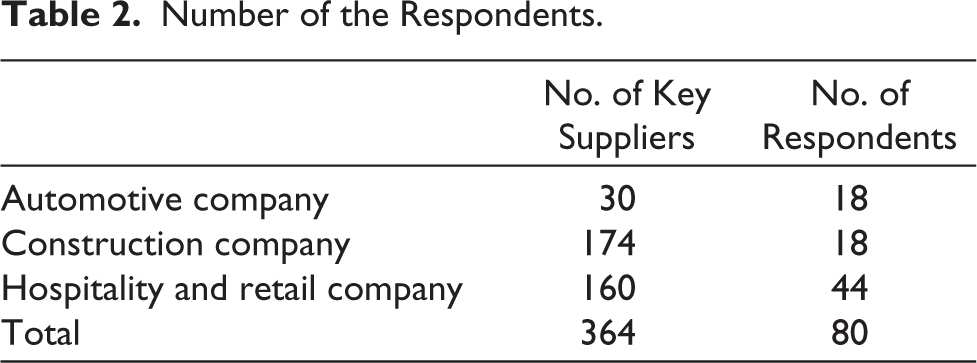
As summarized in Table 2, the total number of key suppliers of the three companies was 364. The authors sent the questionnaire via e-mails to these suppliers themselves to avoid bias. E-mails reminding suppliers to answer the survey were sent three times within three months (April–June 2021). Eighteen suppliers from the Doğuş Construction, 18 from Doğuş Automotive and 44 from Doğuş Hospitality & Retail responded to the questionnaire.
Number of the Respondents.
Data Analysis
Data gathered through in-depth interviews with key informants, company and group reports, and investigation of websites and media news were analysed using content analysis, which is a way of methodologically defining the meanings of qualitative data. The purpose of content analysis is to identify definite statements or those that contain expressions (Gillham, 2000). Case study research is more exploratory than confirmatory in nature, intending to identify themes and categorize phenomena rather than proving relationships or test hypotheses. It also entails the gathering and analysis of data from various sources (Hancock & Algozzine, 2017, p. 16). Since there is insufficient prior knowledge concerning SSCM in Türkiye, both deductive and inductive coding approaches are adopted (Aleixo et al., 2018; Elo & Kyngäs, 2008). The Word document is imported to the MAXQDA software tool. From earlier research and theory, an a priori code was derived. Following the analysis of the interviews, this code was modified whenever necessary. To increase the reliability, the two authors analysed the data. On the basis of the coding protocol, the authors coded the first four interviews separately. Each discrepancy was carefully examined, and the coding protocol was altered until a complete agreement was reached. Two authors coded all data using the advanced coding protocol with 90% inter-coder agreement. Categories, which represent sustainability practices, integration efforts and barriers, were created as a result of the process. MAXQDA software enabled the organization and the analysis of the data through a constant comparative approach (Aleixo et al., 2018).
Data compiled through questionnaires were analysed with the SPSS 25 software application. Since the aim was to scrutinize the perceptions of the key suppliers towards the Doğuş Group companies’ sustainability image, only descriptive analysis was performed.
Results and Discussion
Sustainability Practices
The first research objective was to identify the sustainability practices of each company. Generally, sustainability practices are categorized into three headings: social, environmental and economic.
Most of the practices are common for each company. Considering that Doğuş Automotive has been publishing a sustainability report for 12 years and, as supported by the interviews, it is known that the automotive unit also provides know-how for other companies, the practices of this unit are likely to be more diverse. Results depicted in Table 3 demonstrate that all three Doğuş Group companies attach great importance to training activities within the context of safety and health at work. Besides, women’s empowerment is one of the top priority issues that all three companies pay attention to. As stated by one of the respondents: ‘Woman entrepreneurs preferably take precedence in the supplier selection process’ (Doğuş Hospitality & Retail Purchasing Manager).
Combating domestic violence, protecting and improving employee rights, and abiding by work ethics are among the other social sustainability practices that are applied by all three companies. Another common practice for Doğuş Construction, Doğuş Automotive and Doğuş Hospitality & Retail is the delivery of sustainability training for suppliers. However, as indicated by the purchasing manager of Doğuş Automotive, only they provide training for the retailers as well: ‘We provide ethical code and sustainability training to suppliers, dealers, and blue- and white-collar workers’ (Doğuş Automotive Purchasing Manager).
Sustainability Practices.
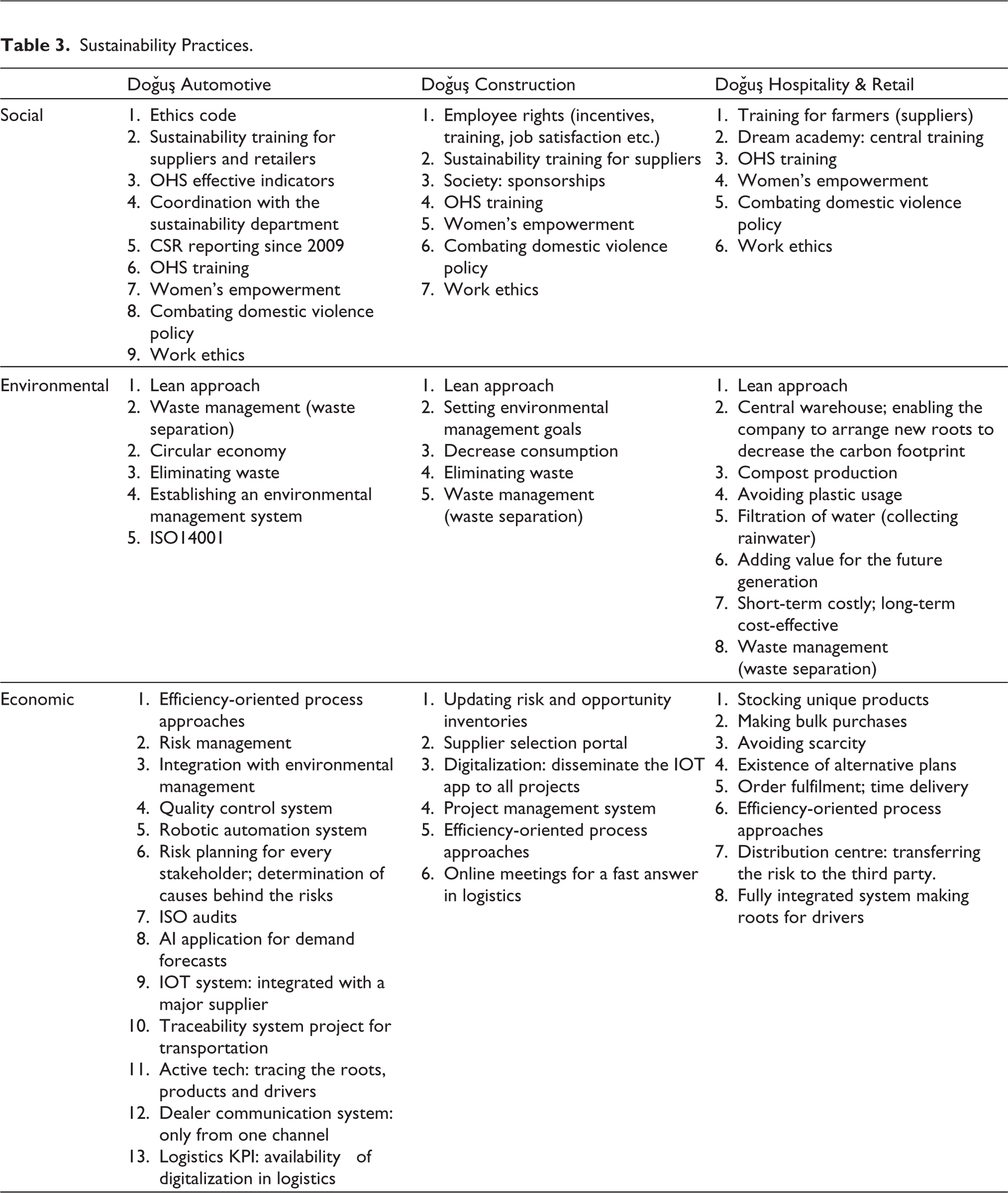
Doğuş Automotive claims that they define effective indicators to measure safety and health at work and report their corporate social responsibility practices since 2009, working in high coordination with the sustainability department. On the other hand, Doğuş Construction provides sponsorships for student clubs.
When it comes to environmental practices, all three companies have some common green efforts, such as waste elimination, energy and water consumption reduction and adopting a lean approach. Besides, Doğuş Automotive has established an environmental management system and is certified with ISO 14001. The company has also initiated circular economy practices in recent years. Doğuş Hospitality & Retail uses a central warehouse and arranges new routes to decrease carbon footprint. They collect rainwater and use it after filtration of the collected water.
Doğuş Construction started its initiatives on decreasing the consumption of energy, water, and oil and on the reduction of waste.
The economic sustainability activity is the third pillar of sustainability and the third category of the sustainability practices of the current research. It is recognized that the most prominent approach undertaken by the three companies in the economic dimension is risk management and a lean approach. The Corporate Communications and Sustainability Expert of Doğuş Automotive stated: ‘I can list operational sustainability under four headings: one is efficiency, business sustainability, risk management to support this, and integration with environmental management’.
The findings of the current research pinpoint that all companies adopt a lean approach. The relationship between lean and green manufacturing is investigated by the researchers. The findings of these studies conclude that there is a significant synergy; however, one should consider that there exist potential trade-offs (King & Lenox, 2001; Larson & Greenwood, 2004; Mollenkopf et al., 2010). On the other hand, the use of lean manufacturing practices improves operational efficiency, lowers costs and enhances environmental sustainability through decreased resource use, better green procurement, lower energy usage and, ultimately, lower carbon emissions (Gopalakrishnan et al., 2012). The companies’ other environmental concerns focus on waste elimination and reduction in water and energy consumption parallel to the findings revealed by the research of Dursun et al. (2023) conducted in Türkiye. Suhi et al. (2019) defined the environmental sustainability indicators in supply chains and identified the ranking of these indicators in the context of Bangladesh. Similar to our findings, waste management was the most important indicator in Bangladesh. It can be further recommended to companies to direct their efforts on making their products reusable and recyclable and producing byproducts within sustainable waste management systems.
Sustainability Integration in the Supply Chain
There are common points of Doğuş Construction, Doğuş Automotive and Doğuş Hospitality & Retail under investigation in terms of the integration of sustainability philosophy and practices into their supply chains, as summarized in Table 4. They all provide training for their suppliers on sustainability and ethics codes to create awareness and to educate, so that the suppliers can embrace and practise sustainability in their operations. It should be highlighted that Doğuş Automotive also includes their car dealers in this training and places an emphasis on dealers’ experience. All companies have distinct supplier selection criteria, and they consider sustainability as a metric. On the other hand, they still have not identified performance indicators to measure the sustainability performance of their suppliers. However, they perform audits within specific time intervals. These audits can be both predefined or unannounced and sudden to capture the real situation of operations of their suppliers. As the interviewees assert: ‘We have frequent inspections. We even ask odd questions about how things work there. For example, where do you dispose of waste? We have a supplier performance rating system’ (Doğuş Hospitality & Retail Purchasing Manager).
Sustainable Integration Efforts of the Firm.
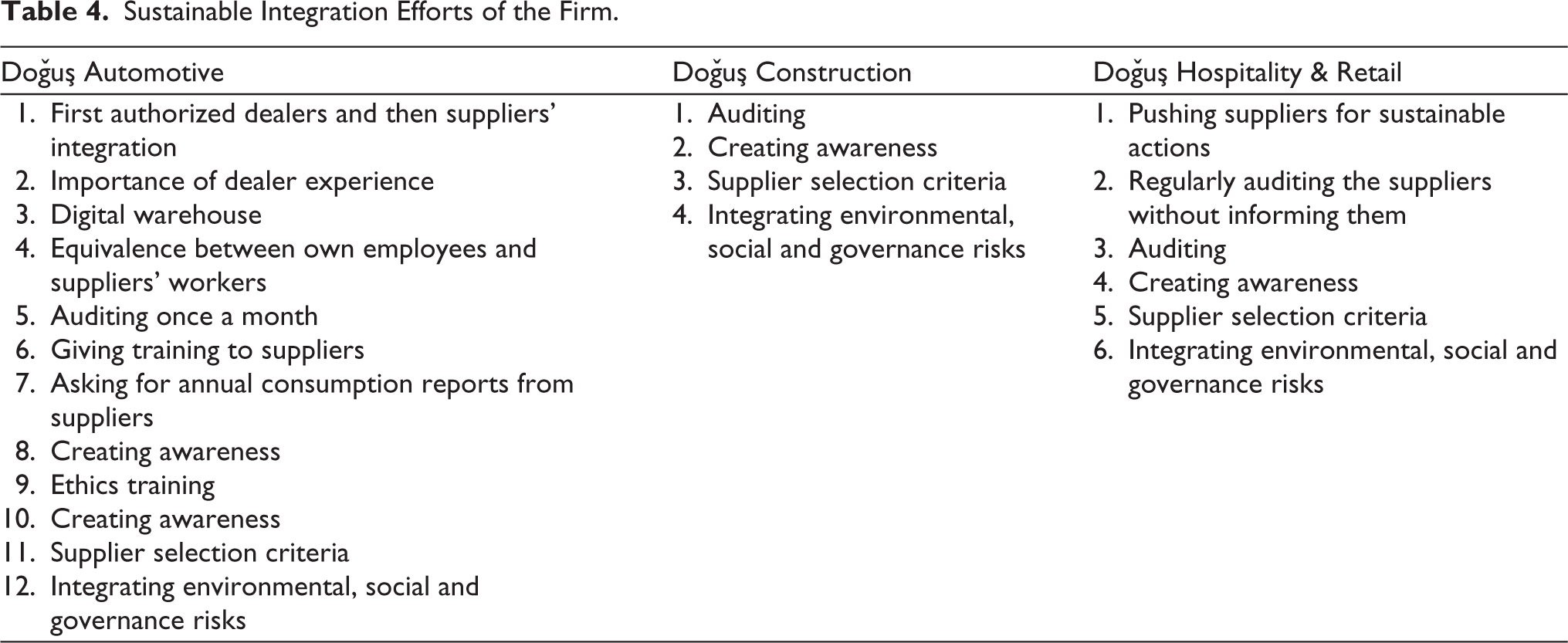
In this article, we address supply chain sustainability integration as the degree to which the focal firm strategically cooperates with its supply chain members and manages sustainability practices within the boundaries of its organization and between the members of the supply chain. In this sense, it can be summarized that the companies in question focus on raising awareness and educating their suppliers to implement sustainability in their operations by providing training on sustainability and ethical codes to their suppliers. Anisul Huq et al. (2014) identify the main elements of a code of conduct (or third-party certification) used by buyers to integrate social sustainability into their supply chain as employee wages and benefits, child labour and forced labour, harassment in the workplace, and working hours and conditions.
Doğuş Construction, Doğuş Automotive and Doğuş Hospitality & Retail have certain standards for choosing suppliers, and they all take sustainability into account during supplier selection. On the other hand, they have still not come up with performance measures to gauge how well their suppliers perform in terms of sustainability. They do, however, conduct audits at certain periods. Large and Thomsen (2011) assert that the methods used by businesses to enhance suppliers’ environmental performance vary greatly in their scope and method of application, such as using questionnaires or supplier visits, versus developing a mentoring and partnership strategy to create long-term gains in environmental performance. Gimenez and Tachizawa (2012) refer to these two key approaches as assessment and collaboration. Technical and social compliance are often the two key factors that buyers use to audit suppliers. An extensive evaluation is carried out by a social audit team if the supplier passes the initial technical audit. Examining the manufacturer’s labour standards, including documents pertaining to labour contracts, working hours and corporate policies, as well as assessing working conditions, including health and safety concerns, are usual components of social audits (Anisul Huq et al., 2014).
Sustainability adoption across the supply chain necessitates systematic methods such as defining corporate policies, establishing purchasing criteria that take into account economic, environmental and social concerns, and managing supplier relationships and collaboration (Sancha et al., 2015). It is observed that Doğuş Automotive differentiates itself from the other two companies in a way that they align better with the corporate sustainability policies and go further in most of the sustainability practices. It has established an environmental management system and is ISO 14001 certified. In recent years, Doğuş Automotive has also started to implement circular economy activities. For the integration efforts, it is the only company that considers downstream integration by providing training for their customers on sustainability and ethical codes to create awareness and to educate. This finding was expected since Doğuş Automotive has been listed in the BIST Sustainability Index, publishing sustainability reports for over 12 years.
Barriers of Integration
When asked about the barriers to the integration of sustainability into their supply chain, the automotive company referred to the lack of resources in digitalization in the first place. Since digitalization is an important building block of integration operations, not having sufficient resources is regarded as an important barrier.
Besides, the speed of reaching the necessary resources is essential, and it requires multi-channel communication and high agility and flexibility in the processes. However, rapidly changing market conditions due to the economic conditions of the country and market imbalance make the adaptation more difficult. As depicted in Table 5, suppliers are regarded as a barrier to sustainability integration within the supply chain since it is highly challenging to find suppliers close to the standards of the company as they employ less qualified employees. Moreover, the awareness of most of the suppliers towards sustainability is low, and it requires a big effort to educate them:
Finding suppliers who adhere to our standards is not always an easy task. We try to raise them to our standards. We make an effort to impart what we know to them. Of course, it is difficult to raise awareness among everyone on an equal level. (Doğuş Automotive Corporate Communications and Sustainability Expert)
Barriers to Integration.
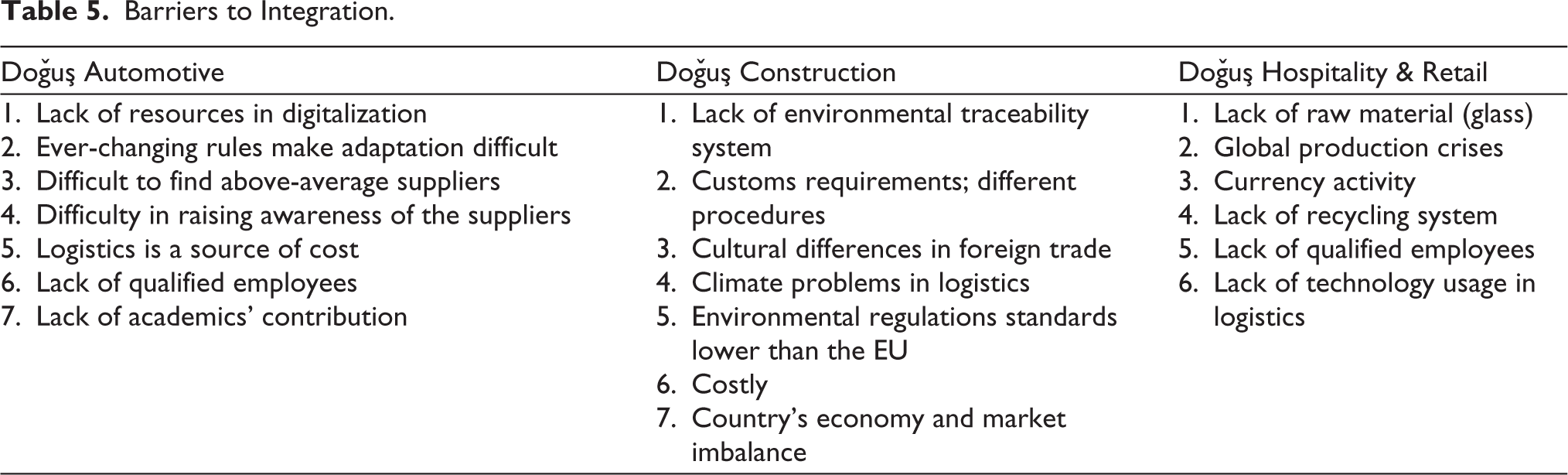
Doğuş Construction highlighted the importance of planning in logistics, which is outsourced. Planning logistics operations is one of the key aspects for the sustainable integration of the supply chain in terms of decreasing carbon emissions due to transportation routes. They also remarked on the lack of an environmental traceability system as a barrier to integration. As the interviewee stated: ‘We have no method for keeping track of the environmental impacts of our suppliers. We are unsure as to whether the supplier we select will properly dispose of the waste. We have no mechanism that allows us to view this’ (Doğuş Construction Purchasing Manager).
Global production crises giving rise to raw material inadequacy coupled with difficulties in importing due to high inflation and currency fluctuation constitute a barrier for Doğuş Hospitality & Retail. Not having established a recycling system, especially not recycling the bottles, is regarded as the biggest problem, and operating and managing the recycling process is a major impediment.
In a nutshell, it is obvious that emerging economies require financial incentives and structured and extended laws and regulations regarding environmental and social sustainability. Besides, technological advancement as well as a partnership with research and development should be entailed for the sustainability integration in supply chains (Mangla et al., 2015). In developing countries, there is evidence that the collaboration between stakeholders can increase the potential for innovation in supply chain operations and remove barriers to global sustainable practices (Campos et al., 2017).
Sustainability Perceptions of the Suppliers
This part of the findings aims at revealing the sustainability images of Doğuş Construction, Doğuş Automotive and Doğuş Hospitality & Retail. The results indicate how key suppliers of the related companies evaluate sustainability practices and sustainability communications.
As depicted in Table 6, descriptive analysis is conducted to identify sustainability images of the companies in terms of credibility (i.e., meeting international standards and getting environmental certifications, having independent audits of their sustainable activities, having a sustainable procurement policy and process, and being transparent), environmental impact (i.e., paying attention to its carbon footprint, having environmental concerns among top priorities and producing less waste), stakeholder consideration( i.e., encouraging sustainability in its supply chain and delivering sustainability knowledge), resource efficiency (i.e., energy monitoring, new technologies to save energy and local sourcing) and holistic philosophy (enforcing sustainable processes by taking into account the environmental, societal and economic components of sustainability) dimensions. The key suppliers of all companies have an above-average sustainability perception for their buyers. Doğuş Automotive and Doğuş Hospitality & Retail Company’s mean scores for all dimensions are all above 4.0, indicating that the key suppliers agree that these companies have a sustainability image. Doğuş Automotive received the highest scores on sustainable credibility and stakeholder consideration, whereas it scored lowest in environmental impact. Doğuş Construction relatively fared poorly in environmental impact while scoring highly in credibility and resource efficiency. It is also obvious that Doğuş Hospitality & Retail has a higher positive image in terms of stakeholder consideration and resource efficiency, which implies that the company is perceived as being able to integrate environmental sustainability into its operations and communicate it to its suppliers. On the other hand, the lowest score belongs to the perceptions of environmental impact.
Sustainability Perceptions of the Suppliers.
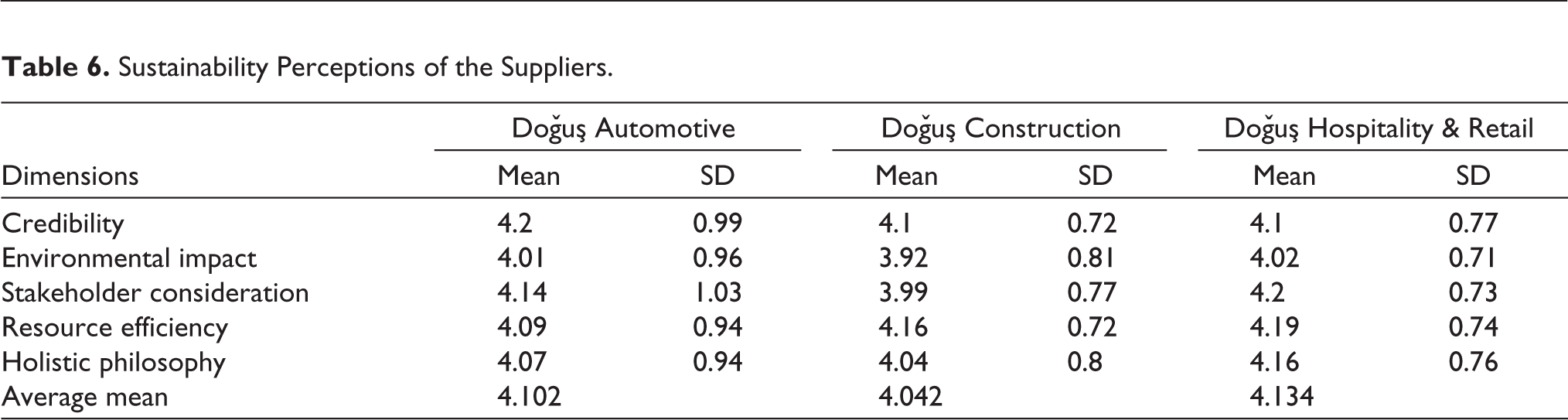
It is crucial to emphasize that SSCM can be abused for greenwashing purposes, like the use of a code of conduct that does not impact behaviour or misleading sustainability reports that do not fully reflect the actual performances (Paulraj et al., 2017). Hence, the perceptions of the supply chain members regarding the sustainability orientation of the focal company can provide clues for the real situation. On the other hand, it should be underlined that perceptions may yield lower scores not due to poor sustainable practices but because of inferior sustainability communication with the supply chain members.
A limited number of studies have focused on sustainability in the context of B2B marketing, with the majority of studies on sustainability having a business-to-consumer emphasis (Sharma, 2020). Hence, one of the originalities of the current research is to consider the perceptions of suppliers regarding the sustainability image of the focal companies. Findings reveal that all three companies’ average means are above the threshold. This finding implies that the companies have favourable sustainable images and are perceived as being able to incorporate sustainability into their operations and convey it to their suppliers.
Implications of the Study
The research reinforces the concept that sustainability is a multifaceted construct that requires a strategic approach to integrate within supply chains effectively. It contributes to the theoretical discourse on sustainable SCM by illustrating the relational dynamics between supplier training, awareness and sustainable practice adoption. Further exploration into the relationship between supplier engagement strategies and operational sustainability could yield valuable insights. The study affirms the relevance of auditor mechanisms in enforcing sustainability and ethical codes among suppliers. This emphasizes the need for ongoing dialogue and examination of audit methodologies as part of sustainability governance frameworks. Theoretical contributions could include expanded models for assessing supplier compliance that incorporate both technical and social compliance metrics.
The findings underscore that lack of resources, particularly in the domain of digitalization, poses a significant barrier to sustainability integration for Doğuş Automotive and other companies. Organizations need to prioritize investments in digital infrastructure to facilitate data collection, analysis and management processes that support sustainability objectives. By allocating resources towards advanced technologies, companies can streamline operations, enhance decision-making capabilities and foster sustainable practices within their supply chains. Besides, the challenges associated with supplier compliance and awareness indicated by Doğuş Automotive highlight the necessity for comprehensive supplier development programmes. Firms should implement initiatives focused on education and training for their suppliers, which can enhance their understanding of sustainability standards and practices. This approach not only promotes a more sustainable supply chain but also builds stronger relationships with suppliers, reinforcing commitment to shared sustainability goals. Moreover, Doğuş Hospitality & Retail’s challenges related to raw material inadequacies and recycling systems emphasize the importance of collaboration among industry stakeholders. By forming strategic partnerships, companies can share resources, best practices and technological advancements that enable a collective approach to sustainability. Encouraging collaboration with local governments, academic institutions and non-governmental organizations can facilitate the establishment of recycling systems and enhance supply chain resilience.
On the other hand, the sustainability perceptions of suppliers highlight areas for potential growth, particularly regarding environmental impact. Doğuş companies can benefit from conducting regular assessments of their environmental practices and setting specific improvement goals. By continually enhancing their sustainability performance, these companies can further strengthen their reputation and competitive advantage in the market. The findings emphasize a gap in the existing literature that predominantly focuses on business-to-consumer sustainability initiatives. By examining the B2B context, this research provides a foundation for further studies aimed at understanding the dynamics of sustainability communication and perception within supply chains. This perspective can enrich theoretical discussions around sustainability marketing and communication strategies.
Conclusion
In recent years, research on SSCM in developing countries has emerged and accelerated; however, it is still in its infancy relative to studies conducted in developed economies. This article addressed four interrelated research problems in an emerging economy context. The first entails the basic question of what the SSCM practices are. The second research question considers the efforts made to incorporate sustainability into the supply chain, and the third concern is to uncover the barriers within the integration process. Additionally, the research also aims to uncover the outcomes of such sustainability adoption and integration in terms of how it reflects on supplier perceptions.
After reviewing key sustainable practices and supply chain literature, it can be concluded that Doğuş Group is one of the leading companies in Türkiye in incorporating sustainability practices in their internal processes. Doğuş Automotive, which is listed in the BIST Sustainability Index, has been publishing sustainability reports for over 12 years. Besides these efforts, the presence of a corporate sustainability department within the group and the implementation of a code of ethics at global standards are important signals for their commitment to transforming for sustainability. There is still room to enhance social sustainability and sustainability integration efforts in the supply chain. Nevertheless, the extent of their dedication and their sustainability image perceived by the suppliers makes them prominent actors to enable societal transformation for the society as well. Considering the barriers such as financial and technological constraints, unstable economic conditions, lack of education of small and medium-sized firms for sustainability, and lack of standards and regulations in terms of environmental and social sustainability, it should be remarked that in Türkiye, as a developing country, firms endeavour to enhance the full integration of sustainability within their supply chains.
This research strives to contribute to the sustainable production literature in general and to the SSCM literature in three ways. First, drawing on sustainability practices and sustainability integration in supply chains, this study broadens the understanding of SSCM in developing countries in a theoretically integrated fashion. Second, it unveils the barriers to sustainability integration that have been relatively ignored by prior research. Third, it provides a sustainability marketing approach in terms of a B2B context by responding to the call for deepening investigation into sustainability within B2B marketing. In a similar vein, the results are also expected to contribute to future studies by underlining the points for improvement for developing countries.
While the current research contributes valuable insights into the sustainability practices and perceptions of suppliers within the context of the Doğuş Group, it is conducted within a single group of companies within Türkiye, which may limit the generalizability of the findings to other industries or regions. The unique context of an emerging market with specific economic, cultural and regulatory characteristics may not adequately represent the experiences of firms in developed economies or different sectors. Future research could include a larger and more diverse sample of companies from other sectors and industries within developing countries. Including firms across various regions could enhance the representativeness of the findings and facilitate comparisons between different contexts.
Footnotes
Acknowledgements
We extend our heartfelt thanks to Dogus Group members, especially, Corporate Sustainability Manager Leyla Gürbüz for leading and participating in our study.
Declaration of Conflicting Interests
The authors declared no potential conflicts of interest with respect to the research, authorship and/or publication of this article.
Funding
The authors received no financial support for the research, authorship and/or publication of this article.
Research Transparency and Reproducibility
Data collected and related analyses are available at