




Abstract
This study offers a comprehensive literature review on the gaps related to online learning efficiency and a structured conceptual model. The findings would be favourable for the learners, lecturers, future researchers, universities and other educational institutes. This study has presented the results of a systematic literature review on the factors affecting the efficiency of online learning and how they impact on satisfaction and commitment of learners. To conduct the literature review, approximately 40 empirical studies were reviewed and analysed. The results reveal that several factors, including academic issues, accessibility issues, technological skills, mental well-being and lecturer commitment, impact depreciating the online learning efficiency, which has made a significant impact on learner satisfaction and learner commitment during the COVID-19 pandemic. If the pandemic would continue, the institutes can use the deliverables to figure out the difficulties encountered by the learners during the pandemic, how to prevent those issues and to search for a solution: to re-open the universities following necessary health guidelines or to resume delivering education online. The literature evaluates the impact of online learning efficiency on learners’ satisfaction and commitment, and there are no adequate empirical studies available for testing the online learning efficiency with respect to learners’ satisfaction and commitment. Hence, in identifying several gaps related to online learning efficiency, this study offers a new structured conceptual model.
Introduction
Online learning can be defined as the latest model of learning and the use of the Internet to access learning materials; to interact with the content, instructor and other learners; and to obtain support during the learning process, to acquire knowledge, construct personal meaning and grow from the learning experience (Martin et al., 2020). During the COVID-19 pandemic, the educational sectors have implemented online learning methods to proceed with the studies. It is unlikely that online learning will replace traditional learning, but it can be used as an alternative towards traditional learning and due to its flexibility, affordability and accessibility, it is gaining popularity (Sun & Chen, 2016). Online education was considered as an alternative to traditional learning, but the continuation of the pandemic has caused universities to continue with it. Student preference towards online learning is a complex matter due to various issues related to online learning. According to Chogo (2020), approximately 52% of learners do not like the idea of online learning because the participants were in favour of online learning but the performance had mixed reviews thus showing few are satisfied but few are unsatisfied. Considering the current situation, the complications that arise due to online learning could have minimized if the preparation for such an event is at a satisfactory level.
The learners’ satisfaction is the degree to which a learner is delighted towards the involvement in online learning. During the COVID-19 pandemic, the higher educational institutes switched from traditional learning methods to online learning methods. To develop courses, the institutes consider factors that affect the efficiency of online learning while student satisfaction and other course-related aspects are influenced by the strategies adopted to provide online learning during the COVID-19 pandemic (Almusharraf & Khahro, 2020). According to Ghaderizefreh and Hoover (2018), factors influencing online learning, such as technicality issues, lack of social support and sense of isolation, impact the satisfaction of the students and student emotions, for instance, anger, anxiety and enthusiasm also affect student satisfaction.
The learners’ commitment is the degree to which a learner is engaged in the online learning committedly and the willingness to engage in online learning. Universities across the globe engage in activities to improve the students’ commitment towards studies, which will contribute to students’ benefit. According to Anghelache (2013), it identifies the level of awareness in students, the personality of the student and the student performance that affect the student commitment. During the COVID-19 pandemic, the commitment of the student towards online learning was tested. Students were accustomed to traditional face-to-face learning, and the implication of online learning caused issues. Jovi et al. (2017) have identified e-learning usefulness, ease of use and content design, and highlighted the importance of efficient online learning methods. During the COVID-19 pandemic, online learning was introduced as an alternative to traditional learning, and Peytcheva-Forsyth et al. (2018) found out that the students with better digital accuracy have expressed their preference towards online learning, which suggests that satisfaction about the technical skills influences their commitment. Thus, several factors have affected the satisfaction and commitment of learners.
To prevent the delays in education delivery due to COVID-19, higher educational institutions and universities have introduced learning management systems and started delivering lectures through online platforms, but meanwhile, the learners are facing several difficulties with the online learning method. The difficulties that learners face in accessing online lectures include Internet connection issues, expensive mobile data plans, quality and availability of devices, difficulties in preparing online assignments and facing exams, maintaining a good interaction between lecturers and students, etc. (Duraku & Hoxha, 2020a). Unpredicted changes in learning, learning environmental issues at home, lack of technological capabilities influence by affecting the concentration of the learners during the online learning process (Rameez et al., 2020). Difficulties in concentrating, reduced social interactions and distancing, depressive feelings and stress that are disrupting the mental well-being of the learner affect the academic performance of the learners (Son et al., 2020). The technological skills, online teaching methods of lecturers impact the success of online education (Duraku & Hoxha, 2020a). Thus, the difficulties encountered by learners on academic issues, accessibility issues, technological skills, mental health and the lecturer commitment influence by reducing the efficiency of online learning, which this study reveals on how those factors impact learners’ satisfaction and commitment. As well as there are no adequate empirical studies for testing online learning efficiency with respect to learners’ satisfaction and commitment. Thus, by identifying gaps related to online learning efficiency, supposing the variables and answering these knowledge gaps, this study reveals the effect of online learning efficiency on the learners’ satisfaction and commitment during the COVID-19 pandemic by presenting a conceptual model.
Design and Methodology
The literature review has presented the results of a systematic review on the factors affecting the efficiency of online learning, and how it impacts learners’ satisfaction and commitment. To conduct the literature review, approximately 40 empirical studies were reviewed and analysed. Journal and research articles conducted from the last five years on online learning, and e-learning during COVID-19 from foreign and local researchers were reviewed for the literature review. The articles were selected from databases, such as Google Scholar, ScienceDirect, ResearchGate, Emerald Insight and Elsevier. The reviewing of articles and the content analysis were completed manually by the group members.
Literature Review
The sudden and unexpected emergence of the deadly corona virus (SARS-CoV-2) disease convulsed the entire world and has confronted the entire educational system across the world and forced educators to shift to online delivery of education instead of traditional educational system (Dhawan, 2020). The implementation of online learning, which is a part of e-learning, has made a significant change for the continuity of education and the growth of information technology. Worldwide, a sudden increase in the introduction of new online learning platforms occurred, facilitating students to attend lectures during the COVID-19 pandemic (Gonzalez et al., 2020). Online learning is recognized as a relatively cheaper mode of education regarding the lower cost of transportation, accommodation and the overall cost of physical in-class learning method, but the empirical researchers have brought out several arguments associated with online pedagogy.
The literature aims at identifying and analysing several gaps and arguments related to online learning during the COVID-19 pandemic. Following the empirical studies, several factors affect depreciating the online learning efficiency: academic issues, accessibility issues, technological skills, mental well-being and lecturer commitment have made a significant impact on learners’ satisfaction and commitment during the COVID-19 pandemic. The learners’ satisfaction is the degree to which a learner is delighted towards the involvement in online learning. The learners’ commitment is the degree to which a learner is engaged in the online learning committedly and the willingness to engage in online learning. Hence, the literature review is arranging on the sub-topics related to identifying the impact to learner satisfaction by the academic issues, accessibility issues, technological skills, mental well-being, lecturer commitment, overall online learning efficiency and identifying the impact to learners’ commitment by the learners’ satisfaction.
Impact of Academic Issues on Learners’ Satisfaction
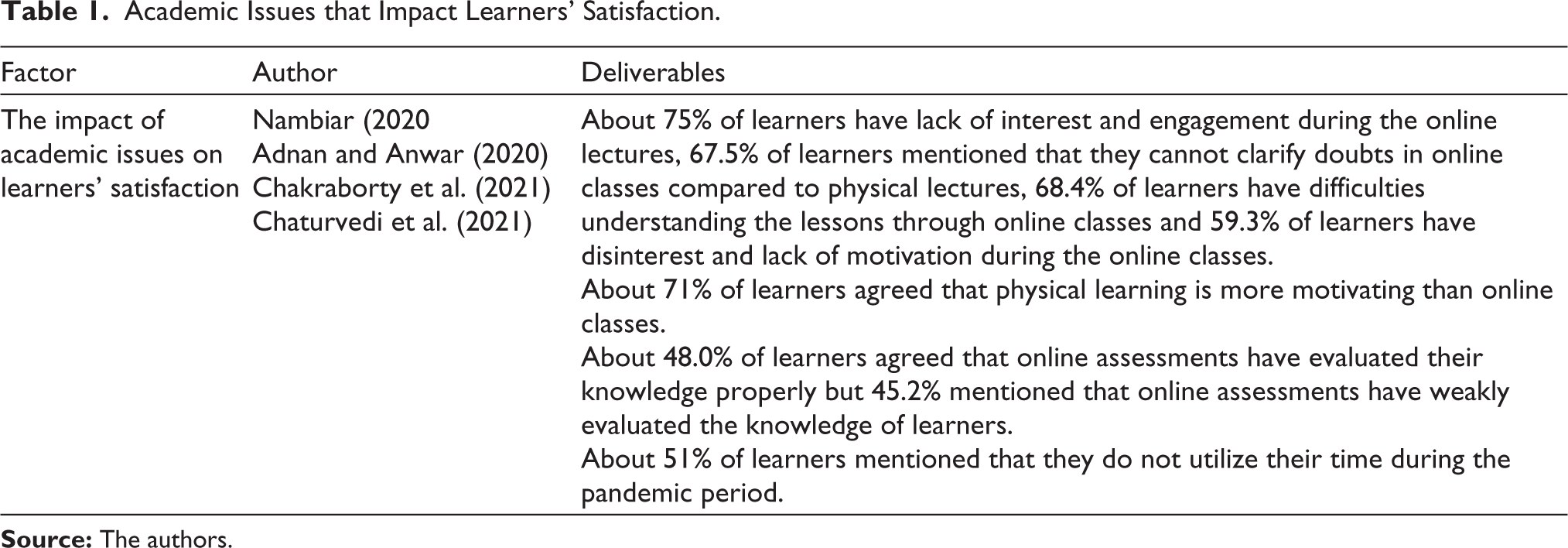
The academic issues were identified as disruptive towards online educational activities during the Covid-19 pandemic. Following the empirical studies, academic issues were identified to affect learners’ satisfaction. During the online lectures, as percentages, 75% of learners have lack of interest and engagement, 67.5% of learners mentioned their difficulties in clarifying doubts in online classes compared to physical lectures, 68.4% of learners have difficulties understanding the lessons and 59.3% of learners have disinterest and lack of motivation (Nambiar, 2020). Compared to the online lectures, in physical classes, learners have the chance to actively participate due to the traditional face-to-face learning system; therefore, 71% of learners agreed that physical learning has more motivation than online classes (Adnan & Anwar, 2020). According to Aboagye et al. (2020), the lack of effective communication, the limit of communication among learners and the lack of group discussions cause academic issues. The sudden change in the education system has created difficulties for learners in continuing their academic studies since they cannot pay full attention to online lectures (Rameez et al., 2020). The economic status of the family, lack of IT knowledge and loneliness at home environment also affect the academic studies, and online educational methods have only suites for theoretical learning rather than practical learning; therefore, it matters to the learners who are following practical modules (Rameez et al., 2020).
Online learning platforms and live streaming mostly focus on theoretical learning, therefore learners who belong to technical fields are affected by this (Amir et al., 2020). The actual gain of knowledge is low in online learning, with practical training is minimized due to the inability to use laboratory facilities (Oyedotun, 2020). A peer-to-peer engagement available in a university environment is not possible in online learning, creating a lack of motivation among learners (Chaturvedi et al., 2021). Learning for some of the art, accounting and science subjects cannot be conducted online most of the time (Yogendrarajah, 2020). Online education bothers learners due to lack of supportive academic materials (Patricia, 2020). According to the survey of Chakraborty et al. (2021), 48.0% of learners agreed that online assessments have evaluated their knowledge properly, but 45.2% of learners mentioned that online assessments have weakly evaluated the knowledge of learners, whereas 51% of learners mentioned that they do not utilize their time during the pandemic period (Chaturvedi et al., 2021) (Table 1). Thus, academic issues have affected learners’ satisfaction during the COVID-19 pandemic as mentioned in Hypothesis 1 (H1).
H1 = The academic issues have a significant impact on learners’ satisfaction.
Academic Issues that Impact Learners’ Satisfaction
Impact of Accessibility Issues on Learners’ Satisfaction
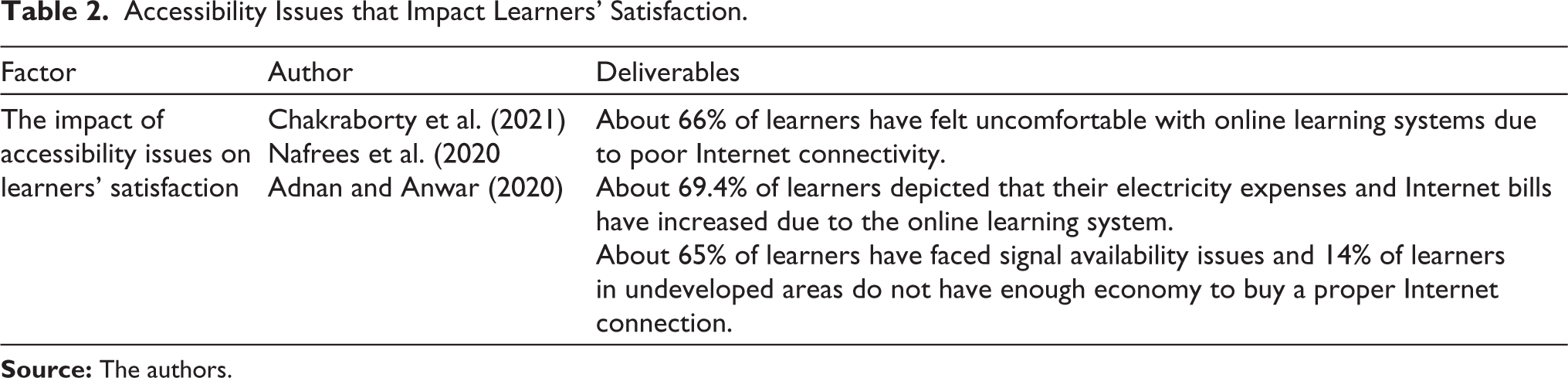
Accessibility issues are the issues encountered with poor Internet connection that hinders learners from properly connecting with the online educational activities during the pandemic period that leads to impact on the learners’ satisfaction. Relating to the survey of Raju (2020), learners who are living in rural areas have poor connectivity, and the lack of proper electricity facilities caused them to avoid accessibility to connect with online educational activities. Device unavailability, mobile data connections and downloadable resources are challenges with online learning (Sharma et al., 2020), and most of the learners have unstable Internet access, their family members are also working from home, which makes unstable access with low Internet bandwidth (Chakraborty et al., 2021). While 66.0% of learners have felt uncomfortable with online learning systems due to losing Internet connectivity (Chakraborty et al., 2021), 69.4% of learners indicated that their electricity expenses and Internet bills have increased due to the online learning system (Nafrees et al., 2020).
According to Nambiar (2020), 55.7% of learners have a poor network connection, power cuts, issues regarding audio and video quality and broadband issues that disconnect online learning accessibility. Some learners in rural and backward areas have issues regarding device unavailability (smartphones, laptops, desktops, etc.) and have no 4G connection to access online classes (Rameez et al., 2020). Aboagye et al. (2020) have mentioned that unavailability of required technologies, lack of proper accessibility and expensive Internet bills affect the learners’ satisfaction towards the online lectures. Lack of Internet access is the main challenge for learners in Pakistan, where 65% of learners have faced signal availability issues and 14% of learners who are living in especially undeveloped areas do not have enough economic status to buy a proper Internet connection (Adnan & Anwar, 2020) (Table 2). Thus, accessibility issues have affected learners’ satisfaction during the COVID-19 pandemic as mentioned in Hypothesis 2 (H2).
H2= The accessibility issues have a significant impact on learners’ satisfaction.
Accessibility Issues that Impact Learners’ Satisfaction
Impact of Technological Skills on Learners’ Satisfaction
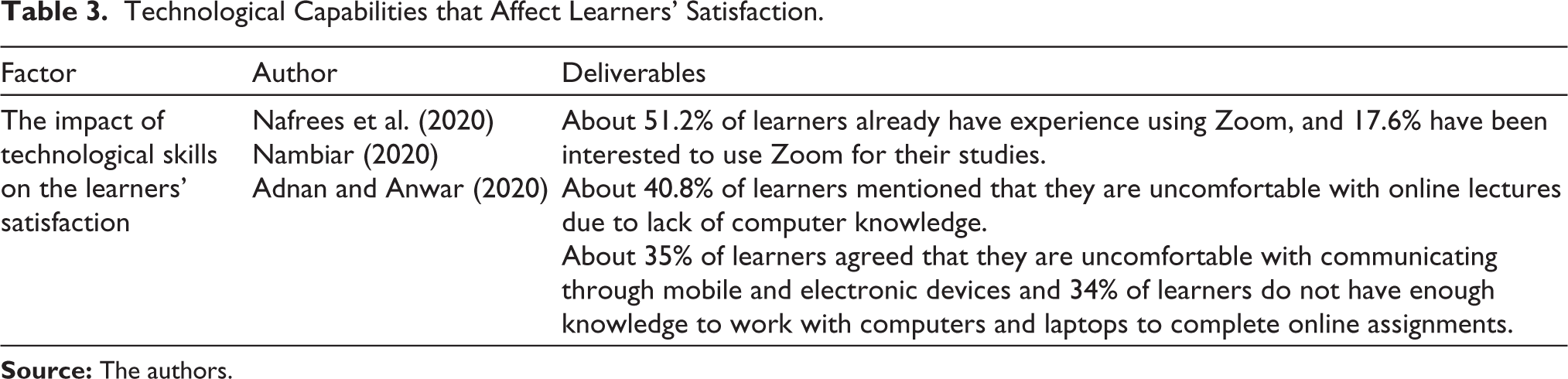
Technological skills of learners can be determined as the degree to which learners can handle technological devices and online platforms during the COVID-19 pandemic, which also has a direct impact on learners’ satisfaction. During the pandemic period, educational institutes use online platforms (Zoom, MS teams and Google meet) to continue the online lectures. About 51.2% of learners already have experience using Zoom, and 17.6% have been interested to use Zoom for their studies (Nafrees et al., 2020). About 40.8% of learners mentioned that they are uncomfortable with online lectures due to a lack of computer knowledge (Nambiar, 2020). About 35% of learners agreed that they are uncomfortable with communicating through mobile and electronic devices and 34% of learners do not have enough knowledge to work with computers and laptops to complete online assignments (Adnan & Anwar, 2020).
To cope with the online learning platforms, the learners must possess the essential skills to operate and work with them. If the learner is new to this technology, it might be harder since the online educational platforms are having a lot of technical functions (Sathishkumar et al., 2020). The technological devices can fail, power failures can happen, etc., and in such a situation, the learner must be aware of resolving it or taking essential steps to overcome it as well as learners should be aware of operating the learning management system of the university (MIiller, 2014) (Table 3). Thus, the technological skills of the learners affect their satisfaction with online learning as mentioned in Hypothesis 3 (H3).
H3 = The technological skills have a significant impact on learners’ satisfaction.
Technological Capabilities that Affect Learners’ Satisfaction
Impact of Mental Well-Being on Learners’ Satisfaction
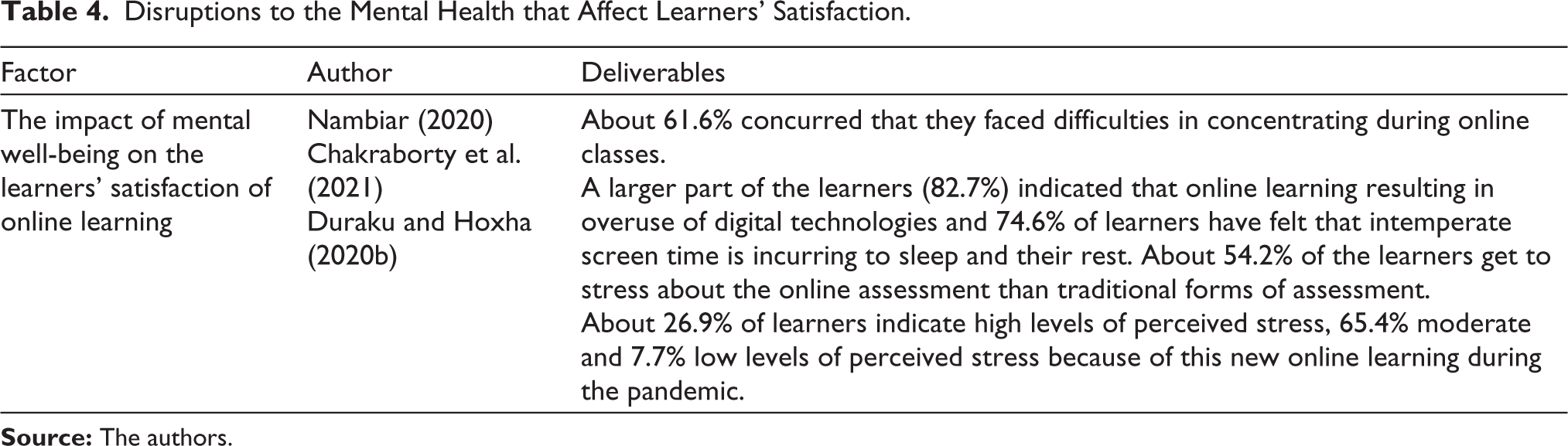
Learners’ mental well-being can be identified as the extent to which learners are mentally able for dealing with the pandemic circumstance and concentrating on their learning during COVID-19. Following the empirical studies, mental well-being is found to be effective towards learners’ satisfaction. Considering the study of Nambiar (2020), 61.6% concurred that they faced difficulties in concentrating on online classes during this situation. Generally, a few diversions have come from home, problems of family, the trouble of adjusting housework and studies at the same time, less backing from the domestic environment for studies, etc. Magson et al. (2020) have shown that the COVID-19 crisis impacted the mental well-being of the young people who are doing their studies. Since the need for the time assigned for interaction with colleagues and concerns on moving to online learning strategy have driven for the trouble among young people as well as the social detachment, anxiety and depressive side effects.
Considering the survey of Chakraborty et al. (2021), a larger part of the learners (82.7%) has indicated that online learning resulted in the overuse of digital technologies, 74.6% of learners have felt that intemperate screen time is incurring to sleep and their rest, 54.2% of the learners get to stress about the online assessment than traditional forms of assessment and 67.9% of the learners indicate that online learning is influencing their day-to-day life works. About 63.6% of the learners have indicated that online education is the reason for the advanced partition among them. About 26.9% of learners indicated high levels of perceived stress, 65.4% moderate and 7.7% low levels of perceived stress because of this new online learning during pandemic (Duraku & Hoxha, 2020b). For keeping healthy mental well-being, a good social connection between learners and lecturers helps positively (Fernando & Schleiche, 2020). Many learners experienced loneliness during the COVID-19; consequently, online education was an inspiration for them. Lack of money during the pandemic as well as stress balancing, need of inspiration, negative feelings of learners are specified as the reasons for occurring issues during the pandemic (Patricia, 2020). Online lectures ended up long and unpleasant (Oyedotun, 2020) as a result of the pandemic situation, many learners suffering from stress, and to get out learners from this depression, providing emotional support for learners is necessary (Chaturvedi et al., 2021). In an open-ended survey overview, 25 learners (8.7%) indicated that increment in negative feelings, such as uneasiness, sadness and stress were challenges they face in online studies (Patricia, 2020) (Table 4). Thus, mental well-being affects learners’ satisfaction during the COVID-19 pandemic as mentioned in Hypothesis 4 (H4).
H4 = The mental well-being of the learners has a significant impact on learners’ satisfaction.
Disruptions to the Mental Health that Affect Learners’ Satisfaction
Impact of Lecturer Commitment on Learners’ Satisfaction
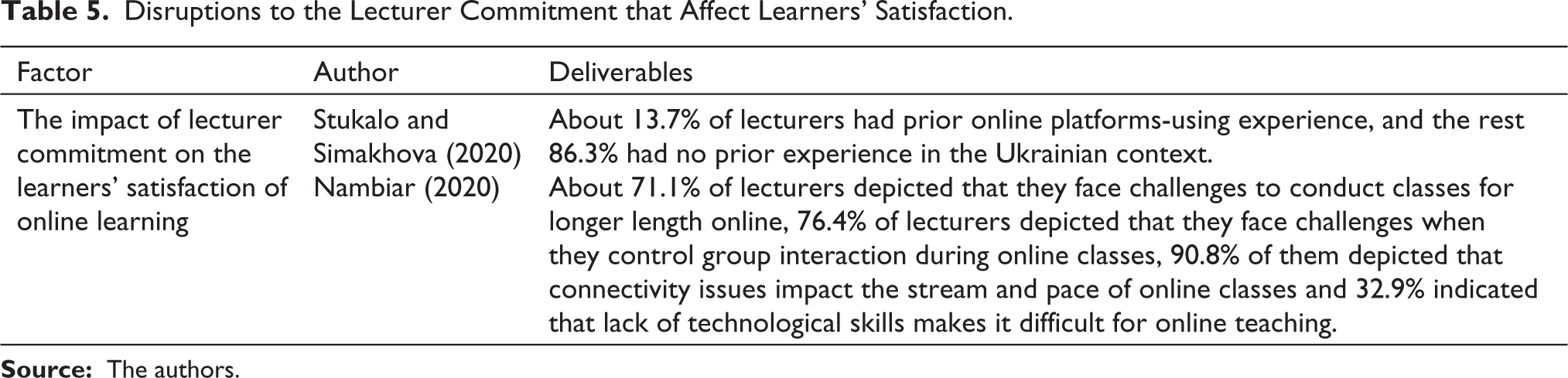
Lecturer’s full potential for the online lecturing process can be defined as the lecturer’s commitment, which has a direct impact on learners’ satisfaction; 73.9% of lecturers state that online learning is not successful due to the few reasons that they have encountered, such as insufficient office accessibility, web-associated issues, costly Internet expenses, difficulty in giving objective assessments and guide them, a lot of time should be invested in preparing teaching materials, difficulty in measuring learners’ understanding, difficulty in explaining some practical works in detail, etc. (Fauzi & Sastra Khusuma, 2020). The lecturers should consider the learner’s readiness, learner’s execution and learner’s satisfaction as important when conducting online lectures.
The study of Stukalo and Simakhova (2020), conducted for the Ukrainian context, recognized that only 13.7% of lecturers had prior online platforms-using experience, the rest 86.3% had no prior experience. Through face-to-face interactions and discussions with learners, lecturers can get learners’ ideas on the teaching lessons. Based on that, lecturers can customize their teaching strategies and lesson plans. Chakraborty et al. (2021) depict that there are a better lecturer–learner interaction in physical classrooms than online platforms. Subject matter expert lecturers are also facing challenges when they change their traditional teaching system for online teaching. For some subjects, online learning materials are not much valuable for gaining knowledge (Yogendrarajah, 2020). About 71.1% of lecturers depicted that they face challenges to conduct classes for longer length online, 76.4% of lecturers depicted that they face challenges when they control group interaction during online classes, 90.8% of them depicted that connectivity issues impact the stream and pace of online classes and 32.9 % indicated that lack of technological skills makes it difficult for online teaching (Nambiar, 2020) (Table 5). Thus, lecturer commitment impacts learner satisfaction during the COVID-19 pandemic as mentioned in Hypothesis 5 (H5).
H5 = The lecturer commitment has a significant impact on learners’ satisfaction.
Disruptions to the Lecturer Commitment that Affect Learners’ Satisfaction
Impact of Online Learning Efficiency on Learners’ Satisfaction
Online learning is the latest model of providing education. According to Martin et al. (2020), online learning is defined as the use of the Internet to access learning materials, connect with teachers and other learners and seek assistance during the learning process to gain information and to use the experience to develop. Replacing traditional learning with online learning is highly unlikely but during such pandemics, online learning is a valuable alternate because of flexibility, affordability and accessibility (Sun & Chen, 2016).
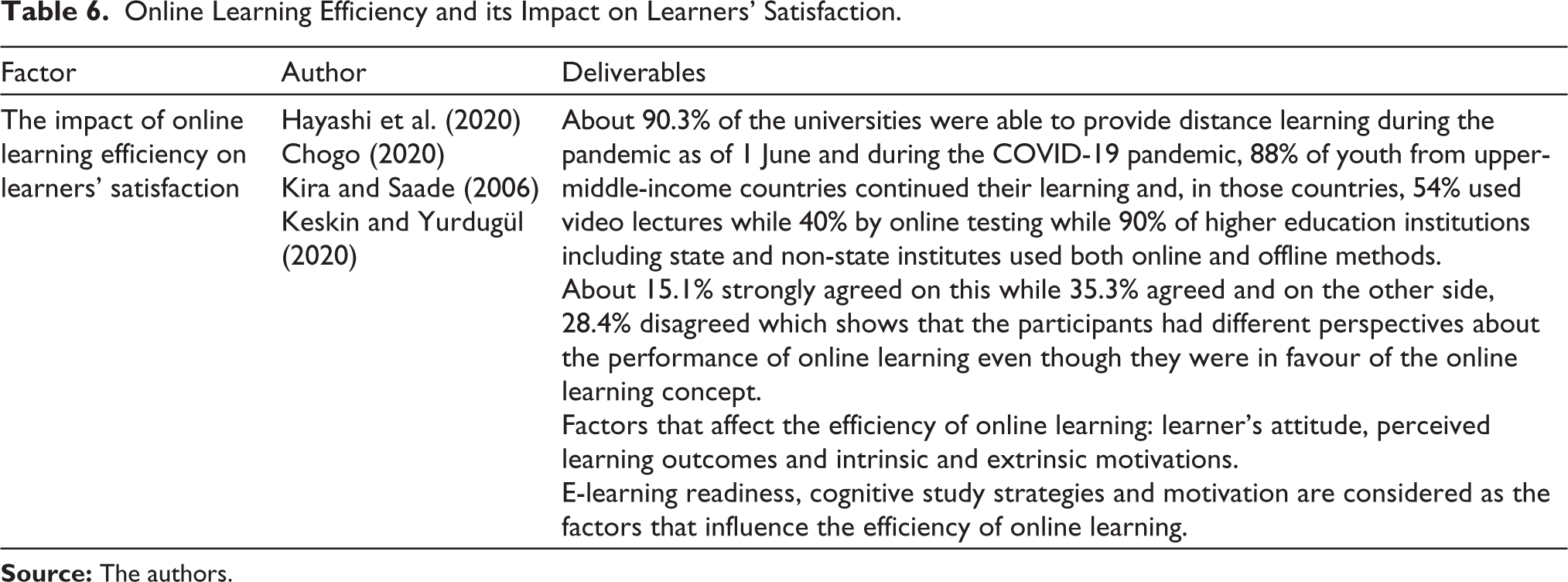
According to Hayashi et al. (2020), 90.3% of the universities were able to provide distance learning during the pandemic as of 1 June 2020, and during the COVID-19 pandemic, 88% of youth from upper-middle-income countries continued their learning, and, in those countries, 54% used video lectures, while 40% by online testing while 90% of higher education institutions including state and non-state institutes used both online and offline methods. Online learning is considered an alternative to traditional learning, but the ongoing pandemic forced universities to continue with online learning and due to various issues, learner preference for online learning has become a complex matter. According to Chogo (2020), 15.1% strongly agreed on this, whereas 35.3% agreed and on the other side 28.4% disagreed showing that the participants had different perspectives about the performance of online learning even though they were in favour of the online learning concept. If the preparations for such situations were at a satisfactory level, complications raised due to online learning could have been minimized. According to the study of Kira and Saade (2006), the following factors affect the efficiency of online learning: learner’s attitude, perceived learning outcomes and intrinsic and extrinsic motivations, while Keskin and Yurdugül (2020) point out that e-learning readiness, cognitive study strategies and motivation are considered as the factors that influence the efficiency of online learning (Table 6). Thus, online learning efficiency affects learners’ satisfaction during COVID-19 as mentioned in Hypothesis 6 (H6).
H6 = The online learning efficiency has a significant impact on learners’ satisfaction.
Impact of Learners’ Satisfaction on Learners’ Commitment to Online Learning
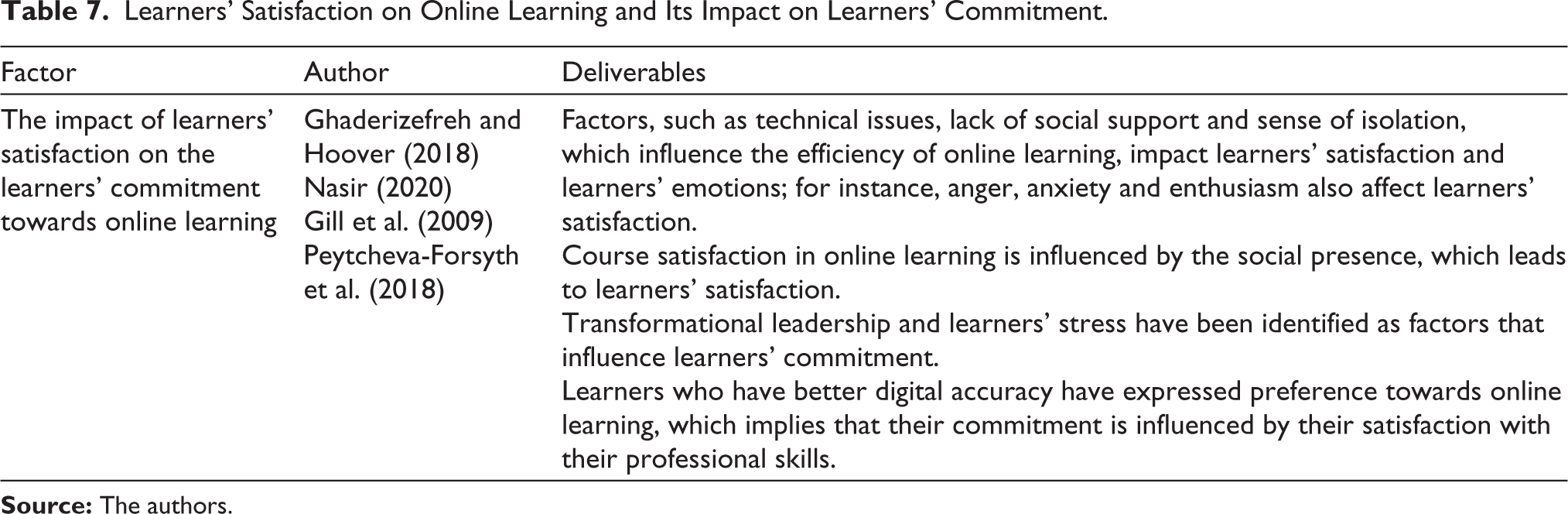
Learners’ satisfaction can be described as the degree to which a learner is delighted in participating in online learning. According to Almusharraf and Khahro (2020), institutes should consider factors that affect the online learning efficiency when developing courses and when the strategies adopted by the institutes influence learners’ satisfaction and other course-related aspects. When developing courses for learners, universities should consider learners’ satisfaction towards online learning and the facilities that universities can provide to improve learners’ commitment (Riaz et al., 2011). According to Ghaderizefreh and Hoover (2018), factors, such as technical issues, lack of social support and sense of isolation, which influence the efficiency of online learning, impact learner’s satisfaction and learner’s emotions; for instance, anger, anxiety and enthusiasm also affect the satisfaction of the learner. Also according to Nasir (2020), course satisfaction in online learning is influenced by the social presence, which leads to learners’ satisfaction. According to Weerasinghe and Fernando (2018), university facilities, quality of the degree programmes and the image of the university are the factors affecting learners’ satisfaction. By referring to past literature, academic issues, accessibility issues, technological skills, mental wellbeing and lecturer commitment are found effective towards learner satisfaction.
Online Learning Efficiency and its Impact on Learners’ Satisfaction
The learners’ commitment is the degree to which a learner is involving in online learning committedly. Universities across the globe create various activities to improve the commitment of the learners, which in hindsight benefits the learner. According to Anghelache (2013), the awareness level of the learner, the personality of the learner and the learners’ performance affect the commitment of learners. According to Gill et al. (2009), transformational leadership and learner stress have been identified as factors that influence learners’ commitment. According to Jovi et al. (2017), the usefulness of e-learning, ease of use and content design emphasize the significance of effective online learning methods. Online learning was introduced as an alternative to traditional learning, and Peytcheva-Forsyth et al. (2018) highlight that learners who have a better digital accuracy have expressed preference towards online learning, which implies that their commitment is influenced by their satisfaction with their professional skills (Table 7). Thus, learner satisfaction impacts learner commitment during COVID-19 as mentioned in Hypothesis 7 (H7).
H7 = The learners’ satisfaction has a significant impact on the learners’ commitment to online learning.
Learners’ Satisfaction on Online Learning and Its Impact on Learners’ Commitment
Results and Discussions
This study has identified several gaps and arguments related to online learning efficiency. The academic issues can be determined as issues that disrupt the online educational activities during the COVID-19 pandemic. The issues encountered with academics during the pandemic impact the online learning efficiency that was identified as lack of interest and involvement during online classes, difficulty to clarify doubts in online classes compared to physical classroom learning, difficulty to understand the lessons, lack of group discussions, lack of effective communication, difficulties in paying full attention to their online learning, lack of practical training, etc. Thus, academic issues have affected learners’ satisfaction during the COVID-19 pandemic as mentioned in Hypothesis 1 (H1).
Accessibility issues are the issues encountered with an Internet connection that hinders the learners from properly connecting with the online studies during the pandemic period leading to an impact on the learners’ satisfaction. The issues encountered with the Internet accessibility during the pandemic impact the online learning efficiency that was identified as a poor Internet connectivity, not having proper electricity facilities, less availability of devices, problems with the applications, high monthly Internet bill, not having a stable Internet connectivity, etc. Thus, accessibility issues have affected learners’ satisfaction during the COVID-19 pandemic as mentioned in Hypothesis 2 (H2).
Technological skills of learners can be determined as the degree to which learners can handle technological devices and online platforms during the COVID-19 pandemic, which also directly impact learners’ satisfaction. The essential technological skills were identified as having the capability of handling technological devices and the Internet, having experience in using online platforms, having some technical knowledge about running the programs on the computer and other activities on the online mode and integrating with the learning management system of the university, etc. Thus, the technological skills of the learners impact their satisfaction with online learning as mentioned in Hypothesis 3 (H3).
Learners’ mental well-being can be identified as to which extent learners are mentally able for dealing with the pandemic circumstance and concentrating on their learning during COVID-19. Following the empirical studies, mental well-being is found effective towards learners’ satisfaction. The disruptions that occur to the mental wellness of the learners were identified as difficulty in concentrating, inability to manage workload, lack of support from home environment, lack of time allocated for spending time with colleagues and concerns about shifting to an online learning method that led to social disconnection, anxiety and depressive symptoms, etc. Thus, mental well-being impacts learner satisfaction during the COVID-19 pandemic as mentioned in Hypothesis 4 (H4).
Lecturer’s full potential for the online lecturing process can be defined as the lecturer’s commitment, which has a direct impact on learners’ satisfaction. The issues with the lecturers’ commitment were identified as poor facilities availability, Internet connection speed, expensive Internet quota fees, difficulty in giving objective assessments, difficulty in measuring student understanding, difficulty in explaining the materials in detail, difficult to control group interaction during online classes, etc. Thus, lecturers’ commitment impacts learners’ satisfaction during the COVID-19 pandemic as mentioned in Hypothesis 5 (H5).
Online learning is the latest model of providing education. The majority of the universities were able to provide online learning during the pandemic, which has led to learners’ satisfaction. Learners are having different perspectives about the performance of online learning even though they were in favour of the online learning concept. If the preparations for such situations were at a satisfactory level, complications raised due to online learning could have been minimized. This study figures out that learner’s attitudes, perceived learning outcomes, intrinsic and extrinsic motivations, e-learning readiness and cognitive study strategies are influent towards the efficiency of online learning. Thus, online learning efficiency affects learners’ satisfaction during COVID-19 as mentioned in Hypothesis 6 (H6).
Learners’ satisfaction can be described as the degree to which a learner is delighted in participating in online learning. Factors, such as technical issues, lack of social support and sense of isolation, which influence the efficiency of online learning, impacts learner’s satisfaction and learner’s emotions; for instance, anger, anxiety and enthusiasm also affect the satisfaction of the learner. Further, course satisfaction in online learning is influenced by the social presence, which leads to learners’ satisfaction. By referring to past literature, academic issues, accessibility issues, technological skills, mental well-being and lecturer commitment are found effective towards learners’ satisfaction. The learners’ commitment is the degree to which a learner is involving in online learning committedly. The research has identified that satisfaction in online learning impacts increasing the commitment to online learning. Thus, learners’ satisfaction impacts learners’ commitment during COVID-19 as mentioned in Hypothesis 7 (H7).
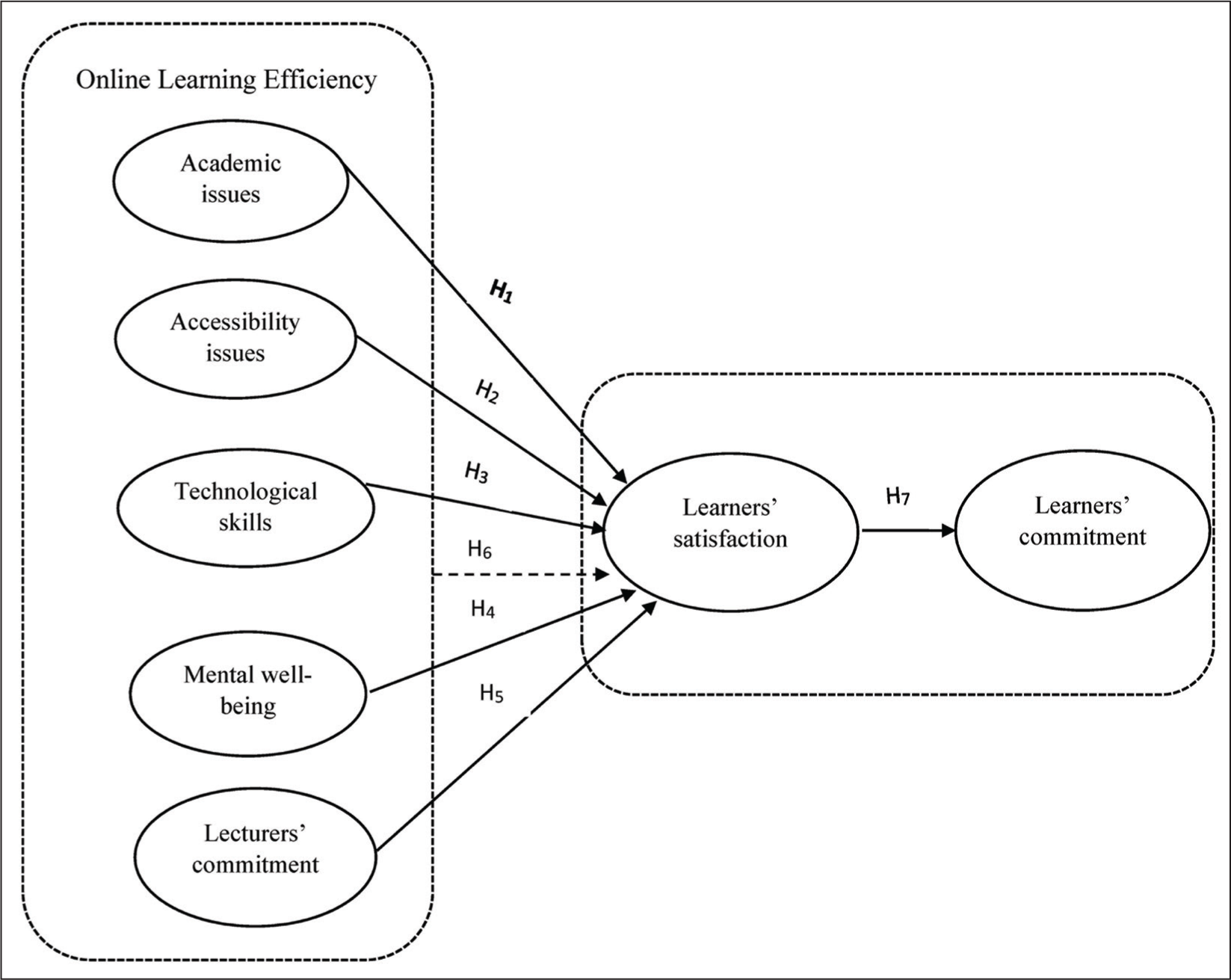
Thus, this study has identified several gaps and arguments related to online learning efficiency that impact learners’ satisfaction and commitment. With the use of empirical findings, the independent variables are defined as academic issues, accessibility issues, technological skills, mental well-being and lecturers’ commitment that are identified as factors affecting online learning efficiency. Learners’ satisfaction is the mediator variable that influences both online learning efficiency and learners’ commitment. Learners’ commitment is identified as the dependent variable for the study.
Proposed Conceptual Framework
Based on the literature evaluation, the conceptual framework is designed as following (Figure 1).
Significance and Future Implications of the Study
The findings of this study deliver what factors impact learners’ satisfaction and commitment, which would be favourable for the learners, lecturers and the universities and other education-providing institutes. Since there is no study published to identify how the factors affecting online learning efficiency impact the satisfaction and commitment of the learners, this study will be beneficial for future researchers because they can use the findings for their research articles. For the institutes, they can provide their learners more efficient online education delivery referring to the findings of this study. In a practical view, if the pandemic would continue, the institutes can use the deliverables to figure out the difficulties learners usually face during the pandemic, how to prevent those issues and to search for a solution whether to re-open the universities following necessary health guidelines or to resume delivering education online.
Conclusion
Due to the escalating COVID-19 disease, many countries across the world have closed their higher educational institutes and universities (UNESCO, 2020) and shifted towards online learning methods to continue the education delivery without detaining (Duraku & Hoxha, 2020a). is study outlines the abstract, introduction, literature review, conceptual framework, hypotheses, discussions, significance and future implications and the conclusion accordingly. This study has focused on analysing the efficiency of online learning under academic issues, accessibility issues, technological skills of the learners, mental well-being of the learners, lecturer commitment and how those will impact on satisfaction and commitment of the learners and presented a systematic literature review with the use of reviewing and analysing approximately 40 empirical studies on the topic context. Referring to the empirical studies, this study has brought out that the academic issues, accessibility issues, technological skills of the learners, mental well-being of the learners and lecturers’ commitment have a significant impact on learners’ satisfaction and commitment towards online learning during the COVID-19 pandemic. Further, identifying gaps related to online learning efficiency, supposing the variables, and answering these knowledge gaps, this study has visualized how online learning efficiency impacts the learners’ satisfaction and commitment during the COVID-19 pandemic by presenting a conceptual model.
Footnotes
Declaration of Conflicting Interests
The authors declared no potential conflicts of interest with respect to the research, authorship and/or publication of this article.
Funding
The authors received no financial support for the research, authorship and/or publication of this article.